
Presented by: Vrushali T. Lanjewar
Paper ID- 130
Comparison of Threshold Methods useful in
Handwritten Marathi Character
Recognition
Authors: R. N. Khobragade1, Vrushali T. Lanjewar2, Mahendra S. Makesar3
1,2 Sant Gadge Baba Amravati University, Amravati, India,
3Nagpur Institute of Technology, RTMNU, Nagpur, India.
1st International virtual Conference on Integrated Intelligence Enable Networks
& Computing (IIENC-2020)
Contents
 Introduction
 Problems
 Methods
 Result and Discussion
 Conclusions
Introduction
If the image is 𝑔 𝑥, 𝑦 Then, the threshold of 𝑔 𝑥, 𝑦 as global threshold 𝑇
given by equation (1).
𝑔 𝑥, 𝑦 = ቊ
1, 𝑖𝑓𝑓 𝑥, 𝑦 ≥ 𝑇
0, 𝑜𝑡ℎ𝑒𝑟𝑤𝑖𝑠𝑒
………….. (1)
Thresholding generates a binary image using all pixels below a certain
threshold set to zero and all the pixels above the threshold set to one [1].
Original
image
Threshold
image
Problem using thresholding of image
➢The main problem in thresholding is while processing the image, we
only focus on intensity and no correlation between pixels considered.
➢In the initial work, there is no surety that the fixed pixels are reliable.
We add or separate external pixels that are not part of the desired
pixels in the region, especially near the state boundary [2].
➢As the noise increases, so does the effect also increase. This is
because the pixel intensity does not reflect the intensity of the field.
Problems
Methods
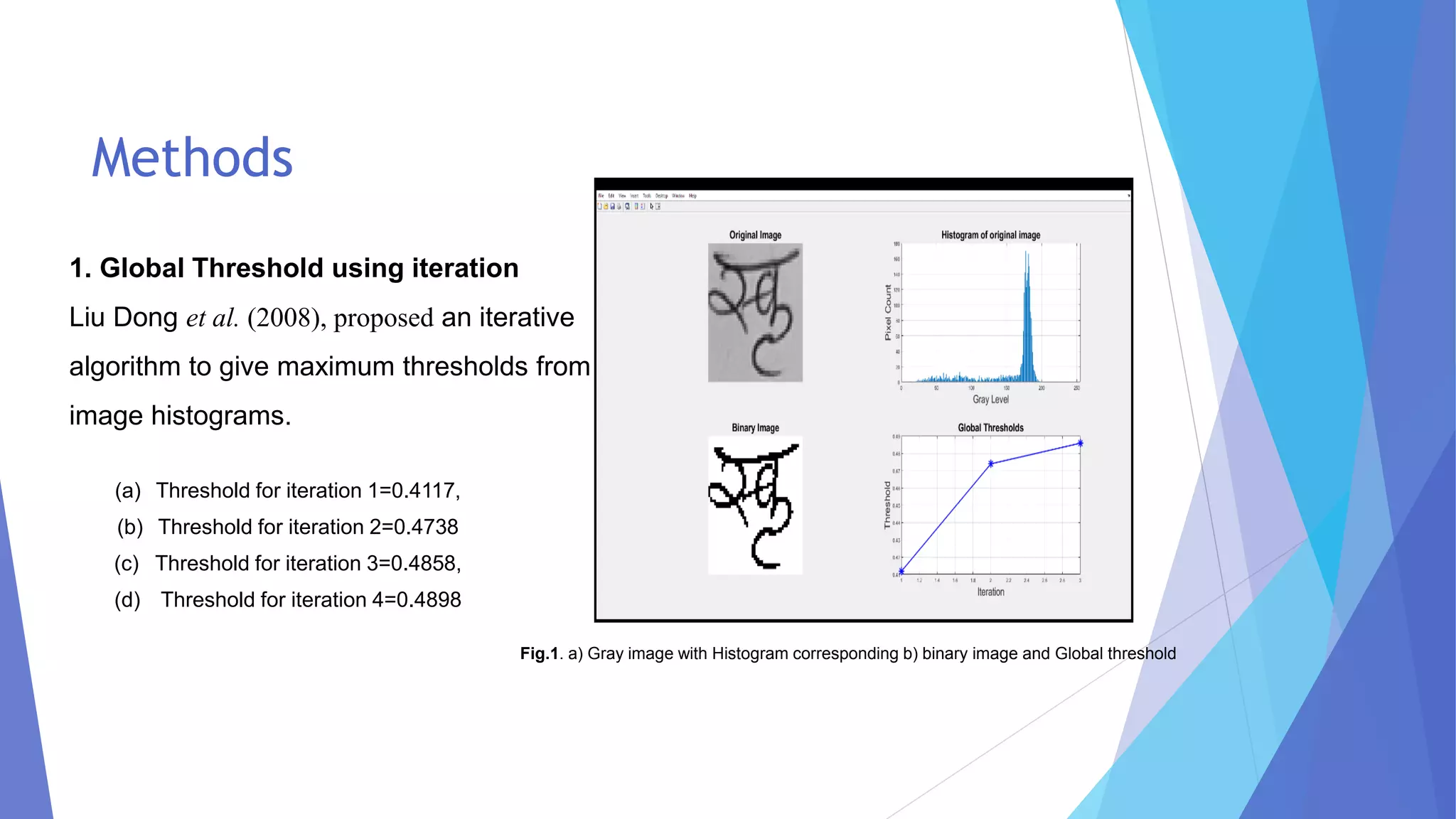
(a) Threshold for iteration 1=0.4117,
(b) Threshold for iteration 2=0.4738
(c) Threshold for iteration 3=0.4858,
(d) Threshold for iteration 4=0.4898
1. Global Threshold using iteration
Liu Dong et al. (2008), proposed an iterative
algorithm to give maximum thresholds from
image histograms.
Fig.1. a) Gray image with Histogram corresponding b) binary image and Global threshold
Step1: Read the input gray-scale image
Step2: Compute and display histogram of input image
Step3: Max and Min of Input
Step4: Initialize Iteration loop
 count =1;
Step5: Calculate Binary image using threshold Thresh, set value to calculate
threshold. d is set to false to create iterations.
Step6: Generate Binary image using threshold
Step7: Calculate a New temporary threshold value
Step8: Increment iteration and save the values of ‘Thresh’ in the ‘save’ array
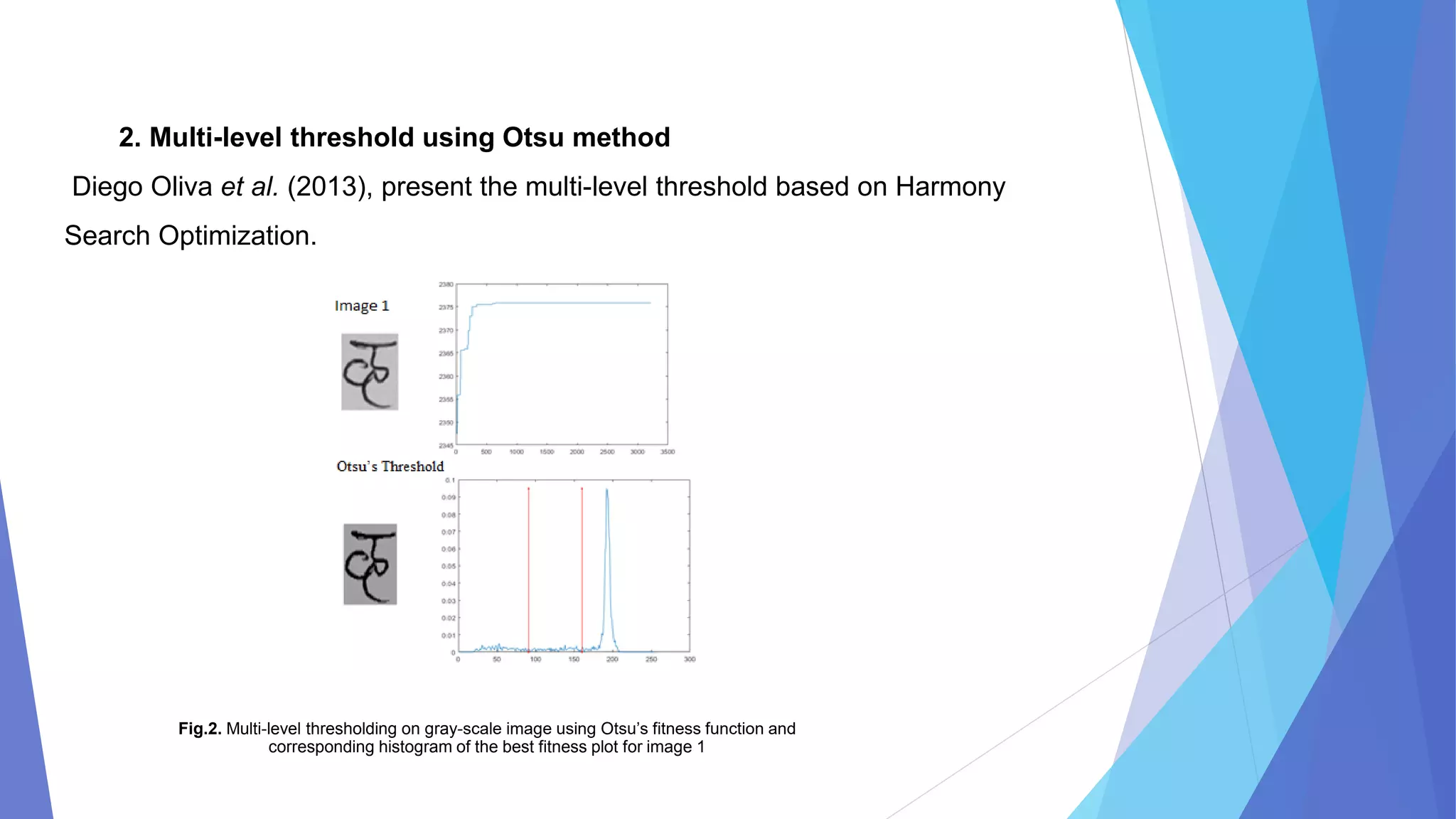
2. Multi-level threshold using Otsu method
Diego Oliva et al. (2013), present the multi-level threshold based on Harmony
Search Optimization.
Fig.2. Multi-level thresholding on gray-scale image using Otsu’s fitness function and
corresponding histogram of the best fitness plot for image 1
Results
Sr.
no
Threshold
type
Method MSE PNSR Jaccard Distance
1 Global
Threshold
Otsu’s [1] 2.9989e+04 3.3612 0.1902
2 Kapur’s [2] 0.01920000 65.2977 0.0235
3 Local
Threshold
Niblack [3] 2.9998e+04 3.3599 0.2205
4 Bernsen [4][5] 2.9979e+04 3.3626 0.2544
5 Sauvola [6] 2.9946e+04 3.3673 0.0645
6 Feng [7] 2.9981e+04 3.3623 0.1171
7 Wolf [8][13] 2.9970e+04 3.3639 0.0686
8 Bradley [9] 3.0027e+04 3.3556 0.2938
9 Adaptive [11][12] 2.9926e+04 3.3703 0.2260
10 Hysteresis [13] 2.9971e+04 3.3637 0.0962
11 Varied threshold[15] 2.9858e+04 3.3802 0.2313
Table 1. Comparison of Threshold of Image using various methods
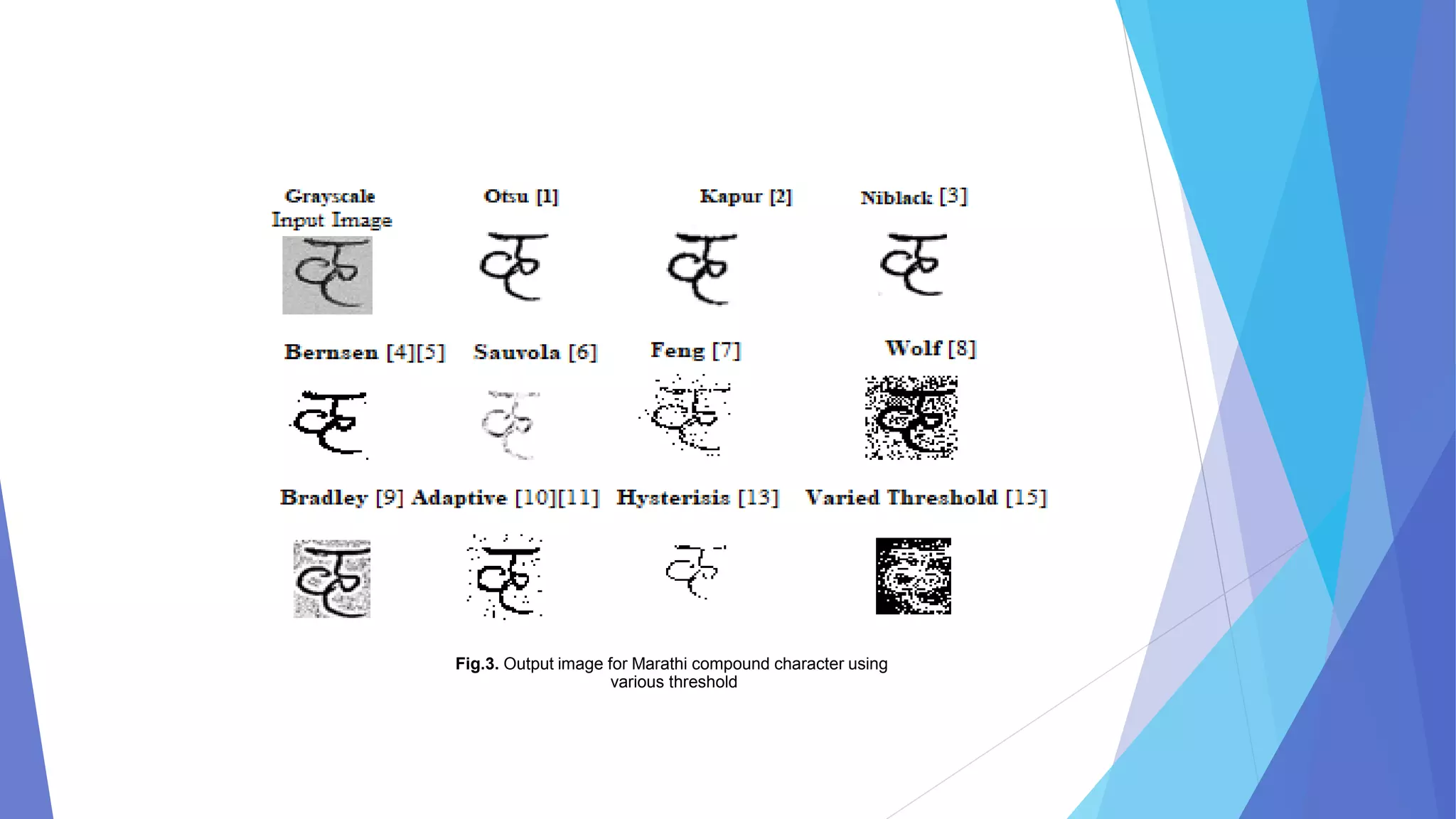
Fig.3. Output image for Marathi compound character using
various threshold
Conclusions
In this paper, we study of global and local threshold performed to extract the text
foreground pixels in image.
Global thresholding is appropriate only when object and background classes are
distinctive.
Local image thresholding is useful for segmentation of handwritten text images.
Multi-level thresholding using Otsu’s method requires maximizing the class difference
between the background and the object.
There is scope that these used in feature extraction with multi-level thresholding and
global iterative partition method.
Acknowledgment
The authors acknowledge the financial assistance of the
Department of Science and Technology, Science and Engineering
Research Board (DST- SERB), New Delhi, Government of India,
under grant EEQ/2017/000102.
References
1. Otsu N (1979). A threshold selection method from gray-level histograms. IEEE Trans Syst Man Cybern 9:62–66
2. J. N. Kapur, P. K. Sahoo, and A. K. Wong, “A new method for gray-level picture thresholding using the entropy of the histogram,” Computer vision, graphics,
and image processing, vol. 29, no. 3, pp. 273-285, March 1985.
3. W. Niblack. An introduction to digital image processing. Prentice-Hall International, 1986. ISBN 9780134806747.
4. Bernsen, J.: ‘Dynamic thresholding of gray-level images. Proc. 8th Int. Conf. on Pattern Recognition, Paris, 1986, pp. 1251–1255
5. Sauvola and M. Pietikäinen, Adaptive document image binarization, PATTERN RECOGNITION, 2000, vol.33, pp.225-236
6. Meng-Ling Feng and Yap-Peng Tan, “Contrast adaptive binarization of low-quality document images”, IEICE Electron. Express, Vol. 1, No. 16, pp.501-506,
(2004)
7. Wolf, C., Jolion, J.M. Extraction and recognition of artificial text in multimedia documents. Form. PatternAnal. Appl. 2004,6, 309–326
8. Derek Bradley & Gerhard Roth (2007) Adaptive Thresholding using the Integral Image, Journal of Graphics Tools, 12:2, 13-
21, DOI: 10.1080/2151237X.2007.10129236
9. Renata Freire de Paiva Neves, Cleber Zanchettin, and Carlos Alexandre Barros Mello. 2013. An adaptive thresholding algorithm based on edge detection and
morphological operations for document images. In Proceedings of the 2013 ACM symposium on Document engineering (DocEng ’13). Association for
Computing Machinery, New York, NY, USA, 107–110.
10. M. Sornam, M. S. Kavitha and M. Nivetha, "Hysteresis thresholding-based edge detectors for inscriptional image enhancement," 2016 IEEE International
Conference on Computational Intelligence and Computing Research (ICCIC), Chennai, 2016, pp. 1-4. doi: 10.1109/ICCIC.2016.7919568
11. Dong, L., Yu, G., Ogunbona, P., & Li, W. (2008). An efficient iterative algorithm for image thresholding. Pattern Recognition Letters, 29(9), 1311–1316. doi:
10.1016/j.patrec.2008.02.001
12. Welekar R., Thakur N.V. (2015) Memetic Algorithm Used in Character Recognition. In: Panigrahi B., Suganthan P., Das S. (eds) Swarm, Evolutionary,
and Memetic Computing. SEMCCO 2014. Lecture Notes in Computer Science, vol 8947. Springer, Cham. https://doi.org/10.1007/978-3-319-20294-5_55.
13. Baptiste Magnier (2020). Objective supervised edge detection evaluation by varying thresholds of the thin edges (https://www.mathworks.com/
matlabcentral/fileexchange/63326-objective -supervised-edge-detection-evaluation-by-varying-thresholds-of-the-thin-edges), MATLAB Central File Exchange.
Retrieved August 3, 2020.
14. Khobragade R.N., Koli N.A., Lanjewar V.T. (2020) Challenges in Recognition of Online and Off-line Compound Handwritten Characters: A Review. In:
Zhang YD., Mandal J., So-In C., Thakur N. (eds) Smart Trends in Computing and Communications. Smart Innovation, Systems and Technologies, vol
165. Springer, Singapore.
15. Welekar R., Thakur N.V. (2019) Best Bound Population-Based Local Search for Memetic Algorithm in View of Character Recognition. In: Yang XS.,
Sherratt S., Dey N., Joshi A. (eds) Third International Congress on Information and Communication Technology. Advances in Intelligent Systems and
Computing, vol 797. Springer, Singapore. https://doi.org/10.1007/978-981-13-1165-9_31.
16. Oliva, D., Cuevas, E., Pajares, G., Zaldivar, D., & Perez-Cisneros, M. (2013). Multilevel Thresholding Segmentation Based on Harmony Search Optimization.
Journal of Applied Mathematics, 2013, 1–24. doi:10.1155/2013/575414.
17. Turkar H. R., Thakur N.V. (2019) Performance Comparison of Clustering Algorithms Based Image Segmentation on Mobile Devices. In: Mallick P., Balas V.,
Bhoi A., Zobaa A. (eds) Cognitive Informatics and Soft Computing. Advances in Intelligent Systems and Computing, vol 768. Springer, Singapore.
https://doi.org/10.1007/978-981-13-0617-4_56
18. Ratnashil N Khobragade (2017), Feature Extraction Method Based on Combine Classifier for Marathi Handwritten Character Recognition, International
Research Journal of Engineering and Technology (IRJET), pp 2942-1952, e-ISSN: 2395 -0056, Volume 04, Issue 04.
19. Khandare S.T., Thakur N.V. (2020) Multi-level Thresholding and Quantization for Segmentation of Color Images. In: Zhang YD., Mandal J., So-In C., Thakur N.
(eds) Smart Trends in Computing and Communications. Smart Innovation, Systems and Technologies, vol 165. Springer, Singapore.
https://doi.org/10.1007/978-981-15-0077-0_50
Thank you

Comparison of thresholding methods

  • 1.
    Presented by: VrushaliT. Lanjewar Paper ID- 130 Comparison of Threshold Methods useful in Handwritten Marathi Character Recognition Authors: R. N. Khobragade1, Vrushali T. Lanjewar2, Mahendra S. Makesar3 1,2 Sant Gadge Baba Amravati University, Amravati, India, 3Nagpur Institute of Technology, RTMNU, Nagpur, India. 1st International virtual Conference on Integrated Intelligence Enable Networks & Computing (IIENC-2020)
  • 2.
    Contents  Introduction  Problems Methods  Result and Discussion  Conclusions
  • 3.
    Introduction If the imageis 𝑔 𝑥, 𝑦 Then, the threshold of 𝑔 𝑥, 𝑦 as global threshold 𝑇 given by equation (1). 𝑔 𝑥, 𝑦 = ቊ 1, 𝑖𝑓𝑓 𝑥, 𝑦 ≥ 𝑇 0, 𝑜𝑡ℎ𝑒𝑟𝑤𝑖𝑠𝑒 ………….. (1) Thresholding generates a binary image using all pixels below a certain threshold set to zero and all the pixels above the threshold set to one [1]. Original image Threshold image
  • 4.
    Problem using thresholdingof image ➢The main problem in thresholding is while processing the image, we only focus on intensity and no correlation between pixels considered. ➢In the initial work, there is no surety that the fixed pixels are reliable. We add or separate external pixels that are not part of the desired pixels in the region, especially near the state boundary [2]. ➢As the noise increases, so does the effect also increase. This is because the pixel intensity does not reflect the intensity of the field. Problems
  • 5.
    Methods (a) Threshold foriteration 1=0.4117, (b) Threshold for iteration 2=0.4738 (c) Threshold for iteration 3=0.4858, (d) Threshold for iteration 4=0.4898 1. Global Threshold using iteration Liu Dong et al. (2008), proposed an iterative algorithm to give maximum thresholds from image histograms. Fig.1. a) Gray image with Histogram corresponding b) binary image and Global threshold
  • 6.
    Step1: Read theinput gray-scale image Step2: Compute and display histogram of input image Step3: Max and Min of Input Step4: Initialize Iteration loop  count =1; Step5: Calculate Binary image using threshold Thresh, set value to calculate threshold. d is set to false to create iterations. Step6: Generate Binary image using threshold Step7: Calculate a New temporary threshold value Step8: Increment iteration and save the values of ‘Thresh’ in the ‘save’ array
  • 7.
    2. Multi-level thresholdusing Otsu method Diego Oliva et al. (2013), present the multi-level threshold based on Harmony Search Optimization. Fig.2. Multi-level thresholding on gray-scale image using Otsu’s fitness function and corresponding histogram of the best fitness plot for image 1
  • 8.
    Results Sr. no Threshold type Method MSE PNSRJaccard Distance 1 Global Threshold Otsu’s [1] 2.9989e+04 3.3612 0.1902 2 Kapur’s [2] 0.01920000 65.2977 0.0235 3 Local Threshold Niblack [3] 2.9998e+04 3.3599 0.2205 4 Bernsen [4][5] 2.9979e+04 3.3626 0.2544 5 Sauvola [6] 2.9946e+04 3.3673 0.0645 6 Feng [7] 2.9981e+04 3.3623 0.1171 7 Wolf [8][13] 2.9970e+04 3.3639 0.0686 8 Bradley [9] 3.0027e+04 3.3556 0.2938 9 Adaptive [11][12] 2.9926e+04 3.3703 0.2260 10 Hysteresis [13] 2.9971e+04 3.3637 0.0962 11 Varied threshold[15] 2.9858e+04 3.3802 0.2313 Table 1. Comparison of Threshold of Image using various methods
  • 9.
    Fig.3. Output imagefor Marathi compound character using various threshold
  • 10.
    Conclusions In this paper,we study of global and local threshold performed to extract the text foreground pixels in image. Global thresholding is appropriate only when object and background classes are distinctive. Local image thresholding is useful for segmentation of handwritten text images. Multi-level thresholding using Otsu’s method requires maximizing the class difference between the background and the object. There is scope that these used in feature extraction with multi-level thresholding and global iterative partition method.
  • 11.
    Acknowledgment The authors acknowledgethe financial assistance of the Department of Science and Technology, Science and Engineering Research Board (DST- SERB), New Delhi, Government of India, under grant EEQ/2017/000102.
  • 12.
    References 1. Otsu N(1979). A threshold selection method from gray-level histograms. IEEE Trans Syst Man Cybern 9:62–66 2. J. N. Kapur, P. K. Sahoo, and A. K. Wong, “A new method for gray-level picture thresholding using the entropy of the histogram,” Computer vision, graphics, and image processing, vol. 29, no. 3, pp. 273-285, March 1985. 3. W. Niblack. An introduction to digital image processing. Prentice-Hall International, 1986. ISBN 9780134806747. 4. Bernsen, J.: ‘Dynamic thresholding of gray-level images. Proc. 8th Int. Conf. on Pattern Recognition, Paris, 1986, pp. 1251–1255 5. Sauvola and M. Pietikäinen, Adaptive document image binarization, PATTERN RECOGNITION, 2000, vol.33, pp.225-236 6. Meng-Ling Feng and Yap-Peng Tan, “Contrast adaptive binarization of low-quality document images”, IEICE Electron. Express, Vol. 1, No. 16, pp.501-506, (2004) 7. Wolf, C., Jolion, J.M. Extraction and recognition of artificial text in multimedia documents. Form. PatternAnal. Appl. 2004,6, 309–326 8. Derek Bradley & Gerhard Roth (2007) Adaptive Thresholding using the Integral Image, Journal of Graphics Tools, 12:2, 13- 21, DOI: 10.1080/2151237X.2007.10129236 9. Renata Freire de Paiva Neves, Cleber Zanchettin, and Carlos Alexandre Barros Mello. 2013. An adaptive thresholding algorithm based on edge detection and morphological operations for document images. In Proceedings of the 2013 ACM symposium on Document engineering (DocEng ’13). Association for Computing Machinery, New York, NY, USA, 107–110. 10. M. Sornam, M. S. Kavitha and M. Nivetha, "Hysteresis thresholding-based edge detectors for inscriptional image enhancement," 2016 IEEE International Conference on Computational Intelligence and Computing Research (ICCIC), Chennai, 2016, pp. 1-4. doi: 10.1109/ICCIC.2016.7919568 11. Dong, L., Yu, G., Ogunbona, P., & Li, W. (2008). An efficient iterative algorithm for image thresholding. Pattern Recognition Letters, 29(9), 1311–1316. doi: 10.1016/j.patrec.2008.02.001 12. Welekar R., Thakur N.V. (2015) Memetic Algorithm Used in Character Recognition. In: Panigrahi B., Suganthan P., Das S. (eds) Swarm, Evolutionary, and Memetic Computing. SEMCCO 2014. Lecture Notes in Computer Science, vol 8947. Springer, Cham. https://doi.org/10.1007/978-3-319-20294-5_55. 13. Baptiste Magnier (2020). Objective supervised edge detection evaluation by varying thresholds of the thin edges (https://www.mathworks.com/ matlabcentral/fileexchange/63326-objective -supervised-edge-detection-evaluation-by-varying-thresholds-of-the-thin-edges), MATLAB Central File Exchange. Retrieved August 3, 2020. 14. Khobragade R.N., Koli N.A., Lanjewar V.T. (2020) Challenges in Recognition of Online and Off-line Compound Handwritten Characters: A Review. In: Zhang YD., Mandal J., So-In C., Thakur N. (eds) Smart Trends in Computing and Communications. Smart Innovation, Systems and Technologies, vol 165. Springer, Singapore. 15. Welekar R., Thakur N.V. (2019) Best Bound Population-Based Local Search for Memetic Algorithm in View of Character Recognition. In: Yang XS., Sherratt S., Dey N., Joshi A. (eds) Third International Congress on Information and Communication Technology. Advances in Intelligent Systems and Computing, vol 797. Springer, Singapore. https://doi.org/10.1007/978-981-13-1165-9_31. 16. Oliva, D., Cuevas, E., Pajares, G., Zaldivar, D., & Perez-Cisneros, M. (2013). Multilevel Thresholding Segmentation Based on Harmony Search Optimization. Journal of Applied Mathematics, 2013, 1–24. doi:10.1155/2013/575414. 17. Turkar H. R., Thakur N.V. (2019) Performance Comparison of Clustering Algorithms Based Image Segmentation on Mobile Devices. In: Mallick P., Balas V., Bhoi A., Zobaa A. (eds) Cognitive Informatics and Soft Computing. Advances in Intelligent Systems and Computing, vol 768. Springer, Singapore. https://doi.org/10.1007/978-981-13-0617-4_56 18. Ratnashil N Khobragade (2017), Feature Extraction Method Based on Combine Classifier for Marathi Handwritten Character Recognition, International Research Journal of Engineering and Technology (IRJET), pp 2942-1952, e-ISSN: 2395 -0056, Volume 04, Issue 04. 19. Khandare S.T., Thakur N.V. (2020) Multi-level Thresholding and Quantization for Segmentation of Color Images. In: Zhang YD., Mandal J., So-In C., Thakur N. (eds) Smart Trends in Computing and Communications. Smart Innovation, Systems and Technologies, vol 165. Springer, Singapore. https://doi.org/10.1007/978-981-15-0077-0_50
  • 13.