


PACK: Prediction-Based Cloud 
Bandwidth and Cost Reduction 
System 
JP INFOTECH
PRESENTED BY
ABSTRACT 
• In this paper, we present PACK (Predictive ACKs), a novel 
end-to-end traffic redundancy elimination (TRE) system, 
designed for cloud computing customers. Cloud-based TRE 
needs to apply a judicious use of cloud resources so that the 
bandwidth cost reduction combined with the additional cost 
of TRE computation and storage would be optimized. 
• PACK’s main advantage is its capability of offloading the 
cloud-server TRE effort to end clients, thus minimizing the 
processing costs induced by the TRE algorithm.
AIM 
• The main aim of this project is PACK based on 
a novel TRE technique, which allows the client 
to use newly received chunks to identify 
previously received chunk chains, which in 
turn can be used as reliable predictors to 
future transmitted chunks.
EXISTING SYSTEM 
• Traffic redundancy stems from common end-users’ 
activities, such as repeatedly accessing, downloading, 
uploading (i.e., backup), distributing, and modifying the 
same or similar information items (documents, data, Web, 
and video). 
• TRE is used to eliminate the transmission of redundant 
content and, therefore, to significantly reduce the network 
cost.
EXISTING SYSTEM 
• In most common TRE solutions, both the sender and the 
receiver examine and compare signatures of data chunks, 
parsed according to the data content, prior to their 
transmission. 
• When redundant chunks are detected, the sender replaces 
the transmission of each redundant chunk with its strong 
signature. Commercial TRE solutions are popular at 
enterprise networks, and involve the deployment of two or 
more proprietary-protocol, state synchronized middle-boxes 
at both the intranet entry points of data centers.
DISADVANTAGES OF EXISTING SYSTEM 
• Cloud providers cannot benefit from a technology whose goal 
is to reduce customer bandwidth bills, and thus are not likely 
to invest in one. 
• The rise of “on-demand” work spaces, meeting rooms, and 
work-from-home solutions detaches the workers from their 
offices. In such a dynamic work environment, fixed-point 
solutions that require a client-side and a server-side middle-box 
pair become ineffective.
DISADVANTAGES OF EXISTING SYSTEM 
• Cloud load balancing and power optimizations may lead to a 
server-side process and data migration environment, in which 
TRE solutions that require full synchronization between the 
server and the client are hard to accomplish or may lose 
efficiency due to lost synchronization 
• Current end-to-end solutions also suffer from the 
requirement to maintain end-to-end synchronization that may 
result in degraded TRE efficiency.
PROPOSED SYSTEM 
• In this paper, we present a novel receiver-based end-to-end TRE solution 
that relies on the power of predictions to eliminate redundant traffic 
between the cloud and its end-users. In this solution, each receiver 
observes the incoming stream and tries to match its chunks with a 
previously received chunk chain or a chunk chain of a local file.
PROPOSED SYSTEM 
• Using the long-term chunks’ metadata information kept 
locally, the receiver sends to the server predictions that 
include chunks’ signatures and easy-to-verify hints of the 
sender’s future data. 
• On the receiver side, we propose a new computationally 
lightweight chunking (fingerprinting) scheme termed PACK 
chunking. PACK chunking is a new alternative for Rabin 
fingerprinting traditionally used by RE applications.
ADVANTAGES OF PROPOSED SYSTEM 
• Our approach can reach data processing speeds over3 Gb/s, at least 20% 
faster than Rabin fingerprinting. 
• The receiver-based TRE solution addresses mobility problems common to 
quasi-mobile desktop/ laptops computational environments. 
• One of them is cloud elasticity due to which the servers are dynamically 
relocated around the federated cloud, thus causing clients to interact with 
multiple changing servers.
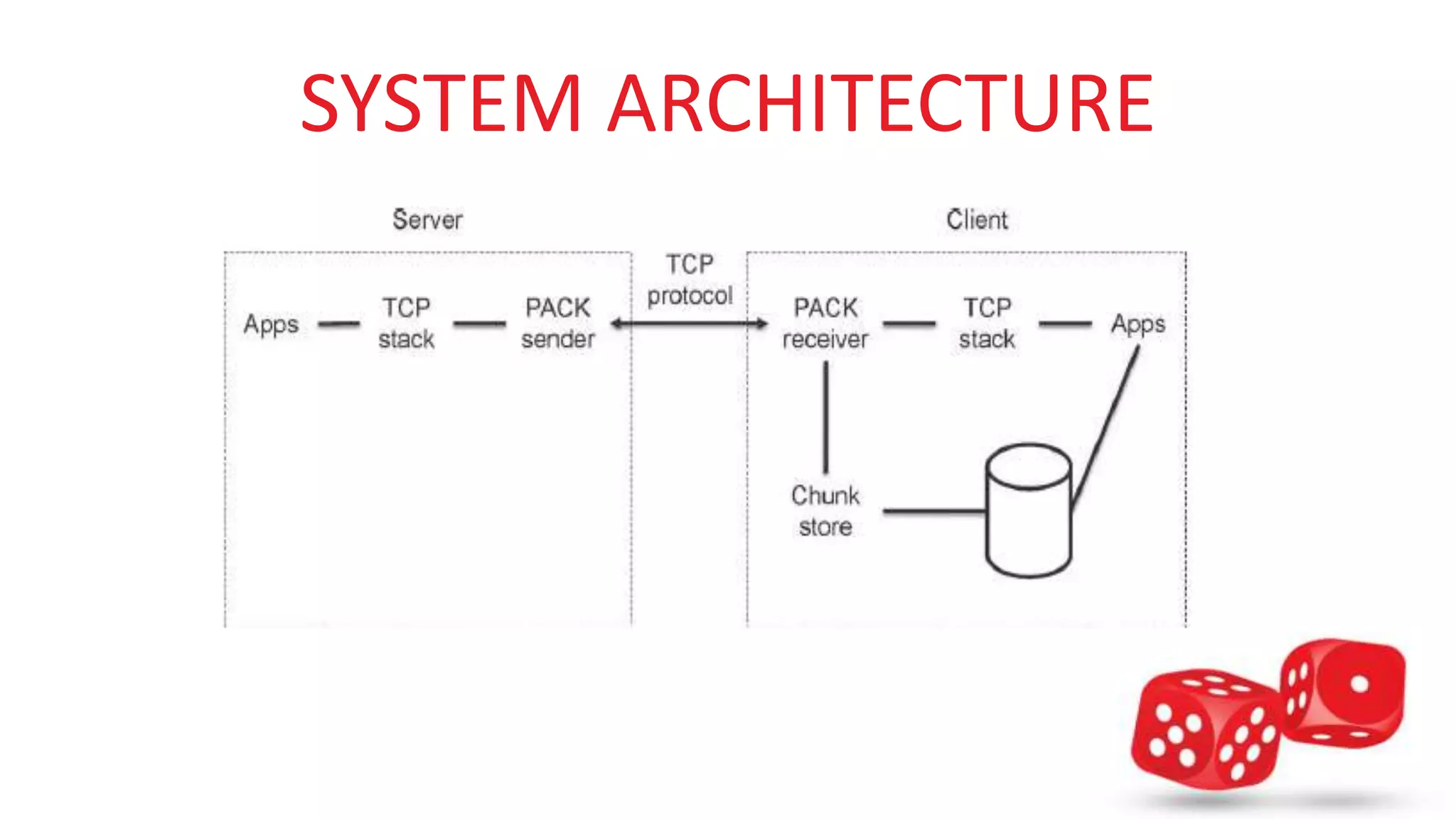
SYSTEM ARCHITECTURE
MODULES 
• Receiver Chunk Store 
• Receiver Algorithm 
• Sender Algorithm 
• Wire Protocol
Receiver Chunk Store 
• PACK uses a new chains scheme. which chunks 
are linked to other chunks according to their last 
received order. The PACK receiver maintains a 
chunk store, which is a large size cache of chunks 
and their associated metadata. Chunk’s metadata 
includes the chunk’s signature and a (single) 
pointer to the successive chunk in the last 
received stream containing this chunk.
Receiver Algorithm 
• Upon the arrival of new data, the receiver 
computes the respective signature for each 
chunk and looks for a match in its local chunk 
store. If the chunk’s signature is found, the 
receiver determines whether it is a part of a 
formerly received chain, using the chunks’ 
metadata.
Sender Algorithm 
• When a sender receives a PRED message from the 
receiver, it tries to match the received predictions to its 
buffered (yet to be sent) data. For each prediction, the 
sender determines the corresponding TCP sequence 
range and verifies the hint. Upon a hint match, the 
sender calculates the more computationally intensive 
SHA-1 signature for the predicted data range and 
compares the result to the signature received in the 
PRED message.
Wire Protocol 
• The PACK wire protocol operates under the 
assumption that the data is redundant. First, both 
sides enable the PACK option during the initial 
TCP handshake by adding a PACK permitted to the 
TCP Options field. Then, the sender sends the 
(redundant) data in one or more TCP segments, 
and the receiver identifies that a currently 
received chunk is identical to a chunk in its chunk 
store.
HARDWARE REQUIREMENTS 
• System : Pentium IV 2.4 GHz. 
• Hard Disk : 40 GB. 
• Floppy Drive : 1.44 Mb. 
• Monitor : 15 VGA Colour. 
• Mouse : Logitech. 
• Ram : 512 Mb.
SOFTWARE REQUIREMENTS 
• Operating system : Windows XP/7. 
• Coding Language : JAVA/J2EE 
• IDE : Netbeans 7.4 
• Database : MYSQL
REFERENCES 
• Salah-Eddine Tbahriti, Chirine Ghedira, Brahim Medjahed and 
Michael Mrissa “Privacy-Enhanced Web Service 
Composition”- IEEE TRANSACTIONS ON SERVICES 
COMPUTING, VOL. 7, NO. 2, APRIL-JUNE 2014
TO GET THIS PROJECT CONTACT:

PACK: Prediction-Based Cloud Bandwidth and Cost Reduction System

  • 1.
    PACK: Prediction-Based Cloud Bandwidth and Cost Reduction System JP INFOTECH
  • 2.
  • 3.
    ABSTRACT • Inthis paper, we present PACK (Predictive ACKs), a novel end-to-end traffic redundancy elimination (TRE) system, designed for cloud computing customers. Cloud-based TRE needs to apply a judicious use of cloud resources so that the bandwidth cost reduction combined with the additional cost of TRE computation and storage would be optimized. • PACK’s main advantage is its capability of offloading the cloud-server TRE effort to end clients, thus minimizing the processing costs induced by the TRE algorithm.
  • 4.
    AIM • Themain aim of this project is PACK based on a novel TRE technique, which allows the client to use newly received chunks to identify previously received chunk chains, which in turn can be used as reliable predictors to future transmitted chunks.
  • 5.
    EXISTING SYSTEM •Traffic redundancy stems from common end-users’ activities, such as repeatedly accessing, downloading, uploading (i.e., backup), distributing, and modifying the same or similar information items (documents, data, Web, and video). • TRE is used to eliminate the transmission of redundant content and, therefore, to significantly reduce the network cost.
  • 6.
    EXISTING SYSTEM •In most common TRE solutions, both the sender and the receiver examine and compare signatures of data chunks, parsed according to the data content, prior to their transmission. • When redundant chunks are detected, the sender replaces the transmission of each redundant chunk with its strong signature. Commercial TRE solutions are popular at enterprise networks, and involve the deployment of two or more proprietary-protocol, state synchronized middle-boxes at both the intranet entry points of data centers.
  • 7.
    DISADVANTAGES OF EXISTINGSYSTEM • Cloud providers cannot benefit from a technology whose goal is to reduce customer bandwidth bills, and thus are not likely to invest in one. • The rise of “on-demand” work spaces, meeting rooms, and work-from-home solutions detaches the workers from their offices. In such a dynamic work environment, fixed-point solutions that require a client-side and a server-side middle-box pair become ineffective.
  • 8.
    DISADVANTAGES OF EXISTINGSYSTEM • Cloud load balancing and power optimizations may lead to a server-side process and data migration environment, in which TRE solutions that require full synchronization between the server and the client are hard to accomplish or may lose efficiency due to lost synchronization • Current end-to-end solutions also suffer from the requirement to maintain end-to-end synchronization that may result in degraded TRE efficiency.
  • 9.
    PROPOSED SYSTEM •In this paper, we present a novel receiver-based end-to-end TRE solution that relies on the power of predictions to eliminate redundant traffic between the cloud and its end-users. In this solution, each receiver observes the incoming stream and tries to match its chunks with a previously received chunk chain or a chunk chain of a local file.
  • 10.
    PROPOSED SYSTEM •Using the long-term chunks’ metadata information kept locally, the receiver sends to the server predictions that include chunks’ signatures and easy-to-verify hints of the sender’s future data. • On the receiver side, we propose a new computationally lightweight chunking (fingerprinting) scheme termed PACK chunking. PACK chunking is a new alternative for Rabin fingerprinting traditionally used by RE applications.
  • 11.
    ADVANTAGES OF PROPOSEDSYSTEM • Our approach can reach data processing speeds over3 Gb/s, at least 20% faster than Rabin fingerprinting. • The receiver-based TRE solution addresses mobility problems common to quasi-mobile desktop/ laptops computational environments. • One of them is cloud elasticity due to which the servers are dynamically relocated around the federated cloud, thus causing clients to interact with multiple changing servers.
  • 12.
  • 13.
    MODULES • ReceiverChunk Store • Receiver Algorithm • Sender Algorithm • Wire Protocol
  • 14.
    Receiver Chunk Store • PACK uses a new chains scheme. which chunks are linked to other chunks according to their last received order. The PACK receiver maintains a chunk store, which is a large size cache of chunks and their associated metadata. Chunk’s metadata includes the chunk’s signature and a (single) pointer to the successive chunk in the last received stream containing this chunk.
  • 15.
    Receiver Algorithm •Upon the arrival of new data, the receiver computes the respective signature for each chunk and looks for a match in its local chunk store. If the chunk’s signature is found, the receiver determines whether it is a part of a formerly received chain, using the chunks’ metadata.
  • 16.
    Sender Algorithm •When a sender receives a PRED message from the receiver, it tries to match the received predictions to its buffered (yet to be sent) data. For each prediction, the sender determines the corresponding TCP sequence range and verifies the hint. Upon a hint match, the sender calculates the more computationally intensive SHA-1 signature for the predicted data range and compares the result to the signature received in the PRED message.
  • 17.
    Wire Protocol •The PACK wire protocol operates under the assumption that the data is redundant. First, both sides enable the PACK option during the initial TCP handshake by adding a PACK permitted to the TCP Options field. Then, the sender sends the (redundant) data in one or more TCP segments, and the receiver identifies that a currently received chunk is identical to a chunk in its chunk store.
  • 18.
    HARDWARE REQUIREMENTS •System : Pentium IV 2.4 GHz. • Hard Disk : 40 GB. • Floppy Drive : 1.44 Mb. • Monitor : 15 VGA Colour. • Mouse : Logitech. • Ram : 512 Mb.
  • 19.
    SOFTWARE REQUIREMENTS •Operating system : Windows XP/7. • Coding Language : JAVA/J2EE • IDE : Netbeans 7.4 • Database : MYSQL
  • 20.
    REFERENCES • Salah-EddineTbahriti, Chirine Ghedira, Brahim Medjahed and Michael Mrissa “Privacy-Enhanced Web Service Composition”- IEEE TRANSACTIONS ON SERVICES COMPUTING, VOL. 7, NO. 2, APRIL-JUNE 2014
  • 21.
    TO GET THISPROJECT CONTACT: