Dispersion Studies on Multimode Polymer Spiral
Waveguides for Board-Level Optical Interconnects
Jian Chen, Nikos Bamiedakis, Richard V. Penty, Ian H. White
Electrical Engineering Division, University of Cambridge, UK
e-mail: jc791@cam.ac.uk
Tom J. Edwards, Christian T.A. Brown
School of Physics & Astronomy, University of St Andrews, UK
Acknowledgement:
The authors would like to acknowledge Dow Corning for providing the waveguide samples and EPSRC for supporting the work.
OPTICAL INTERCONNECTS CONFERENCE 2015
20 April 2015
Outline
• Introduction to Optical Interconnects
• Board-level Optical Interconnects
• Bandwidth Studies
• Conclusions
Outline
• Introduction to Optical Interconnects
• Board-level Optical Interconnects
• Bandwidth Studies
• Conclusions
Why Optical Interconnects?
Electrical Interconnects:
• Limited bandwidths;
• Increasing losses;
• Higher crosstalk;
Optical Interconnects:
• Lower losses at high data rates;
• Lower electromagnetic interference;
• Higher power efficiency;
• Density advantages.
Growing demand for data communications link capacity in:
- data centres
- supercomputers
 need for high-capacity short-reach interconnects operating at > 10 Gb/s
Evolution of Optical Interconnects
• Optical interconnects will be employed in shorter and shorter links to
meet the bandwidth and power efficiency requirements.
Board Level
[1] A.F. Benner et al, Exploitation of optical interconnects in future server architectures, IBM Journal of Research and
Development, vol 49, Issue 4.5, 2005.
[1]1980’s 1990’s 2000’s > 2012
Outline
• Introduction to Optical Interconnects
• Board-level Optical Interconnects
• Bandwidth Studies
• Conclusions
Board-level Optical interconnects
Optics is gradually working in conjunction with electronics for future
communication technologies, however it needs to meet the key
technological requirements at board-level interconnects:
• Cost effectiveness;
• Ability to be integrated into existing architectures;
• Compatibility with existing manufacturing processes of conventional electronic
circuitry.
Polymer Multimode Waveguides
1. Polymer Materials
• Sufficiently low-cost;
• Very low intrinsic attenuation (0.03–0.05 dB/cm at 850 nm);
• Good thermal and mechanical properties (up to 350 °C);
• Fabricated on FR4, glass or silicon using standard techniques such as photolithography
and embossing.
2. Multimode Waveguide
• Cost-efficiency: relaxed alignment tolerances (> ± 10 µm).
Outline
• Introduction to Optical Interconnects
• Board-level Optical Interconnects
• Bandwidth Studies
• Conclusions
VCSEL Performance
Continuous improvement in bandwidth performance of VCSELs:
 850 nm VCSELs:
44 Gb/s (2012), 57 Gb/s (2013) and 64 Gb/s (OFC 2014, Chalmers - IBM)
 performance in longer wavelengths follows same trend
- un-cooled operation up to 90°C: (50 Gb/s Chalmers-IBM, 2014)
- VCSEL arrays with very good uniformity and similarly high bandwidth
[2] P. Westbergh, et al., IEEE PTL, vol. 27, pp. 296-299, 2015
Why do we study the bandwidth of multimode polymer waveguides?
 their highly-multimoded nature raises important concerns about their bandwidth
limitations and their potential to support very high on-board data rates.
Frequency Response Measurements
quasi-overfilled 50/125 µm MMF input “overfilled” 100/140 µm MMF input
 -3 dB frequency response >35 GHz for all inputs and input positions
 suitable for high-speed transmission of ≥ 40 Gb/s data
- results from more overfilled launches into the 1 m long spiral waveguide
50 µm
100 µm
 BW > 35 GHz x m
[3] N. Bamiedakis, et al., IEEE JLT, vol. 33, pp. 1-7, 2015
So, what are the bandwidth limits of these particular waveguides ?
 time domain measurements
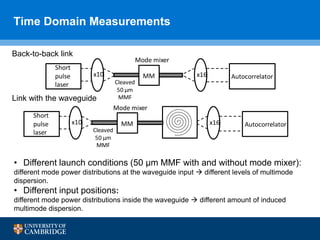
Time Domain Measurements
Back-to-back link
Link with the waveguide
• Different launch conditions (50 μm MMF with and without mode mixer):
different mode power distributions at the waveguide input  different levels of multimode
dispersion.
• Different input positions:
different mode power distributions inside the waveguide  different amount of induced
multimode dispersion.
Short
pulse
laser
Autocorrelatorx10 x16
Cleaved
50 μm
MMF
MM
Mode mixer
Short
pulse
laser
Autocorrelatorx10 x16
Cleaved
50 μm
MMF
MM
Mode mixer
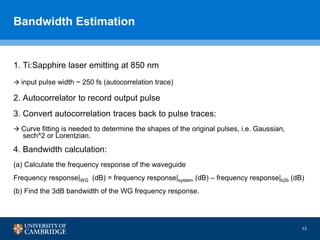
Bandwidth Estimation
1. Ti:Sapphire laser emitting at 850 nm
 input pulse width ~ 250 fs (autocorrelation trace)
2. Autocorrelator to record output pulse
3. Convert autocorrelation traces back to pulse traces:
 Curve fitting is needed to determine the shapes of the original pulses, i.e. Gaussian,
sech^2 or Lorentzian.
4. Bandwidth calculation:
(a) Calculate the frequency response of the waveguide
Frequency response|WG (dB) = frequency response|system (dB) – frequency response|b2b (dB)
(b) Find the 3dB bandwidth of the WG frequency response.
13
1 m Long Spiral Multimode Waveguide
 Our studies show that multimode large waveguides can operate at
higher speed than what people conventionally thought.
(a) the 1 m long spiral waveguide illuminated with red light and facet of the
(b) SI and (c) GI waveguide illuminated with 850 nm light.
32 μm
32μm
32 μm
35μm
(a) (b)
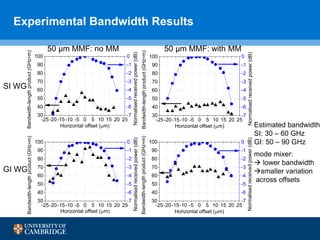
Experimental Bandwidth Results
-25-20-15-10 -5 0 5 10 15 20 25
30
40
50
60
70
80
90
100
Horizontal offset (m)
Bandwidth-lengthproduct(GHzm)
-7
-6
-5
-4
-3
-2
-1
0
Normalisedreceivedpower(dB)
-25-20-15-10 -5 0 5 10 15 20 25
30
40
50
60
70
80
90
100
Horizontal offset (m)
Bandwidth-lengthproduct(GHzm)
-7
-6
-5
-4
-3
-2
-1
0
Normalisedreceivedpower(dB)
-25-20-15-10 -5 0 5 10 15 20 25
30
40
50
60
70
80
90
100
Horizontal offset (m)
Bandwidth-lengthproduct(GHzm)
-7
-6
-5
-4
-3
-2
-1
0
Normalisedreceivedpower(dB)
-25-20-15-10 -5 0 5 10 15 20 25
30
40
50
60
70
80
90
100
Horizontal offset (m)
Bandwidth-lengthproduct(GHzm)
-7
-6
-5
-4
-3
-2
-1
0
Normalisedreceivedpower(dB)
SI WG
GI WG
50 μm MMF: no MM 50 μm MMF: with MM
Estimated bandwidth:
SI: 30 – 60 GHz
GI: 50 – 90 GHz
mode mixer:
 lower bandwidth
smaller variation
across offsets
Bandwidth Discussion
16
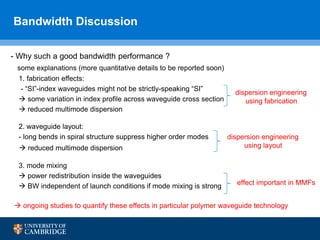
- Why such a good bandwidth performance ?
some explanations (more quantitative details to be reported soon)
1. fabrication effects:
- “SI”-index waveguides might not be strictly-speaking “SI”
 some variation in index profile across waveguide cross section
 reduced multimode dispersion
2. waveguide layout:
- long bends in spiral structure suppress higher order modes
 reduced multimode dispersion
3. mode mixing
 power redistribution inside the waveguides
 BW independent of launch conditions if mode mixing is strong
 ongoing studies to quantify these effects in particular polymer waveguide technology
dispersion engineering
using layout
dispersion engineering
using fabrication
effect important in MMFs
Outline
• Introduction to Optical Interconnects
• Board-level Optical Interconnects
• Bandwidth Studies
• Conclusions
Conclusions
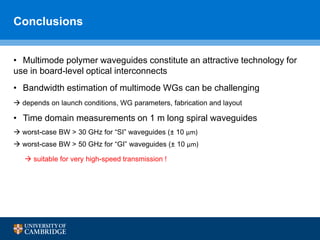
• Multimode polymer waveguides constitute an attractive technology for
use in board-level optical interconnects
• Bandwidth estimation of multimode WGs can be challenging
 depends on launch conditions, WG parameters, fabrication and layout
• Time domain measurements on 1 m long spiral waveguides
 worst-case BW > 30 GHz for “SI” waveguides (± 10 μm)
 worst-case BW > 50 GHz for “GI” waveguides (± 10 μm)
 suitable for very high-speed transmission !
References
[1] N. Bamiedakis, J. Chen, R. Penty, and I. White, "Bandwidth Studies on Multimode
Polymer Waveguides for ≥ 25 Gb/s Optical Interconnects," in IEEE Photonics Technology
Letters, vol. 26, no. 20, pp. 2004–2007, 2014.
[2] J. Chen, N. Bamiedakis, R. V. Penty, I. H. White, P. Westbergh, and A. Larsson,
“Bandwidth and Offset Launch Investigations on a 1.4 m Multimode Polymer Spiral
Waveguide,” in European Conference on Integrated Optics, p. P027, 2014.
[3] D. Kuchta, et al., "64 Gb/s Transmission over 57m MMF using an NRZ Modulated 850nm
VCSEL," in Optical Fiber Communication Conference (OFC), pp. 1-3, 2014.
[4] N. Bamiedakis, J. Chen, P. Westbergh, J. Gustavsson, A. Larsson, R. Penty, and I.
White, "40 Gb/s Data Transmission Over a 1 m Long Multimode Polymer Spiral Waveguide
for Board-Level Optical Interconnects," in Journal of Lightwave Technology, vol. 33, no. 4,
pp. 882–888, 2014.
[5] B. W. Swatowski, C. M. Amb, M. G. Hyer, R. S. John, and W. K. Weidner, "Graded Index
Silicone Waveguides for High Performance Computing," in IEEE Optical Interconnects
Conference (OIC), pp. 1-3, 2014.
Thank you !

Dispersion Studies on Multimode Polymer Spiral Waveguides for Board-Level Optical Interconnects

  • 1.
    Dispersion Studies onMultimode Polymer Spiral Waveguides for Board-Level Optical Interconnects Jian Chen, Nikos Bamiedakis, Richard V. Penty, Ian H. White Electrical Engineering Division, University of Cambridge, UK e-mail: jc791@cam.ac.uk Tom J. Edwards, Christian T.A. Brown School of Physics & Astronomy, University of St Andrews, UK Acknowledgement: The authors would like to acknowledge Dow Corning for providing the waveguide samples and EPSRC for supporting the work. OPTICAL INTERCONNECTS CONFERENCE 2015 20 April 2015
  • 2.
    Outline • Introduction toOptical Interconnects • Board-level Optical Interconnects • Bandwidth Studies • Conclusions
  • 3.
    Outline • Introduction toOptical Interconnects • Board-level Optical Interconnects • Bandwidth Studies • Conclusions
  • 4.
    Why Optical Interconnects? ElectricalInterconnects: • Limited bandwidths; • Increasing losses; • Higher crosstalk; Optical Interconnects: • Lower losses at high data rates; • Lower electromagnetic interference; • Higher power efficiency; • Density advantages. Growing demand for data communications link capacity in: - data centres - supercomputers  need for high-capacity short-reach interconnects operating at > 10 Gb/s
  • 5.
    Evolution of OpticalInterconnects • Optical interconnects will be employed in shorter and shorter links to meet the bandwidth and power efficiency requirements. Board Level [1] A.F. Benner et al, Exploitation of optical interconnects in future server architectures, IBM Journal of Research and Development, vol 49, Issue 4.5, 2005. [1]1980’s 1990’s 2000’s > 2012
  • 6.
    Outline • Introduction toOptical Interconnects • Board-level Optical Interconnects • Bandwidth Studies • Conclusions
  • 7.
    Board-level Optical interconnects Opticsis gradually working in conjunction with electronics for future communication technologies, however it needs to meet the key technological requirements at board-level interconnects: • Cost effectiveness; • Ability to be integrated into existing architectures; • Compatibility with existing manufacturing processes of conventional electronic circuitry.
  • 8.
    Polymer Multimode Waveguides 1.Polymer Materials • Sufficiently low-cost; • Very low intrinsic attenuation (0.03–0.05 dB/cm at 850 nm); • Good thermal and mechanical properties (up to 350 °C); • Fabricated on FR4, glass or silicon using standard techniques such as photolithography and embossing. 2. Multimode Waveguide • Cost-efficiency: relaxed alignment tolerances (> ± 10 µm).
  • 9.
    Outline • Introduction toOptical Interconnects • Board-level Optical Interconnects • Bandwidth Studies • Conclusions
  • 10.
    VCSEL Performance Continuous improvementin bandwidth performance of VCSELs:  850 nm VCSELs: 44 Gb/s (2012), 57 Gb/s (2013) and 64 Gb/s (OFC 2014, Chalmers - IBM)  performance in longer wavelengths follows same trend - un-cooled operation up to 90°C: (50 Gb/s Chalmers-IBM, 2014) - VCSEL arrays with very good uniformity and similarly high bandwidth [2] P. Westbergh, et al., IEEE PTL, vol. 27, pp. 296-299, 2015 Why do we study the bandwidth of multimode polymer waveguides?  their highly-multimoded nature raises important concerns about their bandwidth limitations and their potential to support very high on-board data rates.
  • 11.
    Frequency Response Measurements quasi-overfilled50/125 µm MMF input “overfilled” 100/140 µm MMF input  -3 dB frequency response >35 GHz for all inputs and input positions  suitable for high-speed transmission of ≥ 40 Gb/s data - results from more overfilled launches into the 1 m long spiral waveguide 50 µm 100 µm  BW > 35 GHz x m [3] N. Bamiedakis, et al., IEEE JLT, vol. 33, pp. 1-7, 2015 So, what are the bandwidth limits of these particular waveguides ?  time domain measurements
  • 12.
    Time Domain Measurements Back-to-backlink Link with the waveguide • Different launch conditions (50 μm MMF with and without mode mixer): different mode power distributions at the waveguide input  different levels of multimode dispersion. • Different input positions: different mode power distributions inside the waveguide  different amount of induced multimode dispersion. Short pulse laser Autocorrelatorx10 x16 Cleaved 50 μm MMF MM Mode mixer Short pulse laser Autocorrelatorx10 x16 Cleaved 50 μm MMF MM Mode mixer
  • 13.
    Bandwidth Estimation 1. Ti:Sapphirelaser emitting at 850 nm  input pulse width ~ 250 fs (autocorrelation trace) 2. Autocorrelator to record output pulse 3. Convert autocorrelation traces back to pulse traces:  Curve fitting is needed to determine the shapes of the original pulses, i.e. Gaussian, sech^2 or Lorentzian. 4. Bandwidth calculation: (a) Calculate the frequency response of the waveguide Frequency response|WG (dB) = frequency response|system (dB) – frequency response|b2b (dB) (b) Find the 3dB bandwidth of the WG frequency response. 13
  • 14.
    1 m LongSpiral Multimode Waveguide  Our studies show that multimode large waveguides can operate at higher speed than what people conventionally thought. (a) the 1 m long spiral waveguide illuminated with red light and facet of the (b) SI and (c) GI waveguide illuminated with 850 nm light. 32 μm 32μm 32 μm 35μm (a) (b)
  • 15.
    Experimental Bandwidth Results -25-20-15-10-5 0 5 10 15 20 25 30 40 50 60 70 80 90 100 Horizontal offset (m) Bandwidth-lengthproduct(GHzm) -7 -6 -5 -4 -3 -2 -1 0 Normalisedreceivedpower(dB) -25-20-15-10 -5 0 5 10 15 20 25 30 40 50 60 70 80 90 100 Horizontal offset (m) Bandwidth-lengthproduct(GHzm) -7 -6 -5 -4 -3 -2 -1 0 Normalisedreceivedpower(dB) -25-20-15-10 -5 0 5 10 15 20 25 30 40 50 60 70 80 90 100 Horizontal offset (m) Bandwidth-lengthproduct(GHzm) -7 -6 -5 -4 -3 -2 -1 0 Normalisedreceivedpower(dB) -25-20-15-10 -5 0 5 10 15 20 25 30 40 50 60 70 80 90 100 Horizontal offset (m) Bandwidth-lengthproduct(GHzm) -7 -6 -5 -4 -3 -2 -1 0 Normalisedreceivedpower(dB) SI WG GI WG 50 μm MMF: no MM 50 μm MMF: with MM Estimated bandwidth: SI: 30 – 60 GHz GI: 50 – 90 GHz mode mixer:  lower bandwidth smaller variation across offsets
  • 16.
    Bandwidth Discussion 16 - Whysuch a good bandwidth performance ? some explanations (more quantitative details to be reported soon) 1. fabrication effects: - “SI”-index waveguides might not be strictly-speaking “SI”  some variation in index profile across waveguide cross section  reduced multimode dispersion 2. waveguide layout: - long bends in spiral structure suppress higher order modes  reduced multimode dispersion 3. mode mixing  power redistribution inside the waveguides  BW independent of launch conditions if mode mixing is strong  ongoing studies to quantify these effects in particular polymer waveguide technology dispersion engineering using layout dispersion engineering using fabrication effect important in MMFs
  • 17.
    Outline • Introduction toOptical Interconnects • Board-level Optical Interconnects • Bandwidth Studies • Conclusions
  • 18.
    Conclusions • Multimode polymerwaveguides constitute an attractive technology for use in board-level optical interconnects • Bandwidth estimation of multimode WGs can be challenging  depends on launch conditions, WG parameters, fabrication and layout • Time domain measurements on 1 m long spiral waveguides  worst-case BW > 30 GHz for “SI” waveguides (± 10 μm)  worst-case BW > 50 GHz for “GI” waveguides (± 10 μm)  suitable for very high-speed transmission !
  • 19.
    References [1] N. Bamiedakis,J. Chen, R. Penty, and I. White, "Bandwidth Studies on Multimode Polymer Waveguides for ≥ 25 Gb/s Optical Interconnects," in IEEE Photonics Technology Letters, vol. 26, no. 20, pp. 2004–2007, 2014. [2] J. Chen, N. Bamiedakis, R. V. Penty, I. H. White, P. Westbergh, and A. Larsson, “Bandwidth and Offset Launch Investigations on a 1.4 m Multimode Polymer Spiral Waveguide,” in European Conference on Integrated Optics, p. P027, 2014. [3] D. Kuchta, et al., "64 Gb/s Transmission over 57m MMF using an NRZ Modulated 850nm VCSEL," in Optical Fiber Communication Conference (OFC), pp. 1-3, 2014. [4] N. Bamiedakis, J. Chen, P. Westbergh, J. Gustavsson, A. Larsson, R. Penty, and I. White, "40 Gb/s Data Transmission Over a 1 m Long Multimode Polymer Spiral Waveguide for Board-Level Optical Interconnects," in Journal of Lightwave Technology, vol. 33, no. 4, pp. 882–888, 2014. [5] B. W. Swatowski, C. M. Amb, M. G. Hyer, R. S. John, and W. K. Weidner, "Graded Index Silicone Waveguides for High Performance Computing," in IEEE Optical Interconnects Conference (OIC), pp. 1-3, 2014.
  • 20.