



























Discussing and concluding
Prof. Dr. Ron Martinez
PRPPG7000 - Academic Writing in English
Syllabus outline
• 28/08 - Introduction
• 04/09 - IMRaD, Most common errors,
electronic tools
• 11/09 - Strategic planning for your article:
CARS and other approaches
• 18/09 - Title, Abstract e Introduction
• 25/09 - Writing your Introduction
• 02/10 - Coherence, cohesion and clarity, and
use of authorial voice
• 09/10 - (Introduction due) The Method
section
• 16/10- The (Results and) Discussion section
• 23/10 - (Introduction peer feedback due)
Discussing and Concluding
• 30/10 - Writing (no class)
• 06/11 - (1st draft article due) Students
exchange articles (no class)
• 13/11 - Special guest speaker
• 20/11 - (1st draft peer feedback due)
Plagiarism, the submission process
• 18/12 - Final draft of full article due (send
also to “orientador”, with evaluation form)
• 29/01/2020 - Evaluation form due from
orientador
Introduction peer feedback will be
returned tomorrow
Today’s Homework
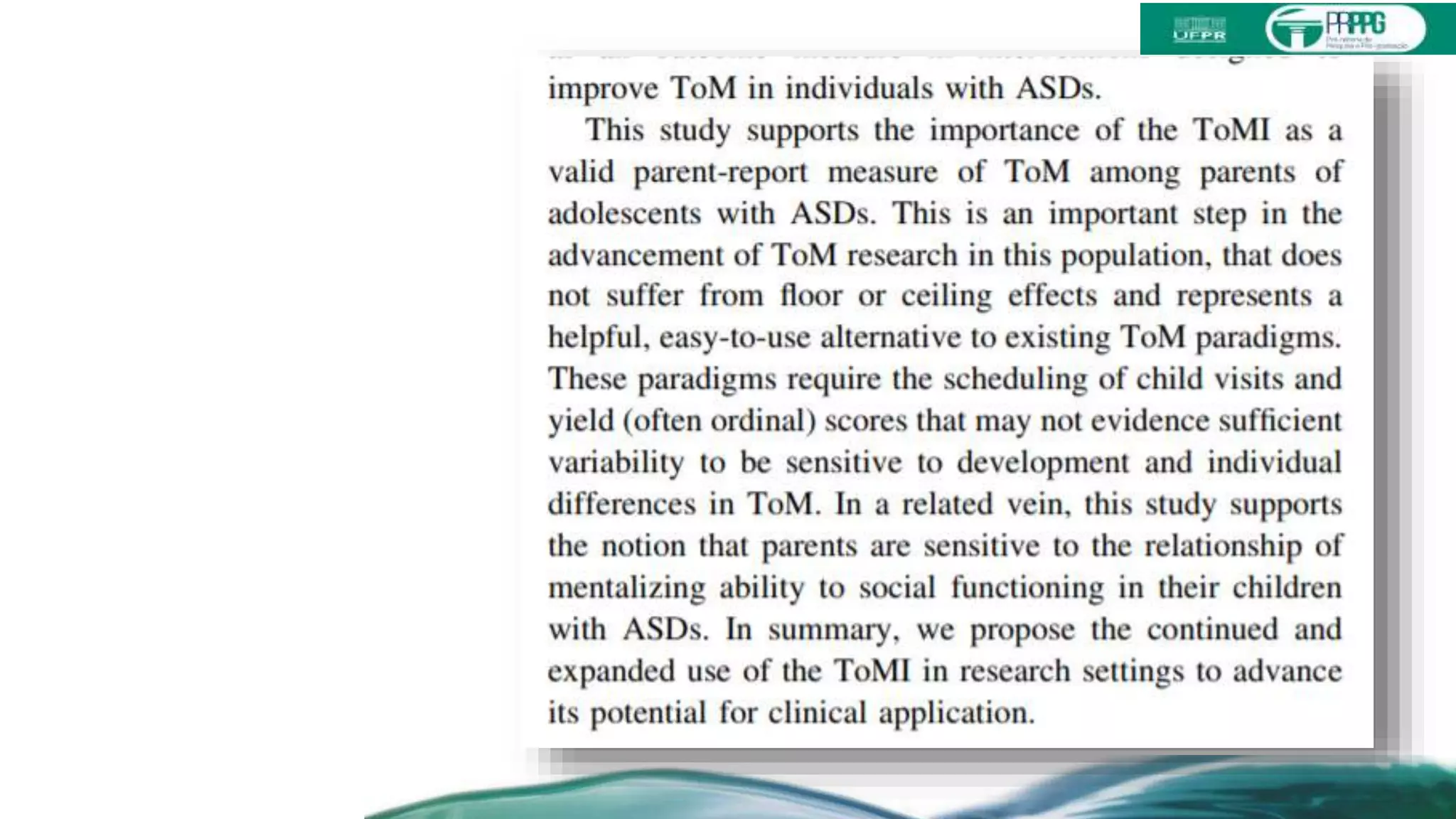
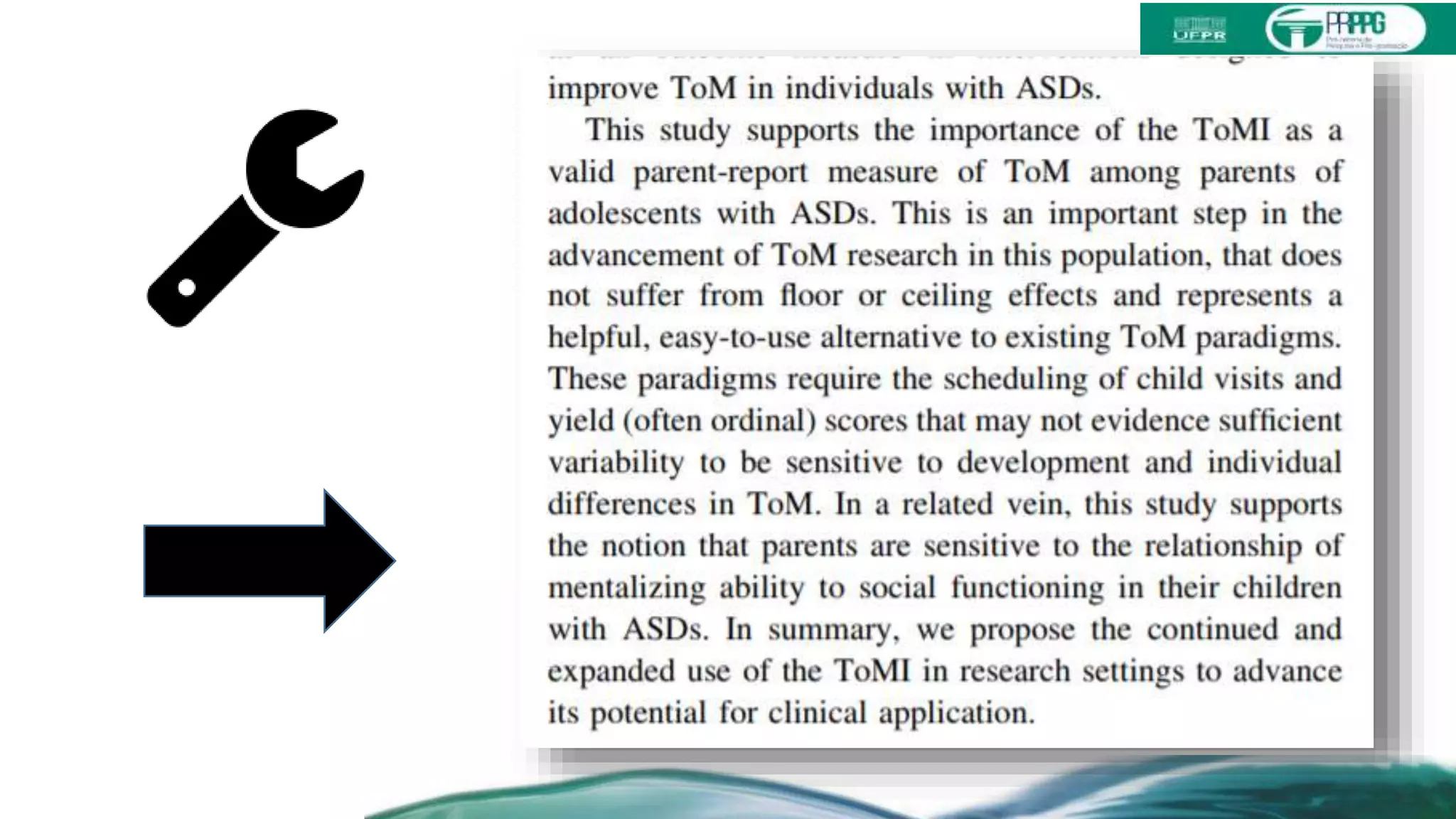
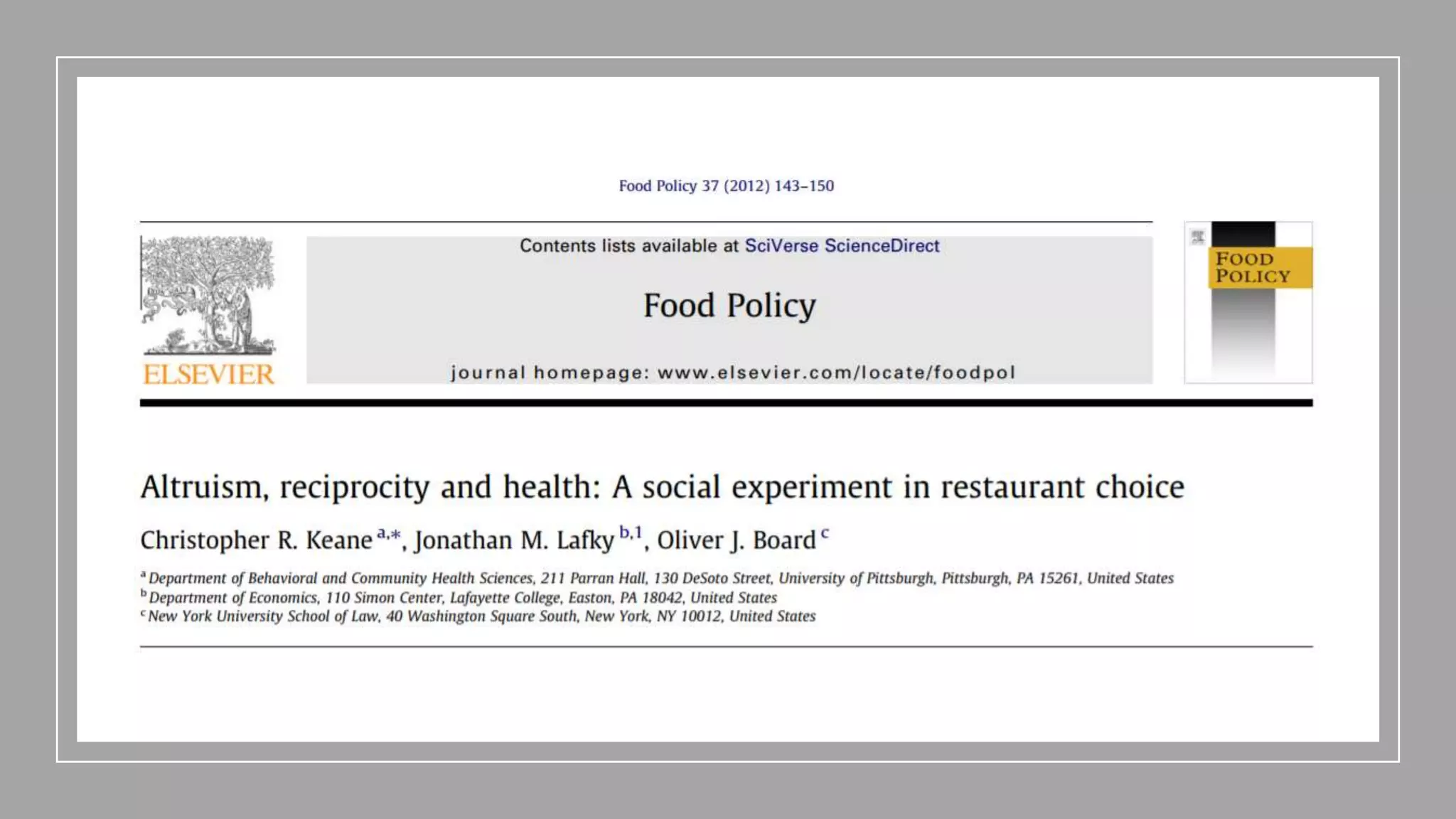
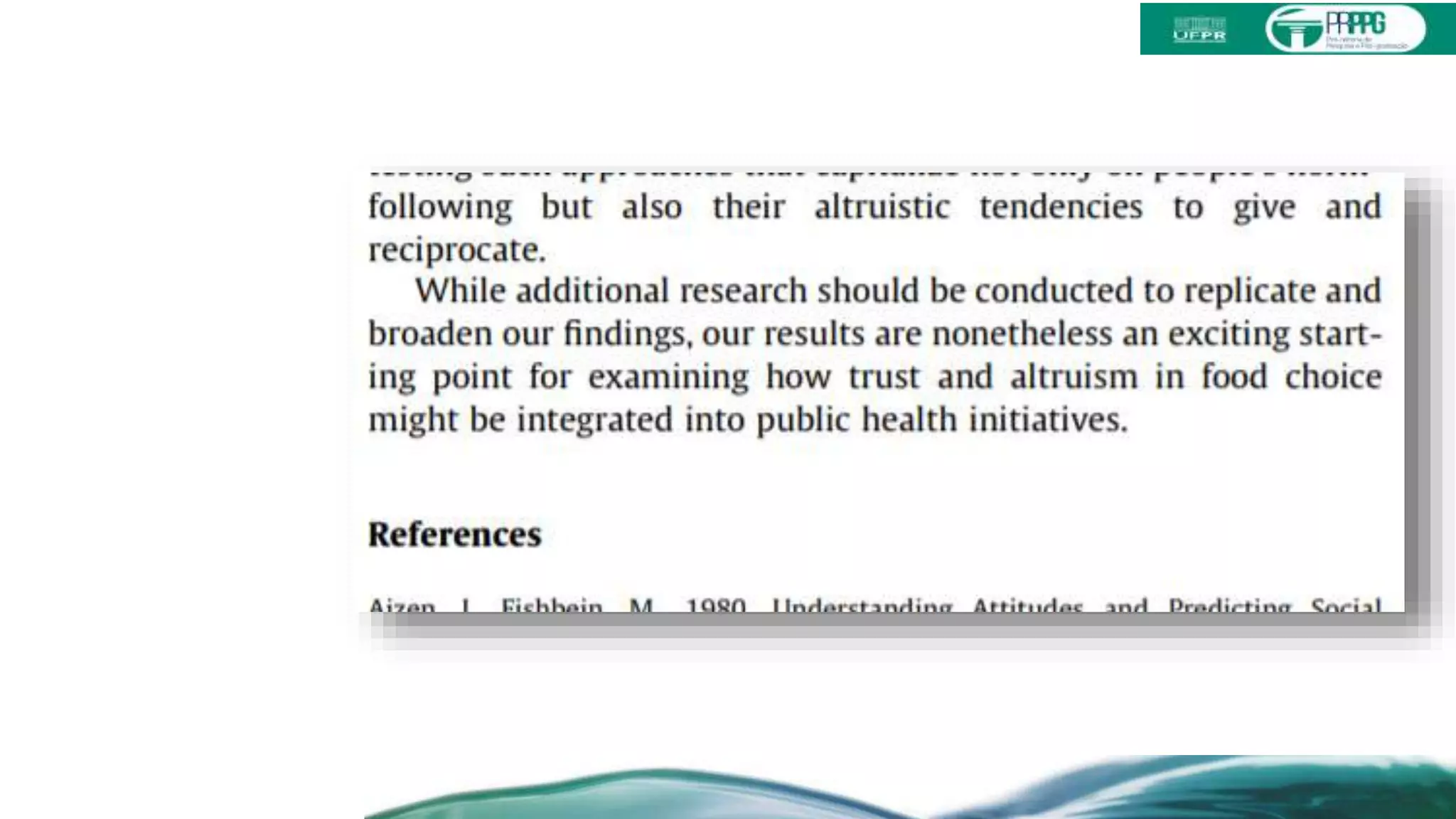
• Download and read the article on our class
webpage. What elements discussed in today’s class
are present? Which are missing? (Respond on
Formative.)
• Remember to complete feedback on Peer
Grade.
• Write about your feedback experience on
Formative.
• If time: Try outlining the rest of your article.
Comment from a student
“I had never before made contributions to an article proposal for
publication. I had the honor of feeling ‘proofreader’. What I liked about
the experience is that I had the opportunity to evaluate / comment on
two works of two completely different subjects. It was interesting to
notice gaps, inconsistent phrases and give meaning to them, to realize
what was missing and what was unnecessary in subjects from different
areas from mine.”
Student comment:
“Achei divertido ler coisas que outras pessoas escreveram e poder
opinar sobre isso. Pena que acabamos lendo algo que não é da nossa
área, então fica meio confuso de entender as introduções, mas
acredito que isso sirva de alerta para nós mesmo, afinal, precisamos
estar atentos ao que iremos escrever, e levar em consideração que
nem sempre quem irá ler o nosso artigo, é alguém que entende do
assunto.”
Student comment:
“A experiência foi muito positiva. Eu já havia realizado correção de
prova e comentários a respeito das questões de outros colegas, mas a
experiência de dar um feedback sobre um artigo é totalmente diferente.
Pelo menos para mim, dar o feedback me fez repensar na minha
escrita e no que eu poderia ter feito diferente. Certamente, só de dar
esses feedbacks eu já faria (e farei) alterações na minha introdução.”
Student comment:
“I was impressed how much I enjoyed reading the introduction of
colleagues and being able to evaluate and contribute to their writing. I
found it very interesting to be able to see clearly in these texts what we
learned in class, and realize that an outside look can be very useful. I'm
sure I couldn't have that clear vision when I wrote my own introduction,
but analyzing my colleagues' text helped me to see better my own
writing. I am sure in the next introductions I will write with more
attention and make fewer mistakes.”
“Eu gostei do site e de que como ele funciona.
Nos dá uma ideia na prática de como as
revisões dos artigos acontecem.”
Presenting results continued...
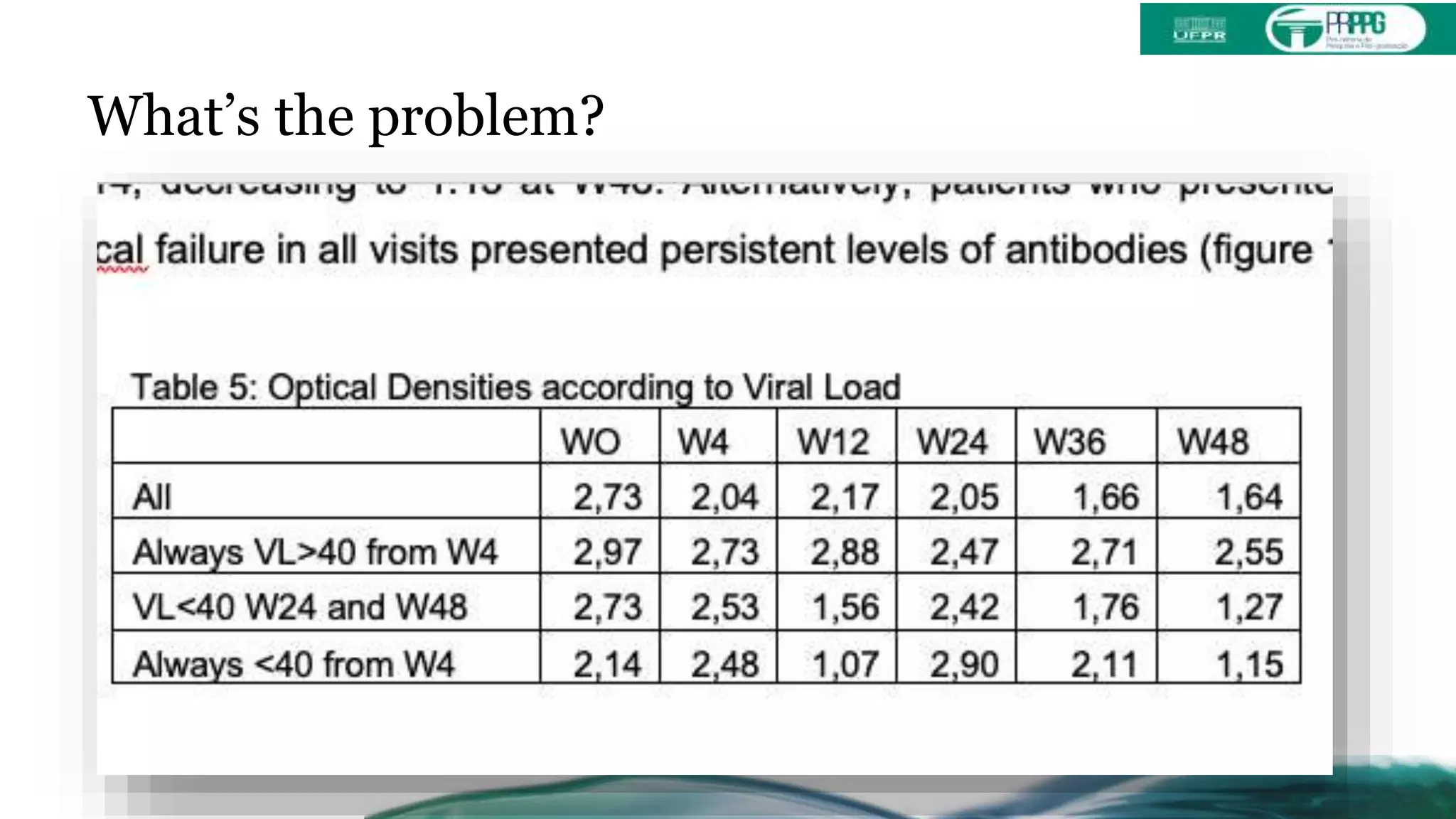
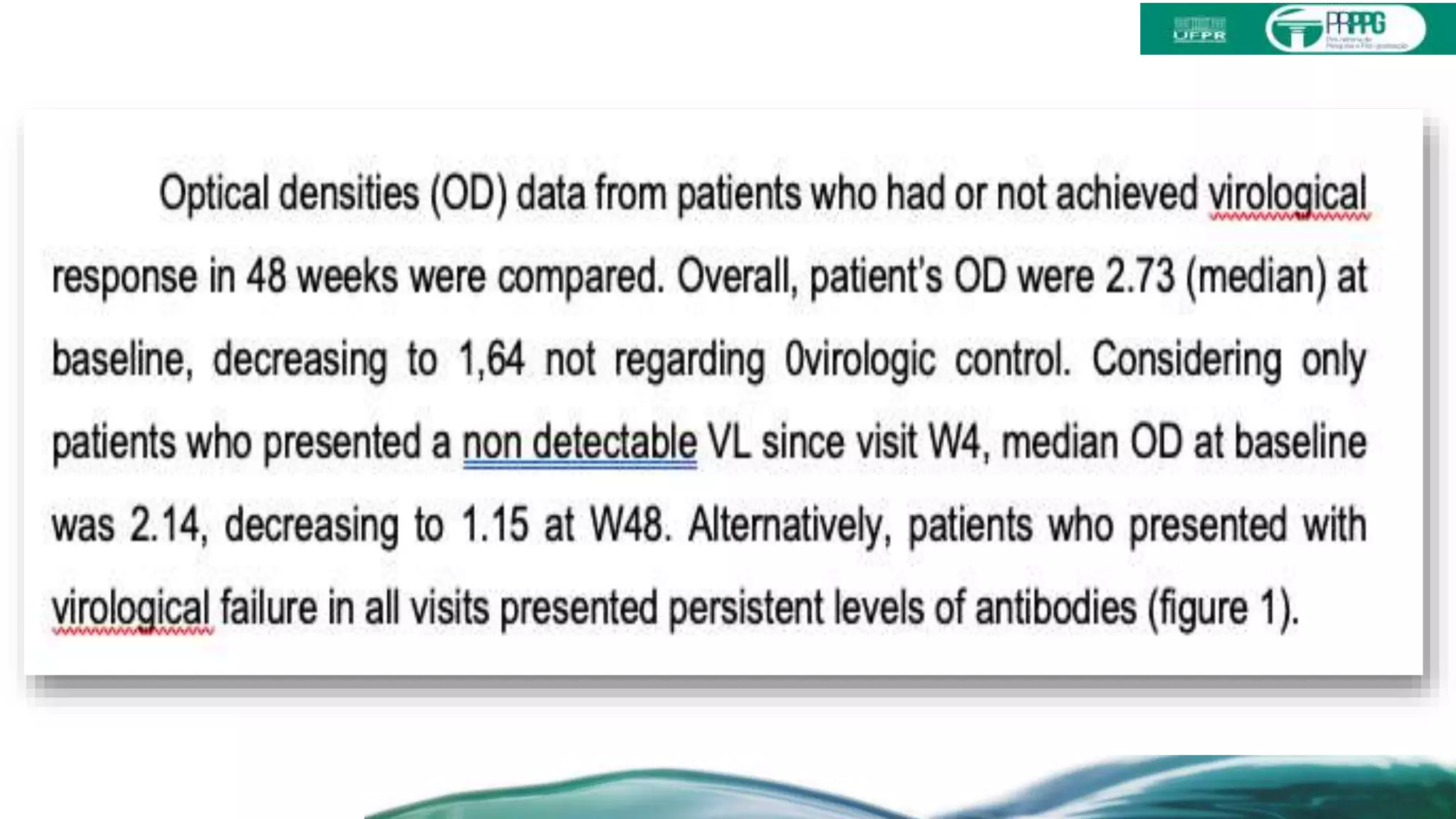
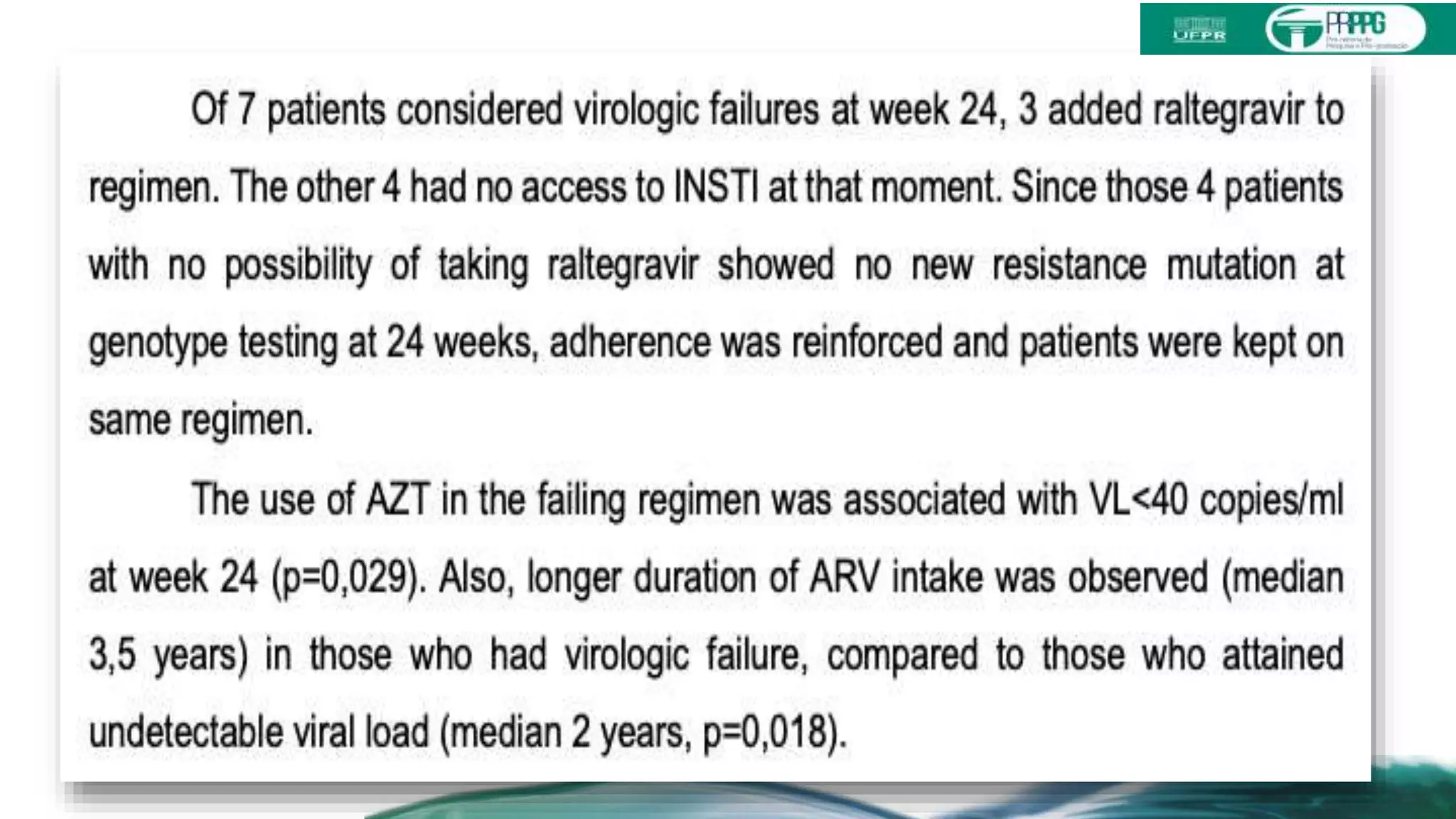
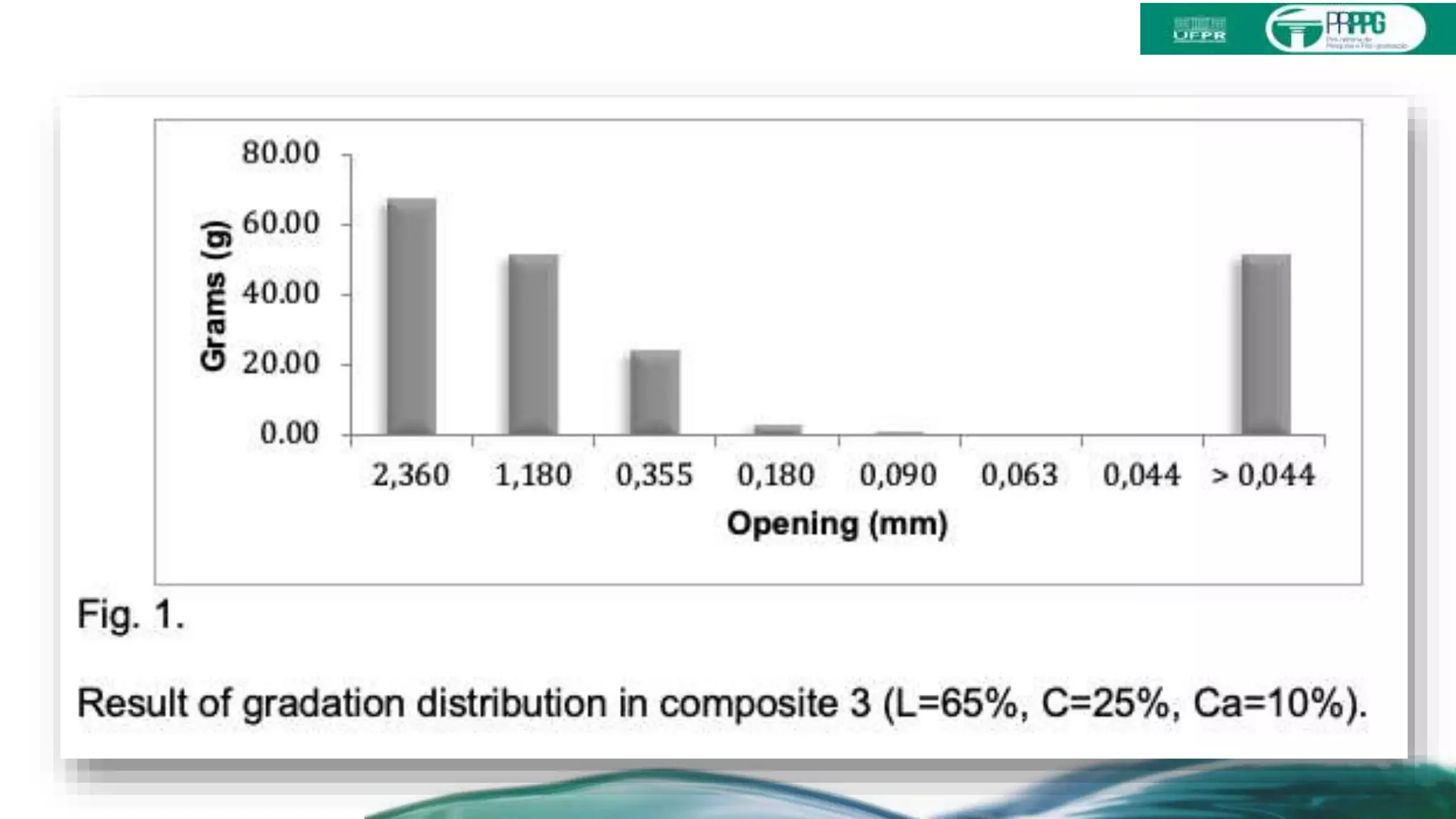
What’s the problem?
Back to that rejection....
Your disussion of the Discussion on Formative
From a student:
“Percebe-se que neste trabalho não há alusão à outras
pesquisas na área, durante a discussão a única referência
que aparece é a NBR, não tem outros autores. É um
trabalho que trata apenas os resultados de forma bem
técnica, sem aplicações muito práticas, embora fale da
importância do uso do material na construção civil.”
Student comment:
Na seção "results and discussion" do artigo rejeitado o
autor só apresenta os resultados do estudo. O autor não
conecta a introdução com a discussão revisitando pontos
levantados, não compara a pesquisa com outros estudos e
não fala de possíveis limitações da pesquisa abrindo uma
brecha para novos estudos. Somente na conclusão
aparece uma possível aplicação prática do resultado
obtido, ou seja, o uso do material desenvolvido na
construção civil.
Another comment:
Move 1 and move 2 of CARS are missing. In the
Discussion topic, I have identified practically none of the six
common elements. The discussion is very descriptive
missing the discussion itself. In the conclusion topic, there
are some implications on points raised in the introduction,
but there is a lack of expanding, explaining or extrapolating
the initial discussion. Thus, this article needs to be more
developed to include the theorization of the results. Also, it
is important to write about the limitations.
“Results” or “Results and discussion”?
Should you
separate them?
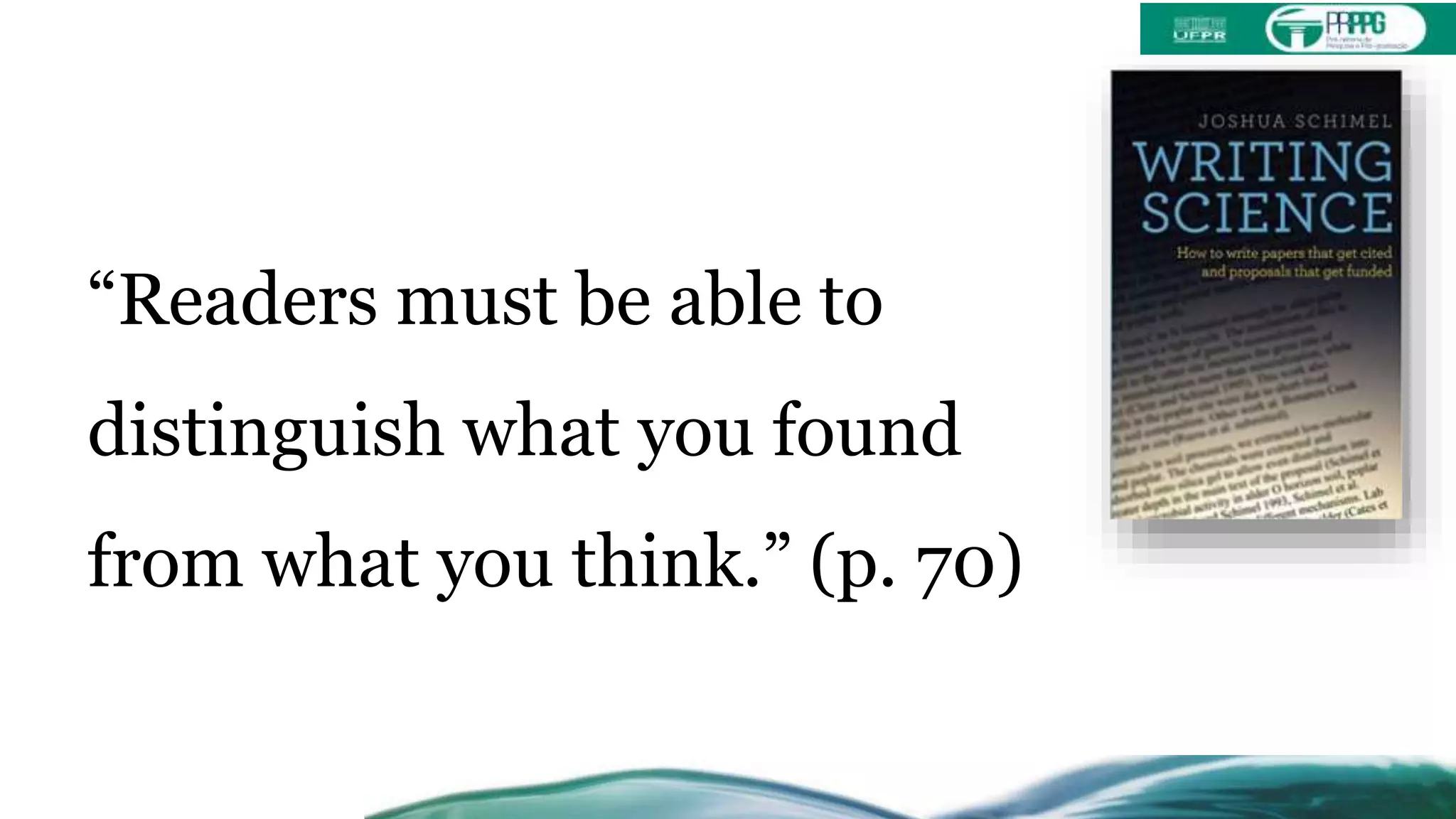
“Readers must be able to
distinguish what you found
from what you think.” (p. 70)
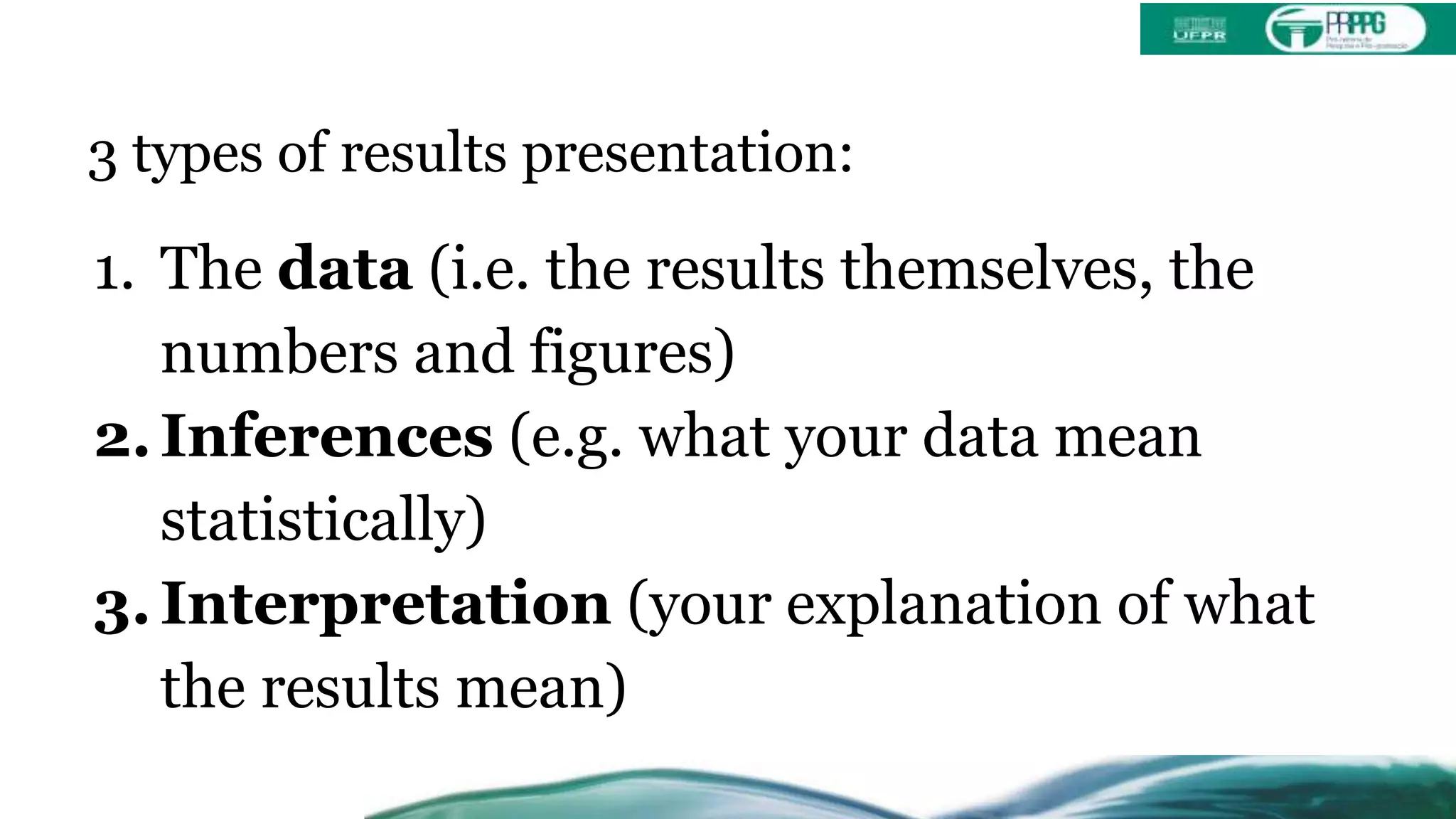
3 types of results presentation:
1. The data (i.e. the results themselves, the
numbers and figures)
2.Inferences (e.g. what your data mean
statistically)
3.Interpretation (your explanation of what
the results mean)
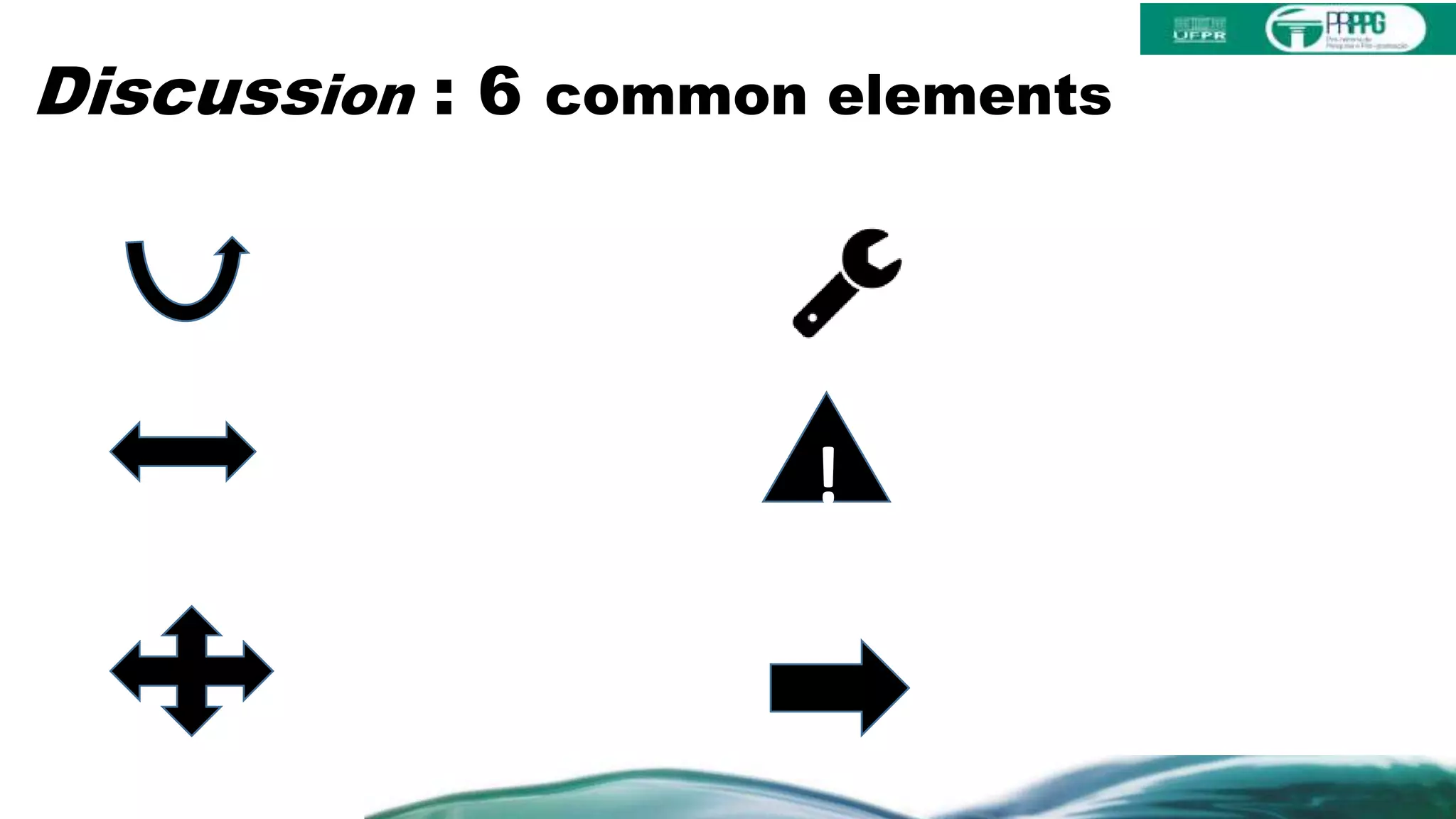
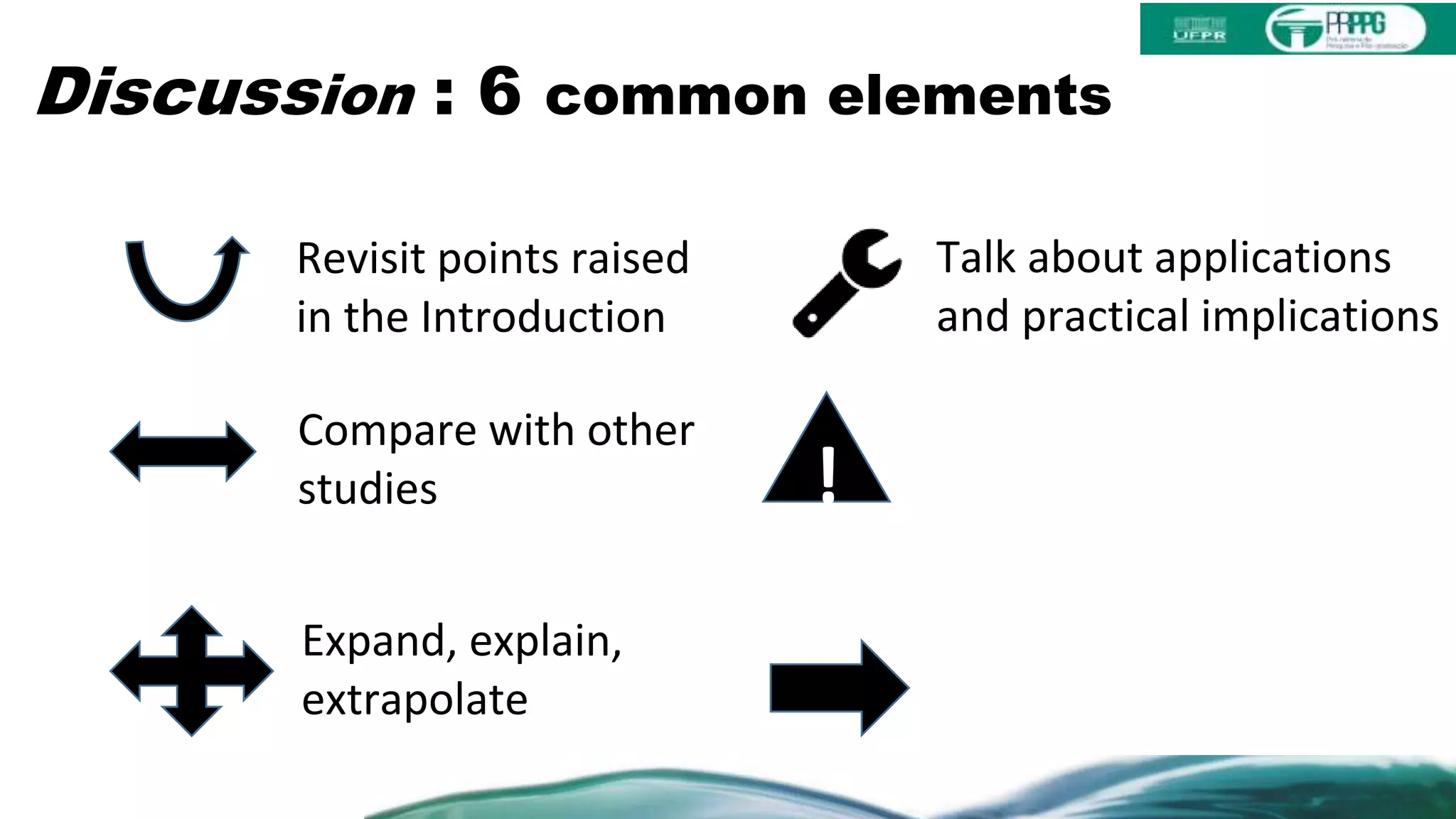
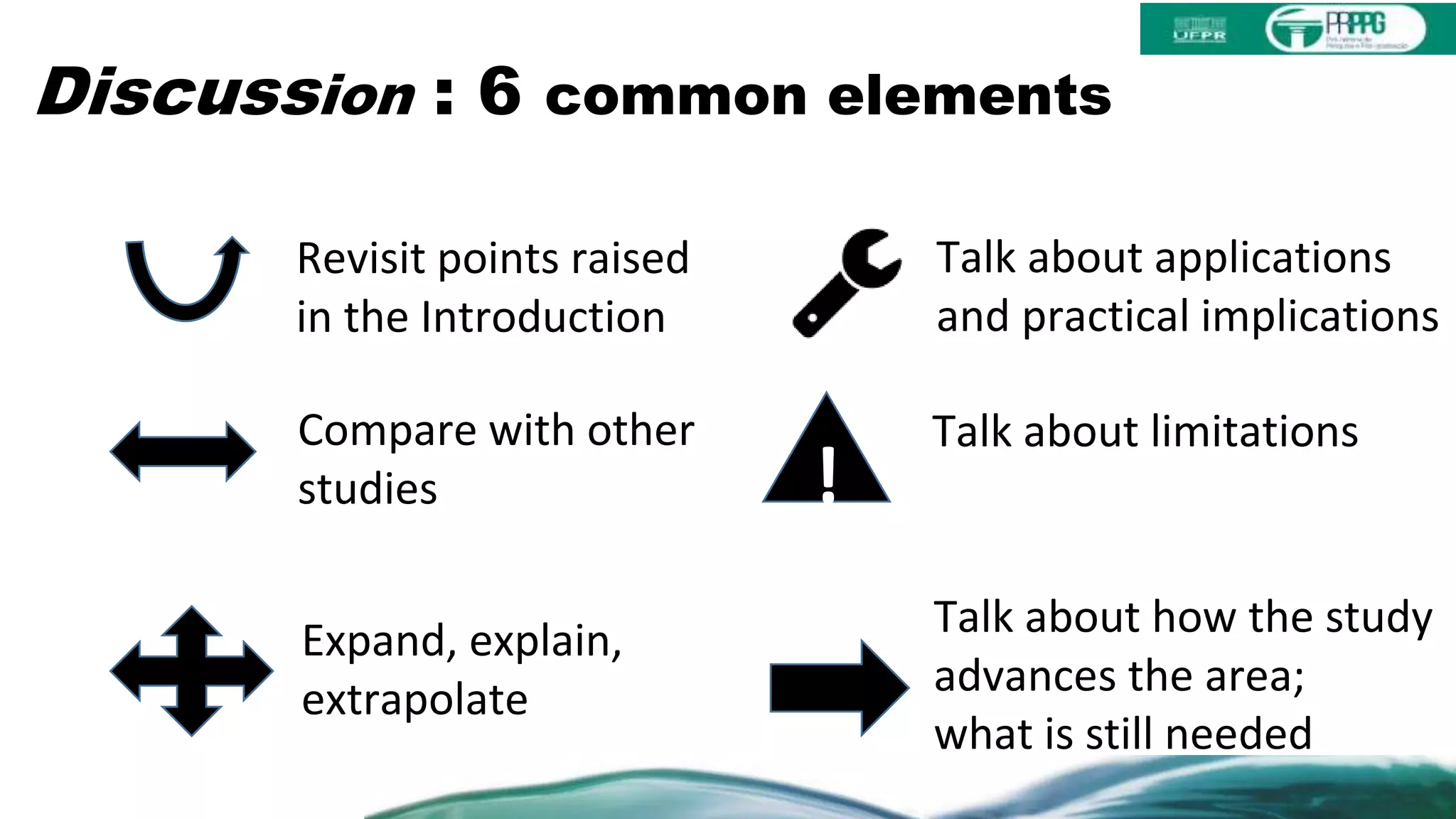
Discussion : 6 common elements
!
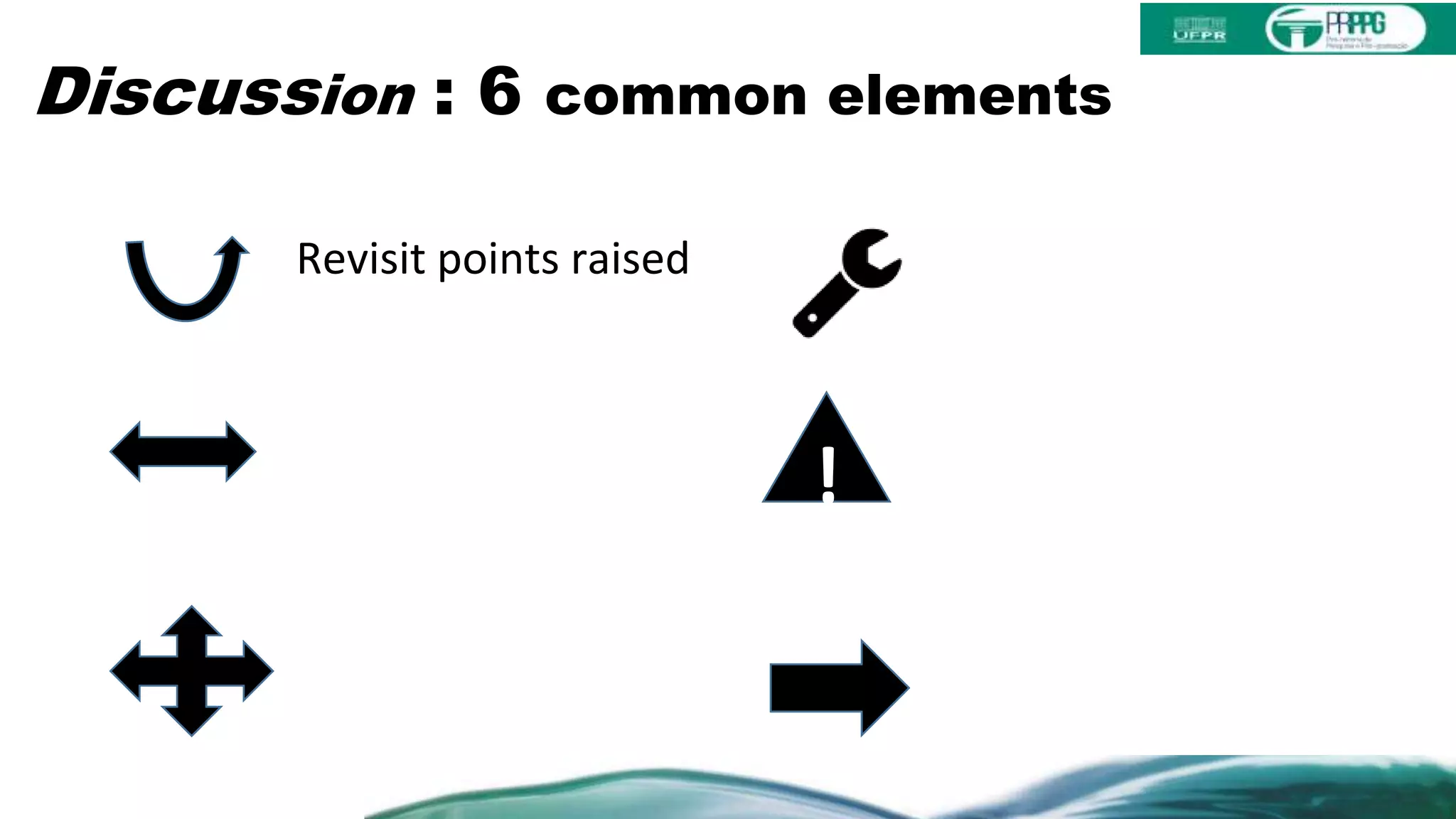
Discussion : 6 common elements
!
Revisit points raised
Discussion : 6 common elements
!
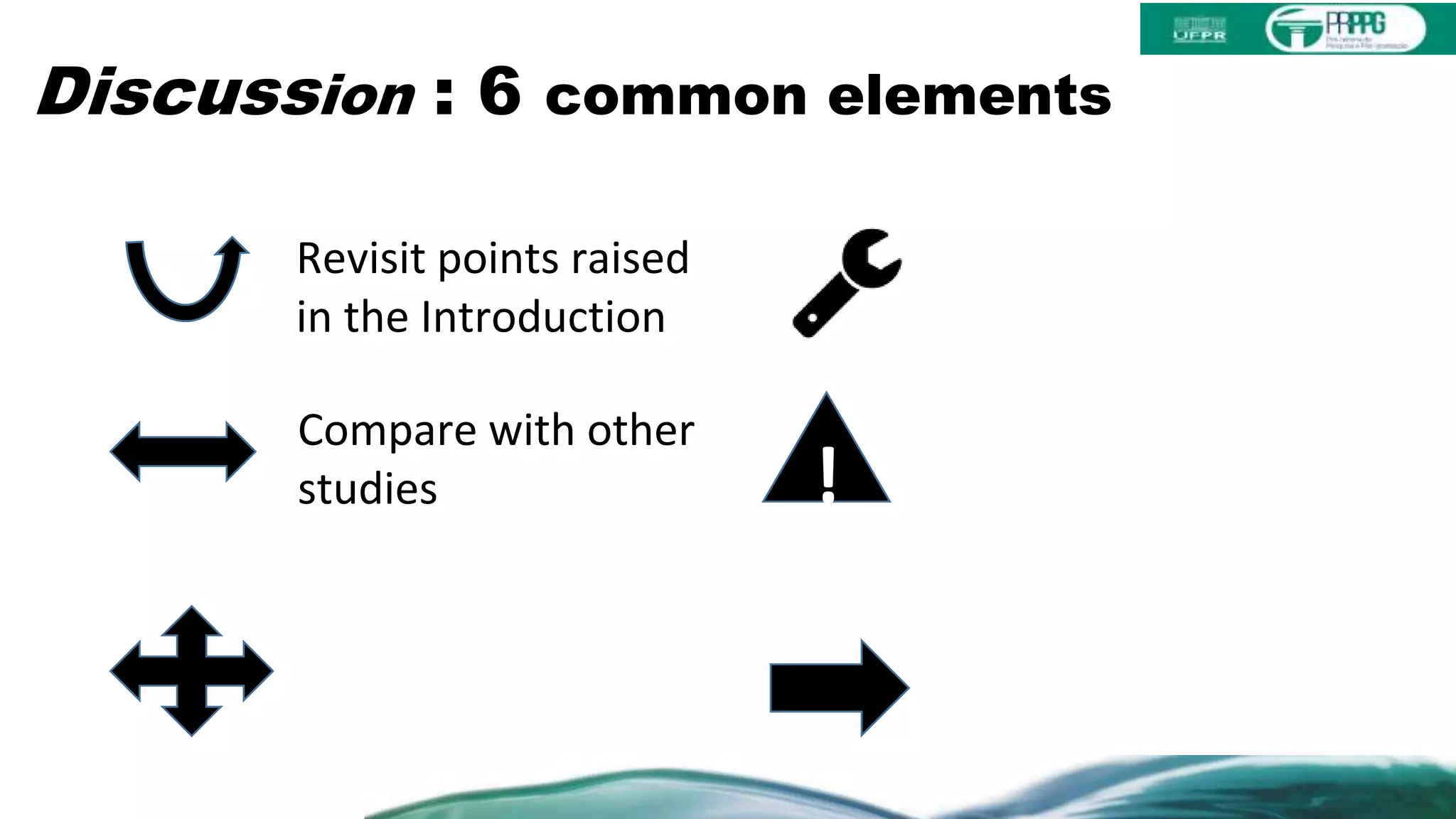
Revisit points raised
in the Introduction
Compare with other
studies
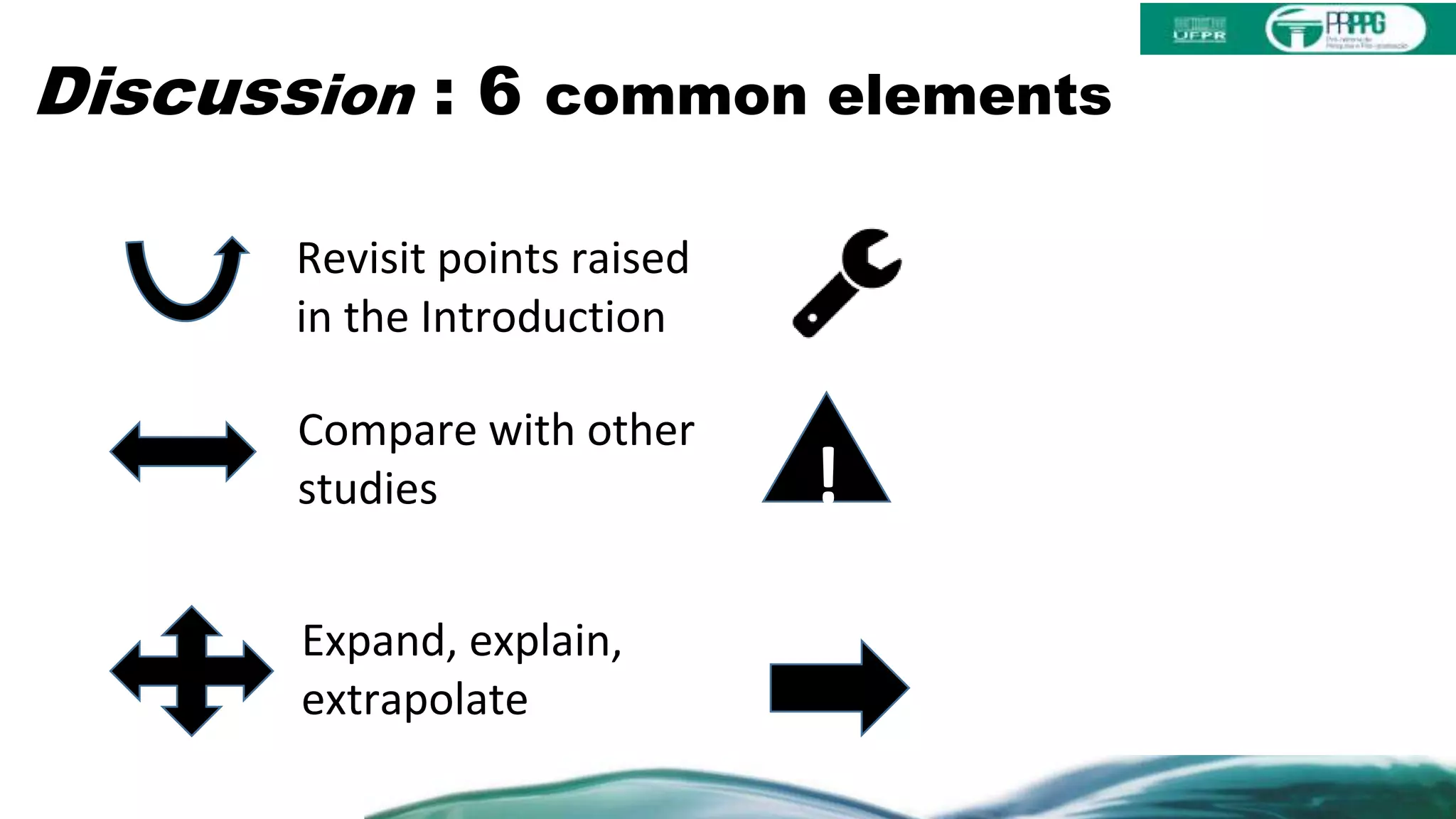
Discussion : 6 common elements
!
Revisit points raised
in the Introduction
Compare with other
studies
Expand, explain,
extrapolate
Discussion : 6 common elements
!
Revisit points raised
in the Introduction
Compare with other
studies
Expand, explain,
extrapolate
Talk about applications
and practical implications
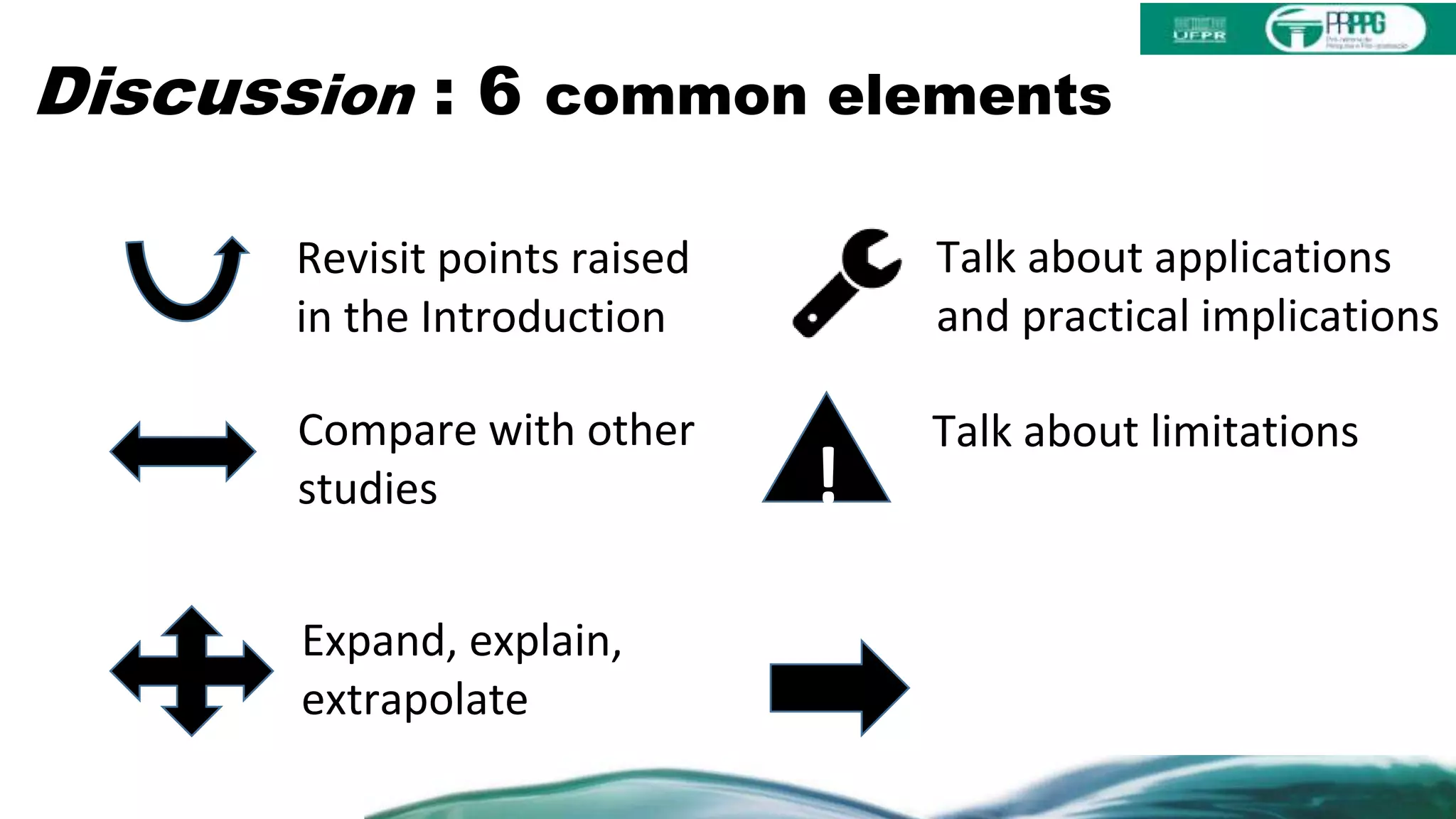
Discussion : 6 common elements
!
Revisit points raised
in the Introduction
Compare with other
studies
Expand, explain,
extrapolate
Talk about applications
and practical implications
Talk about limitations
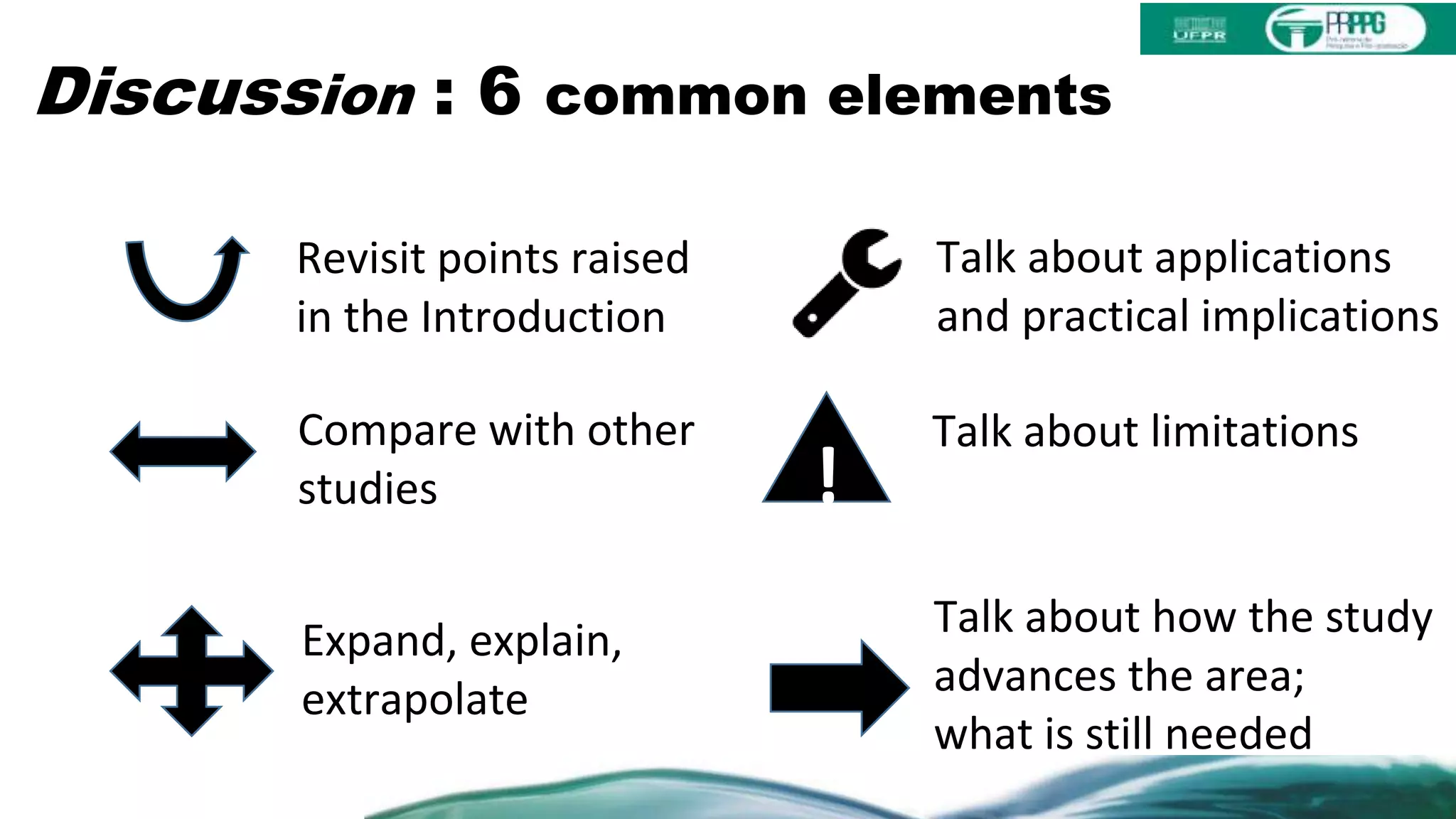
Discussion : 6 common elements
!
Revisit points raised
in the Introduction
Compare with other
studies
Expand, explain,
extrapolate
Talk about applications
and practical implications
Talk about limitations
Talk about how the study
advances the area;
what is still needed
Another comment:
Move 1 and move 2 of CARS are missing. In the
Discussion topic, I have identified practically none of the six
common elements. The discussion is very descriptive
missing the discussion itself. In the conclusion topic, there
are some implications on points raised in the introduction,
but there is a lack of expanding, explaining or extrapolating
the initial discussion. Thus, this article needs to be more
developed to include the theorization of the results. Also, it
is important to write about the limitations.
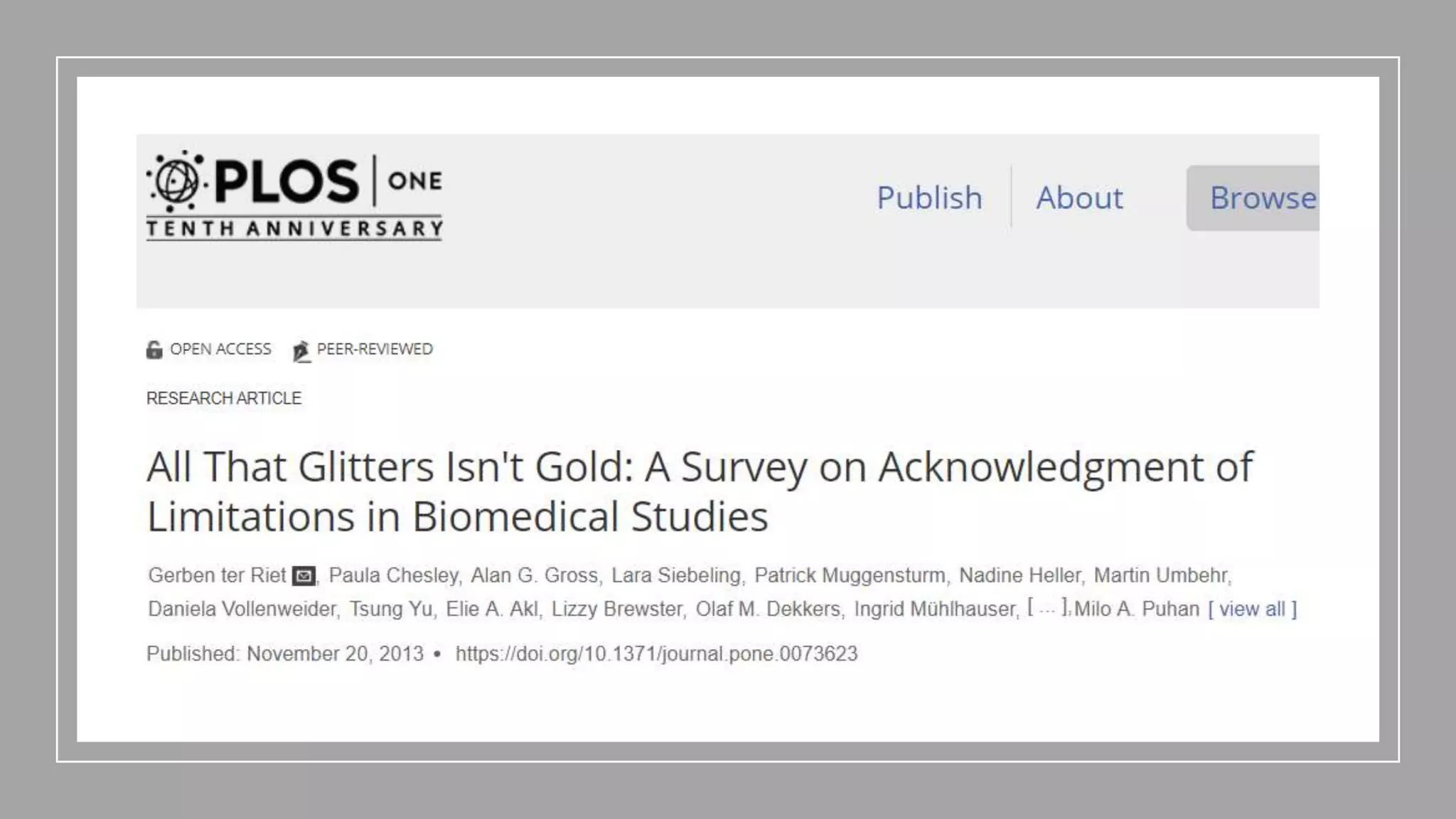
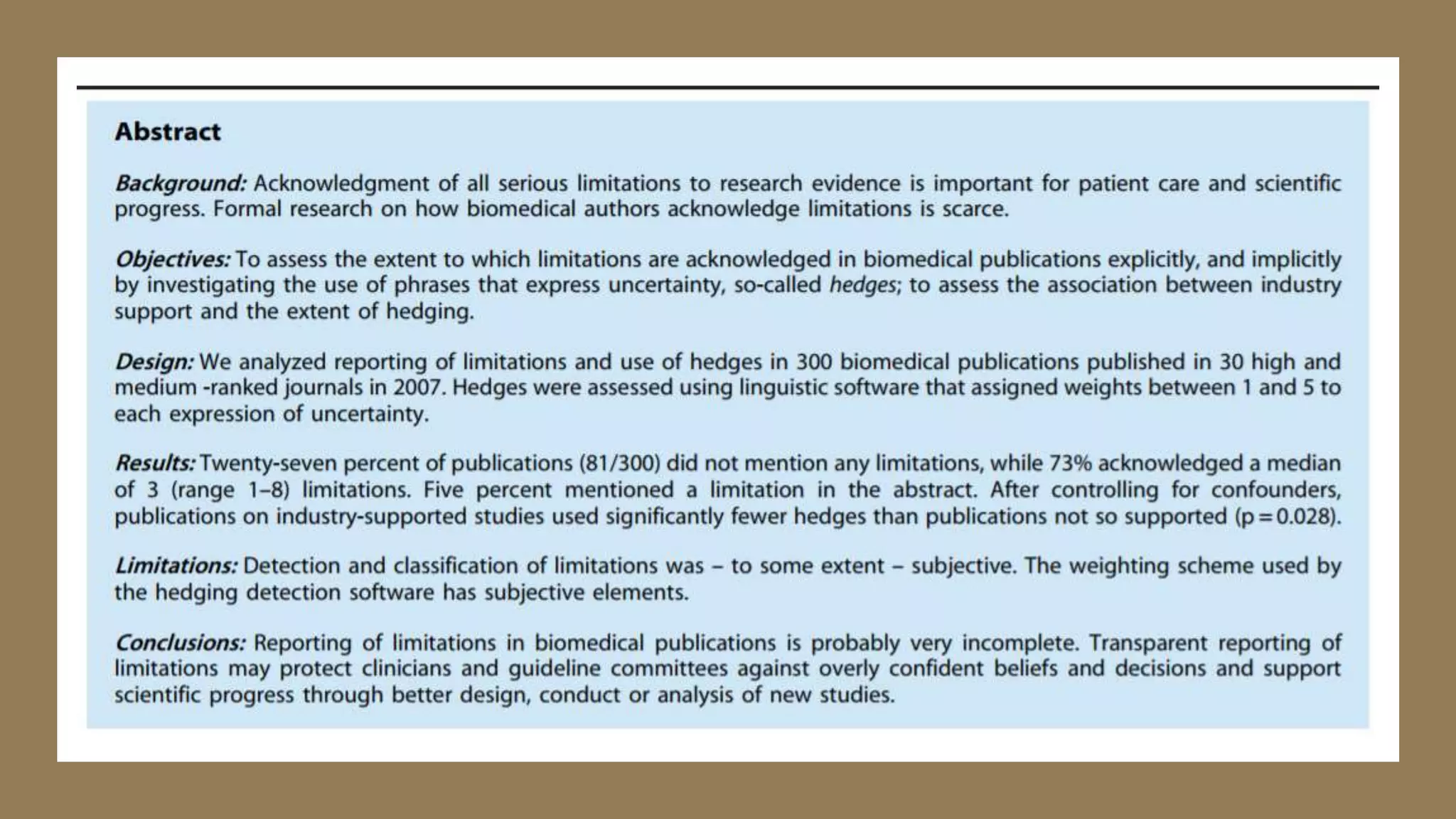
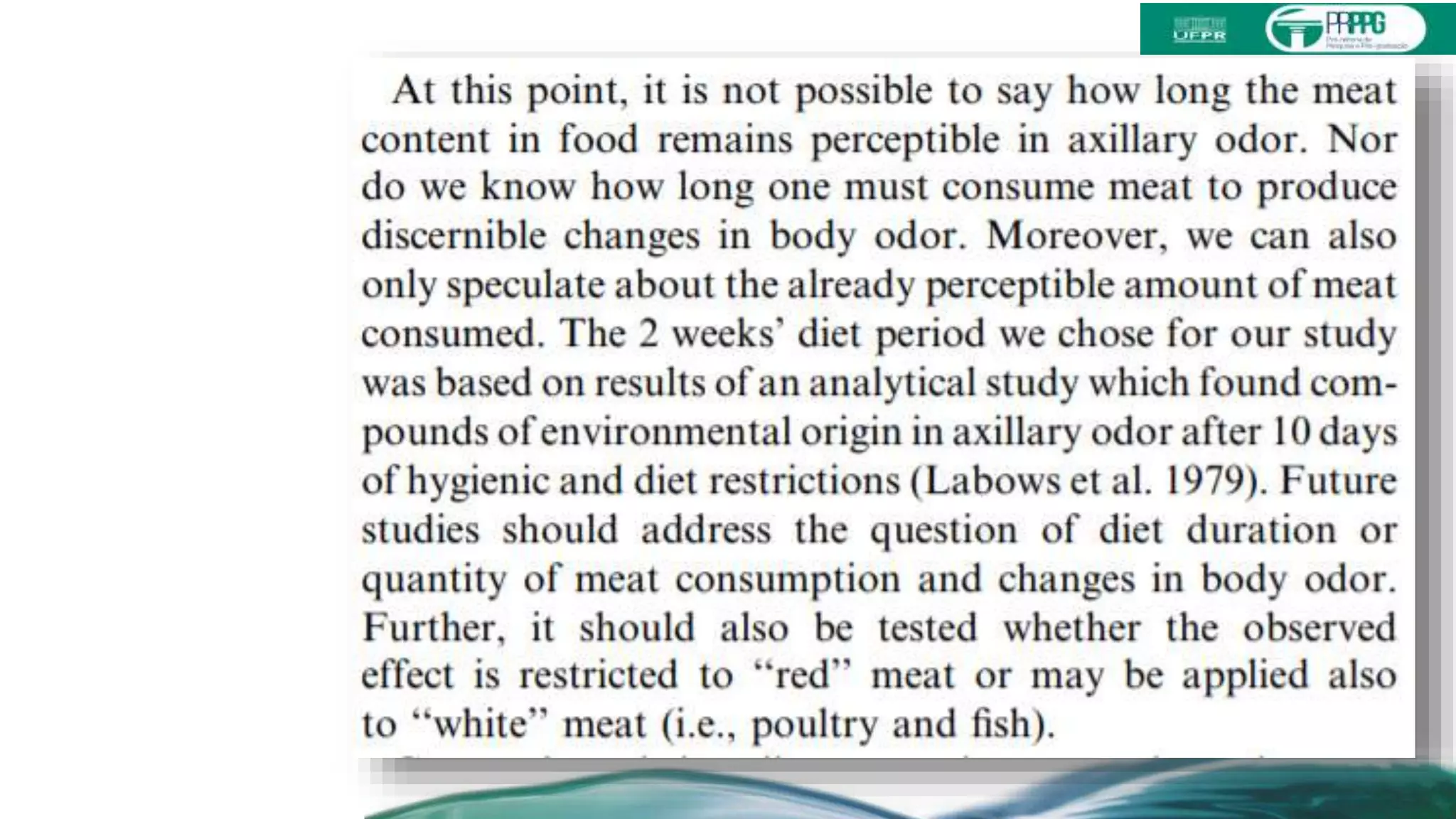
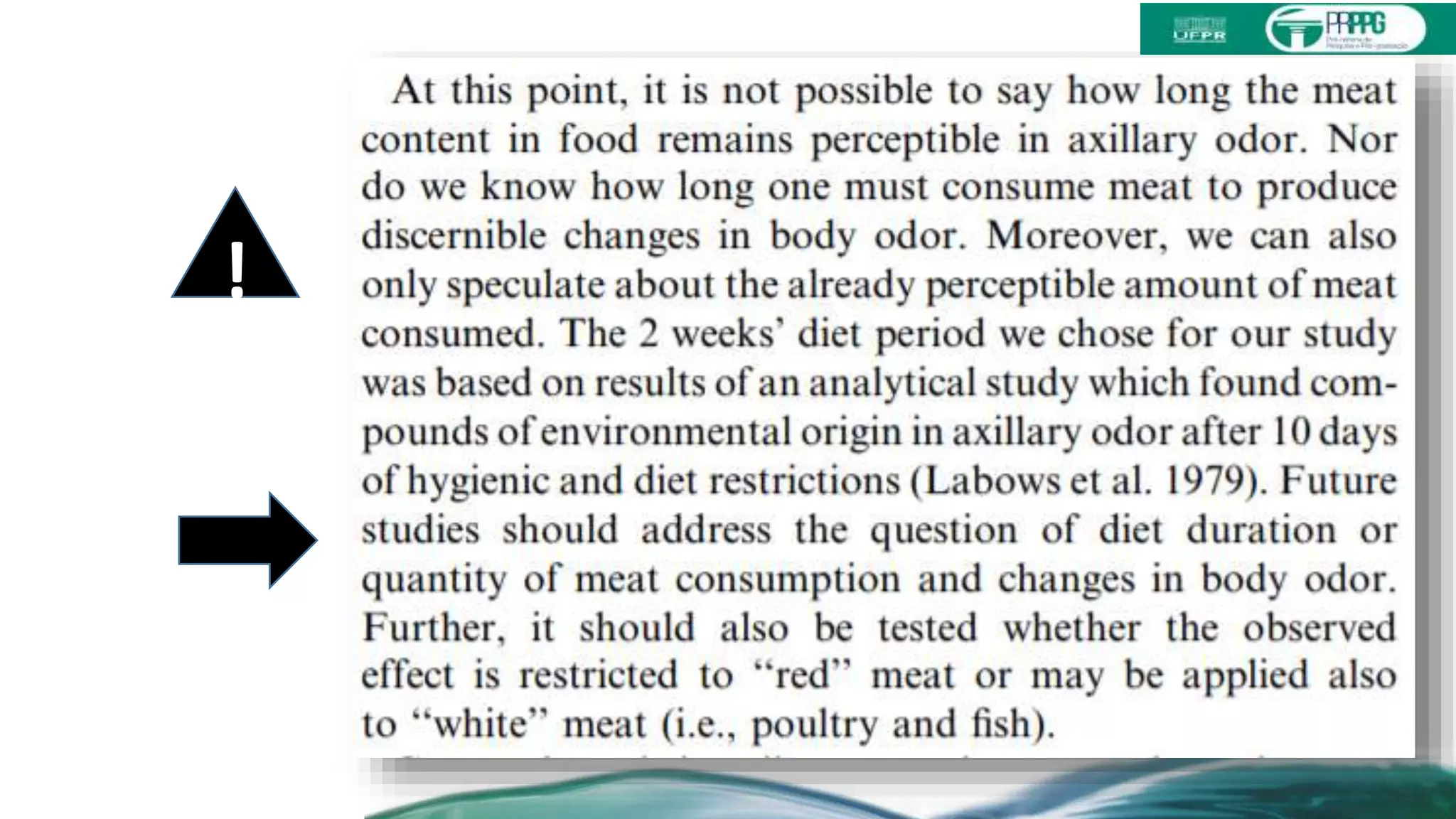
LIMITATIONS "DEFECTS"
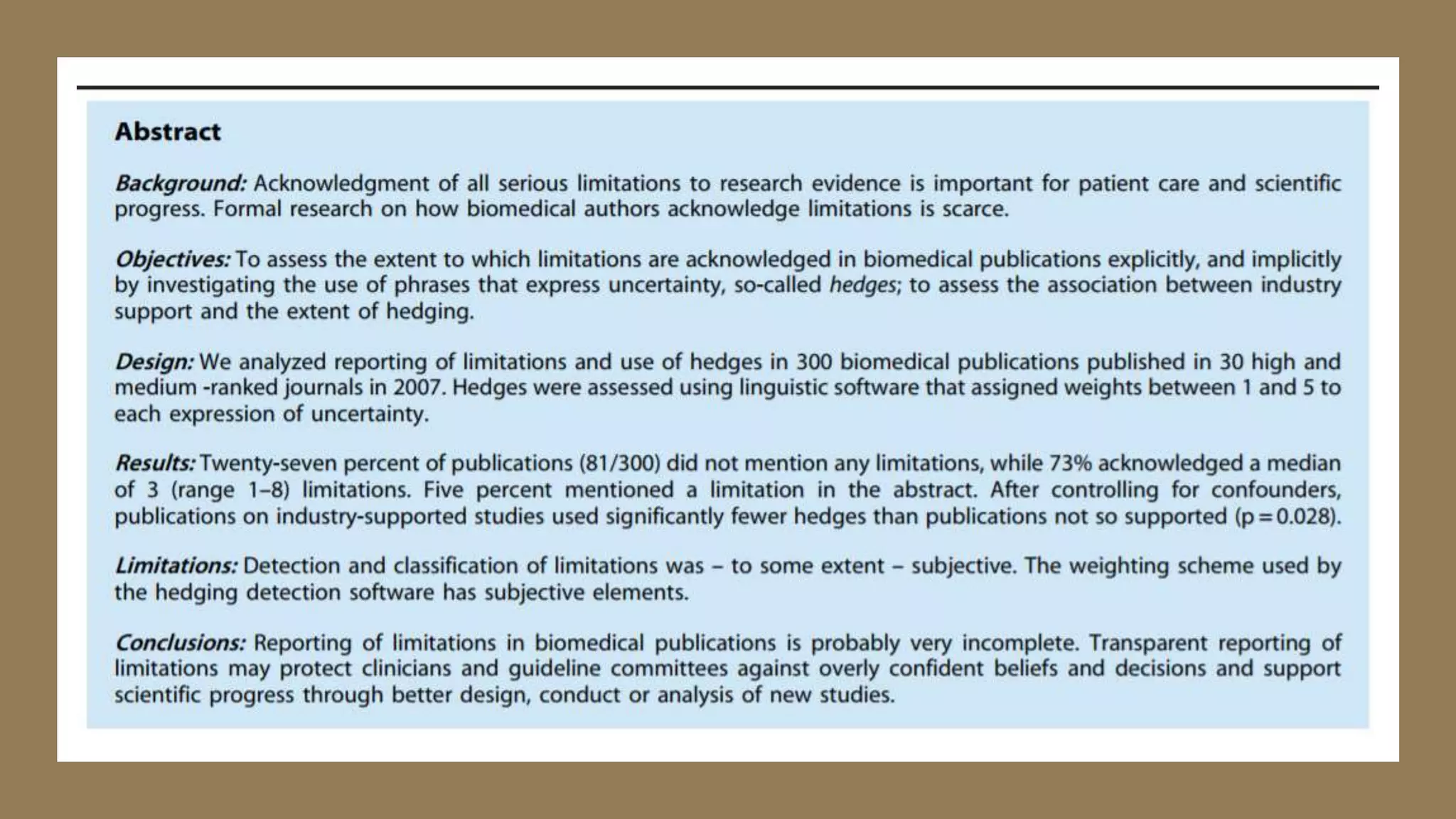
Abstract
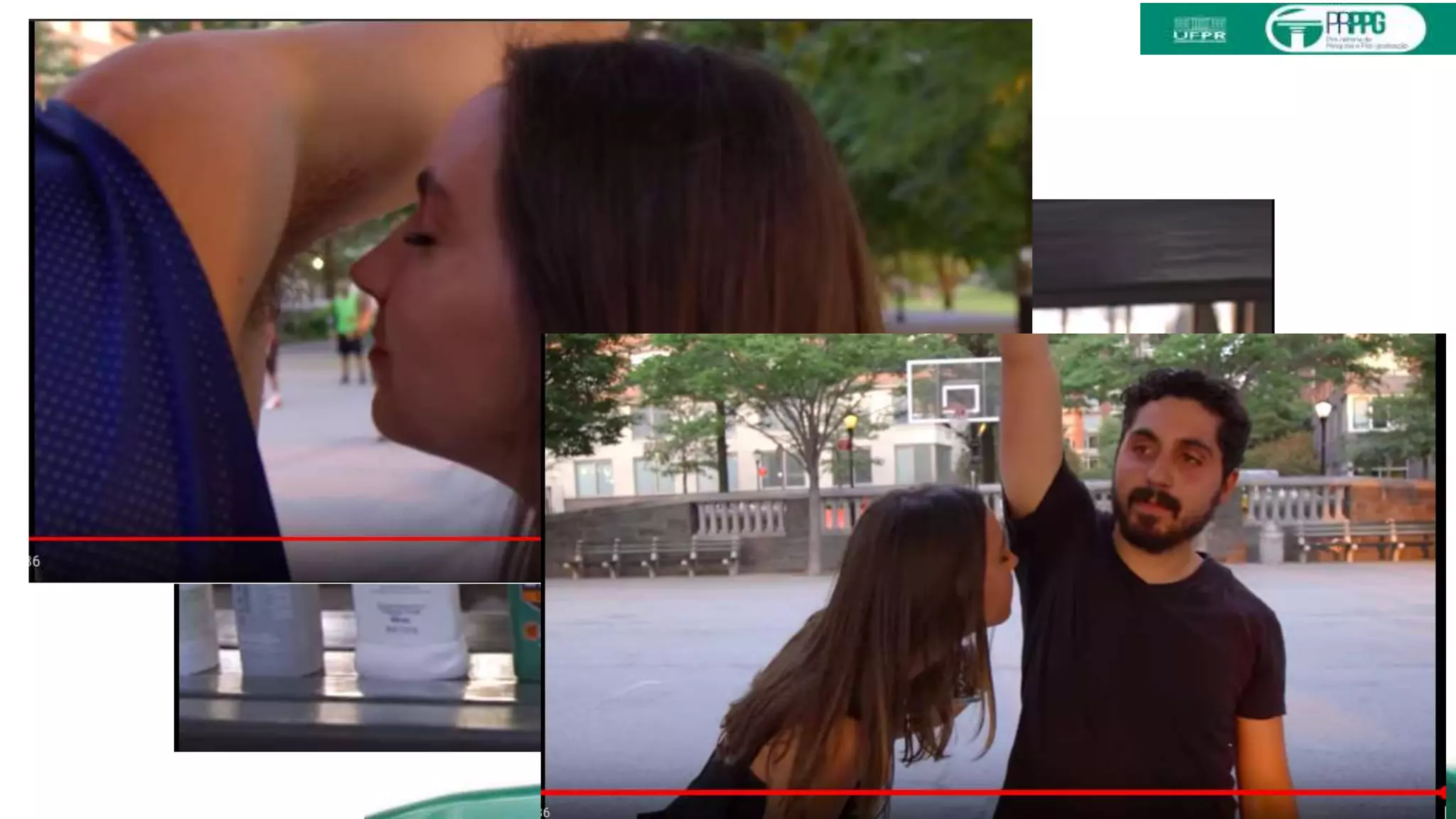
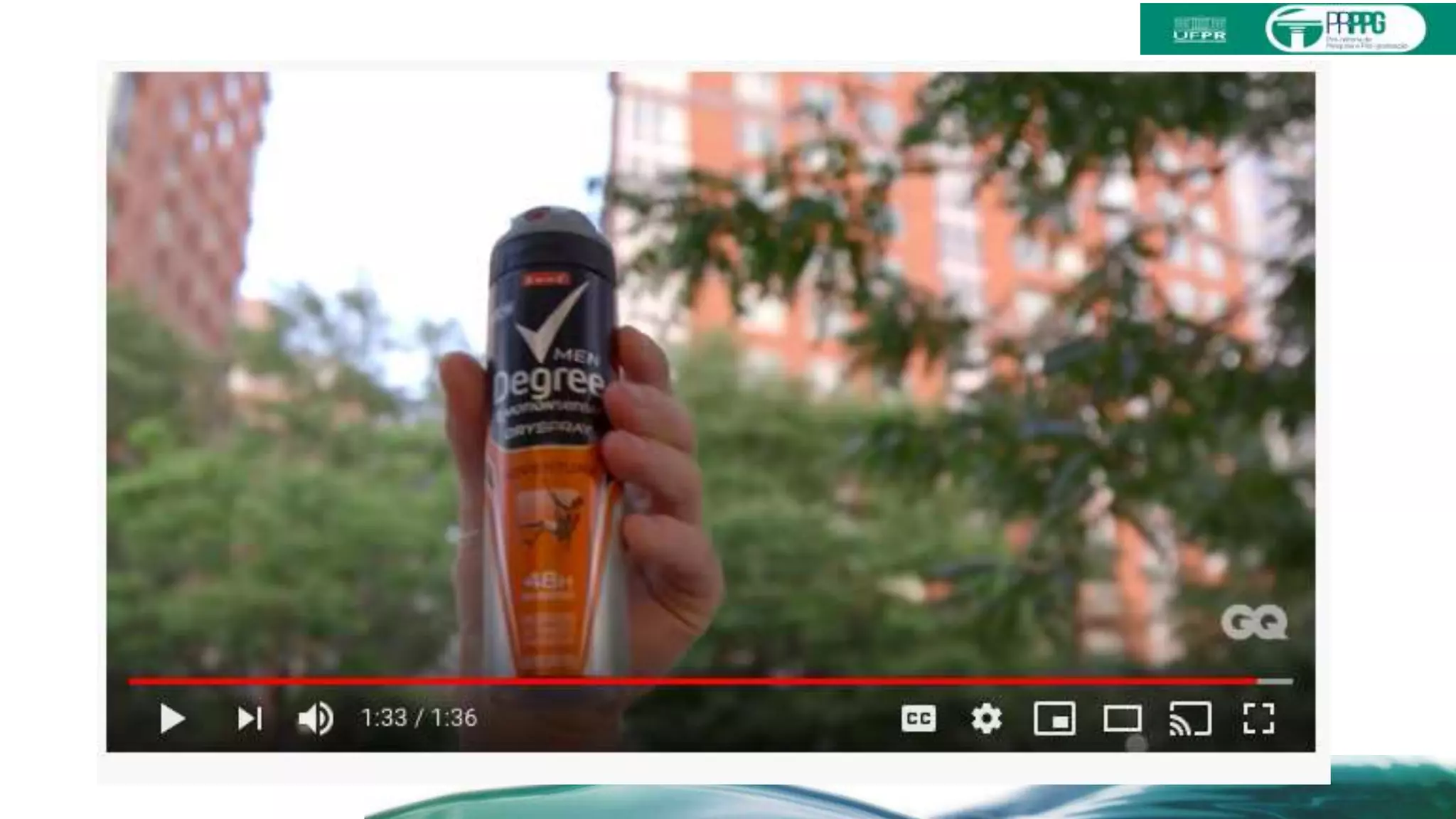
Axillary body odor is individually specific and potentially a rich source of
information about its producer. Odor individuality partly results from genetic
individuality, but the influence of ecological factors such as eating habits are
another main source of odor variability. However, we know very little about how
particular dietary components shape our body odor. Here we tested the effect of
red meat consumption on body odor attractiveness. We used a balanced within-
subject experimental design. Seventeen male odor donors were on “meat” or
“nonmeat” diet for 2 weeks wearing axillary pads to collect body odor during the
final 24 h of the diet. Fresh odor samples were assessed for their pleasantness,
attractiveness, masculinity, and intensity by 30 women not using hormonal
contraceptives. We repeated the same procedure a month later with the same
odor donors, each on the opposite diet than before. Results of repeated measures
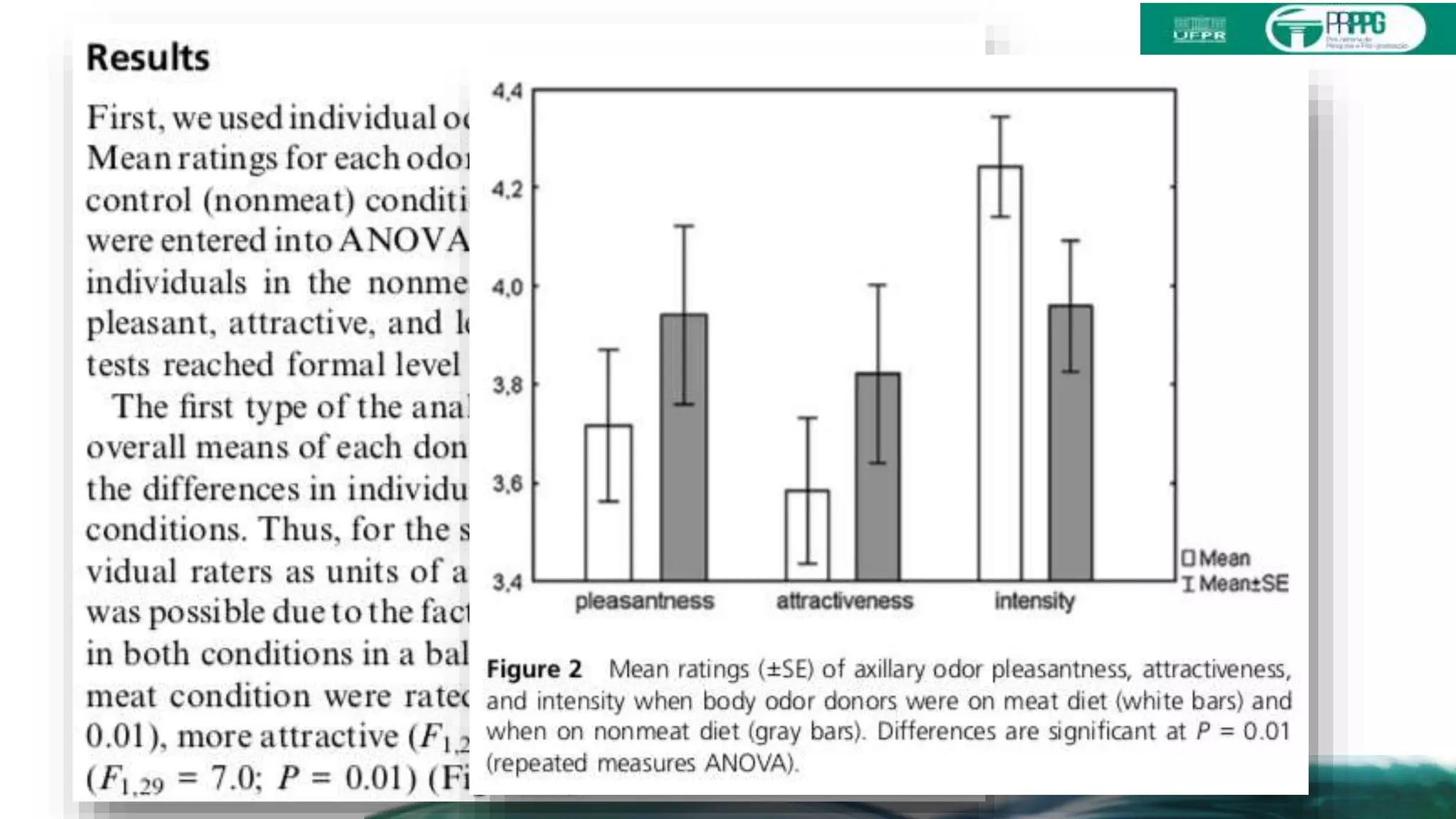
analysis of variance showed that the odor of donors when on the nonmeat diet
was judged as significantly more attractive, more pleasant, and less intense. This
suggests that red meat consumption has a negative impact on perceived body
odor hedonicity.
Abstract
Axillary body odor is individually specific and potentially a rich
source of information about its producer. Odor individuality partly
results from genetic individuality, but the influence of ecological
factors such as eating habits are another main source of odor
variability. However, we know very little about how particular dietary
components shape our body odor. Here we tested the effect of red meat
consumption on body odor attractiveness. We used a balanced within-subject
experimental design. Seventeen male odor donors were on “meat” or “nonmeat”
diet for 2 weeks wearing axillary pads to collect body odor during the final 24 h of
the diet. Fresh odor samples were assessed for their pleasantness, attractiveness,
masculinity, and intensity by 30 women not using hormonal contraceptives. We
repeated the same procedure a month later with the same odor donors, each on
the opposite diet than before. Results of repeated measures analysis of variance
showed that the odor of donors when on the nonmeat diet was judged as
significantly more attractive, more pleasant, and less intense. This suggests that
red meat consumption has a negative impact on perceived body odor hedonicity.
Abstract
Axillary body odor is individually specific and potentially a rich source of
information about its producer. Odor individuality partly results from genetic
individuality, but the influence of ecological factors such as eating habits are
another main source of odor variability. However, we know very little
about how particular dietary components shape our body odor.
Here we tested the effect of red meat consumption on body odor attractiveness.
We used a balanced within-subject experimental design. Seventeen male odor
donors were on “meat” or “nonmeat” diet for 2 weeks wearing axillary pads to
collect body odor during the final 24 h of the diet. Fresh odor samples were
assessed for their pleasantness, attractiveness, masculinity, and intensity by 30
women not using hormonal contraceptives. We repeated the same procedure a
month later with the same odor donors, each on the opposite diet than before.
Results of repeated measures analysis of variance showed that the odor of donors
when on the nonmeat diet was judged as significantly more attractive, more
pleasant, and less intense. This suggests that red meat consumption has a
negative impact on perceived body odor hedonicity.
Abstract
Axillary body odor is individually specific and potentially a rich source of
information about its producer. Odor individuality partly results from genetic
individuality, but the influence of ecological factors such as eating habits are
another main source of odor variability. However, we know very little about how
particular dietary components shape our body odor. Here we tested the
effect of red meat consumption on body odor attractiveness. We
used a balanced within-subject experimental design. Seventeen male odor donors
were on “meat” or “nonmeat” diet for 2 weeks wearing axillary pads to collect
body odor during the final 24 h of the diet. Fresh odor samples were assessed for
their pleasantness, attractiveness, masculinity, and intensity by 30 women not
using hormonal contraceptives. We repeated the same procedure a month later
with the same odor donors, each on the opposite diet than before. Results of
repeated measures analysis of variance showed that the odor of donors when on
the nonmeat diet was judged as significantly more attractive, more pleasant, and
less intense. This suggests that red meat consumption has a negative impact on
perceived body odor hedonicity.
Abstract
Axillary body odor is individually specific and potentially a rich source of
information about its producer. Odor individuality partly results from genetic
individuality, but the influence of ecological factors such as eating habits are
another main source of odor variability. However, we know very little about how
particular dietary components shape our body odor. Here we tested the effect of
red meat consumption on body odor attractiveness. We used a balanced
within-subject experimental design. Seventeen male odor donors
were on “meat” or “nonmeat” diet for 2 weeks wearing axillary
pads to collect body odor during the final 24 h of the diet. Fresh
odor samples were assessed for their pleasantness, attractiveness,
masculinity, and intensity by 30 women not using hormonal
contraceptives. We repeated the same procedure a month later
with the same odor donors, each on the opposite diet than before.
Results of repeated measures analysis of variance showed that the odor of donors
when on the nonmeat diet was judged as significantly more attractive, more
pleasant, and less intense. This suggests that red meat consumption has a
negative impact on perceived body odor hedonicity.
Abstract
Axillary body odor is individually specific and potentially a rich source of
information about its producer. Odor individuality partly results from genetic
individuality, but the influence of ecological factors such as eating habits are
another main source of odor variability. However, we know very little about how
particular dietary components shape our body odor. Here we tested the effect of
red meat consumption on body odor attractiveness. We used a balanced within-
subject experimental design. Seventeen male odor donors were on “meat” or
“nonmeat” diet for 2 weeks wearing axillary pads to collect body odor during the
final 24 h of the diet. Fresh odor samples were assessed for their pleasantness,
attractiveness, masculinity, and intensity by 30 women not using hormonal
contraceptives. We repeated the same procedure a month later with the same
odor donors, each on the opposite diet than before. Results of repeated
measures analysis of variance showed that the odor of donors
when on the nonmeat diet was judged as significantly more
attractive, more pleasant, and less intense. This suggests that red meat
consumption has a negative impact on perceived body odor hedonicity.
Abstract
Axillary body odor is individually specific and potentially a rich source of
information about its producer. Odor individuality partly results from genetic
individuality, but the influence of ecological factors such as eating habits are
another main source of odor variability. However, we know very little about how
particular dietary components shape our body odor. Here we tested the effect of
red meat consumption on body odor attractiveness. We used a balanced within-
subject experimental design. Seventeen male odor donors were on “meat” or
“nonmeat” diet for 2 weeks wearing axillary pads to collect body odor during the
final 24 h of the diet. Fresh odor samples were assessed for their pleasantness,
attractiveness, masculinity, and intensity by 30 women not using hormonal
contraceptives. We repeated the same procedure a month later with the same
odor donors, each on the opposite diet than before. Results of repeated measures
analysis of variance showed that the odor of donors when on the nonmeat diet
was judged as significantly more attractive, more pleasant, and less intense. This
suggests that red meat consumption has a negative impact on
perceived body odor hedonicity.
Abstract
Axillary body odor is individually specific and potentially a rich source of
information about its producer. Odor individuality partly results from genetic
individuality, but the influence of ecological factors such as eating habits are
another main source of odor variability. However, we know very little about how
particular dietary components shape our body odor. Here we tested the effect of
red meat consumption on body odor attractiveness. We used a balanced within-
subject experimental design. Seventeen male odor donors were on “meat” or
“nonmeat” diet for 2 weeks wearing axillary pads to collect body odor during the
final 24 h of the diet. Fresh odor samples were assessed for their pleasantness,
attractiveness, masculinity, and intensity by 30 women not using hormonal
contraceptives. We repeated the same procedure a month later with the same
odor donors, each on the opposite diet than before. Results of repeated measures
analysis of variance showed that the odor of donors when on the nonmeat diet
was judged as significantly more attractive, more pleasant, and less intense. This
suggests that red meat consumption has a negative impact on
perceived body odor hedonicity.
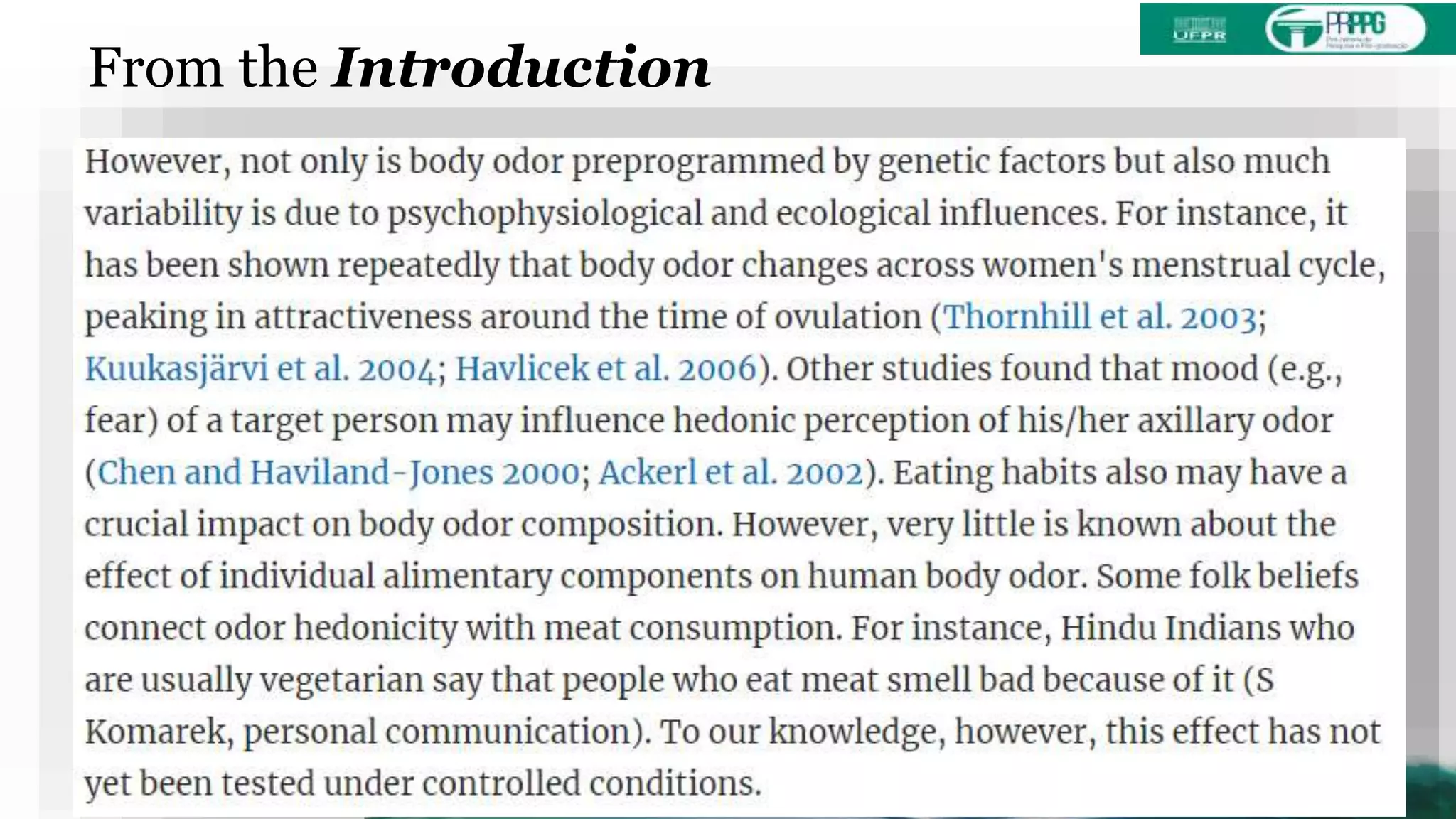
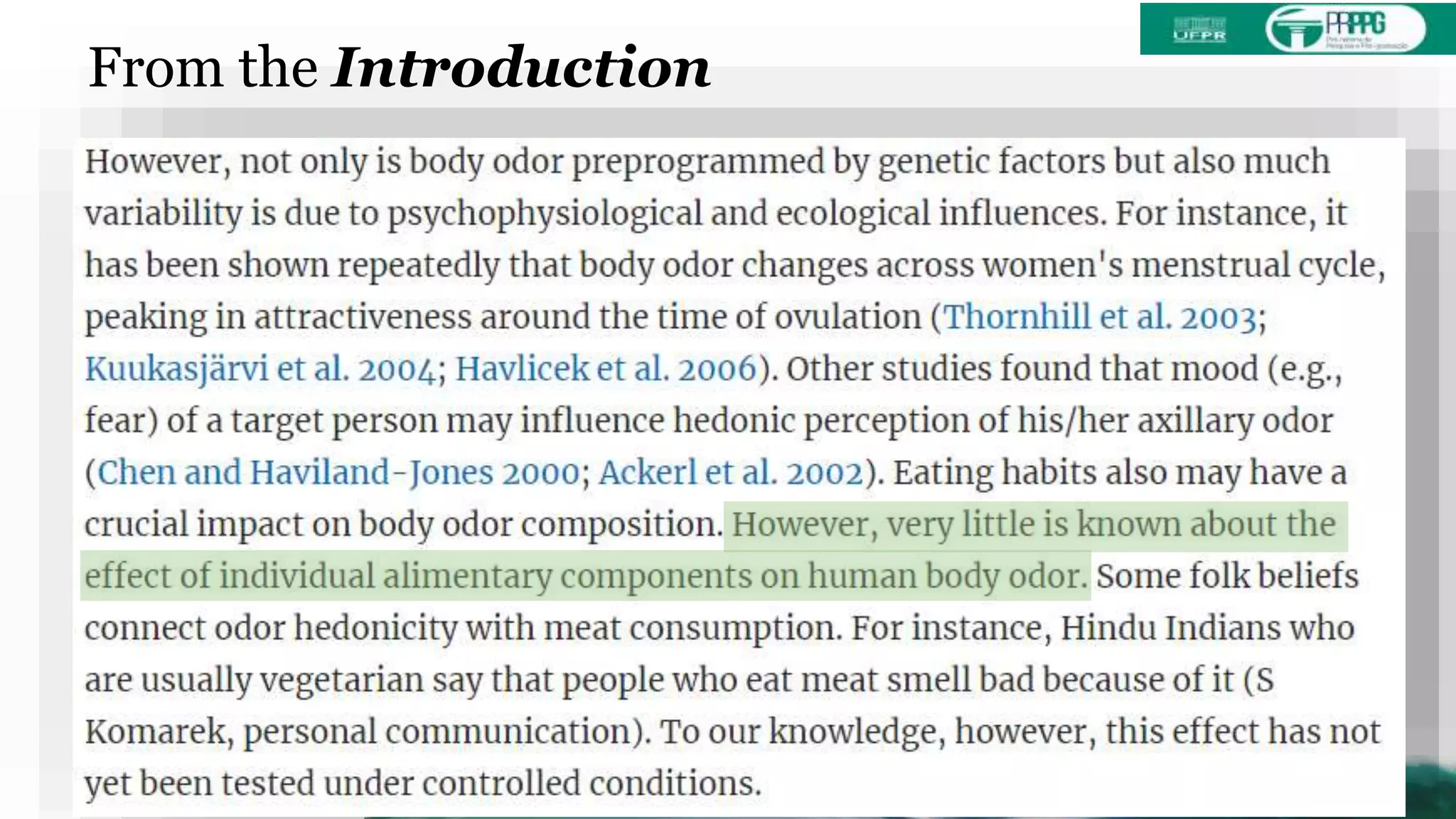
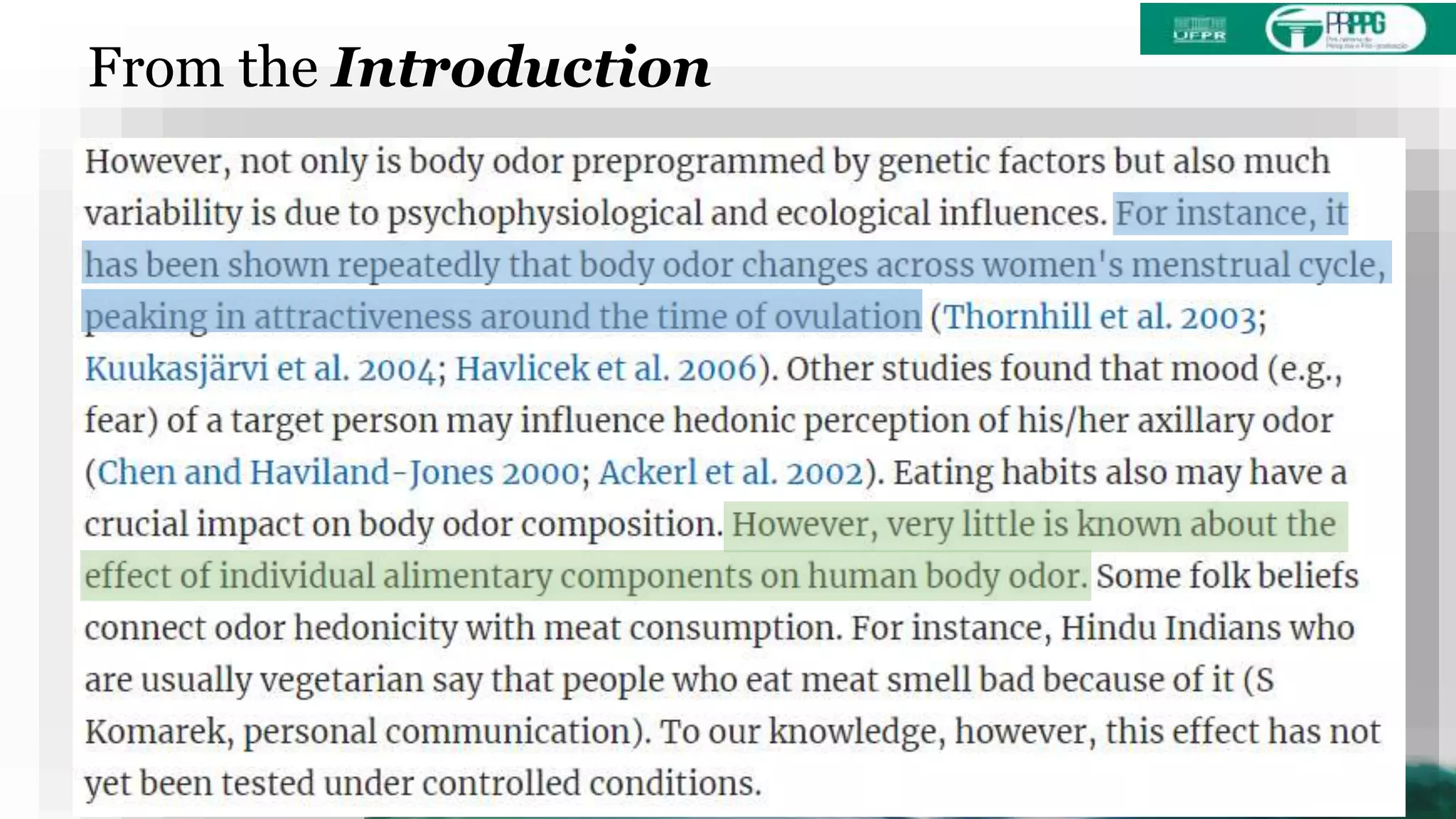
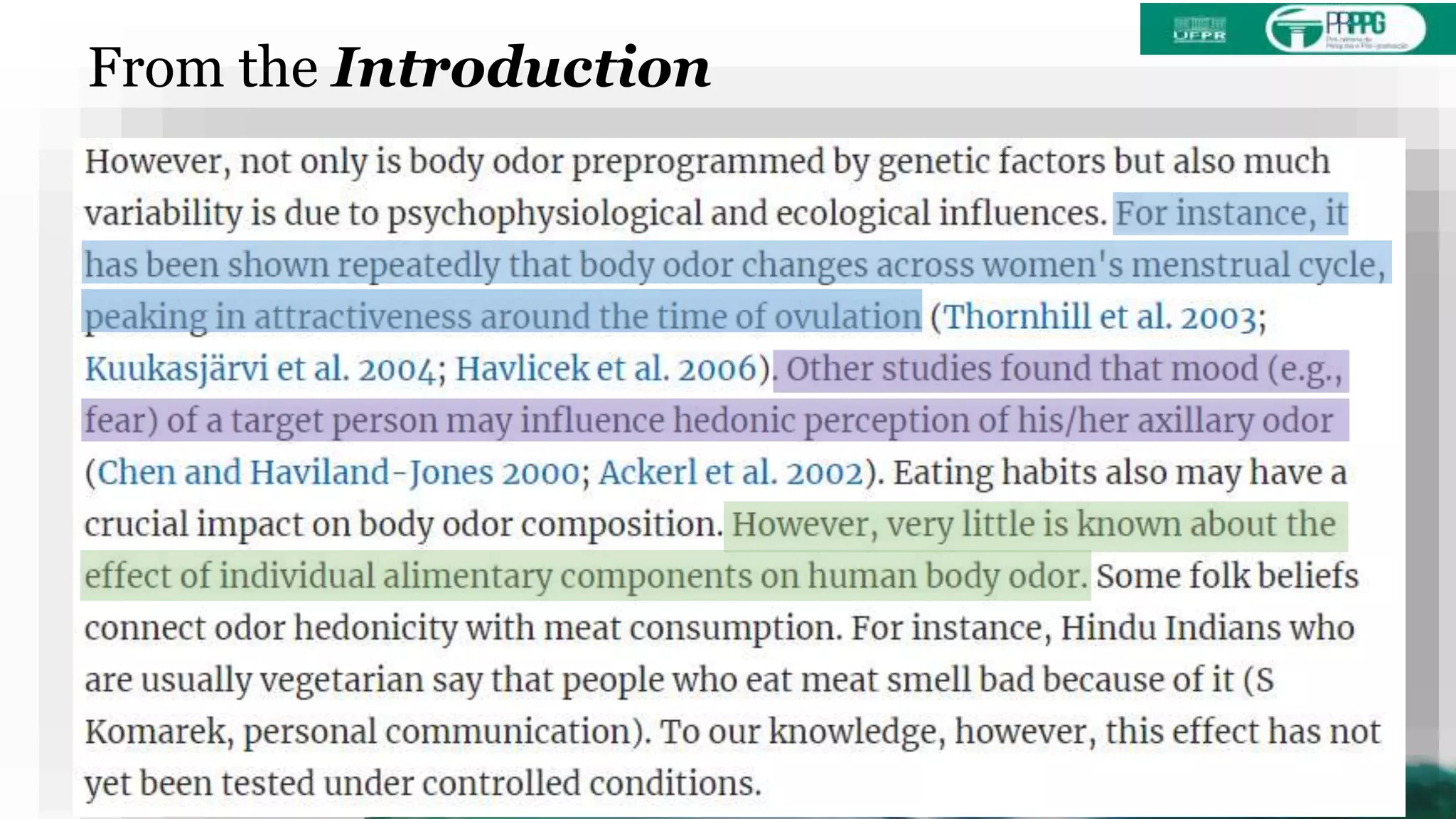
From the Introduction
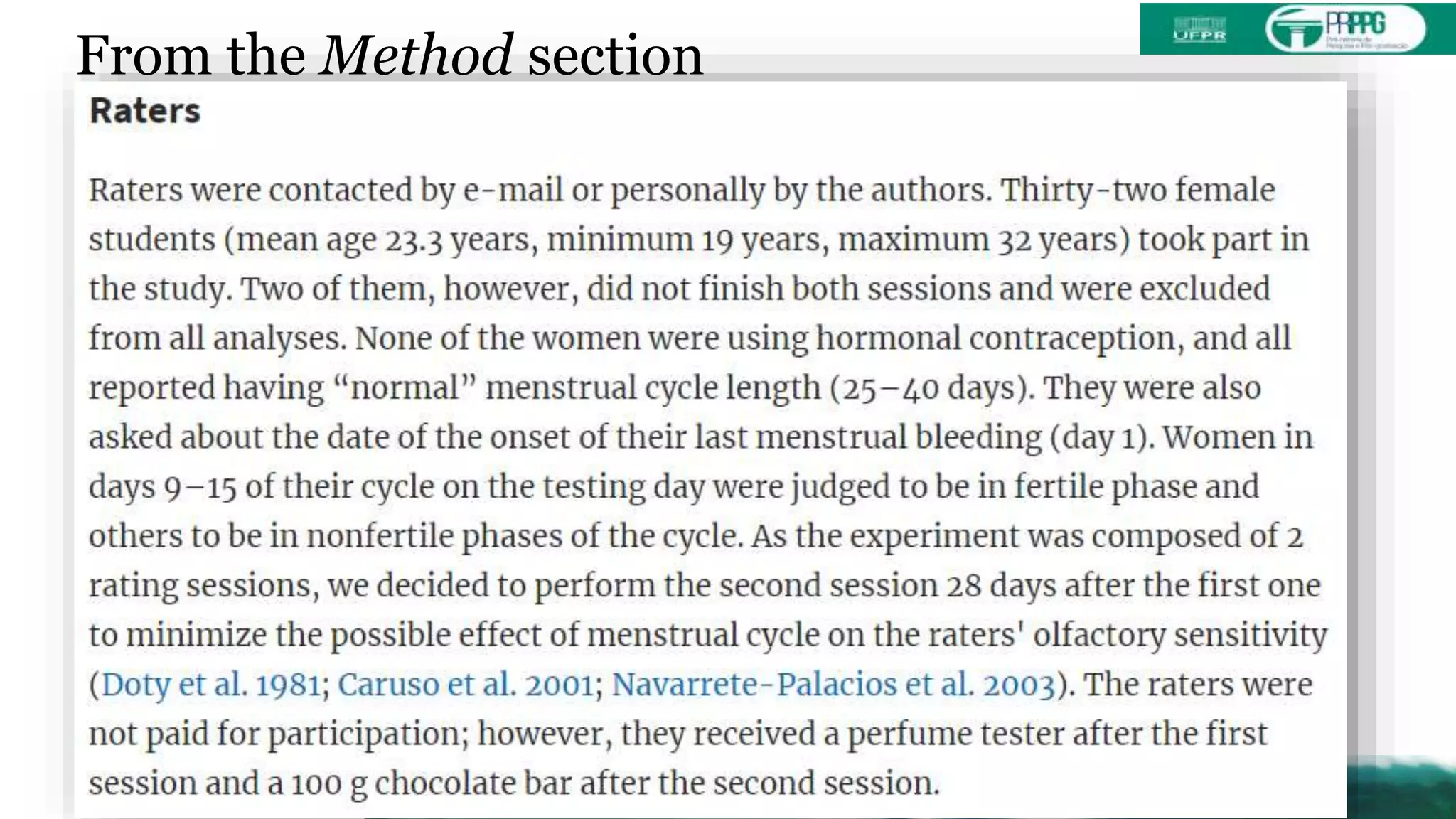
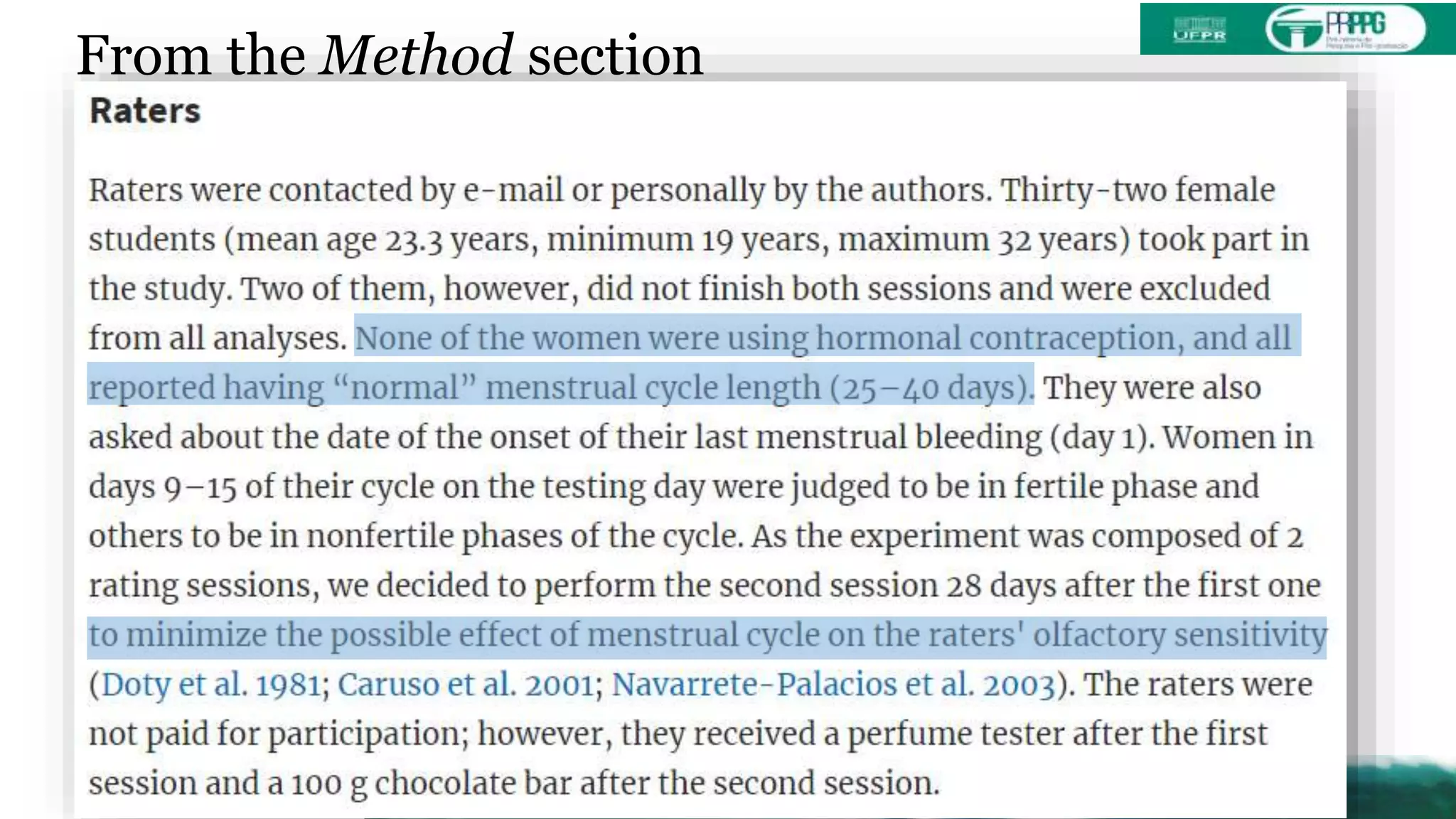
From the Method section
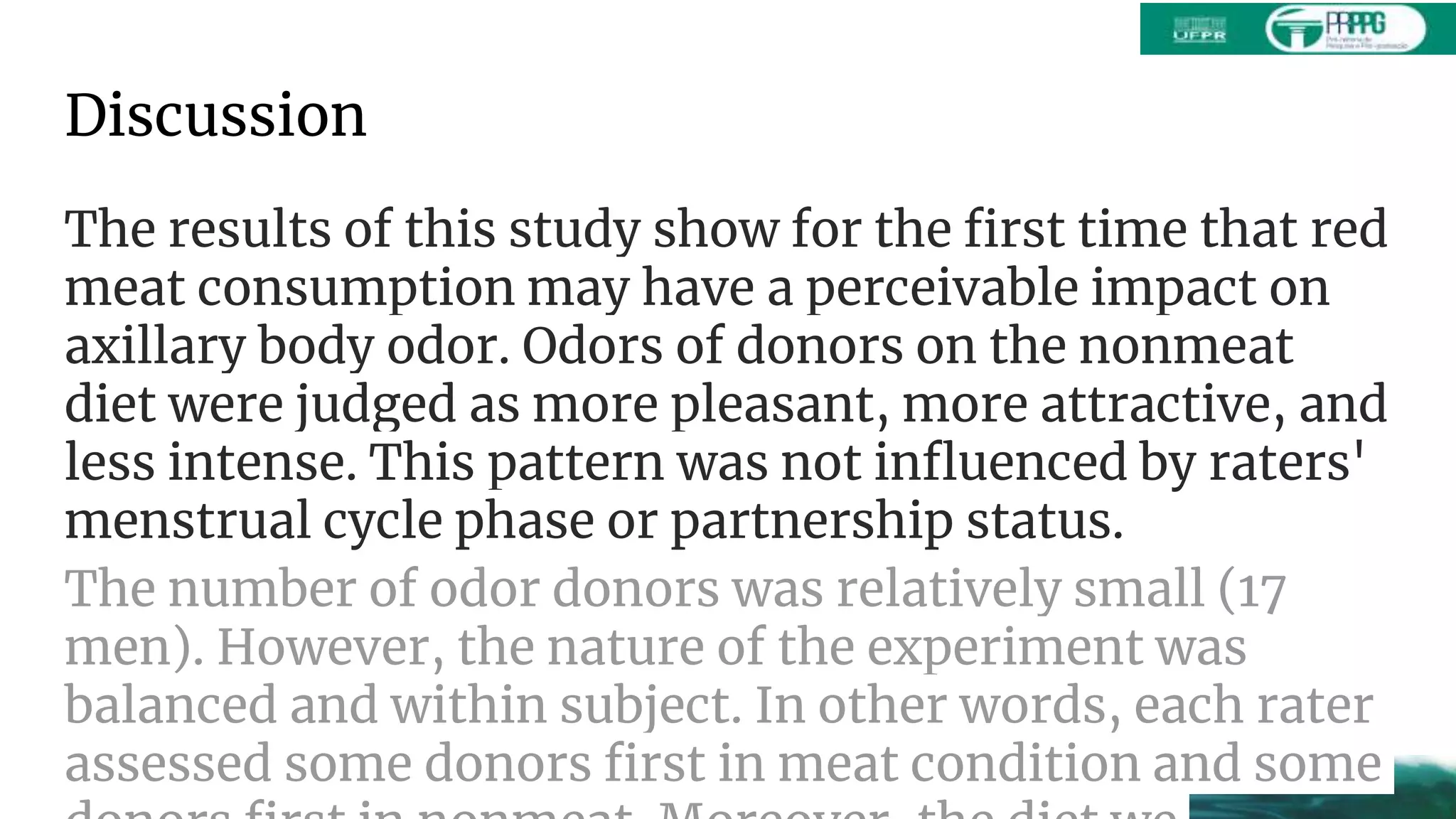
Discussion
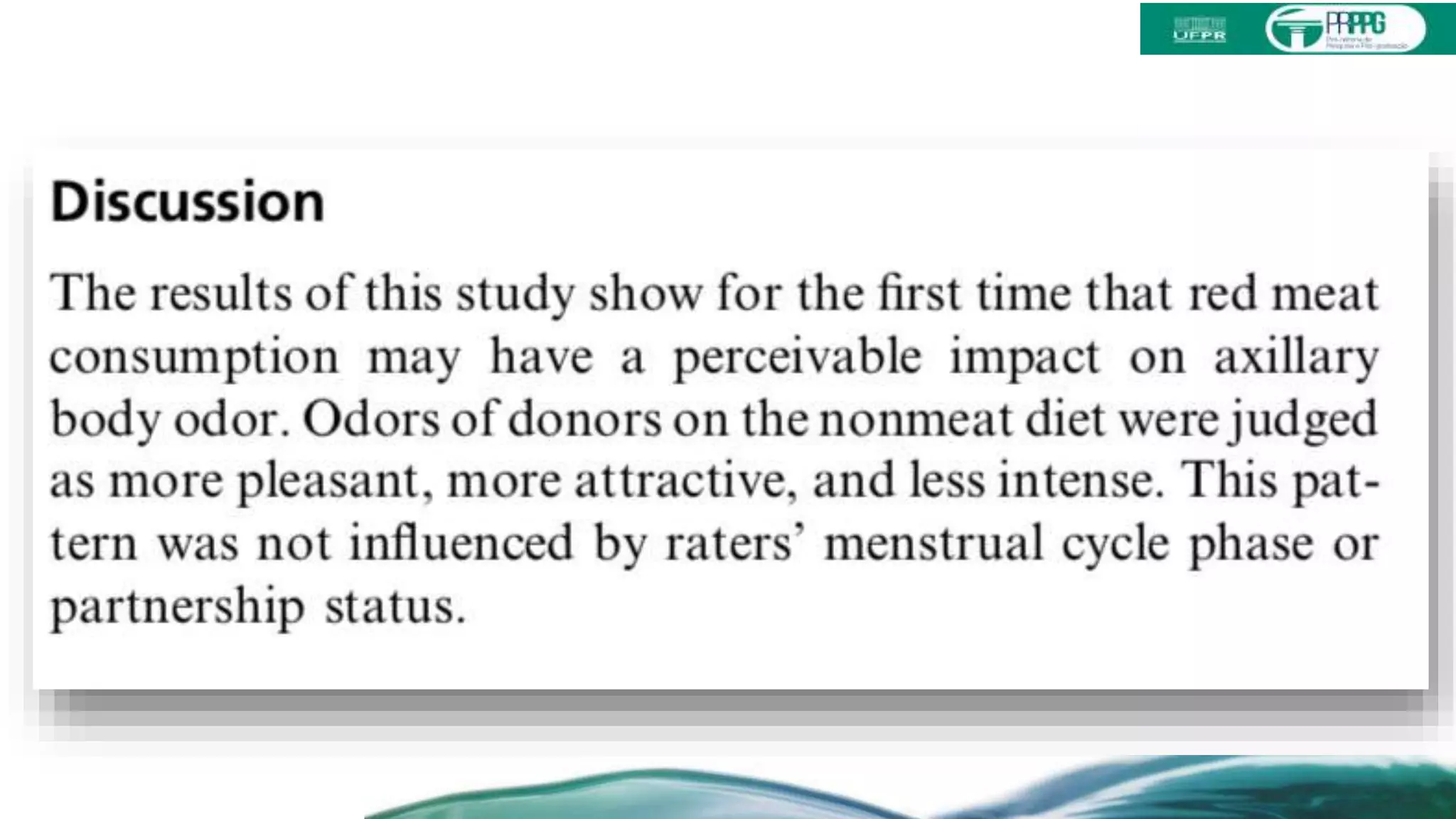
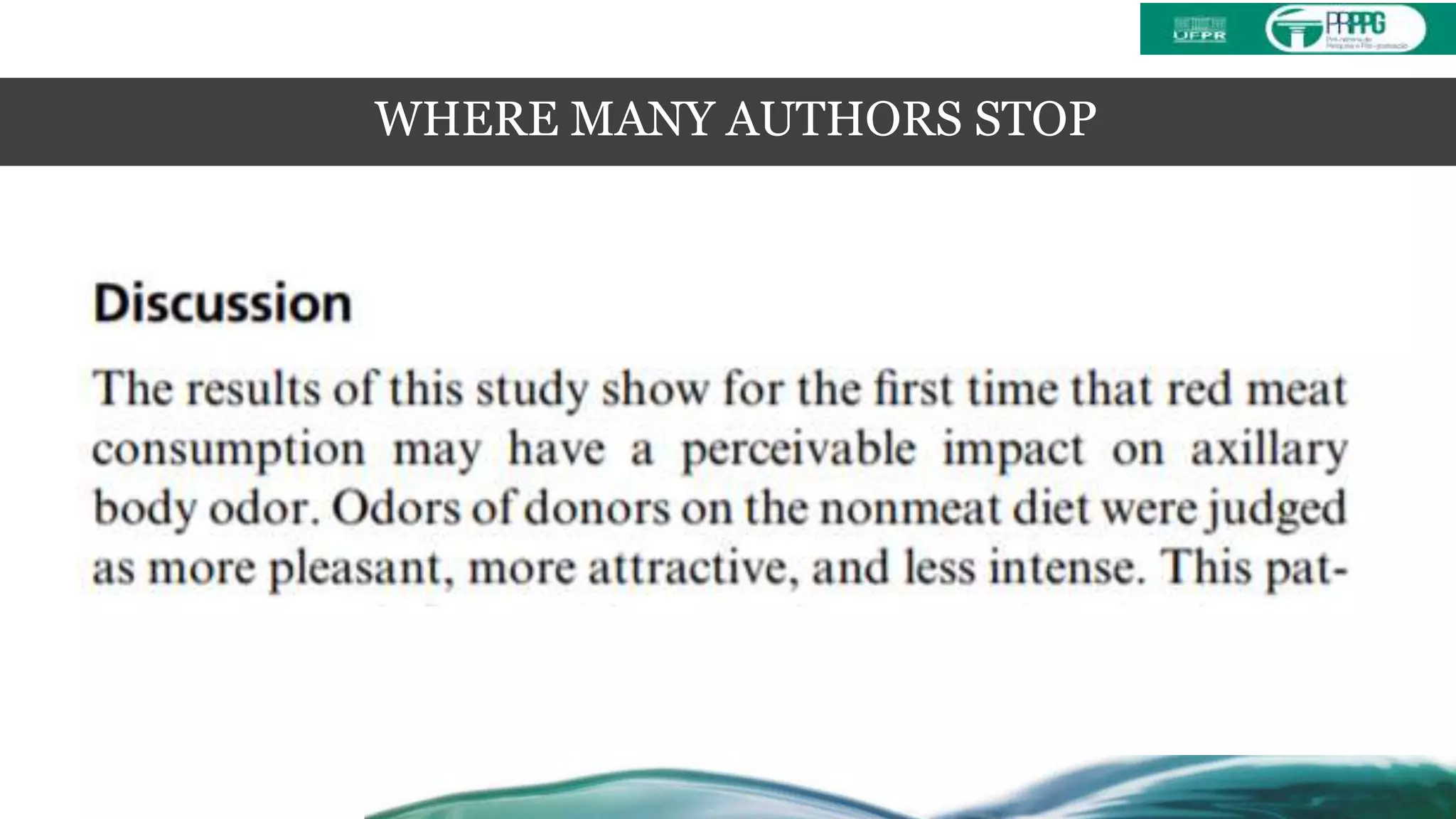
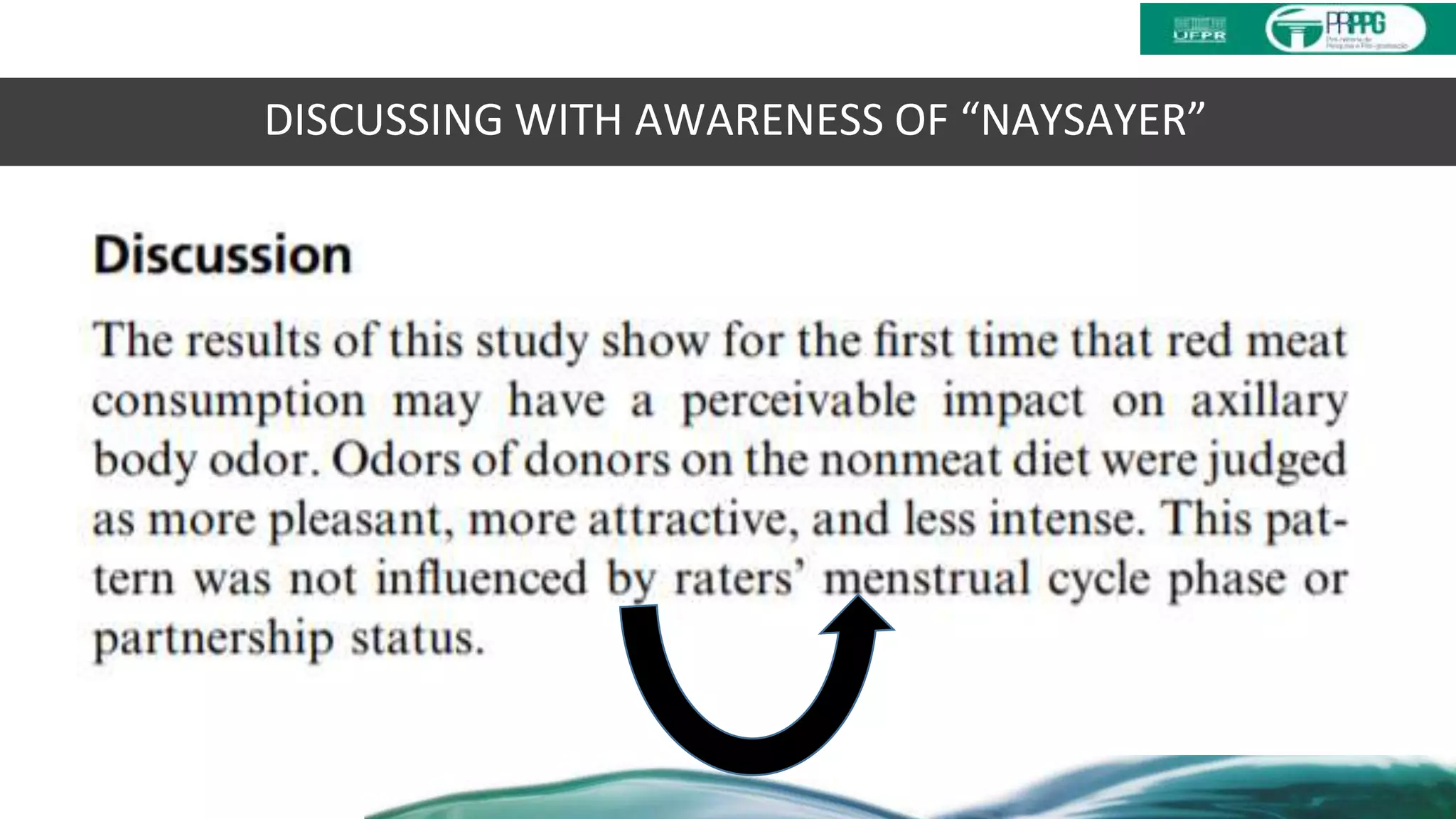
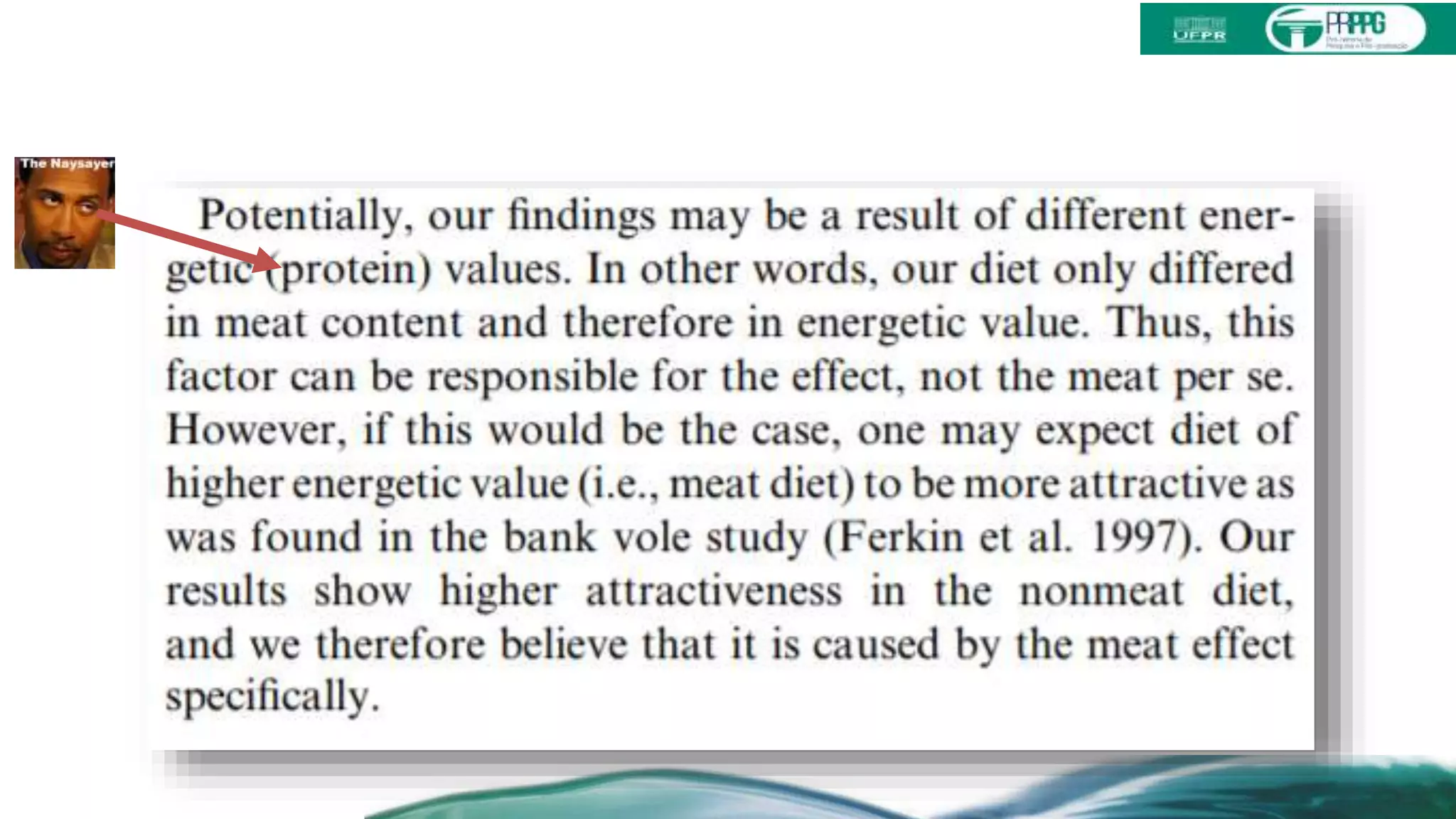
The results of this study show for the first time that red
meat consumption may have a perceivable impact on
axillary body odor. Odors of donors on the nonmeat
diet were judged as more pleasant, more attractive, and
less intense. This pattern was not influenced by raters'
menstrual cycle phase or partnership status.
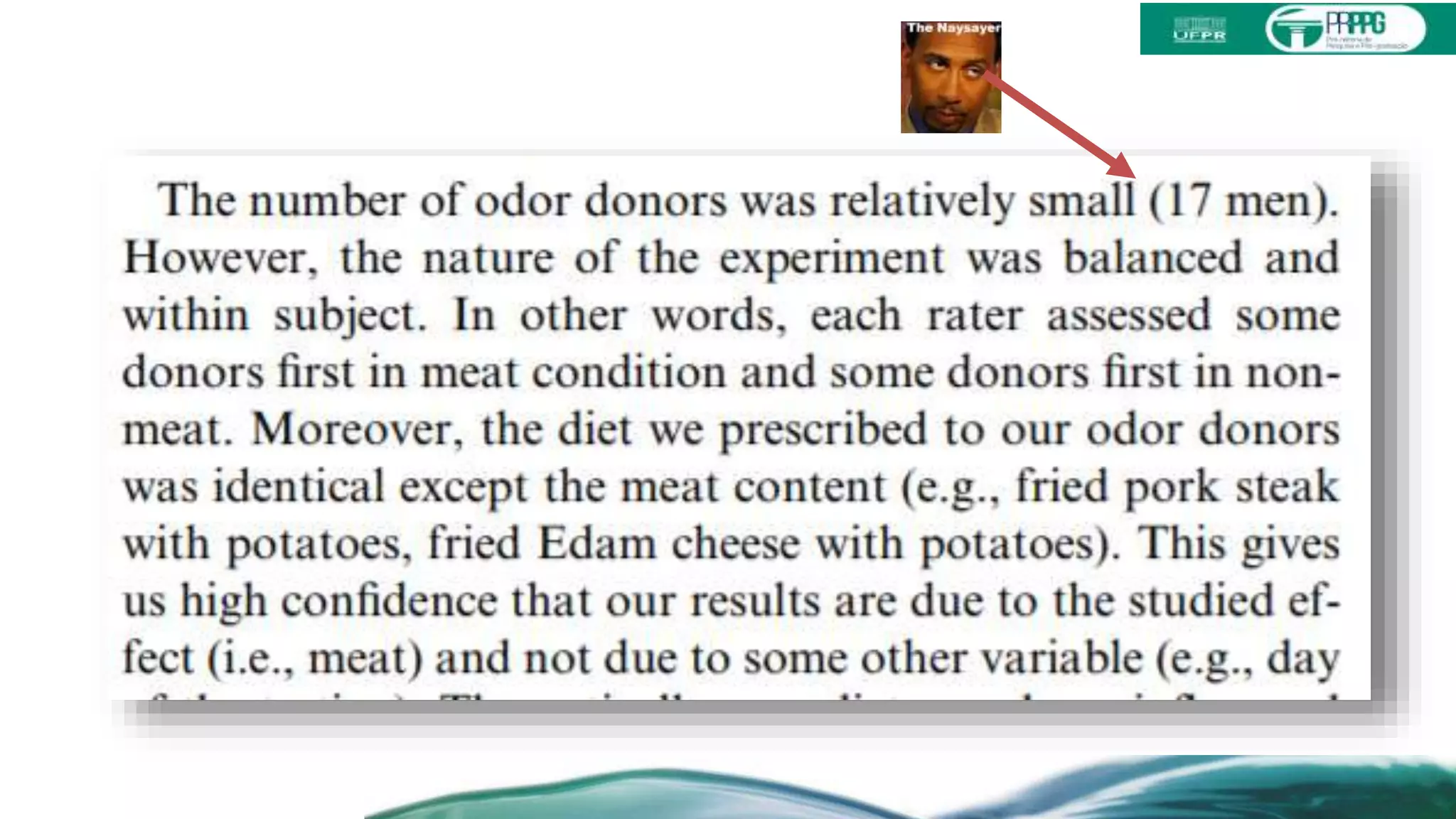
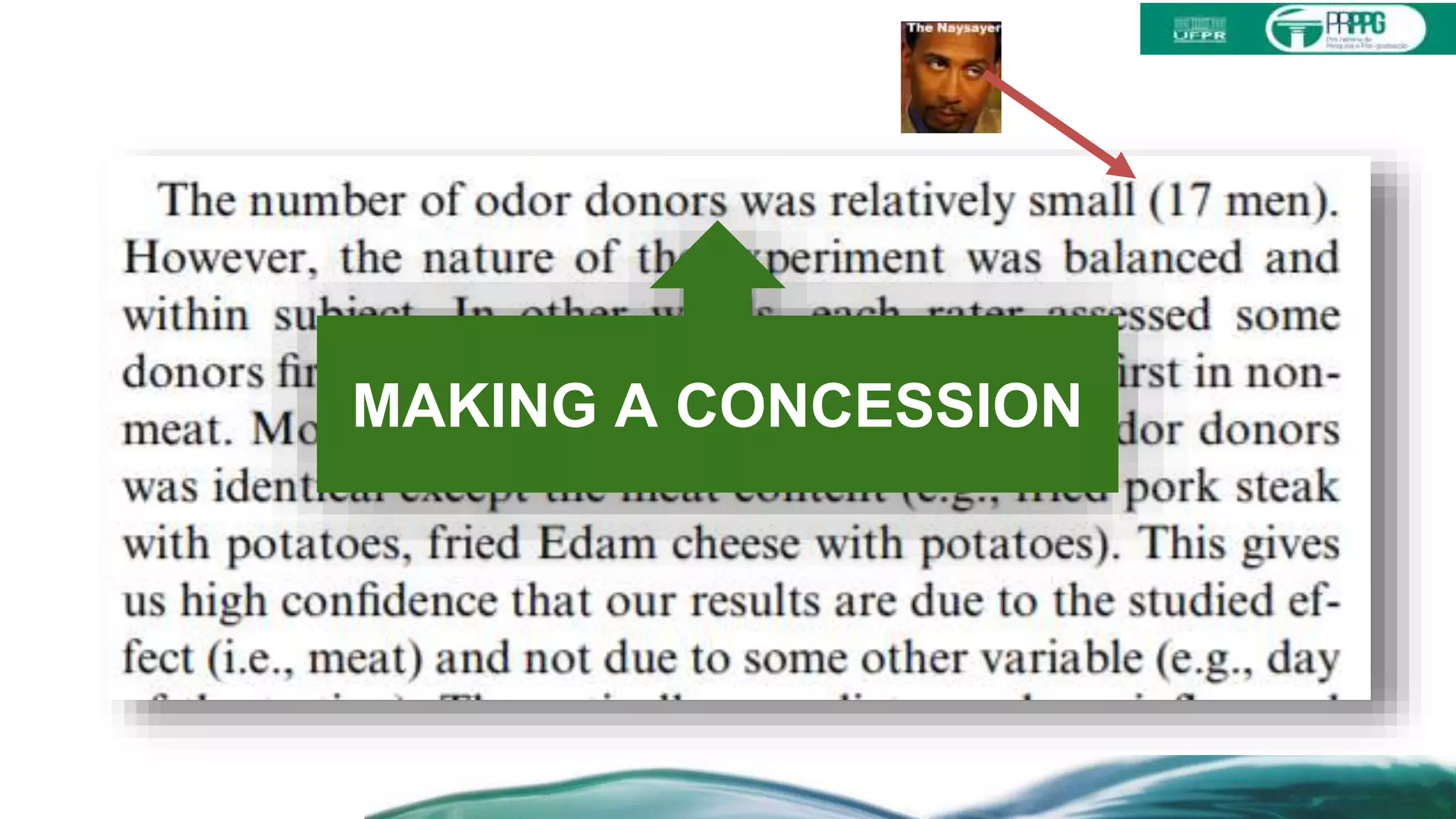
The number of odor donors was relatively small (17
men). However, the nature of the experiment was
balanced and within subject. In other words, each rater
assessed some donors first in meat condition and some
Discussion
The results of this study show for the first time that red
meat consumption may have a perceivable impact on
axillary body odor. Odors of donors on the nonmeat
diet were judged as more pleasant, more attractive, and
less intense. This pattern was not influenced by raters'
menstrual cycle phase or partnership status.
The number of odor donors was relatively small (17
men). However, the nature of the experiment was
balanced and within subject. In other words, each rater
assessed some donors first in meat condition and some
Discussion
The results of this study show for the first time that red
meat consumption may have a perceivable impact on
axillary body odor. Odors of donors on the nonmeat
diet were judged as more pleasant, more attractive, and
less intense. This pattern was not influenced by raters'
menstrual cycle phase or partnership status.
The number of odor donors was relatively small (17
men). However, the nature of the experiment was
balanced and within subject. In other words, each rater
assessed some donors first in meat condition and some
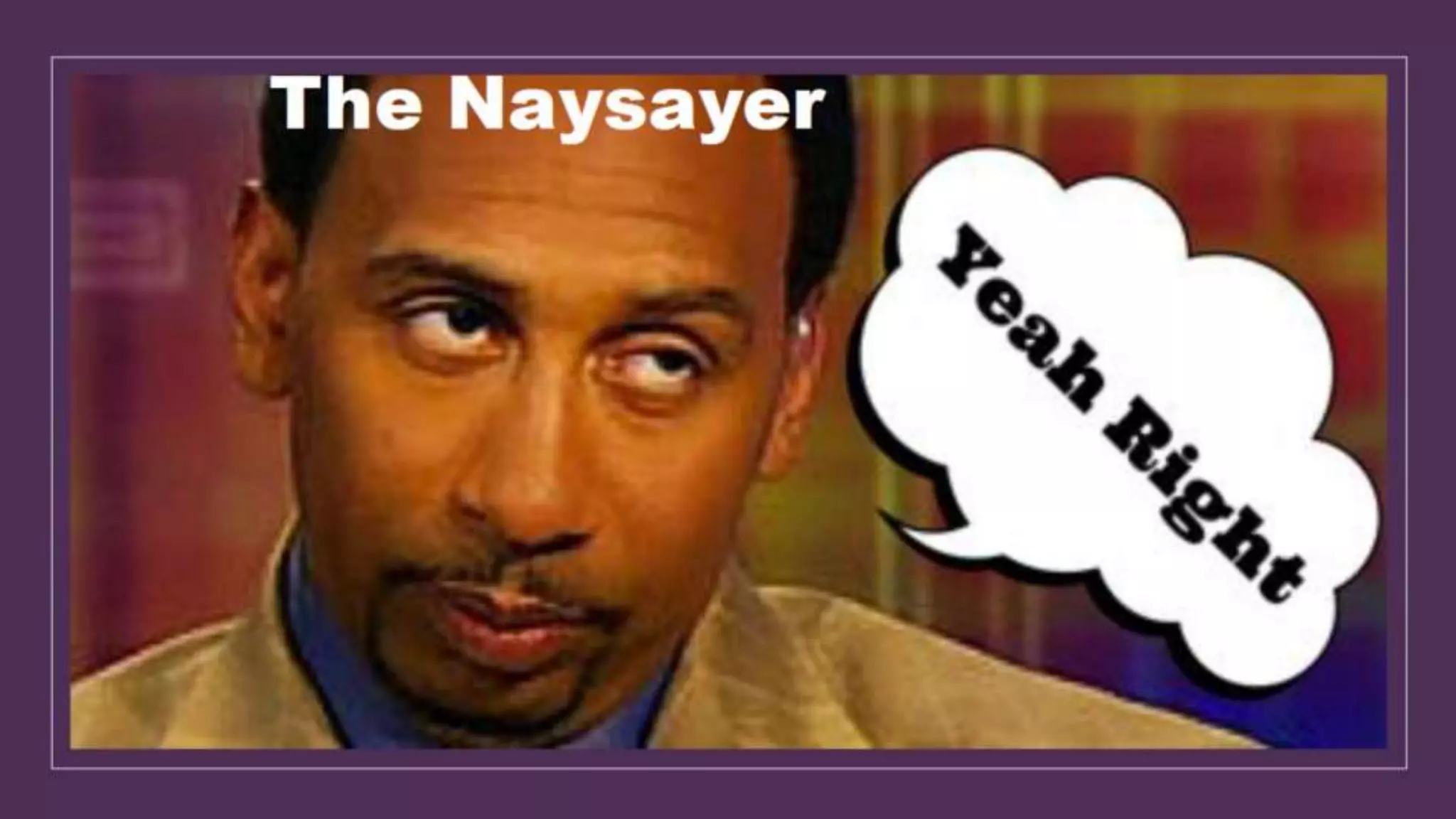
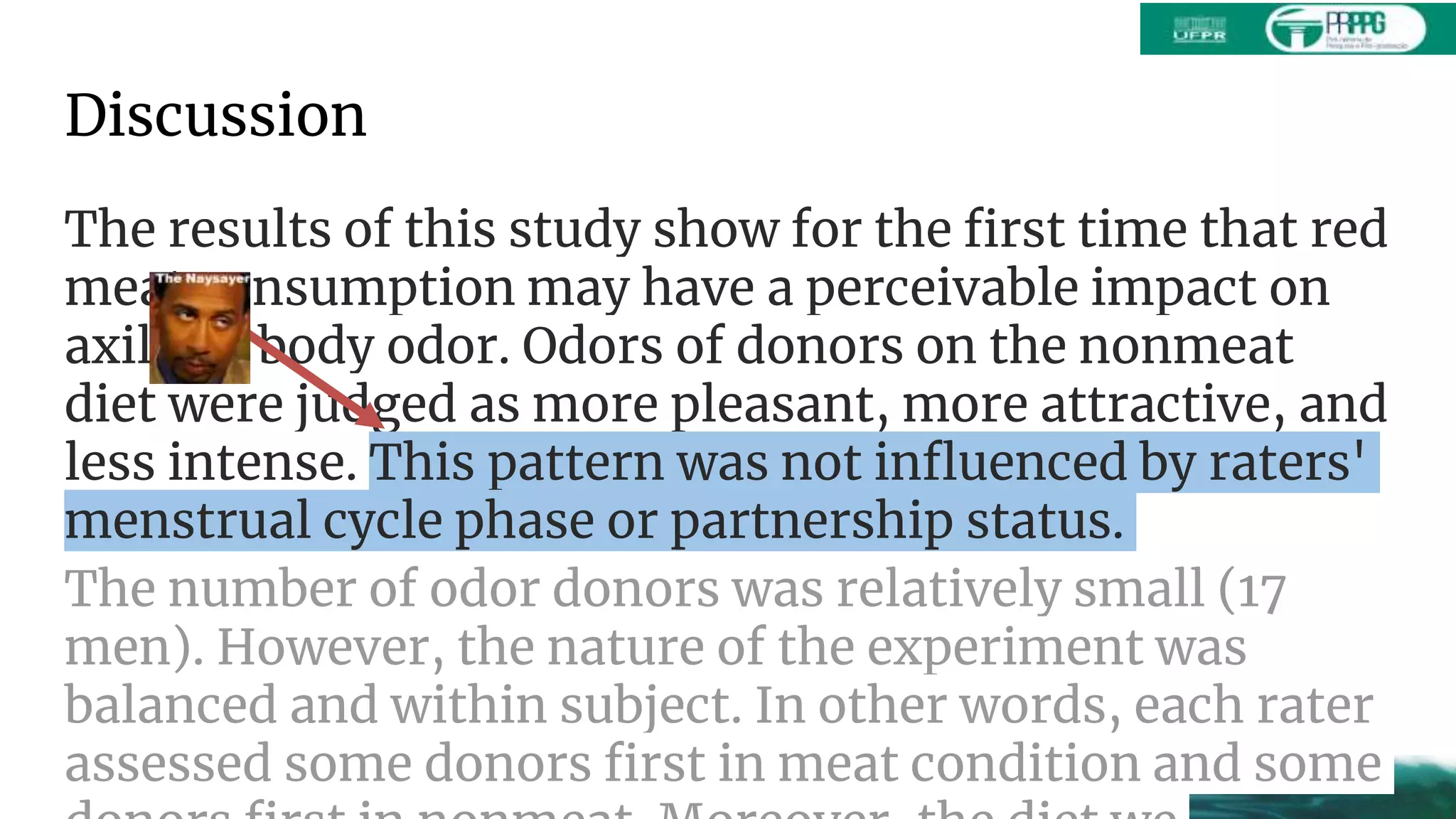
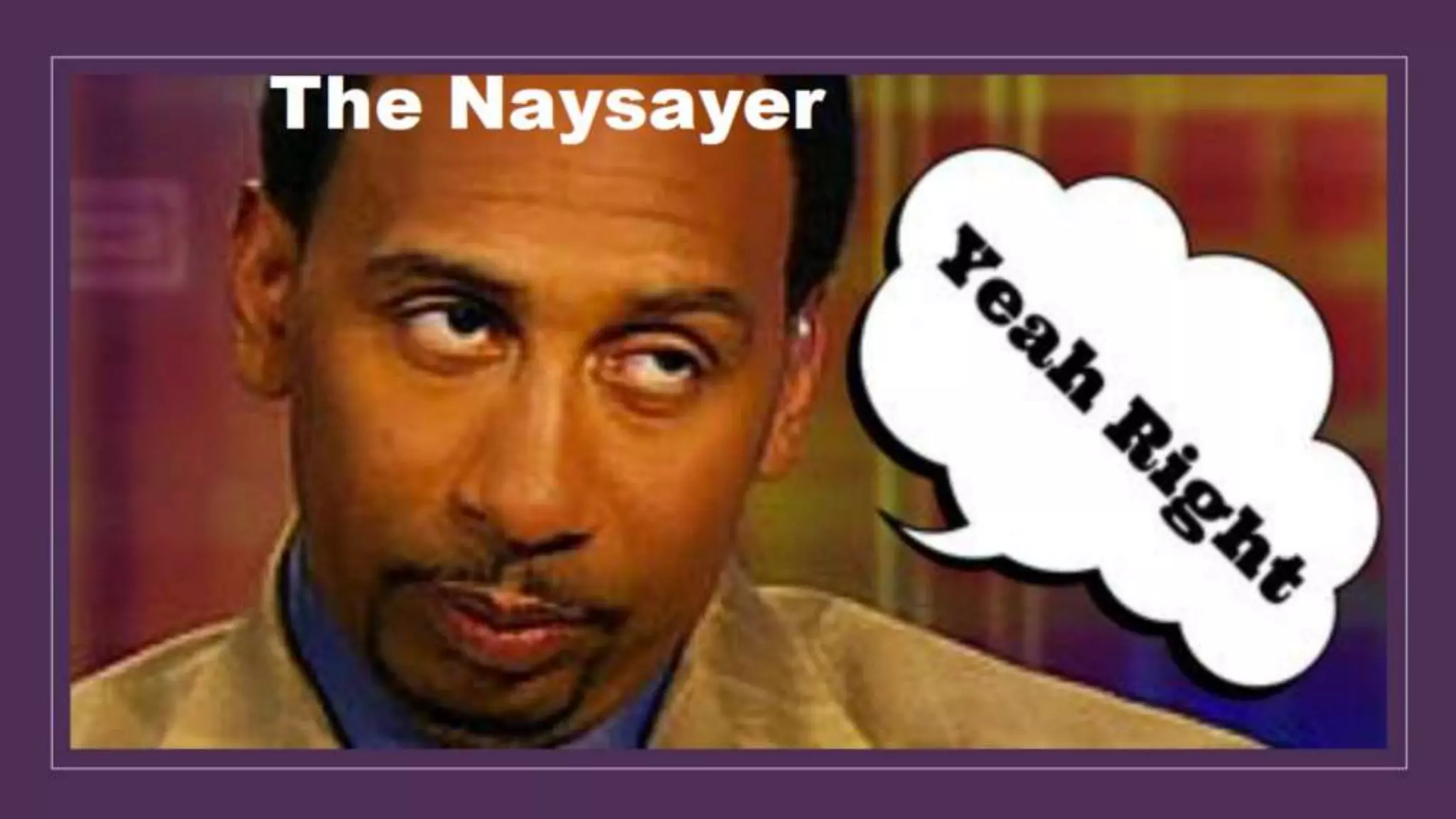
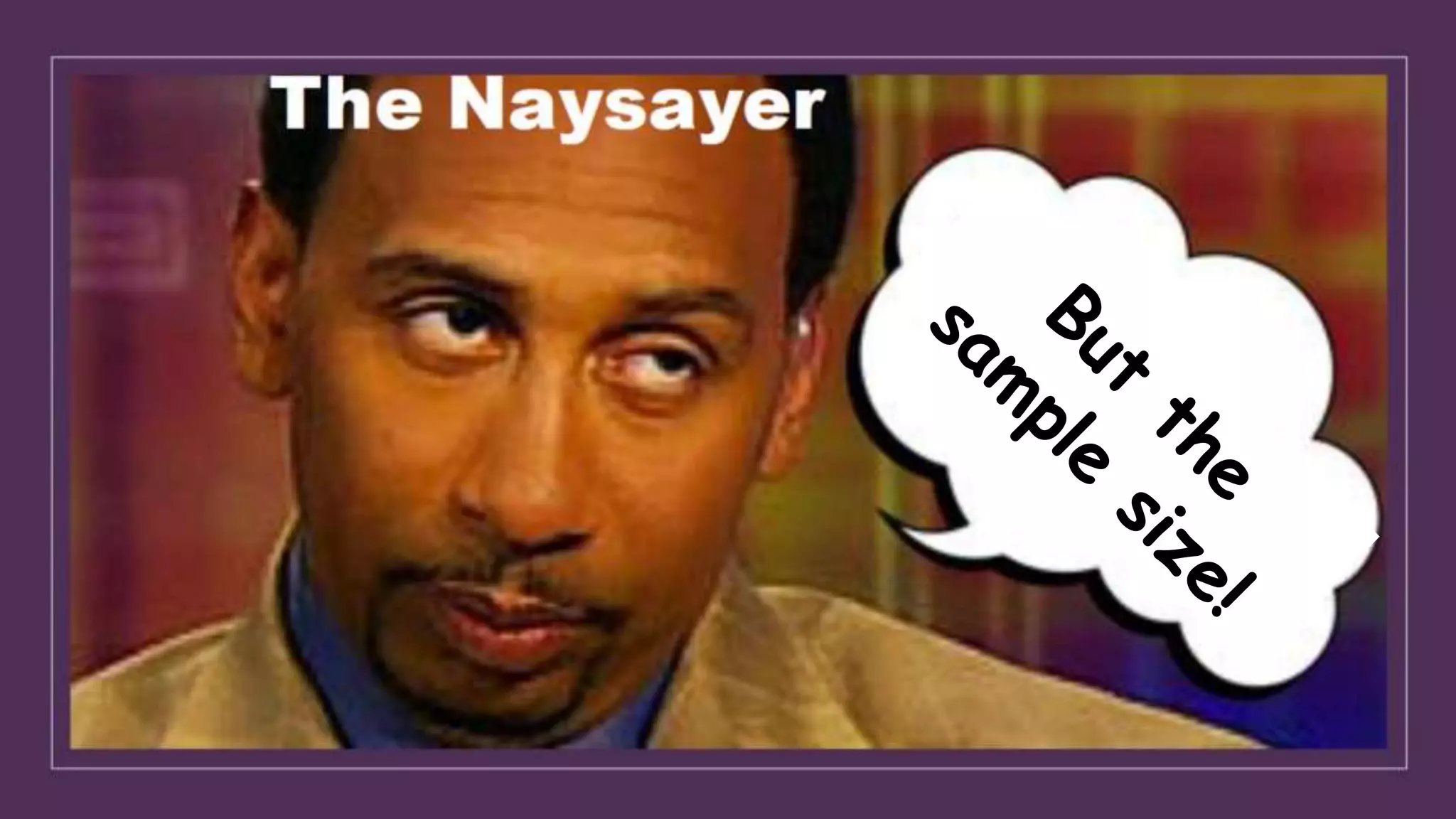
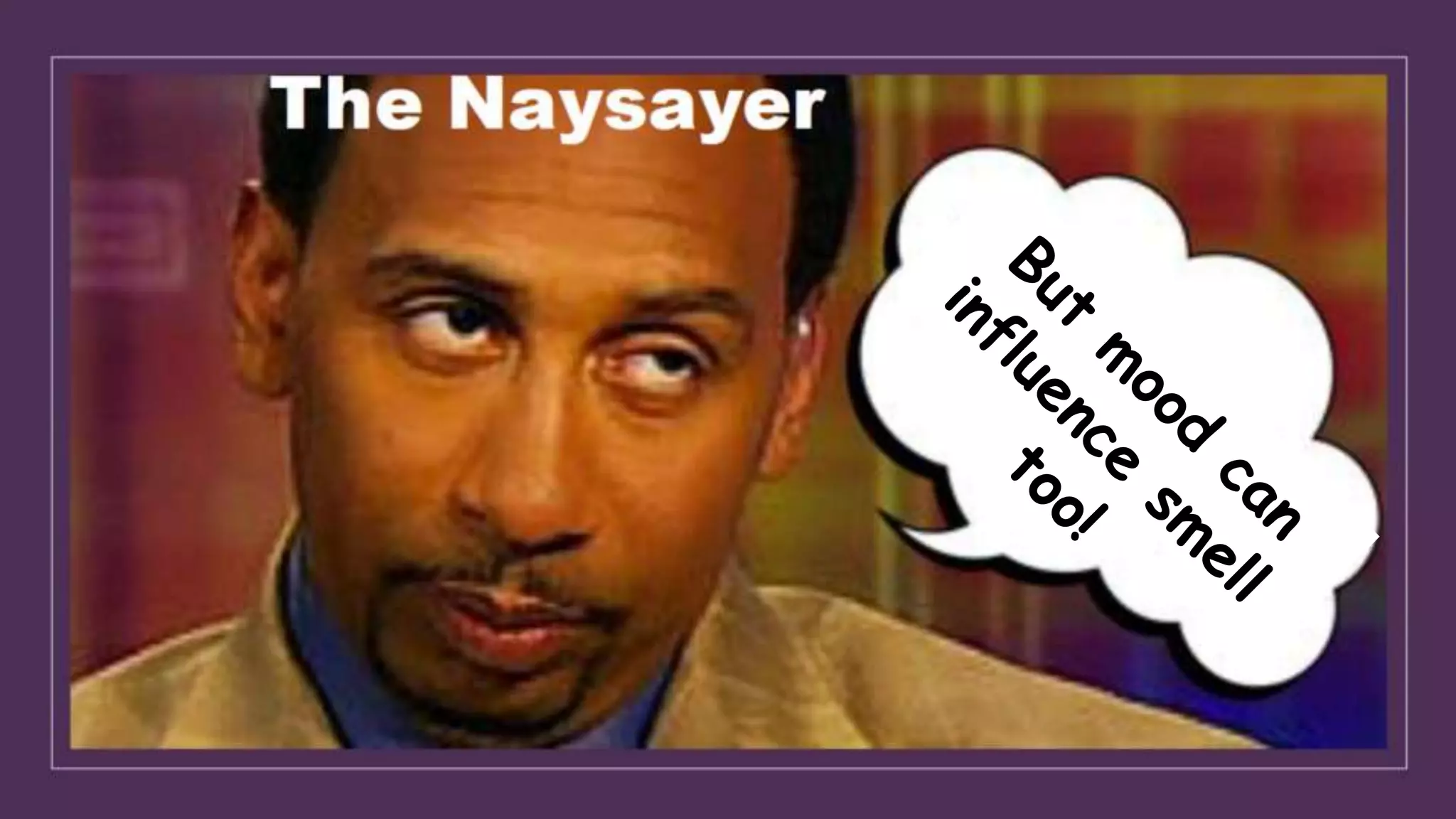
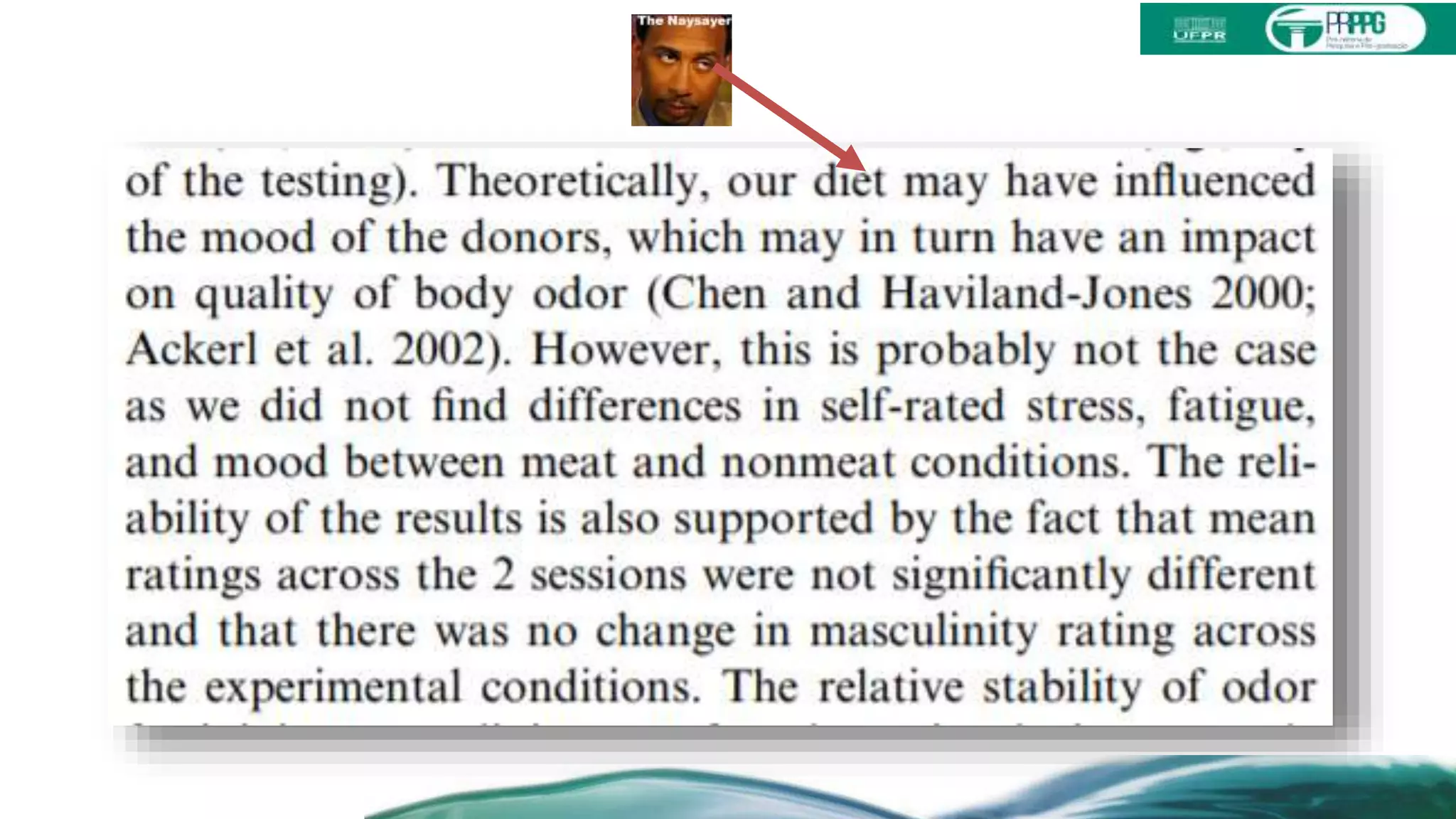
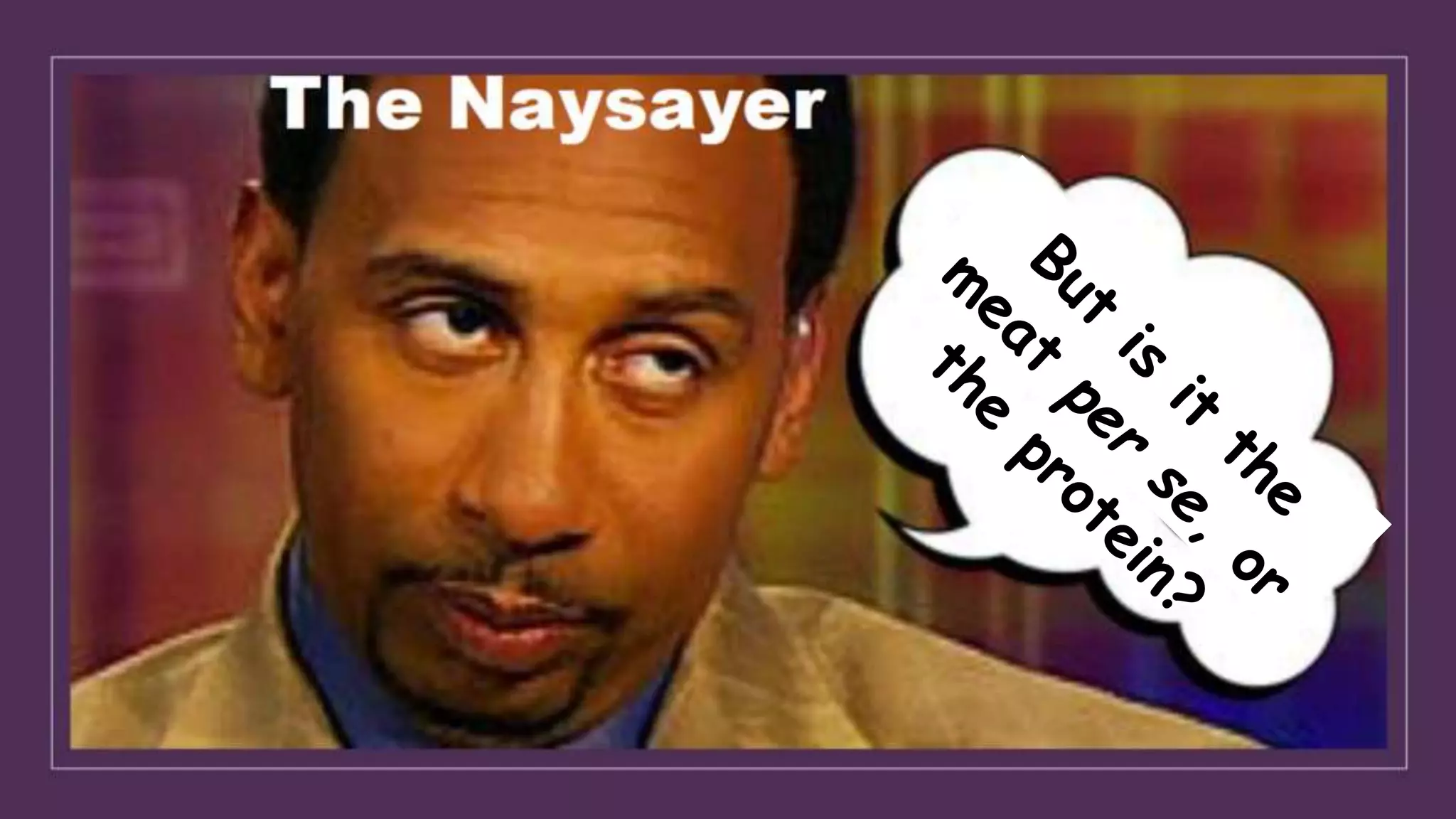
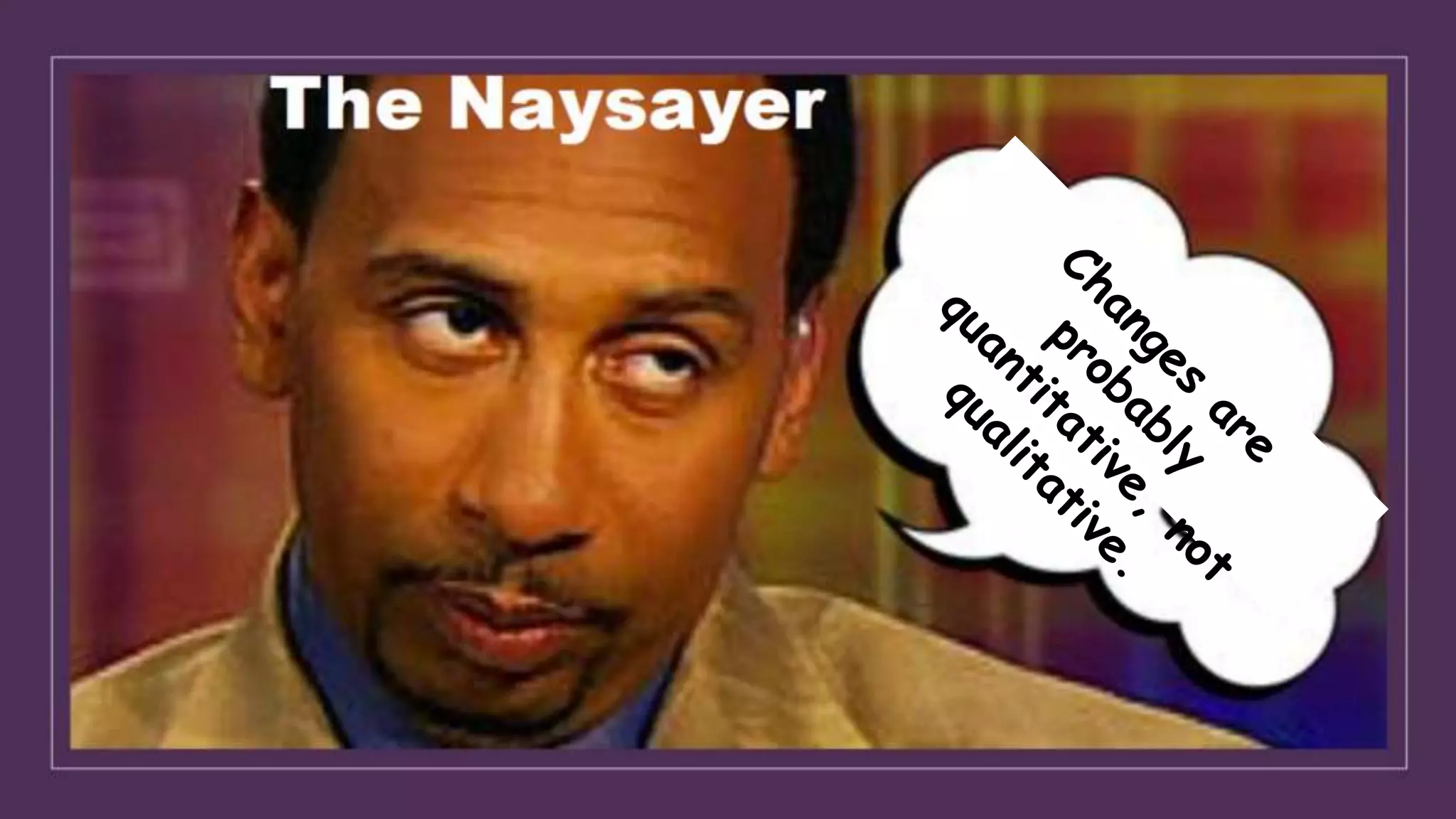
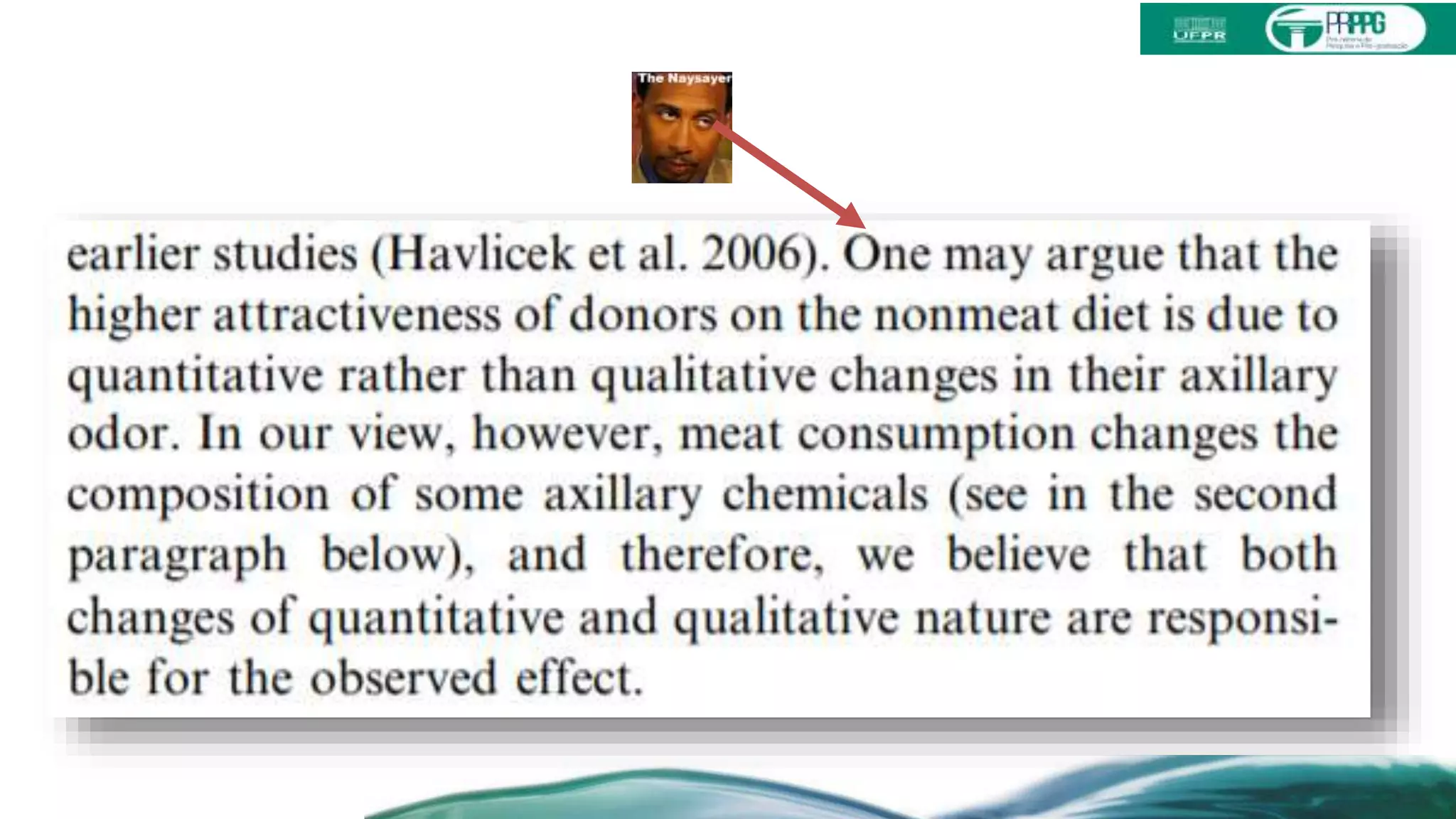
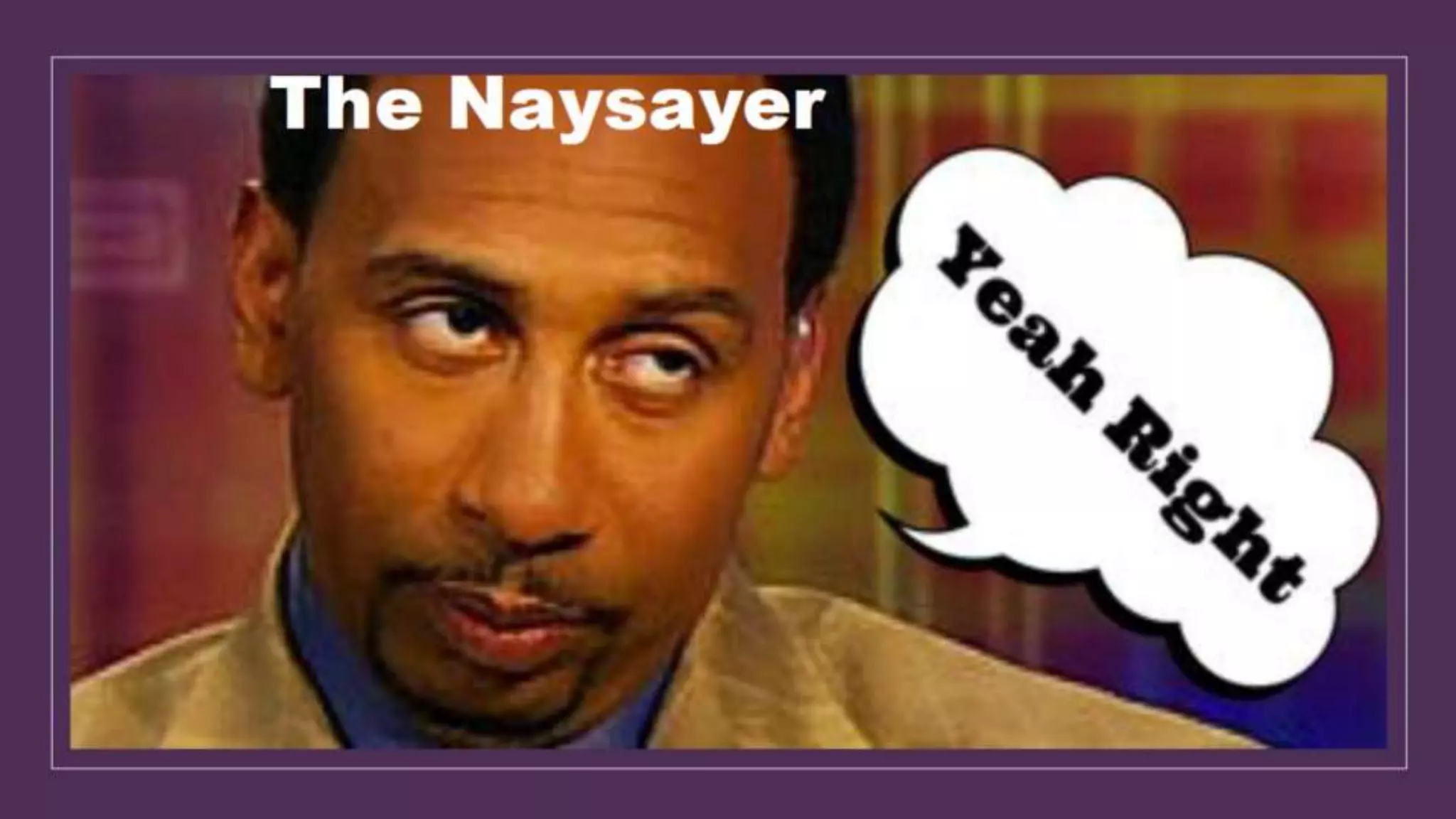
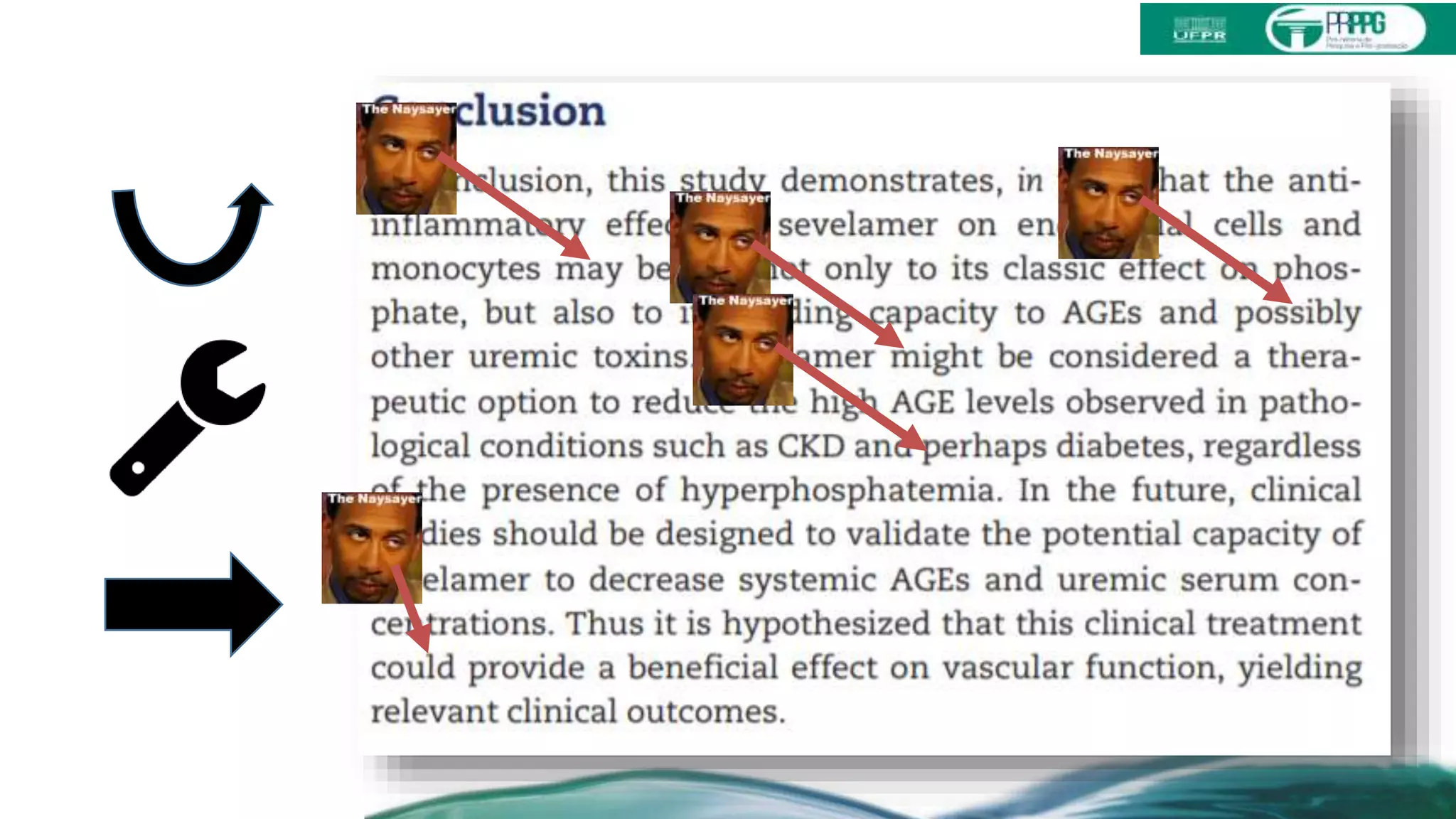
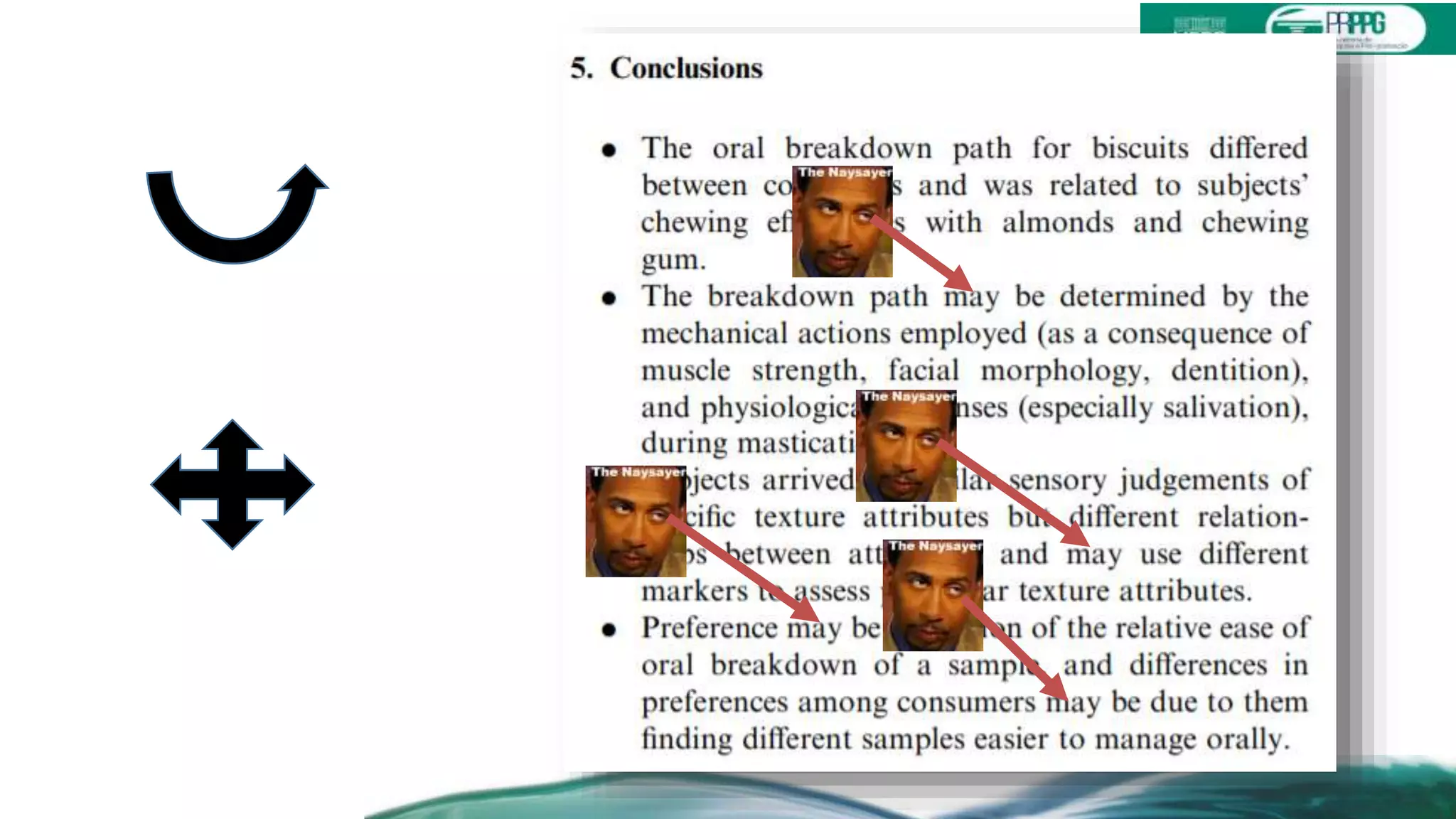
The "Naysayer"
1. In the "Discussion" section (online), underline/highlight
parts that were probably written thinking of the
"Naysayer".
2. Compare with others.
WHERE MANY AUTHORS STOP
DISCUSSING WITH AWARENESS OF “NAYSAYER”
MAKING A CONCESSION
TIP: PRACTICE BEING A NAYSAYER
Ask your “orientador” if you can review
manuscripts together.
Discussion : 6 common elements
!
Revisit points raised
in the Introduction
Compare with other
studies
Expand, explain,
extrapolate
Talk about applications
and practical implications
Talk about limitations
Talk about how the study
advances the area;
what is still needed
!
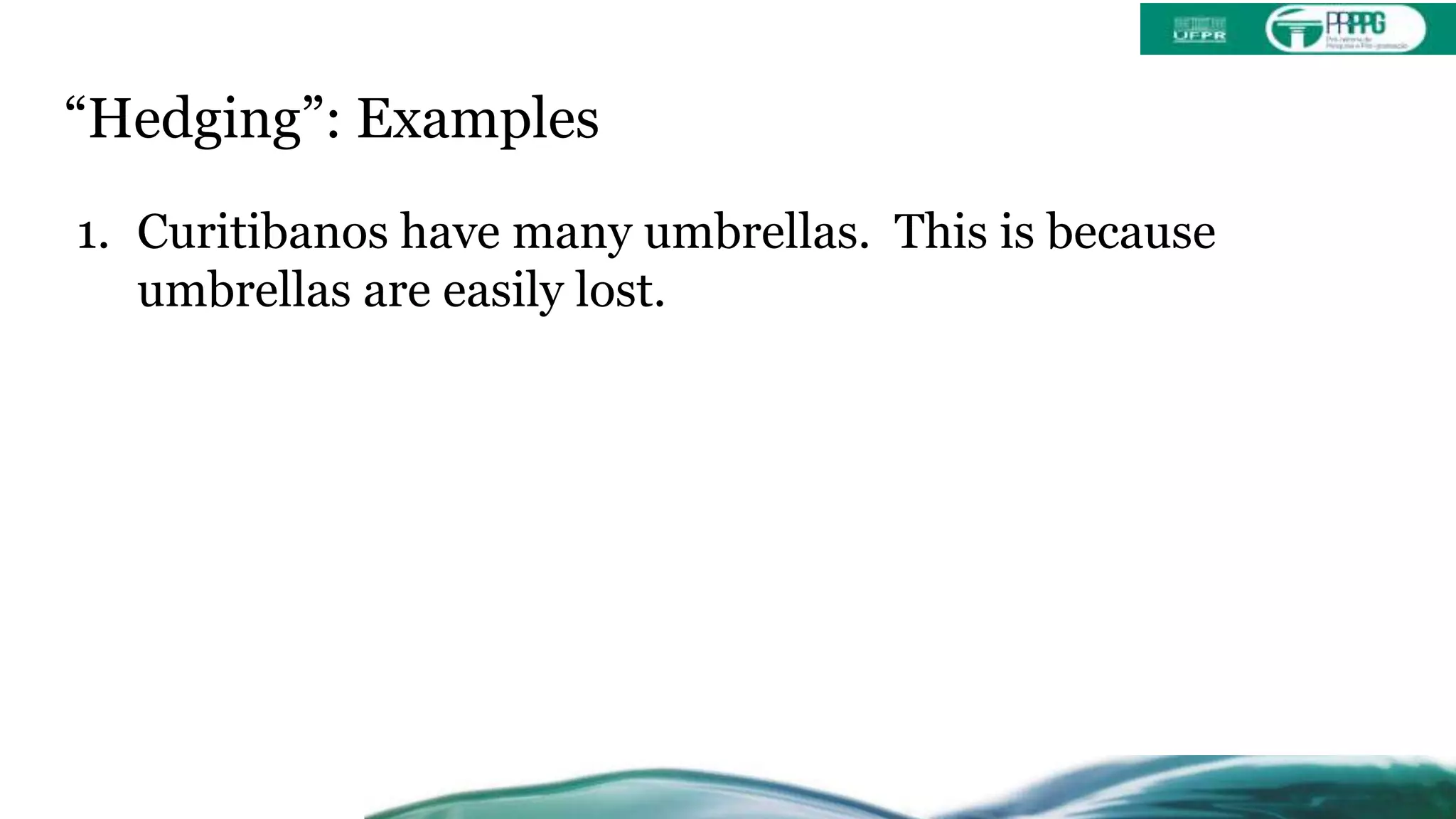
“Hedging”: Examples
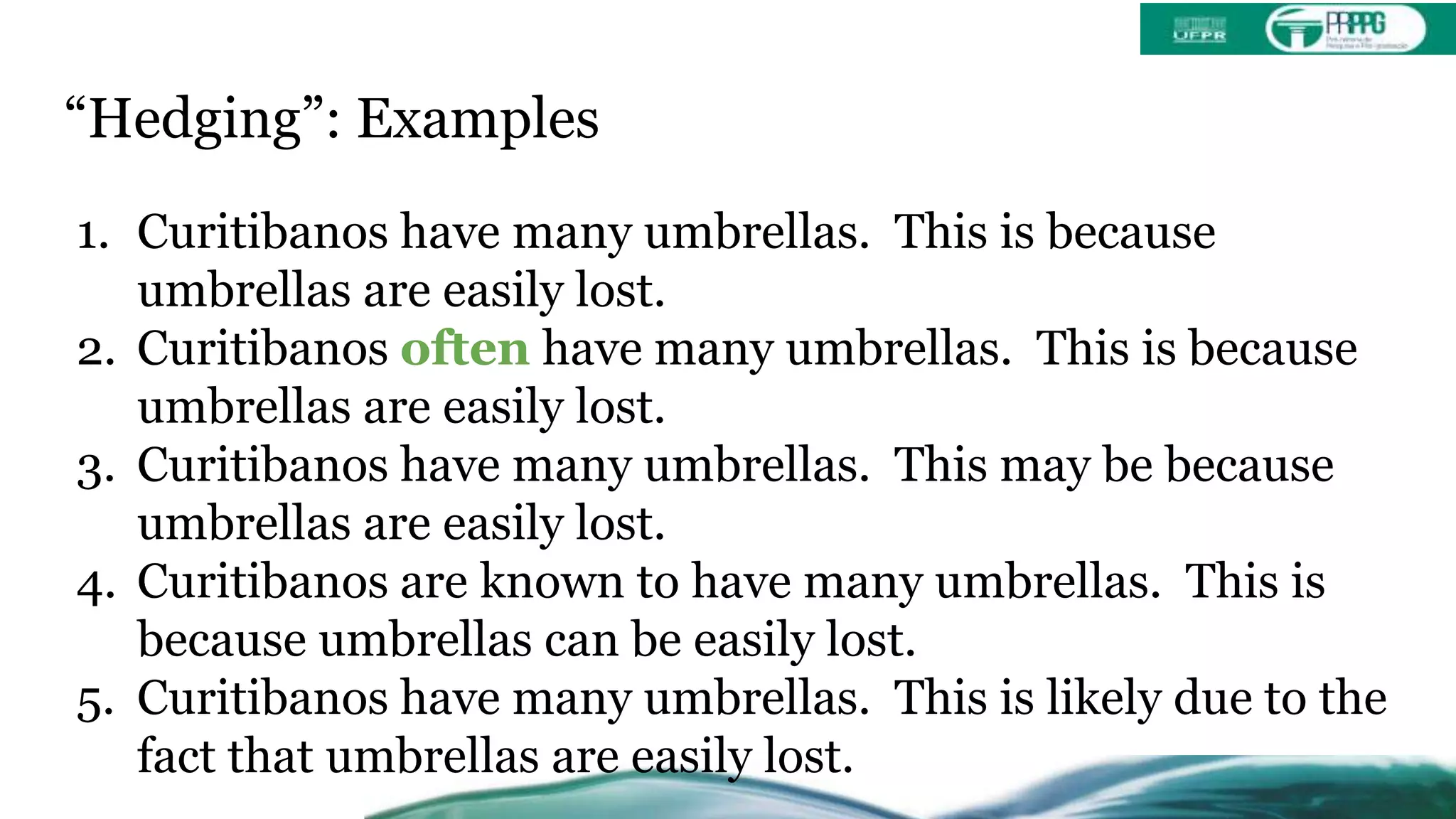
1. Curitibanos have many umbrellas. This is because
umbrellas are easily lost.
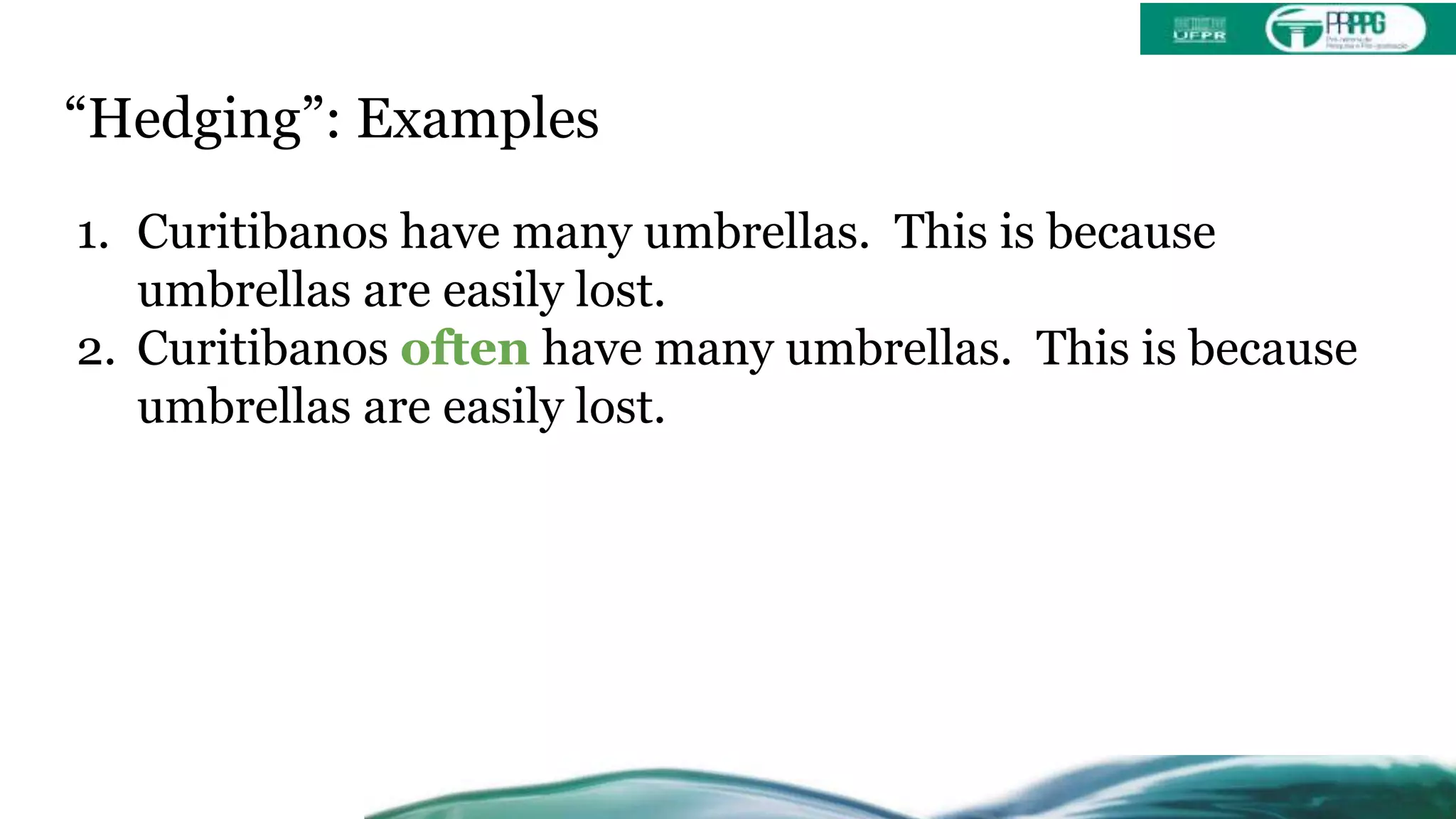
“Hedging”: Examples
1. Curitibanos have many umbrellas. This is because
umbrellas are easily lost.
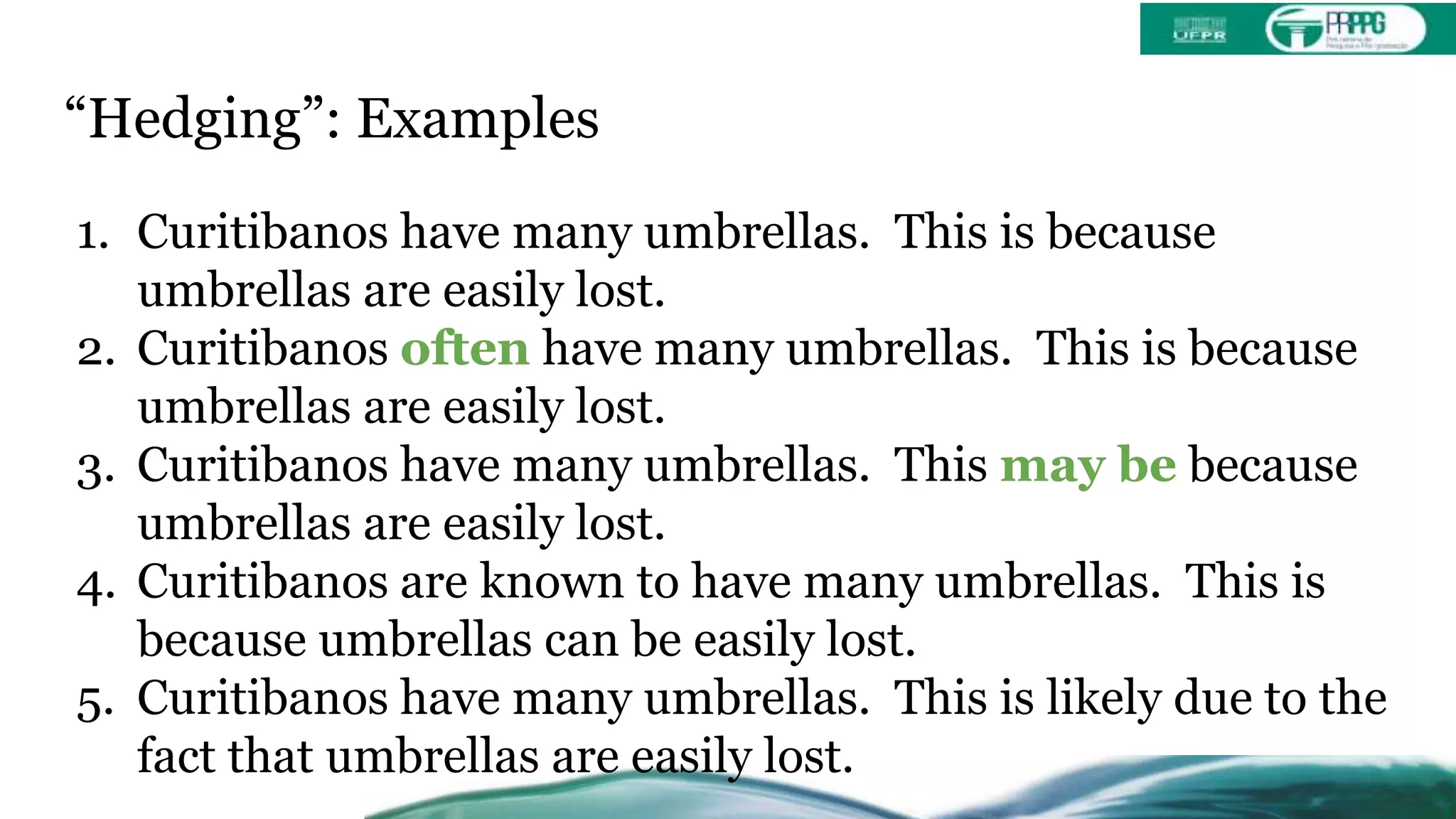
2. Curitibanos often have many umbrellas. This is because
umbrellas are easily lost.
“Hedging”: Examples
1. Curitibanos have many umbrellas. This is because
umbrellas are easily lost.
2. Curitibanos often have many umbrellas. This is because
umbrellas are easily lost.
3. Curitibanos have many umbrellas. This may be because
umbrellas are easily lost.
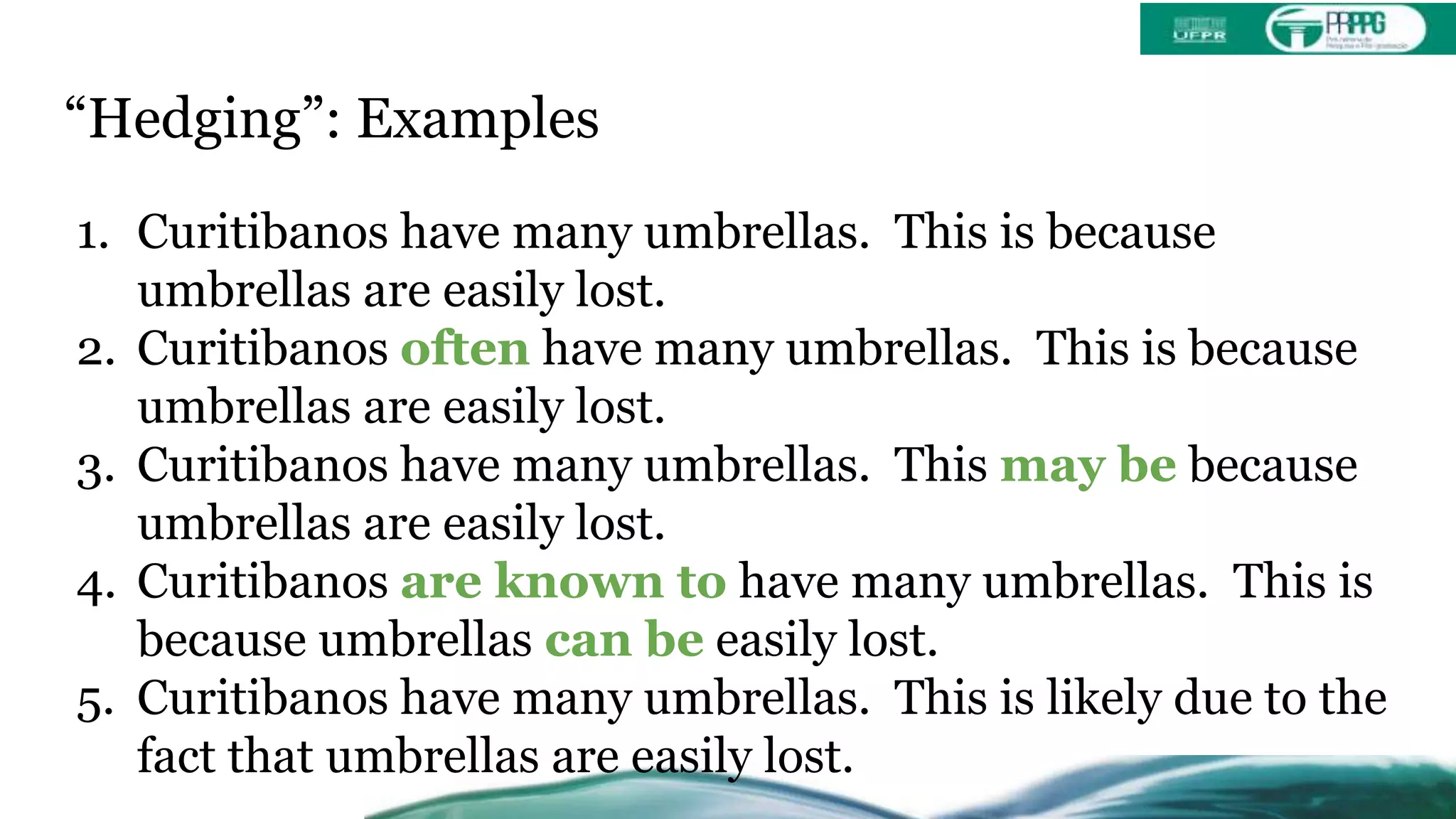
4. Curitibanos are known to have many umbrellas. This is
because umbrellas can be easily lost.
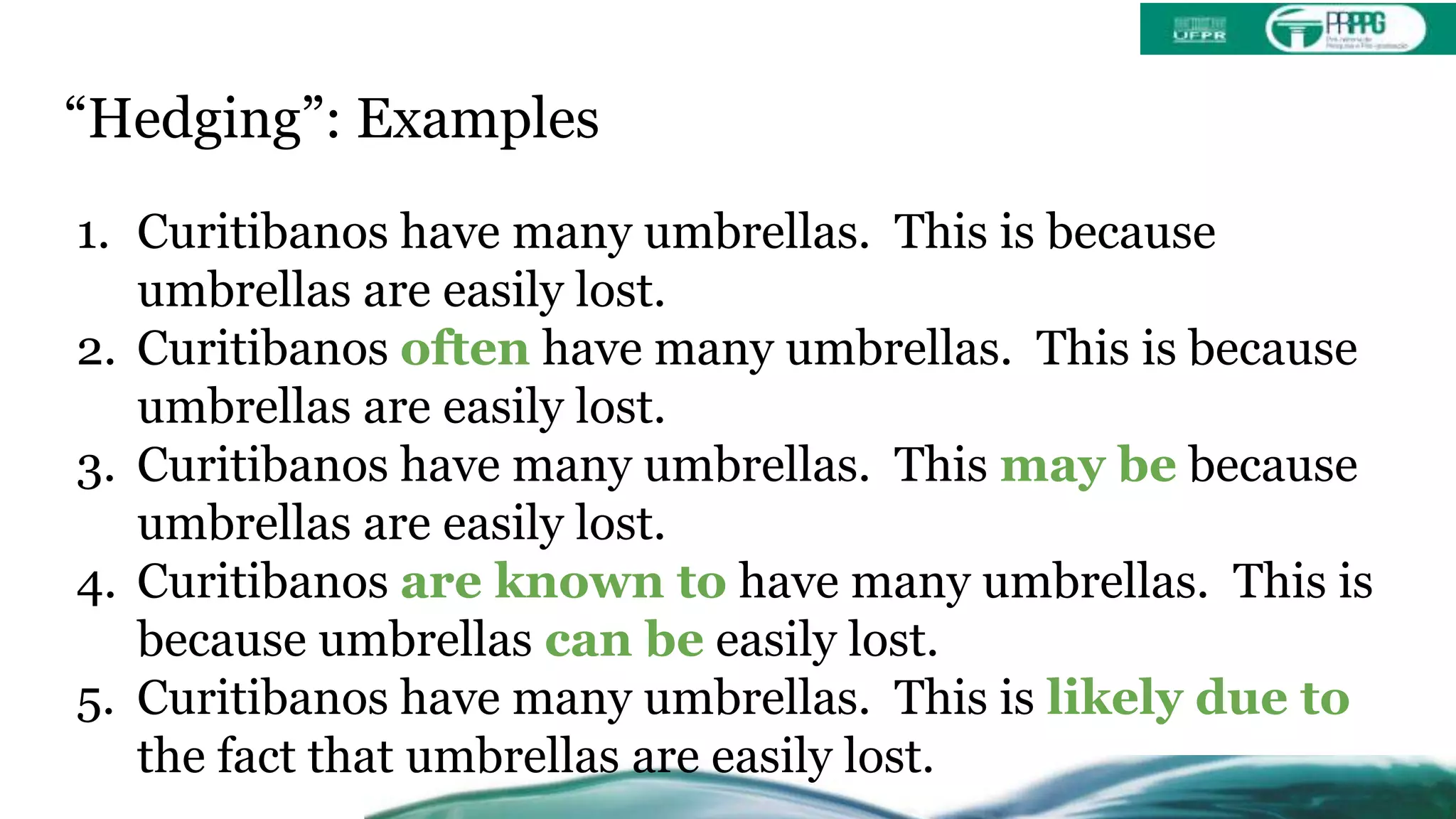
5. Curitibanos have many umbrellas. This is likely due to the
fact that umbrellas are easily lost.
“Hedging”: Examples
1. Curitibanos have many umbrellas. This is because
umbrellas are easily lost.
2. Curitibanos often have many umbrellas. This is because
umbrellas are easily lost.
3. Curitibanos have many umbrellas. This may be because
umbrellas are easily lost.
4. Curitibanos are known to have many umbrellas. This is
because umbrellas can be easily lost.
5. Curitibanos have many umbrellas. This is likely due to the
fact that umbrellas are easily lost.
“Hedging”: Examples
1. Curitibanos have many umbrellas. This is because
umbrellas are easily lost.
2. Curitibanos often have many umbrellas. This is because
umbrellas are easily lost.
3. Curitibanos have many umbrellas. This may be because
umbrellas are easily lost.
4. Curitibanos are known to have many umbrellas. This is
because umbrellas can be easily lost.
5. Curitibanos have many umbrellas. This is likely due to the
fact that umbrellas are easily lost.
“Hedging”: Examples
1. Curitibanos have many umbrellas. This is because
umbrellas are easily lost.
2. Curitibanos often have many umbrellas. This is because
umbrellas are easily lost.
3. Curitibanos have many umbrellas. This may be because
umbrellas are easily lost.
4. Curitibanos are known to have many umbrellas. This is
because umbrellas can be easily lost.
5. Curitibanos have many umbrellas. This is likely due to
the fact that umbrellas are easily lost.
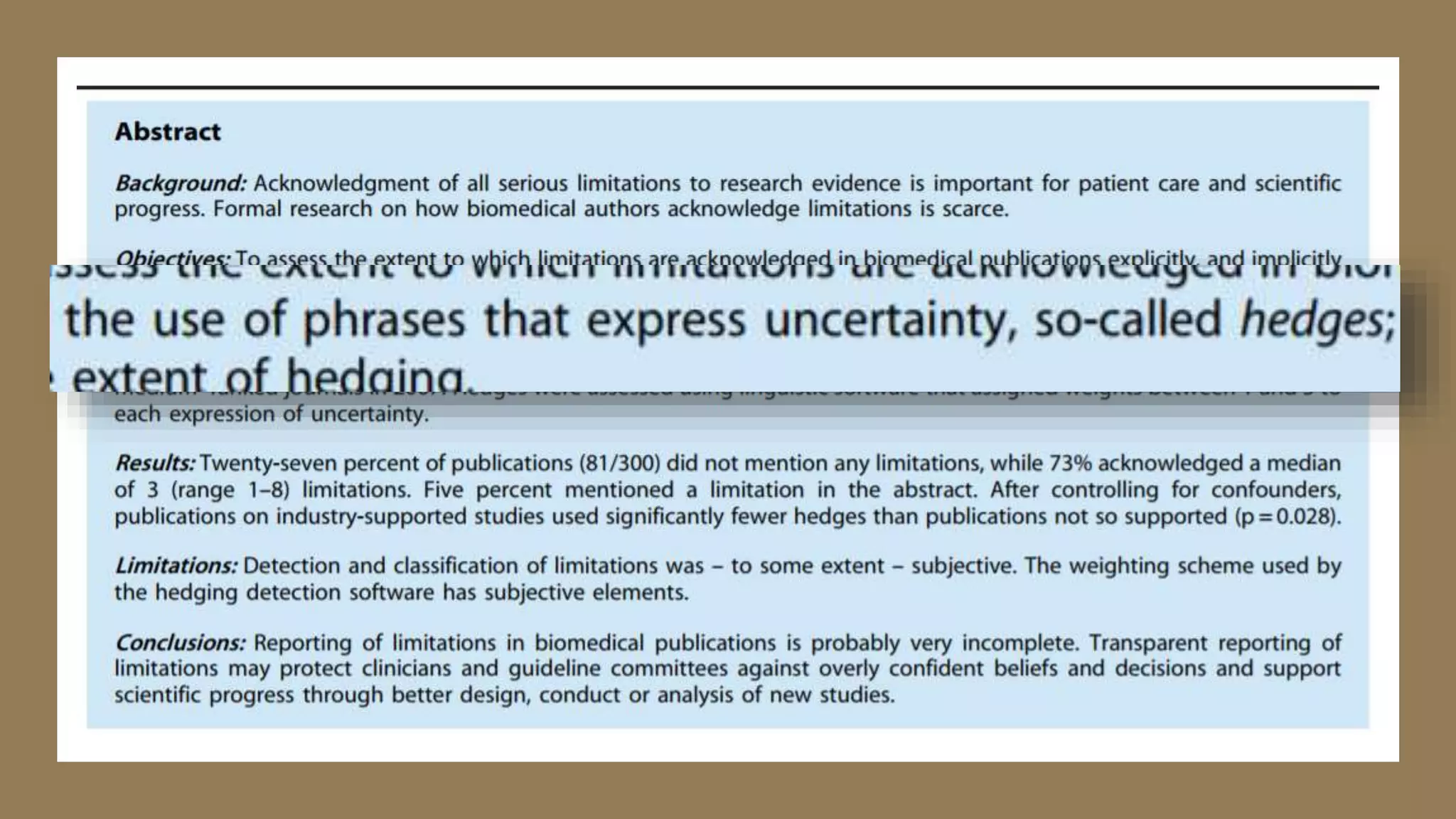
Hedging: a definition
In academic writing, a “hedge” is a word
or phrase used by the author(s) to show
they are being careful about their claims.
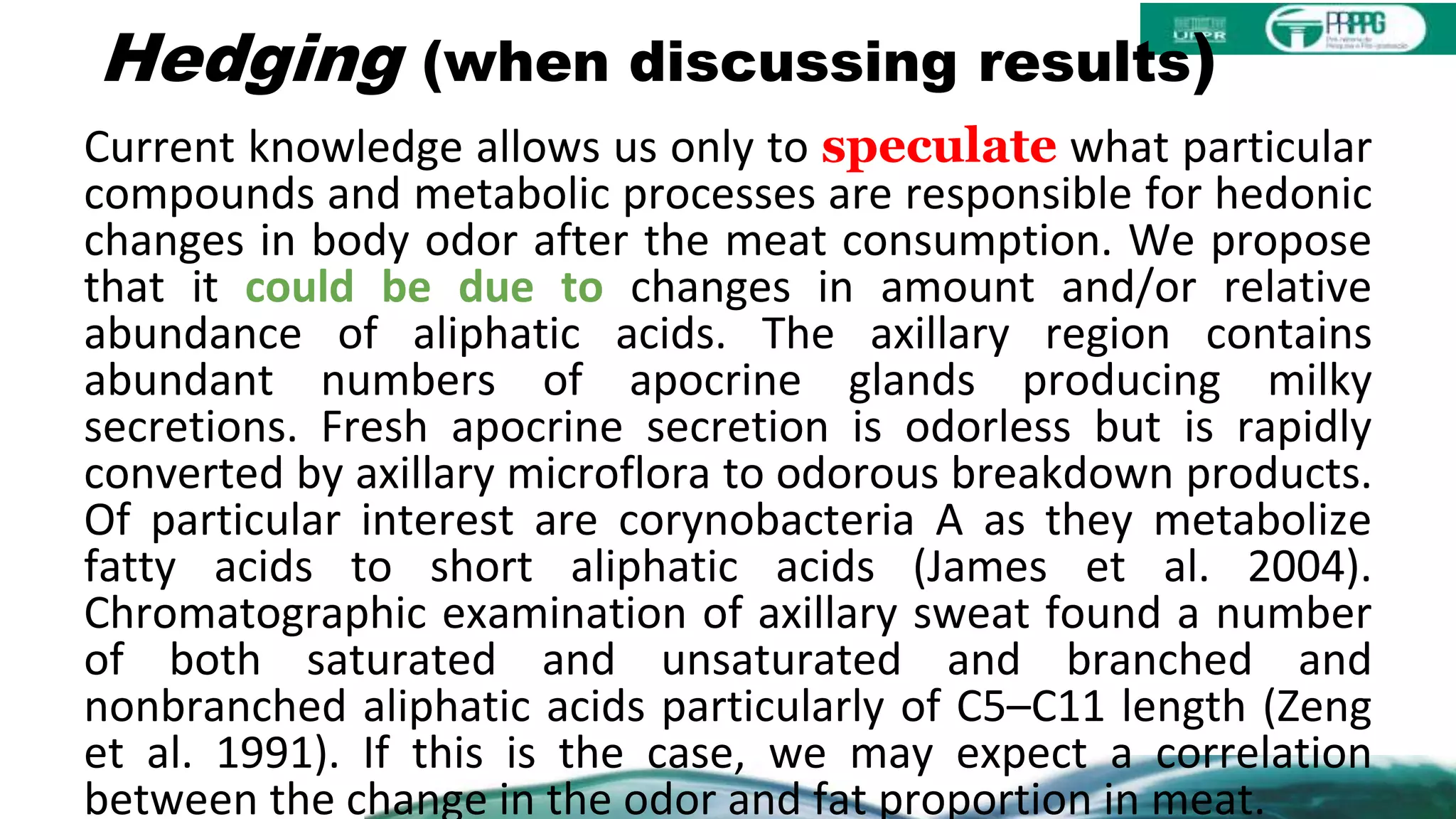
Hedging (when discussing results)
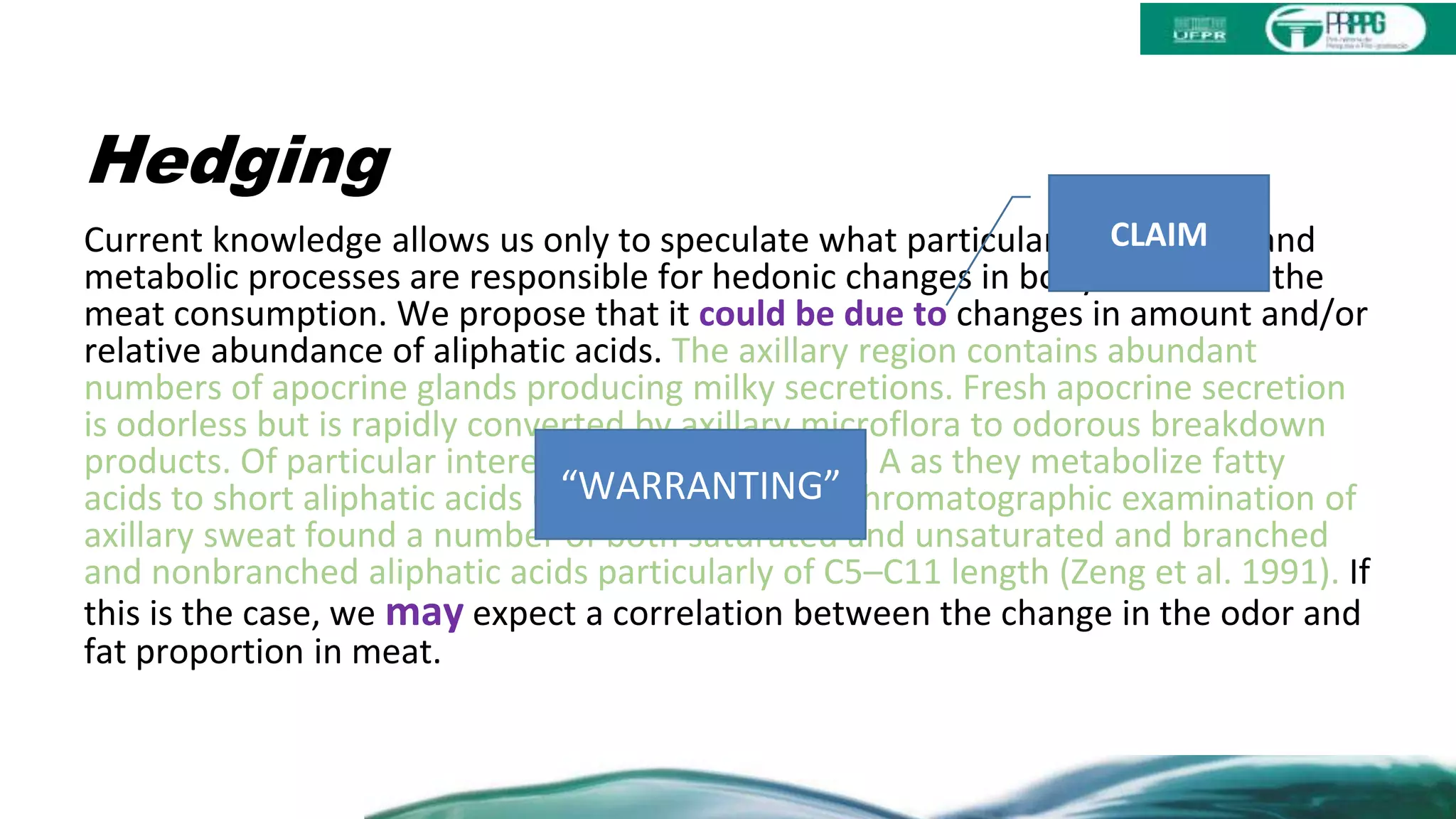
Current knowledge allows us only to speculate what particular compounds and
metabolic processes are responsible for hedonic changes in body odor after
the meat consumption. We propose that it could be due to changes in amount
and/or relative abundance of aliphatic acids. The axillary region contains
abundant numbers of apocrine glands producing milky secretions. Fresh
apocrine secretion is odorless but is rapidly converted by axillary microflora to
odorous breakdown products. Of particular interest are corynobacteria A as
they metabolize fatty acids to short aliphatic acids (James et al. 2004).
Chromatographic examination of axillary sweat found a number of both
saturated and unsaturated and branched and nonbranched aliphatic acids
particularly of C5–C11 length (Zeng et al. 1991). If this is the case, we may
expect a correlation between the change in the odor and fat proportion in
meat.
Hedging (when discussing results)
Current knowledge allows us only to speculate what particular compounds
and metabolic processes are responsible for hedonic changes in body odor
after the meat consumption. We propose that it could be due to changes in
amount and/or relative abundance of aliphatic acids. The axillary region
contains abundant numbers of apocrine glands producing milky secretions.
Fresh apocrine secretion is odorless but is rapidly converted by axillary
microflora to odorous breakdown products. Of particular interest are
corynobacteria A as they metabolize fatty acids to short aliphatic acids (James
et al. 2004). Chromatographic examination of axillary sweat found a number of
both saturated and unsaturated and branched and nonbranched aliphatic
acids particularly of C5–C11 length (Zeng et al. 1991). If this is the case, we
may expect a correlation between the change in the odor and fat proportion in
meat.
Guiding the reader: Title, Abstract
and Introduction
Prof. Dr. Ron Martinez
PRPPG7000 - Academic Writing in English
Prof. Dr. Ron Martinez - UFPR
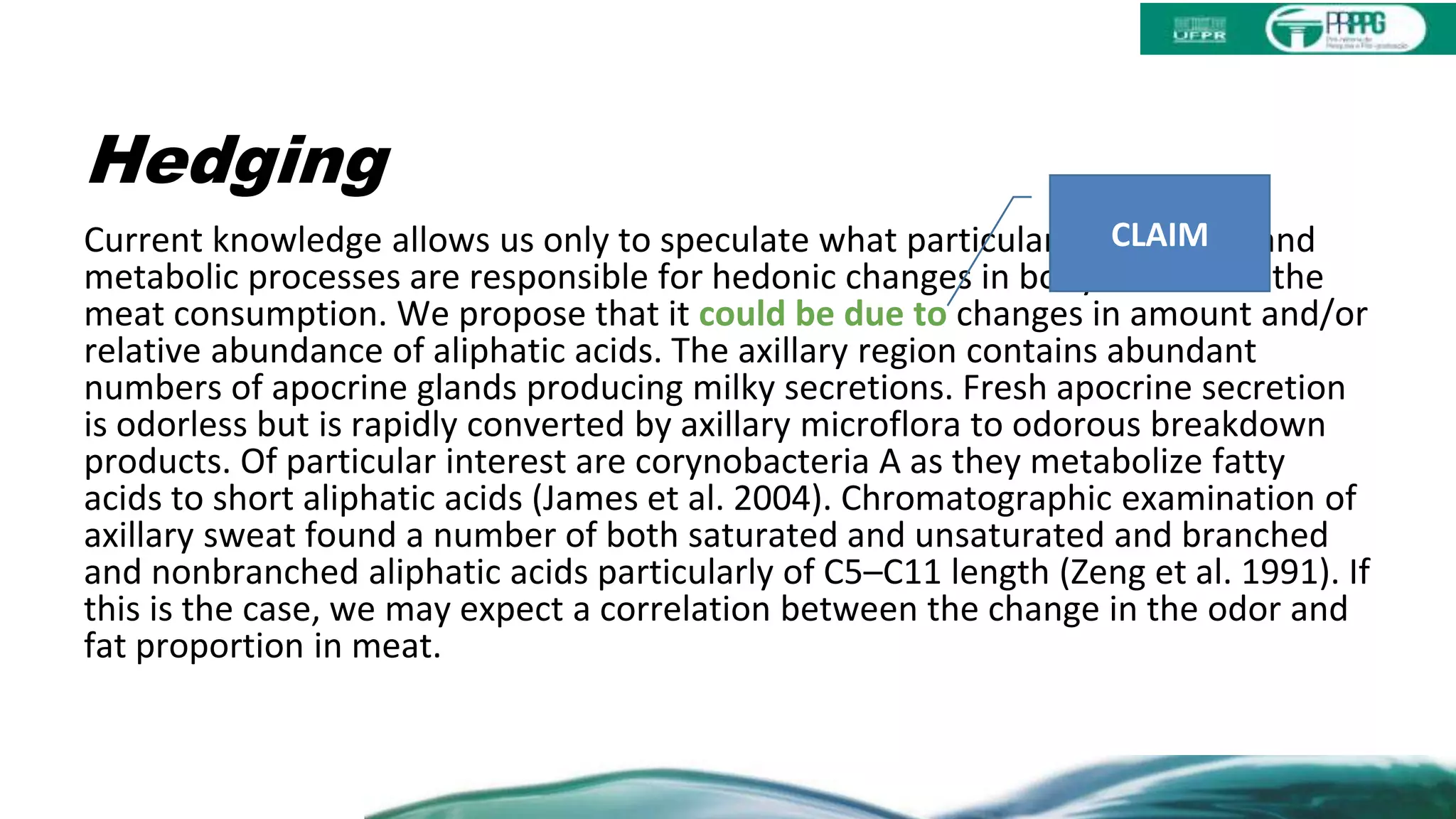
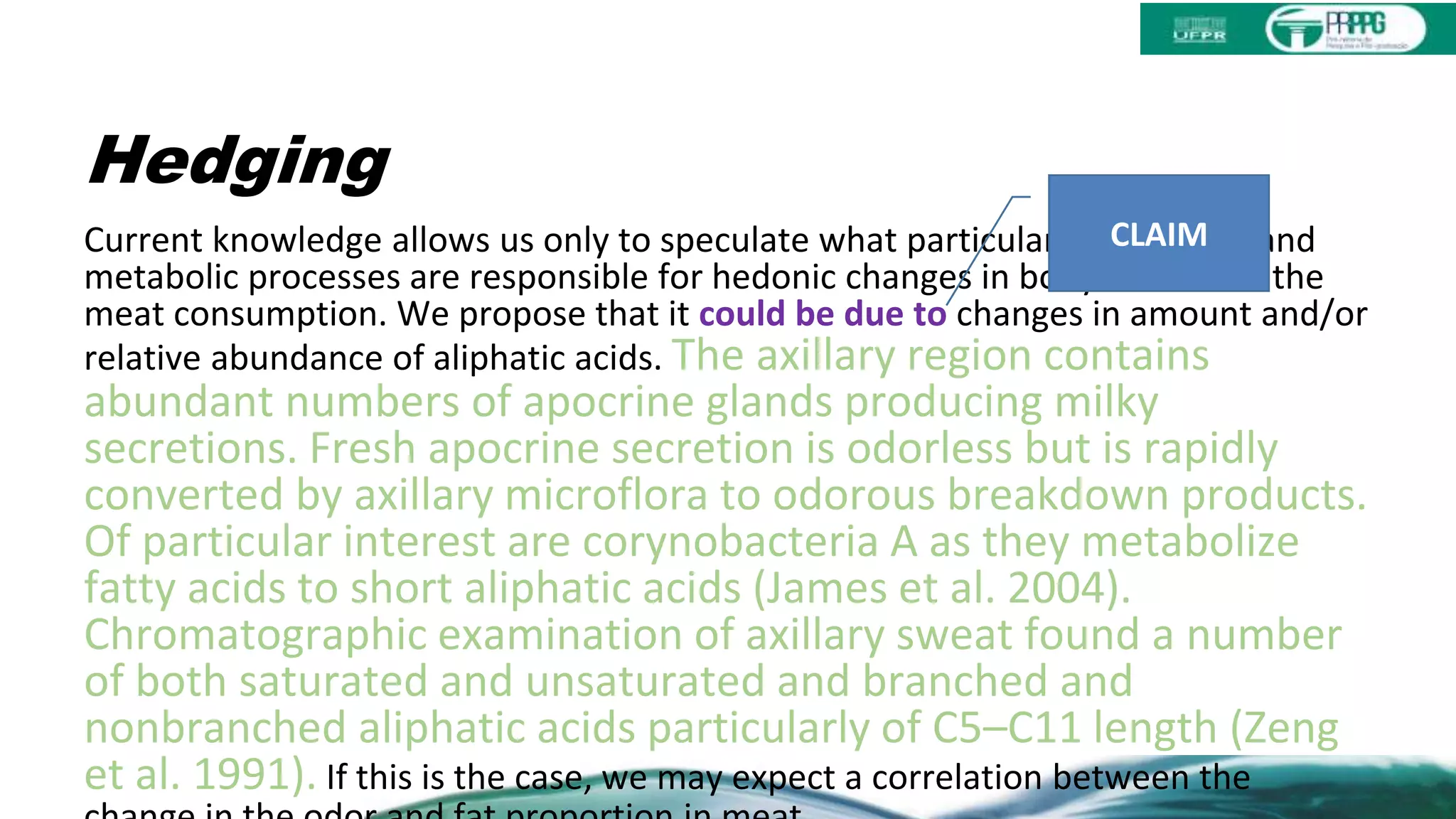
CLAIM
Prof. Dr. Ron Martinez - UFPR
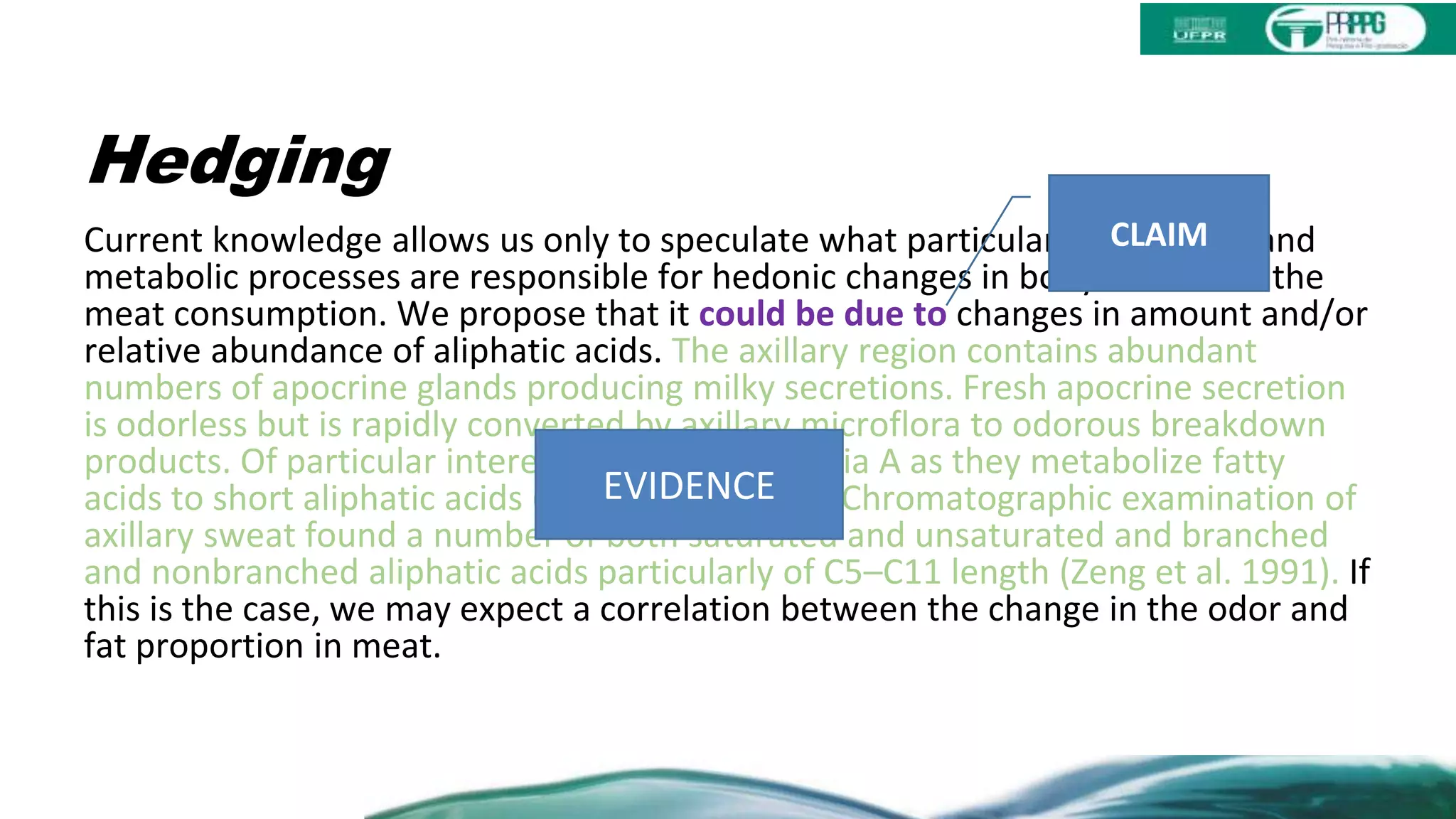
CLAIM
EVIDENCE
CLAIM
CLAIM
EVIDENCE?
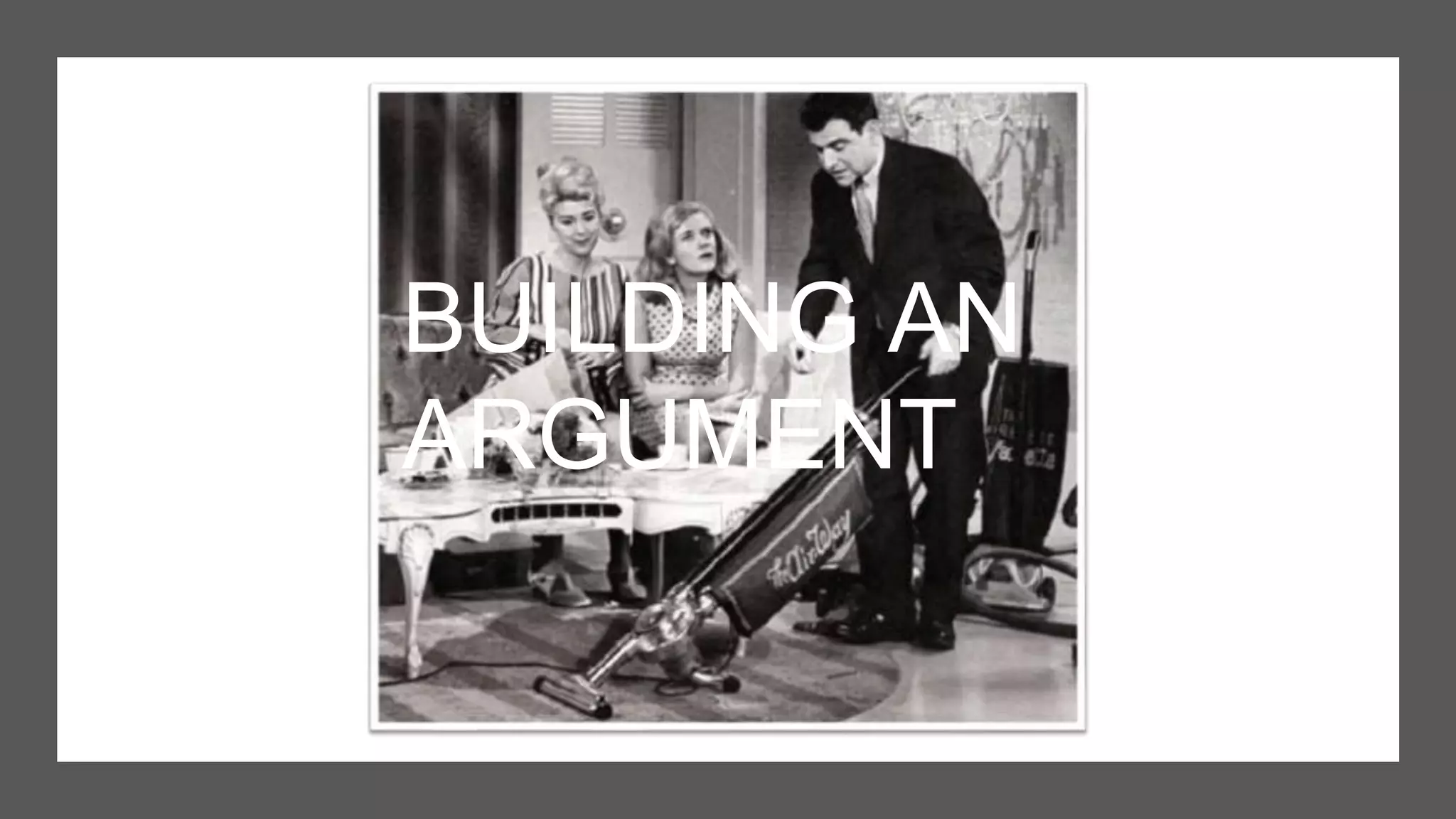
BUILDING AN
ARGUMENT
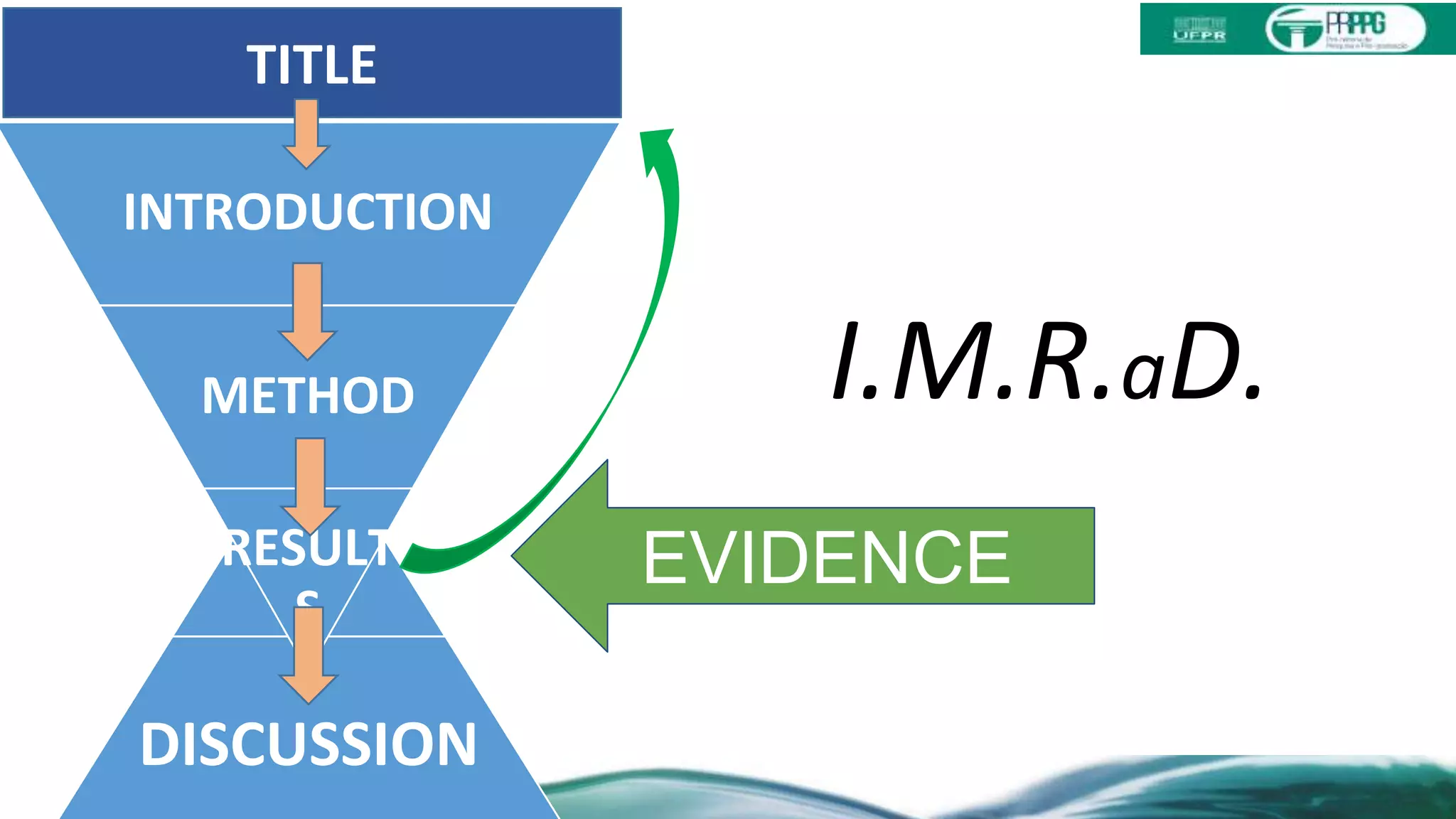
DISCUSSION
INTRODUCTION
METHOD
RESULT
S
I.M.R.aD.
TITLE
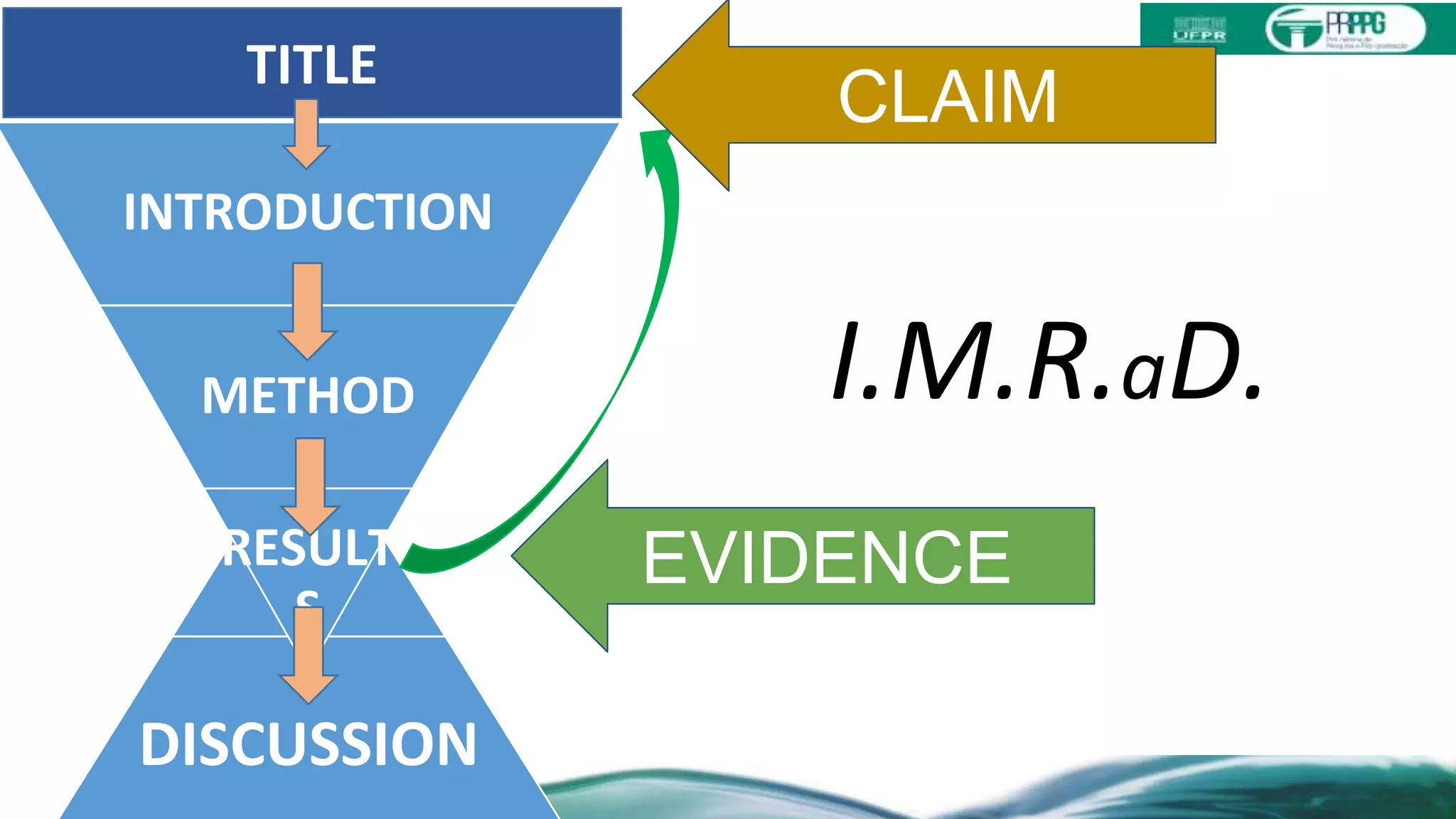
DISCUSSION
INTRODUCTION
METHOD
RESULT
S
I.M.R.aD.
TITLE
EVIDENCE
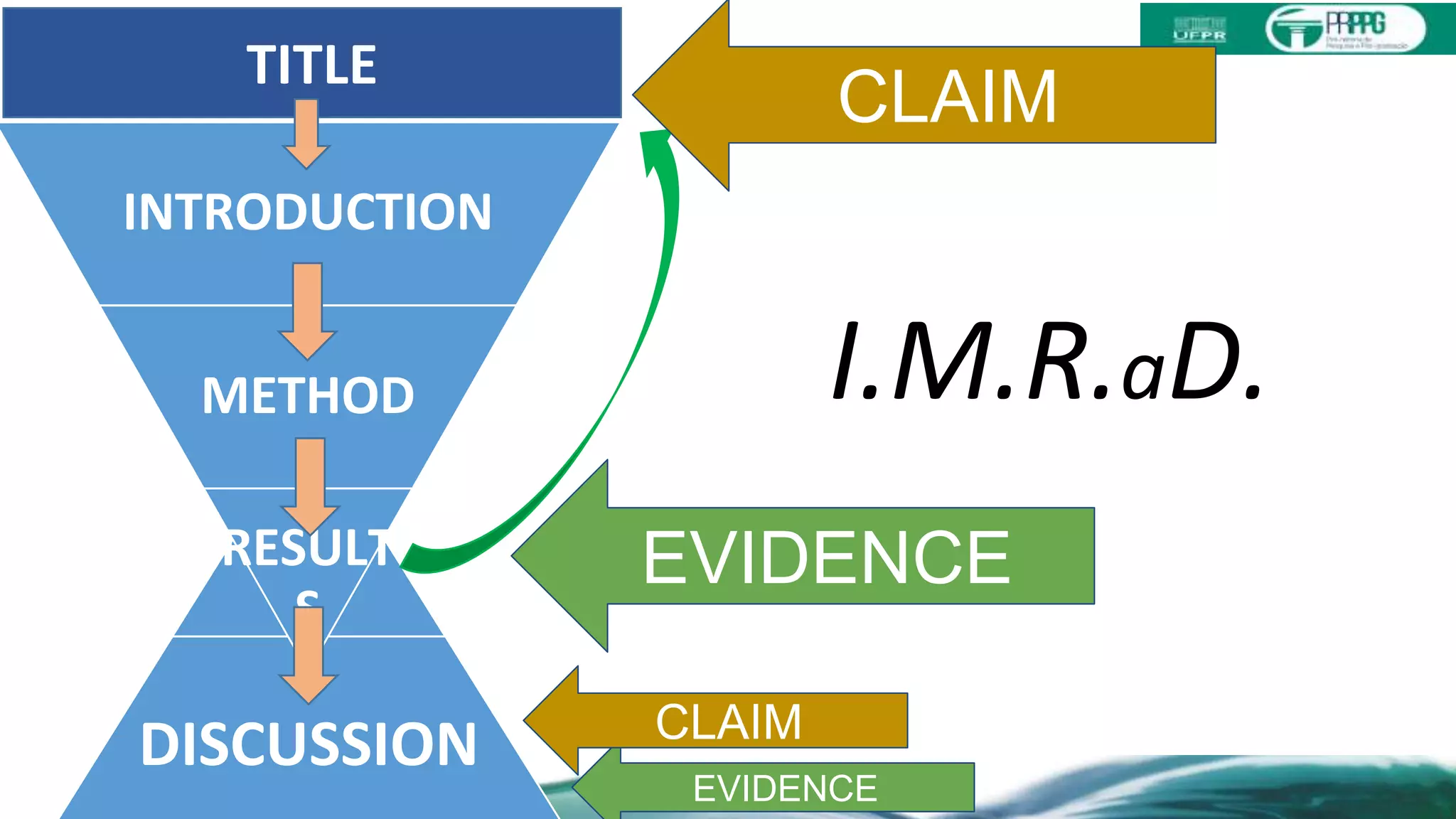
DISCUSSION
INTRODUCTION
METHOD
RESULT
S
I.M.R.aD.
TITLE
EVIDENCE
CLAIM
DISCUSSION
INTRODUCTION
METHOD
RESULT
S
I.M.R.aD.
TITLE
EVIDENCE
CLAIM
EVIDENCE
CLAIM
Hedging (when discussing results)
Current knowledge allows us only to speculate what particular
compounds and metabolic processes are responsible for hedonic
changes in body odor after the meat consumption. We propose
that it could be due to changes in amount and/or relative
abundance of aliphatic acids. The axillary region contains
abundant numbers of apocrine glands producing milky
secretions. Fresh apocrine secretion is odorless but is rapidly
converted by axillary microflora to odorous breakdown products.
Of particular interest are corynobacteria A as they metabolize
fatty acids to short aliphatic acids (James et al. 2004).
Chromatographic examination of axillary sweat found a number
of both saturated and unsaturated and branched and
nonbranched aliphatic acids particularly of C5–C11 length (Zeng
et al. 1991). If this is the case, we may expect a correlation
between the change in the odor and fat proportion in meat.
Hedging
Current knowledge allows us only to speculate what particular compounds and
metabolic processes are responsible for hedonic changes in body odor after the
meat consumption. We propose that it could be due to changes in amount and/or
relative abundance of aliphatic acids. The axillary region contains abundant
numbers of apocrine glands producing milky secretions. Fresh apocrine secretion
is odorless but is rapidly converted by axillary microflora to odorous breakdown
products. Of particular interest are corynobacteria A as they metabolize fatty
acids to short aliphatic acids (James et al. 2004). Chromatographic examination of
axillary sweat found a number of both saturated and unsaturated and branched
and nonbranched aliphatic acids particularly of C5–C11 length (Zeng et al. 1991). If
this is the case, we may expect a correlation between the change in the odor and
fat proportion in meat.
CLAIM
Hedging
Current knowledge allows us only to speculate what particular compounds and
metabolic processes are responsible for hedonic changes in body odor after the
meat consumption. We propose that it could be due to changes in amount and/or
relative abundance of aliphatic acids. The axillary region contains
abundant numbers of apocrine glands producing milky
secretions. Fresh apocrine secretion is odorless but is rapidly
converted by axillary microflora to odorous breakdown products.
Of particular interest are corynobacteria A as they metabolize
fatty acids to short aliphatic acids (James et al. 2004).
Chromatographic examination of axillary sweat found a number
of both saturated and unsaturated and branched and
nonbranched aliphatic acids particularly of C5–C11 length (Zeng
et al. 1991). If this is the case, we may expect a correlation between the
CLAIM
Hedging
Current knowledge allows us only to speculate what particular compounds and
metabolic processes are responsible for hedonic changes in body odor after the
meat consumption. We propose that it could be due to changes in amount and/or
relative abundance of aliphatic acids. The axillary region contains abundant
numbers of apocrine glands producing milky secretions. Fresh apocrine secretion
is odorless but is rapidly converted by axillary microflora to odorous breakdown
products. Of particular interest are corynobacteria A as they metabolize fatty
acids to short aliphatic acids (James et al. 2004). Chromatographic examination of
axillary sweat found a number of both saturated and unsaturated and branched
and nonbranched aliphatic acids particularly of C5–C11 length (Zeng et al. 1991). If
this is the case, we may expect a correlation between the change in the odor and
fat proportion in meat.
CLAIM
EVIDENCE
Hedging
Current knowledge allows us only to speculate what particular compounds and
metabolic processes are responsible for hedonic changes in body odor after the
meat consumption. We propose that it could be due to changes in amount and/or
relative abundance of aliphatic acids. The axillary region contains abundant
numbers of apocrine glands producing milky secretions. Fresh apocrine secretion
is odorless but is rapidly converted by axillary microflora to odorous breakdown
products. Of particular interest are corynobacteria A as they metabolize fatty
acids to short aliphatic acids (James et al. 2004). Chromatographic examination of
axillary sweat found a number of both saturated and unsaturated and branched
and nonbranched aliphatic acids particularly of C5–C11 length (Zeng et al. 1991). If
this is the case, we may expect a correlation between the change in the odor and
fat proportion in meat.
CLAIM
“WARRANTING”
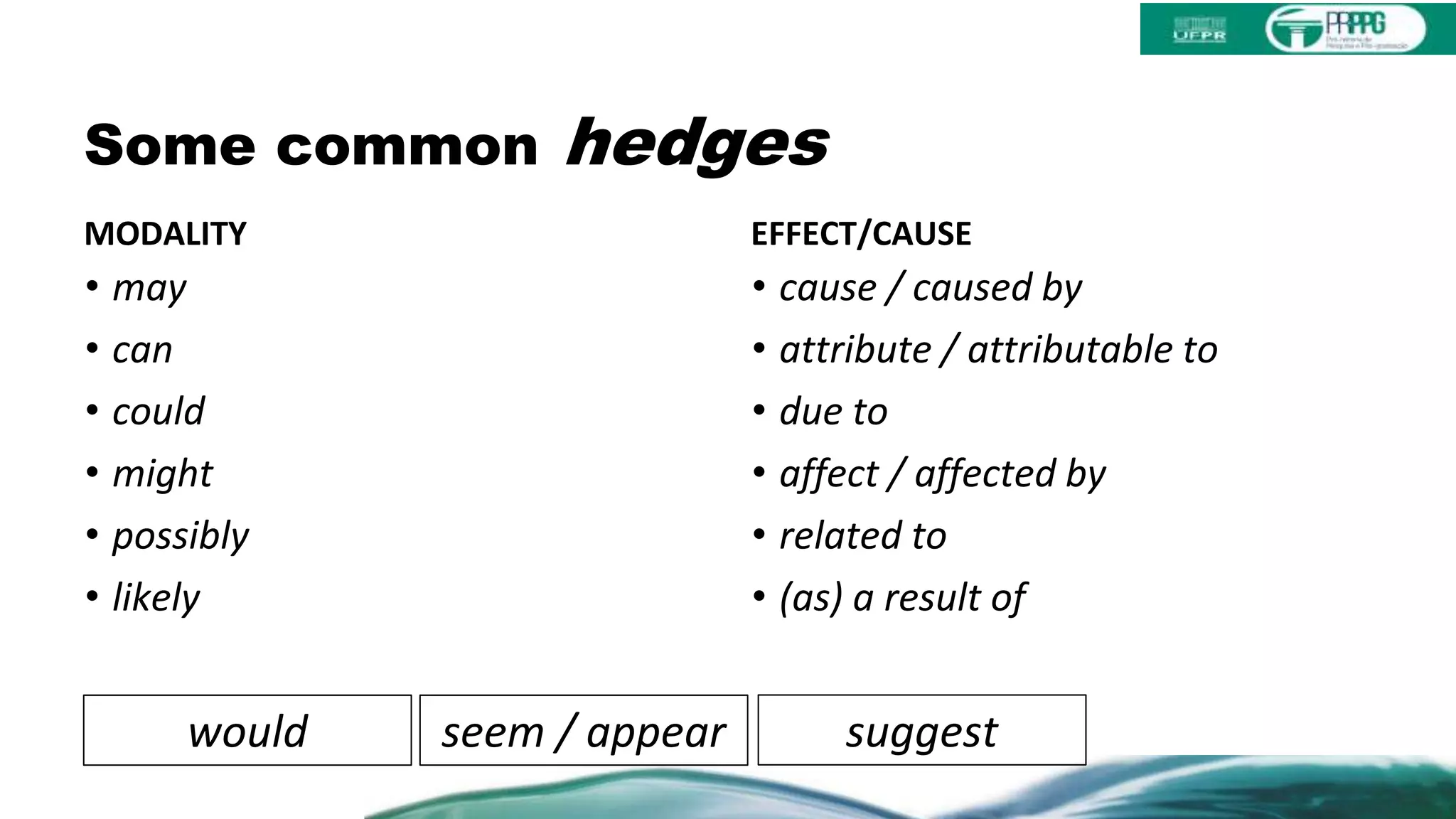
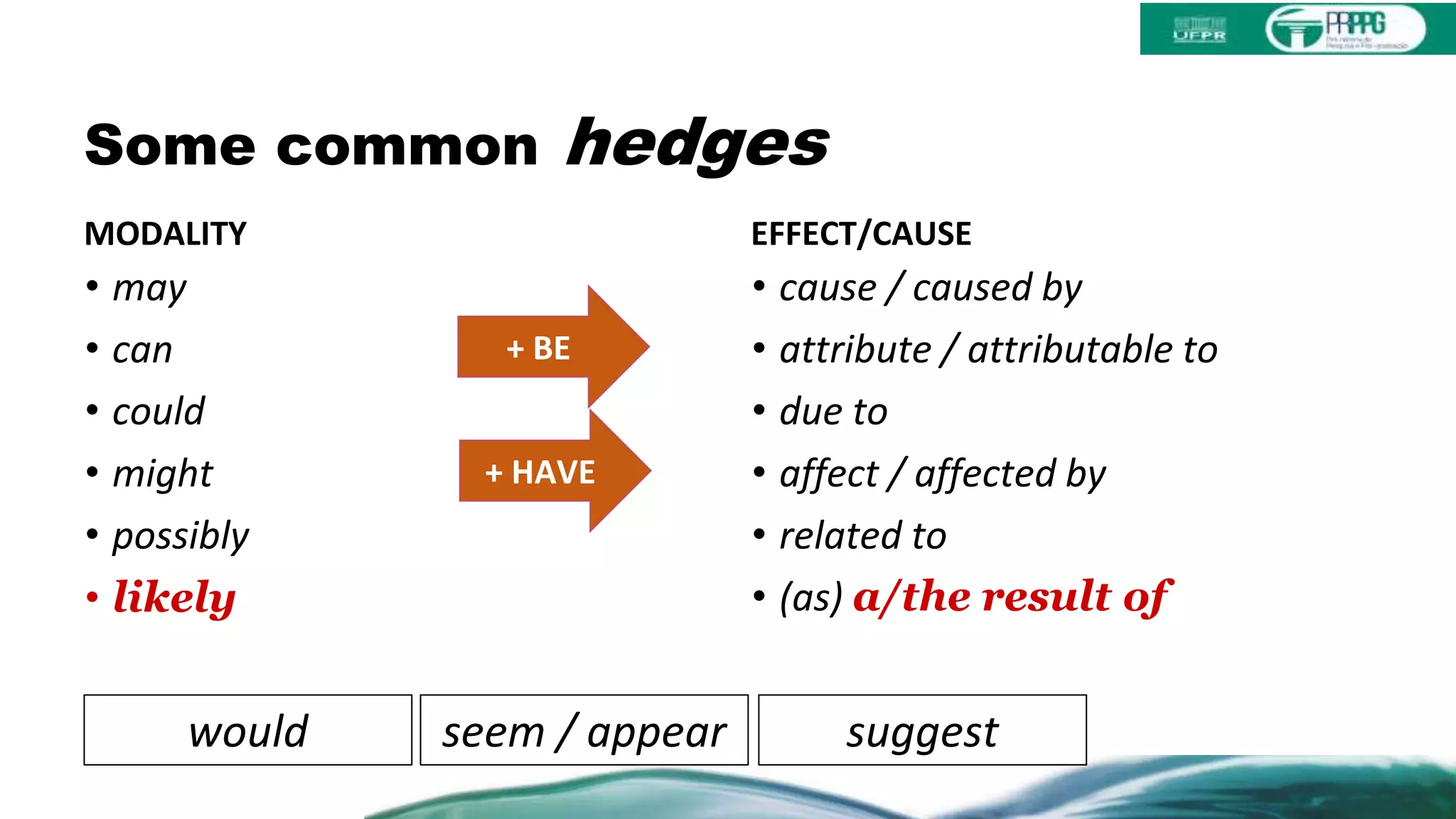
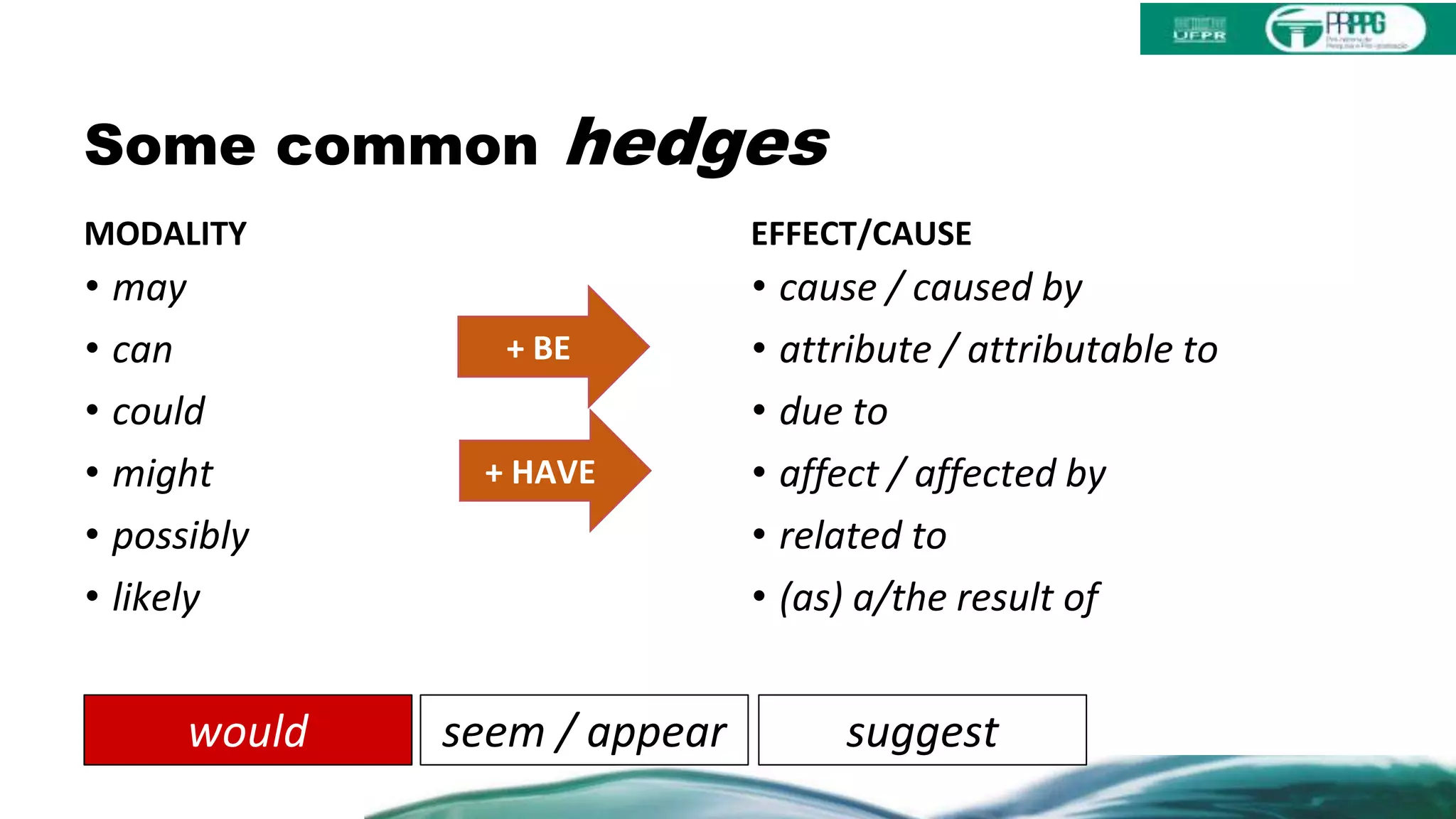
Some common hedges
MODALITY
• may
• can
• could
• might
• possibly
• likely
EFFECT/CAUSE
• cause / caused by
• attribute / attributable to
• due to
• affect / affected by
• related to
• (as) a result of
suggestseem / appearwould
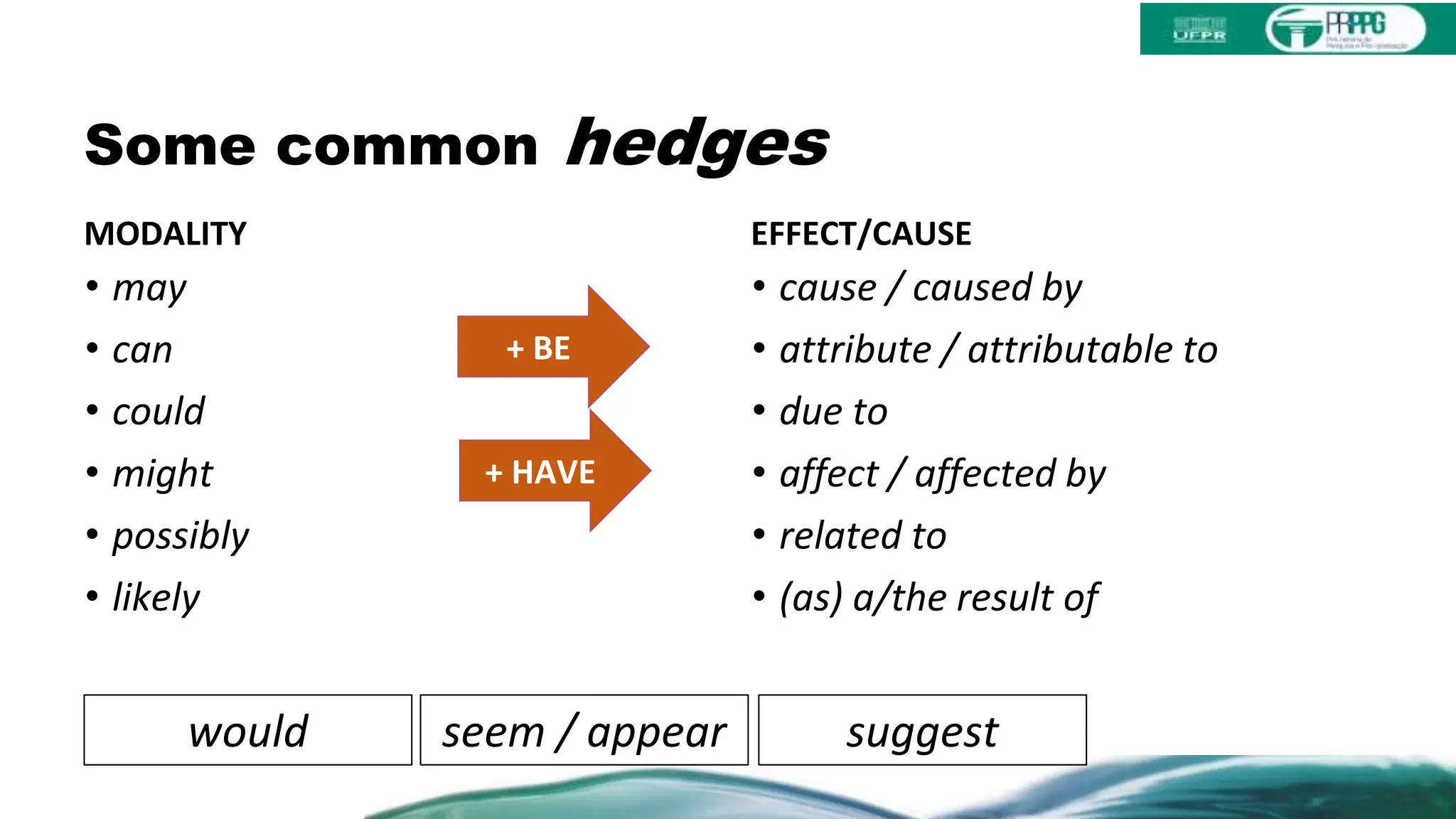
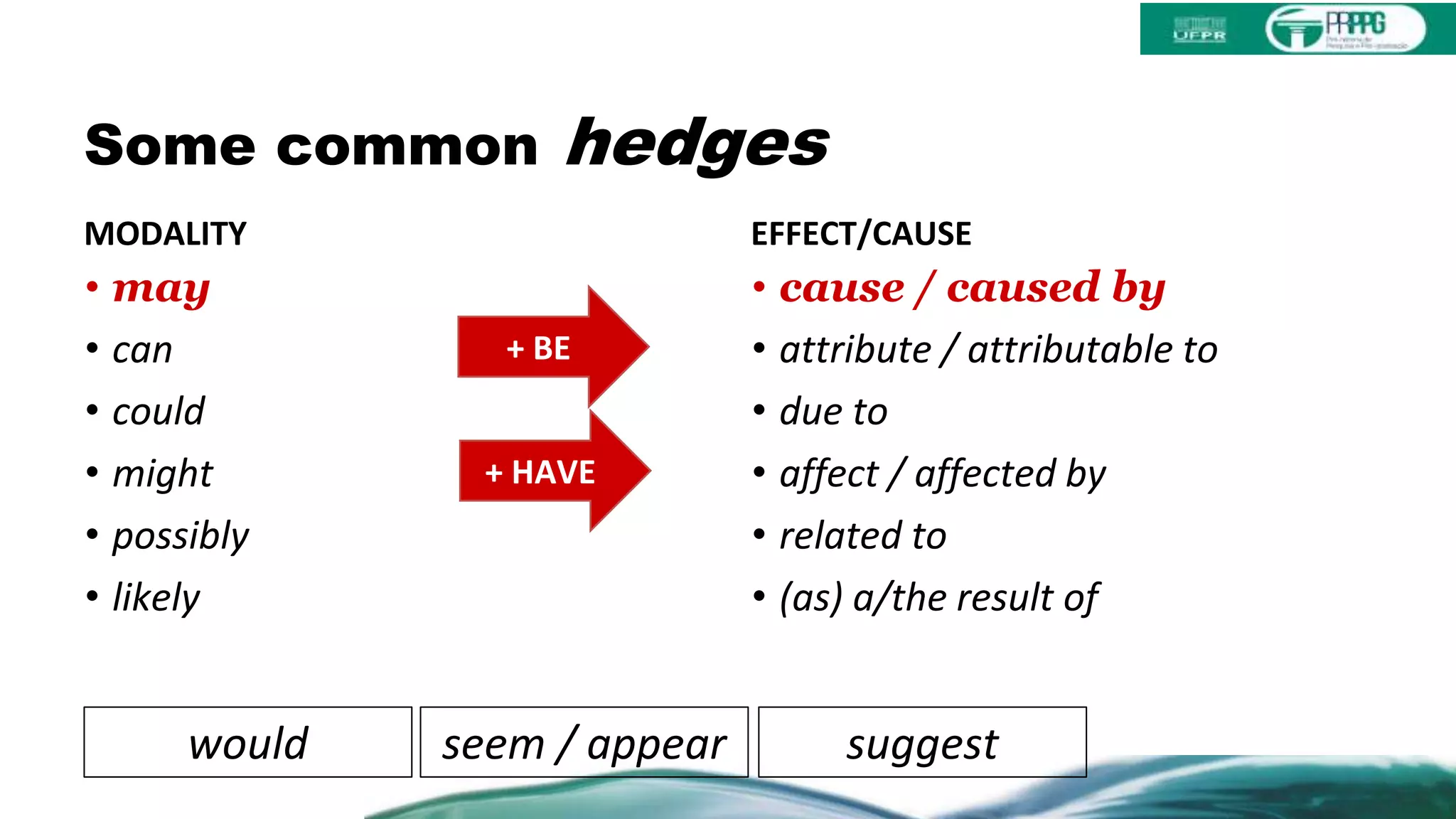
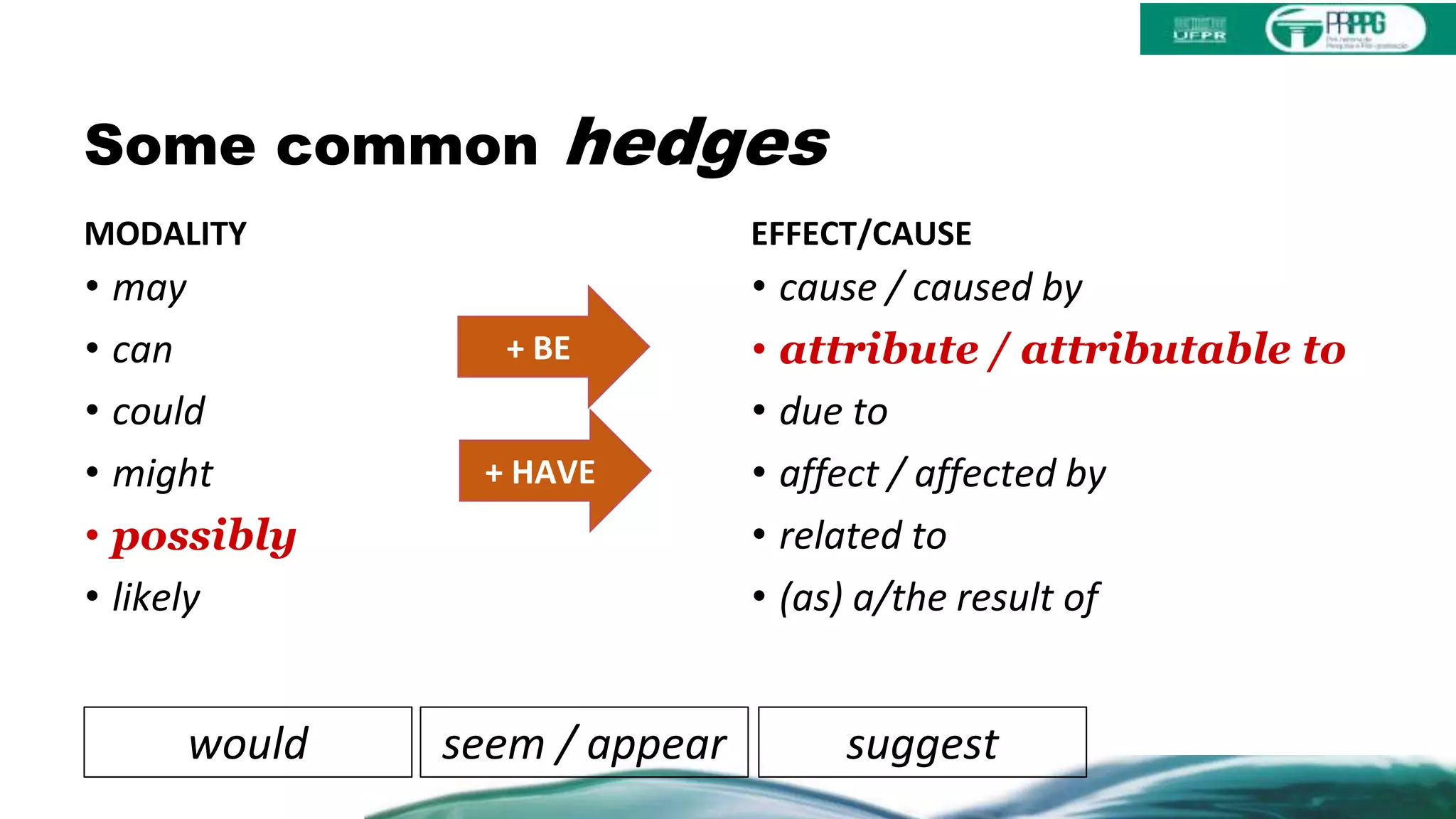
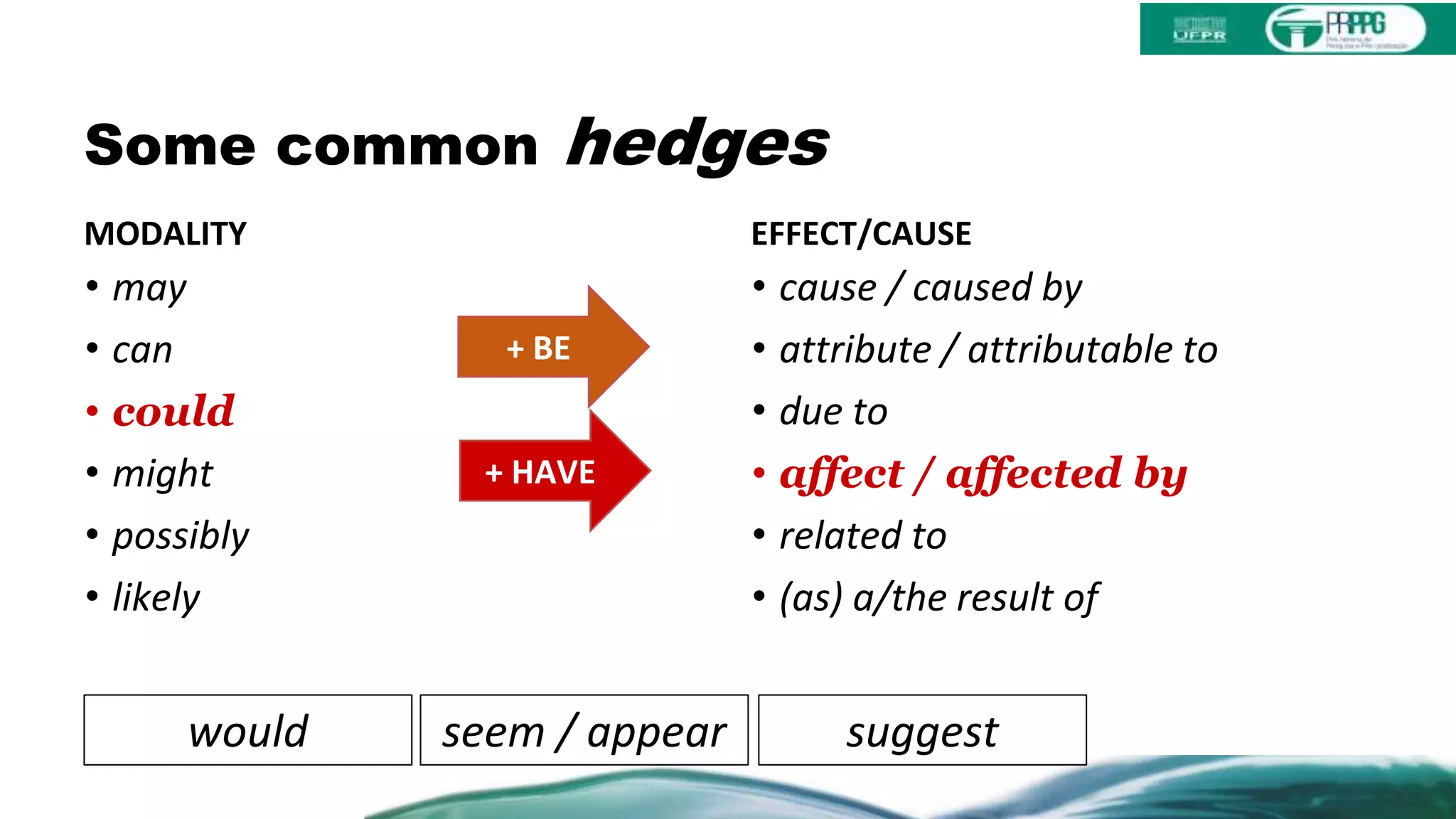
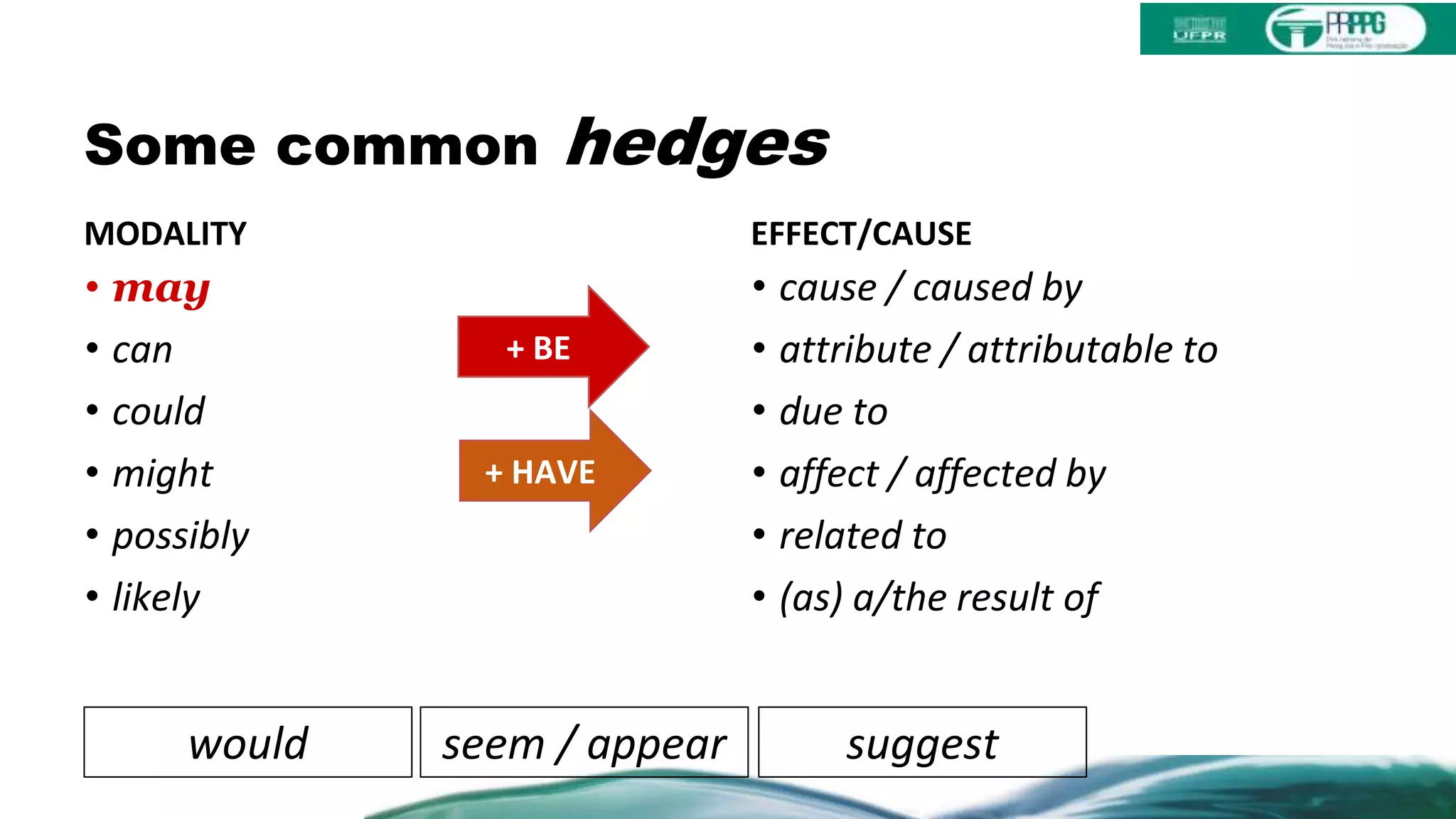
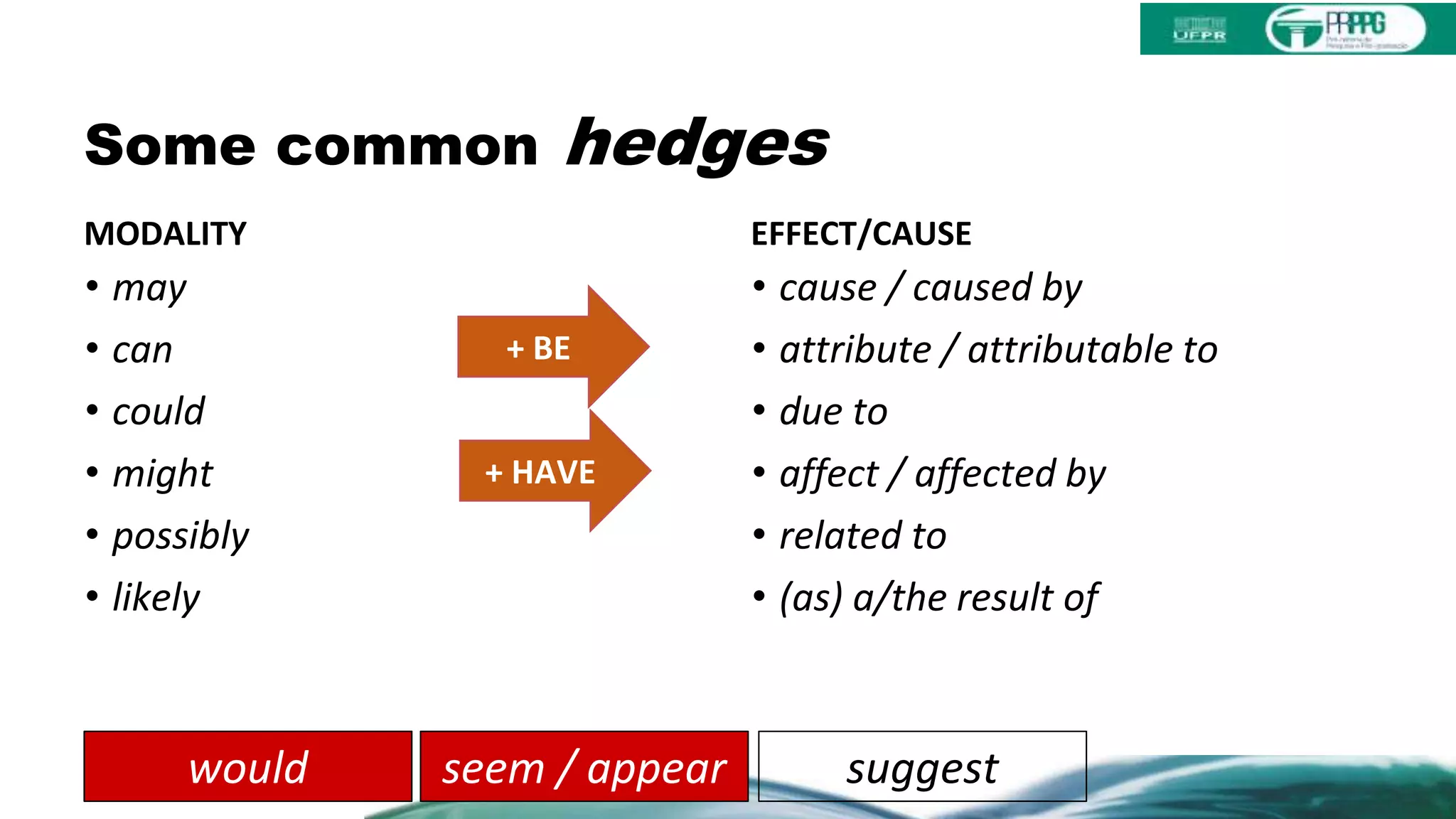
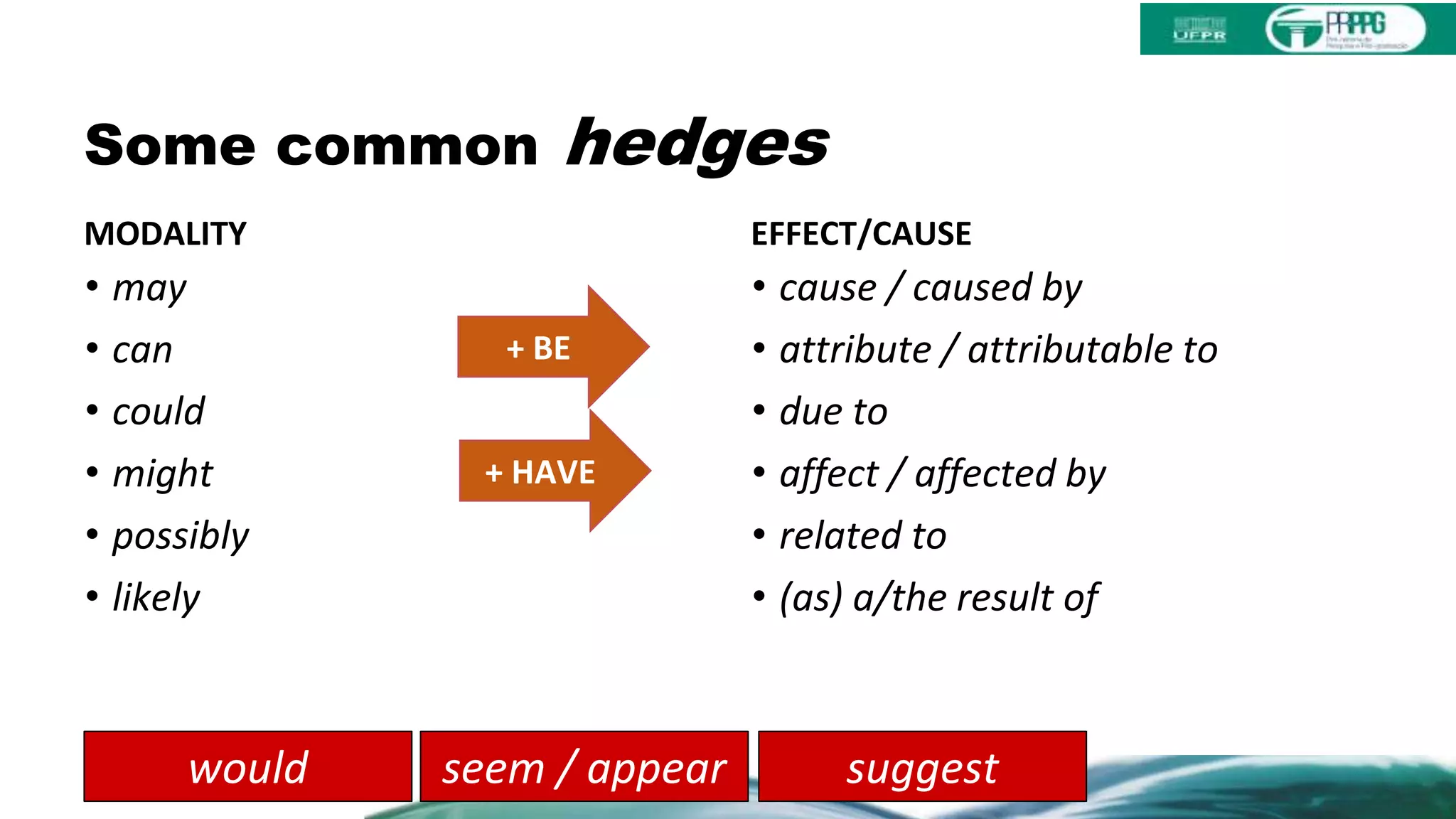
Some common hedges
MODALITY
• may
• can
• could
• might
• possibly
• likely
EFFECT/CAUSE
• cause / caused by
• attribute / attributable to
• due to
• affect / affected by
• related to
• (as) a/the result of
+ BE
+ HAVE
suggestseem / appearwould
For example...
Some common hedges
MODALITY
• may
• can
• could
• might
• possibly
• likely
EFFECT/CAUSE
• cause / caused by
• attribute / attributable to
• due to
• affect / affected by
• related to
• (as) a/the result of
+ BE
+ HAVE
suggestseem / appearwould
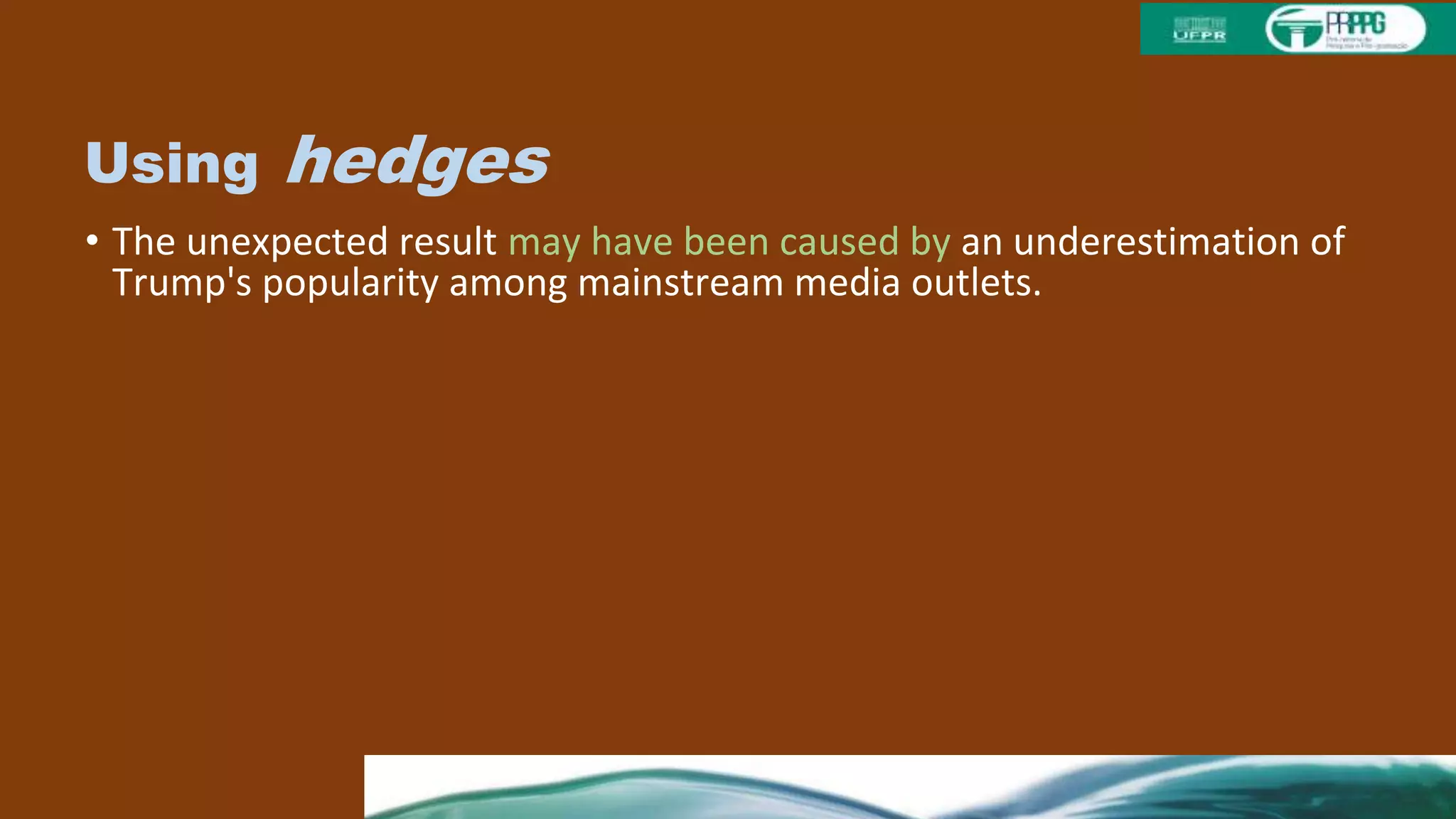
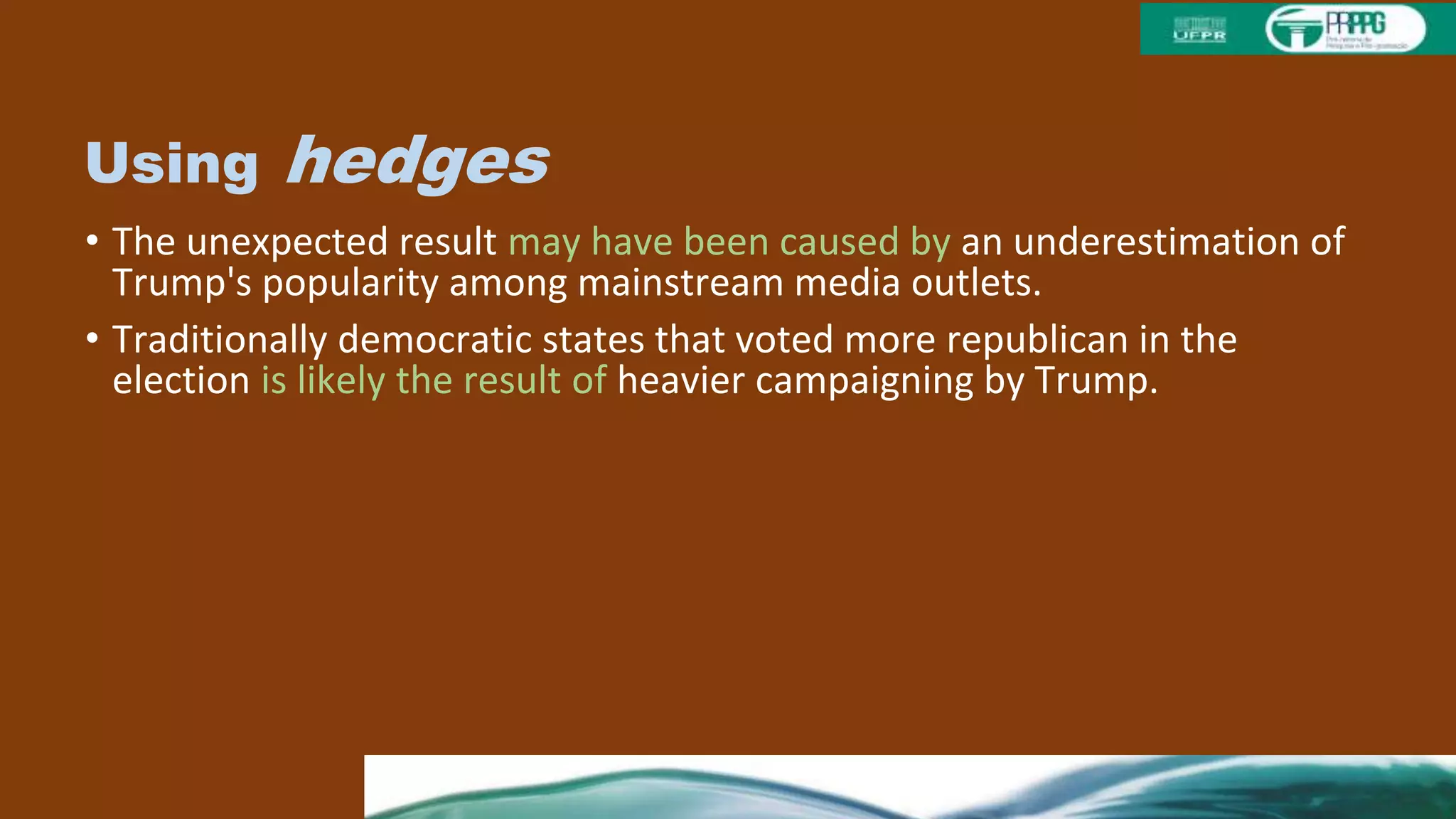
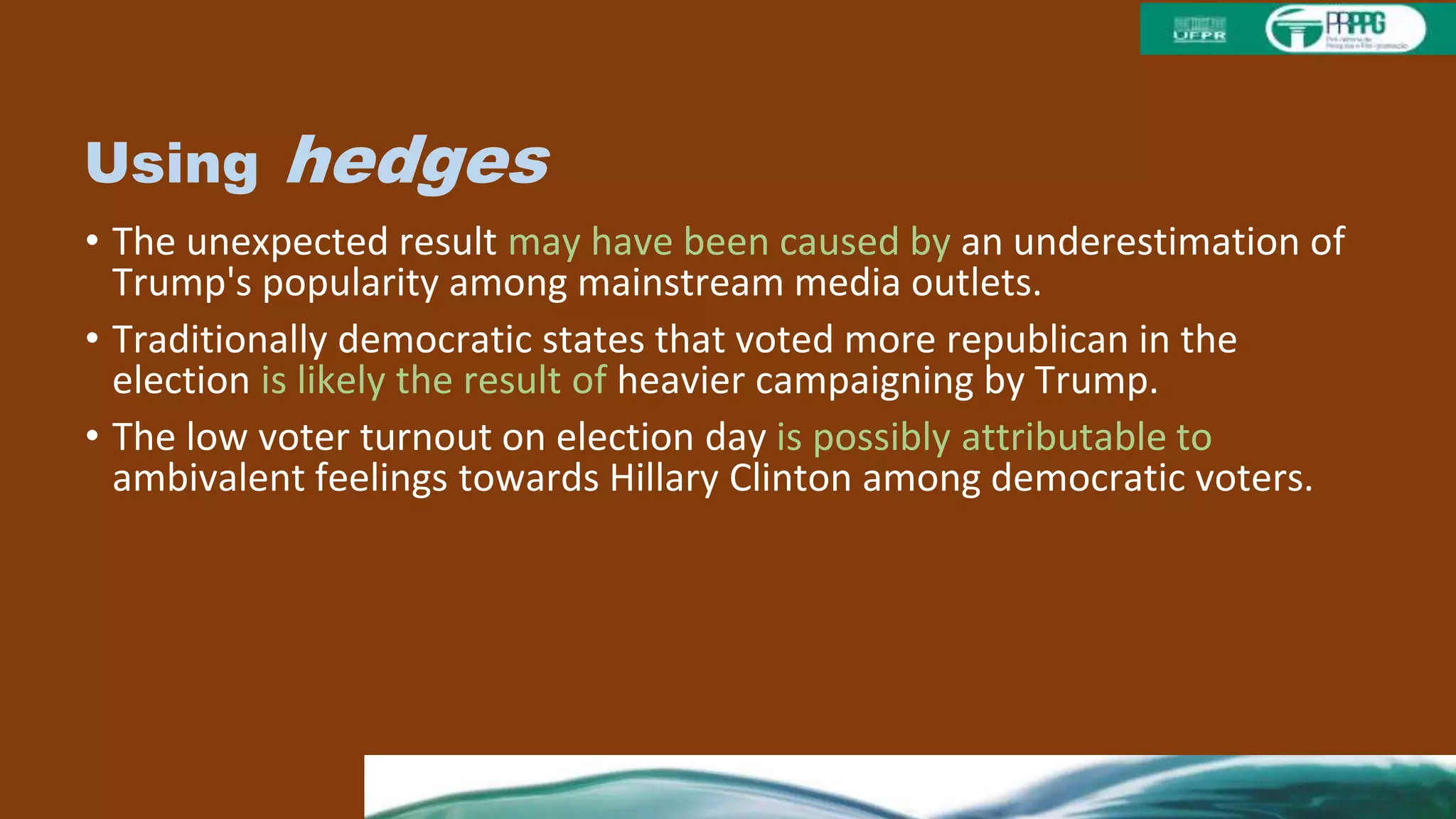
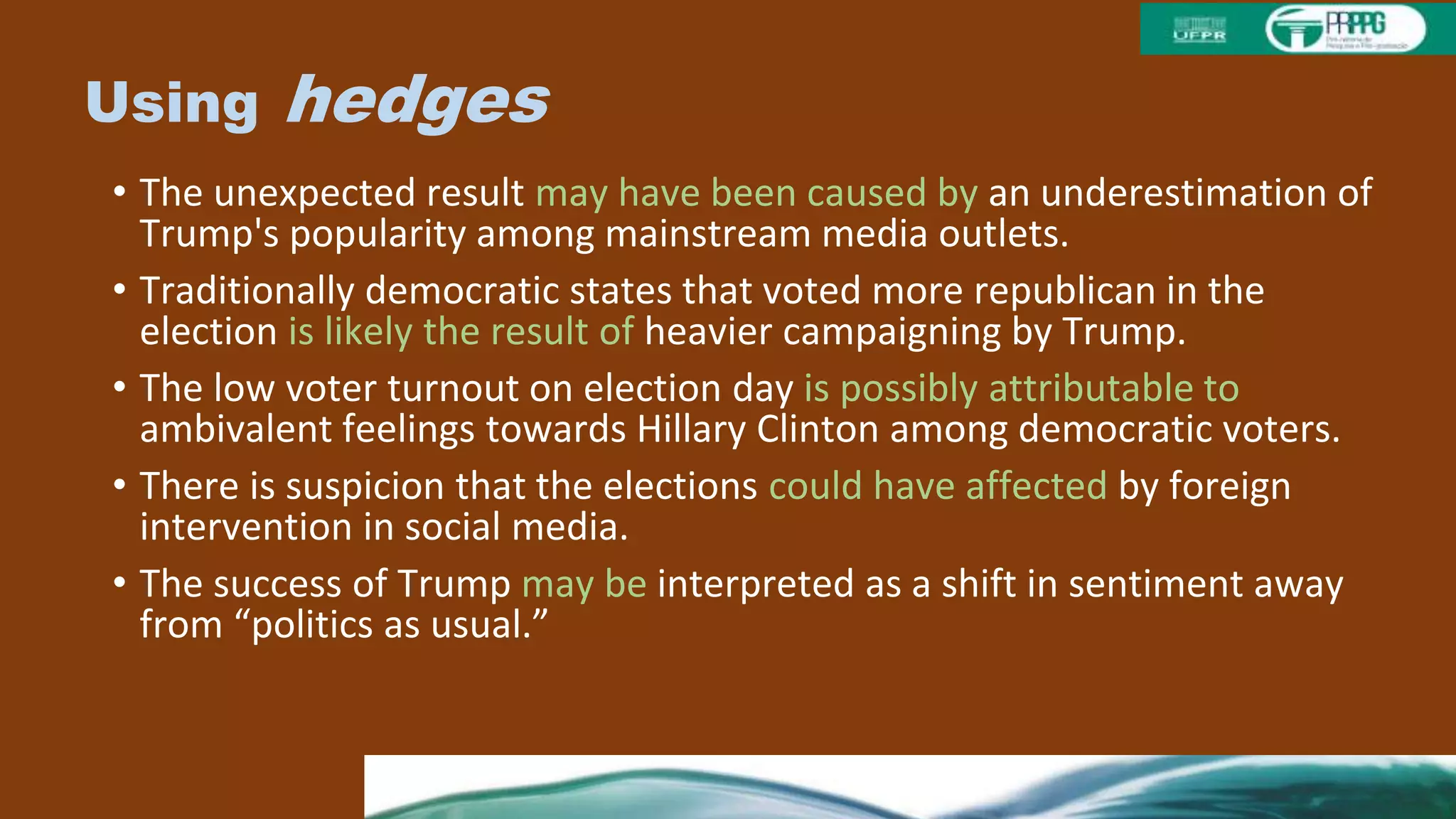
Using hedges
• The unexpected result may have been caused by an underestimation of
Trump's popularity among mainstream media outlets.
• Traditionally democratic states that voted more republican in the
election is likely the result of heavier campaigning by Trump.
• The low voter turnout on election day is possibly attributable to
ambivalent feelings towards Hillary Clinton among democratic voters.
• The recent mass influx of Syrian refugees could have affected voter
sentiment in favor of Trump.
• In future elections, it may be useful to verify emotional stability and
cognitive functioning before allowing a candidate to run for president.
Some common hedges
MODALITY
• may
• can
• could
• might
• possibly
• likely
EFFECT/CAUSE
• cause / caused by
• attribute / attributable to
• due to
• affect / affected by
• related to
• (as) a/the result of
+ BE
+ HAVE
suggestseem / appearwould
Using hedges
• The unexpected result may have been caused by an underestimation of
Trump's popularity among mainstream media outlets.
• Traditionally democratic states that voted more republican in the
election is likely the result of heavier campaigning by Trump.
• The low voter turnout on election day is possibly attributable to
ambivalent feelings towards Hillary Clinton among democratic voters.
• The recent mass influx of Syrian refugees could have affected voter
sentiment in favor of Trump.
• In future elections, it may be useful to verify emotional stability and
cogniti.
Some common hedges
MODALITY
• may
• can
• could
• might
• possibly
• likely
EFFECT/CAUSE
• cause / caused by
• attribute / attributable to
• due to
• affect / affected by
• related to
• (as) a/the result of
+ BE
+ HAVE
suggestseem / appearwould
Using hedges
• The unexpected result may have been caused by an underestimation of
Trump's popularity among mainstream media outlets.
• Traditionally democratic states that voted more republican in the
election is likely the result of heavier campaigning by Trump.
• The low voter turnout on election day is possibly attributable to
ambivalent feelings towards Hillary Clinton among democratic voters.
• The recent mass influx of Syrian refugees could have affected voter
sentiment in favor of Trump.
• In future elections, it may be useful to verify emotional stability and
cognit.
Some common hedges
MODALITY
• may
• can
• could
• might
• possibly
• likely
EFFECT/CAUSE
• cause / caused by
• attribute / attributable to
• due to
• affect / affected by
• related to
• (as) a/the result of
+ BE
+ HAVE
suggestseem / appearwould
Using hedges
• The unexpected result may have been caused by an underestimation of
Trump's popularity among mainstream media outlets.
• Traditionally democratic states that voted more republican in the
election is likely the result of heavier campaigning by Trump.
• The low voter turnout on election day is possibly attributable to
ambivalent feelings towards Hillary Clinton among democratic voters.
• There is suspicion that the elections could have affected by foreign
intervention in social media.
• In future elections, it may be useful to verify emotional stability and
cognitive fu
Some common hedges
MODALITY
• may
• can
• could
• might
• possibly
• likely
EFFECT/CAUSE
• cause / caused by
• attribute / attributable to
• due to
• affect / affected by
• related to
• (as) a/the result of
+ BE
+ HAVE
suggestseem / appearwould
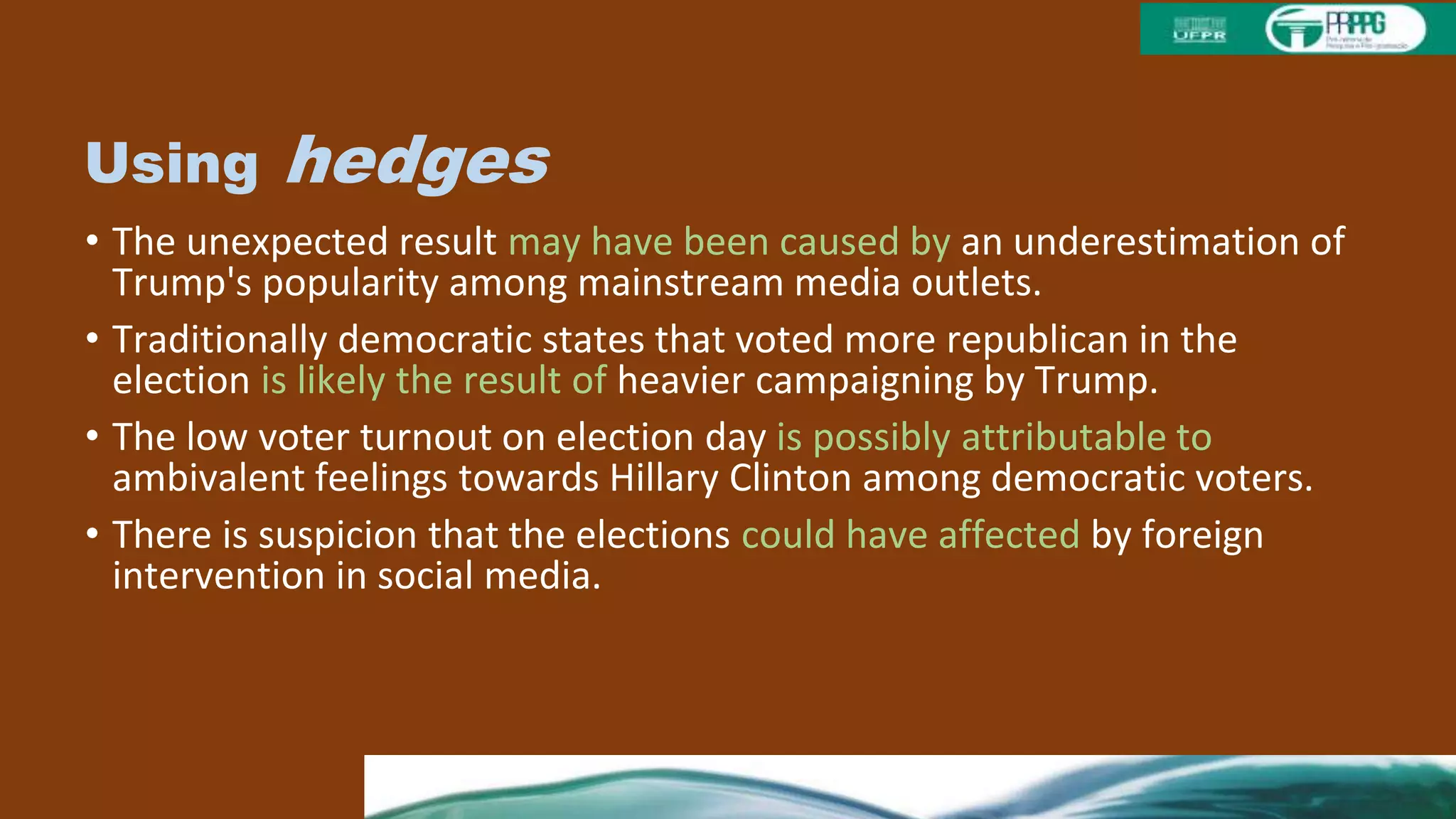
Using hedges
• The unexpected result may have been caused by an underestimation of
Trump's popularity among mainstream media outlets.
• Traditionally democratic states that voted more republican in the
election is likely the result of heavier campaigning by Trump.
• The low voter turnout on election day is possibly attributable to
ambivalent feelings towards Hillary Clinton among democratic voters.
• There is suspicion that the elections could have affected by foreign
intervention in social media.
• The success of Trump may be interpreted as a shift in sentiment away
from “politics as usual.”
Some common hedges
MODALITY
• may
• can
• could
• might
• possibly
• likely
EFFECT/CAUSE
• cause / caused by
• attribute / attributable to
• due to
• affect / affected by
• related to
• (as) a/the result of
+ BE
+ HAVE
suggestseem / appearwould
Some common hedges
MODALITY
• may
• can
• could
• might
• possibly
• likely
EFFECT/CAUSE
• cause / caused by
• attribute / attributable to
• due to
• affect / affected by
• related to
• (as) a/the result of
+ BE
+ HAVE
suggestseem / appearwould
Some common hedges
MODALITY
• may
• can
• could
• might
• possibly
• likely
EFFECT/CAUSE
• cause / caused by
• attribute / attributable to
• due to
• affect / affected by
• related to
• (as) a/the result of
+ BE
+ HAVE
suggestseem / appearwould
Your turn!
Last class...
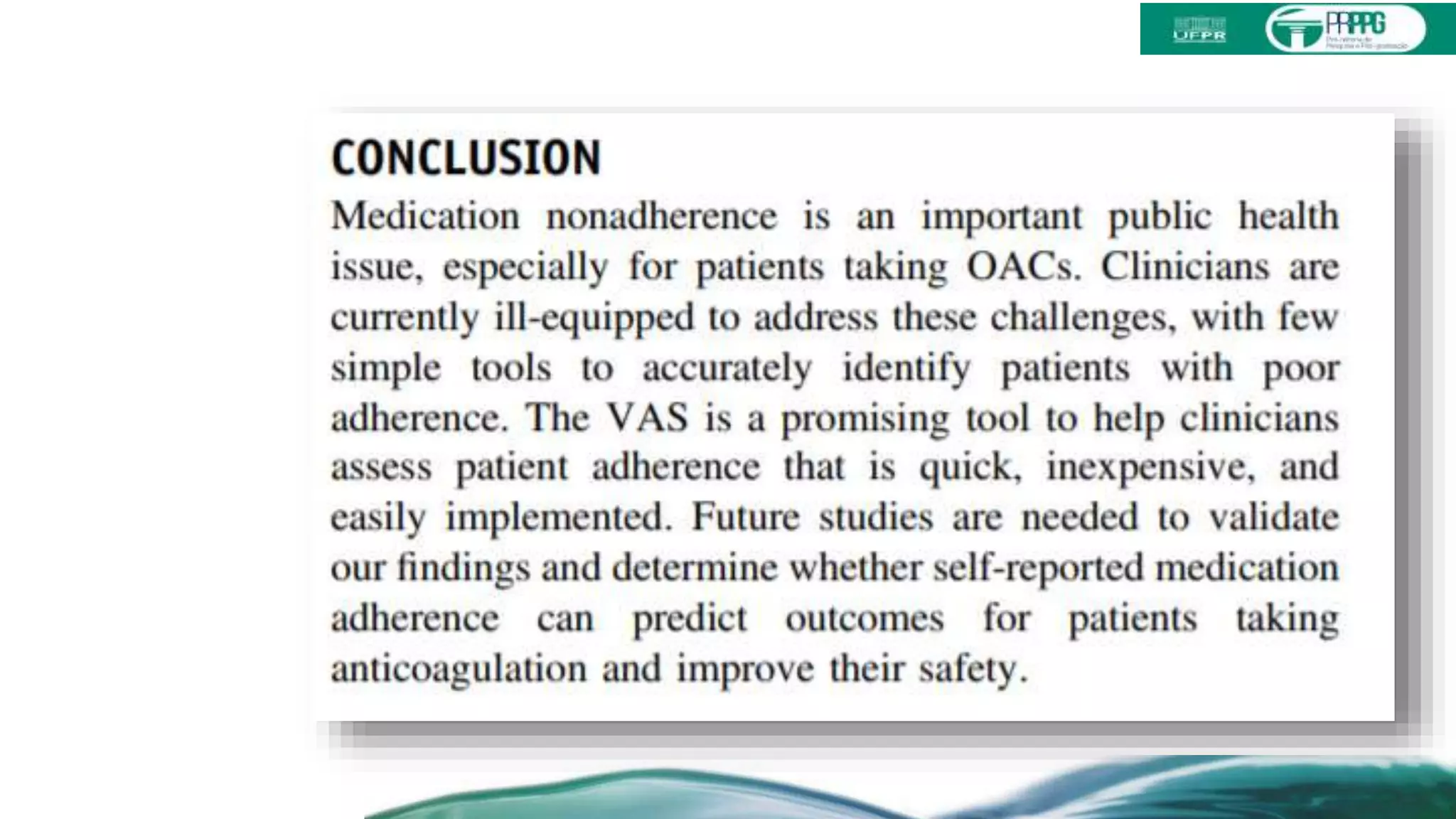
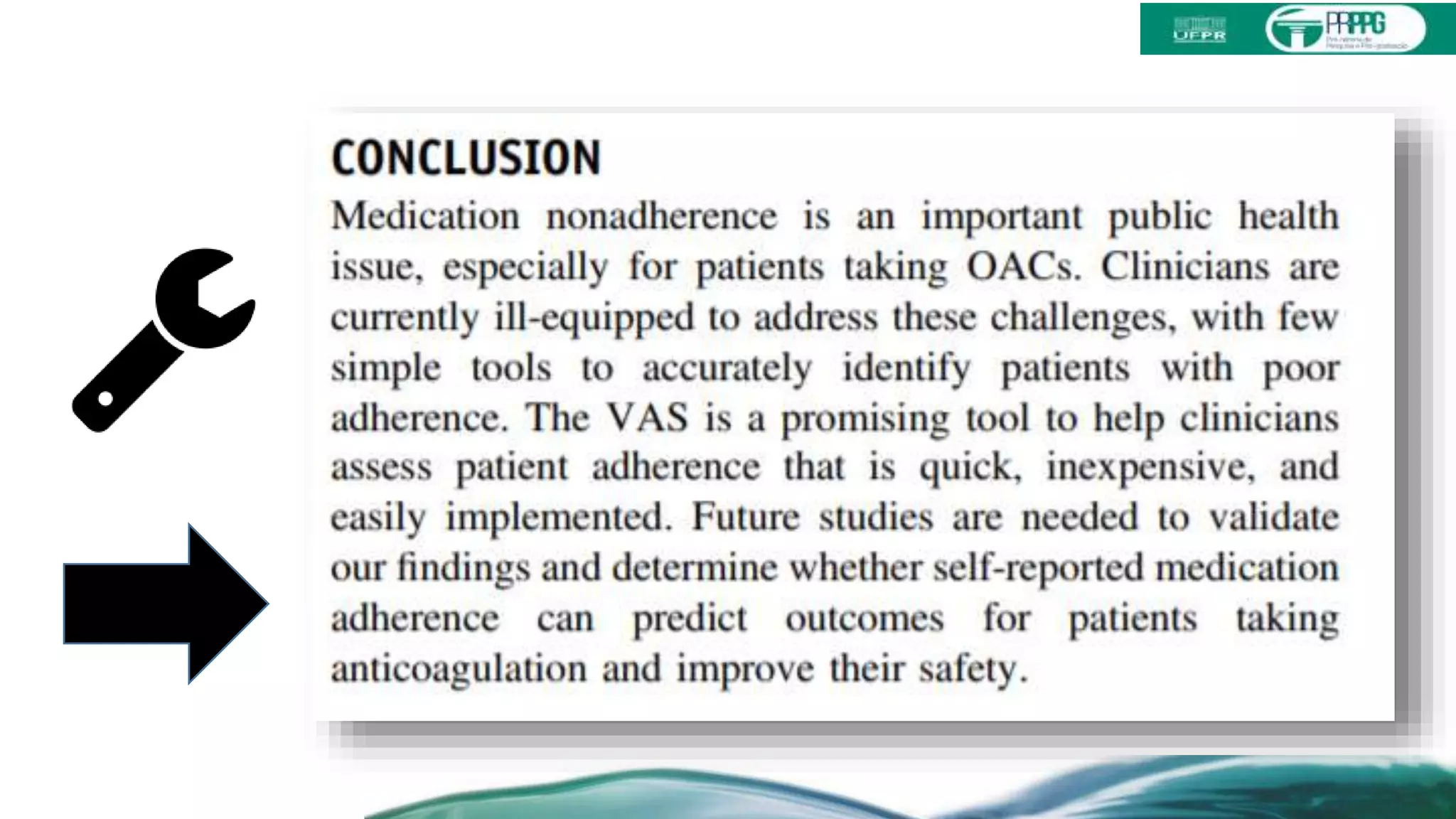
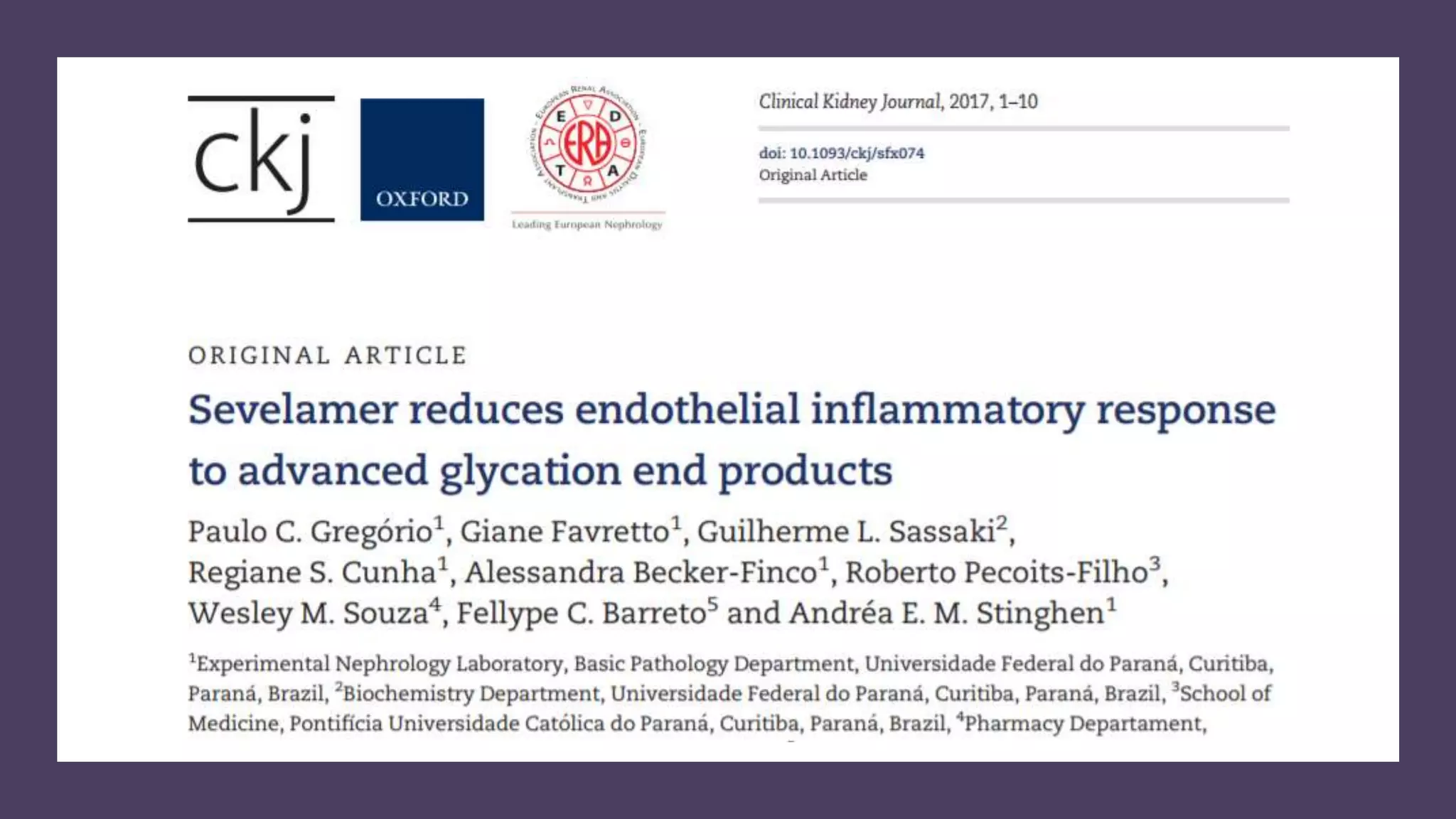
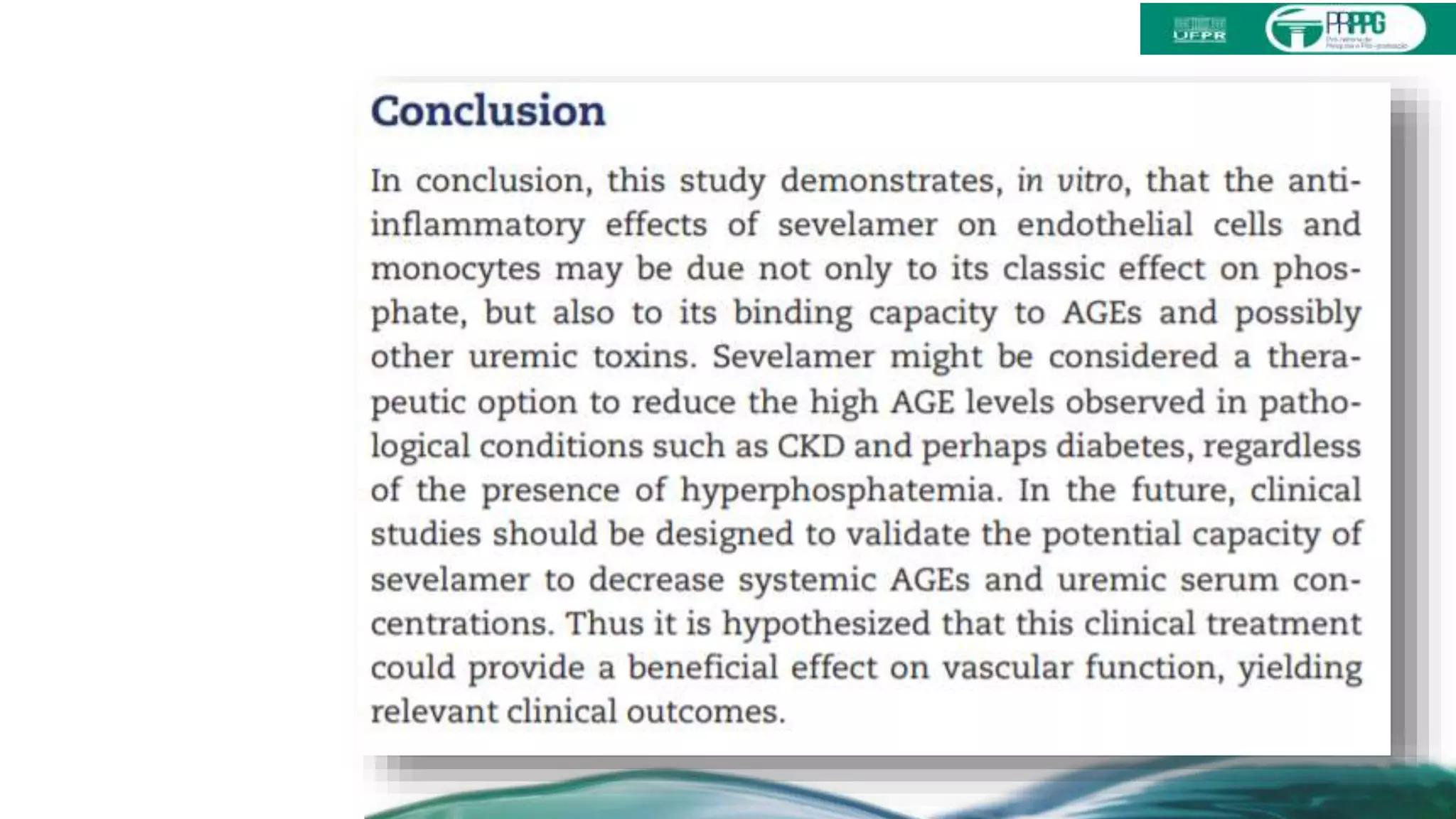
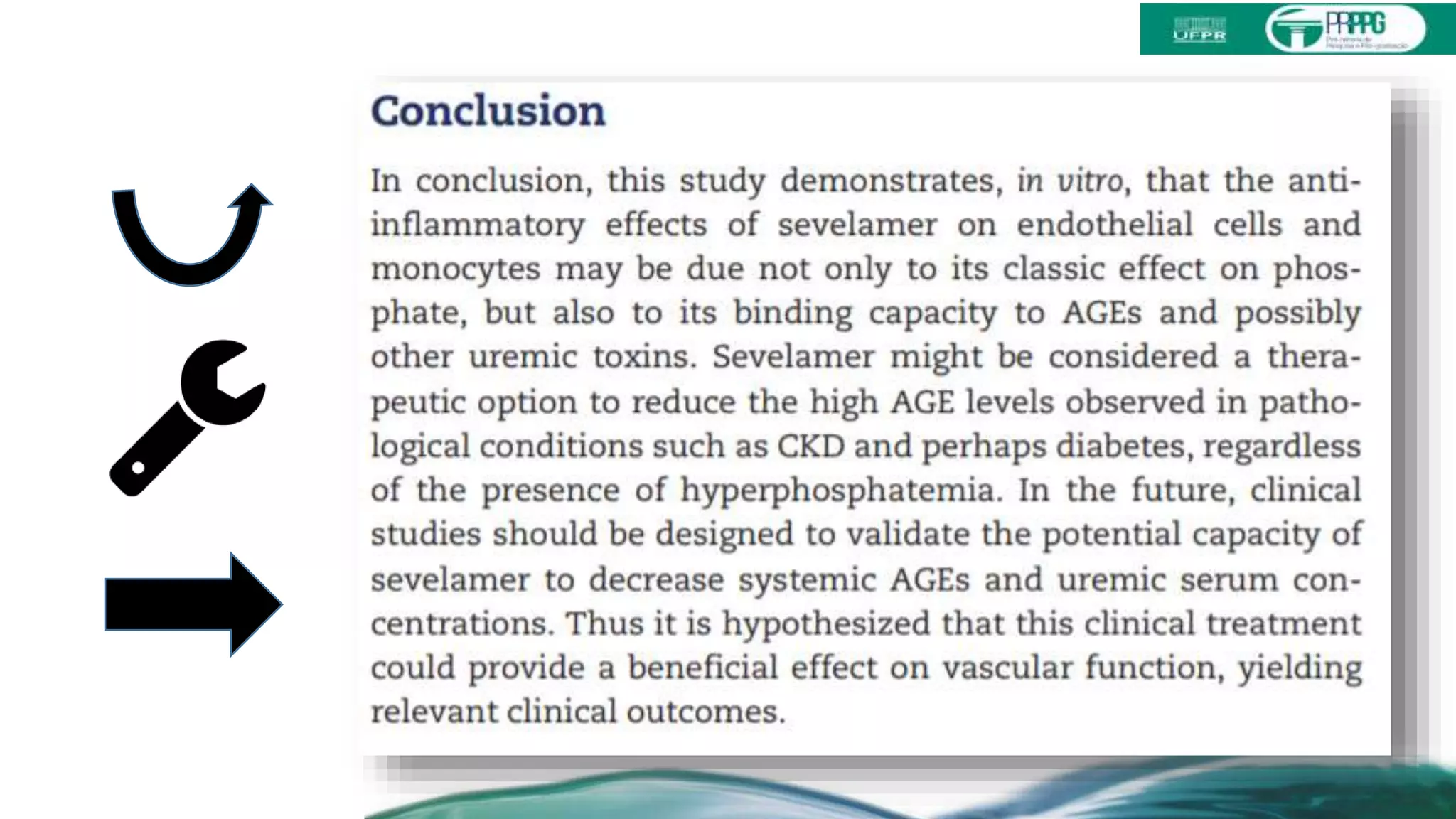
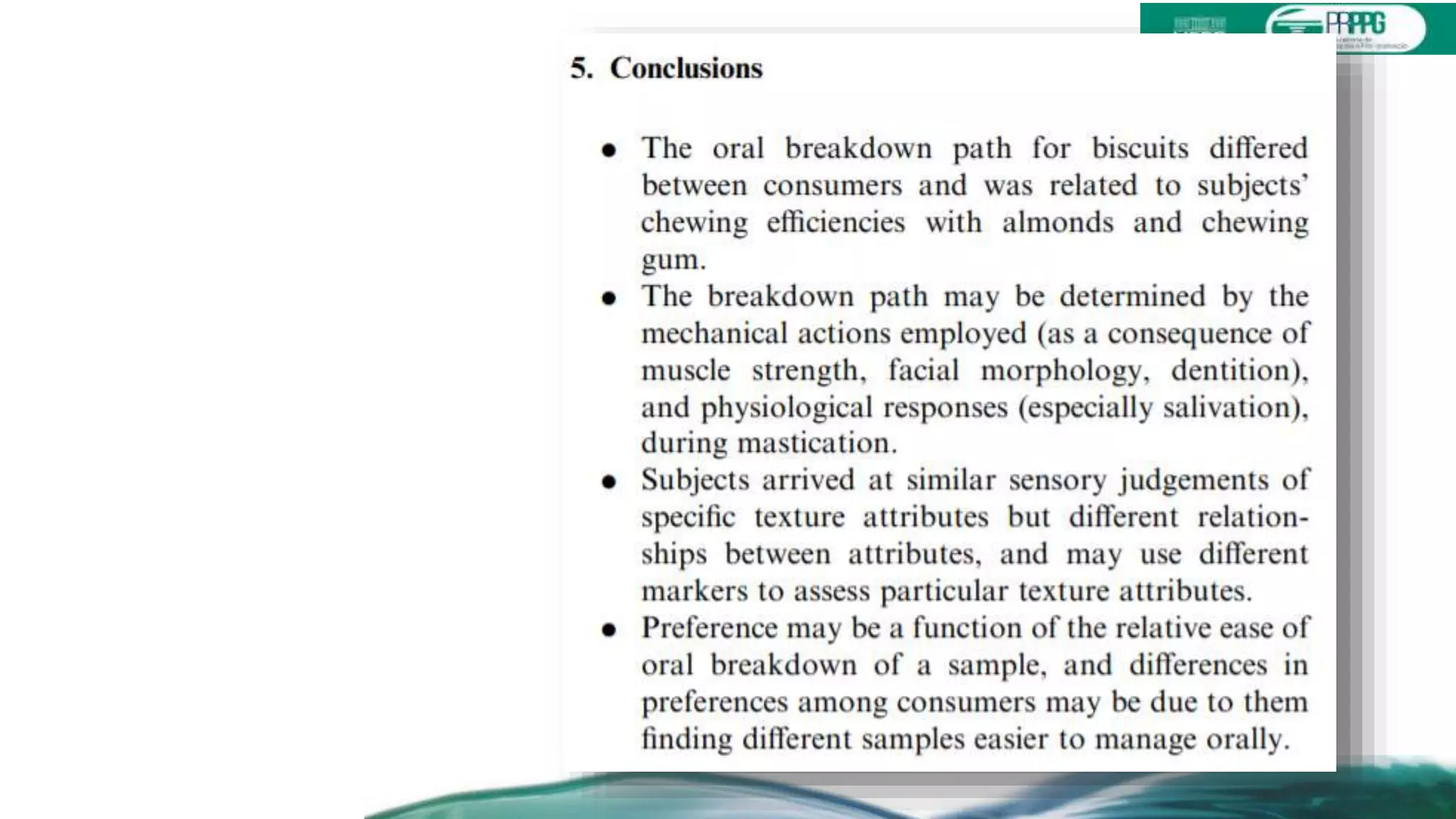
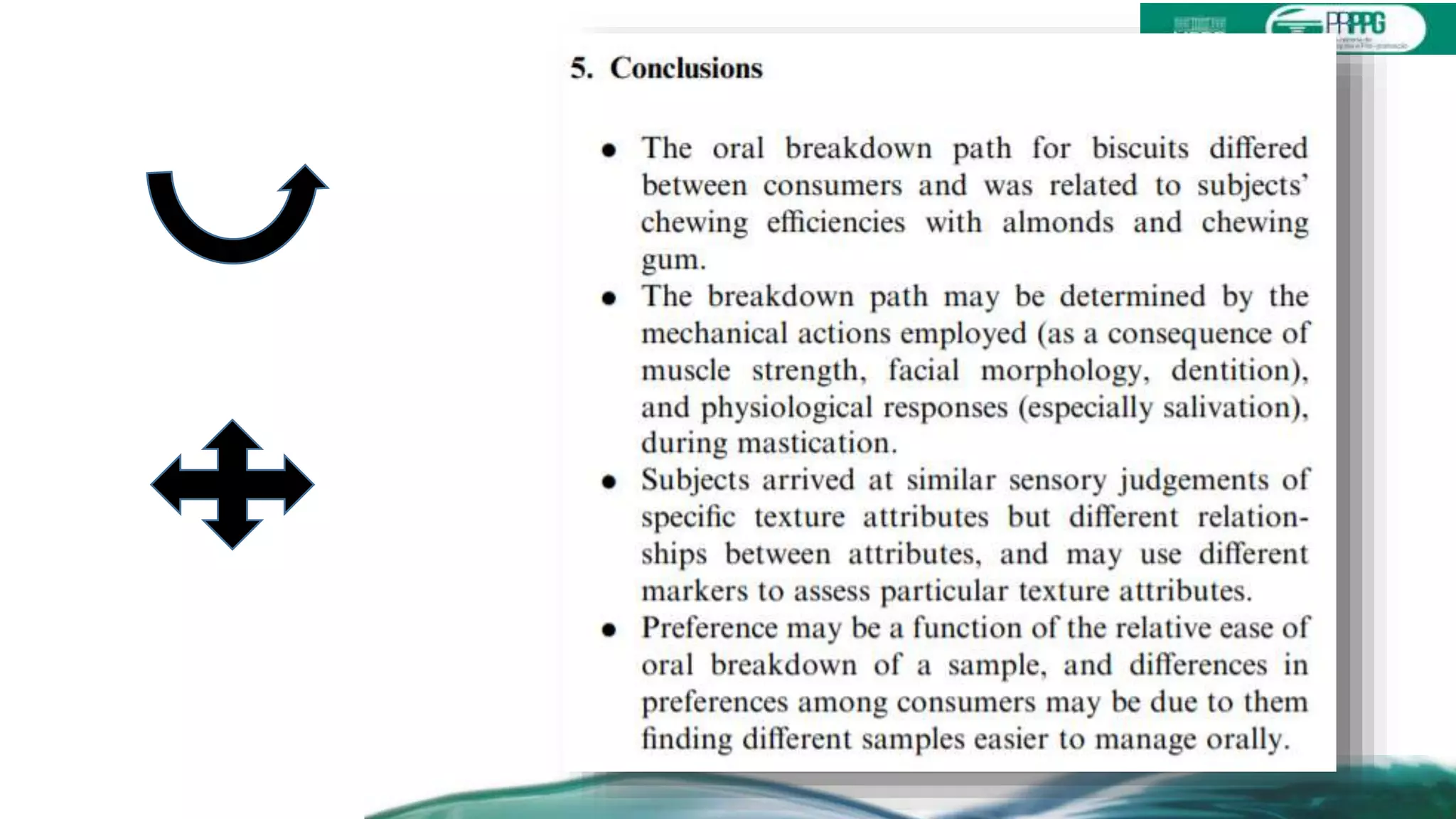
Concluding...
How to conclude?
• Separate section? ("Conclusion")
• Integrated into the Discussion?
• How to signal you are “closing”?
• What should you include?
First: check the journal (you
want to submit to)
Can the Discussion and Conclusion be
integrated?
By next class (13/11):
1. Add your (draft!!!) Discussion/Conclusion section to
your Introduction. Include “hedging” where
appropriate.
2. By 06/11: Submit your (draft!!!) article to
PeerGrade.
3. This assignment counts towards your participation
grade. (Don’t worry if it’s not “complete.”)
Discussing and Concluding  - Academic Writing in English 2019

Discussing and Concluding - Academic Writing in English 2019

  • 1.
    Discussing and concluding Prof.Dr. Ron Martinez PRPPG7000 - Academic Writing in English
  • 2.
    Syllabus outline • 28/08- Introduction • 04/09 - IMRaD, Most common errors, electronic tools • 11/09 - Strategic planning for your article: CARS and other approaches • 18/09 - Title, Abstract e Introduction • 25/09 - Writing your Introduction • 02/10 - Coherence, cohesion and clarity, and use of authorial voice • 09/10 - (Introduction due) The Method section • 16/10- The (Results and) Discussion section • 23/10 - (Introduction peer feedback due) Discussing and Concluding • 30/10 - Writing (no class) • 06/11 - (1st draft article due) Students exchange articles (no class) • 13/11 - Special guest speaker • 20/11 - (1st draft peer feedback due) Plagiarism, the submission process • 18/12 - Final draft of full article due (send also to “orientador”, with evaluation form) • 29/01/2020 - Evaluation form due from orientador
  • 3.
    Introduction peer feedbackwill be returned tomorrow
  • 4.
    Today’s Homework • Downloadand read the article on our class webpage. What elements discussed in today’s class are present? Which are missing? (Respond on Formative.) • Remember to complete feedback on Peer Grade. • Write about your feedback experience on Formative. • If time: Try outlining the rest of your article.
  • 5.
    Comment from astudent “I had never before made contributions to an article proposal for publication. I had the honor of feeling ‘proofreader’. What I liked about the experience is that I had the opportunity to evaluate / comment on two works of two completely different subjects. It was interesting to notice gaps, inconsistent phrases and give meaning to them, to realize what was missing and what was unnecessary in subjects from different areas from mine.”
  • 6.
    Student comment: “Achei divertidoler coisas que outras pessoas escreveram e poder opinar sobre isso. Pena que acabamos lendo algo que não é da nossa área, então fica meio confuso de entender as introduções, mas acredito que isso sirva de alerta para nós mesmo, afinal, precisamos estar atentos ao que iremos escrever, e levar em consideração que nem sempre quem irá ler o nosso artigo, é alguém que entende do assunto.”
  • 7.
    Student comment: “A experiênciafoi muito positiva. Eu já havia realizado correção de prova e comentários a respeito das questões de outros colegas, mas a experiência de dar um feedback sobre um artigo é totalmente diferente. Pelo menos para mim, dar o feedback me fez repensar na minha escrita e no que eu poderia ter feito diferente. Certamente, só de dar esses feedbacks eu já faria (e farei) alterações na minha introdução.”
  • 8.
    Student comment: “I wasimpressed how much I enjoyed reading the introduction of colleagues and being able to evaluate and contribute to their writing. I found it very interesting to be able to see clearly in these texts what we learned in class, and realize that an outside look can be very useful. I'm sure I couldn't have that clear vision when I wrote my own introduction, but analyzing my colleagues' text helped me to see better my own writing. I am sure in the next introductions I will write with more attention and make fewer mistakes.”
  • 9.
    “Eu gostei dosite e de que como ele funciona. Nos dá uma ideia na prática de como as revisões dos artigos acontecem.”
  • 10.
  • 11.
  • 15.
    Back to thatrejection.... Your disussion of the Discussion on Formative
  • 16.
    From a student: “Percebe-seque neste trabalho não há alusão à outras pesquisas na área, durante a discussão a única referência que aparece é a NBR, não tem outros autores. É um trabalho que trata apenas os resultados de forma bem técnica, sem aplicações muito práticas, embora fale da importância do uso do material na construção civil.”
  • 17.
    Student comment: Na seção"results and discussion" do artigo rejeitado o autor só apresenta os resultados do estudo. O autor não conecta a introdução com a discussão revisitando pontos levantados, não compara a pesquisa com outros estudos e não fala de possíveis limitações da pesquisa abrindo uma brecha para novos estudos. Somente na conclusão aparece uma possível aplicação prática do resultado obtido, ou seja, o uso do material desenvolvido na construção civil.
  • 18.
    Another comment: Move 1and move 2 of CARS are missing. In the Discussion topic, I have identified practically none of the six common elements. The discussion is very descriptive missing the discussion itself. In the conclusion topic, there are some implications on points raised in the introduction, but there is a lack of expanding, explaining or extrapolating the initial discussion. Thus, this article needs to be more developed to include the theorization of the results. Also, it is important to write about the limitations.
  • 19.
    “Results” or “Resultsand discussion”? Should you separate them?
  • 20.
    “Readers must beable to distinguish what you found from what you think.” (p. 70)
  • 21.
    3 types ofresults presentation: 1. The data (i.e. the results themselves, the numbers and figures) 2.Inferences (e.g. what your data mean statistically) 3.Interpretation (your explanation of what the results mean)
  • 25.
    Discussion : 6common elements !
  • 26.
    Discussion : 6common elements ! Revisit points raised
  • 27.
    Discussion : 6common elements ! Revisit points raised in the Introduction Compare with other studies
  • 28.
    Discussion : 6common elements ! Revisit points raised in the Introduction Compare with other studies Expand, explain, extrapolate
  • 29.
    Discussion : 6common elements ! Revisit points raised in the Introduction Compare with other studies Expand, explain, extrapolate Talk about applications and practical implications
  • 30.
    Discussion : 6common elements ! Revisit points raised in the Introduction Compare with other studies Expand, explain, extrapolate Talk about applications and practical implications Talk about limitations
  • 31.
    Discussion : 6common elements ! Revisit points raised in the Introduction Compare with other studies Expand, explain, extrapolate Talk about applications and practical implications Talk about limitations Talk about how the study advances the area; what is still needed
  • 32.
    Another comment: Move 1and move 2 of CARS are missing. In the Discussion topic, I have identified practically none of the six common elements. The discussion is very descriptive missing the discussion itself. In the conclusion topic, there are some implications on points raised in the introduction, but there is a lack of expanding, explaining or extrapolating the initial discussion. Thus, this article needs to be more developed to include the theorization of the results. Also, it is important to write about the limitations.
  • 33.
  • 43.
    Abstract Axillary body odoris individually specific and potentially a rich source of information about its producer. Odor individuality partly results from genetic individuality, but the influence of ecological factors such as eating habits are another main source of odor variability. However, we know very little about how particular dietary components shape our body odor. Here we tested the effect of red meat consumption on body odor attractiveness. We used a balanced within- subject experimental design. Seventeen male odor donors were on “meat” or “nonmeat” diet for 2 weeks wearing axillary pads to collect body odor during the final 24 h of the diet. Fresh odor samples were assessed for their pleasantness, attractiveness, masculinity, and intensity by 30 women not using hormonal contraceptives. We repeated the same procedure a month later with the same odor donors, each on the opposite diet than before. Results of repeated measures analysis of variance showed that the odor of donors when on the nonmeat diet was judged as significantly more attractive, more pleasant, and less intense. This suggests that red meat consumption has a negative impact on perceived body odor hedonicity.
  • 44.
    Abstract Axillary body odoris individually specific and potentially a rich source of information about its producer. Odor individuality partly results from genetic individuality, but the influence of ecological factors such as eating habits are another main source of odor variability. However, we know very little about how particular dietary components shape our body odor. Here we tested the effect of red meat consumption on body odor attractiveness. We used a balanced within-subject experimental design. Seventeen male odor donors were on “meat” or “nonmeat” diet for 2 weeks wearing axillary pads to collect body odor during the final 24 h of the diet. Fresh odor samples were assessed for their pleasantness, attractiveness, masculinity, and intensity by 30 women not using hormonal contraceptives. We repeated the same procedure a month later with the same odor donors, each on the opposite diet than before. Results of repeated measures analysis of variance showed that the odor of donors when on the nonmeat diet was judged as significantly more attractive, more pleasant, and less intense. This suggests that red meat consumption has a negative impact on perceived body odor hedonicity.
  • 45.
    Abstract Axillary body odoris individually specific and potentially a rich source of information about its producer. Odor individuality partly results from genetic individuality, but the influence of ecological factors such as eating habits are another main source of odor variability. However, we know very little about how particular dietary components shape our body odor. Here we tested the effect of red meat consumption on body odor attractiveness. We used a balanced within-subject experimental design. Seventeen male odor donors were on “meat” or “nonmeat” diet for 2 weeks wearing axillary pads to collect body odor during the final 24 h of the diet. Fresh odor samples were assessed for their pleasantness, attractiveness, masculinity, and intensity by 30 women not using hormonal contraceptives. We repeated the same procedure a month later with the same odor donors, each on the opposite diet than before. Results of repeated measures analysis of variance showed that the odor of donors when on the nonmeat diet was judged as significantly more attractive, more pleasant, and less intense. This suggests that red meat consumption has a negative impact on perceived body odor hedonicity.
  • 46.
    Abstract Axillary body odoris individually specific and potentially a rich source of information about its producer. Odor individuality partly results from genetic individuality, but the influence of ecological factors such as eating habits are another main source of odor variability. However, we know very little about how particular dietary components shape our body odor. Here we tested the effect of red meat consumption on body odor attractiveness. We used a balanced within-subject experimental design. Seventeen male odor donors were on “meat” or “nonmeat” diet for 2 weeks wearing axillary pads to collect body odor during the final 24 h of the diet. Fresh odor samples were assessed for their pleasantness, attractiveness, masculinity, and intensity by 30 women not using hormonal contraceptives. We repeated the same procedure a month later with the same odor donors, each on the opposite diet than before. Results of repeated measures analysis of variance showed that the odor of donors when on the nonmeat diet was judged as significantly more attractive, more pleasant, and less intense. This suggests that red meat consumption has a negative impact on perceived body odor hedonicity.
  • 47.
    Abstract Axillary body odoris individually specific and potentially a rich source of information about its producer. Odor individuality partly results from genetic individuality, but the influence of ecological factors such as eating habits are another main source of odor variability. However, we know very little about how particular dietary components shape our body odor. Here we tested the effect of red meat consumption on body odor attractiveness. We used a balanced within-subject experimental design. Seventeen male odor donors were on “meat” or “nonmeat” diet for 2 weeks wearing axillary pads to collect body odor during the final 24 h of the diet. Fresh odor samples were assessed for their pleasantness, attractiveness, masculinity, and intensity by 30 women not using hormonal contraceptives. We repeated the same procedure a month later with the same odor donors, each on the opposite diet than before. Results of repeated measures analysis of variance showed that the odor of donors when on the nonmeat diet was judged as significantly more attractive, more pleasant, and less intense. This suggests that red meat consumption has a negative impact on perceived body odor hedonicity.
  • 48.
    Abstract Axillary body odoris individually specific and potentially a rich source of information about its producer. Odor individuality partly results from genetic individuality, but the influence of ecological factors such as eating habits are another main source of odor variability. However, we know very little about how particular dietary components shape our body odor. Here we tested the effect of red meat consumption on body odor attractiveness. We used a balanced within- subject experimental design. Seventeen male odor donors were on “meat” or “nonmeat” diet for 2 weeks wearing axillary pads to collect body odor during the final 24 h of the diet. Fresh odor samples were assessed for their pleasantness, attractiveness, masculinity, and intensity by 30 women not using hormonal contraceptives. We repeated the same procedure a month later with the same odor donors, each on the opposite diet than before. Results of repeated measures analysis of variance showed that the odor of donors when on the nonmeat diet was judged as significantly more attractive, more pleasant, and less intense. This suggests that red meat consumption has a negative impact on perceived body odor hedonicity.
  • 49.
    Abstract Axillary body odoris individually specific and potentially a rich source of information about its producer. Odor individuality partly results from genetic individuality, but the influence of ecological factors such as eating habits are another main source of odor variability. However, we know very little about how particular dietary components shape our body odor. Here we tested the effect of red meat consumption on body odor attractiveness. We used a balanced within- subject experimental design. Seventeen male odor donors were on “meat” or “nonmeat” diet for 2 weeks wearing axillary pads to collect body odor during the final 24 h of the diet. Fresh odor samples were assessed for their pleasantness, attractiveness, masculinity, and intensity by 30 women not using hormonal contraceptives. We repeated the same procedure a month later with the same odor donors, each on the opposite diet than before. Results of repeated measures analysis of variance showed that the odor of donors when on the nonmeat diet was judged as significantly more attractive, more pleasant, and less intense. This suggests that red meat consumption has a negative impact on perceived body odor hedonicity.
  • 50.
    Abstract Axillary body odoris individually specific and potentially a rich source of information about its producer. Odor individuality partly results from genetic individuality, but the influence of ecological factors such as eating habits are another main source of odor variability. However, we know very little about how particular dietary components shape our body odor. Here we tested the effect of red meat consumption on body odor attractiveness. We used a balanced within- subject experimental design. Seventeen male odor donors were on “meat” or “nonmeat” diet for 2 weeks wearing axillary pads to collect body odor during the final 24 h of the diet. Fresh odor samples were assessed for their pleasantness, attractiveness, masculinity, and intensity by 30 women not using hormonal contraceptives. We repeated the same procedure a month later with the same odor donors, each on the opposite diet than before. Results of repeated measures analysis of variance showed that the odor of donors when on the nonmeat diet was judged as significantly more attractive, more pleasant, and less intense. This suggests that red meat consumption has a negative impact on perceived body odor hedonicity.
  • 51.
  • 52.
  • 53.
  • 54.
  • 55.
  • 56.
  • 58.
    Discussion The results ofthis study show for the first time that red meat consumption may have a perceivable impact on axillary body odor. Odors of donors on the nonmeat diet were judged as more pleasant, more attractive, and less intense. This pattern was not influenced by raters' menstrual cycle phase or partnership status. The number of odor donors was relatively small (17 men). However, the nature of the experiment was balanced and within subject. In other words, each rater assessed some donors first in meat condition and some
  • 59.
    Discussion The results ofthis study show for the first time that red meat consumption may have a perceivable impact on axillary body odor. Odors of donors on the nonmeat diet were judged as more pleasant, more attractive, and less intense. This pattern was not influenced by raters' menstrual cycle phase or partnership status. The number of odor donors was relatively small (17 men). However, the nature of the experiment was balanced and within subject. In other words, each rater assessed some donors first in meat condition and some
  • 60.
    Discussion The results ofthis study show for the first time that red meat consumption may have a perceivable impact on axillary body odor. Odors of donors on the nonmeat diet were judged as more pleasant, more attractive, and less intense. This pattern was not influenced by raters' menstrual cycle phase or partnership status. The number of odor donors was relatively small (17 men). However, the nature of the experiment was balanced and within subject. In other words, each rater assessed some donors first in meat condition and some
  • 62.
    The "Naysayer" 1. Inthe "Discussion" section (online), underline/highlight parts that were probably written thinking of the "Naysayer". 2. Compare with others.
  • 63.
  • 64.
    DISCUSSING WITH AWARENESSOF “NAYSAYER”
  • 68.
  • 75.
    TIP: PRACTICE BEINGA NAYSAYER Ask your “orientador” if you can review manuscripts together.
  • 76.
    Discussion : 6common elements ! Revisit points raised in the Introduction Compare with other studies Expand, explain, extrapolate Talk about applications and practical implications Talk about limitations Talk about how the study advances the area; what is still needed
  • 78.
  • 82.
    “Hedging”: Examples 1. Curitibanoshave many umbrellas. This is because umbrellas are easily lost.
  • 83.
    “Hedging”: Examples 1. Curitibanoshave many umbrellas. This is because umbrellas are easily lost. 2. Curitibanos often have many umbrellas. This is because umbrellas are easily lost.
  • 84.
    “Hedging”: Examples 1. Curitibanoshave many umbrellas. This is because umbrellas are easily lost. 2. Curitibanos often have many umbrellas. This is because umbrellas are easily lost. 3. Curitibanos have many umbrellas. This may be because umbrellas are easily lost. 4. Curitibanos are known to have many umbrellas. This is because umbrellas can be easily lost. 5. Curitibanos have many umbrellas. This is likely due to the fact that umbrellas are easily lost.
  • 85.
    “Hedging”: Examples 1. Curitibanoshave many umbrellas. This is because umbrellas are easily lost. 2. Curitibanos often have many umbrellas. This is because umbrellas are easily lost. 3. Curitibanos have many umbrellas. This may be because umbrellas are easily lost. 4. Curitibanos are known to have many umbrellas. This is because umbrellas can be easily lost. 5. Curitibanos have many umbrellas. This is likely due to the fact that umbrellas are easily lost.
  • 86.
    “Hedging”: Examples 1. Curitibanoshave many umbrellas. This is because umbrellas are easily lost. 2. Curitibanos often have many umbrellas. This is because umbrellas are easily lost. 3. Curitibanos have many umbrellas. This may be because umbrellas are easily lost. 4. Curitibanos are known to have many umbrellas. This is because umbrellas can be easily lost. 5. Curitibanos have many umbrellas. This is likely due to the fact that umbrellas are easily lost.
  • 87.
    “Hedging”: Examples 1. Curitibanoshave many umbrellas. This is because umbrellas are easily lost. 2. Curitibanos often have many umbrellas. This is because umbrellas are easily lost. 3. Curitibanos have many umbrellas. This may be because umbrellas are easily lost. 4. Curitibanos are known to have many umbrellas. This is because umbrellas can be easily lost. 5. Curitibanos have many umbrellas. This is likely due to the fact that umbrellas are easily lost.
  • 88.
    Hedging: a definition Inacademic writing, a “hedge” is a word or phrase used by the author(s) to show they are being careful about their claims.
  • 90.
    Hedging (when discussingresults) Current knowledge allows us only to speculate what particular compounds and metabolic processes are responsible for hedonic changes in body odor after the meat consumption. We propose that it could be due to changes in amount and/or relative abundance of aliphatic acids. The axillary region contains abundant numbers of apocrine glands producing milky secretions. Fresh apocrine secretion is odorless but is rapidly converted by axillary microflora to odorous breakdown products. Of particular interest are corynobacteria A as they metabolize fatty acids to short aliphatic acids (James et al. 2004). Chromatographic examination of axillary sweat found a number of both saturated and unsaturated and branched and nonbranched aliphatic acids particularly of C5–C11 length (Zeng et al. 1991). If this is the case, we may expect a correlation between the change in the odor and fat proportion in meat.
  • 91.
    Hedging (when discussingresults) Current knowledge allows us only to speculate what particular compounds and metabolic processes are responsible for hedonic changes in body odor after the meat consumption. We propose that it could be due to changes in amount and/or relative abundance of aliphatic acids. The axillary region contains abundant numbers of apocrine glands producing milky secretions. Fresh apocrine secretion is odorless but is rapidly converted by axillary microflora to odorous breakdown products. Of particular interest are corynobacteria A as they metabolize fatty acids to short aliphatic acids (James et al. 2004). Chromatographic examination of axillary sweat found a number of both saturated and unsaturated and branched and nonbranched aliphatic acids particularly of C5–C11 length (Zeng et al. 1991). If this is the case, we may expect a correlation between the change in the odor and fat proportion in meat.
  • 92.
    Guiding the reader:Title, Abstract and Introduction Prof. Dr. Ron Martinez PRPPG7000 - Academic Writing in English
  • 93.
    Prof. Dr. RonMartinez - UFPR
  • 94.
    Prof. Dr. RonMartinez - UFPR CLAIM
  • 95.
    Prof. Dr. RonMartinez - UFPR CLAIM EVIDENCE
  • 97.
  • 98.
  • 99.
  • 100.
  • 101.
  • 102.
  • 103.
  • 104.
    Hedging (when discussingresults) Current knowledge allows us only to speculate what particular compounds and metabolic processes are responsible for hedonic changes in body odor after the meat consumption. We propose that it could be due to changes in amount and/or relative abundance of aliphatic acids. The axillary region contains abundant numbers of apocrine glands producing milky secretions. Fresh apocrine secretion is odorless but is rapidly converted by axillary microflora to odorous breakdown products. Of particular interest are corynobacteria A as they metabolize fatty acids to short aliphatic acids (James et al. 2004). Chromatographic examination of axillary sweat found a number of both saturated and unsaturated and branched and nonbranched aliphatic acids particularly of C5–C11 length (Zeng et al. 1991). If this is the case, we may expect a correlation between the change in the odor and fat proportion in meat.
  • 105.
    Hedging Current knowledge allowsus only to speculate what particular compounds and metabolic processes are responsible for hedonic changes in body odor after the meat consumption. We propose that it could be due to changes in amount and/or relative abundance of aliphatic acids. The axillary region contains abundant numbers of apocrine glands producing milky secretions. Fresh apocrine secretion is odorless but is rapidly converted by axillary microflora to odorous breakdown products. Of particular interest are corynobacteria A as they metabolize fatty acids to short aliphatic acids (James et al. 2004). Chromatographic examination of axillary sweat found a number of both saturated and unsaturated and branched and nonbranched aliphatic acids particularly of C5–C11 length (Zeng et al. 1991). If this is the case, we may expect a correlation between the change in the odor and fat proportion in meat. CLAIM
  • 106.
    Hedging Current knowledge allowsus only to speculate what particular compounds and metabolic processes are responsible for hedonic changes in body odor after the meat consumption. We propose that it could be due to changes in amount and/or relative abundance of aliphatic acids. The axillary region contains abundant numbers of apocrine glands producing milky secretions. Fresh apocrine secretion is odorless but is rapidly converted by axillary microflora to odorous breakdown products. Of particular interest are corynobacteria A as they metabolize fatty acids to short aliphatic acids (James et al. 2004). Chromatographic examination of axillary sweat found a number of both saturated and unsaturated and branched and nonbranched aliphatic acids particularly of C5–C11 length (Zeng et al. 1991). If this is the case, we may expect a correlation between the CLAIM
  • 107.
    Hedging Current knowledge allowsus only to speculate what particular compounds and metabolic processes are responsible for hedonic changes in body odor after the meat consumption. We propose that it could be due to changes in amount and/or relative abundance of aliphatic acids. The axillary region contains abundant numbers of apocrine glands producing milky secretions. Fresh apocrine secretion is odorless but is rapidly converted by axillary microflora to odorous breakdown products. Of particular interest are corynobacteria A as they metabolize fatty acids to short aliphatic acids (James et al. 2004). Chromatographic examination of axillary sweat found a number of both saturated and unsaturated and branched and nonbranched aliphatic acids particularly of C5–C11 length (Zeng et al. 1991). If this is the case, we may expect a correlation between the change in the odor and fat proportion in meat. CLAIM EVIDENCE
  • 108.
    Hedging Current knowledge allowsus only to speculate what particular compounds and metabolic processes are responsible for hedonic changes in body odor after the meat consumption. We propose that it could be due to changes in amount and/or relative abundance of aliphatic acids. The axillary region contains abundant numbers of apocrine glands producing milky secretions. Fresh apocrine secretion is odorless but is rapidly converted by axillary microflora to odorous breakdown products. Of particular interest are corynobacteria A as they metabolize fatty acids to short aliphatic acids (James et al. 2004). Chromatographic examination of axillary sweat found a number of both saturated and unsaturated and branched and nonbranched aliphatic acids particularly of C5–C11 length (Zeng et al. 1991). If this is the case, we may expect a correlation between the change in the odor and fat proportion in meat. CLAIM “WARRANTING”
  • 109.
    Some common hedges MODALITY •may • can • could • might • possibly • likely EFFECT/CAUSE • cause / caused by • attribute / attributable to • due to • affect / affected by • related to • (as) a result of suggestseem / appearwould
  • 110.
    Some common hedges MODALITY •may • can • could • might • possibly • likely EFFECT/CAUSE • cause / caused by • attribute / attributable to • due to • affect / affected by • related to • (as) a/the result of + BE + HAVE suggestseem / appearwould
  • 111.
  • 113.
    Some common hedges MODALITY •may • can • could • might • possibly • likely EFFECT/CAUSE • cause / caused by • attribute / attributable to • due to • affect / affected by • related to • (as) a/the result of + BE + HAVE suggestseem / appearwould
  • 114.
    Using hedges • Theunexpected result may have been caused by an underestimation of Trump's popularity among mainstream media outlets. • Traditionally democratic states that voted more republican in the election is likely the result of heavier campaigning by Trump. • The low voter turnout on election day is possibly attributable to ambivalent feelings towards Hillary Clinton among democratic voters. • The recent mass influx of Syrian refugees could have affected voter sentiment in favor of Trump. • In future elections, it may be useful to verify emotional stability and cognitive functioning before allowing a candidate to run for president.
  • 115.
    Some common hedges MODALITY •may • can • could • might • possibly • likely EFFECT/CAUSE • cause / caused by • attribute / attributable to • due to • affect / affected by • related to • (as) a/the result of + BE + HAVE suggestseem / appearwould
  • 116.
    Using hedges • Theunexpected result may have been caused by an underestimation of Trump's popularity among mainstream media outlets. • Traditionally democratic states that voted more republican in the election is likely the result of heavier campaigning by Trump. • The low voter turnout on election day is possibly attributable to ambivalent feelings towards Hillary Clinton among democratic voters. • The recent mass influx of Syrian refugees could have affected voter sentiment in favor of Trump. • In future elections, it may be useful to verify emotional stability and cogniti.
  • 117.
    Some common hedges MODALITY •may • can • could • might • possibly • likely EFFECT/CAUSE • cause / caused by • attribute / attributable to • due to • affect / affected by • related to • (as) a/the result of + BE + HAVE suggestseem / appearwould
  • 118.
    Using hedges • Theunexpected result may have been caused by an underestimation of Trump's popularity among mainstream media outlets. • Traditionally democratic states that voted more republican in the election is likely the result of heavier campaigning by Trump. • The low voter turnout on election day is possibly attributable to ambivalent feelings towards Hillary Clinton among democratic voters. • The recent mass influx of Syrian refugees could have affected voter sentiment in favor of Trump. • In future elections, it may be useful to verify emotional stability and cognit.
  • 119.
    Some common hedges MODALITY •may • can • could • might • possibly • likely EFFECT/CAUSE • cause / caused by • attribute / attributable to • due to • affect / affected by • related to • (as) a/the result of + BE + HAVE suggestseem / appearwould
  • 120.
    Using hedges • Theunexpected result may have been caused by an underestimation of Trump's popularity among mainstream media outlets. • Traditionally democratic states that voted more republican in the election is likely the result of heavier campaigning by Trump. • The low voter turnout on election day is possibly attributable to ambivalent feelings towards Hillary Clinton among democratic voters. • There is suspicion that the elections could have affected by foreign intervention in social media. • In future elections, it may be useful to verify emotional stability and cognitive fu
  • 121.
    Some common hedges MODALITY •may • can • could • might • possibly • likely EFFECT/CAUSE • cause / caused by • attribute / attributable to • due to • affect / affected by • related to • (as) a/the result of + BE + HAVE suggestseem / appearwould
  • 122.
    Using hedges • Theunexpected result may have been caused by an underestimation of Trump's popularity among mainstream media outlets. • Traditionally democratic states that voted more republican in the election is likely the result of heavier campaigning by Trump. • The low voter turnout on election day is possibly attributable to ambivalent feelings towards Hillary Clinton among democratic voters. • There is suspicion that the elections could have affected by foreign intervention in social media. • The success of Trump may be interpreted as a shift in sentiment away from “politics as usual.”
  • 123.
    Some common hedges MODALITY •may • can • could • might • possibly • likely EFFECT/CAUSE • cause / caused by • attribute / attributable to • due to • affect / affected by • related to • (as) a/the result of + BE + HAVE suggestseem / appearwould
  • 124.
    Some common hedges MODALITY •may • can • could • might • possibly • likely EFFECT/CAUSE • cause / caused by • attribute / attributable to • due to • affect / affected by • related to • (as) a/the result of + BE + HAVE suggestseem / appearwould
  • 125.
    Some common hedges MODALITY •may • can • could • might • possibly • likely EFFECT/CAUSE • cause / caused by • attribute / attributable to • due to • affect / affected by • related to • (as) a/the result of + BE + HAVE suggestseem / appearwould
  • 126.
  • 127.
  • 129.
  • 130.
    How to conclude? •Separate section? ("Conclusion") • Integrated into the Discussion? • How to signal you are “closing”? • What should you include?
  • 131.
    First: check thejournal (you want to submit to)
  • 143.
    Can the Discussionand Conclusion be integrated?
  • 163.
    By next class(13/11): 1. Add your (draft!!!) Discussion/Conclusion section to your Introduction. Include “hedging” where appropriate. 2. By 06/11: Submit your (draft!!!) article to PeerGrade. 3. This assignment counts towards your participation grade. (Don’t worry if it’s not “complete.”)