THE SACROILIAC JOINT:
To fuse or not to fuse
Azam Basheer MD
Henry Ford Neurosurgery
Azam Basheer
Disclosures
None
Azam Basheer
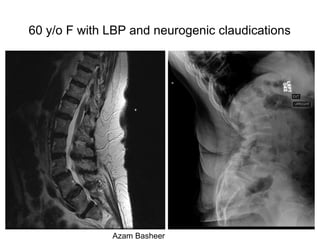
60 y/o F with LBP and neurogenic claudications
Azam Basheer
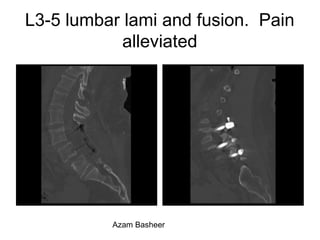
L3-5 lumbar lami and fusion. Pain
alleviated
Azam Basheer
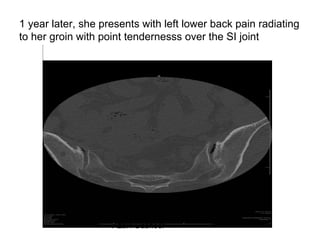
1 year later, she presents with left lower back pain radiating
to her groin with point tendernesss over the SI joint
Azam Basheer
- Diagnosed with left SI joint pain
- Sent to the pain clinic for SI joint injection
which relieves the pain for 3 months and
then returns again with the same
symptoms.
Azam Basheer
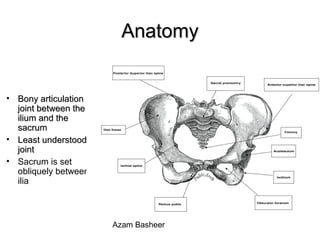
Anatomy
Azam Basheer
AnatomyAnatomy
• Bony articulationBony articulation
joint between thejoint between the
ilium and theilium and the
sacrumsacrum
• Least understoodLeast understood
jointjoint
• Sacrum is set
obliquely between
ilia
Azam Basheer
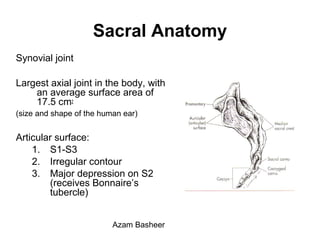
Sacral Anatomy
Synovial joint
Largest axial joint in the body, with
an average surface area of
17.5 cm2
(size and shape of the human ear)
Articular surface:
1. S1-S3
2. Irregular contour
3. Major depression on S2
(receives Bonnaire’s
tubercle)
Azam Basheer
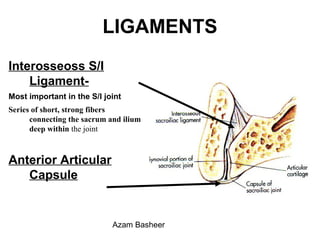
LIGAMENTS
Interosseoss S/I
Ligament-
Most important in the S/I joint
Series of short, strong fibers
connecting the sacrum and ilium
deep within the joint
Anterior Articular
Capsule
Azam Basheer
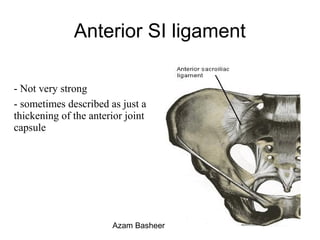
- Not very strong
- sometimes described as just a
thickening of the anterior joint
capsule
Anterior SI ligament
Azam Basheer
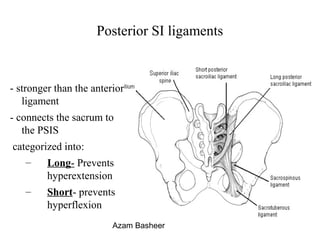
Posterior SI ligaments
- stronger than the anterior
ligament
- connects the sacrum to
the PSIS
categorized into:
– Long- Prevents
hyperextension
– Short- prevents
hyperflexion
Azam Basheer
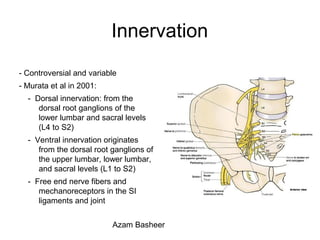
Innervation
- Controversial and variable
- Murata et al in 2001:
- Dorsal innervation: from the
dorsal root ganglions of the
lower lumbar and sacral levels
(L4 to S2)
- Ventral innervation originates
from the dorsal root ganglions of
the upper lumbar, lower lumbar,
and sacral levels (L1 to S2)
- Free end nerve fibers and
mechanoreceptors in the SI
ligaments and joint
Azam Basheer
BIOMECHANICS
Azam Basheer
BiomechanicsBiomechanics
Amphiarthrodial Joint
Minimal movement
Many interlocking osseous structures limits gross excursion
- No muscles acting directly across it.
- Numerous studies on mobility of the sacroiliac joint
have led to a variety of different hypotheses and models
of pelvic mechanics over the years
Azam Basheer
Biomechanics
The primary motions of the sacroiliac joint are nutation and counter-
nutation (flexion and extension about the x-axis)
Rotation and translation about 3 axes of approximately 2-4 degrees
Sturesson et al: flexion and extension was 2.5 ± 0.5° (1.6-3.9°), and a
mean translation of 0.7 mm (0.1 -1.6 mm) along the axes of rotation
Walheim and associates reported between 2 – 3 mm translations and
up to 3 degrees rotational movement
However, SIJ motion occurs simultaneously in multiple planes, not
linearly. Their direction of movement is irregular
Azam Basheer
AGE CHANGES THINGS
ROM is limited increasingly with age
– 0-20 Smooth gliding planes
– 20-50 Interlocking irregularities
– >50 Hypomobility
– >80 Osteophytic, Immobile
Ankylosed in 76% of the population over the age of fifty
Azam Basheer
Function
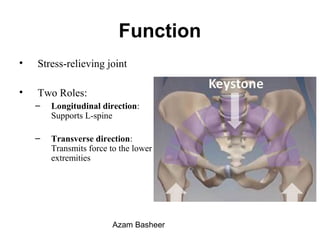
• Stress-relieving joint
• Two Roles:
– Longitudinal direction:
Supports L-spine
– Transverse direction:
Transmits force to the lower
extremities
Azam Basheer
SIJ disease
Azam Basheer
Prevalence
In the late 1980’s, many physicians "rediscovered" the SI joint as
a possible source of back pain
1977, retrospective study by Bernard and Kirkaldy-Willis found a
22.5% prevalence rate of SIJ pain in 1293 adult patients
presenting with LBP
studies have shown that the SI joint is the cause of chronic lower
back pain in 13% – 30% of patients
Azam Basheer
SIJ after Fusion
Clinical studies show a range from 3.2% – 21% of
patients undergoing lumbar fusion report an
incidence of adjacent segmental disease.28
Ha et al. first reported that, based on results from
CT scans and PE, the incidence of SIJ
degeneration in the fusion group was
significantly higher than in the control group (75
vs. 38.2 %, respectively).
Azam Basheer
SIJ after Fusion
Maigne and Planchon prospectively followed 61 pts from 1996 to
2002 after lumbar fusion. 45 developed unilateral persistent
pain (or with unilateral prevalence) for more than 6 months
with a sacroiliac origin.39
Onsel et al. used SPECT to follow up on 753 patients
complaining of lower back pain and found that patients who
had increased uptake of the SI joint, 35% (15 of 43) had prior
lumbar laminectomy and/or spinal fusion.
In 2005 Katz et al. used fluoroscopically guided SI joint injections
to identify the cause of lower back pain in patients following
lumbosacral arthrodesis. They followed 34 patients and found
SI joint dysfunction to be the cause of pain in 32% of the
patients.
Azam Basheer
EVALUATION of the S/I JOINT
Azam Basheer
EVALUATION of the S/I JOINT
Challenging
Wide range of normal anatomy
Cannot directly palpate the joint
You need:
1. Good History
2. Physical exam
3. Imaging
4. X-ray guided injections of lidocaineAzam Basheer
History
– Pain with ascending/descending stairs or standing from a sitting
position
– Pain with hopping or standing on the involved leg
– A positive straight leg raise at, or near, the end of range
– Slipman et al. retrospective study to determine the pain referral
patterns in 50 patients with injection-confirmed SIJ pain. The
most common referral patterns for SIJ pain were found to be
radiation into the buttock (94 %), lower lumbar region (72 %),
lower extremity (50 %), groin area (14 %), upper lumbar lesion
(6 %), and abdomen (2 %).
– The most consistent factor for identifying patients with SIJ pain
is unilateral pain (25% of pts)
Azam Basheer
Exam
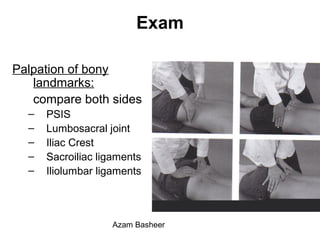
Palpation of bony
landmarks:
compare both sides
– PSIS
– Lumbosacral joint
– Iliac Crest
– Sacroiliac ligaments
– Iliolumbar ligaments
Azam Basheer
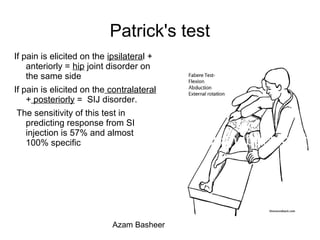
Patrick's test
If pain is elicited on the ipsilateral +
anteriorly = hip joint disorder on
the same side
If pain is elicited on the contralateral
+ posteriorly = SIJ disorder.
The sensitivity of this test in
predicting response from SI
injection is 57% and almost
100% specific
Azam Basheer
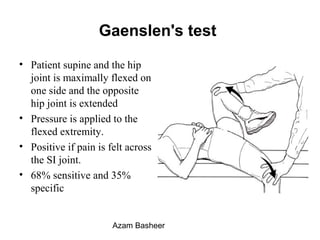
Gaenslen's test
• Patient supine and the hip
joint is maximally flexed on
one side and the opposite
hip joint is extended
• Pressure is applied to the
flexed extremity.
• Positive if pain is felt across
the SI joint.
• 68% sensitive and 35%
specific
Azam Basheer
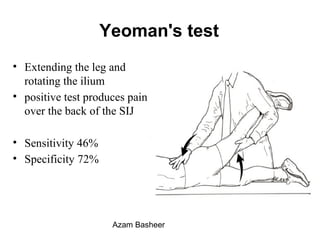
Yeoman's test
• Extending the leg and
rotating the ilium
• positive test produces pain
over the back of the SIJ
• Sensitivity 46%
• Specificity 72%
Azam Basheer
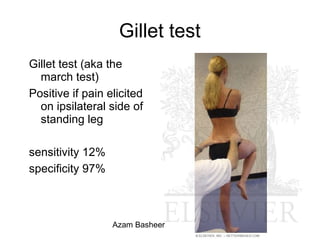
Gillet test (aka the
march test)
Positive if pain elicited
on ipsilateral side of
standing leg
sensitivity 12%
specificity 97%
Gillet test
Azam Basheer
PPV
Slipman et al. reported a PPV of 60 % in
diagnosing SIJ pain in patients using a
positive response to three SIJ provocation
tests.
Broadhurst and Bond reported a sensitivity
of 77–87 % for three positive SIJ
provocation tests.
Azam Basheer
Imaging
Azam Basheer
Not very helpful
No consensus in the literature as to the
recommended radiographic view or series to
evaluate the SIJ
24.5 % of asymptomatic patients >50 years of age
have an abnormal SIJ on plain radiographs
Elgafy et al. found that abnormal CT findings, such
as sclerosis, erosion, and narrowing had a
sensitivity of 58 % and a specificity of 69 % for
determining which patients would experience
pain relief following injection of an anesthetic
into the SIJ Azam Basheer
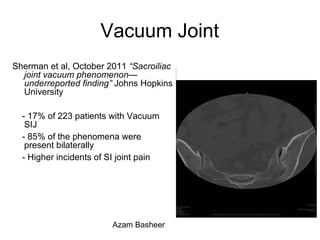
Vacuum Joint
Sherman et al, October 2011 “Sacroiliac
joint vacuum phenomenon—
underreported finding” Johns Hopkins
University
- 17% of 223 patients with Vacuum
SIJ
- 85% of the phenomena were
present bilaterally
- Higher incidents of SI joint pain
Azam Basheer
Treatment
Azam Basheer
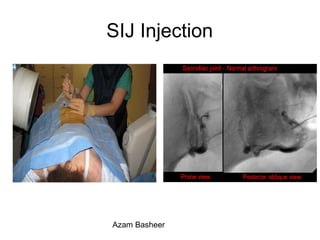
SIJ Injection
Azam Basheer
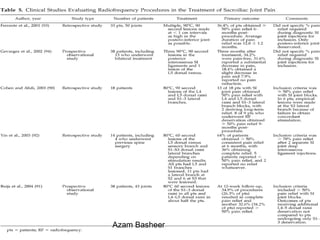
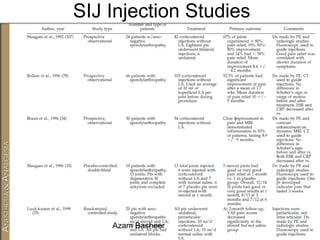
SIJ Injection Studies
Azam Basheer
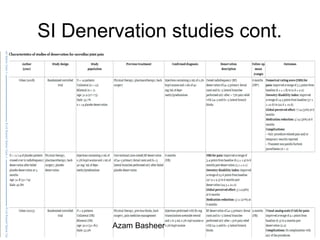
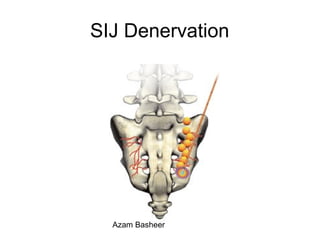
SIJ Denervation
Azam Basheer
Azam Basheer
SI Denervation studies cont.
Azam Basheer
SI Denervation studies cont.
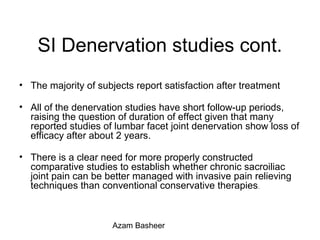
• The majority of subjects report satisfaction after treatment
• All of the denervation studies have short follow-up periods,
raising the question of duration of effect given that many
reported studies of lumbar facet joint denervation show loss of
efficacy after about 2 years.
• There is a clear need for more properly constructed
comparative studies to establish whether chronic sacroiliac
joint pain can be better managed with invasive pain relieving
techniques than conventional conservative therapies.
Azam Basheer
SI Fusion
Azam Basheer
SI Fusion
First pioneered by Smith-Peterson 1921
Currently transitioning from open to percutaneous
techniques
Data is limited to case series
The majority of fusion studies reported patient satisfaction
as an outcome
The mean rate of patient satisfaction in fusion studies was
57.6% (range, 18%–100%)
The pooled infection rate among fusion studies was 5.3%
Fusion studies reported nonunion, pseudarthrosis and
painful hardware as complicationsAzam Basheer
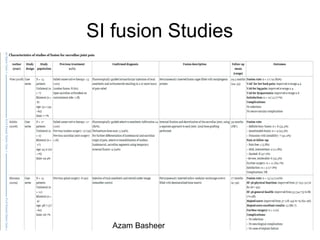
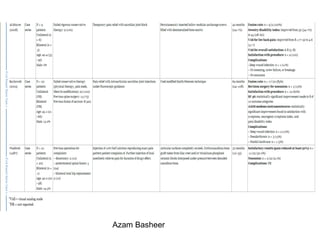
SI fusion Studies
Azam Basheer
Azam Basheer
Azam Basheer
Open techniques
The incidence of significant complications
after open SIJ fusion has been reported to
be between 6 and 25 %
Azam Basheer
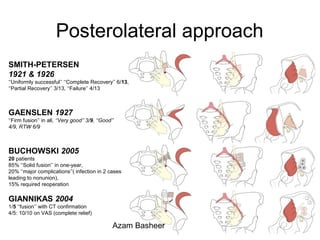
Posterolateral approach
SMITH-PETERSEN
1921 & 1926
‘‘Uniformly successful’’ ‘‘Complete Recovery’’ 6/13,
‘‘Partial Recovery’’ 3/13, ‘‘Failure’’ 4/13
GAENSLEN 1927
‘‘Firm fusion’’ in all, ‘‘Very good’’ 3/9, ‘‘Good’’
4/9, RTW 6/9
BUCHOWSKI 2005
20 patients
85% ‘‘Solid fusion’’ in one-year,
20% ‘‘major complications’’( infection in 2 cases
leading to nonunion),
15% required reoperation
GIANNIKAS 2004
1/5 ‘‘fusion’’ with CT confirmation
4/5: 10/10 on VAS (complete relief)
Azam Basheer
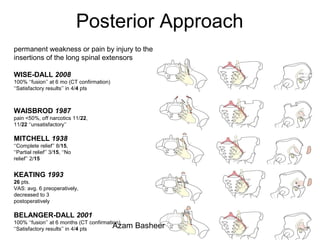
Posterior Approach
permanent weakness or pain by injury to the
insertions of the long spinal extensors
WISE-DALL 2008
100% ‘‘fusion’’ at 6 mo (CT confirmation)
‘‘Satisfactory results’’ in 4/4 pts
WAISBROD 1987
pain <50%, off narcotics 11/22,
11/22 ‘‘unsatisfactory’’
MITCHELL 1938
‘‘Complete relief’’ 8/15,
‘‘Partial relief’’ 3/15, ‘‘No
relief’’ 2/15
KEATING 1993
26 pts.
VAS: avg. 6 preoperatively,
decreased to 3
postoperatively
BELANGER-DALL 2001
100% ‘‘fusion’’ at 6 months (CT confirmation)
‘‘Satisfactory results’’ in 4/4 pts Azam Basheer
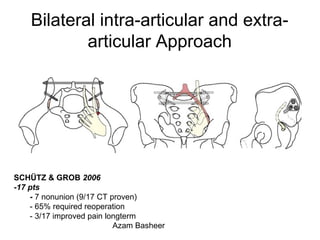
Bilateral intra-articular and extra-
articular Approach
SCHÜTZ & GROB 2006
-17 pts
- 7 nonunion (9/17 CT proven)
- 65% required reoperation
- 3/17 improved pain longterm
Azam Basheer
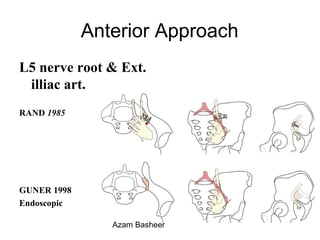
Anterior Approach
L5 nerve root & Ext.
illiac art.
RAND 1985
GUNER 1998
Endoscopic
Azam Basheer
Percutaneous Approach
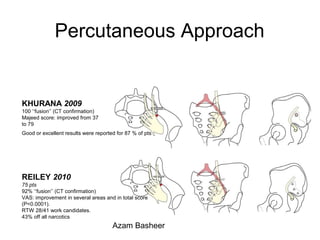
KHURANA 2009
100 ‘‘fusion’’ (CT confirmation)
Majeed score: improved from 37
to 79
Good or excellent results were reported for 87 % of pts
REILEY 2010
75 pts
92% ‘‘fusion’’ (CT confirmation)
VAS: improvement in several areas and in total score
(P<0.0001).
RTW 28/41 work candidates.
43% off all narcotics
Azam Basheer
Perc. Approach cont.
Rudolf et al 2012 (journal of orthopedics) “Sacroiliac
Joint Arthrodesis-MIS Technique with Titanium Implants:
Report of the First 50 Patients and Outcomes”
- retrospective study 40 months
- 82% A clinically significant improvement (>2 point
change from baseline) was observed in 7 out of 9
domains of daily living
- >80% of patients would have the same surgery again
- Low complication rate (1 pt deep-soft tissue wound
infection. 2 pts experienced a large buttock
hematoma)
Azam Basheer
MIS technique
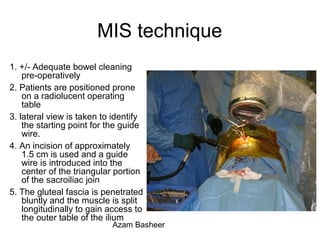
1. +/- Adequate bowel cleaning
pre-operatively
2. Patients are positioned prone
on a radiolucent operating
table
3. lateral view is taken to identify
the starting point for the guide
wire.
4. An incision of approximately
1.5 cm is used and a guide
wire is introduced into the
center of the triangular portion
of the sacroiliac join
5. The gluteal fascia is penetrated
bluntly and the muscle is split
longitudinally to gain access to
the outer table of the ilium
Azam Basheer
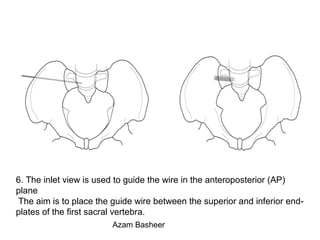
6. The inlet view is used to guide the wire in the anteroposterior (AP)
plane
The aim is to place the guide wire between the superior and inferior end-
plates of the first sacral vertebra.
Azam Basheer
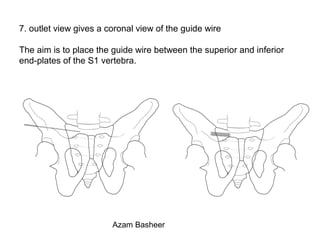
7. outlet view gives a coronal view of the guide wire
The aim is to place the guide wire between the superior and inferior
end-plates of the S1 vertebra.
Azam Basheer
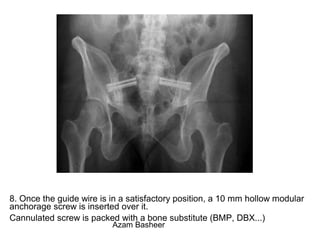
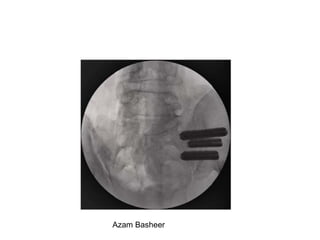
8. Once the guide wire is in a satisfactory position, a 10 mm hollow modular
anchorage screw is inserted over it.
Cannulated screw is packed with a bone substitute (BMP, DBX...)
Azam Basheer
Azam Basheer
Post op
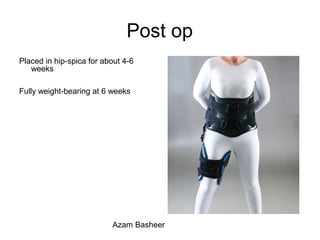
Placed in hip-spica for about 4-6
weeks
Fully weight-bearing at 6 weeks
Azam Basheer
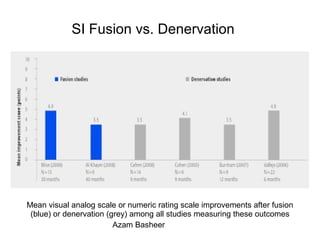
Mean visual analog scale or numeric rating scale improvements after fusion
(blue) or denervation (grey) among all studies measuring these outcomes
SI Fusion vs. Denervation
Azam Basheer
Summary
Positive provocative maneuvers combined with 75% pain
relief after image guided SI joint injection is a reliable
method for diagnosing the SI joint as the pain generator
A positive response to low-volume anesthetic injection into
the sacroiliac joint is required before considering
surgery.
Patients should have failed at least 6 months of
conservative treatment (physical therapy, nonsteroidal
anti-inflammatory drugs [NSAIDs], exercise, and
therapeutic injections) before considering surgical fusion
The open fusion studies reported poorer results and higher
complication rates than the percutaneous studies.
Azam Basheer
References
Al-Khayer A, Hegarty J, Hahn D, Grevitt MP. Percutaneous sacroiliac joint arthrodesis: a novel technique. J Spinal Disord Tech. 2008;
21(5):359-363.
Belanger TA, Dall BE. Sacroiliac arthrodesis using a posterior midline fascial splitting approach and pedicle screw instrumentation: a new
technique. J Spinal Disord. 2001; 14(2):118-124.
Berthelot JM, Gouin F, Glemarec J, et al. Possible use of arthrodesis for intractable sacroiliitis in spondylarthropathy: report of two cases. Spine
(Phila Pa 1976). 2001; 26(20):2297-2299.
Buchowski JM, Kebaish KM, Sinkov V, et al. Functional and radiographic outcome of sacroiliac arthrodesis for the disorders of the sacroiliac
joint. Spine J. 2005; 5(5):520-528; discussion 529.
Davidson D, Letts M, Khoshhal K. Pelvic osteomyelitis in children: a comparison of decades from 1980-1989 with 1990-2001. J Pediatr Orthop.
2003; 23(4):514-521.
Ebraheim NA, Ramineni SK, Alla SR, Ebraheim M. Sacroiliac joint fusion with fibular bone graft in patients with failed percutaneous iliosacral
screw fixation. J Trauma. 2010; 69(5):1226-1229.
Gallia GL, Haque R, Garonzik I, et al. Spinal pelvic reconstruction after total sacrectomy for en bloc resection of a giant sacral chordoma.
Technical note. J Neurosurg Spine. 2005; 3:501-506.
Giannikas KA, Khan AM, Karski MT, Maxwell HA. Sacroiliac joint fusion for chronic pain: a simple technique avoiding the use of metalwork. Eur
Spine J. 2004; 13(3):253-256.
Giannoudis PV, Tsiridis E. A minimally-invasive technique for the treatment of pyogenic sacroiliitis. J Bone Joint Surg Br. 2007; 89(1):112-114.
Griffin DR, Starr AJ, Reinert CM, et al. Vertically unstable pelvic fractures fixed with percutaneous iliosacral screws: does posterior injury pattern
predict fixation failure? J Orthop Trauma. 2006; 20(1 Suppl):S30-36; discussion S36.
Hsu JR, Bear RR, Dickson KF. Open reduction internal fixation of displaced sacral fractures: technique and results. Orthopedics. 2010;
33(10):730.
Kasten MD, Rao LA, Priest B. Long-term results of iliac wing fixation below extensive fusions in ambulatory adult patients with spinal disorders.
J Spinal Disord Tech. 2010; 23(7):e37-42.
Klineberg E, McHenry T, Bellabarba C, et al. Sacral insufficiency fractures caudal to instrumented posterior lumbosacral arthrodesis. Spine
(Phila Pa 1976). 2008; 33(16):1806-1811.
Azam Basheer
References
Lin J, Lachmann E, Nagler W. Sacral insufficiency fractures: a report of two cases and a review of the literature. J Womens Health Gend Based Med. 2001;
10(7):699-705.
Newman CB, Keshavarzi S, Aryan HE. En bloc sacrectomy and reconstruction: technique modification for pelvic fixation. Surg Neurol. 2009; 72(6):752-756.
Papanastassiou ID, Setzer M, Eleraky M, et al. Minimally invasive sacroiliac fixation in oncologic patients with sacral insufficiency fractures using a
fluoroscopy-based navigation system. J Spinal Disord Tech. 2011; 24(2):76-82.
Peng KT, Huang KC, Chen MC, et al. Percutaneous placement of iliosacral screws for unstable pelvic ring injuries: comparison between one and two C-arm
fluoroscopic techniques. J Trauma. 2006; 60(3):602-608.
Rysavý M, Pavelka T, Khayarin M, Dzupa V. Iliosacral screw fixation of the unstable pelvic ring injuries. Acta Chir Orthop Traumatol Cech. 2010; 77(3):209-
214.
Salehi SA, McCafferty RR, Karahalios D, Ondra SL. Neural function preservation and early mobilization after resection of metastatic sacral tumors and
lumbosacropelvic junction reconstruction. Report of three cases. J Neurosurg. 2002; 97(1 Suppl):88-93.
Sar C, Kilicoglu O. S1 pediculoiliac screw fixation in instabilities of the sacroiliac complex: biomechanical study and report of two cases. J Orthop Trauma.
2003; 17(4):262-270.
Schütz U, Grob D. Poor outcome following bilateral sacroiliac joint fusion for degenerative sacroiliac joint syndrome. Acta Orthop Belg. 2006; 72(3):296-308.
Schweitzer D, Zylberberg A, Córdova M, Gonzalez J. Closed reduction and iliosacral percutaneous fixation of unstable pelvic ring fractures. Injury. 2008;
39(8):869-874.
Tjardes T, Paffrath T, Baethis H, et al. Computer assisted percutaneous placement of augmented iliosacral screws: a reasonable alternative to sacroplasty.
Spine (Phila Pa 1976). 2008; 33(13):1497-1500.
Tsiridis E, Upadhyay N, Gamie Z, Giannoudis PV. Percutaneous screw fixation for sacral insufficiency fractures: a review of three cases. J Bone Joint Surg
Br. 2007; 89(12):1650-1653.
Tumialán LM, Mummaneni PV. Long-segment spinal fixation using pelvic screws. Neurosurgery. 2008; 63(3 Suppl):183-190.
Vavken P, Krepler P. Sacral fractures after multi-segmental lumbosacral fusion: a series of four cases and systematic review of literature. Eur Spine J. 2008;
17 Suppl 2:S285-290.
Wise CL, Dall BE. Minimally invasive sacroiliac arthrodesis: outcomes of a new technique. J Spinal Disord Tech. 2008; (8):579-584.
Zhang HY, Thongtrangan I, Balabhadra RS, et al. Surgical techniques for total sacrectomy and spinopelvic reconstruction. Neurosurg Focus. 2003; 15(2):E5
Zelle BA, Gruen GS, Brown S, George S. Sacroiliac joint dysfunction: evaluation and management. Clin J Pain. 2005; 21(5):446-455.
Azam Basheer

SI joint Fusion Azam Basheer MD

  • 1.
    THE SACROILIAC JOINT: Tofuse or not to fuse Azam Basheer MD Henry Ford Neurosurgery Azam Basheer
  • 2.
  • 3.
    60 y/o Fwith LBP and neurogenic claudications Azam Basheer
  • 4.
    L3-5 lumbar lamiand fusion. Pain alleviated Azam Basheer
  • 5.
    1 year later,she presents with left lower back pain radiating to her groin with point tendernesss over the SI joint Azam Basheer
  • 6.
    - Diagnosed withleft SI joint pain - Sent to the pain clinic for SI joint injection which relieves the pain for 3 months and then returns again with the same symptoms. Azam Basheer
  • 7.
  • 8.
    AnatomyAnatomy • Bony articulationBonyarticulation joint between thejoint between the ilium and theilium and the sacrumsacrum • Least understoodLeast understood jointjoint • Sacrum is set obliquely between ilia Azam Basheer
  • 9.
    Sacral Anatomy Synovial joint Largestaxial joint in the body, with an average surface area of 17.5 cm2 (size and shape of the human ear) Articular surface: 1. S1-S3 2. Irregular contour 3. Major depression on S2 (receives Bonnaire’s tubercle) Azam Basheer
  • 10.
    LIGAMENTS Interosseoss S/I Ligament- Most importantin the S/I joint Series of short, strong fibers connecting the sacrum and ilium deep within the joint Anterior Articular Capsule Azam Basheer
  • 11.
    - Not verystrong - sometimes described as just a thickening of the anterior joint capsule Anterior SI ligament Azam Basheer

  • 12.
    Posterior SI ligaments -stronger than the anterior ligament - connects the sacrum to the PSIS categorized into: – Long- Prevents hyperextension – Short- prevents hyperflexion Azam Basheer
  • 13.
    Innervation - Controversial andvariable - Murata et al in 2001: - Dorsal innervation: from the dorsal root ganglions of the lower lumbar and sacral levels (L4 to S2) - Ventral innervation originates from the dorsal root ganglions of the upper lumbar, lower lumbar, and sacral levels (L1 to S2) - Free end nerve fibers and mechanoreceptors in the SI ligaments and joint Azam Basheer
  • 14.
  • 15.
    BiomechanicsBiomechanics Amphiarthrodial Joint Minimal movement Manyinterlocking osseous structures limits gross excursion - No muscles acting directly across it. - Numerous studies on mobility of the sacroiliac joint have led to a variety of different hypotheses and models of pelvic mechanics over the years Azam Basheer
  • 16.
    Biomechanics The primary motionsof the sacroiliac joint are nutation and counter- nutation (flexion and extension about the x-axis) Rotation and translation about 3 axes of approximately 2-4 degrees Sturesson et al: flexion and extension was 2.5 ± 0.5° (1.6-3.9°), and a mean translation of 0.7 mm (0.1 -1.6 mm) along the axes of rotation Walheim and associates reported between 2 – 3 mm translations and up to 3 degrees rotational movement However, SIJ motion occurs simultaneously in multiple planes, not linearly. Their direction of movement is irregular Azam Basheer
  • 17.
    AGE CHANGES THINGS ROMis limited increasingly with age – 0-20 Smooth gliding planes – 20-50 Interlocking irregularities – >50 Hypomobility – >80 Osteophytic, Immobile Ankylosed in 76% of the population over the age of fifty Azam Basheer
  • 18.
    Function • Stress-relieving joint •Two Roles: – Longitudinal direction: Supports L-spine – Transverse direction: Transmits force to the lower extremities Azam Basheer
  • 19.
  • 20.
    Prevalence In the late1980’s, many physicians "rediscovered" the SI joint as a possible source of back pain 1977, retrospective study by Bernard and Kirkaldy-Willis found a 22.5% prevalence rate of SIJ pain in 1293 adult patients presenting with LBP studies have shown that the SI joint is the cause of chronic lower back pain in 13% – 30% of patients Azam Basheer
  • 21.
    SIJ after Fusion Clinicalstudies show a range from 3.2% – 21% of patients undergoing lumbar fusion report an incidence of adjacent segmental disease.28 Ha et al. first reported that, based on results from CT scans and PE, the incidence of SIJ degeneration in the fusion group was significantly higher than in the control group (75 vs. 38.2 %, respectively). Azam Basheer
  • 22.
    SIJ after Fusion Maigneand Planchon prospectively followed 61 pts from 1996 to 2002 after lumbar fusion. 45 developed unilateral persistent pain (or with unilateral prevalence) for more than 6 months with a sacroiliac origin.39 Onsel et al. used SPECT to follow up on 753 patients complaining of lower back pain and found that patients who had increased uptake of the SI joint, 35% (15 of 43) had prior lumbar laminectomy and/or spinal fusion. In 2005 Katz et al. used fluoroscopically guided SI joint injections to identify the cause of lower back pain in patients following lumbosacral arthrodesis. They followed 34 patients and found SI joint dysfunction to be the cause of pain in 32% of the patients. Azam Basheer
  • 23.
    EVALUATION of theS/I JOINT Azam Basheer
  • 24.
    EVALUATION of theS/I JOINT Challenging Wide range of normal anatomy Cannot directly palpate the joint You need: 1. Good History 2. Physical exam 3. Imaging 4. X-ray guided injections of lidocaineAzam Basheer
  • 25.
    History – Pain withascending/descending stairs or standing from a sitting position – Pain with hopping or standing on the involved leg – A positive straight leg raise at, or near, the end of range – Slipman et al. retrospective study to determine the pain referral patterns in 50 patients with injection-confirmed SIJ pain. The most common referral patterns for SIJ pain were found to be radiation into the buttock (94 %), lower lumbar region (72 %), lower extremity (50 %), groin area (14 %), upper lumbar lesion (6 %), and abdomen (2 %). – The most consistent factor for identifying patients with SIJ pain is unilateral pain (25% of pts) Azam Basheer
  • 26.
    Exam Palpation of bony landmarks: compareboth sides – PSIS – Lumbosacral joint – Iliac Crest – Sacroiliac ligaments – Iliolumbar ligaments Azam Basheer
  • 27.
    Patrick's test If painis elicited on the ipsilateral + anteriorly = hip joint disorder on the same side If pain is elicited on the contralateral + posteriorly = SIJ disorder. The sensitivity of this test in predicting response from SI injection is 57% and almost 100% specific Azam Basheer
  • 28.
    Gaenslen's test • Patientsupine and the hip joint is maximally flexed on one side and the opposite hip joint is extended • Pressure is applied to the flexed extremity. • Positive if pain is felt across the SI joint. • 68% sensitive and 35% specific Azam Basheer
  • 29.
    Yeoman's test • Extendingthe leg and rotating the ilium • positive test produces pain over the back of the SIJ • Sensitivity 46% • Specificity 72% Azam Basheer
  • 30.
    Gillet test (akathe march test) Positive if pain elicited on ipsilateral side of standing leg sensitivity 12% specificity 97% Gillet test Azam Basheer
  • 31.
    PPV Slipman et al.reported a PPV of 60 % in diagnosing SIJ pain in patients using a positive response to three SIJ provocation tests. Broadhurst and Bond reported a sensitivity of 77–87 % for three positive SIJ provocation tests. Azam Basheer
  • 32.
  • 33.
    Not very helpful Noconsensus in the literature as to the recommended radiographic view or series to evaluate the SIJ 24.5 % of asymptomatic patients >50 years of age have an abnormal SIJ on plain radiographs Elgafy et al. found that abnormal CT findings, such as sclerosis, erosion, and narrowing had a sensitivity of 58 % and a specificity of 69 % for determining which patients would experience pain relief following injection of an anesthetic into the SIJ Azam Basheer
  • 34.
    Vacuum Joint Sherman etal, October 2011 “Sacroiliac joint vacuum phenomenon— underreported finding” Johns Hopkins University - 17% of 223 patients with Vacuum SIJ - 85% of the phenomena were present bilaterally - Higher incidents of SI joint pain Azam Basheer
  • 35.
  • 36.
  • 37.
  • 38.
  • 39.
  • 40.
    SI Denervation studiescont. Azam Basheer
  • 41.
    SI Denervation studiescont. • The majority of subjects report satisfaction after treatment • All of the denervation studies have short follow-up periods, raising the question of duration of effect given that many reported studies of lumbar facet joint denervation show loss of efficacy after about 2 years. • There is a clear need for more properly constructed comparative studies to establish whether chronic sacroiliac joint pain can be better managed with invasive pain relieving techniques than conventional conservative therapies. Azam Basheer
  • 42.
  • 43.
    SI Fusion First pioneeredby Smith-Peterson 1921 Currently transitioning from open to percutaneous techniques Data is limited to case series The majority of fusion studies reported patient satisfaction as an outcome The mean rate of patient satisfaction in fusion studies was 57.6% (range, 18%–100%) The pooled infection rate among fusion studies was 5.3% Fusion studies reported nonunion, pseudarthrosis and painful hardware as complicationsAzam Basheer
  • 44.
  • 45.
  • 46.
  • 47.
    Open techniques The incidenceof significant complications after open SIJ fusion has been reported to be between 6 and 25 % Azam Basheer
  • 48.
    Posterolateral approach SMITH-PETERSEN 1921 &1926 ‘‘Uniformly successful’’ ‘‘Complete Recovery’’ 6/13, ‘‘Partial Recovery’’ 3/13, ‘‘Failure’’ 4/13 GAENSLEN 1927 ‘‘Firm fusion’’ in all, ‘‘Very good’’ 3/9, ‘‘Good’’ 4/9, RTW 6/9 BUCHOWSKI 2005 20 patients 85% ‘‘Solid fusion’’ in one-year, 20% ‘‘major complications’’( infection in 2 cases leading to nonunion), 15% required reoperation GIANNIKAS 2004 1/5 ‘‘fusion’’ with CT confirmation 4/5: 10/10 on VAS (complete relief) Azam Basheer
  • 49.
    Posterior Approach permanent weaknessor pain by injury to the insertions of the long spinal extensors WISE-DALL 2008 100% ‘‘fusion’’ at 6 mo (CT confirmation) ‘‘Satisfactory results’’ in 4/4 pts WAISBROD 1987 pain <50%, off narcotics 11/22, 11/22 ‘‘unsatisfactory’’ MITCHELL 1938 ‘‘Complete relief’’ 8/15, ‘‘Partial relief’’ 3/15, ‘‘No relief’’ 2/15 KEATING 1993 26 pts. VAS: avg. 6 preoperatively, decreased to 3 postoperatively BELANGER-DALL 2001 100% ‘‘fusion’’ at 6 months (CT confirmation) ‘‘Satisfactory results’’ in 4/4 pts Azam Basheer
  • 50.
    Bilateral intra-articular andextra- articular Approach SCHÜTZ & GROB 2006 -17 pts - 7 nonunion (9/17 CT proven) - 65% required reoperation - 3/17 improved pain longterm Azam Basheer
  • 51.
    Anterior Approach L5 nerveroot & Ext. illiac art. RAND 1985 GUNER 1998 Endoscopic Azam Basheer
  • 52.
    Percutaneous Approach KHURANA 2009 100‘‘fusion’’ (CT confirmation) Majeed score: improved from 37 to 79 Good or excellent results were reported for 87 % of pts REILEY 2010 75 pts 92% ‘‘fusion’’ (CT confirmation) VAS: improvement in several areas and in total score (P<0.0001). RTW 28/41 work candidates. 43% off all narcotics Azam Basheer
  • 53.
    Perc. Approach cont. Rudolfet al 2012 (journal of orthopedics) “Sacroiliac Joint Arthrodesis-MIS Technique with Titanium Implants: Report of the First 50 Patients and Outcomes” - retrospective study 40 months - 82% A clinically significant improvement (>2 point change from baseline) was observed in 7 out of 9 domains of daily living - >80% of patients would have the same surgery again - Low complication rate (1 pt deep-soft tissue wound infection. 2 pts experienced a large buttock hematoma) Azam Basheer
  • 54.
    MIS technique 1. +/-Adequate bowel cleaning pre-operatively 2. Patients are positioned prone on a radiolucent operating table 3. lateral view is taken to identify the starting point for the guide wire. 4. An incision of approximately 1.5 cm is used and a guide wire is introduced into the center of the triangular portion of the sacroiliac join 5. The gluteal fascia is penetrated bluntly and the muscle is split longitudinally to gain access to the outer table of the ilium Azam Basheer
  • 55.
    6. The inletview is used to guide the wire in the anteroposterior (AP) plane The aim is to place the guide wire between the superior and inferior end- plates of the first sacral vertebra. Azam Basheer
  • 56.
    7. outlet viewgives a coronal view of the guide wire The aim is to place the guide wire between the superior and inferior end-plates of the S1 vertebra. Azam Basheer
  • 57.
    8. Once theguide wire is in a satisfactory position, a 10 mm hollow modular anchorage screw is inserted over it. Cannulated screw is packed with a bone substitute (BMP, DBX...) Azam Basheer
  • 58.
  • 59.
    Post op Placed inhip-spica for about 4-6 weeks Fully weight-bearing at 6 weeks Azam Basheer
  • 60.
    Mean visual analogscale or numeric rating scale improvements after fusion (blue) or denervation (grey) among all studies measuring these outcomes SI Fusion vs. Denervation Azam Basheer
  • 61.
    Summary Positive provocative maneuverscombined with 75% pain relief after image guided SI joint injection is a reliable method for diagnosing the SI joint as the pain generator A positive response to low-volume anesthetic injection into the sacroiliac joint is required before considering surgery. Patients should have failed at least 6 months of conservative treatment (physical therapy, nonsteroidal anti-inflammatory drugs [NSAIDs], exercise, and therapeutic injections) before considering surgical fusion The open fusion studies reported poorer results and higher complication rates than the percutaneous studies. Azam Basheer
  • 62.
    References Al-Khayer A, HegartyJ, Hahn D, Grevitt MP. Percutaneous sacroiliac joint arthrodesis: a novel technique. J Spinal Disord Tech. 2008; 21(5):359-363. Belanger TA, Dall BE. Sacroiliac arthrodesis using a posterior midline fascial splitting approach and pedicle screw instrumentation: a new technique. J Spinal Disord. 2001; 14(2):118-124. Berthelot JM, Gouin F, Glemarec J, et al. Possible use of arthrodesis for intractable sacroiliitis in spondylarthropathy: report of two cases. Spine (Phila Pa 1976). 2001; 26(20):2297-2299. Buchowski JM, Kebaish KM, Sinkov V, et al. Functional and radiographic outcome of sacroiliac arthrodesis for the disorders of the sacroiliac joint. Spine J. 2005; 5(5):520-528; discussion 529. Davidson D, Letts M, Khoshhal K. Pelvic osteomyelitis in children: a comparison of decades from 1980-1989 with 1990-2001. J Pediatr Orthop. 2003; 23(4):514-521. Ebraheim NA, Ramineni SK, Alla SR, Ebraheim M. Sacroiliac joint fusion with fibular bone graft in patients with failed percutaneous iliosacral screw fixation. J Trauma. 2010; 69(5):1226-1229. Gallia GL, Haque R, Garonzik I, et al. Spinal pelvic reconstruction after total sacrectomy for en bloc resection of a giant sacral chordoma. Technical note. J Neurosurg Spine. 2005; 3:501-506. Giannikas KA, Khan AM, Karski MT, Maxwell HA. Sacroiliac joint fusion for chronic pain: a simple technique avoiding the use of metalwork. Eur Spine J. 2004; 13(3):253-256. Giannoudis PV, Tsiridis E. A minimally-invasive technique for the treatment of pyogenic sacroiliitis. J Bone Joint Surg Br. 2007; 89(1):112-114. Griffin DR, Starr AJ, Reinert CM, et al. Vertically unstable pelvic fractures fixed with percutaneous iliosacral screws: does posterior injury pattern predict fixation failure? J Orthop Trauma. 2006; 20(1 Suppl):S30-36; discussion S36. Hsu JR, Bear RR, Dickson KF. Open reduction internal fixation of displaced sacral fractures: technique and results. Orthopedics. 2010; 33(10):730. Kasten MD, Rao LA, Priest B. Long-term results of iliac wing fixation below extensive fusions in ambulatory adult patients with spinal disorders. J Spinal Disord Tech. 2010; 23(7):e37-42. Klineberg E, McHenry T, Bellabarba C, et al. Sacral insufficiency fractures caudal to instrumented posterior lumbosacral arthrodesis. Spine (Phila Pa 1976). 2008; 33(16):1806-1811. Azam Basheer
  • 63.
    References Lin J, LachmannE, Nagler W. Sacral insufficiency fractures: a report of two cases and a review of the literature. J Womens Health Gend Based Med. 2001; 10(7):699-705. Newman CB, Keshavarzi S, Aryan HE. En bloc sacrectomy and reconstruction: technique modification for pelvic fixation. Surg Neurol. 2009; 72(6):752-756. Papanastassiou ID, Setzer M, Eleraky M, et al. Minimally invasive sacroiliac fixation in oncologic patients with sacral insufficiency fractures using a fluoroscopy-based navigation system. J Spinal Disord Tech. 2011; 24(2):76-82. Peng KT, Huang KC, Chen MC, et al. Percutaneous placement of iliosacral screws for unstable pelvic ring injuries: comparison between one and two C-arm fluoroscopic techniques. J Trauma. 2006; 60(3):602-608. Rysavý M, Pavelka T, Khayarin M, Dzupa V. Iliosacral screw fixation of the unstable pelvic ring injuries. Acta Chir Orthop Traumatol Cech. 2010; 77(3):209- 214. Salehi SA, McCafferty RR, Karahalios D, Ondra SL. Neural function preservation and early mobilization after resection of metastatic sacral tumors and lumbosacropelvic junction reconstruction. Report of three cases. J Neurosurg. 2002; 97(1 Suppl):88-93. Sar C, Kilicoglu O. S1 pediculoiliac screw fixation in instabilities of the sacroiliac complex: biomechanical study and report of two cases. J Orthop Trauma. 2003; 17(4):262-270. Schütz U, Grob D. Poor outcome following bilateral sacroiliac joint fusion for degenerative sacroiliac joint syndrome. Acta Orthop Belg. 2006; 72(3):296-308. Schweitzer D, Zylberberg A, Córdova M, Gonzalez J. Closed reduction and iliosacral percutaneous fixation of unstable pelvic ring fractures. Injury. 2008; 39(8):869-874. Tjardes T, Paffrath T, Baethis H, et al. Computer assisted percutaneous placement of augmented iliosacral screws: a reasonable alternative to sacroplasty. Spine (Phila Pa 1976). 2008; 33(13):1497-1500. Tsiridis E, Upadhyay N, Gamie Z, Giannoudis PV. Percutaneous screw fixation for sacral insufficiency fractures: a review of three cases. J Bone Joint Surg Br. 2007; 89(12):1650-1653. Tumialán LM, Mummaneni PV. Long-segment spinal fixation using pelvic screws. Neurosurgery. 2008; 63(3 Suppl):183-190. Vavken P, Krepler P. Sacral fractures after multi-segmental lumbosacral fusion: a series of four cases and systematic review of literature. Eur Spine J. 2008; 17 Suppl 2:S285-290. Wise CL, Dall BE. Minimally invasive sacroiliac arthrodesis: outcomes of a new technique. J Spinal Disord Tech. 2008; (8):579-584. Zhang HY, Thongtrangan I, Balabhadra RS, et al. Surgical techniques for total sacrectomy and spinopelvic reconstruction. Neurosurg Focus. 2003; 15(2):E5 Zelle BA, Gruen GS, Brown S, George S. Sacroiliac joint dysfunction: evaluation and management. Clin J Pain. 2005; 21(5):446-455. Azam Basheer