Author: Kennet Musonda
Corrected by: Mgr. Andrea Fabrová
Why is this a social Problem?
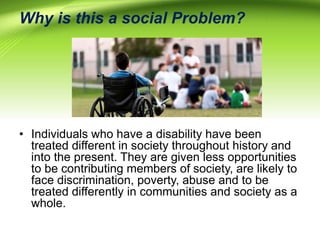
• Individuals who have a disability have been
treated different in society throughout history and
into the present. They are given less opportunities
to be contributing members of society, are likely to
face discrimination, poverty, abuse and to be
treated differently in communities and society as a
whole.
The past of Disabled people
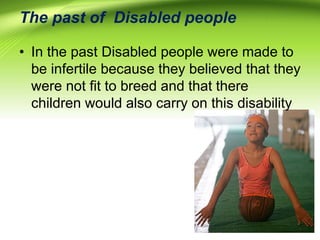
• In the past Disabled people were made to
be infertile because they believed that they
were not fit to breed and that there
children would also carry on this disability
How Are They Discriminated?
• Said to be dependant and unable to cope
on their own.
• Not given jobs because of there disability
• Called humiliating names
• ‘Second class’ citizens
• Meant to be less intelligent
Worlds smartest man
• The Worlds smartest man is disabled.
Disabled people and sports
• From the late 1980s, organizations began
to include athletes with disabilities in
sporting events such as the Olympic
Games and Commonwealth Games.
Wheelchair basketball, Wheelchair
dancing and more you can join if you are
mentally or physical disabled.
How will we create a solution to this
social problem?
• 1. As simple as it sounds, we
need to redefine what disability
means in our society and
reconstruct a positive meaning to
the word. If we had a positive
outlook on individuals who had a
disability imagine how different
our world would be
• 2. Changes within the system
What can you do on a personal level?
• Get to know someone who has a
disability
• Use person centered language
• Volunteer with an organization who
supports individuals who have a
disability
• Question your own thoughts and
attitudes towards individuals who have
a disability
• Say or do something if you see
discrimination
• Support inclusion in your community!
Solutions
Past and Present Future
• Participants
• Active measures to promote
employment and provide income
support
• Independence
• Shared responsibility
• Work skills identified
• Incentives to seek employment and
support volunteering
• Opportunities to develop skills
• Person-centred approach
• Accessibility
• Recipients
• Passive income support
• Dependence
• Government responsibility
• Labelled as unemployable
• Disincentives to leave income
assistance
• Insufficient employment
supports
• Program-centred approach
• Non- accessible
Peter Štefanides
• The man I write about is called Peter Stefanides. Peter has been
on a wheelchair since 1994. He can’t move legs or stand up.
• Using public transport can be very difficult for Peter. For example,
when he goes by train he must organize it 3 days ahead.
• His worst nightmare is to travel by bus. However, he finds
travelling by plane easy, because when you are doing check-in at
the airport you tell them you have a physical disability and they
arrange things to make your travel smooth.
• Peter gets some financial support from the government.
• For example, he was given €7000 for his car and the motorways
are free for him. Nevertheless, this was not always the case but
fortunately things are changing for the better. In the past, there
also used to be a lot of stigma around having a disability, which is
getting better nowadays.
• When you have a physical disability many things can be
challenging for you. So it is always helpful to have good friends
and supportive people around. Peter finds his family and friends
most supportive. He enjoys going to the gym, with people he
knows. They help him with almost everything he needs.
• Disability can happen to anyone.
• Therefore, I believe we should treat people with disabilities with
respect, see their qualities beyond their physical disabilities and
help them whenever we can.
Social benefits
• License for a person with severe disabilities
• People with severe disabilities are eligible for various rebates and benefits.
However, they need a license for a person with a severe disability
• Parking license
• Housekeeping Repairs 20%
• Mobile operators-hearing impaired citizens get up to 50%
• Banks - Discounts
• Insurance-they provide up to 50%
• Discount buses 40 to 50%
• Travel by train 50%

Disabledpeople

  • 1.
    Author: Kennet Musonda Correctedby: Mgr. Andrea Fabrová
  • 2.
    Why is thisa social Problem? • Individuals who have a disability have been treated different in society throughout history and into the present. They are given less opportunities to be contributing members of society, are likely to face discrimination, poverty, abuse and to be treated differently in communities and society as a whole.
  • 3.
    The past ofDisabled people • In the past Disabled people were made to be infertile because they believed that they were not fit to breed and that there children would also carry on this disability
  • 4.
    How Are TheyDiscriminated? • Said to be dependant and unable to cope on their own. • Not given jobs because of there disability • Called humiliating names • ‘Second class’ citizens • Meant to be less intelligent
  • 5.
    Worlds smartest man •The Worlds smartest man is disabled.
  • 6.
    Disabled people andsports • From the late 1980s, organizations began to include athletes with disabilities in sporting events such as the Olympic Games and Commonwealth Games. Wheelchair basketball, Wheelchair dancing and more you can join if you are mentally or physical disabled.
  • 7.
    How will wecreate a solution to this social problem? • 1. As simple as it sounds, we need to redefine what disability means in our society and reconstruct a positive meaning to the word. If we had a positive outlook on individuals who had a disability imagine how different our world would be • 2. Changes within the system
  • 8.
    What can youdo on a personal level? • Get to know someone who has a disability • Use person centered language • Volunteer with an organization who supports individuals who have a disability • Question your own thoughts and attitudes towards individuals who have a disability • Say or do something if you see discrimination • Support inclusion in your community!
  • 9.
    Solutions Past and PresentFuture • Participants • Active measures to promote employment and provide income support • Independence • Shared responsibility • Work skills identified • Incentives to seek employment and support volunteering • Opportunities to develop skills • Person-centred approach • Accessibility • Recipients • Passive income support • Dependence • Government responsibility • Labelled as unemployable • Disincentives to leave income assistance • Insufficient employment supports • Program-centred approach • Non- accessible
  • 10.
    Peter Štefanides • Theman I write about is called Peter Stefanides. Peter has been on a wheelchair since 1994. He can’t move legs or stand up. • Using public transport can be very difficult for Peter. For example, when he goes by train he must organize it 3 days ahead. • His worst nightmare is to travel by bus. However, he finds travelling by plane easy, because when you are doing check-in at the airport you tell them you have a physical disability and they arrange things to make your travel smooth. • Peter gets some financial support from the government. • For example, he was given €7000 for his car and the motorways are free for him. Nevertheless, this was not always the case but fortunately things are changing for the better. In the past, there also used to be a lot of stigma around having a disability, which is getting better nowadays. • When you have a physical disability many things can be challenging for you. So it is always helpful to have good friends and supportive people around. Peter finds his family and friends most supportive. He enjoys going to the gym, with people he knows. They help him with almost everything he needs. • Disability can happen to anyone. • Therefore, I believe we should treat people with disabilities with respect, see their qualities beyond their physical disabilities and help them whenever we can.
  • 11.
    Social benefits • Licensefor a person with severe disabilities • People with severe disabilities are eligible for various rebates and benefits. However, they need a license for a person with a severe disability • Parking license • Housekeeping Repairs 20% • Mobile operators-hearing impaired citizens get up to 50% • Banks - Discounts • Insurance-they provide up to 50% • Discount buses 40 to 50% • Travel by train 50%