Disability Equality Training  Laura (Mole) Chapman
Welcome Fun with labels
Ground Rules What do you need to participate?
Shared Outcomes: Hopes and fears:
Respectful language
Respectful language  Disability... the disadvantage or restriction of activity caused by contemporary social organisation which takes little or no account of people who have physical impairments and thus excludes them from the mainstream of social activities. ( the Union for of Physically Impaired Segregation 1976)
Respectful language Impairment , disabled people use this term to talk about their medical condition or diagnosis or description of their functioning—if there is nothing more formal.
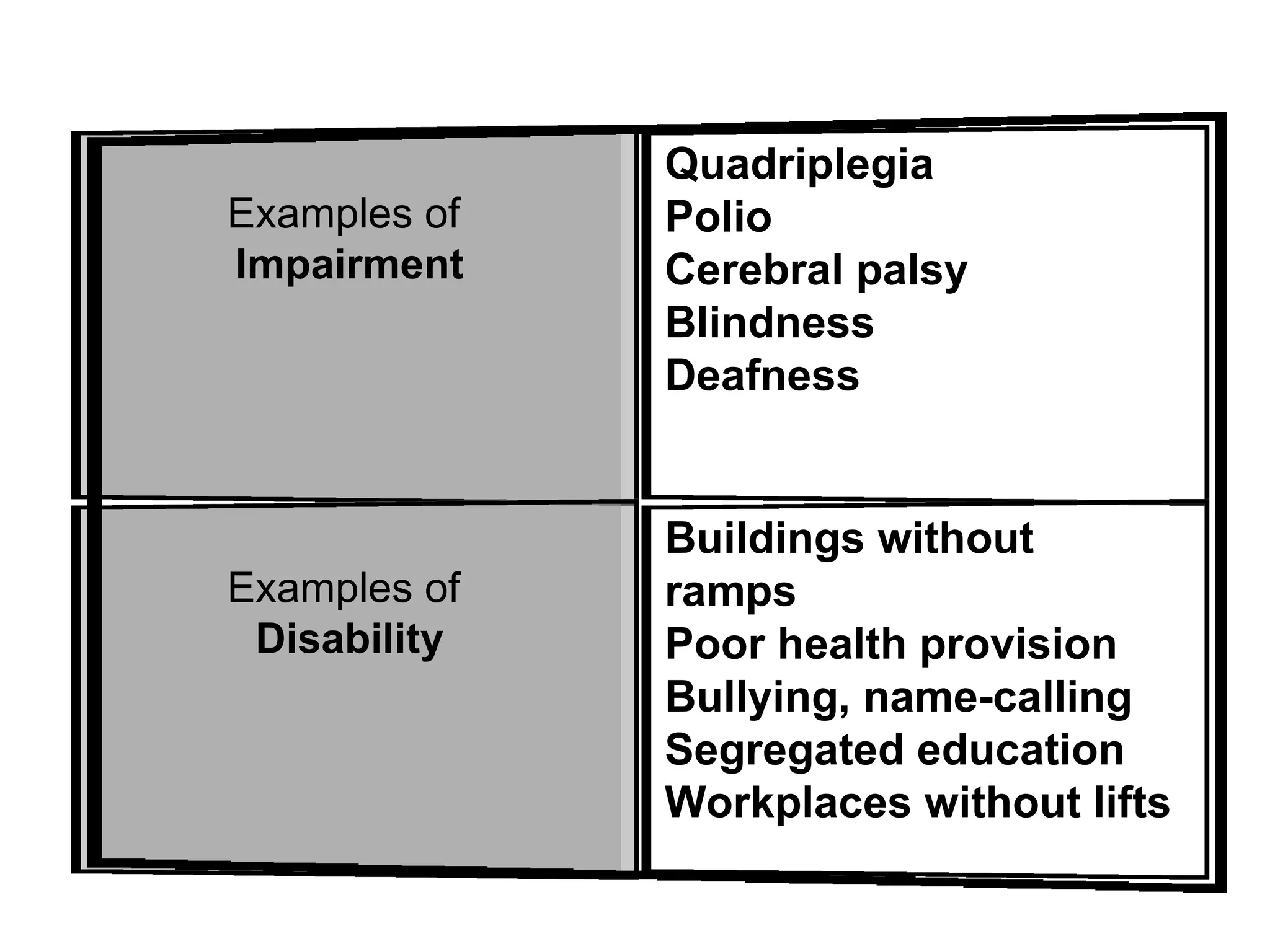
  Examples of  Impairment Quadriplegia Polio Cerebral palsy Blindness Deafness   Examples of  Disability Buildings without ramps Poor health provision Bullying, name-calling Segregated education Workplaces without lifts
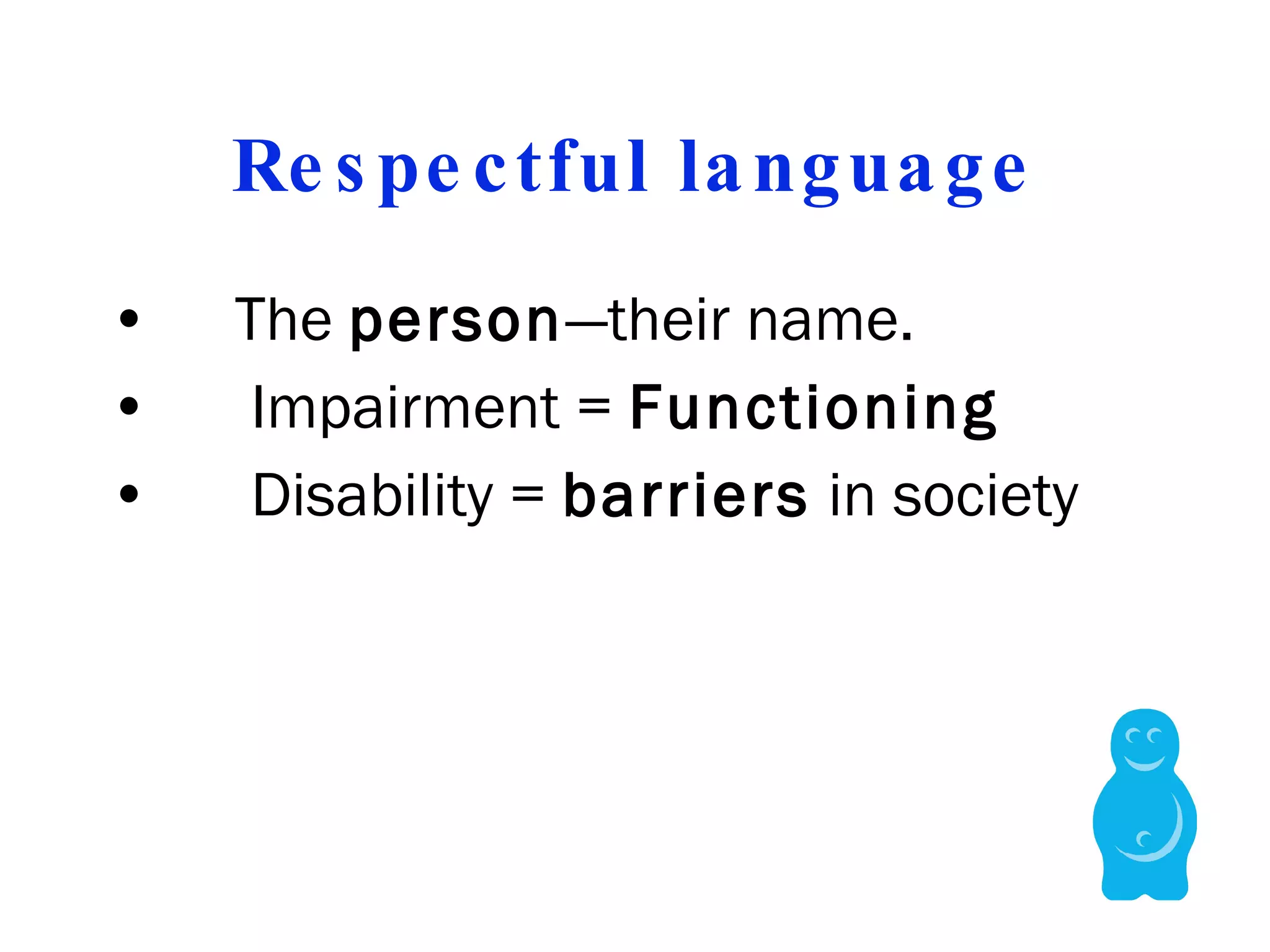
Respectful language The  person —their name.   Impairment =  Functioning   Disability =  barriers  in society
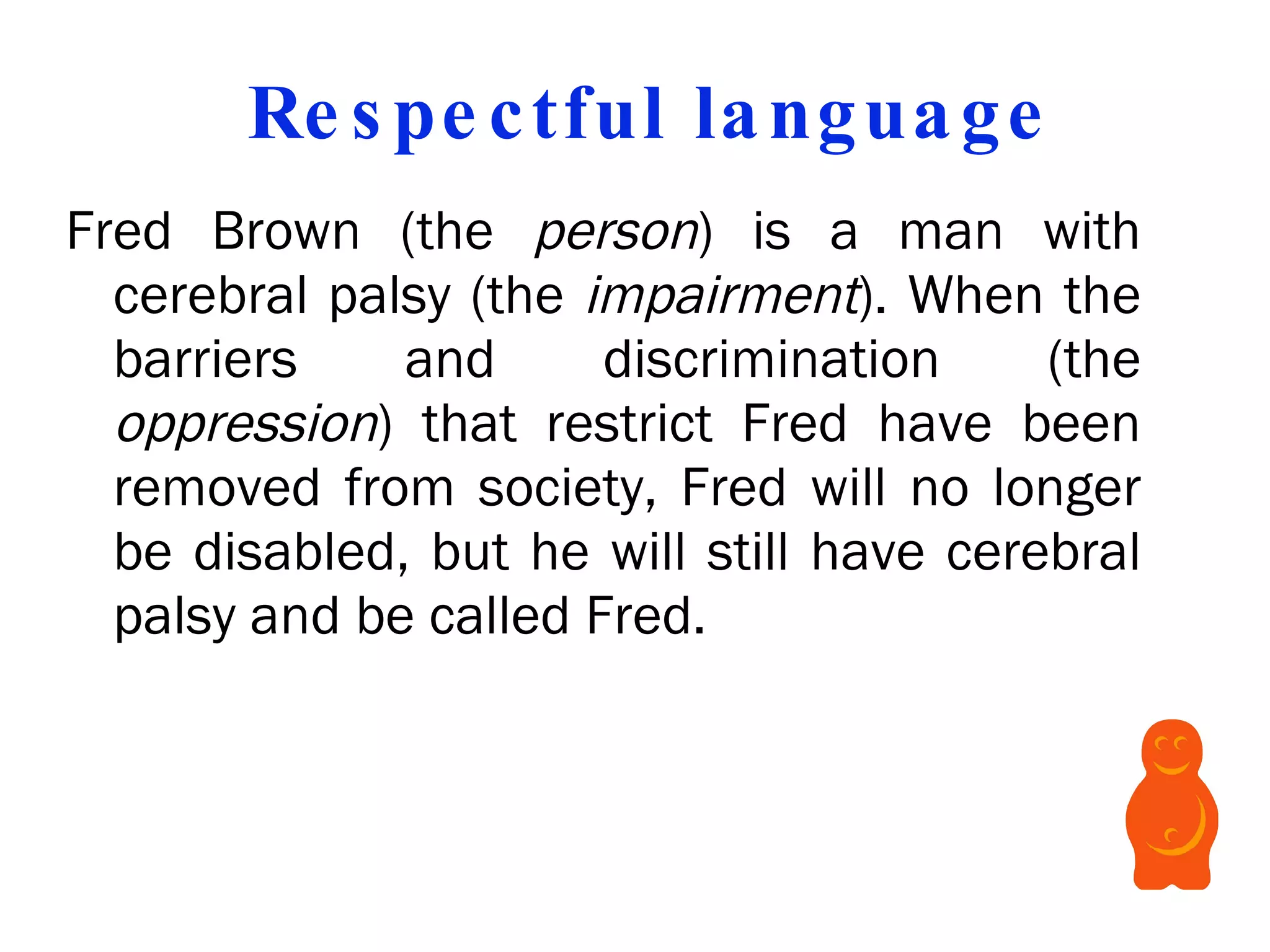
Respectful language Fred Brown (the  person ) is a man with cerebral palsy (the  impairment ). When the barriers and discrimination (the  oppression ) that restrict Fred have been removed from society, Fred will no longer be disabled, but he will still have cerebral palsy and be called Fred.
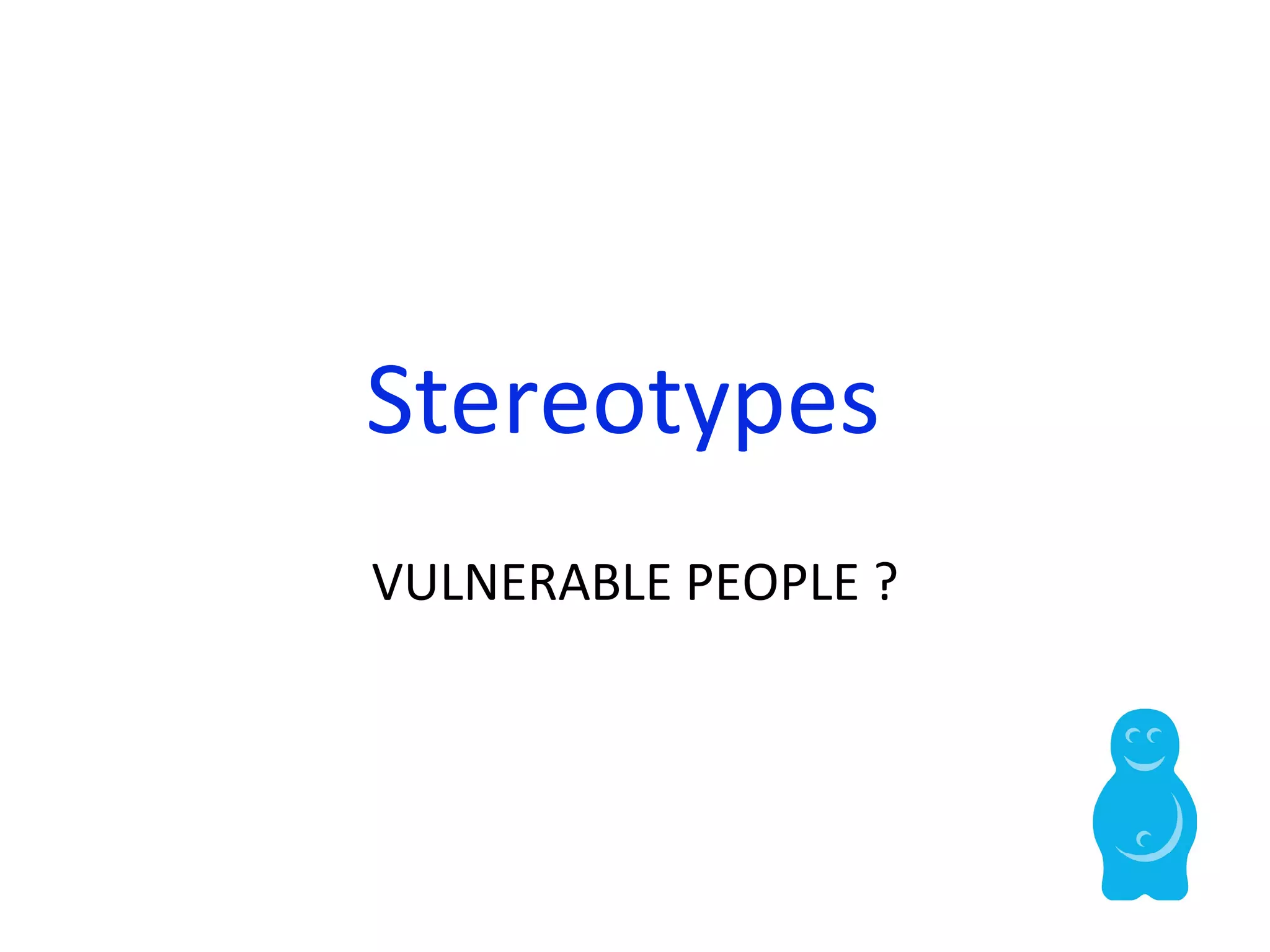
Stereotypes  VULNERABLE PEOPLE ?
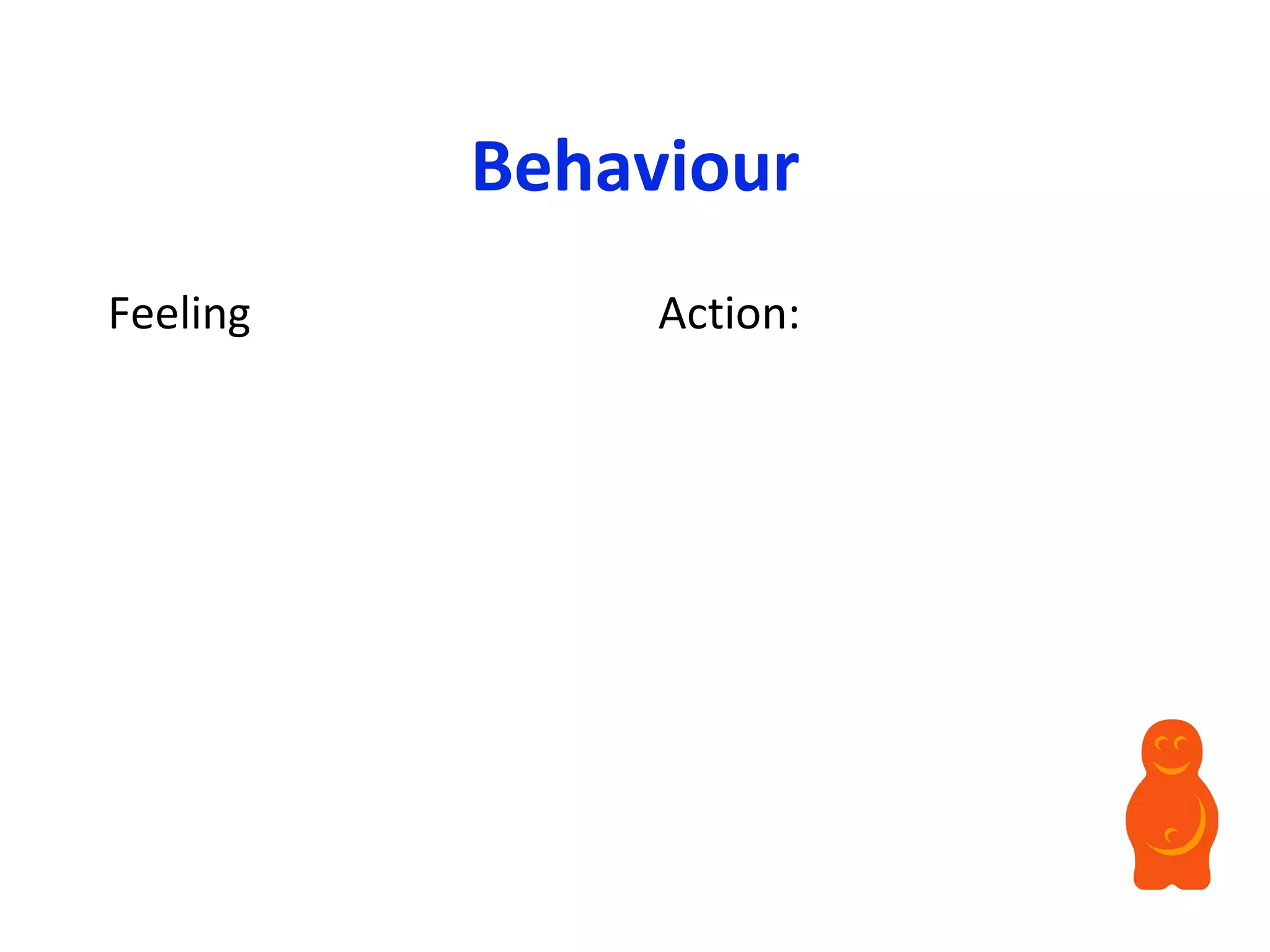
Behaviour Feeling Action:
What is disability?
The Facts Visually impaired people are four times more likely to be verbally and physically abused than sighted people  People with mental health issues are 11 times more likely to be victimised  90% of adults with a learning difficulty report being 'bullied'.  Scope 2008
Compared with non-disabled people, disabled people are: more likely to be  economically inactive  – only one in two disabled people of working age are currently in employment, compared with four out of five non-disabled people; more likely to experience problems with  hate crime or harassment  – a quarter of all disabled people say that they have experienced hate crime or  harassment, and this number rises to 47% of people with mental  health conditions;
"on the experience of disability, history is largely silent, and when it is discussed at all, it is within the context of the history of medical advances. Just as women and black people have discovered that they must write their own histories, so too with disabled people."
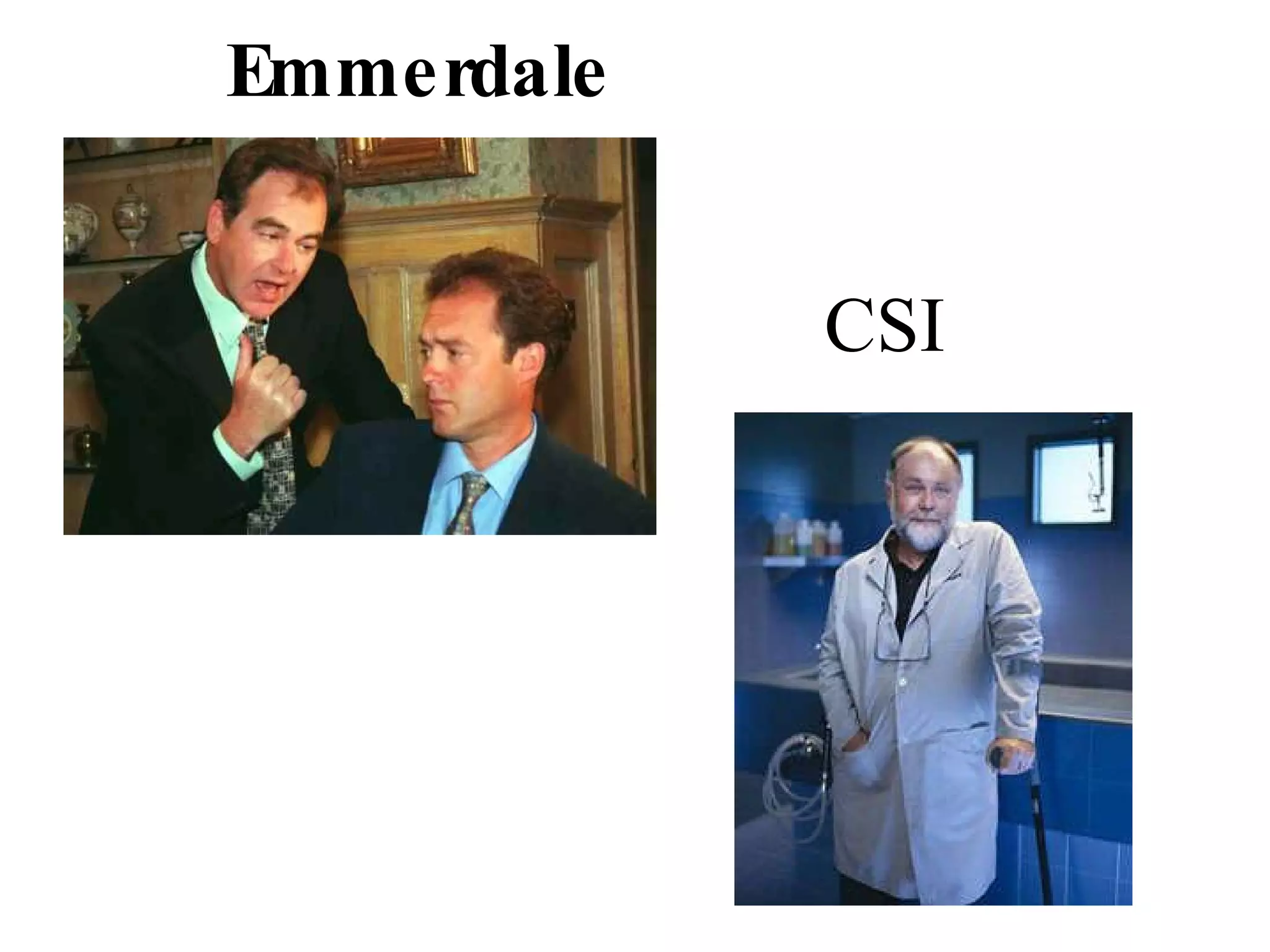
Emmerdale   CSI
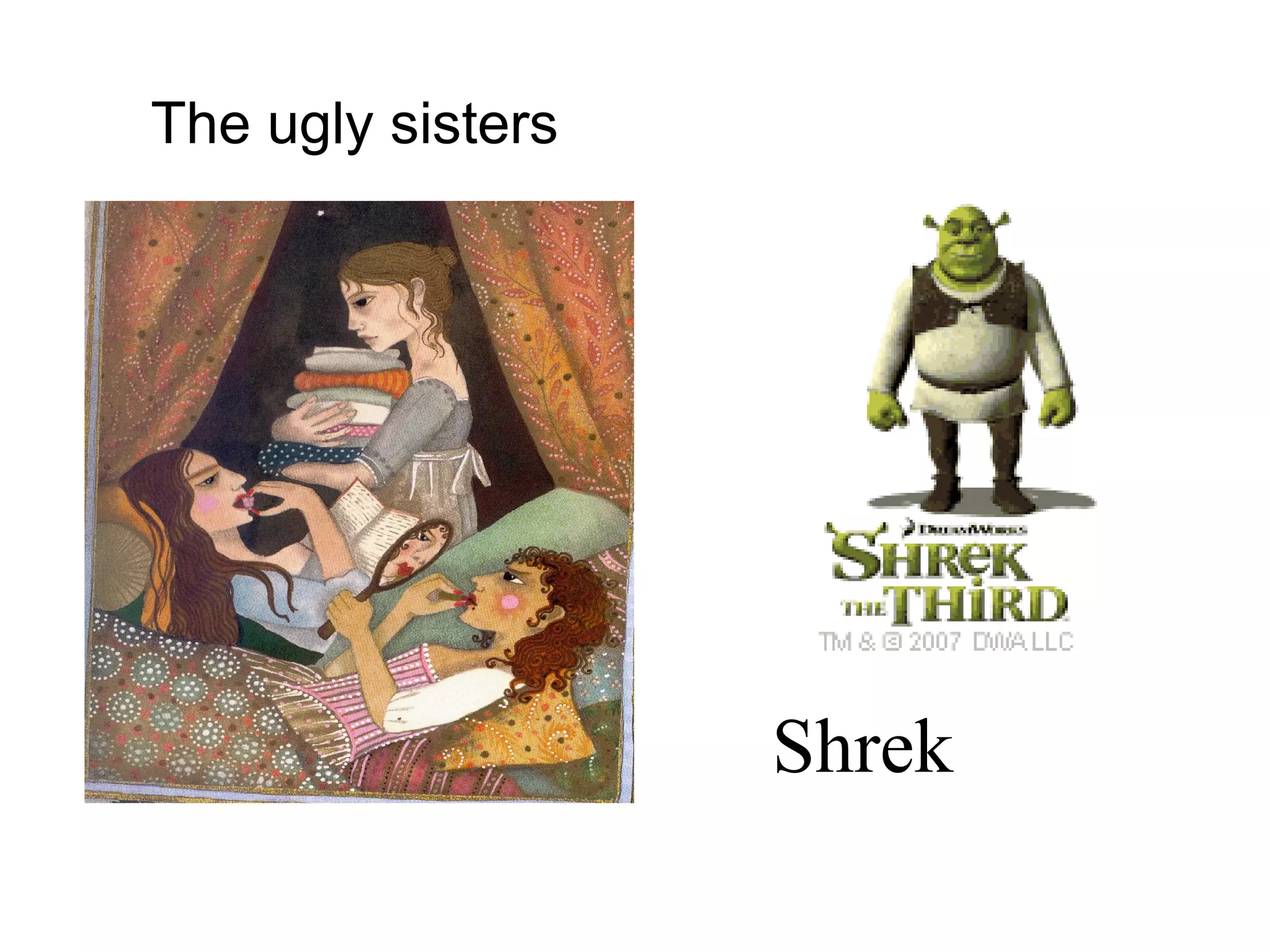
The ugly sisters Shrek
The Medical Model of disability Medical approach to the problem.  Defined by non-disabled professionals Equated to illness in terms of research and findings.  Care and benefits have been awarded  to compensate for personal tragedy.
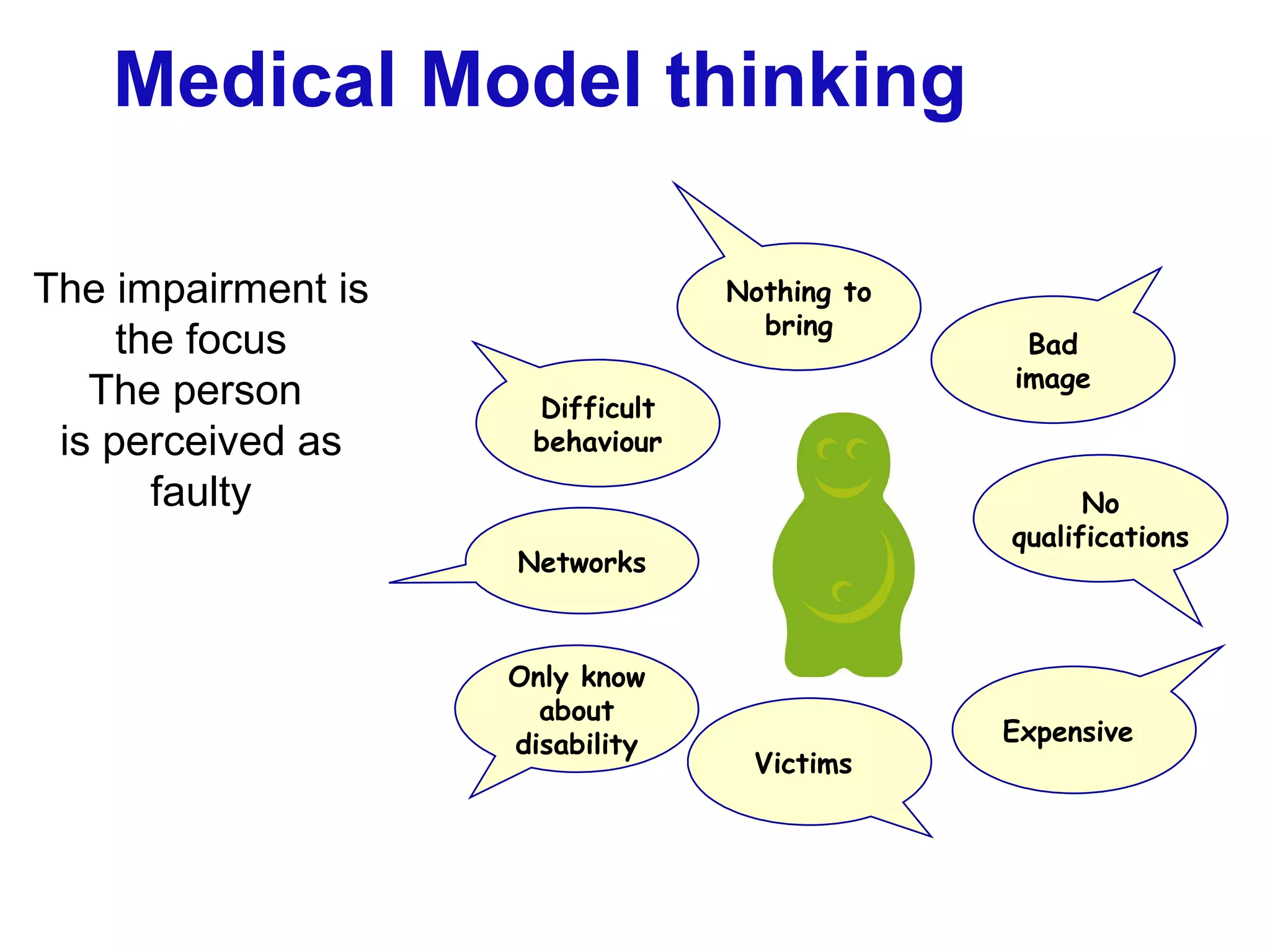
Medical Model thinking Bad image No qualifications Expensive  Nothing to bring Victims  Only know about disability Networks Difficult behaviour The impairment is the focus The person  is perceived as faulty
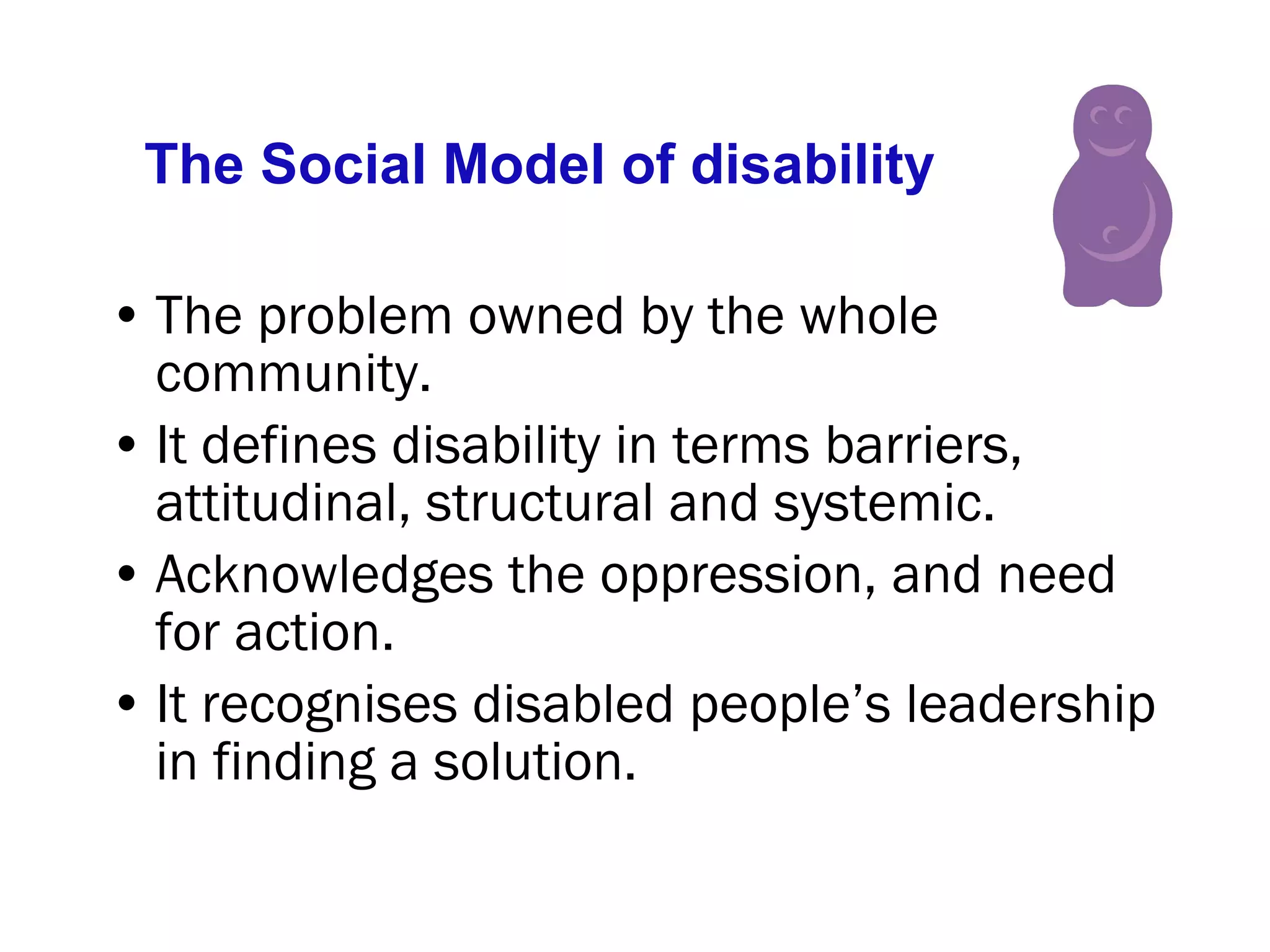
The Social Model of disability The problem owned by the whole community.  It defines disability in terms barriers, attitudinal, structural and systemic. Acknowledges the oppression, and need for action. It recognises disabled people’s leadership in finding a solution.
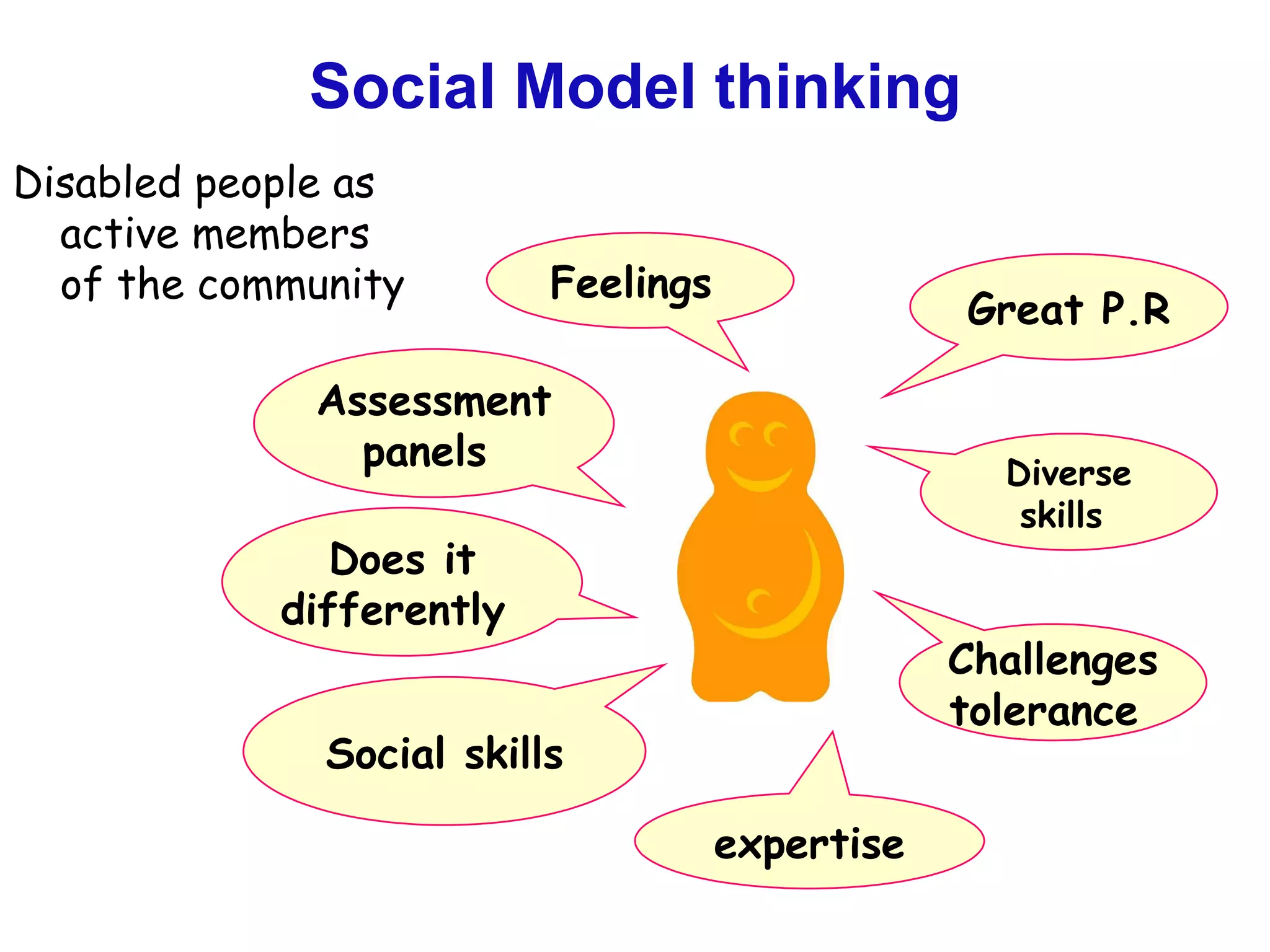
Social Model thinking Disabled people as active members of the community  Great P.R expertise Challenges tolerance  Diverse skills  Social skills Does it differently  Feelings  Assessment panels
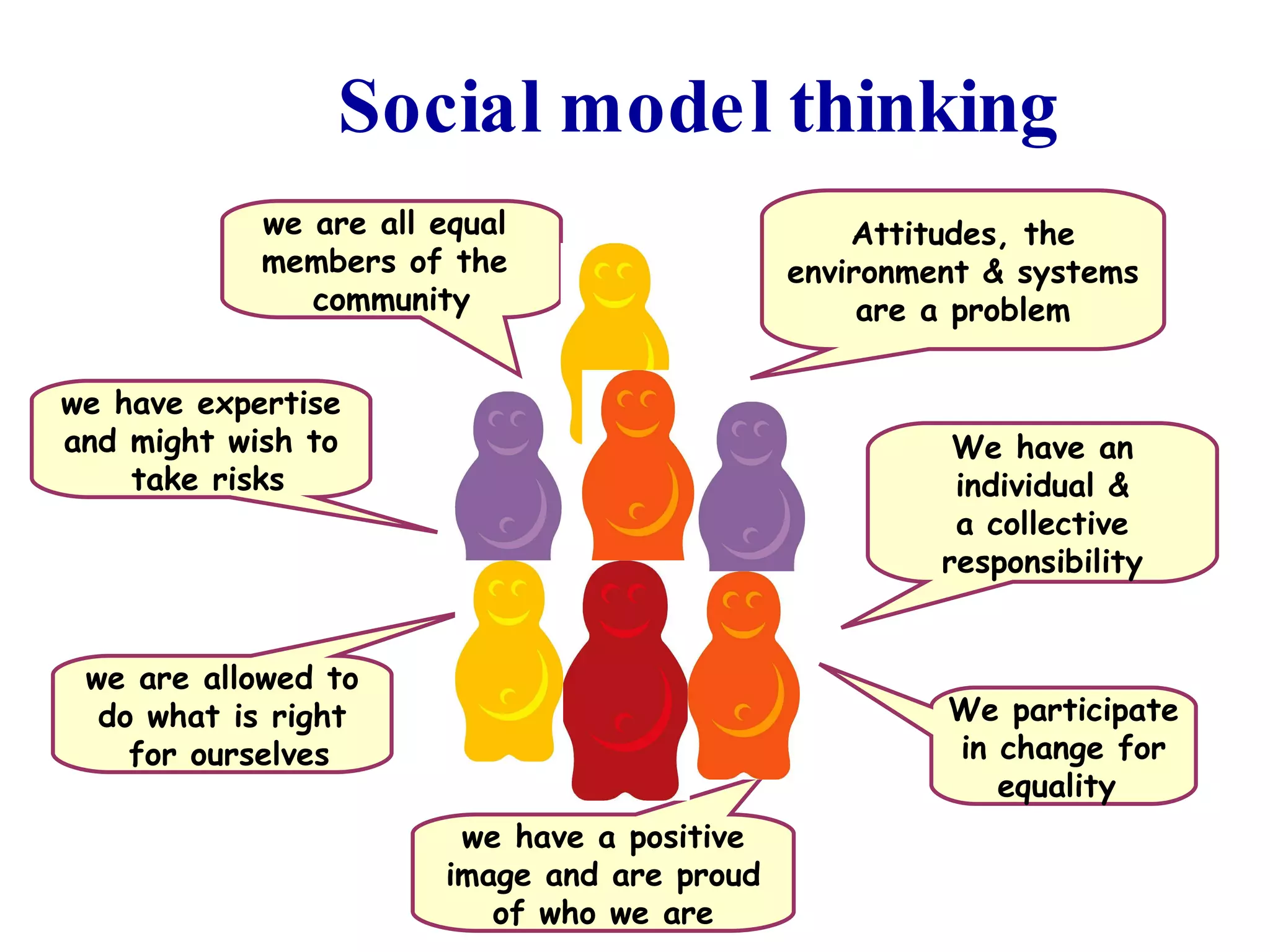
Social model thinking Attitudes, the environment & systems are a problem We participate in change for equality  We have an individual & a collective responsibility we are allowed to do what is right for ourselves we have a positive image and are proud of who we are we have expertise and might wish to take risks we are all equal  members of the  community
Barriers  attitudinal structural  systemic
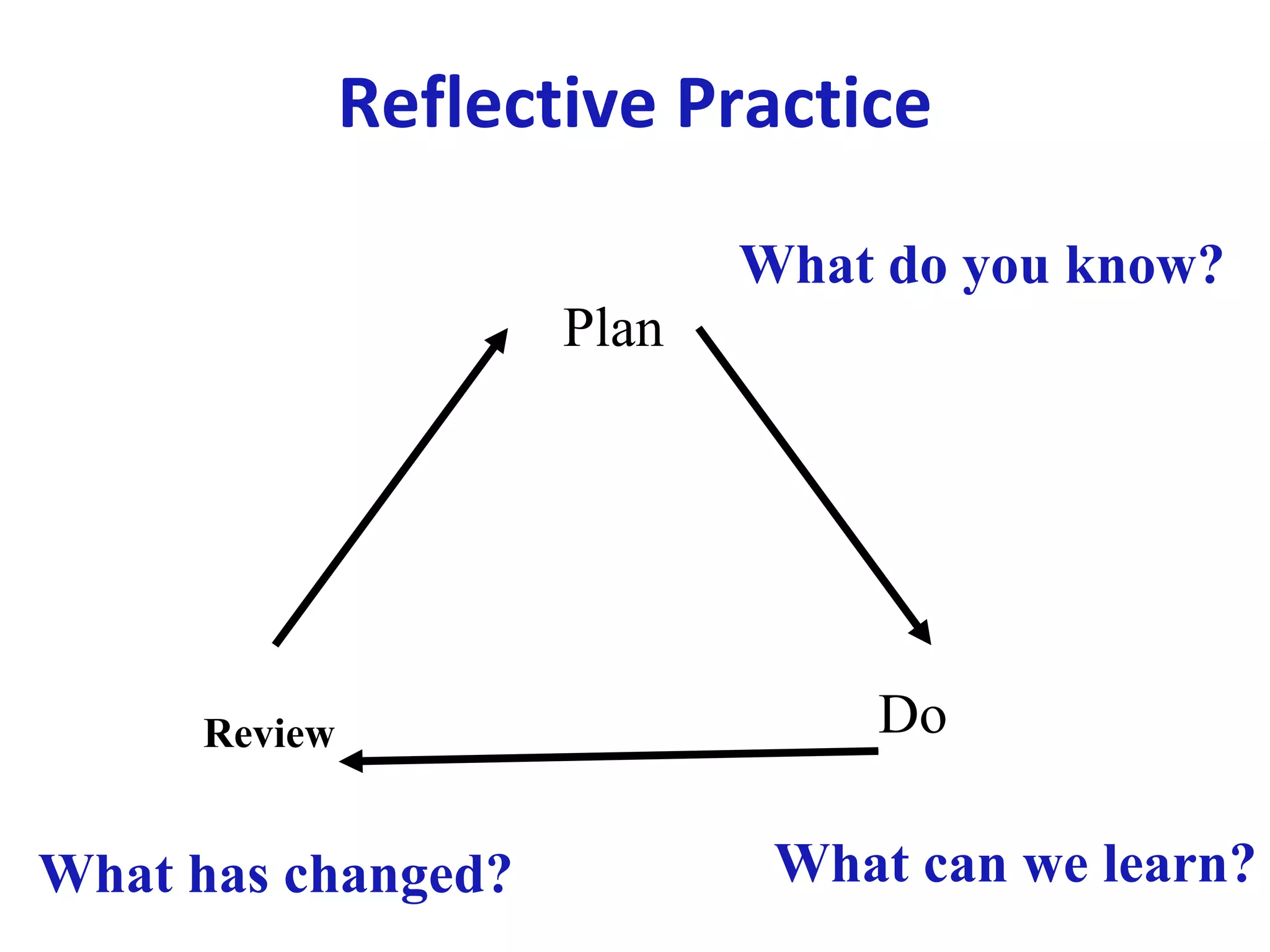
Reflective Practice Plan   Do Review What do you know? What can we learn? What has changed?
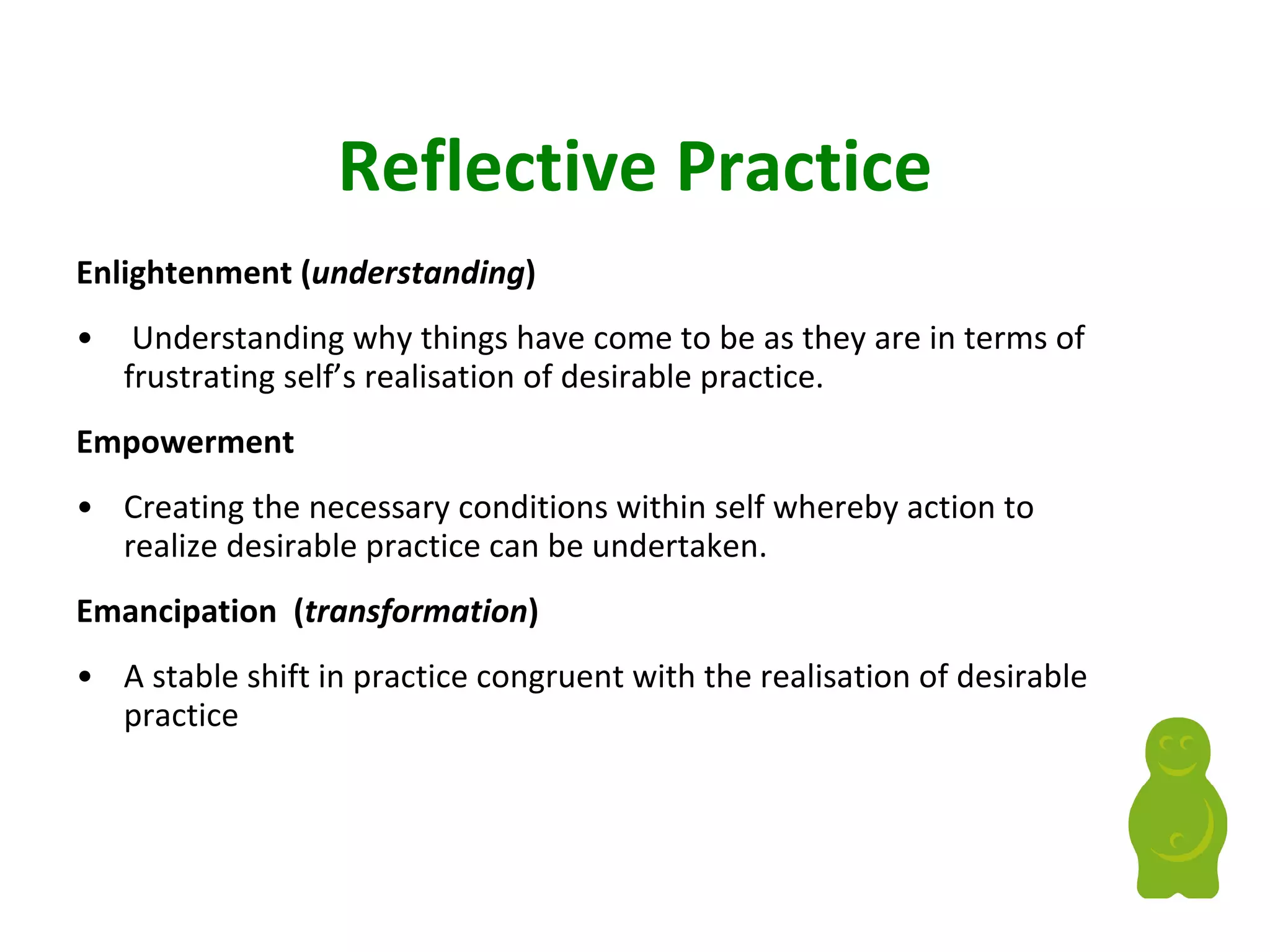
Reflective Practice Enlightenment   ( understanding ) Understanding why things have come to be as they are in terms of frustrating self’s realisation of desirable practice. Empowerment  Creating the necessary conditions within self whereby action to realize desirable practice can be undertaken. Emancipation  ( transformation ) A stable shift in practice congruent with the realisation of desirable practice
 
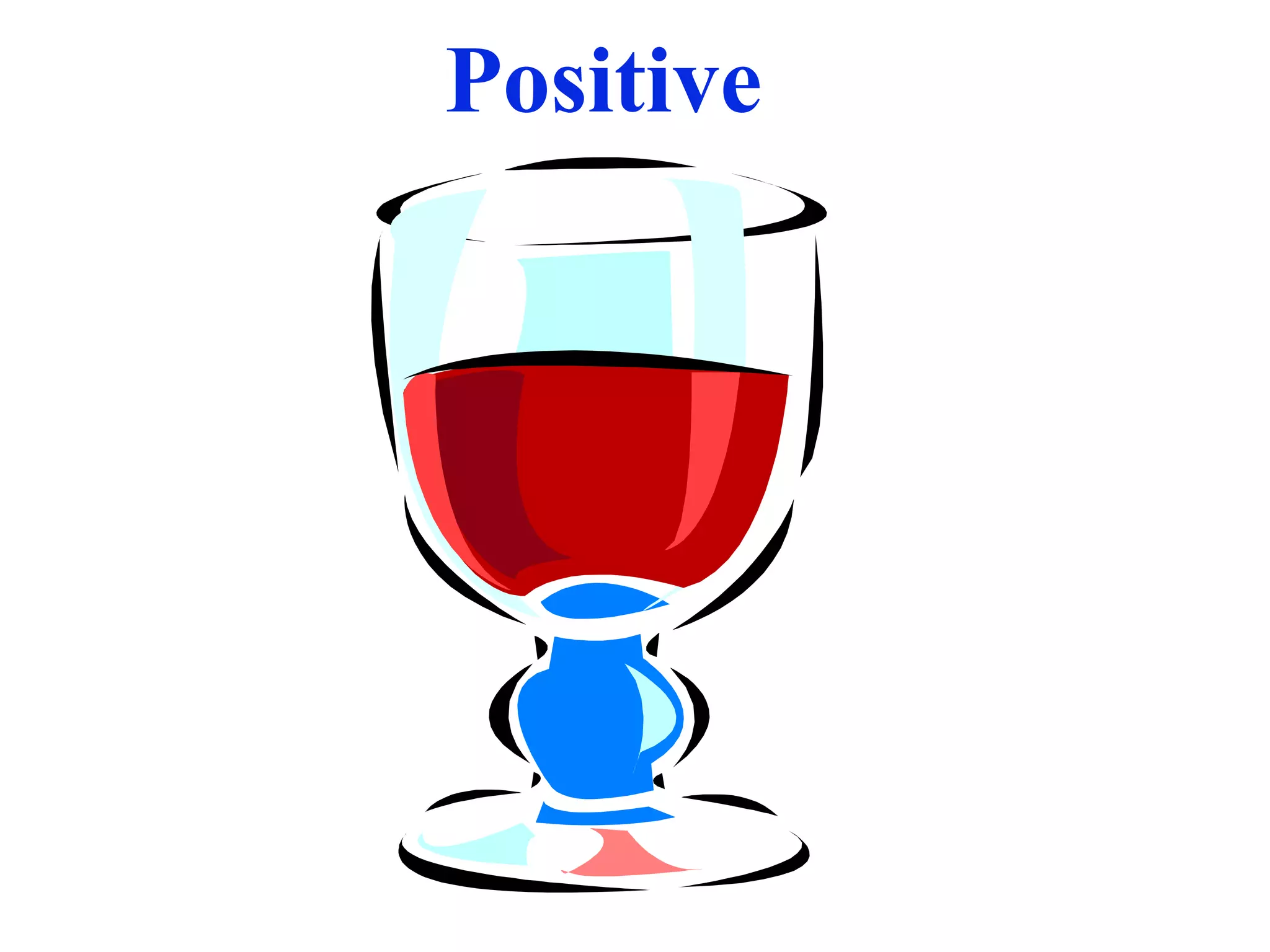
Positive
“ Vision without action is merely a dream Action without vision just passes the time Vision with action can change the world” Joel Barker
Possible We can: EYFS:  Learning and Development
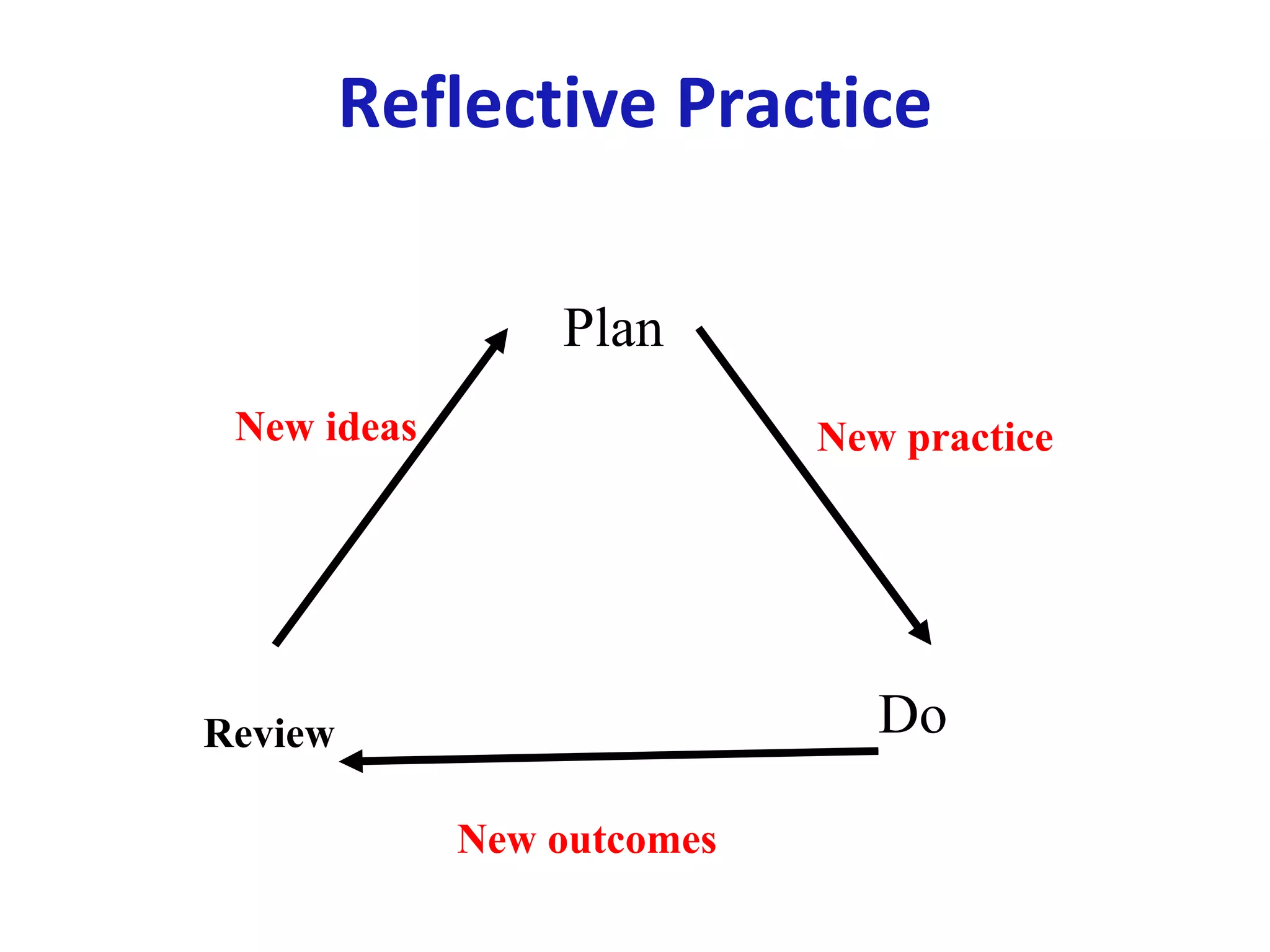
Reflective Practice Plan   Do Review New ideas New practice New outcomes
Not Goodbye…. But a bientot Find us on FaceBook & twitter  Equality Training Or www.equalitytraining.co.uk

Disability Equality - single strand.

  • 1.
    Disability Equality Training Laura (Mole) Chapman
  • 2.
  • 3.
    Ground Rules Whatdo you need to participate?
  • 4.
  • 5.
  • 6.
    Respectful language Disability... the disadvantage or restriction of activity caused by contemporary social organisation which takes little or no account of people who have physical impairments and thus excludes them from the mainstream of social activities. ( the Union for of Physically Impaired Segregation 1976)
  • 7.
    Respectful language Impairment, disabled people use this term to talk about their medical condition or diagnosis or description of their functioning—if there is nothing more formal.
  • 8.
      Examples of Impairment Quadriplegia Polio Cerebral palsy Blindness Deafness   Examples of Disability Buildings without ramps Poor health provision Bullying, name-calling Segregated education Workplaces without lifts
  • 9.
    Respectful language The person —their name. Impairment = Functioning Disability = barriers in society
  • 10.
    Respectful language FredBrown (the person ) is a man with cerebral palsy (the impairment ). When the barriers and discrimination (the oppression ) that restrict Fred have been removed from society, Fred will no longer be disabled, but he will still have cerebral palsy and be called Fred.
  • 11.
  • 12.
  • 13.
  • 14.
    The Facts Visuallyimpaired people are four times more likely to be verbally and physically abused than sighted people People with mental health issues are 11 times more likely to be victimised 90% of adults with a learning difficulty report being 'bullied'. Scope 2008
  • 15.
    Compared with non-disabledpeople, disabled people are: more likely to be economically inactive – only one in two disabled people of working age are currently in employment, compared with four out of five non-disabled people; more likely to experience problems with hate crime or harassment – a quarter of all disabled people say that they have experienced hate crime or harassment, and this number rises to 47% of people with mental health conditions;
  • 16.
    "on the experienceof disability, history is largely silent, and when it is discussed at all, it is within the context of the history of medical advances. Just as women and black people have discovered that they must write their own histories, so too with disabled people."
  • 17.
  • 18.
  • 19.
    The Medical Modelof disability Medical approach to the problem. Defined by non-disabled professionals Equated to illness in terms of research and findings. Care and benefits have been awarded to compensate for personal tragedy.
  • 20.
    Medical Model thinkingBad image No qualifications Expensive Nothing to bring Victims Only know about disability Networks Difficult behaviour The impairment is the focus The person is perceived as faulty
  • 21.
    The Social Modelof disability The problem owned by the whole community. It defines disability in terms barriers, attitudinal, structural and systemic. Acknowledges the oppression, and need for action. It recognises disabled people’s leadership in finding a solution.
  • 22.
    Social Model thinkingDisabled people as active members of the community Great P.R expertise Challenges tolerance Diverse skills Social skills Does it differently Feelings Assessment panels
  • 23.
    Social model thinkingAttitudes, the environment & systems are a problem We participate in change for equality We have an individual & a collective responsibility we are allowed to do what is right for ourselves we have a positive image and are proud of who we are we have expertise and might wish to take risks we are all equal members of the community
  • 24.
    Barriers attitudinalstructural systemic
  • 25.
    Reflective Practice Plan Do Review What do you know? What can we learn? What has changed?
  • 26.
    Reflective Practice Enlightenment ( understanding ) Understanding why things have come to be as they are in terms of frustrating self’s realisation of desirable practice. Empowerment Creating the necessary conditions within self whereby action to realize desirable practice can be undertaken. Emancipation ( transformation ) A stable shift in practice congruent with the realisation of desirable practice
  • 27.
  • 28.
  • 29.
    “ Vision withoutaction is merely a dream Action without vision just passes the time Vision with action can change the world” Joel Barker
  • 30.
    Possible We can:EYFS: Learning and Development
  • 31.
    Reflective Practice Plan Do Review New ideas New practice New outcomes
  • 32.
    Not Goodbye…. Buta bientot Find us on FaceBook & twitter Equality Training Or www.equalitytraining.co.uk