People in wheelchairs
automatically have
mental disabilities or
developmental delays.
TRUE or false
These days there are so many outlets we can
go to for information: Google, Facebook, Twitter, USQ’s
Social Hub… the list goes on! But with all these fantastic
resources, it’s disappointing to learn that myths, stigma
and stereotypes still exist when it comes to disability.
Here at USQ, we think it’s important to help you get on
the right page when it comes to understanding different
life experiences in your classrooms, workplaces and
relationships, so we’ve put together some true or false
scenarios to test your knowledge.
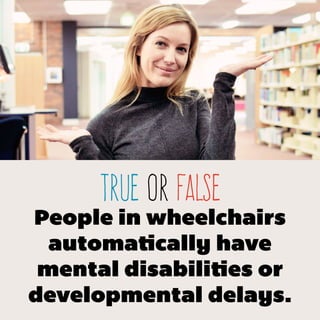
People in wheelchairs
automatically have
mental disabilities or
developmental delays.
TRUE or false
false
This is a common myth but completely incorrect. While there
are some disabilities that affect both a person’s physical
and cognitive ability, the two do not automatically go hand
in hand. Just because someone is in a wheelchair or has a
physical/mobility impairment does not mean that they have
any kind of mental disability, speech or hearing impairment.
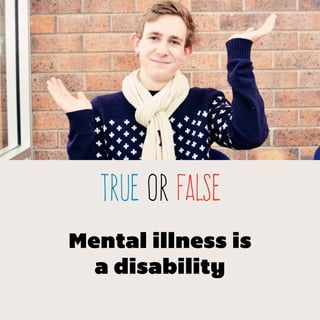
TRUE or false
Mental illness is
a disability.
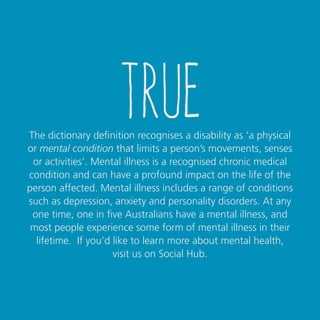
true
The Oxford Dictionary definition recognises a disability as
‘a physical or mental condition that limits a person’s
movements, senses or activities’. Mental illness is a recognised
chronic medical condition and can have a profound impact on
the life of the person affected. Mental illness includes a range
of conditions such as depression, anxiety and personality
disorders. At any one time, 1 in 5 Australians have a mental
illness, and most people experience some form of mental
illness in their lifetime*.
If you’d like to learn more about mental health,
contact USQ’s Student Services team.
*Mindframe, Facts and stats about mental illness in Australia, 2014.
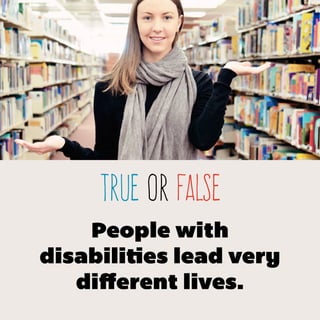
TRUE or false
People with
disabilities lead very
different lives.
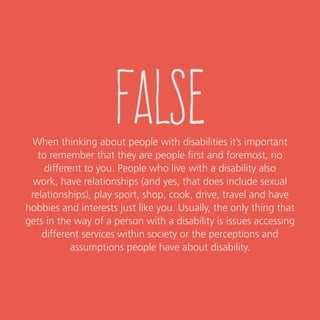
false
When thinking about people with disabilities, it’s important
to remember that they are people first and foremost, no
different to you. People who live with a disability also
work, have relationships (and yes, that does include sexual
relationships), play sport, shop, cook, drive, travel and have
hobbies and interests just like you.
Usually, the only thing that gets in the way of a person with a
disability is issues accessing different services within society or
the perceptions and assumptions people have about disability.
TRUE or false
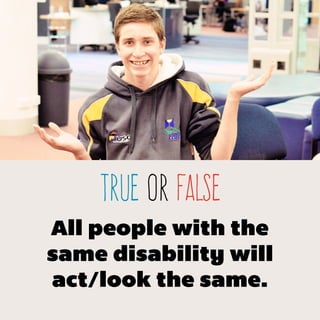
All people with the
same disability will
act/look the same.
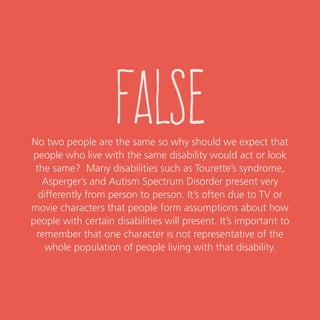
false
No two people are the same, so why should we
expect that people who live with the same disability
would act or look the same?
Many disabilities such as Tourette’s syndrome,
Asperger syndrome and Autism Spectrum Disorder
present very differently from person to person. It’s often due
to TV or movie characters that people form assumptions
about how people with certain disabilities will present.
It’s important to remember that one character is not
representative of the whole population of people living with
that disability.
TRUE or false
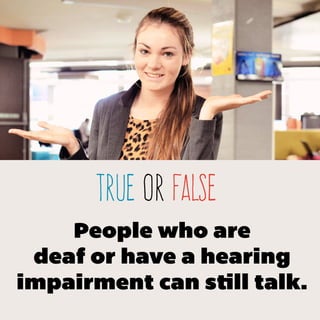
People who are
deaf or have a hearing
impairment can still talk.
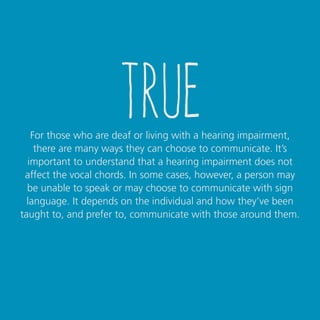
true
For those who are deaf or living with a hearing impairment,
there are many ways they can choose to communicate. It’s
important to understand that a hearing impairment does not
affect the vocal chords. In some cases, however, a person may
be unable to speak or may choose to communicate with sign
language. It depends on the individual and how they’ve been
taught to, and prefer to, communicate with those around them.
TRUE or false
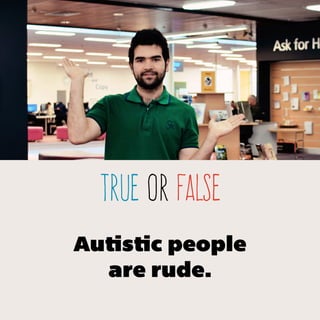
Autistic people
are rude.
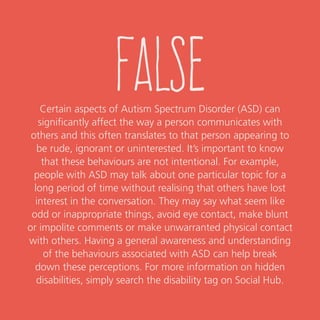
false
Certain aspects of Autism Spectrum Disorder (ASD) can
significantly affect the way a person communicates with others
and this often translates to that person appearing to be rude,
ignorant or uninterested. It’s important to know that these
behaviours are not intentional.
For example, people with ASD may talk about one particular topic
for a long period of time without realising that others have lost
interest in the conversation. They may say what seems like odd or
inappropriate things, avoid eye contact, make blunt or impolite
comments or make unwarranted physical contact with others. Having
a general awareness and understanding of the behaviours associated
with ASD can help break down these perceptions.
For more information on hidden or invisible disabilities,
get in touch with USQ’s Student Services team.
TRUE or false
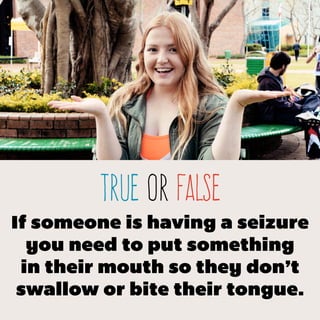
If someone is having a seizure
you need to put something
in their mouth so they don’t
swallow or bite their tongue.
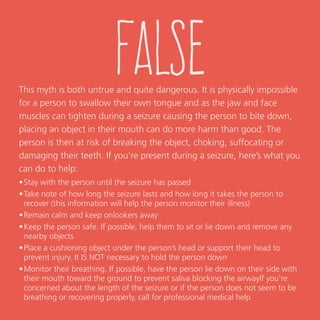
false
This myth is both untrue and quite dangerous. It is physically impossible
for a person to swallow their own tongue and as the jaw and face
muscles can tighten during a seizure causing the person to bite down,
placing an object in their mouth can do more harm than good. The
person is then at risk of breaking the object, choking, suffocating or
damaging their teeth. If you’re present during a seizure, here’s what you
can do to help:
•	stay with the person until the seizure has passed
•	take note of how long the seizure lasts and how long it takes the person to
recover (this information will help the person monitor their illness)
•	remain calm and keep onlookers away
•	keep the person safe. If possible, help them to sit or lie down and remove any
nearby objects
•	place a cushioning object under the person’s head or support their head to
prevent injury. It IS NOT necessary to hold the person down
•	monitor their breathing. If possible, have the person lie down on their side with
their mouth toward the ground to prevent saliva blocking the airway. If you’re
concerned about the length of the seizure or if the person does not seem to be
breathing or recovering properly, call for professional medical help.
How did you go at answering these true and false questions
about disability? Did you learn something new?
If you liked these disability myth busters and want to learn
more about how to better understand and support your
peers, get in touch with USQ’s Student Services team!
#usq #stopthestigma
social.usq.edu.au
1800 269 500
CRICOSQLD00244BNSW02225MTEQSAPRV12081 9.1.H 02.2017

Disability myth buster - True or false

  • 1.
    People in wheelchairs automaticallyhave mental disabilities or developmental delays. TRUE or false
  • 2.
    These days thereare so many outlets we can go to for information: Google, Facebook, Twitter, USQ’s Social Hub… the list goes on! But with all these fantastic resources, it’s disappointing to learn that myths, stigma and stereotypes still exist when it comes to disability. Here at USQ, we think it’s important to help you get on the right page when it comes to understanding different life experiences in your classrooms, workplaces and relationships, so we’ve put together some true or false scenarios to test your knowledge.
  • 3.
    People in wheelchairs automaticallyhave mental disabilities or developmental delays. TRUE or false
  • 4.
    false This is acommon myth but completely incorrect. While there are some disabilities that affect both a person’s physical and cognitive ability, the two do not automatically go hand in hand. Just because someone is in a wheelchair or has a physical/mobility impairment does not mean that they have any kind of mental disability, speech or hearing impairment.
  • 5.
    TRUE or false Mentalillness is a disability.
  • 6.
    true The Oxford Dictionarydefinition recognises a disability as ‘a physical or mental condition that limits a person’s movements, senses or activities’. Mental illness is a recognised chronic medical condition and can have a profound impact on the life of the person affected. Mental illness includes a range of conditions such as depression, anxiety and personality disorders. At any one time, 1 in 5 Australians have a mental illness, and most people experience some form of mental illness in their lifetime*. If you’d like to learn more about mental health, contact USQ’s Student Services team. *Mindframe, Facts and stats about mental illness in Australia, 2014.
  • 7.
    TRUE or false Peoplewith disabilities lead very different lives.
  • 8.
    false When thinking aboutpeople with disabilities, it’s important to remember that they are people first and foremost, no different to you. People who live with a disability also work, have relationships (and yes, that does include sexual relationships), play sport, shop, cook, drive, travel and have hobbies and interests just like you. Usually, the only thing that gets in the way of a person with a disability is issues accessing different services within society or the perceptions and assumptions people have about disability.
  • 9.
    TRUE or false Allpeople with the same disability will act/look the same.
  • 10.
    false No two peopleare the same, so why should we expect that people who live with the same disability would act or look the same? Many disabilities such as Tourette’s syndrome, Asperger syndrome and Autism Spectrum Disorder present very differently from person to person. It’s often due to TV or movie characters that people form assumptions about how people with certain disabilities will present. It’s important to remember that one character is not representative of the whole population of people living with that disability.
  • 11.
    TRUE or false Peoplewho are deaf or have a hearing impairment can still talk.
  • 12.
    true For those whoare deaf or living with a hearing impairment, there are many ways they can choose to communicate. It’s important to understand that a hearing impairment does not affect the vocal chords. In some cases, however, a person may be unable to speak or may choose to communicate with sign language. It depends on the individual and how they’ve been taught to, and prefer to, communicate with those around them.
  • 13.
    TRUE or false Autisticpeople are rude.
  • 14.
    false Certain aspects ofAutism Spectrum Disorder (ASD) can significantly affect the way a person communicates with others and this often translates to that person appearing to be rude, ignorant or uninterested. It’s important to know that these behaviours are not intentional. For example, people with ASD may talk about one particular topic for a long period of time without realising that others have lost interest in the conversation. They may say what seems like odd or inappropriate things, avoid eye contact, make blunt or impolite comments or make unwarranted physical contact with others. Having a general awareness and understanding of the behaviours associated with ASD can help break down these perceptions. For more information on hidden or invisible disabilities, get in touch with USQ’s Student Services team.
  • 15.
    TRUE or false Ifsomeone is having a seizure you need to put something in their mouth so they don’t swallow or bite their tongue.
  • 16.
    false This myth isboth untrue and quite dangerous. It is physically impossible for a person to swallow their own tongue and as the jaw and face muscles can tighten during a seizure causing the person to bite down, placing an object in their mouth can do more harm than good. The person is then at risk of breaking the object, choking, suffocating or damaging their teeth. If you’re present during a seizure, here’s what you can do to help: • stay with the person until the seizure has passed • take note of how long the seizure lasts and how long it takes the person to recover (this information will help the person monitor their illness) • remain calm and keep onlookers away • keep the person safe. If possible, help them to sit or lie down and remove any nearby objects • place a cushioning object under the person’s head or support their head to prevent injury. It IS NOT necessary to hold the person down • monitor their breathing. If possible, have the person lie down on their side with their mouth toward the ground to prevent saliva blocking the airway. If you’re concerned about the length of the seizure or if the person does not seem to be breathing or recovering properly, call for professional medical help.
  • 17.
    How did yougo at answering these true and false questions about disability? Did you learn something new? If you liked these disability myth busters and want to learn more about how to better understand and support your peers, get in touch with USQ’s Student Services team! #usq #stopthestigma social.usq.edu.au 1800 269 500 CRICOSQLD00244BNSW02225MTEQSAPRV12081 9.1.H 02.2017