Working inside the box:  < Discretion isn’t lying when disclosing your disability > Presenter: Geoff Moses Stepping Stones, Sept 2011
Note: The information contained in these pages is for educational purposes only, and is not legal advice. Individuals should contact the appropriate legal resources for specific legal advice regarding their particular situations
QUESTION:   Should I bring up the subject of my disability, mental illness or addiction?
How does mental illness affect work performance? Mental illness affects everyone sooner or later—one in five people will experience a mental illness directly. Those of us who do not have a mental health problem ourselves, will have a friend, colleague, or family member who is dealing with a mental health issue. Workplaces are heavily impacted by mental health issues according to a  1. 2011 report, Forty-four (44) per cent of the employees surveyed reported they were either currently (12 per cent) or had previously (32 per cent) personally experienced a mental health issue. 1. “ Building Mentally Healthy Workplaces: Perspectives of Canadian Workers and Front-Line Managers ” Report by Karla Thorpe, Louise Chenier
Mental Health in the Workplace Employee Fundamentals 101 Under the Human Rights Code, your employer only needs to provide accommodations for limitations that can be directly connected to your disability  ( for which they need to be aware of ) Only you can decide whether and how much to tell your employer about your psychiatric disability. Telling your employer about your diagnosis is the only way to protect your legal right to any accommodations you might need to get or keep a job.  However, revealing your disability may subject you to discrimination which could limit your opportunities for employment and advancement. Its your right not to disclose your health concerns, unless there are health and safety reasons  --- or that you require some sort of formal accommodations.
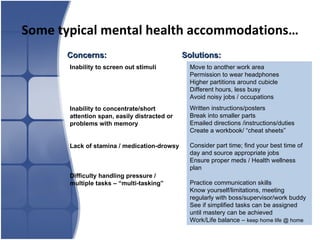
Some typical mental health accommodations… Inability to screen out stimuli Inability to concentrate/short attention span, easily distracted or problems with memory Lack of stamina / medication-drowsy Difficulty handling pressure / multiple tasks – “multi-tasking” Concerns: Solutions: Move to another work area Permission to wear headphones Higher partitions around cubicle Different hours, less busy Avoid noisy jobs / occupations Written instructions/posters Break into smaller parts Emailed directions /instructions/duties Create a workbook/ “cheat sheets” Consider part time; find your best time of day and source appropriate jobs  Ensure proper meds / Health wellness plan Practice communication skills Know yourself/limitations, meeting regularly with boss/supervisor/work buddy See if simplified tasks can be assigned until mastery can be achieved Work/Life balance –  keep home life @ home
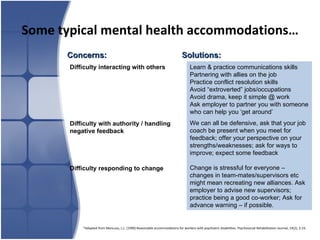
Some typical mental health accommodations… Difficulty interacting with others Difficulty with authority / handling negative feedback Difficulty responding to change Concerns: Solutions: Learn & practice communications skills  Partnering with allies on the job Practice conflict resolution skills Avoid “extroverted” jobs/occupations Avoid drama, keep it simple @ work Ask employer to partner you with someone who can help you ‘get around’ We can all be defensive, ask that your job coach be present when you meet for feedback; offer your perspective on your strengths/weaknesses; ask for ways to improve; expect some feedback Change is stressful for everyone – changes in team-mates/supervisors etc might mean recreating new alliances. Ask employer to advise new supervisors; practice being a good co-worker; Ask for advance warning – if possible. *Adapted from Mancuso, L.L. (1990) Reasonable accommodations for workers with psychiatric disabilities. Psychosocial Rehabilitation Journal, 14(2), 3-19.
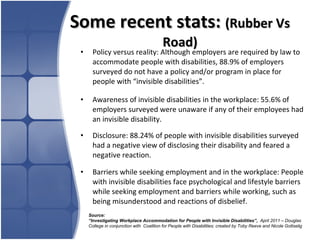
Some recent stats:  (Rubber Vs Road) Policy versus reality: Although employers are required by law to accommodate people with disabilities, 88.9% of employers surveyed do not have a policy and/or program in place for people with “invisible disabilities”. Awareness of invisible disabilities in the workplace: 55.6% of employers surveyed were unaware if any of their employees had an invisible disability.  Disclosure: 88.24% of people with invisible disabilities surveyed had a negative view of disclosing their disability and feared a negative reaction.  Barriers while seeking employment and in the workplace: People with invisible disabilities face psychological and lifestyle barriers while seeking employment and barriers while working, such as being misunderstood and reactions of disbelief.  Source:  “ Investigating Workplace Accommodation for People with Invisible Disabilities”,  April 2011 – Douglas College in conjunction with  Coalition for People with Disabilities; created by Toby Reeve and Nicole Gottselig
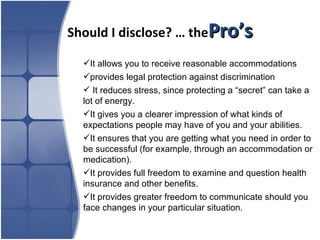
Should I disclose? … the Pro’s It allows you to receive reasonable accommodations  provides legal protection against discrimination It reduces stress, since protecting a “secret” can take a lot of energy. It gives you a clearer impression of what kinds of expectations people may have of you and your abilities. It ensures that you are getting what you need in order to be successful (for example, through an accommodation or medication).  It provides full freedom to examine and question health insurance and other benefits.  It provides greater freedom to communicate should you face changes in your particular situation.
Should I disclose? … the  Con’s Your employer may have an absenteeism policy that  requires you to provide a medical certificate if you  miss more than a specified number of days of work.  It can cause you to relive bad past experiences that  resulted in the loss of a job or negative responses It can cause you to become an object of curiosity. It can lead to your being blamed if something happens It can lead to your being treated differently than others. It can lead to your being viewed as needy, not  independent, or unable to perform the same. It could cause you to be overlooked for a job / project Disclosing personal and sensitive information can be  extremely difficult and embarrassing.
If I decide to disclose my disability… When you disclose,  you are intentionally releasing personal information about yourself for a specific purpose. Decide what and who needs to know the information . Your disclosure might be different depending on who you talk to. It is important to keep the importance of the disability  within the context of the interview and/or job . Do not over share! The main focus of any interview is to find out who you are, what you can do and why the employer should hire you.  Focus on your ability to do the essential functions  of the position. Next bring up the functions that you will need a reasonable accommodation to do; stress the resulting productivity and effectiveness of the accommodation to allow you to perform the function.  You are requesting accommodation.  You do not necessarily have to disclose the nature of your illness , but you will have to provide enough information to the employer about your disability so that appropriate accommodation can be provided.
Before hand, things to consider… Your  knowledge of your disability  and how easily you talk about it Your  ability to perform  the essential job functions How your disability  may affect your ability  to perform the job The  employer’s attitude   toward people with disabilities  Your  own comfort and trust level  with the employer  Your  past accommodations  in a professional environment Your  suggestions for  accommodations , if needed (An accommodation is essentially any strategy that gets rid of or lessens the effect of a specific barrier.)
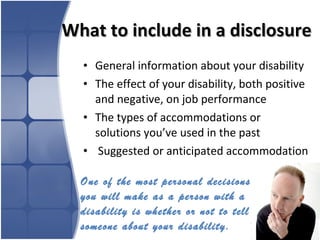
What to include in a disclosure General information about your disability The effect of your disability, both positive and negative, on job performance The types of accommodations or solutions you’ve used in the past Suggested or anticipated accommodation One of the most personal decisions you will make as a person with a disability is whether or not to tell someone about your disability.
Timing your disclosure may help: When can it come up?
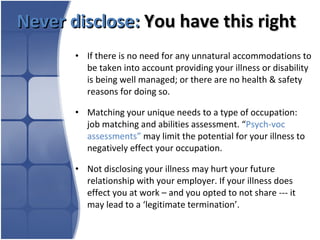
Never disclose:   You have this right  If there is no need for any unnatural accommodations to be taken into account providing your illness or disability is being well managed; or there are no health & safety reasons for doing so.  Matching your unique needs to a type of occupation: job matching and abilities assessment. “ Psych-voc assessments”  may limit the potential for your illness to negatively effect your occupation. Not disclosing your illness may hurt your future relationship with your employer. If your illness does effect you at work – and you opted to not share --- it may lead to a ‘legitimate termination’.
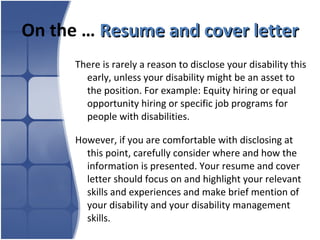
On the …  Resume and cover letter There is rarely a reason to disclose your disability this early, unless your disability might be an asset to the position. For example: Equity hiring or equal opportunity hiring or specific job programs for people with disabilities.  However, if you are comfortable with disclosing at this point, carefully consider where and how the information is presented. Your resume and cover letter should focus on and highlight your relevant skills and experiences and make brief mention of your disability and your disability management skills.
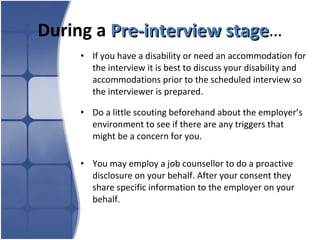
During a  Pre-interview stage … If you have a disability or need an accommodation for the interview it is best to discuss your disability and accommodations prior to the scheduled interview so the interviewer is prepared.  Do a little scouting beforehand about the employer’s environment to see if there are any triggers that might be a concern for you. You may employ a job counsellor to do a proactive disclosure on your behalf. After your consent they share specific information to the employer on your behalf.
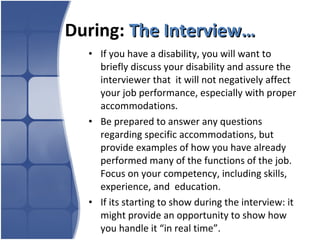
During:  The Interview… If you have a disability, you will want to briefly discuss your disability and assure the interviewer that  it will not negatively affect your job performance, especially with proper accommodations.  Be prepared to answer any questions regarding specific accommodations, but provide examples of how you have already  performed many of the functions of the job. Focus on your competency, including skills, experience, and  education.  If its starting to show during the interview: it might provide an opportunity to show how you handle it “in real time”.
…  After being  “offered the job” Many people choose to disclose their disability after a job has been offered to ensure that the employer will focus solely on the individual’s qualifications and skills.  If you determine that you will need an accommodation, discuss it prior to your start date to ensure accommodations are made prior to your arrival.  This also makes it easier to illustrate that discrimination might have been a factor should there be concerns about hiring or human rights violations.
During “ the employment period ” During the course of employment If you discover over time that you have underestimated your need for an accommodation, it is best to disclose your disability to your employer and ask for accommodations before your work performance is affected.
Conclusion : 3 golden rules Know your rights :  Preview the BC Human Rights Process Know thyself :  Know your limits; help others on how to help you Use discretion:  Know when to share & don’t over share

Stepping Stones Disability Disclosure

  • 1.
    Working inside thebox: < Discretion isn’t lying when disclosing your disability > Presenter: Geoff Moses Stepping Stones, Sept 2011
  • 2.
    Note: The informationcontained in these pages is for educational purposes only, and is not legal advice. Individuals should contact the appropriate legal resources for specific legal advice regarding their particular situations
  • 3.
    QUESTION: Should I bring up the subject of my disability, mental illness or addiction?
  • 4.
    How does mentalillness affect work performance? Mental illness affects everyone sooner or later—one in five people will experience a mental illness directly. Those of us who do not have a mental health problem ourselves, will have a friend, colleague, or family member who is dealing with a mental health issue. Workplaces are heavily impacted by mental health issues according to a 1. 2011 report, Forty-four (44) per cent of the employees surveyed reported they were either currently (12 per cent) or had previously (32 per cent) personally experienced a mental health issue. 1. “ Building Mentally Healthy Workplaces: Perspectives of Canadian Workers and Front-Line Managers ” Report by Karla Thorpe, Louise Chenier
  • 5.
    Mental Health inthe Workplace Employee Fundamentals 101 Under the Human Rights Code, your employer only needs to provide accommodations for limitations that can be directly connected to your disability ( for which they need to be aware of ) Only you can decide whether and how much to tell your employer about your psychiatric disability. Telling your employer about your diagnosis is the only way to protect your legal right to any accommodations you might need to get or keep a job. However, revealing your disability may subject you to discrimination which could limit your opportunities for employment and advancement. Its your right not to disclose your health concerns, unless there are health and safety reasons --- or that you require some sort of formal accommodations.
  • 6.
    Some typical mentalhealth accommodations… Inability to screen out stimuli Inability to concentrate/short attention span, easily distracted or problems with memory Lack of stamina / medication-drowsy Difficulty handling pressure / multiple tasks – “multi-tasking” Concerns: Solutions: Move to another work area Permission to wear headphones Higher partitions around cubicle Different hours, less busy Avoid noisy jobs / occupations Written instructions/posters Break into smaller parts Emailed directions /instructions/duties Create a workbook/ “cheat sheets” Consider part time; find your best time of day and source appropriate jobs Ensure proper meds / Health wellness plan Practice communication skills Know yourself/limitations, meeting regularly with boss/supervisor/work buddy See if simplified tasks can be assigned until mastery can be achieved Work/Life balance – keep home life @ home
  • 7.
    Some typical mentalhealth accommodations… Difficulty interacting with others Difficulty with authority / handling negative feedback Difficulty responding to change Concerns: Solutions: Learn & practice communications skills Partnering with allies on the job Practice conflict resolution skills Avoid “extroverted” jobs/occupations Avoid drama, keep it simple @ work Ask employer to partner you with someone who can help you ‘get around’ We can all be defensive, ask that your job coach be present when you meet for feedback; offer your perspective on your strengths/weaknesses; ask for ways to improve; expect some feedback Change is stressful for everyone – changes in team-mates/supervisors etc might mean recreating new alliances. Ask employer to advise new supervisors; practice being a good co-worker; Ask for advance warning – if possible. *Adapted from Mancuso, L.L. (1990) Reasonable accommodations for workers with psychiatric disabilities. Psychosocial Rehabilitation Journal, 14(2), 3-19.
  • 8.
    Some recent stats: (Rubber Vs Road) Policy versus reality: Although employers are required by law to accommodate people with disabilities, 88.9% of employers surveyed do not have a policy and/or program in place for people with “invisible disabilities”. Awareness of invisible disabilities in the workplace: 55.6% of employers surveyed were unaware if any of their employees had an invisible disability. Disclosure: 88.24% of people with invisible disabilities surveyed had a negative view of disclosing their disability and feared a negative reaction. Barriers while seeking employment and in the workplace: People with invisible disabilities face psychological and lifestyle barriers while seeking employment and barriers while working, such as being misunderstood and reactions of disbelief. Source: “ Investigating Workplace Accommodation for People with Invisible Disabilities”, April 2011 – Douglas College in conjunction with Coalition for People with Disabilities; created by Toby Reeve and Nicole Gottselig
  • 9.
    Should I disclose?… the Pro’s It allows you to receive reasonable accommodations provides legal protection against discrimination It reduces stress, since protecting a “secret” can take a lot of energy. It gives you a clearer impression of what kinds of expectations people may have of you and your abilities. It ensures that you are getting what you need in order to be successful (for example, through an accommodation or medication). It provides full freedom to examine and question health insurance and other benefits. It provides greater freedom to communicate should you face changes in your particular situation.
  • 10.
    Should I disclose?… the Con’s Your employer may have an absenteeism policy that requires you to provide a medical certificate if you miss more than a specified number of days of work. It can cause you to relive bad past experiences that resulted in the loss of a job or negative responses It can cause you to become an object of curiosity. It can lead to your being blamed if something happens It can lead to your being treated differently than others. It can lead to your being viewed as needy, not independent, or unable to perform the same. It could cause you to be overlooked for a job / project Disclosing personal and sensitive information can be extremely difficult and embarrassing.
  • 11.
    If I decideto disclose my disability… When you disclose, you are intentionally releasing personal information about yourself for a specific purpose. Decide what and who needs to know the information . Your disclosure might be different depending on who you talk to. It is important to keep the importance of the disability within the context of the interview and/or job . Do not over share! The main focus of any interview is to find out who you are, what you can do and why the employer should hire you. Focus on your ability to do the essential functions of the position. Next bring up the functions that you will need a reasonable accommodation to do; stress the resulting productivity and effectiveness of the accommodation to allow you to perform the function. You are requesting accommodation. You do not necessarily have to disclose the nature of your illness , but you will have to provide enough information to the employer about your disability so that appropriate accommodation can be provided.
  • 12.
    Before hand, thingsto consider… Your knowledge of your disability and how easily you talk about it Your ability to perform the essential job functions How your disability may affect your ability to perform the job The employer’s attitude toward people with disabilities Your own comfort and trust level with the employer Your past accommodations in a professional environment Your suggestions for accommodations , if needed (An accommodation is essentially any strategy that gets rid of or lessens the effect of a specific barrier.)
  • 13.
    What to includein a disclosure General information about your disability The effect of your disability, both positive and negative, on job performance The types of accommodations or solutions you’ve used in the past Suggested or anticipated accommodation One of the most personal decisions you will make as a person with a disability is whether or not to tell someone about your disability.
  • 14.
    Timing your disclosuremay help: When can it come up?
  • 15.
    Never disclose: You have this right If there is no need for any unnatural accommodations to be taken into account providing your illness or disability is being well managed; or there are no health & safety reasons for doing so. Matching your unique needs to a type of occupation: job matching and abilities assessment. “ Psych-voc assessments” may limit the potential for your illness to negatively effect your occupation. Not disclosing your illness may hurt your future relationship with your employer. If your illness does effect you at work – and you opted to not share --- it may lead to a ‘legitimate termination’.
  • 16.
    On the … Resume and cover letter There is rarely a reason to disclose your disability this early, unless your disability might be an asset to the position. For example: Equity hiring or equal opportunity hiring or specific job programs for people with disabilities. However, if you are comfortable with disclosing at this point, carefully consider where and how the information is presented. Your resume and cover letter should focus on and highlight your relevant skills and experiences and make brief mention of your disability and your disability management skills.
  • 17.
    During a Pre-interview stage … If you have a disability or need an accommodation for the interview it is best to discuss your disability and accommodations prior to the scheduled interview so the interviewer is prepared. Do a little scouting beforehand about the employer’s environment to see if there are any triggers that might be a concern for you. You may employ a job counsellor to do a proactive disclosure on your behalf. After your consent they share specific information to the employer on your behalf.
  • 18.
    During: TheInterview… If you have a disability, you will want to briefly discuss your disability and assure the interviewer that it will not negatively affect your job performance, especially with proper accommodations. Be prepared to answer any questions regarding specific accommodations, but provide examples of how you have already performed many of the functions of the job. Focus on your competency, including skills, experience, and education. If its starting to show during the interview: it might provide an opportunity to show how you handle it “in real time”.
  • 19.
    … Afterbeing “offered the job” Many people choose to disclose their disability after a job has been offered to ensure that the employer will focus solely on the individual’s qualifications and skills. If you determine that you will need an accommodation, discuss it prior to your start date to ensure accommodations are made prior to your arrival. This also makes it easier to illustrate that discrimination might have been a factor should there be concerns about hiring or human rights violations.
  • 20.
    During “ theemployment period ” During the course of employment If you discover over time that you have underestimated your need for an accommodation, it is best to disclose your disability to your employer and ask for accommodations before your work performance is affected.
  • 21.
    Conclusion : 3golden rules Know your rights : Preview the BC Human Rights Process Know thyself : Know your limits; help others on how to help you Use discretion: Know when to share & don’t over share