Disability Equity What Constitute A Disability?
09/24/09 Page
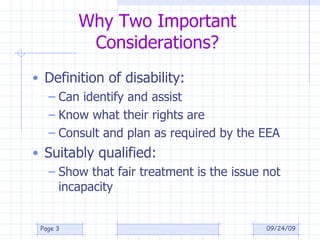
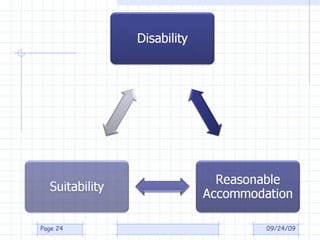
Why Two Important Considerations? Definition of disability: Can identify and assist Know what their rights are Consult and plan as required by the EEA Suitably qualified: Show that fair treatment is the issue not incapacity 09/24/09 Page
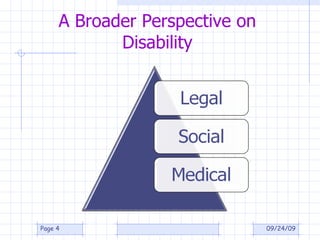
A Broader Perspective on Disability 09/24/09 Page
EMPLOYMENT EQUITY ACT, NO. 55 OF 1998 "People who have a  long-term or recurring  physical or mental impairment which  substantially limits their prospects  of entry into, or advancement in, employment." 09/24/09 Page
First, a person must have an impairment A physical impairment means " a partial or total loss of a bodily function or part of the body . It includes sensory impairments such as being deaf, hearing impaired or visually impaired" (Code, Paragraph 5). 09/24/09 Page
First, a person must have an impairment A mental impairment is a  clinically recognised condition or illness  that affects a person’s thought processes, judgement or emotions. 09/24/09 Page
Secondly, the impairment must also be long-term or recurring Long-term means the impairment has lasted or is likely to  persist at least 12 months. Recurring means the impairment  is likely to happen again  and to be substantially limiting 09/24/09 Page
Secondly, the impairment must also be long-term or recurring Progressive conditions are those that are  likely to develop or change or recur . People living with progressive conditions or illnesses  are considered as people with disabilities once the impairment starts to be substantially limiting. 09/24/09 Page
Thirdly, the impairment must be substantially limiting An impairment is substantially limiting if its  nature, duration or effects substantially limit a person’s ability to perform essential functions of the job  for which she/he is being considered. 09/24/09 Page
Two categories of impairments are excluded The first category are impairments, which are so  easily controlled, corrected or lessened, that they have no limiting effects.  For example, a person who wears spectacles or contact lenses does not have a disability unless even with spectacles or contact lenses the person's vision is substantially impaired 09/24/09 Page
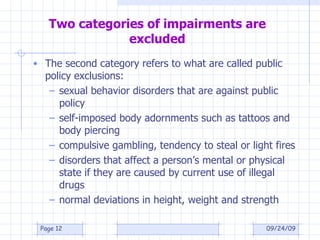
Two categories of impairments are excluded The second category refers to what are called public policy exclusions: sexual behavior disorders that are against public policy self-imposed body adornments such as tattoos and body piercing compulsive gambling, tendency to steal or light fires disorders that affect a person’s mental or physical state if they are caused by current use of illegal drugs normal deviations in height, weight and strength 09/24/09 Page
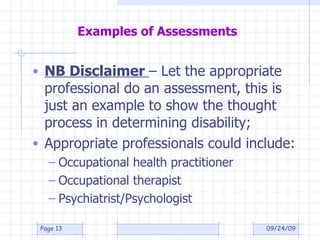
Examples of Assessments NB Disclaimer  – Let the appropriate professional do an assessment, this is just an example to show the thought process in determining disability; Appropriate professionals could include: Occupational health practitioner Occupational therapist Psychiatrist/Psychologist 09/24/09 Page
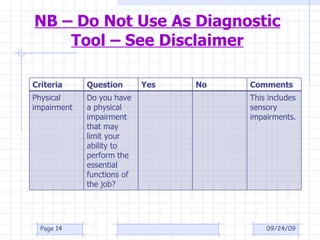
NB – Do Not Use As Diagnostic Tool – See Disclaimer 09/24/09 Page  Criteria Question Yes No Comments Physical impairment Do you have a physical impairment that may limit your ability to perform the essential functions of the job? This includes sensory impairments.
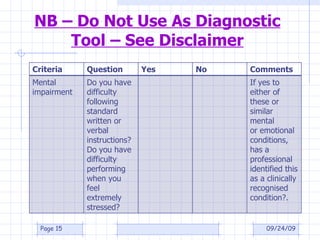
NB – Do Not Use As Diagnostic Tool – See Disclaimer 09/24/09 Page  Criteria Question Yes No Comments Mental impairment Do you have difficulty following standard written or verbal instructions? Do you have difficulty performing when you feel extremely stressed? If yes to either of these or similar mental or emotional conditions, has a professional identified this as a clinically recognised condition?.
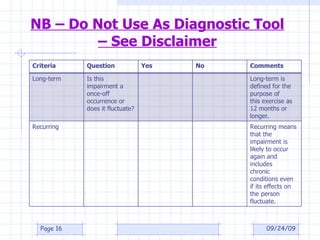
NB – Do Not Use As Diagnostic Tool – See Disclaimer 09/24/09 Page  Criteria Question Yes No Comments Long-term Is this impairment a once-off occurrence or does it fluctuate? Long-term is defined for the purpose of this exercise as 12 months or longer. Recurring Recurring means that the impairment is likely to occur again and includes chronic conditions even if its effects on the person fluctuate.
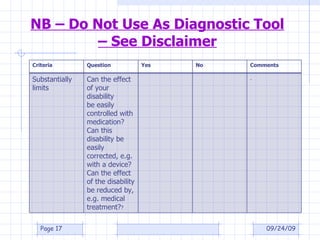
NB – Do Not Use As Diagnostic Tool – See Disclaimer 09/24/09 Page  Criteria Question Yes No Comments Substantially limits Can the effect of your disability be easily controlled with medication? Can this disability be easily corrected, e.g. with a device? Can the effect of the disability be reduced by, e.g. medical treatment? ? .
09/24/09 Page
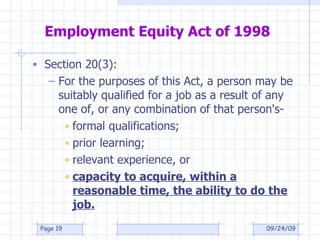
Employment Equity Act of 1998 Section 20(3):  For the purposes of this Act, a person may be suitably qualified for a job as a result of any one of, or any combination of that person's- formal qualifications; prior learning; relevant experience, or capacity to acquire, within a reasonable time, the ability to do the job. 09/24/09 Page
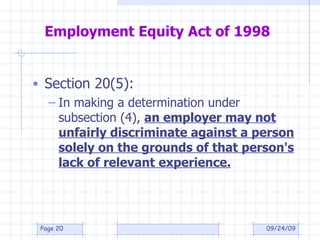
Employment Equity Act of 1998 Section 20(5): In making a determination under subsection (4),  an employer may not unfairly discriminate against a person solely on the grounds of that person's lack of relevant experience. 09/24/09 Page
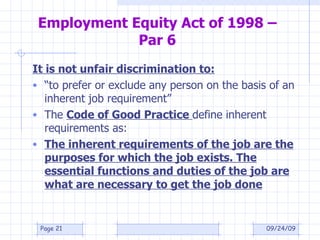
Employment Equity Act of 1998 – Par 6 It is not unfair discrimination to: “ to prefer or exclude any person on the basis of an inherent job requirement” The  Code of Good Practice  define inherent requirements as: The inherent requirements of the job are the purposes for which the job exists. The essential functions and duties of the job are what are necessary to get the job done 09/24/09 Page
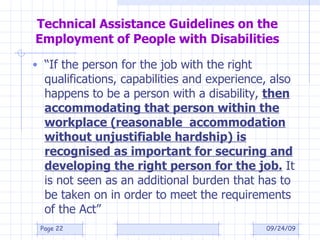
Technical Assistance Guidelines on the Employment of People with Disabilities “ If the person for the job with the right qualifications, capabilities and experience, also happens to be a person with a disability,  then accommodating that person within the workplace (reasonable  accommodation without unjustifiable hardship) is recognised as important for securing and developing the right person for the job.  It is not seen as an additional burden that has to be taken on in order to meet the requirements of the Act” 09/24/09 Page
09/24/09 Page
09/24/09 Page
09/24/09 Page

Disability Equity A South African Perspective 3

  • 1.
    Disability Equity WhatConstitute A Disability?
  • 2.
  • 3.
    Why Two ImportantConsiderations? Definition of disability: Can identify and assist Know what their rights are Consult and plan as required by the EEA Suitably qualified: Show that fair treatment is the issue not incapacity 09/24/09 Page
  • 4.
    A Broader Perspectiveon Disability 09/24/09 Page
  • 5.
    EMPLOYMENT EQUITY ACT,NO. 55 OF 1998 "People who have a long-term or recurring physical or mental impairment which substantially limits their prospects of entry into, or advancement in, employment." 09/24/09 Page
  • 6.
    First, a personmust have an impairment A physical impairment means " a partial or total loss of a bodily function or part of the body . It includes sensory impairments such as being deaf, hearing impaired or visually impaired" (Code, Paragraph 5). 09/24/09 Page
  • 7.
    First, a personmust have an impairment A mental impairment is a clinically recognised condition or illness that affects a person’s thought processes, judgement or emotions. 09/24/09 Page
  • 8.
    Secondly, the impairmentmust also be long-term or recurring Long-term means the impairment has lasted or is likely to persist at least 12 months. Recurring means the impairment is likely to happen again and to be substantially limiting 09/24/09 Page
  • 9.
    Secondly, the impairmentmust also be long-term or recurring Progressive conditions are those that are likely to develop or change or recur . People living with progressive conditions or illnesses are considered as people with disabilities once the impairment starts to be substantially limiting. 09/24/09 Page
  • 10.
    Thirdly, the impairmentmust be substantially limiting An impairment is substantially limiting if its nature, duration or effects substantially limit a person’s ability to perform essential functions of the job for which she/he is being considered. 09/24/09 Page
  • 11.
    Two categories ofimpairments are excluded The first category are impairments, which are so easily controlled, corrected or lessened, that they have no limiting effects. For example, a person who wears spectacles or contact lenses does not have a disability unless even with spectacles or contact lenses the person's vision is substantially impaired 09/24/09 Page
  • 12.
    Two categories ofimpairments are excluded The second category refers to what are called public policy exclusions: sexual behavior disorders that are against public policy self-imposed body adornments such as tattoos and body piercing compulsive gambling, tendency to steal or light fires disorders that affect a person’s mental or physical state if they are caused by current use of illegal drugs normal deviations in height, weight and strength 09/24/09 Page
  • 13.
    Examples of AssessmentsNB Disclaimer – Let the appropriate professional do an assessment, this is just an example to show the thought process in determining disability; Appropriate professionals could include: Occupational health practitioner Occupational therapist Psychiatrist/Psychologist 09/24/09 Page
  • 14.
    NB – DoNot Use As Diagnostic Tool – See Disclaimer 09/24/09 Page Criteria Question Yes No Comments Physical impairment Do you have a physical impairment that may limit your ability to perform the essential functions of the job? This includes sensory impairments.
  • 15.
    NB – DoNot Use As Diagnostic Tool – See Disclaimer 09/24/09 Page Criteria Question Yes No Comments Mental impairment Do you have difficulty following standard written or verbal instructions? Do you have difficulty performing when you feel extremely stressed? If yes to either of these or similar mental or emotional conditions, has a professional identified this as a clinically recognised condition?.
  • 16.
    NB – DoNot Use As Diagnostic Tool – See Disclaimer 09/24/09 Page Criteria Question Yes No Comments Long-term Is this impairment a once-off occurrence or does it fluctuate? Long-term is defined for the purpose of this exercise as 12 months or longer. Recurring Recurring means that the impairment is likely to occur again and includes chronic conditions even if its effects on the person fluctuate.
  • 17.
    NB – DoNot Use As Diagnostic Tool – See Disclaimer 09/24/09 Page Criteria Question Yes No Comments Substantially limits Can the effect of your disability be easily controlled with medication? Can this disability be easily corrected, e.g. with a device? Can the effect of the disability be reduced by, e.g. medical treatment? ? .
  • 18.
  • 19.
    Employment Equity Actof 1998 Section 20(3): For the purposes of this Act, a person may be suitably qualified for a job as a result of any one of, or any combination of that person's- formal qualifications; prior learning; relevant experience, or capacity to acquire, within a reasonable time, the ability to do the job. 09/24/09 Page
  • 20.
    Employment Equity Actof 1998 Section 20(5): In making a determination under subsection (4), an employer may not unfairly discriminate against a person solely on the grounds of that person's lack of relevant experience. 09/24/09 Page
  • 21.
    Employment Equity Actof 1998 – Par 6 It is not unfair discrimination to: “ to prefer or exclude any person on the basis of an inherent job requirement” The Code of Good Practice define inherent requirements as: The inherent requirements of the job are the purposes for which the job exists. The essential functions and duties of the job are what are necessary to get the job done 09/24/09 Page
  • 22.
    Technical Assistance Guidelineson the Employment of People with Disabilities “ If the person for the job with the right qualifications, capabilities and experience, also happens to be a person with a disability, then accommodating that person within the workplace (reasonable accommodation without unjustifiable hardship) is recognised as important for securing and developing the right person for the job. It is not seen as an additional burden that has to be taken on in order to meet the requirements of the Act” 09/24/09 Page
  • 23.
  • 24.
  • 25.