CHAPTER 3
Nischitha R Rao
Table of Contents
• Introduction
• Definition
• Concept of CBR
• Need for CBR
• Difference between CBR & IBR
• Objectives & Scope of CBR
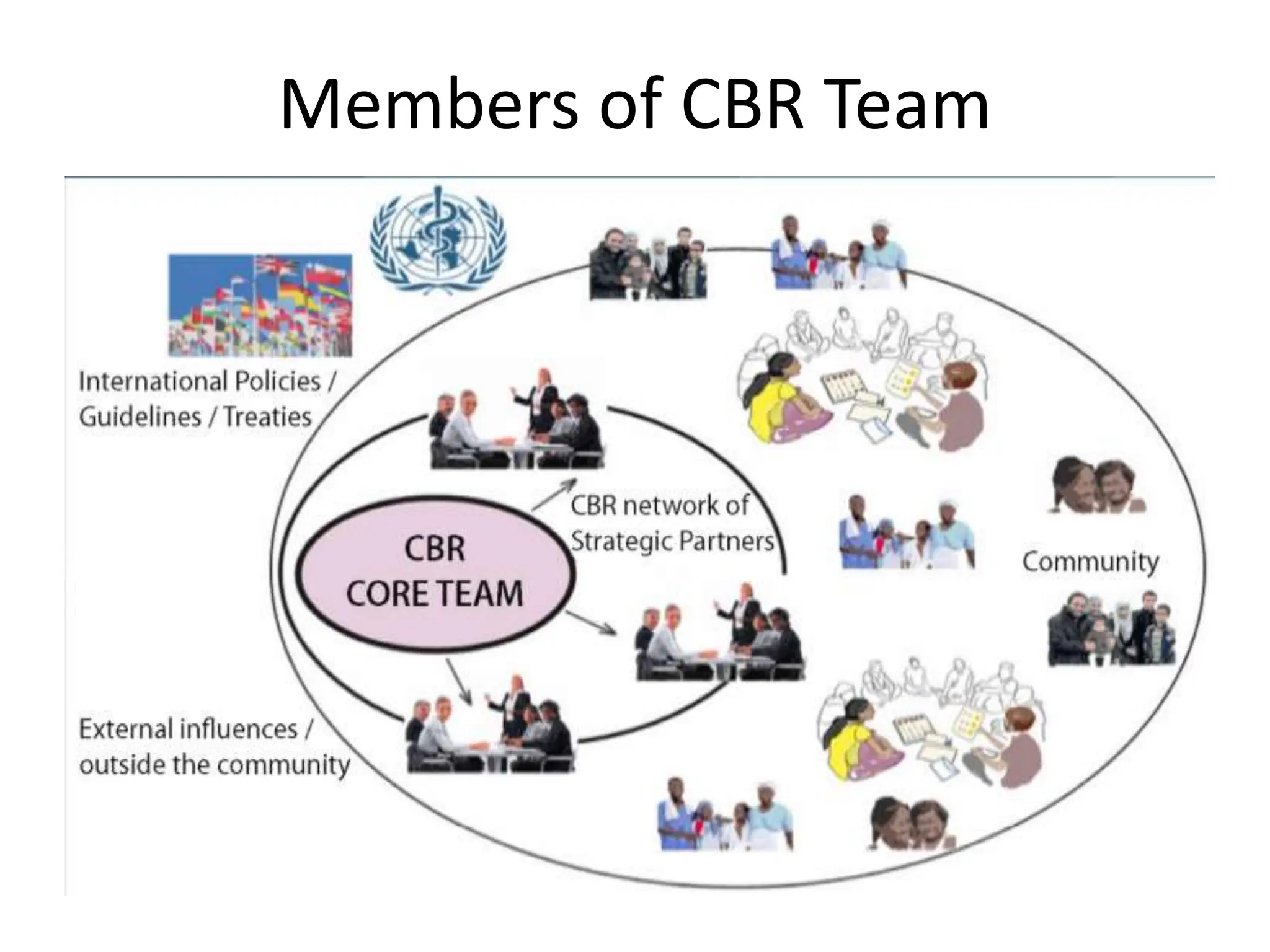
• Members of CBR team
• Models of CBR
Introduction
• Community-based rehabilitation (CBR) was
initiated by WHO following the Declaration of
Alma-Ata in 1978 in an effort to enhance the
quality of life for people with disabilities and
their families; meet their basic needs; and
ensure their inclusion and participation. While
initially a strategy to increase access to
rehabilitation services in resource-constrained
settings.
• CBR is now a multisectoral approach working
to improve the equalization of opportunities
and social inclusion of people with disabilities
while combating the perpetual cycle of
poverty and disability. CBR is implemented
through the combined efforts of people with
disabilities, their families and communities,
and relevant government and non-
government health, education, vocational,
social and other services.
UNESCO and WHO define CBR, as
• A strategy within community development for
rehabilitation, equalization of opportunities,
and social inclusion for all children and adults
with disabilities.
• CBR is implemented through the combined
efforts of people with disabilities themselves,
their families and communities, and
appropriate health, education, vocation and
social services.
Concept of CBR
• Disability and Rehabilitation
• Human Rights
• Poverty
• Inclusive Communities
• Organizations of Persons with Disabilities
(DPOs)
Need for CBR
• Training family and community members on
disability and CBR using the WHO CBR training
manual as a guide;
• Providing educational assistance and
facilitating inclusive education through
capacity building with teaching staff and
students, and improving physical access;
• Referring people with disabilities to specialist
services, e.g. surgical and rehabilitation
services, where physiotherapists, speech
therapists and occupational therapists are
available;
• Providing assistive devices, e.g. walking sticks,
crutches, wheelchairs, hearing aids, glasses;
• Creating employment opportunities by
providing access to training, job coaching and
financial support for income-generation
activities;
• Providing support for social activities including
for sports and recreation;
• Providing financial assistance for living,
education and home modifications.
Objectives & Scope of CBR
The major objectives of CBR are:
• To ensure that people with disabilities are able
to maximise their physical and mental
abilities, to access regular services and
opportunities, and to become active
contributors to the community and society at
large.
• To activate communities to promote and
protect the human rights of people with
disabilities through changes within the
community, for example, by removing barriers
to participation.
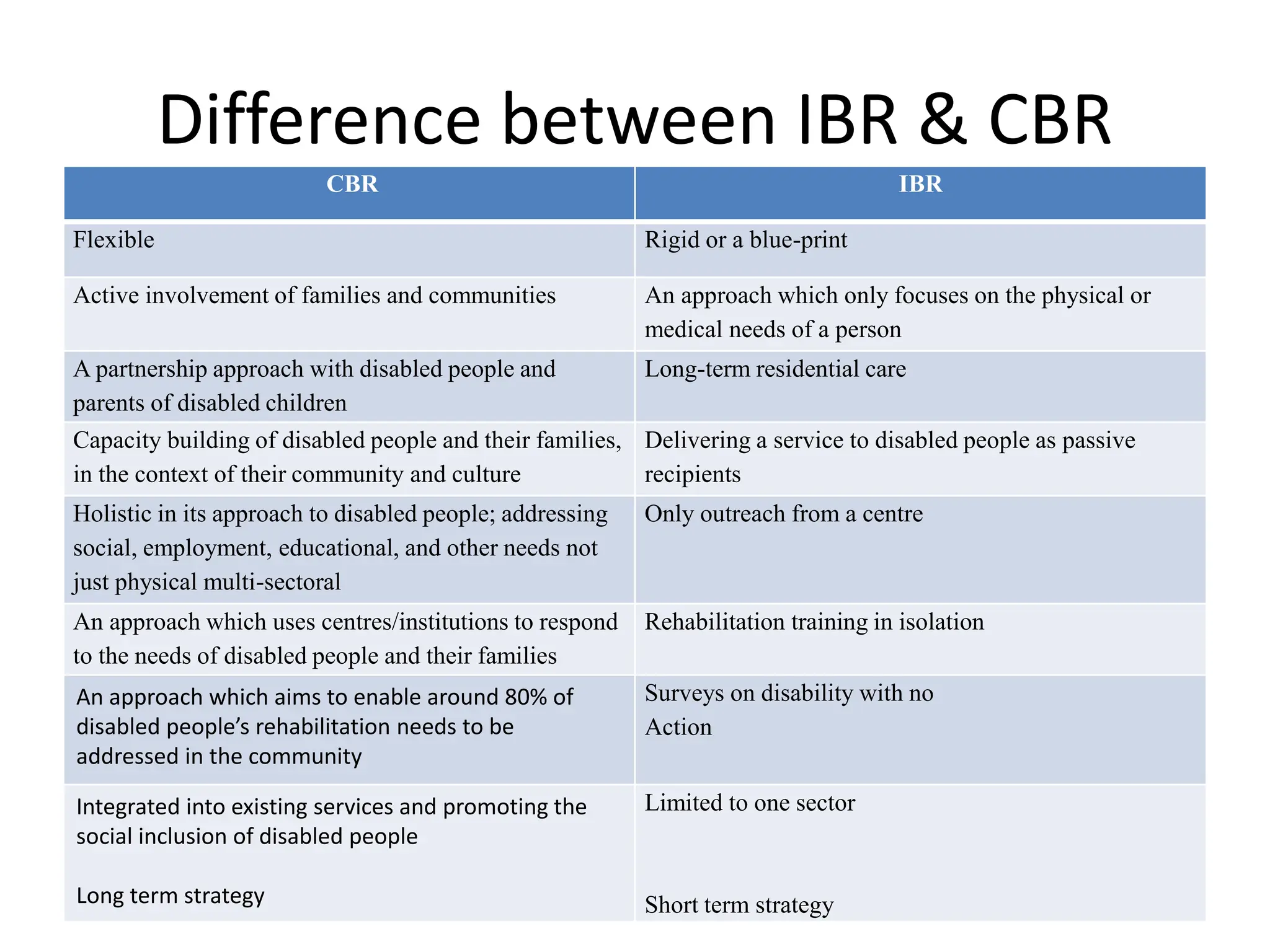
Difference between IBR & CBR
CBR IBR
Flexible Rigid or a blue-print
Active involvement of families and communities An approach which only focuses on the physical or
medical needs of a person
A partnership approach with disabled people and
parents of disabled children
Long-term residential care
Capacity building of disabled people and their families,
in the context of their community and culture
Delivering a service to disabled people as passive
recipients
Holistic in its approach to disabled people; addressing
social, employment, educational, and other needs not
just physical multi-sectoral
Only outreach from a centre
An approach which uses centres/institutions to respond
to the needs of disabled people and their families
Rehabilitation training in isolation
An approach which aims to enable around 80% of
disabled people’s rehabilitation needs to be
addressed in the community
Surveys on disability with no
Action
Integrated into existing services and promoting the
social inclusion of disabled people
Long term strategy
Limited to one sector
Short term strategy
Members of CBR Team
Rehabilitation approaches and
Strategies
Community based rehabilitation
Institutional based rehabilitation
Outreach services
Out Reach Program
• Here the expert from hospital visit the
community or home for disabled.
• And training will be given in the areas of;
-self care
-ambulatory effect
-vocational guidance
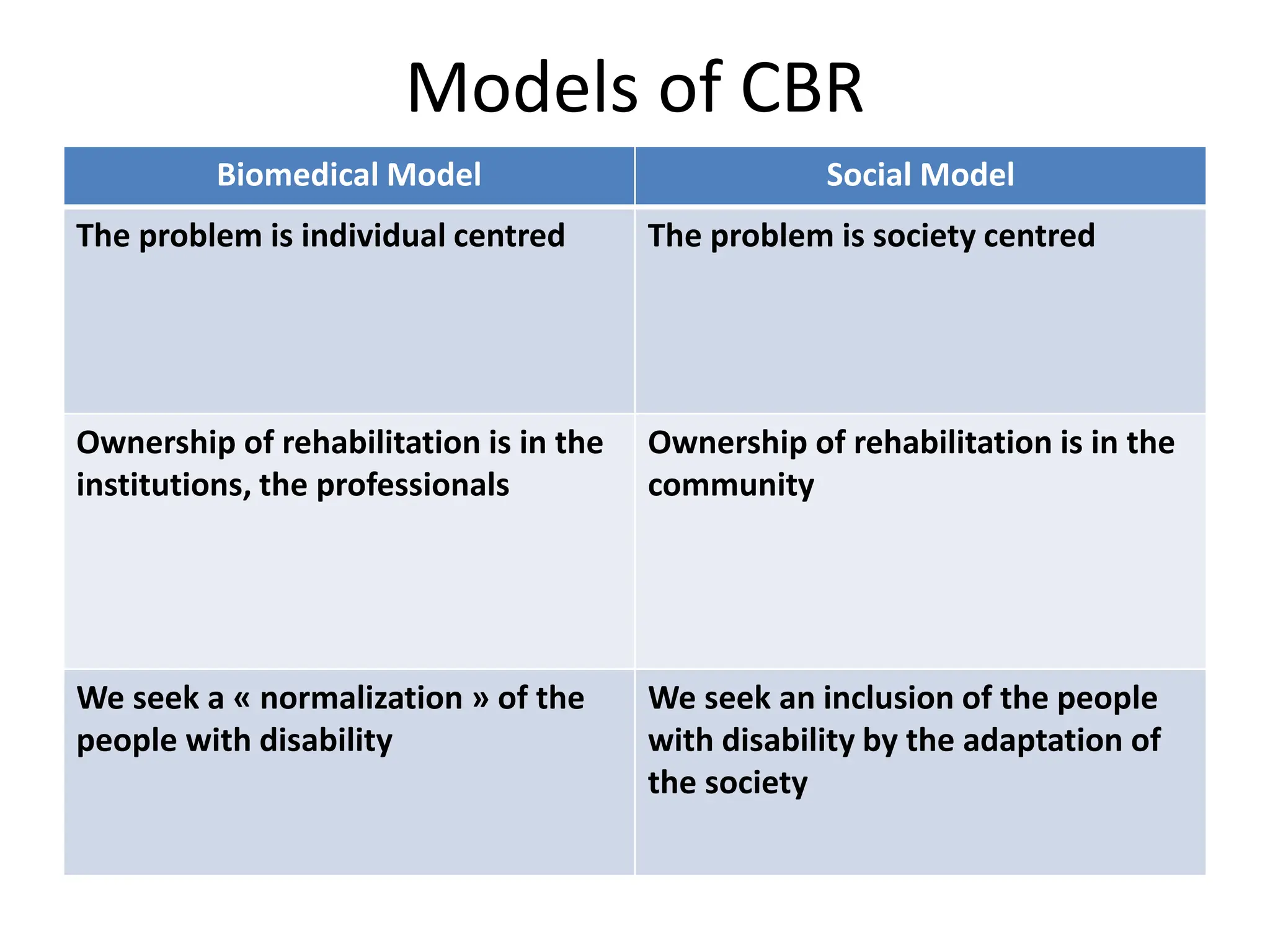
Models of CBR
Biomedical Model Social Model
The problem is individual centred The problem is society centred
Ownership of rehabilitation is in the
institutions, the professionals
Ownership of rehabilitation is in the
community
We seek a « normalization » of the
people with disability
We seek an inclusion of the people
with disability by the adaptation of
the society
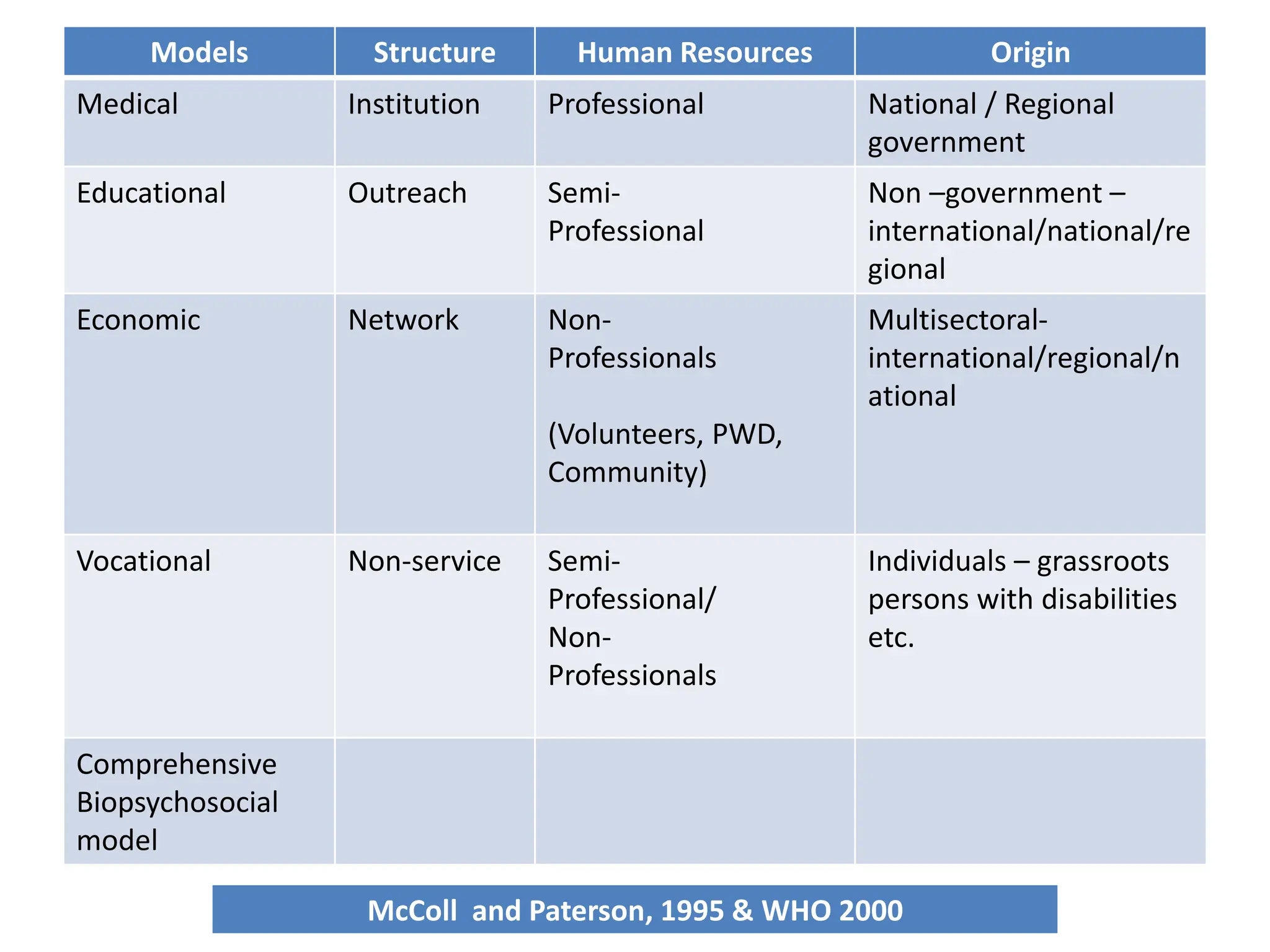
Models Structure Human Resources Origin
Medical Institution Professional National / Regional
government
Educational Outreach Semi-
Professional
Non –government –
international/national/re
gional
Economic Network Non-
Professionals
(Volunteers, PWD,
Community)
Multisectoral-
international/regional/n
ational
Vocational Non-service Semi-
Professional/
Non-
Professionals
Individuals – grassroots
persons with disabilities
etc.
Comprehensive
Biopsychosocial
model
McColl and Paterson, 1995 & WHO 2000
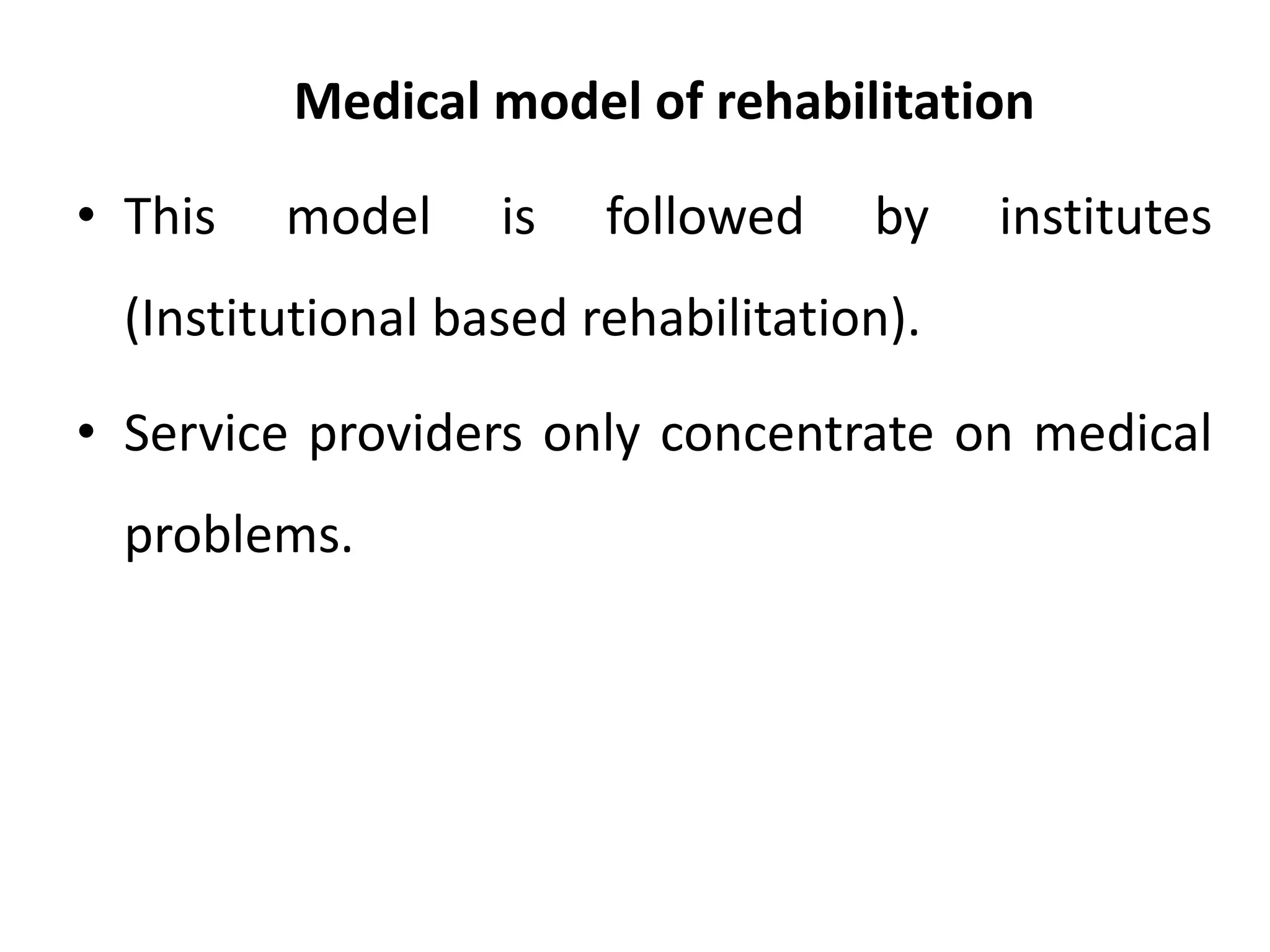
Medical model of rehabilitation
• This model is followed by institutes
(Institutional based rehabilitation).
• Service providers only concentrate on medical
problems.
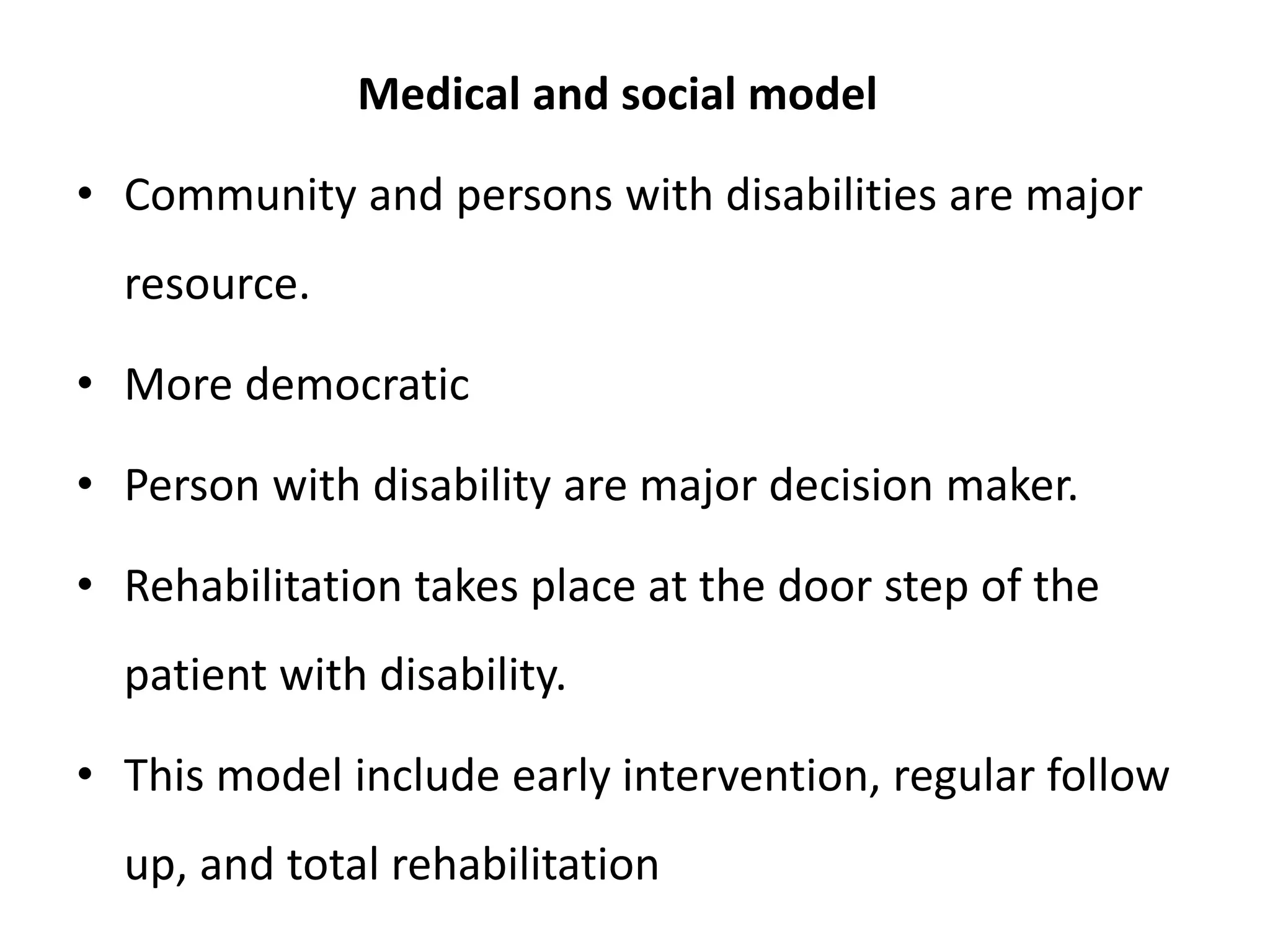
Medical and social model
• Community and persons with disabilities are major
resource.
• More democratic
• Person with disability are major decision maker.
• Rehabilitation takes place at the door step of the
patient with disability.
• This model include early intervention, regular follow
up, and total rehabilitation
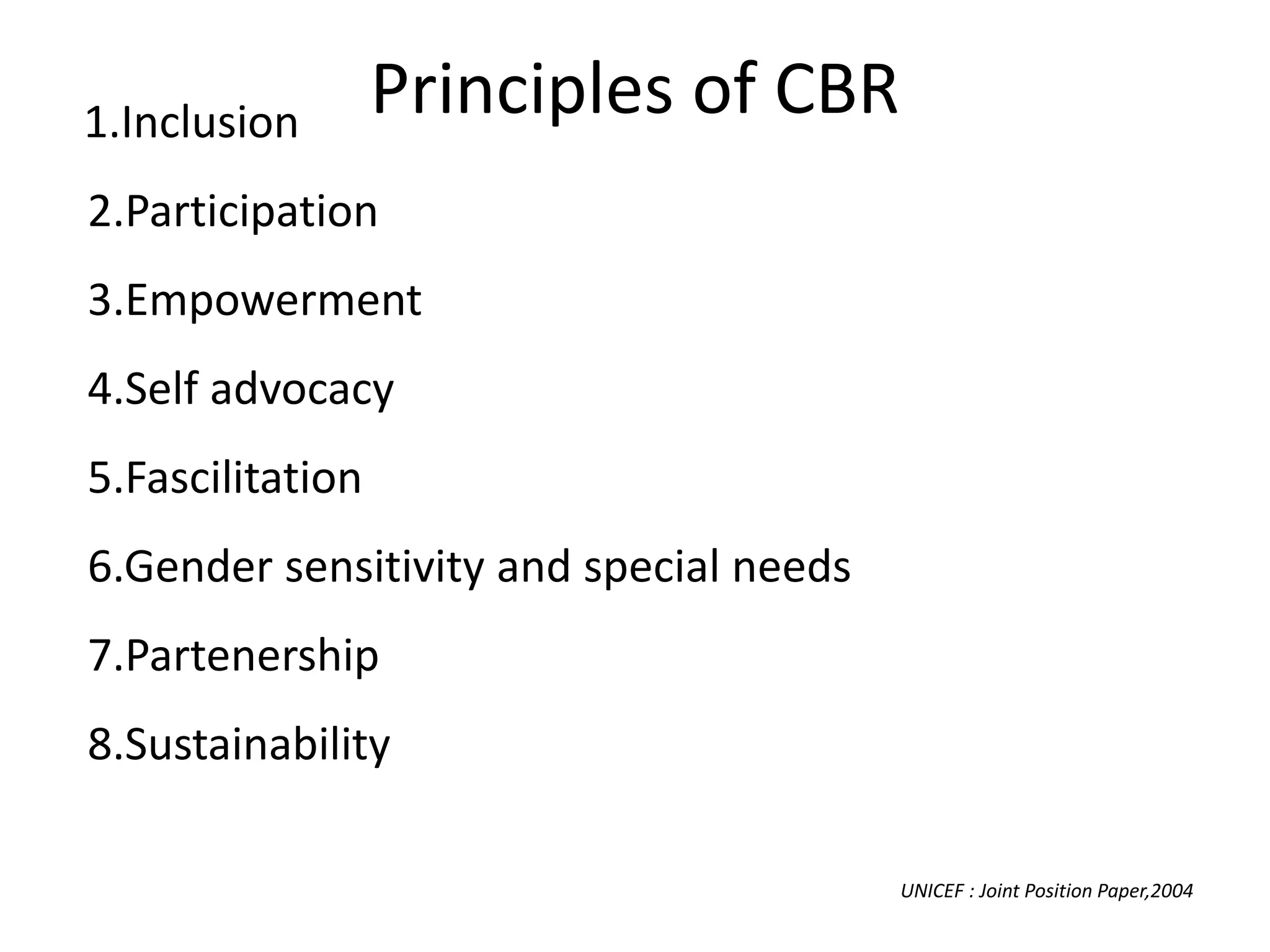
Principles of CBR
1.Inclusion
2.Participation
3.Empowerment
4.Self advocacy
5.Fascilitation
6.Gender sensitivity and special needs
7.Partenership
8.Sustainability
UNICEF : Joint Position Paper,2004
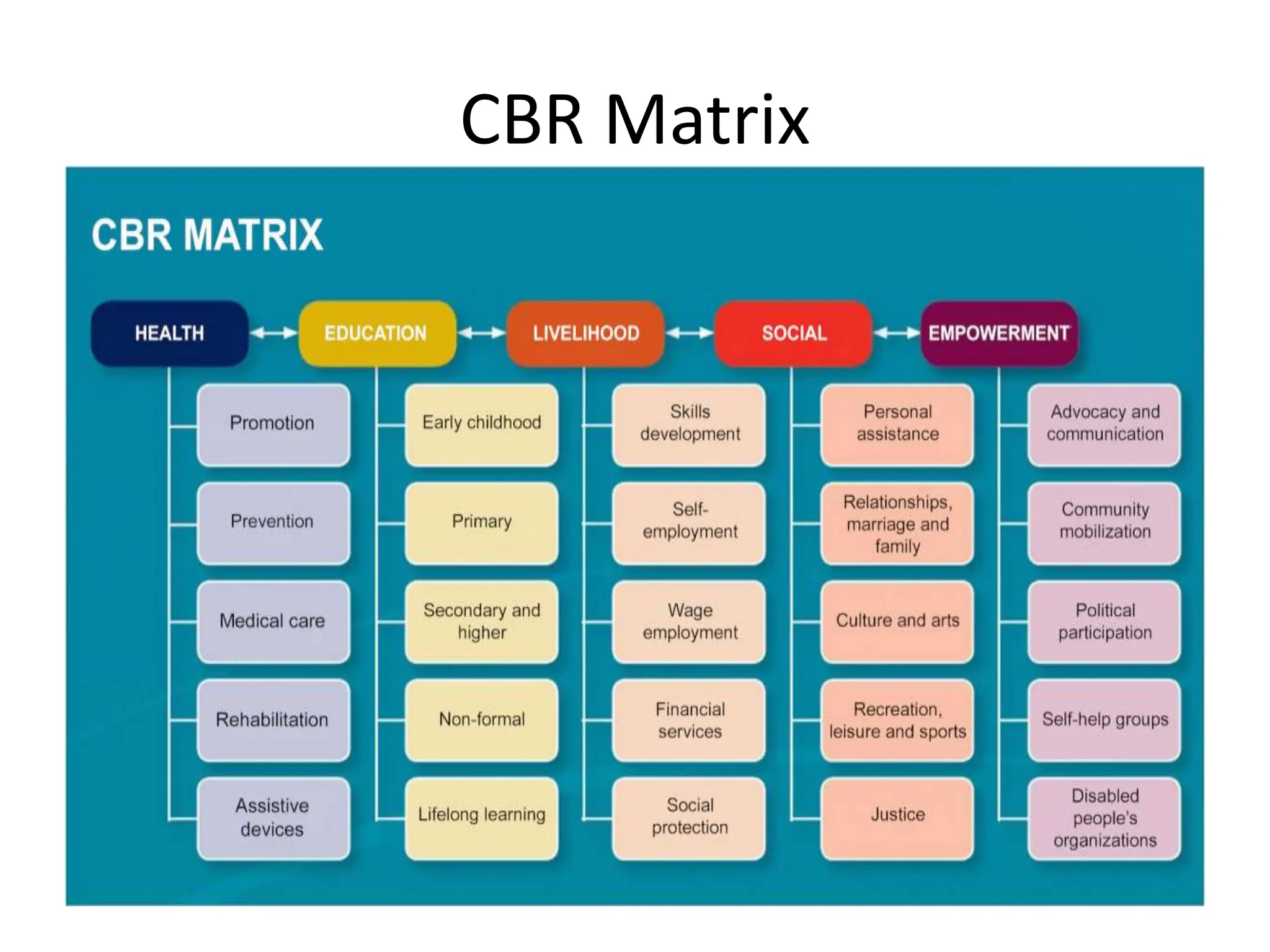
CBR Matrix
Principles of CBR, Difference between IBR & CBR

Principles of CBR, Difference between IBR & CBR

  • 1.
  • 2.
    Table of Contents •Introduction • Definition • Concept of CBR • Need for CBR • Difference between CBR & IBR • Objectives & Scope of CBR • Members of CBR team • Models of CBR
  • 3.
    Introduction • Community-based rehabilitation(CBR) was initiated by WHO following the Declaration of Alma-Ata in 1978 in an effort to enhance the quality of life for people with disabilities and their families; meet their basic needs; and ensure their inclusion and participation. While initially a strategy to increase access to rehabilitation services in resource-constrained settings.
  • 4.
    • CBR isnow a multisectoral approach working to improve the equalization of opportunities and social inclusion of people with disabilities while combating the perpetual cycle of poverty and disability. CBR is implemented through the combined efforts of people with disabilities, their families and communities, and relevant government and non- government health, education, vocational, social and other services.
  • 5.
    UNESCO and WHOdefine CBR, as • A strategy within community development for rehabilitation, equalization of opportunities, and social inclusion for all children and adults with disabilities.
  • 6.
    • CBR isimplemented through the combined efforts of people with disabilities themselves, their families and communities, and appropriate health, education, vocation and social services.
  • 7.
    Concept of CBR •Disability and Rehabilitation • Human Rights • Poverty • Inclusive Communities • Organizations of Persons with Disabilities (DPOs)
  • 8.
    Need for CBR •Training family and community members on disability and CBR using the WHO CBR training manual as a guide; • Providing educational assistance and facilitating inclusive education through capacity building with teaching staff and students, and improving physical access; • Referring people with disabilities to specialist services, e.g. surgical and rehabilitation services, where physiotherapists, speech therapists and occupational therapists are available;
  • 9.
    • Providing assistivedevices, e.g. walking sticks, crutches, wheelchairs, hearing aids, glasses; • Creating employment opportunities by providing access to training, job coaching and financial support for income-generation activities; • Providing support for social activities including for sports and recreation; • Providing financial assistance for living, education and home modifications.
  • 10.
    Objectives & Scopeof CBR The major objectives of CBR are: • To ensure that people with disabilities are able to maximise their physical and mental abilities, to access regular services and opportunities, and to become active contributors to the community and society at large.
  • 11.
    • To activatecommunities to promote and protect the human rights of people with disabilities through changes within the community, for example, by removing barriers to participation.
  • 12.
    Difference between IBR& CBR CBR IBR Flexible Rigid or a blue-print Active involvement of families and communities An approach which only focuses on the physical or medical needs of a person A partnership approach with disabled people and parents of disabled children Long-term residential care Capacity building of disabled people and their families, in the context of their community and culture Delivering a service to disabled people as passive recipients Holistic in its approach to disabled people; addressing social, employment, educational, and other needs not just physical multi-sectoral Only outreach from a centre An approach which uses centres/institutions to respond to the needs of disabled people and their families Rehabilitation training in isolation An approach which aims to enable around 80% of disabled people’s rehabilitation needs to be addressed in the community Surveys on disability with no Action Integrated into existing services and promoting the social inclusion of disabled people Long term strategy Limited to one sector Short term strategy
  • 14.
  • 15.
    Rehabilitation approaches and Strategies Communitybased rehabilitation Institutional based rehabilitation Outreach services
  • 16.
    Out Reach Program •Here the expert from hospital visit the community or home for disabled. • And training will be given in the areas of; -self care -ambulatory effect -vocational guidance
  • 17.
    Models of CBR BiomedicalModel Social Model The problem is individual centred The problem is society centred Ownership of rehabilitation is in the institutions, the professionals Ownership of rehabilitation is in the community We seek a « normalization » of the people with disability We seek an inclusion of the people with disability by the adaptation of the society
  • 18.
    Models Structure HumanResources Origin Medical Institution Professional National / Regional government Educational Outreach Semi- Professional Non –government – international/national/re gional Economic Network Non- Professionals (Volunteers, PWD, Community) Multisectoral- international/regional/n ational Vocational Non-service Semi- Professional/ Non- Professionals Individuals – grassroots persons with disabilities etc. Comprehensive Biopsychosocial model McColl and Paterson, 1995 & WHO 2000
  • 19.
    Medical model ofrehabilitation • This model is followed by institutes (Institutional based rehabilitation). • Service providers only concentrate on medical problems.
  • 20.
    Medical and socialmodel • Community and persons with disabilities are major resource. • More democratic • Person with disability are major decision maker. • Rehabilitation takes place at the door step of the patient with disability. • This model include early intervention, regular follow up, and total rehabilitation
  • 21.
    Principles of CBR 1.Inclusion 2.Participation 3.Empowerment 4.Selfadvocacy 5.Fascilitation 6.Gender sensitivity and special needs 7.Partenership 8.Sustainability UNICEF : Joint Position Paper,2004
  • 22.