DIRECTING
C.Lalramdini
Asst.Prof
CON ,RIPANS
Introduction
Directing/Direction is a
function of management
performed by top level
management in order to
achieve organizational goals.
It is very important and
necessary function of
management.
Management has to undertake
various activities like, guide
people, inspired and lead them
as well as supervision of their
activity is required in order to
achieve desired results.
2
Meaning and Definition
Direction is a complex
function that includes all
those activities that are
designed to encourage
subordinates to work
effectively and efficiently in
both the short and long run-
Koontz and O’Donnel.
“Directing involves
determining the course, giving
order and instruction and
providing dynamic leadership”
– Marshall
“Activating means and moving into action- supplying simulative
power to the group”- G.R Terry
3
1.
CHARACTERISTICS OF
DIRECTION
4
The nature and characteristics of direction can be
summed up as follows:
â–· Direction is considered the essence of management.
â–· It deals exclusively with people/Human efforts.
â–· Helps in achieving coordination among the various operations of the
enterprise..
â–· Achievement of purpose of planning, organizing and staffing.
â–· Role of a manager & it exist at every level of management.
â–· Continuing activity.
â–· Direction stimulates the staff to execute the desired plans.
â–· It motivates command.
â–· Provides necessary Leadership
â–· Facilitates securing the cooperation of employees. 5
2.
PRINCIPLES OF DIRECTION
6
© Freeology.com
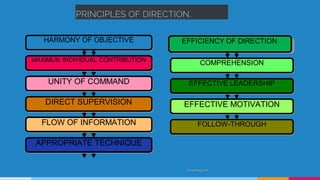
PRINCIPLES OF DIRECTION.
HARMONY OF OBJECTIVE
MAXIMUN INDIVIDUAL CONTRIBUTION
UNITY OF COMMAND
DIRECT SUPERVISION
FLOW OF INFORMATION
APPROPRIATE TECHNIQUE
EFFICIENCY OF DIRECTION
COMPREHENSION
EFFECTIVE LEADERSHIP
EFFECTIVE MOTIVATION
FOLLOW-THROUGH
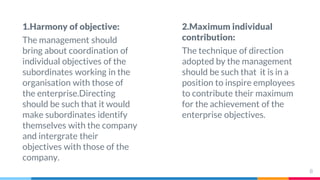
1.Harmony of objective:
The management should
bring about coordination of
individual objectives of the
subordinates working in the
organisation with those of
the enterprise.Directing
should be such that it would
make subordinates identify
themselves with the company
and intergrate their
objectives with those of the
company.
2.Maximum individual
contribution:
The technique of direction
adopted by the management
should be such that it is in a
position to inspire employees
to contribute their maximum
for the achievement of the
enterprise objectives.
8
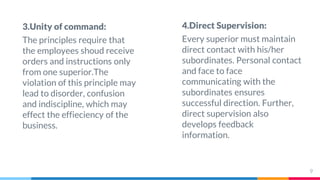
3.Unity of command:
The principles require that
the employees shoud receive
orders and instructions only
from one superior.The
violation of this principle may
lead to disorder, confusion
and indiscipline, which may
effect the effieciency of the
business.
4.Direct Supervision:
Every superior must maintain
direct contact with his/her
subordinates. Personal contact
and face to face
communicating with the
subordinates ensures
successful direction. Further,
direct supervision also
develops feedback
information.
9
5.Flow of information:
Effective direction is largely
dependent upon the flow of
information and the
efficeincy with which it is
desiminated among
subirdinates.The
management may be helped if
it uses both formal and
informal channels of
communication.
â–· 6.Appropriateness of
direction technique:
â–· The techniques that is used by
the management for direction
should be appropriate so as to
ensure effective direction
such as:
â–· Consultative
â–· Free-rein
â–· Autocratic
Which should be selected
according to circumstances.
10
7.Efficiency of direction:
The principles require that
there should be an effective
network of communication,
effective supervision,far-
sighted leadership and good
motivation for ensuing the
success of direction.
8.Comprehension:
As per the principles, how
much information is accurately
understood by the
subordinates is more
important than what is said and
how it is said. This principles
can be honored only if the
management builds provision
for a right feedback system of
communication.
11
9.Effective leadership:
It is necessary for the boss to
possess the qualities of a good
leader for getting the work
done by subordinates who
would also be happy if they get
effective leadership from their
boss.
The boss should guide and
councel the workers not only
on work problems but also on
personal problems of his/her
subordinates.
10.Effective motivation:
The workers, if they are
properly induced and
motivated, will volunteer
themselves towards
accomplishing the desired
goals.
Hence direction should be such
that it inspires the workers to
contribute their maximum with
enthusiasm for the purpose of
the organization.
12
11.Follow through:
Direction not only tells
subordinates what they
should do but also see to it
that they do it in the desired
way. This requires the
management to provide
continuous guidance ,
supervision, advice and help
to the subordinates in their
activities.
13
3.
TECHNIQUES OF DIRECTION
14
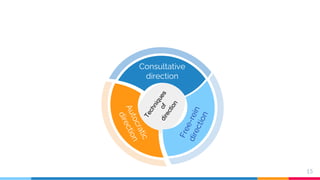
Consultative
direction
15
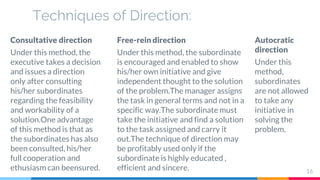
Techniques of Direction:
Consultative direction
Under this method, the
executive takes a decision
and issues a direction
only after consulting
his/her subordinates
regarding the feasibility
and workability of a
solution.One advantage
of this method is that as
the subordinates has also
been consulted, his/her
full cooperation and
ethusiasm can beensured.
Free-rein direction
Under this method, the subordinate
is encouraged and enabled to show
his/her own initiative and give
independent thought to the solution
of the problem.The manager assigns
the task in general terms and not in a
specific way.The subordinate must
take the initiative and find a solution
to the task assigned and carry it
out.The technique of direction may
be profitably used only if the
subordinate is highly educated ,
efficient and sincere.
Autocratic
direction
Under this
method,
subordinates
are not allowed
to take any
initiative in
solving the
problem.
16
4.
ELEMENTS OF DIRECTION
17
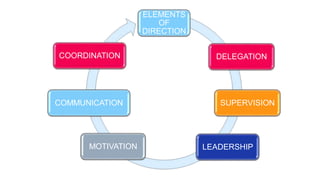
ELEMENTS
OF
DIRECTION
DELEGATION
SUPERVISION
LEADERSHIP
MOTIVATION
COMMUNICATION
COORDINATION
Delegation
â–· Delegation is the process by which the manager assigns
specific tasks/duties to a worker with commensurate
authority to perform the job.
â–· Delegation is an important method of organising and also a
skill required in a manager.
â–· By deviding the work and sharing the reponsibilities the
manager can work smoothly and effectively.
▷ By delegating well –defined tasks and responsibility the
nurse manager can have free time that can be well spent on
planning and evaluating nursing programs and activities. 19
Supervision
â–· Supervision is working together to achieve the organisation
goal.
â–· It can be defined as the process by which the subordinates
make the best use of their abilities, under the direction of
their immediate superiors,so as to do their jobs efficiently
and effectively, to their and the organisations satisfaction.
20
Leadership
â–· Leadership represent an abstract quality in a man.
â–· It is a psychological process of influencing followers or
subordinates and providing guidance to them.
â–· Leadership is an activity to persuade others to seek defined
objectives enthusiastically.
â–· It is also a human factor which binds a group together and
motivates it towards the predetermined goals.
21
Motivation
â–· Motivation means inspiring the subordinates with zeal to do
work for the accomplishment of the organisational
objectives.
â–· It is an effective instrument in the hand of the management
for inspiring and creating confidence in the workforce so
that they are capable of achieving good results.
22
Communication
â–· Communication is the process of passing information and
understanding from one person to another.
â–· To become successful a manager should develop an effective
system of communication so that he/she may issue
instructions, received the reactions of the subordinates and
motivate them.
â–· Communication is the basic element of human interactions.
â–· It is one of the most vital components of nursing practice.
â–· A great deal of nursing practice involves interpersonal
communication skills. 23
Coordination
â–· It is the synchronizing of people and their activities so that
they function smoothly in the achievement of
organisational objectives.
â–· Coordination is more important in the health services
organisation, because functionally they are
departmentalized.
24
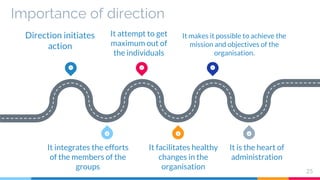
Importance of direction
25
1 3 5
6
4
2
Direction initiates
action
It attempt to get
maximum out of
the individuals
It makes it possible to achieve the
mission and objectives of the
organisation.
It integrates the efforts
of the members of the
groups
It facilitates healthy
changes in the
organisation
It is the heart of
administration
Conclusion
To conclude , it can be said that
direction is the guidance, the
inspiration, the leadership of men
and women that constitutes the
real core of managment
process.The function of direction is
to keep administrative wheels oiled
and moving. For effective direction,
it is essential that managers should
have the adminstrative knowledge
of leadership, motivation,
communication and supervision.
26
Are you good at directing?
27
So!
I am Didini Chenkual
I am here because I love to give
presentations.
28
Thanks!
Any questions?
29

Directing

  • 1.
  • 2.
    Introduction Directing/Direction is a functionof management performed by top level management in order to achieve organizational goals. It is very important and necessary function of management. Management has to undertake various activities like, guide people, inspired and lead them as well as supervision of their activity is required in order to achieve desired results. 2
  • 3.
    Meaning and Definition Directionis a complex function that includes all those activities that are designed to encourage subordinates to work effectively and efficiently in both the short and long run- Koontz and O’Donnel. “Directing involves determining the course, giving order and instruction and providing dynamic leadership” – Marshall “Activating means and moving into action- supplying simulative power to the group”- G.R Terry 3
  • 4.
  • 5.
    The nature andcharacteristics of direction can be summed up as follows: â–· Direction is considered the essence of management. â–· It deals exclusively with people/Human efforts. â–· Helps in achieving coordination among the various operations of the enterprise.. â–· Achievement of purpose of planning, organizing and staffing. â–· Role of a manager & it exist at every level of management. â–· Continuing activity. â–· Direction stimulates the staff to execute the desired plans. â–· It motivates command. â–· Provides necessary Leadership â–· Facilitates securing the cooperation of employees. 5
  • 6.
  • 7.
    © Freeology.com PRINCIPLES OFDIRECTION. HARMONY OF OBJECTIVE MAXIMUN INDIVIDUAL CONTRIBUTION UNITY OF COMMAND DIRECT SUPERVISION FLOW OF INFORMATION APPROPRIATE TECHNIQUE EFFICIENCY OF DIRECTION COMPREHENSION EFFECTIVE LEADERSHIP EFFECTIVE MOTIVATION FOLLOW-THROUGH
  • 8.
    1.Harmony of objective: Themanagement should bring about coordination of individual objectives of the subordinates working in the organisation with those of the enterprise.Directing should be such that it would make subordinates identify themselves with the company and intergrate their objectives with those of the company. 2.Maximum individual contribution: The technique of direction adopted by the management should be such that it is in a position to inspire employees to contribute their maximum for the achievement of the enterprise objectives. 8
  • 9.
    3.Unity of command: Theprinciples require that the employees shoud receive orders and instructions only from one superior.The violation of this principle may lead to disorder, confusion and indiscipline, which may effect the effieciency of the business. 4.Direct Supervision: Every superior must maintain direct contact with his/her subordinates. Personal contact and face to face communicating with the subordinates ensures successful direction. Further, direct supervision also develops feedback information. 9
  • 10.
    5.Flow of information: Effectivedirection is largely dependent upon the flow of information and the efficeincy with which it is desiminated among subirdinates.The management may be helped if it uses both formal and informal channels of communication. â–· 6.Appropriateness of direction technique: â–· The techniques that is used by the management for direction should be appropriate so as to ensure effective direction such as: â–· Consultative â–· Free-rein â–· Autocratic Which should be selected according to circumstances. 10
  • 11.
    7.Efficiency of direction: Theprinciples require that there should be an effective network of communication, effective supervision,far- sighted leadership and good motivation for ensuing the success of direction. 8.Comprehension: As per the principles, how much information is accurately understood by the subordinates is more important than what is said and how it is said. This principles can be honored only if the management builds provision for a right feedback system of communication. 11
  • 12.
    9.Effective leadership: It isnecessary for the boss to possess the qualities of a good leader for getting the work done by subordinates who would also be happy if they get effective leadership from their boss. The boss should guide and councel the workers not only on work problems but also on personal problems of his/her subordinates. 10.Effective motivation: The workers, if they are properly induced and motivated, will volunteer themselves towards accomplishing the desired goals. Hence direction should be such that it inspires the workers to contribute their maximum with enthusiasm for the purpose of the organization. 12
  • 13.
    11.Follow through: Direction notonly tells subordinates what they should do but also see to it that they do it in the desired way. This requires the management to provide continuous guidance , supervision, advice and help to the subordinates in their activities. 13
  • 14.
  • 15.
  • 16.
    Techniques of Direction: Consultativedirection Under this method, the executive takes a decision and issues a direction only after consulting his/her subordinates regarding the feasibility and workability of a solution.One advantage of this method is that as the subordinates has also been consulted, his/her full cooperation and ethusiasm can beensured. Free-rein direction Under this method, the subordinate is encouraged and enabled to show his/her own initiative and give independent thought to the solution of the problem.The manager assigns the task in general terms and not in a specific way.The subordinate must take the initiative and find a solution to the task assigned and carry it out.The technique of direction may be profitably used only if the subordinate is highly educated , efficient and sincere. Autocratic direction Under this method, subordinates are not allowed to take any initiative in solving the problem. 16
  • 17.
  • 18.
  • 19.
    Delegation ▷ Delegation isthe process by which the manager assigns specific tasks/duties to a worker with commensurate authority to perform the job. ▷ Delegation is an important method of organising and also a skill required in a manager. ▷ By deviding the work and sharing the reponsibilities the manager can work smoothly and effectively. ▷ By delegating well –defined tasks and responsibility the nurse manager can have free time that can be well spent on planning and evaluating nursing programs and activities. 19
  • 20.
    Supervision â–· Supervision isworking together to achieve the organisation goal. â–· It can be defined as the process by which the subordinates make the best use of their abilities, under the direction of their immediate superiors,so as to do their jobs efficiently and effectively, to their and the organisations satisfaction. 20
  • 21.
    Leadership â–· Leadership representan abstract quality in a man. â–· It is a psychological process of influencing followers or subordinates and providing guidance to them. â–· Leadership is an activity to persuade others to seek defined objectives enthusiastically. â–· It is also a human factor which binds a group together and motivates it towards the predetermined goals. 21
  • 22.
    Motivation â–· Motivation meansinspiring the subordinates with zeal to do work for the accomplishment of the organisational objectives. â–· It is an effective instrument in the hand of the management for inspiring and creating confidence in the workforce so that they are capable of achieving good results. 22
  • 23.
    Communication â–· Communication isthe process of passing information and understanding from one person to another. â–· To become successful a manager should develop an effective system of communication so that he/she may issue instructions, received the reactions of the subordinates and motivate them. â–· Communication is the basic element of human interactions. â–· It is one of the most vital components of nursing practice. â–· A great deal of nursing practice involves interpersonal communication skills. 23
  • 24.
    Coordination â–· It isthe synchronizing of people and their activities so that they function smoothly in the achievement of organisational objectives. â–· Coordination is more important in the health services organisation, because functionally they are departmentalized. 24
  • 25.
    Importance of direction 25 13 5 6 4 2 Direction initiates action It attempt to get maximum out of the individuals It makes it possible to achieve the mission and objectives of the organisation. It integrates the efforts of the members of the groups It facilitates healthy changes in the organisation It is the heart of administration
  • 26.
    Conclusion To conclude ,it can be said that direction is the guidance, the inspiration, the leadership of men and women that constitutes the real core of managment process.The function of direction is to keep administrative wheels oiled and moving. For effective direction, it is essential that managers should have the adminstrative knowledge of leadership, motivation, communication and supervision. 26
  • 27.
    Are you goodat directing? 27
  • 28.
    So! I am DidiniChenkual I am here because I love to give presentations. 28
  • 29.