Chem. Mater. 2008, 20, 1251–1253                                                           1251


Direct Poly(dimethylsiloxane) Surface
Functionalization with Vinyl Modified DNA

Kevin A. Heyries, Loïc J. Blum, and
Christophe A. Marquette*

       Laboratoire de Génie Enzymatique et Biomoléculaire,
   UniVersité Lyon 1 - CNRS 5246 (ICBMS), bât CPE, 43 Bd
         du 11 NoVembre 1918, Villeurbanne, 69622 France

                                  ReceiVed December 6, 2007
              ReVised Manuscript ReceiVed December 20, 2007

   Poly(dimethylsiloxane) (PDMS) remains the most em-
ployed polymer for numerous biotechnological applications1
because of its chemical inertness, transparency, hydrophobi-
city, and molding properties. Moreover, its low toxicity and
ease to use in standard laboratory conditions grant it great
popularity for rapid and cost-effective development of
protein,2 DNA,3 and cell4 biochips or separation assays.5
Concerning DNA immobilization on the PDMS surface,
extensive investigations using micro-contact printing6 (µCP)
or chemical modifications7 have already been performed and
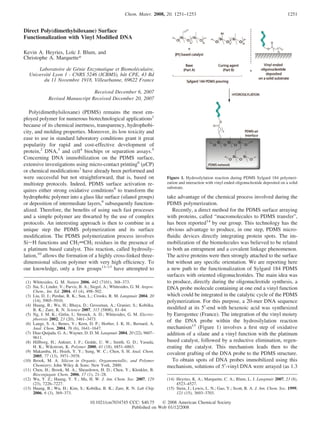
were successful but not straightforward, that is, based on                      Figure 1. Hydrosilylation reaction during PDMS Sylgard 184 polymeri-
multistep protocols. Indeed, PDMS surface activation re-                        zation and interaction with vinyl ended oligonucleotide deposited on a solid
                                                                                substrate.
quires either strong oxidative conditions8 to transform the
hydrophobic polymer into a glass like surface (silanol groups)                  take advantage of the chemical process involved during the
or deposition of intermediate layers,9 subsequently function-                   PDMS polymerization.
alized. Therefore, the benefits of using such fast processes                        Recently, a direct method for the PDMS surface arraying
and a simple polymer are thwarted by the use of complex                         with proteins, called “macromolecules to PDMS transfer”,
protocols. An interesting approach is then to combine in a                      has been reported14 by our group. This technology has the
unique step the PDMS polymerization and its surface                             obvious advantage to produce, in one step, PDMS micro-
modification. The PDMS polymerization process involves                           fluidic devices directly integrating protein spots. The im-
SisH functions and CH2dCH2 residues in the presence of                          mobilization of the biomolecules was believed to be related
a platinum based catalyst. This reaction, called hydrosily-                     to both an entrapment and a covalent linkage phenomenon.
lation,10 allows the formation of a highly cross-linked three-                  The active proteins were then strongly attached to the surface
dimensional silicon polymer with very high efficiency. To                        but without any specific orientation. We are reporting here
our knowledge, only a few groups11–13 have attempted to                         a new path to the functionalization of Sylgard 184 PDMS
                                                                                surfaces with oriented oligonucleotides. The main idea was
 (1) Whitesides, G. M. Nature 2006, 442 (7101), 368–373.                        to produce, directly during the oligonucleotide synthesis, a
 (2) Sia, S.; Linder, V.; Parviz, B. A.; Siegel, A.; Whitesides, G. M. Angew.   DNA probe molecule containing at one end a vinyl function
     Chem., Int. Ed. 2004, 43 (4), 498–502.
 (3) Liu, D. J.; Perdue, R. K.; Sun, L.; Crooks, R. M. Langmuir 2004, 20        which could be integrated in the catalytic cycle of the PDMS
     (14), 5905–5910.                                                           polymerization. For this purpose, a 20-mer DNA sequence
 (4) Huang, B.; Wu, H.; Bhaya, D.; Grossman, A.; Granier, S.; Kobilka,
     B. K.; Zare, R. N. Science 2007, 315 (5808), 81–84.                        modified at its 5′-end with hexenoic acid was synthesized
 (5) Ng, J. M. K.; Gitlin, I.; Stroock, A. D.; Whitesides, G. M. Electro-       by Eurogentec (France). The integration of the vinyl moiety
     phoresis 2002, 23 (20), 3461–3473.                                         of the DNA probe within the hydrosilylation reaction
 (6) Lange, S. A.; Benes, V.; Kern, D. P.; Horber, J. K. H.; Bernard, A.
     Anal. Chem. 2004, 76 (6), 1641–1647.                                       mechanism15 (Figure 1) involves a first step of oxidative
 (7) Diaz-Quijada, G. A.; Wayner, D. D. M. Langmuir 2004, 20 (22), 9607–        addition of a silane and a vinyl function with the platinum
     9611.
 (8) Hillborg, H.; Ankner, J. F.; Gedde, U. W.; Smith, G. D.; Yasuda,           based catalyst, followed by a reductive elimination, regen-
     H. K.; Wikstrom, K. Polymer 2000, 41 (18), 6851–6863.                      erating the catalyst. This mechanism leads then to the
 (9) Makamba, H.; Hsieh, Y. Y.; Sung, W. C.; Chen, S. H. Anal. Chem.
     2005, 77 (13), 3971–3978.
                                                                                covalent grafting of the DNA probe to the PDMS structure.
(10) Brook, M. A. Silicon in Organic, Organometallic, and Polymer                  To obtain spots of DNA probes immobilized using this
     Chemistry; John Wiley & Sons: New York, 2000.                              mechanism, solutions of 5′-vinyl DNA were arrayed (as 1.3
(11) Chen, H.; Brook, M. A.; Sheardown, H. D.; Chen, Y.; Klenkler, B.
     Bioconjugate Chem. 2006, 17 (1), 21–28.
(12) Wu, Y. Z.; Huang, Y. Y.; Ma, H. W. J. Am. Chem. Soc. 2007, 129             (14) Heyries, K. A.; Marquette, C. A.; Blum, L. J. Langmuir 2007, 23 (8),
     (23), 7226–7227.                                                                4523–4527.
(13) Huang, B.; Wu, H.; Kim, S.; Kobilka, B. K.; Zare, R. N. Lab Chip           (15) Stein, J.; Lewis, L. N.; Gao, Y.; Scott, R. A. J. Am. Chem. Soc. 1999,
     2006, 6 (3), 369–373.                                                           121 (15), 3693–3703.

                                       10.1021/cm7034745 CCC: $40.75     2008 American Chemical Society
                                                          Published on Web 01/12/2008
1252    Chem. Mater., Vol. 20, No. 4, 2008                                                                                        Communications


                                                                            Figure 3. Analytical performances of biochips prepared with immobilized
                                                                            (]) 5′-vinyl DNA probes and (0) unmodified DNA probes. Biotin labeled
                                                                            DNA were incubated 60 min at 37 °C in buffer containing BSA 1% and
                                                                            0.1% Tween 20. Error bars are the standard deviation of four experiments,
                                                                            and curves are provided as a guide for the eyes.

                                                                               The spos characteristics were previously described for
                                                                            protein arrays.14 Particularly, their specific area was shown
                                                                            to be highly dependent on the composition of the spotting
Figure 2. (a) Overview of the “macromolecules to PDMS transfer”. (b)        solution. The use of carbonate buffer (Na2CO3, 0.1 M, pH
Schematic representation of the chemiluminescent labeling of DNA probe/     9) instead of water as spotting carrier was shown to increase
target hybridization. (c) Chemiluminescent image of a hybridized 5′-vinyl   the specific area of the spot and then lead to higher spot
DNA microarray.
                                                                            signal. Indeed, the salt charged spotting solution crystallizes
nL drops) at the surface of a 3D Teflon master (Figure 2a).                  during the drying step, leading to highly textured surfaces.
Liquid PDMS was then poured onto the Teflon substrate,                       Thus, during the PDMS pouring and drying steps, these
covering the 5′-vinyl DNA spots, and cured at 90 °C for 20                  surfaces were used as masters to produce PDMS replica
min. Peeling off the polymer generates a PDMS microarray                    entrapping the biomolecules and having a high specific area.
exhibiting spots of orientated DNA probe at the PDMS-air                    A similar effect was experienced for the present 5′-vinyl
interface. The ability of these immobilized probes to be                    DNA spots (AFM images shown in the Supporting Informa-
hybridized with complementary oligonucleotide was studied                   tion). A drastic 940% increase of the spot chemiluminescent
using a chemiluminescent labeling of a biotinylated target                  signal, related to this increased specific area, was recorded
sequence (Figure 2b). A special arraying pattern was easily                 when using carbonate buffer instead of water as a spotting
produced for this purpose by spotting our institute logo                    carrier.
ICBMS with 5′-vinyl DNA (25 µM) out of a 625 spots                             To demonstrate the importance of the vinyl residue in the
matrix. The chemiluminescent image obtained after hybrid-                   actual DNA immobilization reaction, unmodified DNA
ization with a complementary biotinylated target sequence                   sequence probes were immobilized using the “macromol-
(1 nM), and its labeling using peroxidase-streptavidin                      ecules to PDMS transfer”. After hybridization with the
conjugate is presented in Figure 2c. An intense and specific                 corresponding target sequence, a specific signal was obtained,
signal was obtained from the interactions between the                       demonstrating the possibility of trapping accessible unmodi-
immobilized 5′-vinyl DNA probe and the target sequence,                     fied DNA strand during the PDMS polymerization and
while no detectable signal was obtained from the nonspecific                 underlining the importance of the interactions between DNA
interactions with the bare PDMS surface.                                    and PDMS, mainly due to Van der Waals interactions and
   As a control experiment, 5′-modified DNA molecules were                   hydrophobic effects.16
spotted directly onto already polymerized PDMS and hybrid-                     Nevertheless, as can be seen in Figure 3, the analytical
ized with complementary probes. No measurable signal was                    performances of the biochips prepared with either the 5′-
obtained, suggesting the importance of the interactions                     vinyl DNA or the unmodified DNA were really dissimilar.
between PDMS and biomolecules during the polymerization                     The vinyl based biochip exhibits a broad detection range from
process. Obtaining such a PDMS DNA array with a so                          0.2 pM (3.75 mol in 25 µL) to 1 nM with a detection limit
straightforward protocol was only possible because of the                   three decades lower than using the biochip prepared with
use on the one hand of the “Macromolecules to PDMS                          unmodified DNA. This difference of hybridization ability is
transfer” technique and on the other hand of 5′-vinyl DNA                   believed to be related to (i) the high reactivity of the vinyl
probes. Indeed, most of the current technologies for DNA                    modification toward PDMS chains during polymerization and
based biochips rely on different separated steps for the
preparation of the chip which are cost intensive and time-                  (16) Quist, A. P.; Pavlovic, E.; Oscarsson, S. Anal. Bioanal. Chem. 2005,
consuming.                                                                       381 (3), 591–600.
Communications                                                                        Chem. Mater., Vol. 20, No. 4, 2008 1253

(ii) a possible better orientation of the DNA probe molecules   when compared to the unmodified DNA probe. This differ-
thanks to the preferential immobilization through the vinyl     ence of reactivity arises directly from the interactions of the
residue. Finally, the specificity of the immobilized probe was   vinyl function with the catalytic cycle during PDMS
assessed using a fully non-DNA sequence. No signal was          polymerization.
recorded when the noncomplementary biotin labeled strand
was incubated with immobilized DNA, demonstrating the             Acknowledgment. Published with the support of the Euro-
absence of nonspecific adsorption of target sequence on 5′-      pean Commission, Sixth Framework Program, Information
vinyl DNA spots.                                                Society Technologies. NANOSPAD (no. 016610).
   In conclusion, we have demonstrated that vinyl modified          Supporting Information Available: Experimental details and
DNA molecules can be easily transferred and grafted at the      protocols and AFM images of 5′-vinyl DNA spots in water and
PDMS-air interface using the “macromolecules to PDMS            carbonate buffer (PDF). This material is available free of charge
                                                                via the Internet at http://pubs.acs.org.
transfer” procedure. Such modification at one end of a DNA
molecule greatly enhances the target hybridization ability      CM7034745

Direct Poly(Dimethylsiloxane) Surface...

  • 1.
    Chem. Mater. 2008,20, 1251–1253 1251 Direct Poly(dimethylsiloxane) Surface Functionalization with Vinyl Modified DNA Kevin A. Heyries, Loïc J. Blum, and Christophe A. Marquette* Laboratoire de Génie Enzymatique et Biomoléculaire, UniVersité Lyon 1 - CNRS 5246 (ICBMS), bât CPE, 43 Bd du 11 NoVembre 1918, Villeurbanne, 69622 France ReceiVed December 6, 2007 ReVised Manuscript ReceiVed December 20, 2007 Poly(dimethylsiloxane) (PDMS) remains the most em- ployed polymer for numerous biotechnological applications1 because of its chemical inertness, transparency, hydrophobi- city, and molding properties. Moreover, its low toxicity and ease to use in standard laboratory conditions grant it great popularity for rapid and cost-effective development of protein,2 DNA,3 and cell4 biochips or separation assays.5 Concerning DNA immobilization on the PDMS surface, extensive investigations using micro-contact printing6 (µCP) or chemical modifications7 have already been performed and were successful but not straightforward, that is, based on Figure 1. Hydrosilylation reaction during PDMS Sylgard 184 polymeri- multistep protocols. Indeed, PDMS surface activation re- zation and interaction with vinyl ended oligonucleotide deposited on a solid substrate. quires either strong oxidative conditions8 to transform the hydrophobic polymer into a glass like surface (silanol groups) take advantage of the chemical process involved during the or deposition of intermediate layers,9 subsequently function- PDMS polymerization. alized. Therefore, the benefits of using such fast processes Recently, a direct method for the PDMS surface arraying and a simple polymer are thwarted by the use of complex with proteins, called “macromolecules to PDMS transfer”, protocols. An interesting approach is then to combine in a has been reported14 by our group. This technology has the unique step the PDMS polymerization and its surface obvious advantage to produce, in one step, PDMS micro- modification. The PDMS polymerization process involves fluidic devices directly integrating protein spots. The im- SisH functions and CH2dCH2 residues in the presence of mobilization of the biomolecules was believed to be related a platinum based catalyst. This reaction, called hydrosily- to both an entrapment and a covalent linkage phenomenon. lation,10 allows the formation of a highly cross-linked three- The active proteins were then strongly attached to the surface dimensional silicon polymer with very high efficiency. To but without any specific orientation. We are reporting here our knowledge, only a few groups11–13 have attempted to a new path to the functionalization of Sylgard 184 PDMS surfaces with oriented oligonucleotides. The main idea was (1) Whitesides, G. M. Nature 2006, 442 (7101), 368–373. to produce, directly during the oligonucleotide synthesis, a (2) Sia, S.; Linder, V.; Parviz, B. A.; Siegel, A.; Whitesides, G. M. Angew. DNA probe molecule containing at one end a vinyl function Chem., Int. Ed. 2004, 43 (4), 498–502. (3) Liu, D. J.; Perdue, R. K.; Sun, L.; Crooks, R. M. Langmuir 2004, 20 which could be integrated in the catalytic cycle of the PDMS (14), 5905–5910. polymerization. For this purpose, a 20-mer DNA sequence (4) Huang, B.; Wu, H.; Bhaya, D.; Grossman, A.; Granier, S.; Kobilka, B. K.; Zare, R. N. Science 2007, 315 (5808), 81–84. modified at its 5′-end with hexenoic acid was synthesized (5) Ng, J. M. K.; Gitlin, I.; Stroock, A. D.; Whitesides, G. M. Electro- by Eurogentec (France). The integration of the vinyl moiety phoresis 2002, 23 (20), 3461–3473. of the DNA probe within the hydrosilylation reaction (6) Lange, S. A.; Benes, V.; Kern, D. P.; Horber, J. K. H.; Bernard, A. Anal. Chem. 2004, 76 (6), 1641–1647. mechanism15 (Figure 1) involves a first step of oxidative (7) Diaz-Quijada, G. A.; Wayner, D. D. M. Langmuir 2004, 20 (22), 9607– addition of a silane and a vinyl function with the platinum 9611. (8) Hillborg, H.; Ankner, J. F.; Gedde, U. W.; Smith, G. D.; Yasuda, based catalyst, followed by a reductive elimination, regen- H. K.; Wikstrom, K. Polymer 2000, 41 (18), 6851–6863. erating the catalyst. This mechanism leads then to the (9) Makamba, H.; Hsieh, Y. Y.; Sung, W. C.; Chen, S. H. Anal. Chem. 2005, 77 (13), 3971–3978. covalent grafting of the DNA probe to the PDMS structure. (10) Brook, M. A. Silicon in Organic, Organometallic, and Polymer To obtain spots of DNA probes immobilized using this Chemistry; John Wiley & Sons: New York, 2000. mechanism, solutions of 5′-vinyl DNA were arrayed (as 1.3 (11) Chen, H.; Brook, M. A.; Sheardown, H. D.; Chen, Y.; Klenkler, B. Bioconjugate Chem. 2006, 17 (1), 21–28. (12) Wu, Y. Z.; Huang, Y. Y.; Ma, H. W. J. Am. Chem. Soc. 2007, 129 (14) Heyries, K. A.; Marquette, C. A.; Blum, L. J. Langmuir 2007, 23 (8), (23), 7226–7227. 4523–4527. (13) Huang, B.; Wu, H.; Kim, S.; Kobilka, B. K.; Zare, R. N. Lab Chip (15) Stein, J.; Lewis, L. N.; Gao, Y.; Scott, R. A. J. Am. Chem. Soc. 1999, 2006, 6 (3), 369–373. 121 (15), 3693–3703. 10.1021/cm7034745 CCC: $40.75  2008 American Chemical Society Published on Web 01/12/2008
  • 2.
    1252 Chem. Mater., Vol. 20, No. 4, 2008 Communications Figure 3. Analytical performances of biochips prepared with immobilized (]) 5′-vinyl DNA probes and (0) unmodified DNA probes. Biotin labeled DNA were incubated 60 min at 37 °C in buffer containing BSA 1% and 0.1% Tween 20. Error bars are the standard deviation of four experiments, and curves are provided as a guide for the eyes. The spos characteristics were previously described for protein arrays.14 Particularly, their specific area was shown to be highly dependent on the composition of the spotting Figure 2. (a) Overview of the “macromolecules to PDMS transfer”. (b) solution. The use of carbonate buffer (Na2CO3, 0.1 M, pH Schematic representation of the chemiluminescent labeling of DNA probe/ 9) instead of water as spotting carrier was shown to increase target hybridization. (c) Chemiluminescent image of a hybridized 5′-vinyl the specific area of the spot and then lead to higher spot DNA microarray. signal. Indeed, the salt charged spotting solution crystallizes nL drops) at the surface of a 3D Teflon master (Figure 2a). during the drying step, leading to highly textured surfaces. Liquid PDMS was then poured onto the Teflon substrate, Thus, during the PDMS pouring and drying steps, these covering the 5′-vinyl DNA spots, and cured at 90 °C for 20 surfaces were used as masters to produce PDMS replica min. Peeling off the polymer generates a PDMS microarray entrapping the biomolecules and having a high specific area. exhibiting spots of orientated DNA probe at the PDMS-air A similar effect was experienced for the present 5′-vinyl interface. The ability of these immobilized probes to be DNA spots (AFM images shown in the Supporting Informa- hybridized with complementary oligonucleotide was studied tion). A drastic 940% increase of the spot chemiluminescent using a chemiluminescent labeling of a biotinylated target signal, related to this increased specific area, was recorded sequence (Figure 2b). A special arraying pattern was easily when using carbonate buffer instead of water as a spotting produced for this purpose by spotting our institute logo carrier. ICBMS with 5′-vinyl DNA (25 µM) out of a 625 spots To demonstrate the importance of the vinyl residue in the matrix. The chemiluminescent image obtained after hybrid- actual DNA immobilization reaction, unmodified DNA ization with a complementary biotinylated target sequence sequence probes were immobilized using the “macromol- (1 nM), and its labeling using peroxidase-streptavidin ecules to PDMS transfer”. After hybridization with the conjugate is presented in Figure 2c. An intense and specific corresponding target sequence, a specific signal was obtained, signal was obtained from the interactions between the demonstrating the possibility of trapping accessible unmodi- immobilized 5′-vinyl DNA probe and the target sequence, fied DNA strand during the PDMS polymerization and while no detectable signal was obtained from the nonspecific underlining the importance of the interactions between DNA interactions with the bare PDMS surface. and PDMS, mainly due to Van der Waals interactions and As a control experiment, 5′-modified DNA molecules were hydrophobic effects.16 spotted directly onto already polymerized PDMS and hybrid- Nevertheless, as can be seen in Figure 3, the analytical ized with complementary probes. No measurable signal was performances of the biochips prepared with either the 5′- obtained, suggesting the importance of the interactions vinyl DNA or the unmodified DNA were really dissimilar. between PDMS and biomolecules during the polymerization The vinyl based biochip exhibits a broad detection range from process. Obtaining such a PDMS DNA array with a so 0.2 pM (3.75 mol in 25 µL) to 1 nM with a detection limit straightforward protocol was only possible because of the three decades lower than using the biochip prepared with use on the one hand of the “Macromolecules to PDMS unmodified DNA. This difference of hybridization ability is transfer” technique and on the other hand of 5′-vinyl DNA believed to be related to (i) the high reactivity of the vinyl probes. Indeed, most of the current technologies for DNA modification toward PDMS chains during polymerization and based biochips rely on different separated steps for the preparation of the chip which are cost intensive and time- (16) Quist, A. P.; Pavlovic, E.; Oscarsson, S. Anal. Bioanal. Chem. 2005, consuming. 381 (3), 591–600.
  • 3.
    Communications Chem. Mater., Vol. 20, No. 4, 2008 1253 (ii) a possible better orientation of the DNA probe molecules when compared to the unmodified DNA probe. This differ- thanks to the preferential immobilization through the vinyl ence of reactivity arises directly from the interactions of the residue. Finally, the specificity of the immobilized probe was vinyl function with the catalytic cycle during PDMS assessed using a fully non-DNA sequence. No signal was polymerization. recorded when the noncomplementary biotin labeled strand was incubated with immobilized DNA, demonstrating the Acknowledgment. Published with the support of the Euro- absence of nonspecific adsorption of target sequence on 5′- pean Commission, Sixth Framework Program, Information vinyl DNA spots. Society Technologies. NANOSPAD (no. 016610). In conclusion, we have demonstrated that vinyl modified Supporting Information Available: Experimental details and DNA molecules can be easily transferred and grafted at the protocols and AFM images of 5′-vinyl DNA spots in water and PDMS-air interface using the “macromolecules to PDMS carbonate buffer (PDF). This material is available free of charge via the Internet at http://pubs.acs.org. transfer” procedure. Such modification at one end of a DNA molecule greatly enhances the target hybridization ability CM7034745