Published on Web 10/05/2004


              Highly Enantio- and Diastereoselective One-Pot Synthesis of Acyclic Epoxy
                            Alcohols with Three Contiguous Stereocenters
                   Alice E. Lurain, Aaron Maestri, Ann Rowley Kelly, Patrick J. Carroll, and Patrick J. Walsh*
                     P. Roy and Diana T. Vagelos Laboratories, Department of Chemistry, UniVersity of PennsylVania,
                                     231 South 34th Street, Philadelphia, PennsylVania 19104-6323
                                               Received June 2, 2004; E-mail: pwalsh@sas.upenn.edu


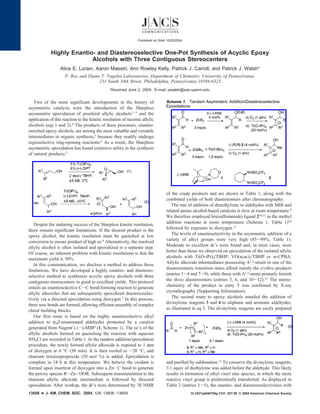
   Two of the most significant developments in the history of                   Scheme 1. Tandem Asymmetric Addition/Diastereoselective
asymmetric catalysis were the introduction of the Sharpless                     Epoxidations
asymmetric epoxidation of prochiral allylic alcohols1-3 and the
application of this reaction to the kinetic resolution of racemic allylic
alcohols (eqs 1 and 2).4 The products of these processes, enantio-
enriched epoxy alcohols, are among the most valuable and versatile
intermediates in organic synthesis,5 because they readily undergo
regioselective ring-opening reactions.6 As a result, the Sharpless
asymmetric epoxidation has found extensive utility in the synthesis
of natural products.3


                                                                                of the crude products and are shown in Table 1, along with the
                                                                                combined yields of both diastereomers after chromatography.
                                                                                   The rate of addition of dimethylzinc to aldehydes with MIB and
                                                                                related amino alcohol-based catalysts is slow at room temperature.9
                                                                                We therefore employed bis(sulfonamide) ligand 210,11 in the methyl
   Despite the enduring success of the Sharpless kinetic resolution,            addition reactions at room temperature (Scheme 1, Table 1)10
there remain significant limitations. If the desired product is the             followed by exposure to dioxygen.11
epoxy alcohol, the kinetic resolution must be quenched at low                      The levels of enantioselectivity in the asymmetric addition of a
conversion to ensure product of high ee.6 Alternatively, the resolved           variety of alkyl groups were very high (85-99%, Table 1).
allylic alcohol is often isolated and epoxidized in a separate step.            Moderate to excellent dr’s were found and, in most cases, were
Of course, an inherent problem with kinetic resolutions is that the             better than those we observed on epoxidation of the isolated allylic
maximum yield is 50%.                                                           alcohols with Ti(O-iPr)4/TBHP, VO(acac)2/TBHP or m-CPBA.
   In this communication, we disclose a method to address these                 Allylic alkoxide intermediates possessing A1,2-strain in one of the
limitations. We have developed a highly enantio- and diastereo-                 diastereomeric transition states afford mainly the erythro products
selective method to synthesize acyclic epoxy alcohols with three                (entries 1-4 and 7-9), while those with A1,3-strain primarly furnish
contiguous stereocenters in good to excellent yields. This protocol             the threo diastereomers (entries 5, 6, and 10-12).12 The stereo-
entails an enantioselective C-C bond-forming reaction to generate               chemistry of the product in entry 5 was confirmed by X-ray
allylic alkoxides that are subsequently epoxidized diastereoselec-              crystallography (Supporting Information).
tively via a directed epoxidation using dioxygen.7 In this process,                The second route to epoxy alcohols entailed the addition of
three new bonds are formed, allowing efficient assembly of complex              divinylzinc reagents 3 and 4 to aliphatic and aromatic aldehydes,
chiral building blocks.                                                         as illustrated in eq 3. The divinylzinc reagents are easily prepared
    Our first route is based on the highly enantioselective alkyl
addition to R,β-unsaturated aldehydes promoted by a catalyst
generated from Nugent’s (-)-MIB8 (1, Scheme 1). The ee’s of the
allylic alcohols formed on quenching the reaction with aqueous
NH4Cl are recorded in Table 1. In the tandem addition/epoxidation
procedure, the newly formed allylic alkoxide is exposed to 1 atm
of dioxygen at 0 °C (30 min). It is then cooled to -20 °C, and
titanium tetraisopropoxide (20 mol %) is added. Epoxidation is
complete in 18 h at this temperature. We believe the oxidant is                 and purified by sublimation.13 To conserve the divinylzinc reagents,
formed upon insertion of dioxygen into a Zn-C bond to generate                  3.1 equiv of diethylzinc was added before the aldehyde. This likely
the peroxy species R-Zn-OOR. Subsequent transmetalation to the                  results in formation of ethyl vinyl zinc species, in which the more
titanium allylic alkoxide intermediate is followed by directed                  reactive vinyl group is preferentially transferred. As displayed in
epoxidation. After workup, the dr’s were determined by 1H NMR                   Table 2 (entries 1-5), the enantio- and diastereoselectivities with
13608   9   J. AM. CHEM. SOC. 2004, 126, 13608-13609                                         10.1021/ja046750g CCC: $27.50 © 2004 American Chemical Society
COMMUNICATIONS

Table 1. Synthesis of Epoxy Alcohols from Enals                                 Table 2. Synthesis of Epoxy Alcohols from Divinylzinc Reagents


                                                                                   a Stereochemistry indicated corresponds to that of the major diastereomer.
                                                                                bDetermined by chiral HPLC or GC analysis. c Determined by 1H NMR
                                                                                analysis.

   a Stereochemistry indicated corresponds to that of the major diastereomer.
                                                                                   Supporting Information Available: A cif file containg crystal-
bDetermined by chiral HPLC or GC analysis. c Determined by 1H NMR               lographic data for the product in entry 5 of Table 1, text giving
analysis.
                                                                                procedures and full characterization of new compounds and conditions
                                                                                for determining the enantiomeric excess for the compounds, and figures
divinylzinc reagent 3 are excellent, and the yields are high. Like-
                                                                                giving 1H and 13C{1H} NMR spectra for the compounds. This material
wise, reaction of the 2,2′-dimethyl divinylzinc reagent 4 resulted in           is available free of charge via the Internet at http://pubs.acs.org.
very high enantio- and diastereoselectivities, except with unbranched
aldehydes, where the enantioselectivities were around 80%.                      References
   In summary, two expedient routes for the synthesis of acyclic
epoxy alcohols containing up to three stereogenic centers have been                  (1) Katsuki, T.; Sharpless, K. B. J. Am. Chem. Soc. 1980, 102, 5974-5776.
                                                                                     (2) Gao, Y.; Klunder, J. M.; Hanson, R. M.; Masamune, H.; Ko, S. Y.;
presented. They involve initial asymmetric C-C bond formation                            Sharpless, K. B. J. Am. Chem. Soc. 1987, 109, 5765-5780.
followed by diastereoselective epoxidation. The advantages of these                  (3) Katsuki, T. In ComprehensiVe Asymmetric Catalysis; Jacobsen, E. N.;
                                                                                         Pfaltz, A.; Yamamoto, H., Eds.; Springer: Berlin, 1999; Vol. 2, pp 621-
methods are (1) that they circumvent the need to prepare and isolate                     648.
either racemic or enantioenriched allylic alcohols, (2) the oxidant                  (4) Martın, V. S.; Woodard, S. S.; Katsuki, T.; Yamada, Y.; Ikeda, M.;
                                                                                              ´
is generated under the reaction conditions from organozinc reagents                      Sharpless, K. B. J. Am. Chem. Soc. 1981, 103, 6237-6240.
                                                                                     (5) Bonini, C.; Righib, G. Tetrahedron 2002, 58, 4981-5021.
and dioxygen, (3) the enantio- and diastereoselectivities are very                   (6) Sharpless, K. B.; Behrens, C. H.; Katsuki, T.; Lee, A. W. M.; Martın, V.
                                                                                                                                                            ´
high for almost all classes of substrates, and (4) the asymmetric                        S.; Takatani, M.; Viti, S. M.; Walker, F. J.; Woodard, S. S. Pure Appl.
C-C bond-forming step can be catalyzed by literally hundreds of                          Chem. 1983, 55, 589-604.
                                                                                     (7) Jeon, S.-J.; Walsh, P. J. J. Am. Chem. Soc. 2003, 125, 9544-9545.
catalysts.14 Like the epoxy alcohols prepared by the Sharpless                       (8) Nugent, W. A. J. Chem. Soc., Chem. Commun. 1999, 1369-1370.
asymmetric epoxidation, we anticipate that the epoxy alcohols                        (9) Kitamura, M.; Okada, S.; Suga, S.; Noyori, R. J. Am. Chem. Soc. 1989,
outlined here will find widespread utility in enantioselective                           111, 4028-4036.
                                                                                    (10) Takahashi, H.; Kawakita, T.; Ohno, M.; Yoshioka, M.; Kobayashi, S.
synthesis.                                                                               Tetrahedron 1992, 48, 5691-5700.
  Acknowledgment. This work was supported by the NIH                                (11) Nowotny, S.; Vettel, S.; Knochel, P. Tetrahedron Lett. 1994, 35, 4539-
                                                                                         4540.
(GM58101) and the NSF (CHE-0315913). We are also grateful to                        (12) Adam, W.; Wirth, T. Acc. Chem. Res. 1999, 32, 703-710.
Azko Nobel for the gift of alkyl zinc reagents. This work is                        (13) Shibata, T.; Nakatsui, K.; Soai, K. Inorg. Chim. Acta 1999, 296, 33-36.
dedicated to Prof. Lars Hellberg (SDSU and Instituto Tecnologico
                                                           ´                        (14) Pu, L.; Yu, H.-B. Chem. ReV. 2001, 101, 757-824.
de Tijuana) on the occasion of his 75th birthday.                                        JA046750G

                                                                                                    J. AM. CHEM. SOC.       9   VOL. 126, NO. 42, 2004 13609

Jacs 3 pot_synthesis_article

  • 1.
    Published on Web10/05/2004 Highly Enantio- and Diastereoselective One-Pot Synthesis of Acyclic Epoxy Alcohols with Three Contiguous Stereocenters Alice E. Lurain, Aaron Maestri, Ann Rowley Kelly, Patrick J. Carroll, and Patrick J. Walsh* P. Roy and Diana T. Vagelos Laboratories, Department of Chemistry, UniVersity of PennsylVania, 231 South 34th Street, Philadelphia, PennsylVania 19104-6323 Received June 2, 2004; E-mail: pwalsh@sas.upenn.edu Two of the most significant developments in the history of Scheme 1. Tandem Asymmetric Addition/Diastereoselective asymmetric catalysis were the introduction of the Sharpless Epoxidations asymmetric epoxidation of prochiral allylic alcohols1-3 and the application of this reaction to the kinetic resolution of racemic allylic alcohols (eqs 1 and 2).4 The products of these processes, enantio- enriched epoxy alcohols, are among the most valuable and versatile intermediates in organic synthesis,5 because they readily undergo regioselective ring-opening reactions.6 As a result, the Sharpless asymmetric epoxidation has found extensive utility in the synthesis of natural products.3 of the crude products and are shown in Table 1, along with the combined yields of both diastereomers after chromatography. The rate of addition of dimethylzinc to aldehydes with MIB and related amino alcohol-based catalysts is slow at room temperature.9 We therefore employed bis(sulfonamide) ligand 210,11 in the methyl Despite the enduring success of the Sharpless kinetic resolution, addition reactions at room temperature (Scheme 1, Table 1)10 there remain significant limitations. If the desired product is the followed by exposure to dioxygen.11 epoxy alcohol, the kinetic resolution must be quenched at low The levels of enantioselectivity in the asymmetric addition of a conversion to ensure product of high ee.6 Alternatively, the resolved variety of alkyl groups were very high (85-99%, Table 1). allylic alcohol is often isolated and epoxidized in a separate step. Moderate to excellent dr’s were found and, in most cases, were Of course, an inherent problem with kinetic resolutions is that the better than those we observed on epoxidation of the isolated allylic maximum yield is 50%. alcohols with Ti(O-iPr)4/TBHP, VO(acac)2/TBHP or m-CPBA. In this communication, we disclose a method to address these Allylic alkoxide intermediates possessing A1,2-strain in one of the limitations. We have developed a highly enantio- and diastereo- diastereomeric transition states afford mainly the erythro products selective method to synthesize acyclic epoxy alcohols with three (entries 1-4 and 7-9), while those with A1,3-strain primarly furnish contiguous stereocenters in good to excellent yields. This protocol the threo diastereomers (entries 5, 6, and 10-12).12 The stereo- entails an enantioselective C-C bond-forming reaction to generate chemistry of the product in entry 5 was confirmed by X-ray allylic alkoxides that are subsequently epoxidized diastereoselec- crystallography (Supporting Information). tively via a directed epoxidation using dioxygen.7 In this process, The second route to epoxy alcohols entailed the addition of three new bonds are formed, allowing efficient assembly of complex divinylzinc reagents 3 and 4 to aliphatic and aromatic aldehydes, chiral building blocks. as illustrated in eq 3. The divinylzinc reagents are easily prepared Our first route is based on the highly enantioselective alkyl addition to R,β-unsaturated aldehydes promoted by a catalyst generated from Nugent’s (-)-MIB8 (1, Scheme 1). The ee’s of the allylic alcohols formed on quenching the reaction with aqueous NH4Cl are recorded in Table 1. In the tandem addition/epoxidation procedure, the newly formed allylic alkoxide is exposed to 1 atm of dioxygen at 0 °C (30 min). It is then cooled to -20 °C, and titanium tetraisopropoxide (20 mol %) is added. Epoxidation is complete in 18 h at this temperature. We believe the oxidant is and purified by sublimation.13 To conserve the divinylzinc reagents, formed upon insertion of dioxygen into a Zn-C bond to generate 3.1 equiv of diethylzinc was added before the aldehyde. This likely the peroxy species R-Zn-OOR. Subsequent transmetalation to the results in formation of ethyl vinyl zinc species, in which the more titanium allylic alkoxide intermediate is followed by directed reactive vinyl group is preferentially transferred. As displayed in epoxidation. After workup, the dr’s were determined by 1H NMR Table 2 (entries 1-5), the enantio- and diastereoselectivities with 13608 9 J. AM. CHEM. SOC. 2004, 126, 13608-13609 10.1021/ja046750g CCC: $27.50 © 2004 American Chemical Society
  • 2.
    COMMUNICATIONS Table 1. Synthesisof Epoxy Alcohols from Enals Table 2. Synthesis of Epoxy Alcohols from Divinylzinc Reagents a Stereochemistry indicated corresponds to that of the major diastereomer. bDetermined by chiral HPLC or GC analysis. c Determined by 1H NMR analysis. a Stereochemistry indicated corresponds to that of the major diastereomer. Supporting Information Available: A cif file containg crystal- bDetermined by chiral HPLC or GC analysis. c Determined by 1H NMR lographic data for the product in entry 5 of Table 1, text giving analysis. procedures and full characterization of new compounds and conditions for determining the enantiomeric excess for the compounds, and figures divinylzinc reagent 3 are excellent, and the yields are high. Like- giving 1H and 13C{1H} NMR spectra for the compounds. This material wise, reaction of the 2,2′-dimethyl divinylzinc reagent 4 resulted in is available free of charge via the Internet at http://pubs.acs.org. very high enantio- and diastereoselectivities, except with unbranched aldehydes, where the enantioselectivities were around 80%. References In summary, two expedient routes for the synthesis of acyclic epoxy alcohols containing up to three stereogenic centers have been (1) Katsuki, T.; Sharpless, K. B. J. Am. Chem. Soc. 1980, 102, 5974-5776. (2) Gao, Y.; Klunder, J. M.; Hanson, R. M.; Masamune, H.; Ko, S. Y.; presented. They involve initial asymmetric C-C bond formation Sharpless, K. B. J. Am. Chem. Soc. 1987, 109, 5765-5780. followed by diastereoselective epoxidation. The advantages of these (3) Katsuki, T. In ComprehensiVe Asymmetric Catalysis; Jacobsen, E. N.; Pfaltz, A.; Yamamoto, H., Eds.; Springer: Berlin, 1999; Vol. 2, pp 621- methods are (1) that they circumvent the need to prepare and isolate 648. either racemic or enantioenriched allylic alcohols, (2) the oxidant (4) Martın, V. S.; Woodard, S. S.; Katsuki, T.; Yamada, Y.; Ikeda, M.; ´ is generated under the reaction conditions from organozinc reagents Sharpless, K. B. J. Am. Chem. Soc. 1981, 103, 6237-6240. (5) Bonini, C.; Righib, G. Tetrahedron 2002, 58, 4981-5021. and dioxygen, (3) the enantio- and diastereoselectivities are very (6) Sharpless, K. B.; Behrens, C. H.; Katsuki, T.; Lee, A. W. M.; Martın, V. ´ high for almost all classes of substrates, and (4) the asymmetric S.; Takatani, M.; Viti, S. M.; Walker, F. J.; Woodard, S. S. Pure Appl. C-C bond-forming step can be catalyzed by literally hundreds of Chem. 1983, 55, 589-604. (7) Jeon, S.-J.; Walsh, P. J. J. Am. Chem. Soc. 2003, 125, 9544-9545. catalysts.14 Like the epoxy alcohols prepared by the Sharpless (8) Nugent, W. A. J. Chem. Soc., Chem. Commun. 1999, 1369-1370. asymmetric epoxidation, we anticipate that the epoxy alcohols (9) Kitamura, M.; Okada, S.; Suga, S.; Noyori, R. J. Am. Chem. Soc. 1989, outlined here will find widespread utility in enantioselective 111, 4028-4036. (10) Takahashi, H.; Kawakita, T.; Ohno, M.; Yoshioka, M.; Kobayashi, S. synthesis. Tetrahedron 1992, 48, 5691-5700. Acknowledgment. This work was supported by the NIH (11) Nowotny, S.; Vettel, S.; Knochel, P. Tetrahedron Lett. 1994, 35, 4539- 4540. (GM58101) and the NSF (CHE-0315913). We are also grateful to (12) Adam, W.; Wirth, T. Acc. Chem. Res. 1999, 32, 703-710. Azko Nobel for the gift of alkyl zinc reagents. This work is (13) Shibata, T.; Nakatsui, K.; Soai, K. Inorg. Chim. Acta 1999, 296, 33-36. dedicated to Prof. Lars Hellberg (SDSU and Instituto Tecnologico ´ (14) Pu, L.; Yu, H.-B. Chem. ReV. 2001, 101, 757-824. de Tijuana) on the occasion of his 75th birthday. JA046750G J. AM. CHEM. SOC. 9 VOL. 126, NO. 42, 2004 13609