Direct and Indirect Object
        Pronouns
          Français 2
     L’unité 3 & L’unité 4
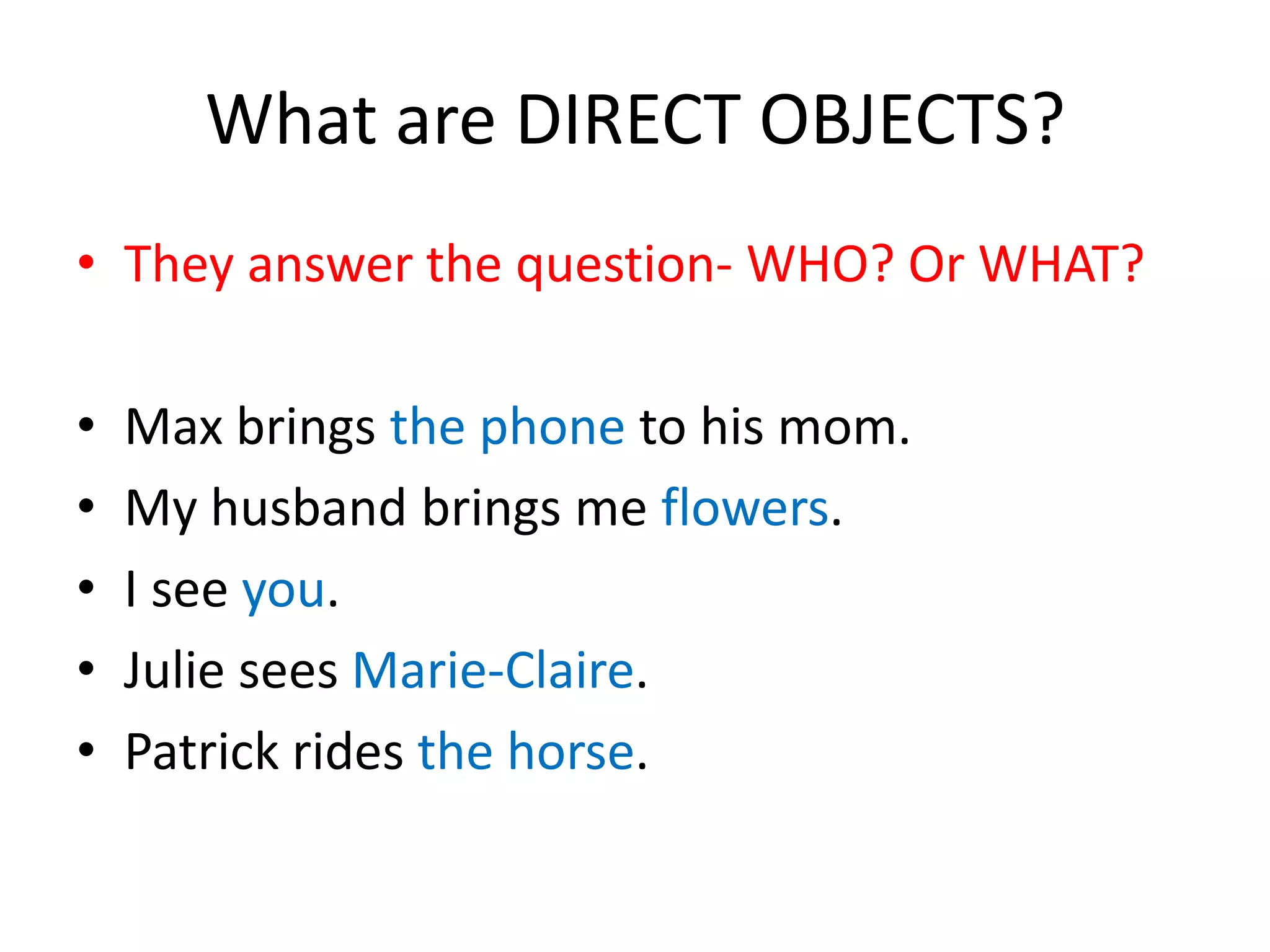
What are DIRECT OBJECTS?
• They answer the question- WHO? Or WHAT?

•   Max brings the phone to his mom.
•   My husband brings me flowers.
•   I see you.
•   Julie sees Marie-Claire.
•   Patrick rides the horse.
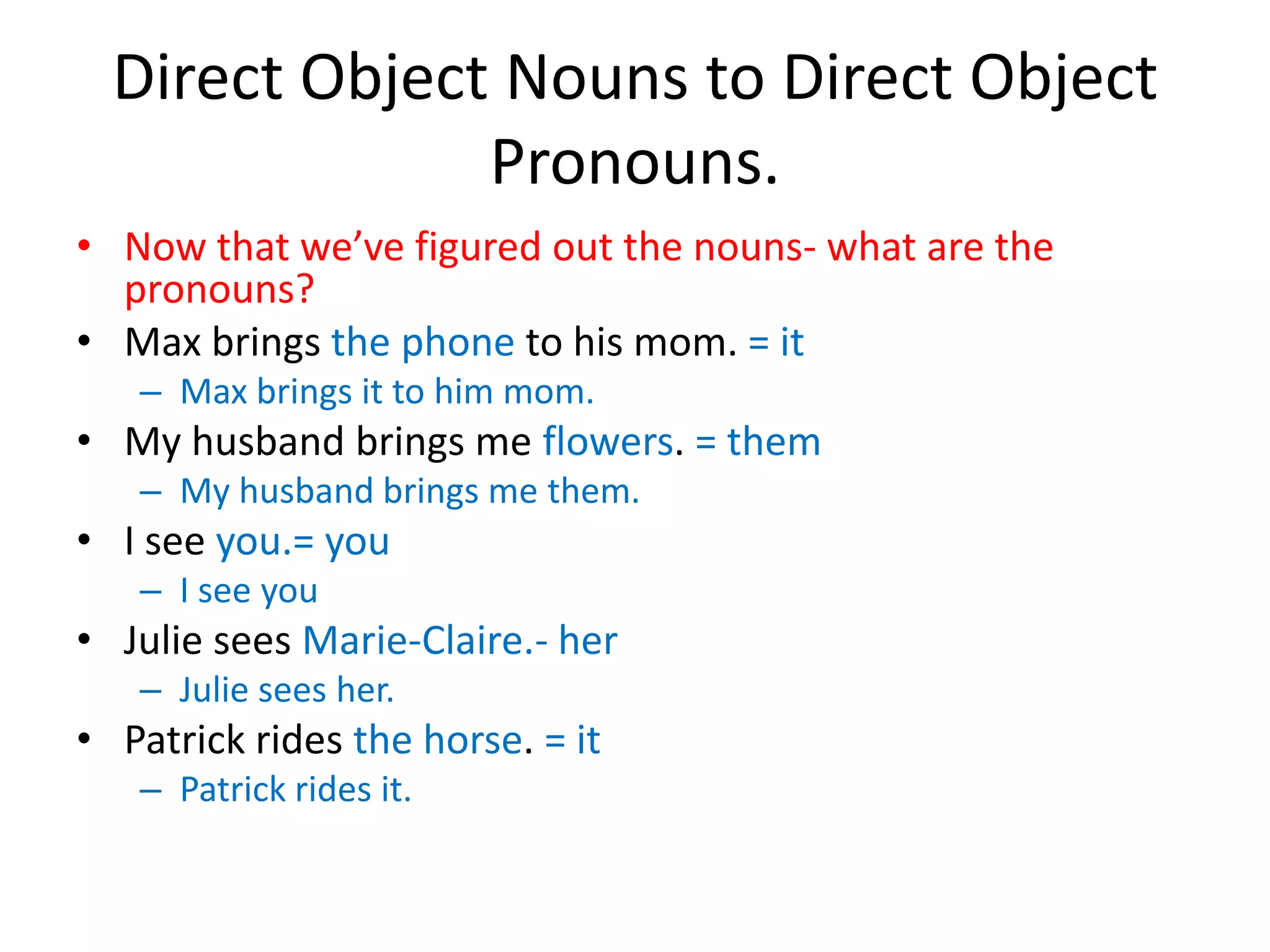
Direct Object Nouns to Direct Object
               Pronouns.
• Now that we’ve figured out the nouns- what are the
  pronouns?
• Max brings the phone to his mom. = it
   – Max brings it to him mom.
• My husband brings me flowers. = them
   – My husband brings me them.
• I see you.= you
   – I see you
• Julie sees Marie-Claire.- her
   – Julie sees her.
• Patrick rides the horse. = it
   – Patrick rides it.
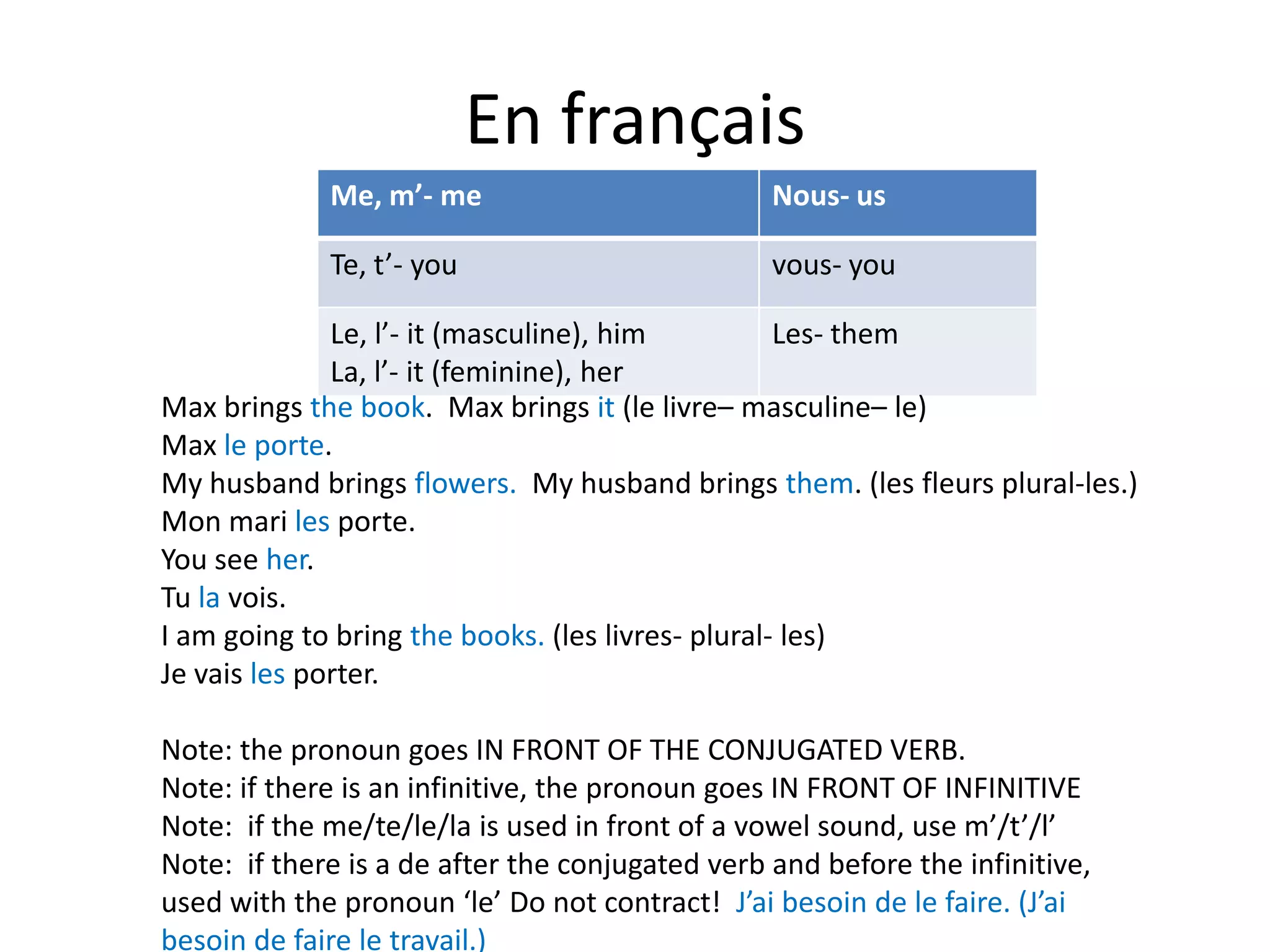
En français
             Me, m’- me                          Nous- us

             Te, t’- you                         vous- you

              Le, l’- it (masculine), him          Les- them
              La, l’- it (feminine), her
Max brings the book. Max brings it (le livre– masculine– le)
Max le porte.
My husband brings flowers. My husband brings them. (les fleurs plural-les.)
Mon mari les porte.
You see her.
Tu la vois.
I am going to bring the books. (les livres- plural- les)
Je vais les porter.

Note: the pronoun goes IN FRONT OF THE CONJUGATED VERB.
Note: if there is an infinitive, the pronoun goes IN FRONT OF INFINITIVE
Note: if the me/te/le/la is used in front of a vowel sound, use m’/t’/l’
Note: if there is a de after the conjugated verb and before the infinitive,
used with the pronoun ‘le’ Do not contract! J’ai besoin de le faire. (J’ai
besoin de faire le travail.)
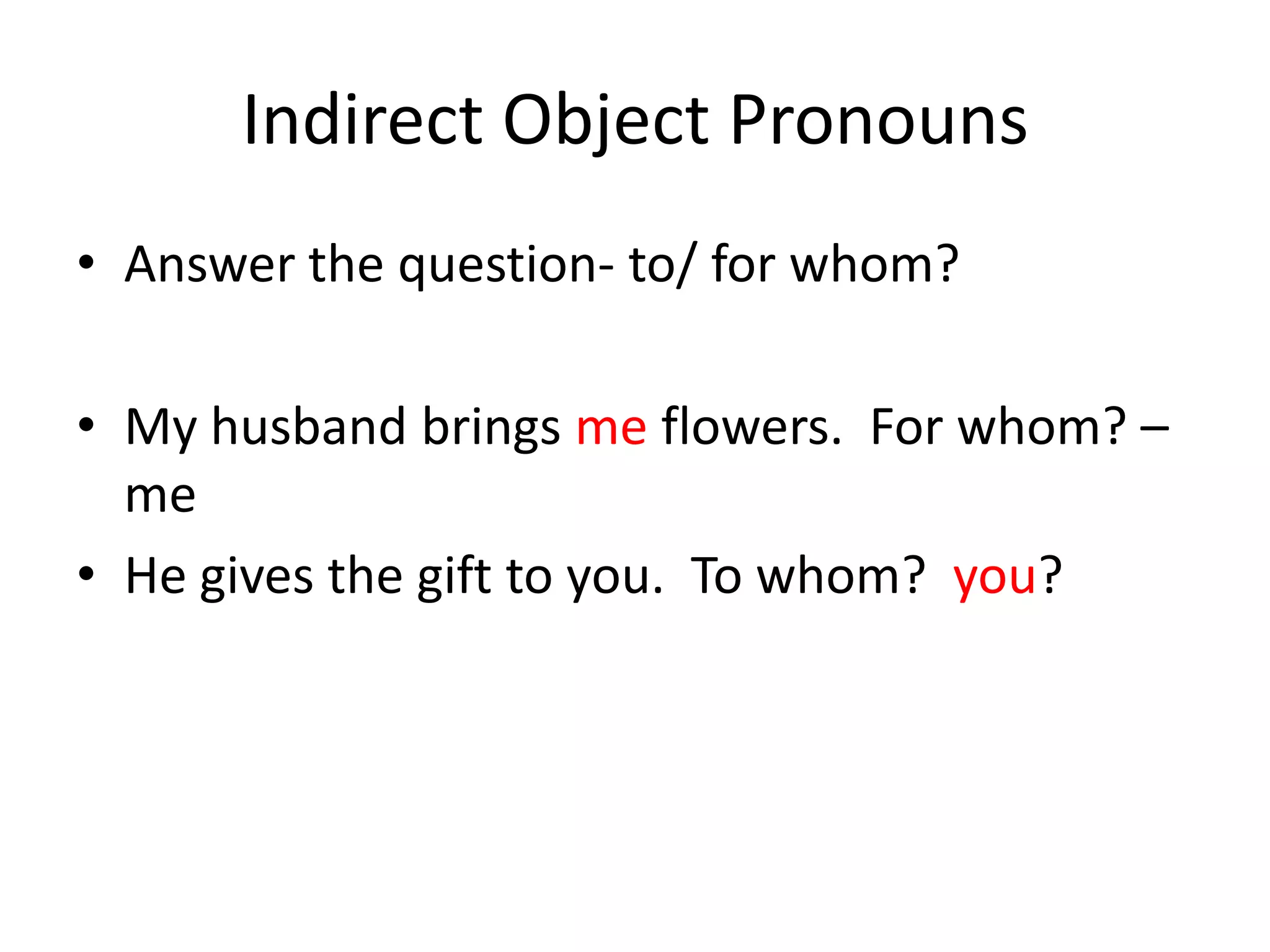
Indirect Object Pronouns
• Answer the question- to/ for whom?

• My husband brings me flowers. For whom? –
  me
• He gives the gift to you. To whom? you?
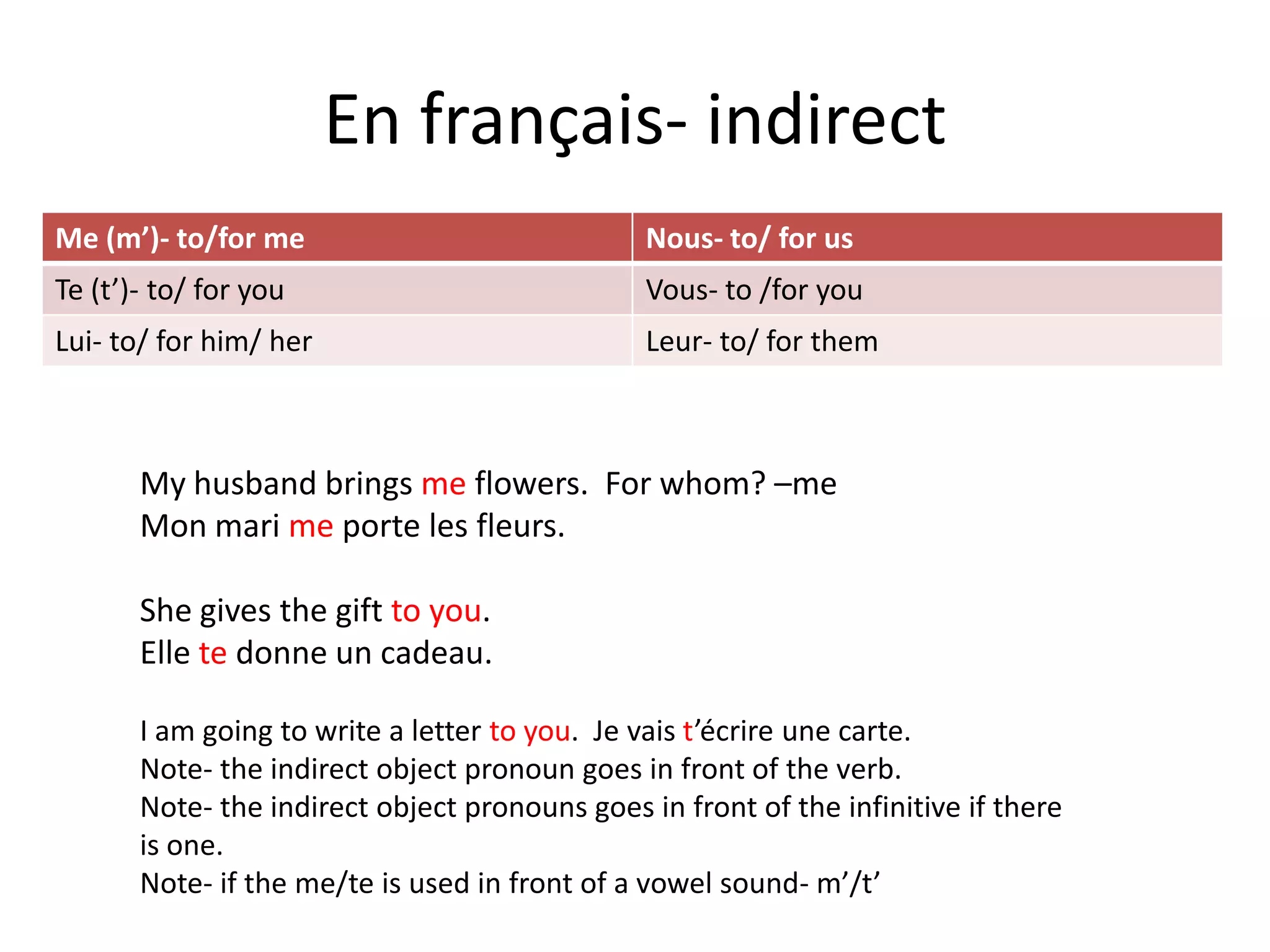
En français- indirect
Me (m’)- to/for me                              Nous- to/ for us
Te (t’)- to/ for you                            Vous- to /for you
Lui- to/ for him/ her                           Leur- to/ for them


       My husband brings me flowers. For whom? –me
       Mon mari me porte les fleurs.

       She gives the gift to you.
       Elle te donne un cadeau.

       I am going to write a letter to you. Je vais t’écrire une carte.
       Note- the indirect object pronoun goes in front of the verb.
       Note- the indirect object pronouns goes in front of the infinitive if there
       is one.
       Note- if the me/te is used in front of a vowel sound- m’/t’
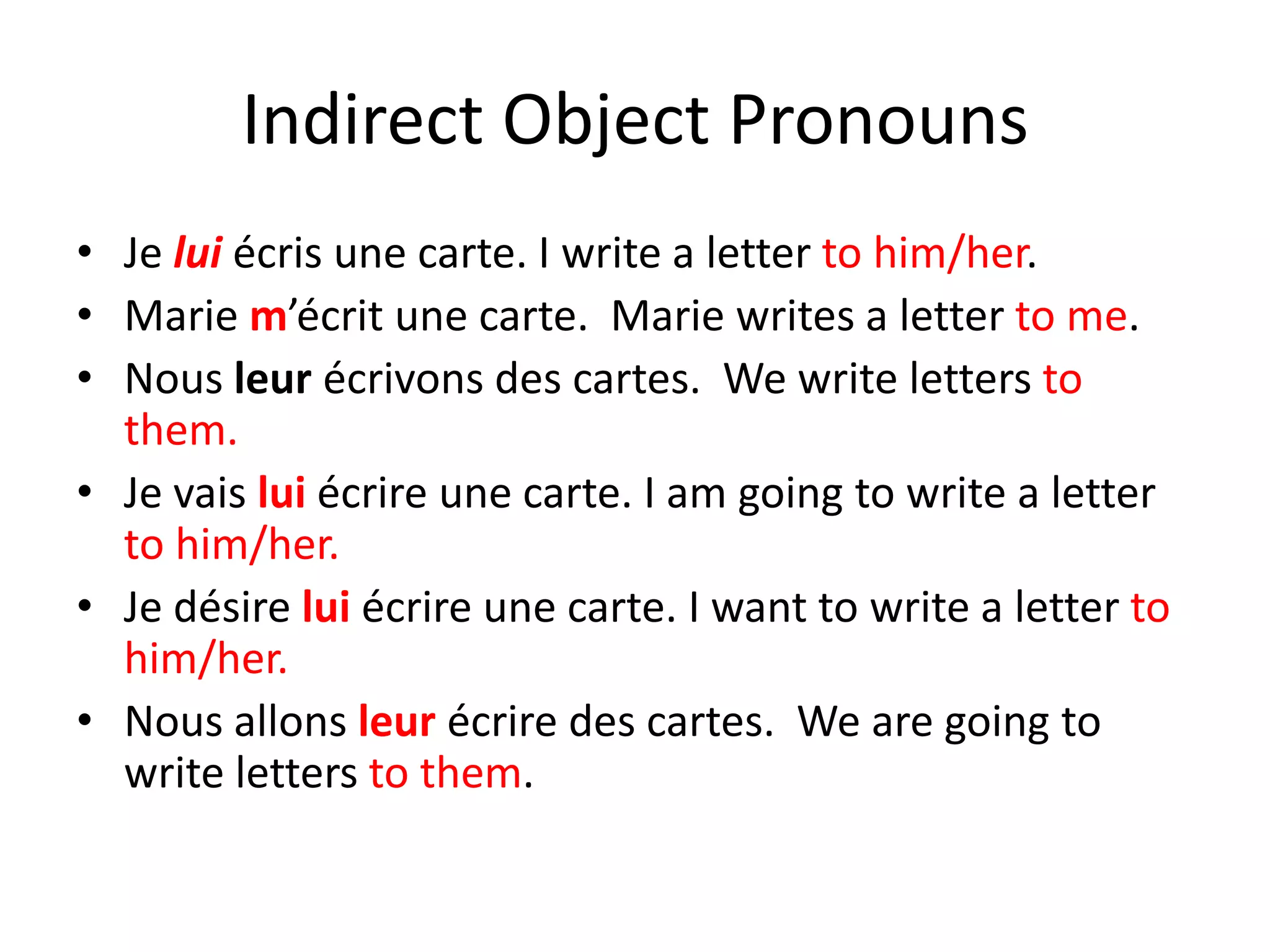
Indirect Object Pronouns
• Je lui écris une carte. I write a letter to him/her.
• Marie m’écrit une carte. Marie writes a letter to me.
• Nous leur écrivons des cartes. We write letters to
  them.
• Je vais lui écrire une carte. I am going to write a letter
  to him/her.
• Je désire lui écrire une carte. I want to write a letter to
  him/her.
• Nous allons leur écrire des cartes. We are going to
  write letters to them.

Direct and indirect object pronouns francais

  • 1.
    Direct and IndirectObject Pronouns Français 2 L’unité 3 & L’unité 4
  • 2.
    What are DIRECTOBJECTS? • They answer the question- WHO? Or WHAT? • Max brings the phone to his mom. • My husband brings me flowers. • I see you. • Julie sees Marie-Claire. • Patrick rides the horse.
  • 3.
    Direct Object Nounsto Direct Object Pronouns. • Now that we’ve figured out the nouns- what are the pronouns? • Max brings the phone to his mom. = it – Max brings it to him mom. • My husband brings me flowers. = them – My husband brings me them. • I see you.= you – I see you • Julie sees Marie-Claire.- her – Julie sees her. • Patrick rides the horse. = it – Patrick rides it.
  • 4.
    En français Me, m’- me Nous- us Te, t’- you vous- you Le, l’- it (masculine), him Les- them La, l’- it (feminine), her Max brings the book. Max brings it (le livre– masculine– le) Max le porte. My husband brings flowers. My husband brings them. (les fleurs plural-les.) Mon mari les porte. You see her. Tu la vois. I am going to bring the books. (les livres- plural- les) Je vais les porter. Note: the pronoun goes IN FRONT OF THE CONJUGATED VERB. Note: if there is an infinitive, the pronoun goes IN FRONT OF INFINITIVE Note: if the me/te/le/la is used in front of a vowel sound, use m’/t’/l’ Note: if there is a de after the conjugated verb and before the infinitive, used with the pronoun ‘le’ Do not contract! J’ai besoin de le faire. (J’ai besoin de faire le travail.)
  • 5.
    Indirect Object Pronouns •Answer the question- to/ for whom? • My husband brings me flowers. For whom? – me • He gives the gift to you. To whom? you?
  • 6.
    En français- indirect Me(m’)- to/for me Nous- to/ for us Te (t’)- to/ for you Vous- to /for you Lui- to/ for him/ her Leur- to/ for them My husband brings me flowers. For whom? –me Mon mari me porte les fleurs. She gives the gift to you. Elle te donne un cadeau. I am going to write a letter to you. Je vais t’écrire une carte. Note- the indirect object pronoun goes in front of the verb. Note- the indirect object pronouns goes in front of the infinitive if there is one. Note- if the me/te is used in front of a vowel sound- m’/t’
  • 7.
    Indirect Object Pronouns •Je lui écris une carte. I write a letter to him/her. • Marie m’écrit une carte. Marie writes a letter to me. • Nous leur écrivons des cartes. We write letters to them. • Je vais lui écrire une carte. I am going to write a letter to him/her. • Je désire lui écrire une carte. I want to write a letter to him/her. • Nous allons leur écrire des cartes. We are going to write letters to them.