Directly acting
arteriolar
dilators
Submitted to: Dr. Jalaj Tripathi
Submitted by: Anjali Rani
M.Sc. 4th Semester
Arteriolar vasodilators
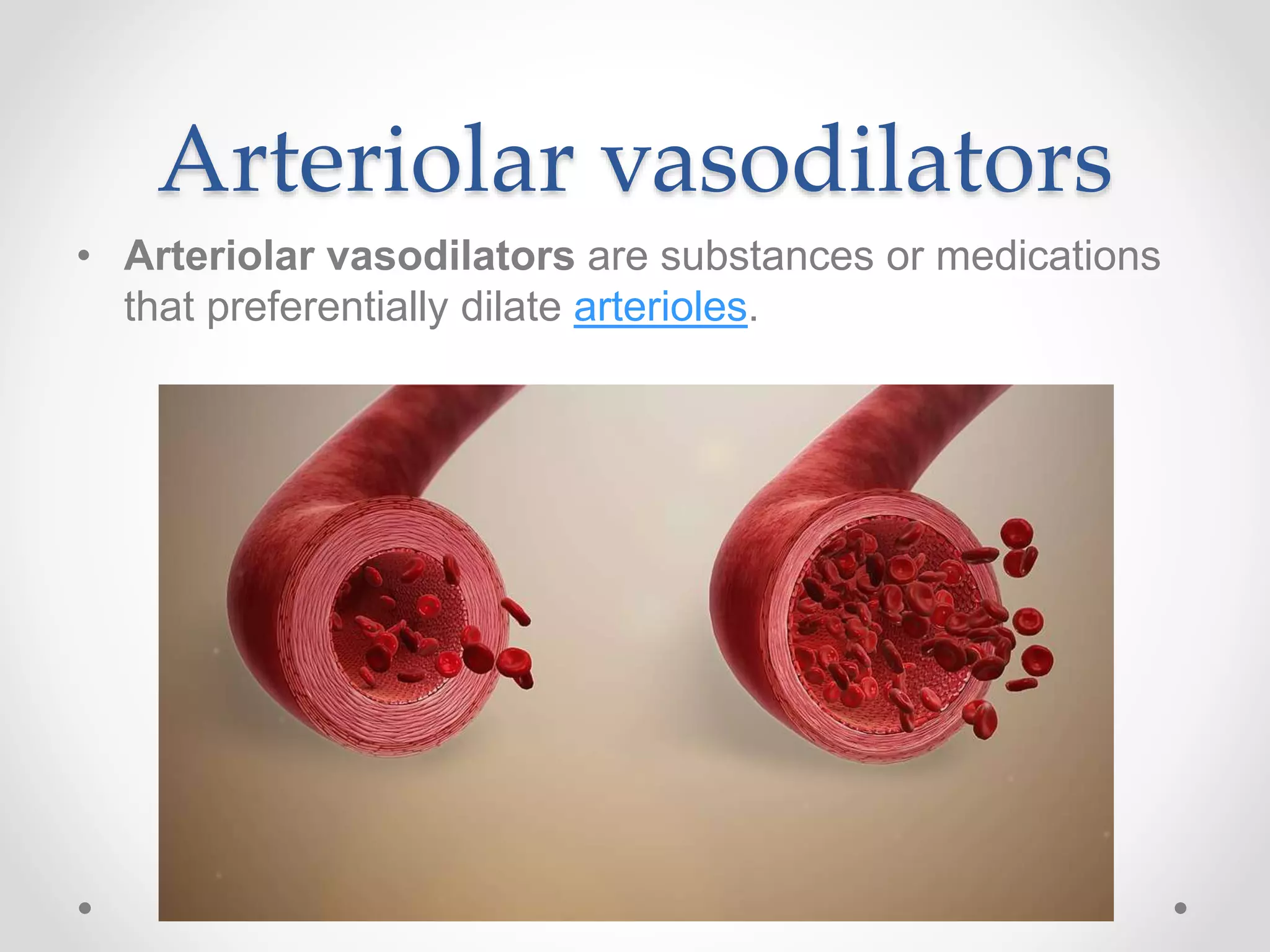
• Arteriolar vasodilators are substances or medications
that preferentially dilate arterioles.
Directly Acting Vasodilators
Directly relax the muscle in the walls of the blood
vessels (especially the arterioles), allowing the vessel to
dilate (widen).
Classification is done-
According to the route of administration
1. Oral Vasodilators :Hydralazine, Minoxidil
2. Parenteral Vasodilators : Sodium Nitroprusside,
Diazoxide, Fenoldopam
3. Oral & Parenteral Vasodilators :Calcium Channel
Blockers
• Drugs used parenterally are for hypertensive
emergencies.
• Among these only Na Nitroprusside is both Arteriolar and
Venous Dilators while all the others are arterial dilators
Mechanism of Action
• Hydralazine directly relaxes arteriolar smooth
muscle.
• Molecular targets/mechanisms that explain its
capacity to dilate arteries remain uncertain.
• Hydralazine (1-hydrazinophthalazine) was
one of the first orally active antihypertensive
drugs marketed.
Hydralazine
Evidence shows that
• Hydralazine inhibits IP3-induced release of
Ca2+ from intracellular storage sites in
arteries.
Ultimately fall in intracellular
calcium concentrations.
Leading to diminished contraction.
• Hydralazine promotes arterial dilation by
opening high conductance Ca2+-
activated K+ channels.
• Also, it has nitric oxide–enhancing
actions
• It does not relax venous smooth muscle.
• It is confined to the cardiovascular system.
• Involves selective reduction of blood
pressure in coronary, cerebral, and renal
circulations, with smaller effect in skin and
muscle.
Pharmacological Effects
Postural hypotension is not a common
problem (Because of preferential dilation of
arterioles over veins)
• However , vasodilation is associated with
baroreceptor-mediated reflexes, to
results in
Increased heart rate and contractility.
Increased plasma renin activity, and fluid
retention.
• Hydralazine is well absorbed.
• But the systemic bioavailability is low due to
first pass metabolism(16% in fast
acetylators and 35% in slow acetylators).
• Hydralazine is N-acetylated in the bowel and
the liver. The t1/2 is 1 hour.
• Duration of action : 12 hrs. (accumulation in
artery wall)
• Peak hypotensive effect : within 30-120
minutes of PO
Pharmacokinetics
Toxicity and Precautions
• Headache , nausea, flushing, hypotension.
• Stimulation of the sympathetic nervous
system :
• Palpitations, tachycardia, dizziness,
and angina pectoris.
• Myocardial ischemia (baroreceptor
reflex- induced ,increased O2
demand)
 So I.V Hydralazine is not preferred in HTN
with CAD
• Salt retention + high-output congestive
heart failure (if the drug is used alone)
So it is better tolerated when combined
with beta blocker and diuretic.
• Drug -induced lupus syndrome ( usually
after 6 months).
Uses
• No more first line drugs for essential
hypertension.
 If used, it is with combination diuretics and
Beta- blockers.
 Dose : 25-100 mg twice daily. Max 200mg.
 Mainly used In hypertensive emergencies :
10–50 mg at 30-min intervals I.V
• It is preferred in preeclampsia.
Nitroglycerine
• Organic nitrates/ nitrovasodilators/
nitric oxide donors : Nitroglycerine etc.
• They lead to the formation of the
reactive gaseous free radical NO and
related compounds.
• The exact mechanism of denitration to
liberate NO is an active area of
investigation.
• Phosphorylation of the myosin light chain
regulates the maintenance of the contractile
state in smooth muscle.
• NO activate guanylyl cyclase, increase the
cellular level of cyclic GMP, activate Protein
Kinase G (PKG).
• Activated PKG and leads to dephosphorylation
of the myosin light chain.
• This promotes vasorelaxation both for arterial
and venous smooth muscle.
Mechanism of action
• Low concentrations of nitroglycerin preferentially
dilate veins more than arterioles.
• Decreased venous return, leads to fall in left
and right ventricular chamber size and end-
diastolic pressures.
• Systemic arterial pressure may fall slightly.
• Heart rate is unchanged or may increase slightly
in response to a decrease in blood pressure
Pharmacological action
• Pulmonary vascular resistance and cardiac
output are slightly reduced.
• Very low Doses ,(that do not alter systemic arterial
pressure) may still produce arteriolar dilation in
the face and neck.
• This result in a facial flush, or dilation of
meningeal arterial vessels, cause headache.
• Basis for the differential response of arterial
versus venous tissues remains unclear.
• However, at higher doses, there is further venous
pooling and may decrease arteriolar resistance as
well.
• This decreases SBP ,DBP and CO.
• Angina (including prinzmetal’s):An initial dose of 0.3 mg
nitroglycerin often relieves pain within 3 minutes.
• MI :To relieve ischemic pain and pulmonary congestion.
Intravenous 5–200 mcg/min.
• CHF/ LVF : To decrease preload.
• Biliary colic & Esophageal spasm :To relieve pain.
• Post operative Hypertension : (drug of choice)
• Cyanide Poisoning : Methaemoglobin generated by
nitrates has greater affinity for cyanide. Used along with
Sodium thiosulphate.
Uses
Sodium Nitroprusside
Mechanism of Action
• It is a nitrovasodilator that acts by releasing
NO.
• NO activates the guanylyl cyclase– cyclic
GMP– PKG pathway, leading to vasodilation.
• So it mimicks the production of NO by vascular
endothelial cells, which is impaired in many
hypertensive patients .
• Tolerance develops to nitroglycerin but not to
Nitroprusside.
• Nitroprusside dilates both arterioles and venules
thereby causes :venous pooling and reduced
arterial impedance.
• In normal subjects ,venous pooling affects cardiac output
(more than does the reduction of afterload) so here,
cardiac output tends to fall. In contrast, in patients with
severely impaired left ventricular function and diastolic
ventricular distention the reduction of arterial impedance
is the predominant effect, leading to a rise in cardiac
output.
Pharmacological Effects
• It is a nonselective vasodilator, and regional
distribution of blood flow is little affected by
the drug.
• Renal blood flow and glomerular filtration
are maintained unlike, other arteriolar
vasodilators, only a modest increase in
heart rate and an overall reduction in
myocardial O2 demand.
• The drug must be protected from light and
given by continuous intravenous infusion
to be effective.
• Onset of action is within 30 seconds.
• Peakhypotensive effect : 2 minutes
• The effect disappears within 3 minutes
when the infusion is stopped.
Pharmacokinetics
• Metabolized in blood (100%), ferrous ion in
nitroprusside reacts with sulphydryl
compounds in RBCs .This releases
Cyanide.
• Cyanide is further metabolized by
rhodanase in liver to form thiocyanate.
• It is eliminated almost entirely in the urine.
Uses
• It is used primarily to treat hypertensive
emergencies. Dose : 2–4 mcg/kg/min; maximum
10 mcg/kg/min for 10 min
• Acute aortic dissection (to lower blood pressure)
• To improve cardiac output in CHF, especially in
hypertensive patients with pulmonary edema.
• To induce controlled hypotension during
anesthesia to reduce bleeding in surgical
procedures.
Adverse effects
Common ones :
• Hypotension, bradyarrhythmia, tachyarrhythmia .
• Headache, restlessness.
• Injection site irritation.
Serious ones :
• Cyanide poisoning :
Management - concomitant administration of sodium
thiosulfate can prevent accumulation of cyanide.
• Thiocynate toxicity : (seen in renal failure) anorexia,
nausea, fatigue, disorientation, and toxic psychosis
Management - Hemodialysis
• Raised intracranial pressure
References
• https://en.wikipedia.org/wiki/Hydralazine
• https://en.wikipedia.org/wiki/Arteriolar_vasodilator
• https://en.wikipedia.org/wiki/Vasodilation
• https://pubmed.ncbi.nlm.nih.gov/1904576/
• Foye’s Principle of Medicinal Chemistry, 6th edition
Directly acting Arteriolar Dilators

Directly acting Arteriolar Dilators

  • 1.
    Directly acting arteriolar dilators Submitted to:Dr. Jalaj Tripathi Submitted by: Anjali Rani M.Sc. 4th Semester
  • 2.
    Arteriolar vasodilators • Arteriolarvasodilators are substances or medications that preferentially dilate arterioles.
  • 3.
    Directly Acting Vasodilators Directlyrelax the muscle in the walls of the blood vessels (especially the arterioles), allowing the vessel to dilate (widen). Classification is done- According to the route of administration 1. Oral Vasodilators :Hydralazine, Minoxidil 2. Parenteral Vasodilators : Sodium Nitroprusside, Diazoxide, Fenoldopam 3. Oral & Parenteral Vasodilators :Calcium Channel Blockers
  • 4.
    • Drugs usedparenterally are for hypertensive emergencies. • Among these only Na Nitroprusside is both Arteriolar and Venous Dilators while all the others are arterial dilators
  • 5.
    Mechanism of Action •Hydralazine directly relaxes arteriolar smooth muscle. • Molecular targets/mechanisms that explain its capacity to dilate arteries remain uncertain. • Hydralazine (1-hydrazinophthalazine) was one of the first orally active antihypertensive drugs marketed. Hydralazine
  • 6.
    Evidence shows that •Hydralazine inhibits IP3-induced release of Ca2+ from intracellular storage sites in arteries. Ultimately fall in intracellular calcium concentrations. Leading to diminished contraction.
  • 7.
    • Hydralazine promotesarterial dilation by opening high conductance Ca2+- activated K+ channels. • Also, it has nitric oxide–enhancing actions • It does not relax venous smooth muscle.
  • 8.
    • It isconfined to the cardiovascular system. • Involves selective reduction of blood pressure in coronary, cerebral, and renal circulations, with smaller effect in skin and muscle. Pharmacological Effects
  • 9.
    Postural hypotension isnot a common problem (Because of preferential dilation of arterioles over veins) • However , vasodilation is associated with baroreceptor-mediated reflexes, to results in Increased heart rate and contractility. Increased plasma renin activity, and fluid retention.
  • 10.
    • Hydralazine iswell absorbed. • But the systemic bioavailability is low due to first pass metabolism(16% in fast acetylators and 35% in slow acetylators). • Hydralazine is N-acetylated in the bowel and the liver. The t1/2 is 1 hour. • Duration of action : 12 hrs. (accumulation in artery wall) • Peak hypotensive effect : within 30-120 minutes of PO Pharmacokinetics
  • 11.
    Toxicity and Precautions •Headache , nausea, flushing, hypotension. • Stimulation of the sympathetic nervous system : • Palpitations, tachycardia, dizziness, and angina pectoris. • Myocardial ischemia (baroreceptor reflex- induced ,increased O2 demand)  So I.V Hydralazine is not preferred in HTN with CAD
  • 12.
    • Salt retention+ high-output congestive heart failure (if the drug is used alone) So it is better tolerated when combined with beta blocker and diuretic. • Drug -induced lupus syndrome ( usually after 6 months).
  • 13.
    Uses • No morefirst line drugs for essential hypertension.  If used, it is with combination diuretics and Beta- blockers.  Dose : 25-100 mg twice daily. Max 200mg.  Mainly used In hypertensive emergencies : 10–50 mg at 30-min intervals I.V • It is preferred in preeclampsia.
  • 14.
    Nitroglycerine • Organic nitrates/nitrovasodilators/ nitric oxide donors : Nitroglycerine etc. • They lead to the formation of the reactive gaseous free radical NO and related compounds. • The exact mechanism of denitration to liberate NO is an active area of investigation.
  • 15.
    • Phosphorylation ofthe myosin light chain regulates the maintenance of the contractile state in smooth muscle. • NO activate guanylyl cyclase, increase the cellular level of cyclic GMP, activate Protein Kinase G (PKG). • Activated PKG and leads to dephosphorylation of the myosin light chain. • This promotes vasorelaxation both for arterial and venous smooth muscle. Mechanism of action
  • 17.
    • Low concentrationsof nitroglycerin preferentially dilate veins more than arterioles. • Decreased venous return, leads to fall in left and right ventricular chamber size and end- diastolic pressures. • Systemic arterial pressure may fall slightly. • Heart rate is unchanged or may increase slightly in response to a decrease in blood pressure Pharmacological action
  • 18.
    • Pulmonary vascularresistance and cardiac output are slightly reduced. • Very low Doses ,(that do not alter systemic arterial pressure) may still produce arteriolar dilation in the face and neck. • This result in a facial flush, or dilation of meningeal arterial vessels, cause headache. • Basis for the differential response of arterial versus venous tissues remains unclear. • However, at higher doses, there is further venous pooling and may decrease arteriolar resistance as well. • This decreases SBP ,DBP and CO.
  • 19.
    • Angina (includingprinzmetal’s):An initial dose of 0.3 mg nitroglycerin often relieves pain within 3 minutes. • MI :To relieve ischemic pain and pulmonary congestion. Intravenous 5–200 mcg/min. • CHF/ LVF : To decrease preload. • Biliary colic & Esophageal spasm :To relieve pain. • Post operative Hypertension : (drug of choice) • Cyanide Poisoning : Methaemoglobin generated by nitrates has greater affinity for cyanide. Used along with Sodium thiosulphate. Uses
  • 20.
    Sodium Nitroprusside Mechanism ofAction • It is a nitrovasodilator that acts by releasing NO. • NO activates the guanylyl cyclase– cyclic GMP– PKG pathway, leading to vasodilation. • So it mimicks the production of NO by vascular endothelial cells, which is impaired in many hypertensive patients . • Tolerance develops to nitroglycerin but not to Nitroprusside.
  • 21.
    • Nitroprusside dilatesboth arterioles and venules thereby causes :venous pooling and reduced arterial impedance. • In normal subjects ,venous pooling affects cardiac output (more than does the reduction of afterload) so here, cardiac output tends to fall. In contrast, in patients with severely impaired left ventricular function and diastolic ventricular distention the reduction of arterial impedance is the predominant effect, leading to a rise in cardiac output. Pharmacological Effects
  • 22.
    • It isa nonselective vasodilator, and regional distribution of blood flow is little affected by the drug. • Renal blood flow and glomerular filtration are maintained unlike, other arteriolar vasodilators, only a modest increase in heart rate and an overall reduction in myocardial O2 demand.
  • 23.
    • The drugmust be protected from light and given by continuous intravenous infusion to be effective. • Onset of action is within 30 seconds. • Peakhypotensive effect : 2 minutes • The effect disappears within 3 minutes when the infusion is stopped. Pharmacokinetics
  • 24.
    • Metabolized inblood (100%), ferrous ion in nitroprusside reacts with sulphydryl compounds in RBCs .This releases Cyanide. • Cyanide is further metabolized by rhodanase in liver to form thiocyanate. • It is eliminated almost entirely in the urine.
  • 25.
    Uses • It isused primarily to treat hypertensive emergencies. Dose : 2–4 mcg/kg/min; maximum 10 mcg/kg/min for 10 min • Acute aortic dissection (to lower blood pressure) • To improve cardiac output in CHF, especially in hypertensive patients with pulmonary edema. • To induce controlled hypotension during anesthesia to reduce bleeding in surgical procedures.
  • 26.
    Adverse effects Common ones: • Hypotension, bradyarrhythmia, tachyarrhythmia . • Headache, restlessness. • Injection site irritation. Serious ones : • Cyanide poisoning : Management - concomitant administration of sodium thiosulfate can prevent accumulation of cyanide. • Thiocynate toxicity : (seen in renal failure) anorexia, nausea, fatigue, disorientation, and toxic psychosis Management - Hemodialysis • Raised intracranial pressure
  • 27.
    References • https://en.wikipedia.org/wiki/Hydralazine • https://en.wikipedia.org/wiki/Arteriolar_vasodilator •https://en.wikipedia.org/wiki/Vasodilation • https://pubmed.ncbi.nlm.nih.gov/1904576/ • Foye’s Principle of Medicinal Chemistry, 6th edition