Presented by,
Shabnom.N
English
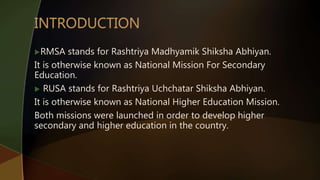
RMSA stands for Rashtriya Madhyamik Shiksha Abhiyan.
It is otherwise known as National Mission For Secondary
Education.
 RUSA stands for Rashtriya Uchchatar Shiksha Abhiyan.
It is otherwise known as National Higher Education Mission.
Both missions were launched in order to develop higher
secondary and higher education in the country.
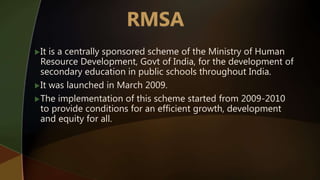
It is a centrally sponsored scheme of the Ministry of Human
Resource Development, Govt of India, for the development of
secondary education in public schools throughout India.
It was launched in March 2009.
The implementation of this scheme started from 2009-2010
to provide conditions for an efficient growth, development
and equity for all.
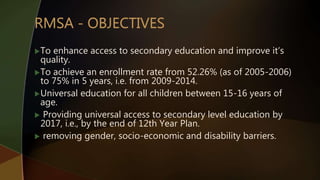
To enhance access to secondary education and improve it’s
quality.
To achieve an enrollment rate from 52.26% (as of 2005-2006)
to 75% in 5 years, i.e. from 2009-2014.
Universal education for all children between 15-16 years of
age.
 Providing universal access to secondary level education by
2017, i.e., by the end of 12th Year Plan.
 removing gender, socio-economic and disability barriers.
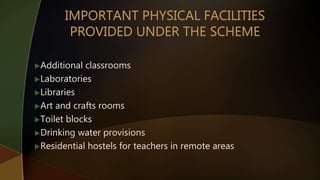
Additional classrooms
Laboratories
Libraries
Art and crafts rooms
Toilet blocks
Drinking water provisions
Residential hostels for teachers in remote areas
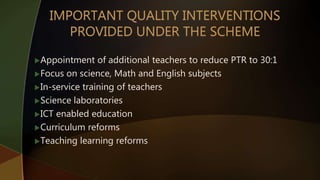
Appointment of additional teachers to reduce PTR to 30:1
Focus on science, Math and English subjects
In-service training of teachers
Science laboratories
ICT enabled education
Curriculum reforms
Teaching learning reforms
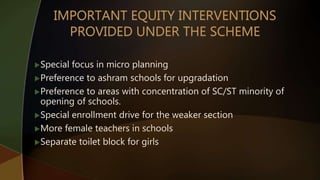
Special focus in micro planning
Preference to ashram schools for upgradation
Preference to areas with concentration of SC/ST minority of
opening of schools.
Special enrollment drive for the weaker section
More female teachers in schools
Separate toilet block for girls
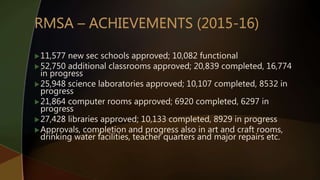
11,577 new sec schools approved; 10,082 functional
52,750 additional classrooms approved; 20,839 completed, 16,774
in progress
25,948 science laboratories approved; 10,107 completed, 8532 in
progress
21,864 computer rooms approved; 6920 completed, 6297 in
progress
27,428 libraries approved; 10,133 completed, 8929 in progress
Approvals, completion and progress also in art and craft rooms,
drinking water facilities, teacher quarters and major repairs etc.
Holistic scheme for the development of higher education in
India
It was launched in 2013 by the Ministry of Human Resource
Development, Govt. of India
The centrally sponsored scheme aims at providing strategic
funding to higher educational institutions throughout the
country.
To provide equal development to all higher institutions and
rectify weaknesses in the higher education system.
It’s target achievement is to raise the Gross Enrollment Ratio
(GER) to 32% by the end of XII plan in 2017
Improve the overall quality of existing state institutions
Promoting autonomy in state universities
Ensure academic and examination reforms in the higher
educational institutions
Ensure adequate availability of quality faculty in all higher
educational institutions
Enable conversion of some of the universities in to research
universities
Improve quality in higher education by providing adequate
opportunities of higher education to SC/ST s and socially
backward classes
Promote inclusion of women, minorities and differently abled
persons
RUSA is provided by the Central Ministry of Human Resource
Development directly to the state and UT governments. From
the State/UT budgets, the funds are disbursed to individual
institutions. The funding to states would be made on the basis
of critical appraisal of state plans in the field of higher
education.
The funds will be provided in the ratio 65:35 for general
category states and for special category states, it will be 90:10.
Rmsa
Rmsa
Rmsa

Rmsa

  • 1.
  • 2.
    RMSA stands forRashtriya Madhyamik Shiksha Abhiyan. It is otherwise known as National Mission For Secondary Education.  RUSA stands for Rashtriya Uchchatar Shiksha Abhiyan. It is otherwise known as National Higher Education Mission. Both missions were launched in order to develop higher secondary and higher education in the country.
  • 3.
    It is acentrally sponsored scheme of the Ministry of Human Resource Development, Govt of India, for the development of secondary education in public schools throughout India. It was launched in March 2009. The implementation of this scheme started from 2009-2010 to provide conditions for an efficient growth, development and equity for all.
  • 4.
    To enhance accessto secondary education and improve it’s quality. To achieve an enrollment rate from 52.26% (as of 2005-2006) to 75% in 5 years, i.e. from 2009-2014. Universal education for all children between 15-16 years of age.  Providing universal access to secondary level education by 2017, i.e., by the end of 12th Year Plan.  removing gender, socio-economic and disability barriers.
  • 5.
    Additional classrooms Laboratories Libraries Art andcrafts rooms Toilet blocks Drinking water provisions Residential hostels for teachers in remote areas
  • 6.
    Appointment of additionalteachers to reduce PTR to 30:1 Focus on science, Math and English subjects In-service training of teachers Science laboratories ICT enabled education Curriculum reforms Teaching learning reforms
  • 7.
    Special focus inmicro planning Preference to ashram schools for upgradation Preference to areas with concentration of SC/ST minority of opening of schools. Special enrollment drive for the weaker section More female teachers in schools Separate toilet block for girls
  • 8.
    11,577 new secschools approved; 10,082 functional 52,750 additional classrooms approved; 20,839 completed, 16,774 in progress 25,948 science laboratories approved; 10,107 completed, 8532 in progress 21,864 computer rooms approved; 6920 completed, 6297 in progress 27,428 libraries approved; 10,133 completed, 8929 in progress Approvals, completion and progress also in art and craft rooms, drinking water facilities, teacher quarters and major repairs etc.
  • 9.
    Holistic scheme forthe development of higher education in India It was launched in 2013 by the Ministry of Human Resource Development, Govt. of India The centrally sponsored scheme aims at providing strategic funding to higher educational institutions throughout the country.
  • 10.
    To provide equaldevelopment to all higher institutions and rectify weaknesses in the higher education system. It’s target achievement is to raise the Gross Enrollment Ratio (GER) to 32% by the end of XII plan in 2017 Improve the overall quality of existing state institutions Promoting autonomy in state universities Ensure academic and examination reforms in the higher educational institutions Ensure adequate availability of quality faculty in all higher educational institutions
  • 11.
    Enable conversion ofsome of the universities in to research universities Improve quality in higher education by providing adequate opportunities of higher education to SC/ST s and socially backward classes Promote inclusion of women, minorities and differently abled persons
  • 12.
    RUSA is providedby the Central Ministry of Human Resource Development directly to the state and UT governments. From the State/UT budgets, the funds are disbursed to individual institutions. The funding to states would be made on the basis of critical appraisal of state plans in the field of higher education. The funds will be provided in the ratio 65:35 for general category states and for special category states, it will be 90:10.