Significant Figures 
Help with Science and Sig Figs
What is a significant figure? 
• There are 2 kinds of 
numbers: 
–Exact: the amount of 
money in your account. 
Known with certainty.
What is a significant figure? 
–Approximate: weight, 
height—anything 
MEASURED. No 
measurement is perfect.
When to use Significant figures 
• When a measurement is 
recorded only those 
digits that are 
dependable are written 
down.
When to use Significant figures 
–If you measured the 
width of a paper with 
your ruler you might 
record 21.7cm. 
To a mathematician 21.70, 
or 21.700 is the same.
But, to a scientist 21.7cm and 
21.70cm is NOT the same 
• 21.700cm to a scientist 
means the measurement 
is accurate to within one 
thousandth of a cm.
But, to a scientist 21.7cm and 
21.70cm is NOT the same 
• If you used an ordinary 
ruler, the smallest 
marking is the mm, so 
your measurement has 
to be recorded as 
21.7cm.
How do I know how many Sig Figs? 
• Rule: All digits are 
significant starting with 
the first non-zero digit 
on the left.
How do I know how many Sig Figs? 
• Exception to rule: In 
whole numbers that end 
in zero, the zeros at the 
end are not significant.
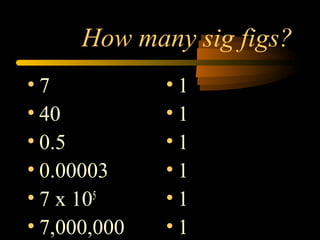
How many sig figs? 
• 7 
• 40 
• 0.5 
• 0.00003 
• 7 x 10⁵ 
• 7,000,000 
• 1 
• 1 
• 1 
• 1 
• 1 
• 1
How do I know how many Sig Figs? 
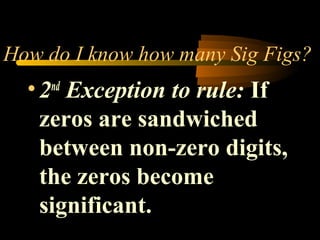
• 2nd Exception to rule: If 
zeros are sandwiched 
between non-zero digits, 
the zeros become 
significant.
How do I know how many Sig Figs? 
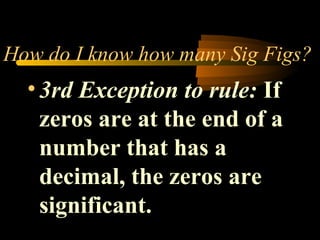
• 3rd Exception to rule: If 
zeros are at the end of a 
number that has a 
decimal, the zeros are 
significant.
How do I know how many Sig Figs? 
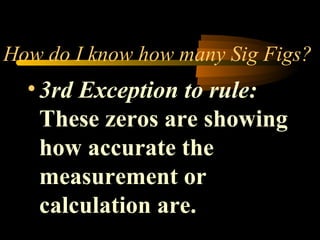
• 3rd Exception to rule: 
These zeros are showing 
how accurate the 
measurement or 
calculation are.
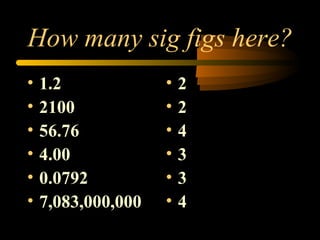
How many sig figs here? 
• 1.2 
• 2 
• 2100 
• 2 
• 56.76 
• 4 
• 4.00 
• 3 
• 0.0792 
• 3 
• 7,083,000,000 
• 4
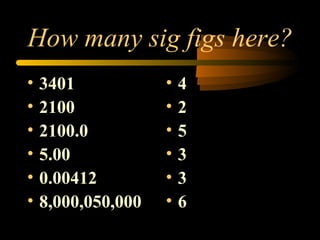
How many sig figs here? 
• 3401 
• 4 
• 2100 
• 2 
• 2100.0 
• 5 
• 5.00 
• 3 
• 0.00412 
• 3 
• 8,000,050,000 
• 6
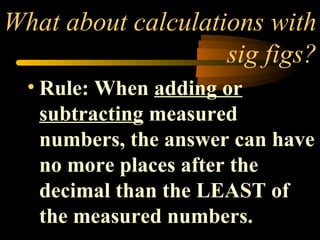
What about calculations with 
sig figs? 
• Rule: When adding or 
subtracting measured 
numbers, the answer can have 
no more places after the 
decimal than the LEAST of 
the measured numbers.
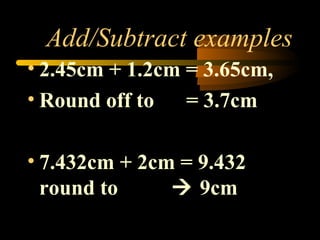
Add/Subtract examples 
• 2.45cm + 1.2cm = 3.65cm, 
• Round off to = 3.7cm 
• 7.432cm + 2cm = 9.432 
round to  9cm
Multiplication and Division 
• Rule: When multiplying 
or dividing, the result 
can have no more 
significant figures than 
the least reliable 
measurement.
A couple of examples 
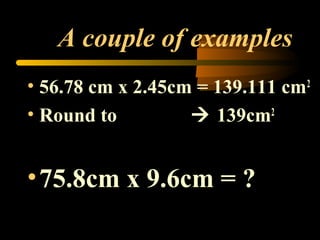
• 56.78 cm x 2.45cm = 139.111 cm2 
• Round to  139cm2 
•75.8cm x 9.6cm = ?
The End 
Have Fun Measuring and 
Happy Calculating!

Significant figures

  • 1.
    Significant Figures Helpwith Science and Sig Figs
  • 2.
    What is asignificant figure? • There are 2 kinds of numbers: –Exact: the amount of money in your account. Known with certainty.
  • 3.
    What is asignificant figure? –Approximate: weight, height—anything MEASURED. No measurement is perfect.
  • 4.
    When to useSignificant figures • When a measurement is recorded only those digits that are dependable are written down.
  • 5.
    When to useSignificant figures –If you measured the width of a paper with your ruler you might record 21.7cm. To a mathematician 21.70, or 21.700 is the same.
  • 6.
    But, to ascientist 21.7cm and 21.70cm is NOT the same • 21.700cm to a scientist means the measurement is accurate to within one thousandth of a cm.
  • 7.
    But, to ascientist 21.7cm and 21.70cm is NOT the same • If you used an ordinary ruler, the smallest marking is the mm, so your measurement has to be recorded as 21.7cm.
  • 8.
    How do Iknow how many Sig Figs? • Rule: All digits are significant starting with the first non-zero digit on the left.
  • 9.
    How do Iknow how many Sig Figs? • Exception to rule: In whole numbers that end in zero, the zeros at the end are not significant.
  • 10.
    How many sigfigs? • 7 • 40 • 0.5 • 0.00003 • 7 x 10⁵ • 7,000,000 • 1 • 1 • 1 • 1 • 1 • 1
  • 11.
    How do Iknow how many Sig Figs? • 2nd Exception to rule: If zeros are sandwiched between non-zero digits, the zeros become significant.
  • 12.
    How do Iknow how many Sig Figs? • 3rd Exception to rule: If zeros are at the end of a number that has a decimal, the zeros are significant.
  • 13.
    How do Iknow how many Sig Figs? • 3rd Exception to rule: These zeros are showing how accurate the measurement or calculation are.
  • 14.
    How many sigfigs here? • 1.2 • 2 • 2100 • 2 • 56.76 • 4 • 4.00 • 3 • 0.0792 • 3 • 7,083,000,000 • 4
  • 15.
    How many sigfigs here? • 3401 • 4 • 2100 • 2 • 2100.0 • 5 • 5.00 • 3 • 0.00412 • 3 • 8,000,050,000 • 6
  • 16.
    What about calculationswith sig figs? • Rule: When adding or subtracting measured numbers, the answer can have no more places after the decimal than the LEAST of the measured numbers.
  • 17.
    Add/Subtract examples •2.45cm + 1.2cm = 3.65cm, • Round off to = 3.7cm • 7.432cm + 2cm = 9.432 round to  9cm
  • 18.
    Multiplication and Division • Rule: When multiplying or dividing, the result can have no more significant figures than the least reliable measurement.
  • 19.
    A couple ofexamples • 56.78 cm x 2.45cm = 139.111 cm2 • Round to  139cm2 •75.8cm x 9.6cm = ?
  • 20.
    The End HaveFun Measuring and Happy Calculating!