Cryptographic Hash
Functions
Each of the messages, like each one he had ever
read of Stern's commands, began with a number
and ended with a number or row of numbers. No
efforts on the part of Mungo or any of his experts
had been able to break Stern's code, nor was
there any clue as to what the preliminary
number and those ultimate numbers signified.
—Talking to Strange Men, Ruth Rendell
Hash Functions
➢ condenses arbitrary message to fixed size
h = H(M)
➢ usually assume hash function is public
➢ hash used to detect changes to message
➢ want a cryptographic hash function
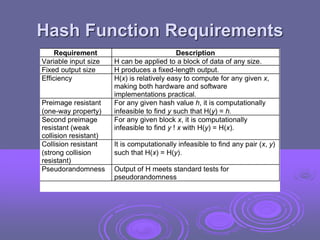
⚫ computationally infeasible to find data mapping
to specific hash (one-way property)
⚫ computationally infeasible to find two data to
same hash (collision-free property)
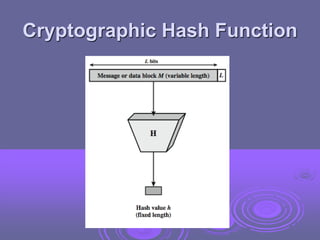
Cryptographic Hash Function
Hash Function Uses
➢ Message Integrity Check (MIC)
⚫ send hash of message (digest)
⚫ MIC always encrypted, message optionally
➢ Message Authentication Code (MAC)
⚫ send keyed hash of message
⚫ MAC, message optionally encrypted
➢ Digital Signature (non-repudiation)
⚫ Encrypt hash with private (signing) key
⚫ Verify with public (verification) key
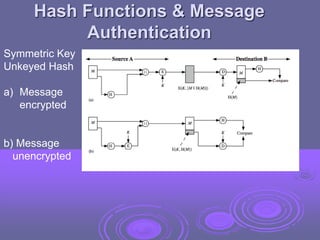
Hash Functions & Message
Authentication
Symmetric Key
Unkeyed Hash
a) Message
encrypted
b) Message
unencrypted
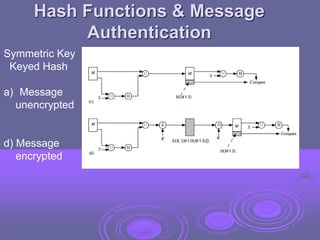
Hash Functions & Message
Authentication
Symmetric Key
Keyed Hash
a) Message
unencrypted
d) Message
encrypted
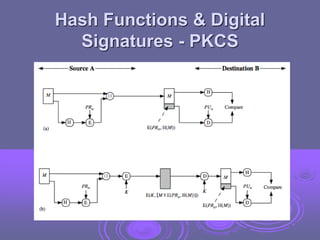
Hash Functions & Digital
Signatures - PKCS
More Hash Function Uses
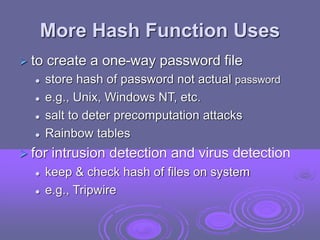
➢ to create a one-way password file
⚫ store hash of password not actual password
⚫ e.g., Unix, Windows NT, etc.
⚫ salt to deter precomputation attacks
⚫ Rainbow tables
➢ for intrusion detection and virus detection
⚫ keep & check hash of files on system
⚫ e.g., Tripwire
Hash Function Requirements
Secure Hash Algorithm
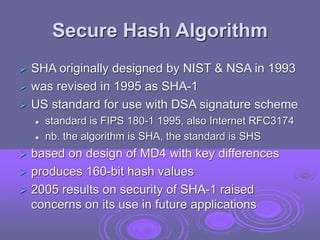
➢ SHA originally designed by NIST & NSA in 1993
➢ was revised in 1995 as SHA-1
➢ US standard for use with DSA signature scheme
⚫ standard is FIPS 180-1 1995, also Internet RFC3174
⚫ nb. the algorithm is SHA, the standard is SHS
➢ based on design of MD4 with key differences
➢ produces 160-bit hash values
➢ 2005 results on security of SHA-1 raised
concerns on its use in future applications
Revised Secure Hash
Standard
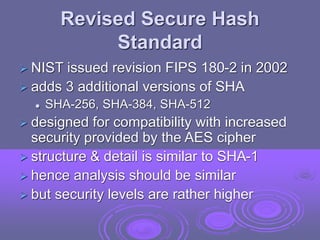
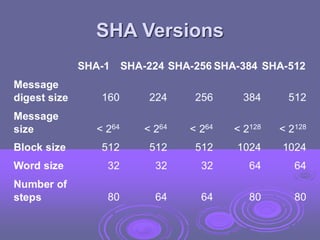
➢ NIST issued revision FIPS 180-2 in 2002
➢ adds 3 additional versions of SHA
⚫ SHA-256, SHA-384, SHA-512
➢ designed for compatibility with increased
security provided by the AES cipher
➢ structure & detail is similar to SHA-1
➢ hence analysis should be similar
➢ but security levels are rather higher
SHA Versions
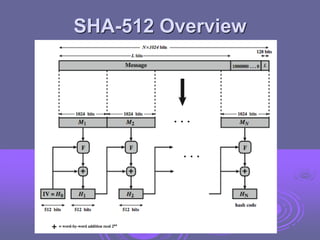
SHA-512 Overview
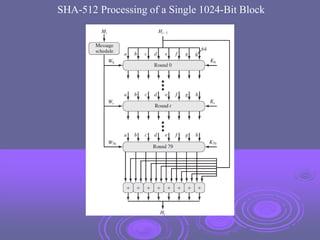
SHA-512 Processing of a Single 1024-Bit Block
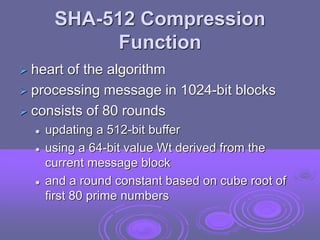
SHA-512 Compression
Function
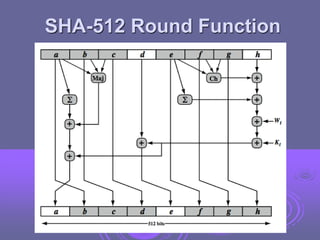
➢ heart of the algorithm
➢ processing message in 1024-bit blocks
➢ consists of 80 rounds
⚫ updating a 512-bit buffer
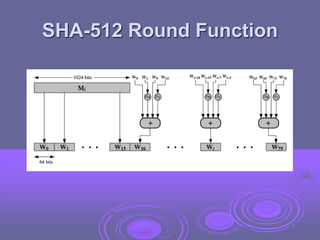
⚫ using a 64-bit value Wt derived from the
current message block
⚫ and a round constant based on cube root of
first 80 prime numbers
SHA-512 Round Function
Summary
➢ have considered:
⚫ hash functions
• uses, requirements, security
⚫ SHA-512

Hash Functions - Uses, Requirements, Secure Hash Algorithm

  • 1.
    Cryptographic Hash Functions Each ofthe messages, like each one he had ever read of Stern's commands, began with a number and ended with a number or row of numbers. No efforts on the part of Mungo or any of his experts had been able to break Stern's code, nor was there any clue as to what the preliminary number and those ultimate numbers signified. —Talking to Strange Men, Ruth Rendell
  • 2.
    Hash Functions ➢ condensesarbitrary message to fixed size h = H(M) ➢ usually assume hash function is public ➢ hash used to detect changes to message ➢ want a cryptographic hash function ⚫ computationally infeasible to find data mapping to specific hash (one-way property) ⚫ computationally infeasible to find two data to same hash (collision-free property)
  • 3.
  • 4.
    Hash Function Uses ➢Message Integrity Check (MIC) ⚫ send hash of message (digest) ⚫ MIC always encrypted, message optionally ➢ Message Authentication Code (MAC) ⚫ send keyed hash of message ⚫ MAC, message optionally encrypted ➢ Digital Signature (non-repudiation) ⚫ Encrypt hash with private (signing) key ⚫ Verify with public (verification) key
  • 5.
    Hash Functions &Message Authentication Symmetric Key Unkeyed Hash a) Message encrypted b) Message unencrypted
  • 6.
    Hash Functions &Message Authentication Symmetric Key Keyed Hash a) Message unencrypted d) Message encrypted
  • 7.
    Hash Functions &Digital Signatures - PKCS
  • 8.
    More Hash FunctionUses ➢ to create a one-way password file ⚫ store hash of password not actual password ⚫ e.g., Unix, Windows NT, etc. ⚫ salt to deter precomputation attacks ⚫ Rainbow tables ➢ for intrusion detection and virus detection ⚫ keep & check hash of files on system ⚫ e.g., Tripwire
  • 9.
  • 10.
    Secure Hash Algorithm ➢SHA originally designed by NIST & NSA in 1993 ➢ was revised in 1995 as SHA-1 ➢ US standard for use with DSA signature scheme ⚫ standard is FIPS 180-1 1995, also Internet RFC3174 ⚫ nb. the algorithm is SHA, the standard is SHS ➢ based on design of MD4 with key differences ➢ produces 160-bit hash values ➢ 2005 results on security of SHA-1 raised concerns on its use in future applications
  • 11.
    Revised Secure Hash Standard ➢NIST issued revision FIPS 180-2 in 2002 ➢ adds 3 additional versions of SHA ⚫ SHA-256, SHA-384, SHA-512 ➢ designed for compatibility with increased security provided by the AES cipher ➢ structure & detail is similar to SHA-1 ➢ hence analysis should be similar ➢ but security levels are rather higher
  • 12.
  • 13.
  • 14.
    SHA-512 Processing ofa Single 1024-Bit Block
  • 15.
    SHA-512 Compression Function ➢ heartof the algorithm ➢ processing message in 1024-bit blocks ➢ consists of 80 rounds ⚫ updating a 512-bit buffer ⚫ using a 64-bit value Wt derived from the current message block ⚫ and a round constant based on cube root of first 80 prime numbers
  • 16.
  • 17.
  • 18.
    Summary ➢ have considered: ⚫hash functions • uses, requirements, security ⚫ SHA-512