Honey Jose
EC B
NO:7
Contents:
Introduction
Continuous time system
Discrete time system
Interconnections
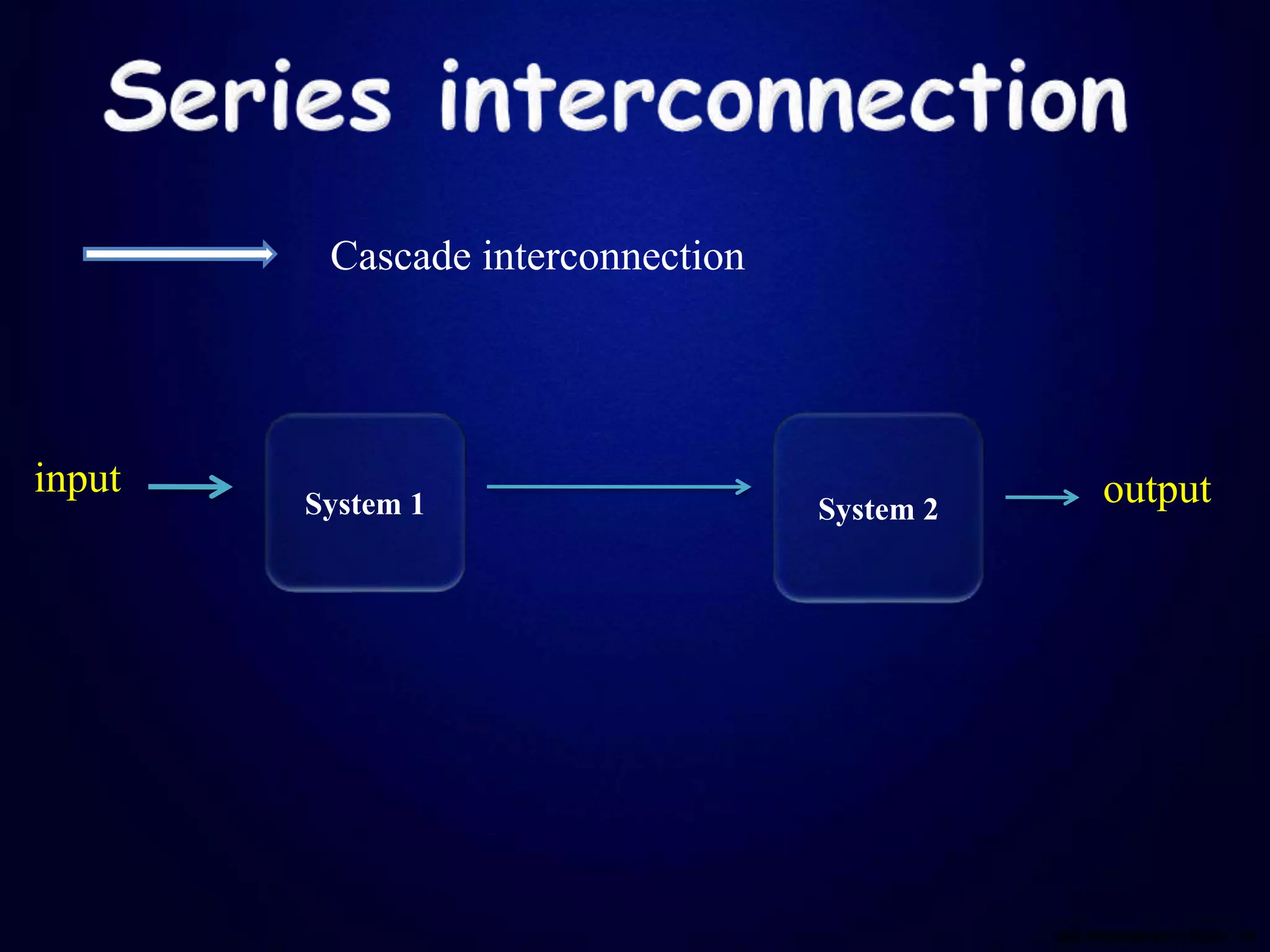
Series
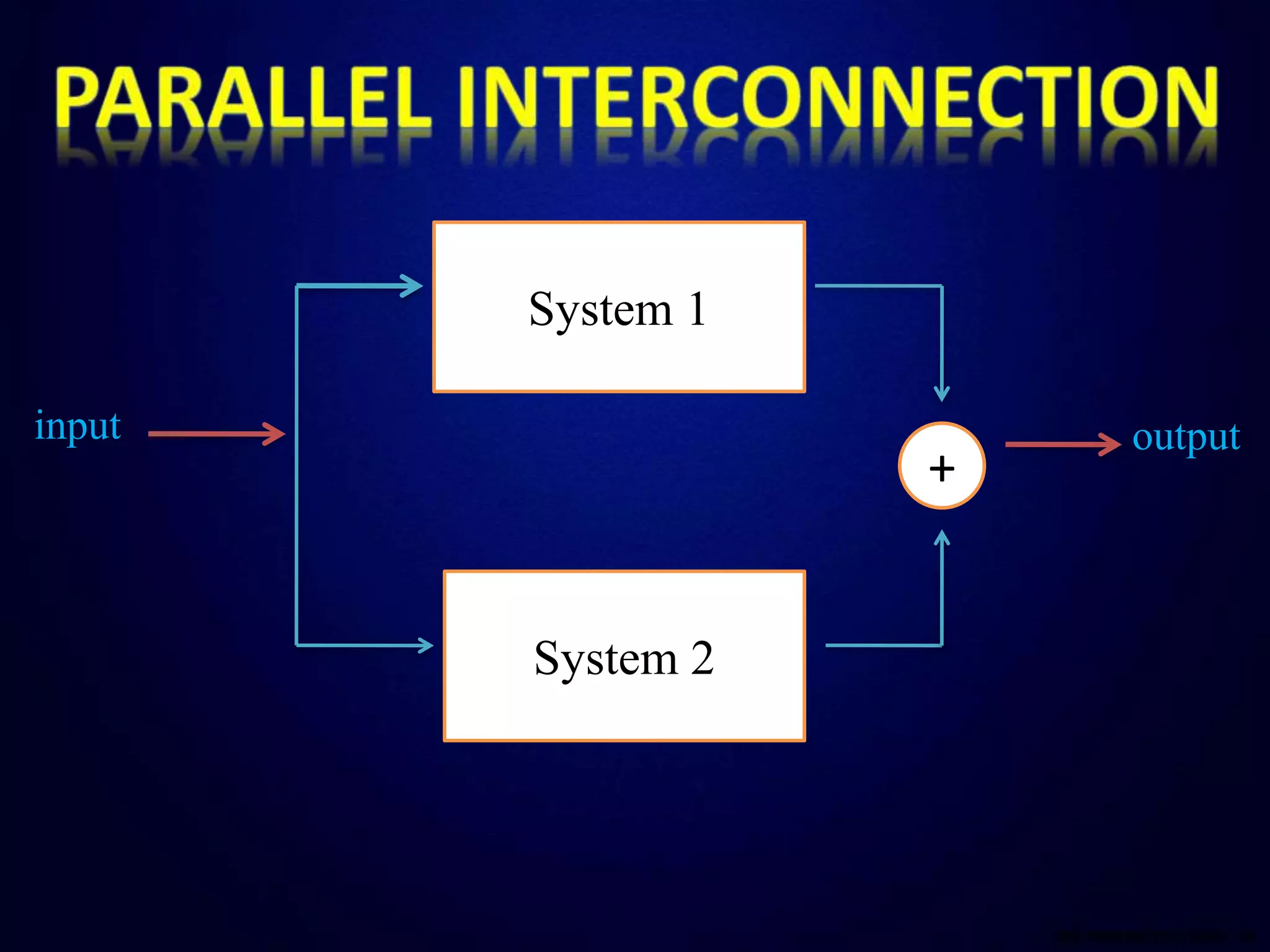
Parallel
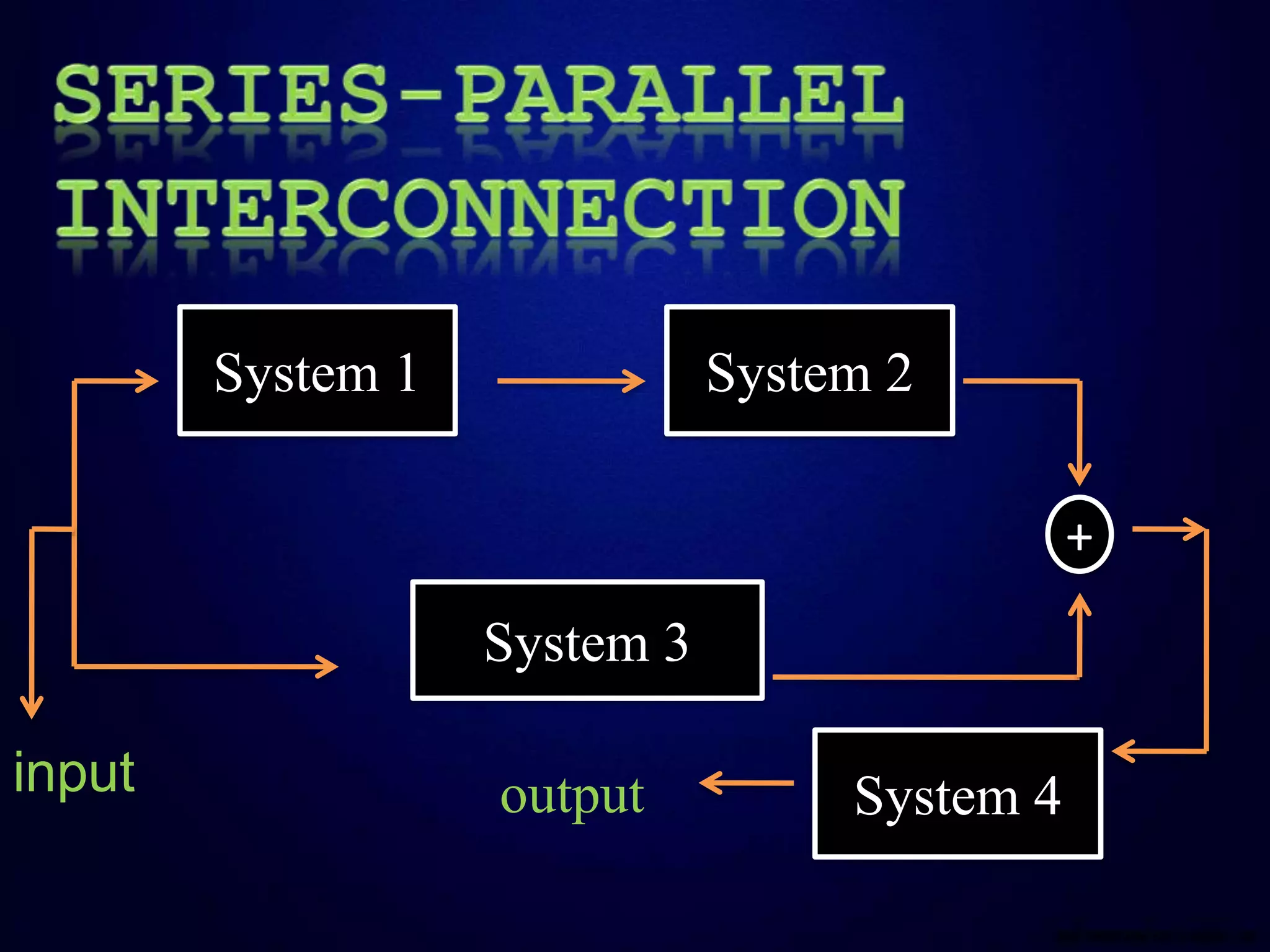
Series-parallel
Basic properties
Systems with and without memory
Invertibility and inverse systems
Causality
Stability
Time invariance
Linearity
Continuous time
system
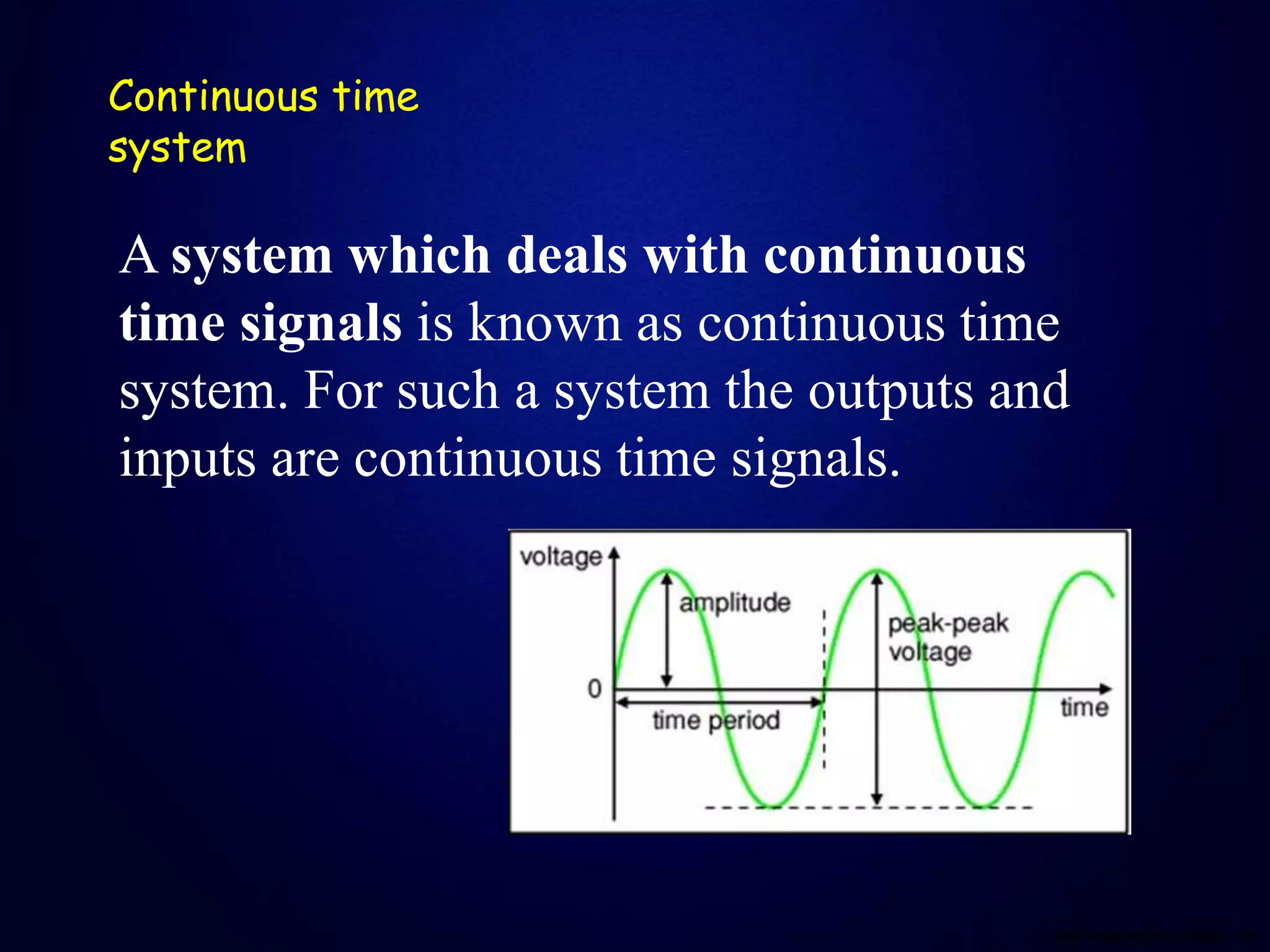
A system which deals with continuous
time signals is known as continuous time
system. For such a system the outputs and
inputs are continuous time signals.
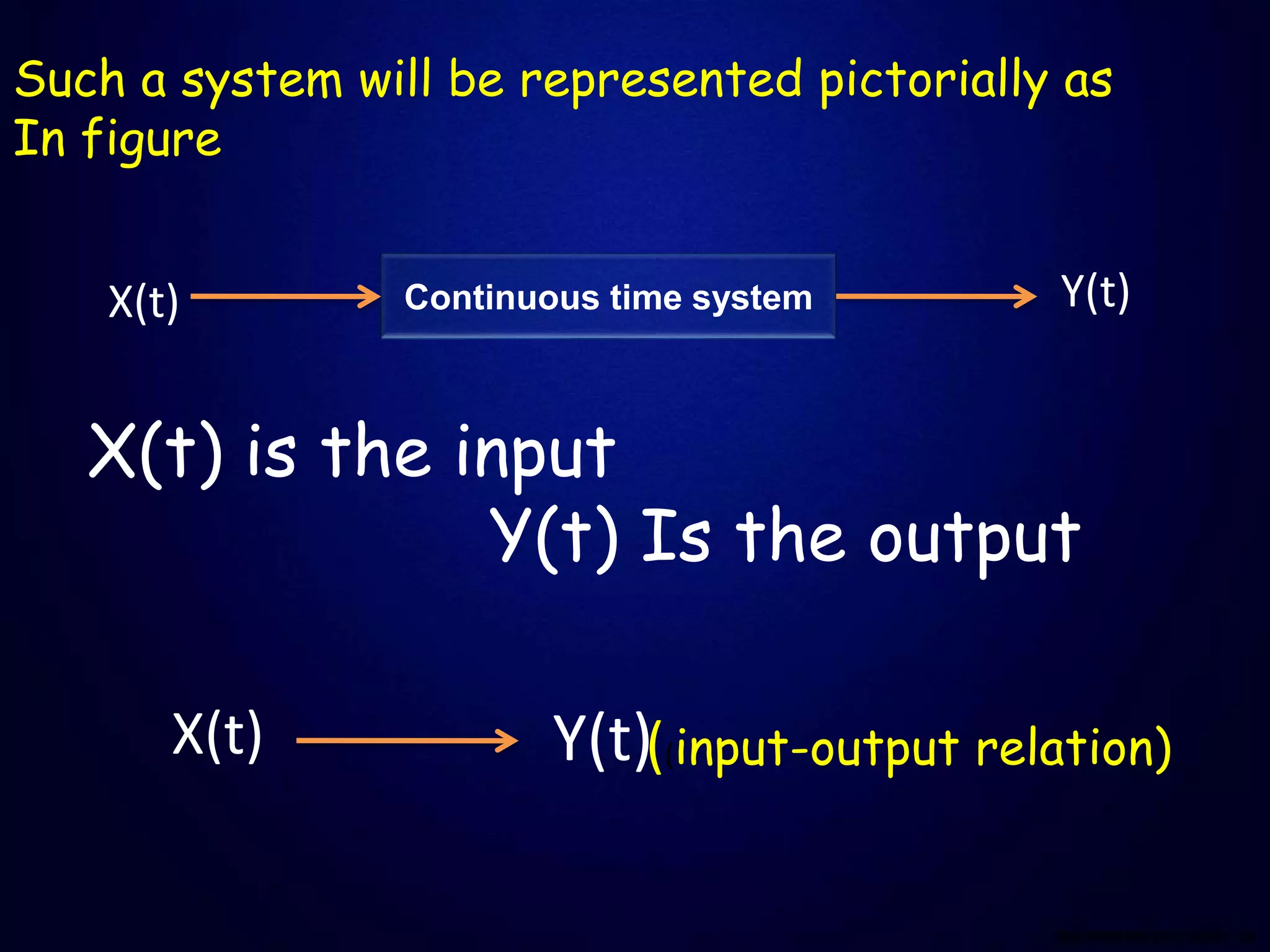
Such a system will be represented pictorially as
In figure
Continuous time systemX(t) Y(t)
X(t) is the input
Y(t) Is the output
X(t) Y(t)((input-output relation)
Discrete time system
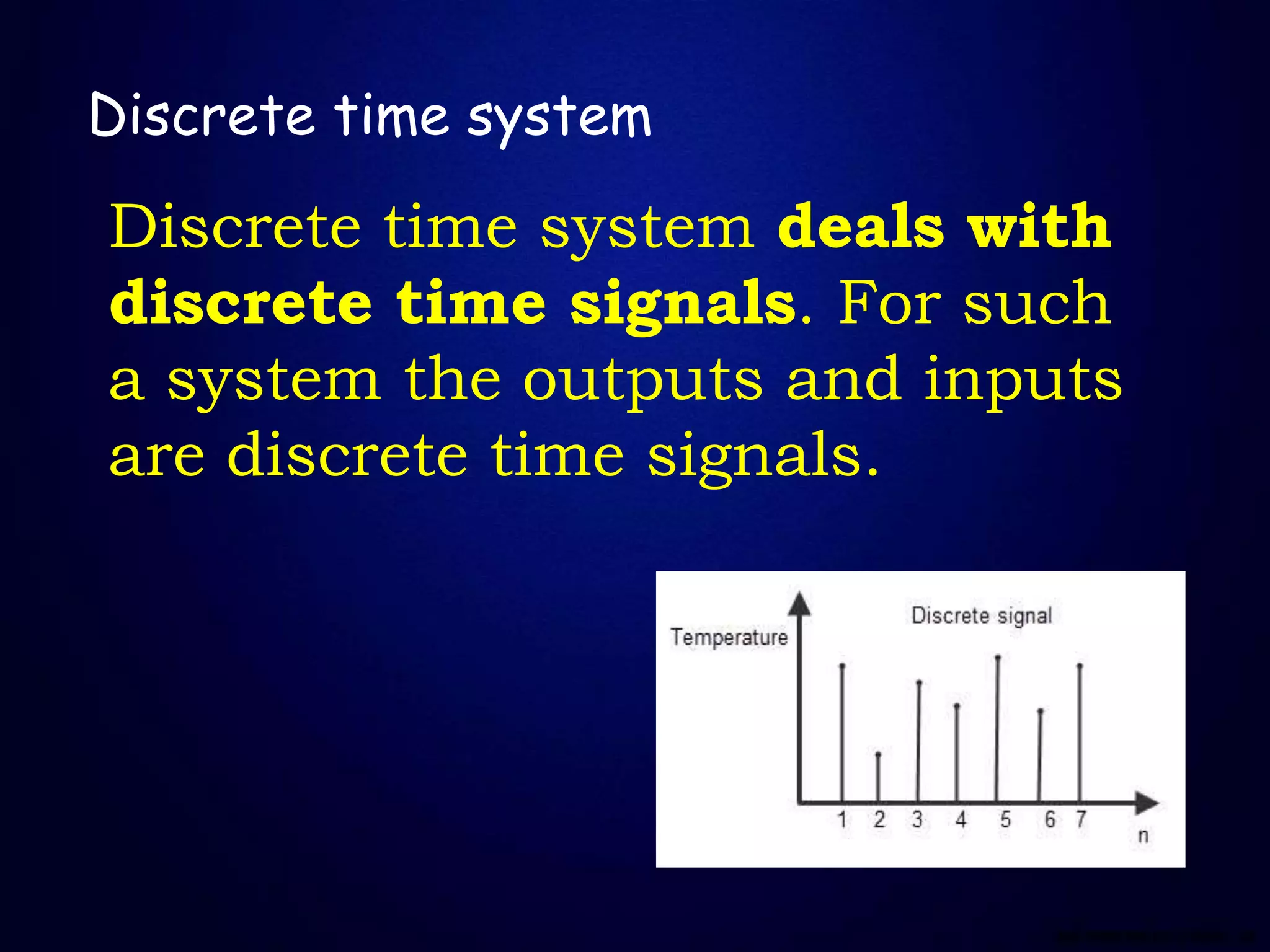
Discrete time system deals with
discrete time signals. For such
a system the outputs and inputs
are discrete time signals.
Discrete time system can be depicted
As shown below
Discrete
time signal
X[n] Y[n]
Sometimes it will symbolically represented as follows
X[n] Y[n]
Interconnections of systems
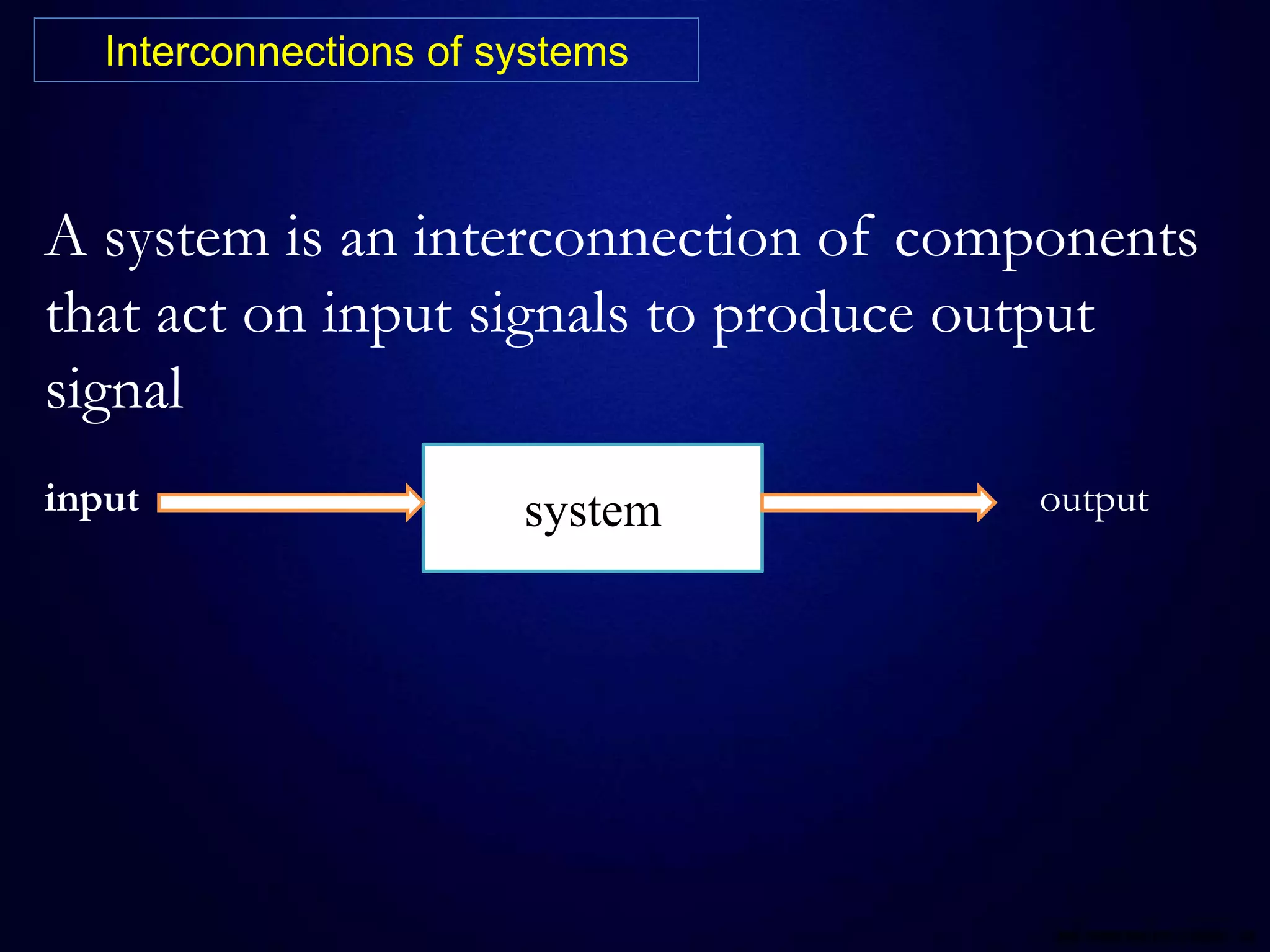
A system is an interconnection of components
that act on input signals to produce output
signal
systeminput output
Cascade interconnection
System 1 System 2
input output
System 1
System 2
+
input output
System 1 System 2
System 3
+
input System 4output
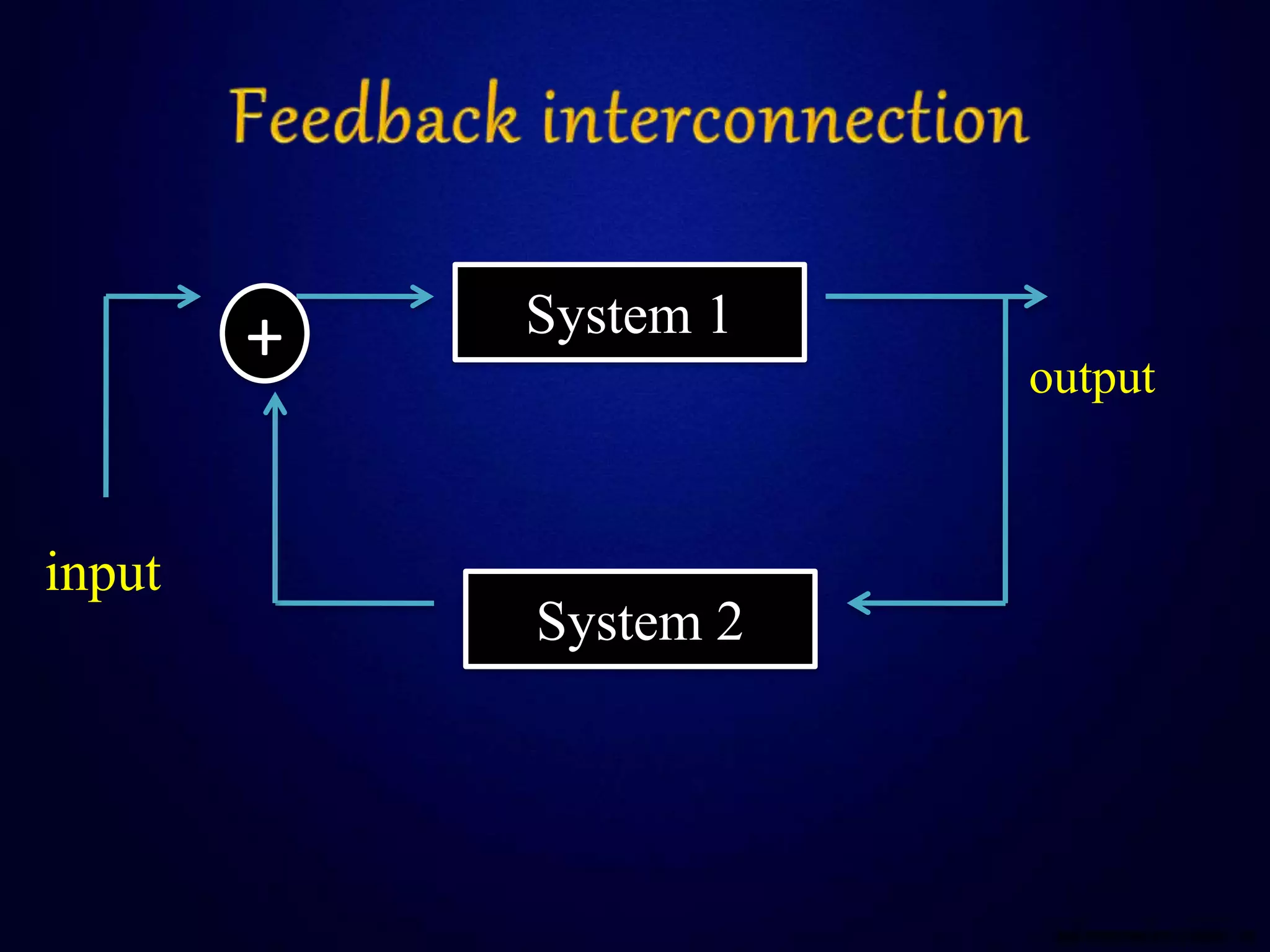
System 1
System 2
+
input
output
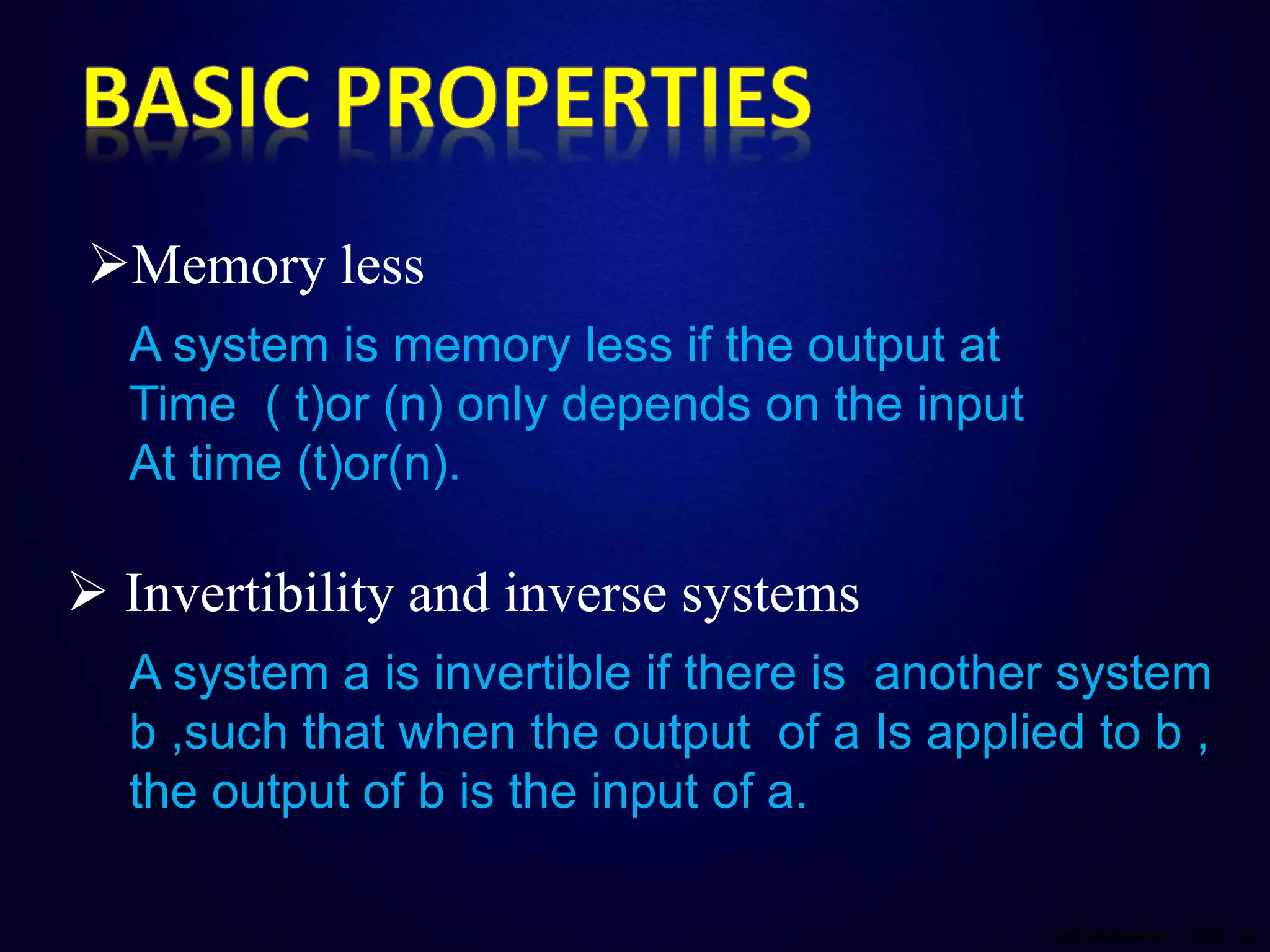
Memory less
A system is memory less if the output at
Time ( t)or (n) only depends on the input
At time (t)or(n).
 Invertibility and inverse systems
A system a is invertible if there is another system
b ,such that when the output of a Is applied to b ,
the output of b is the input of a.
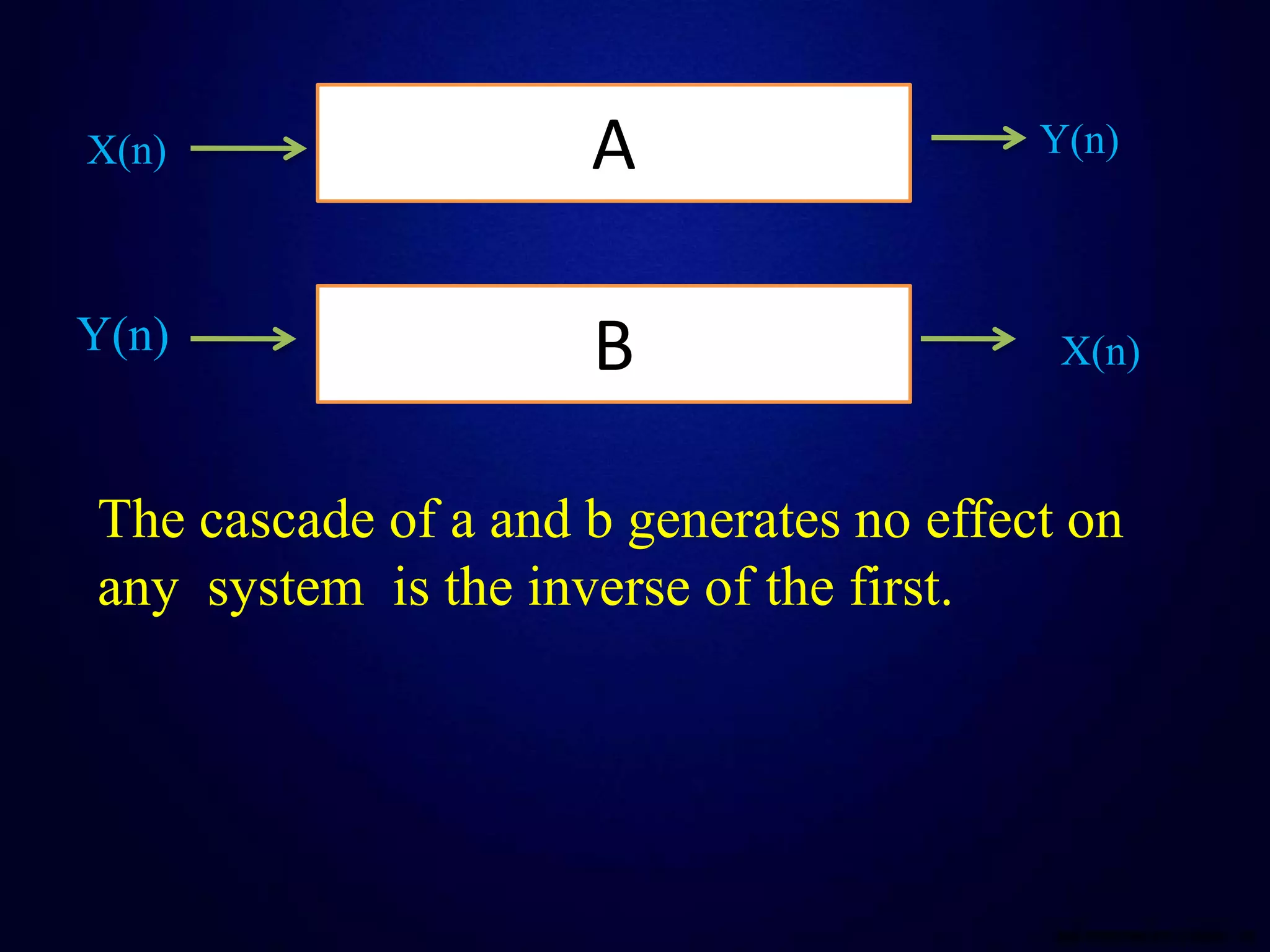
A
B
X(n) Y(n)
Y(n) X(n)
The cascade of a and b generates no effect on
any system is the inverse of the first.
A system is causal if the value of the
output at time t(or n)can be
computed by knowing only all the
values of input up to and including
time t(or n).
stability
A system is stable if up on a small
fluctuation in input , the fluctuations of the
output are bounded. A system is, bounded
input bounded output (BIBO)if and only if
when ever |x[n]|≤B1<∞ for all n , there
existsB2>0such that |y[n]|≤B2<∞for all
n(whereB1andB2are positive numbers).
Time invariance
A system is called time-invariant when
its behavior and characteristics are
fixed over time.More precisely, if
x[n]→y[n](x(t)→y(t))then for any n0(t0),
x[n−n0]→y[n−n0](x(t−t0)→y(t−t0)).A
system that is not time-invariant is
called time-varying.
linearity
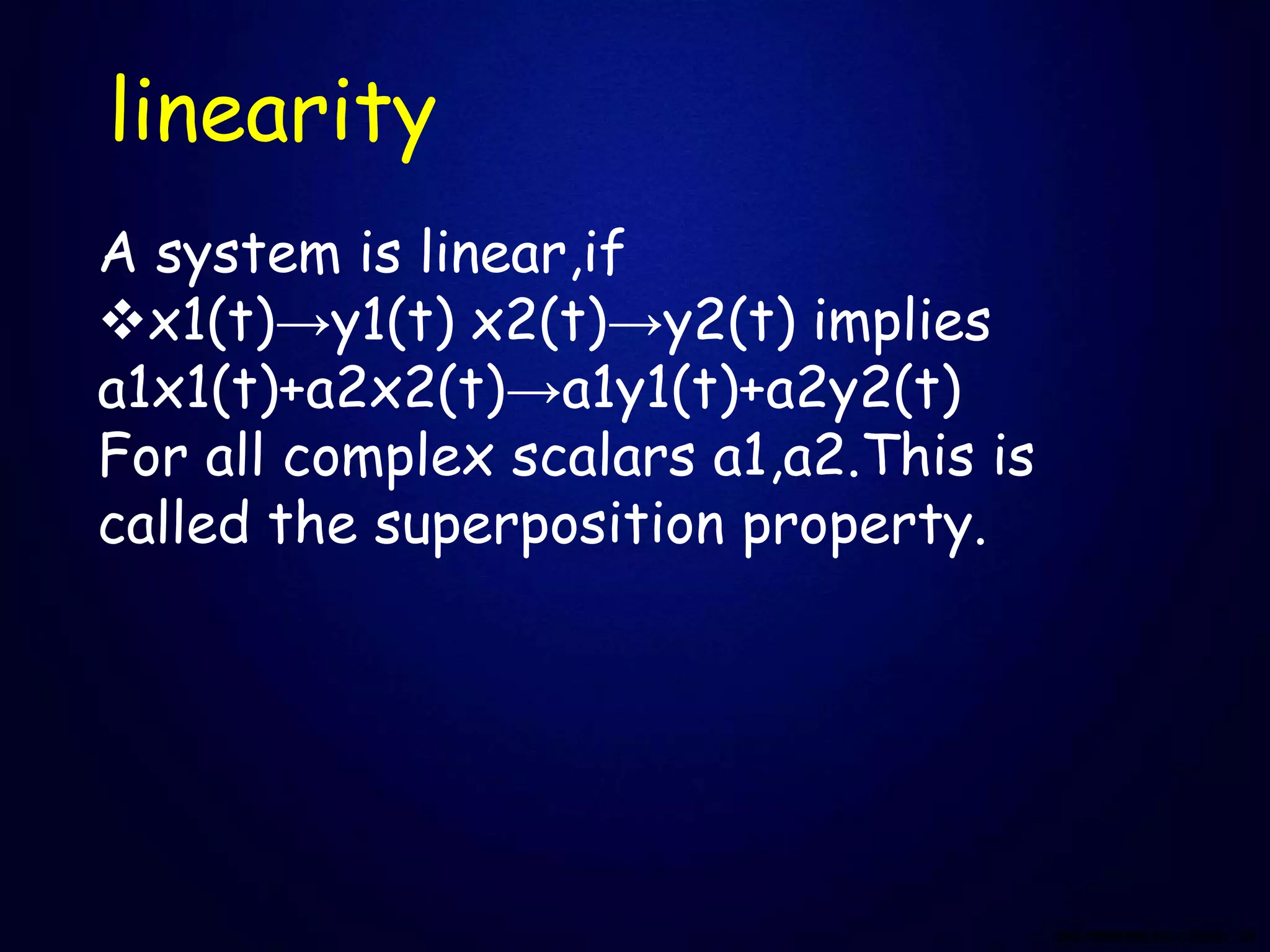
A system is linear,if
x1(t)→y1(t) x2(t)→y2(t) implies
a1x1(t)+a2x2(t)→a1y1(t)+a2y2(t)
For all complex scalars a1,a2.This is
called the superposition property.
conclusion
Discussed basic concepts related to
continuous and discrete time
Signals and systems.
In developing some of the elementary ideas
related to systems , introduced
Block diagrams to facilitate our discussions
concerning the interconnection of systems.
Discussed abut the various properties.
signals and systems

signals and systems

  • 1.
  • 2.
    Contents: Introduction Continuous time system Discretetime system Interconnections Series Parallel Series-parallel Basic properties Systems with and without memory Invertibility and inverse systems Causality Stability Time invariance Linearity
  • 3.
    Continuous time system A systemwhich deals with continuous time signals is known as continuous time system. For such a system the outputs and inputs are continuous time signals.
  • 4.
    Such a systemwill be represented pictorially as In figure Continuous time systemX(t) Y(t) X(t) is the input Y(t) Is the output X(t) Y(t)((input-output relation)
  • 5.
    Discrete time system Discretetime system deals with discrete time signals. For such a system the outputs and inputs are discrete time signals.
  • 6.
    Discrete time systemcan be depicted As shown below Discrete time signal X[n] Y[n] Sometimes it will symbolically represented as follows X[n] Y[n]
  • 7.
    Interconnections of systems Asystem is an interconnection of components that act on input signals to produce output signal systeminput output
  • 8.
    Cascade interconnection System 1System 2 input output
  • 9.
  • 10.
    System 1 System2 System 3 + input System 4output
  • 11.
  • 12.
    Memory less A systemis memory less if the output at Time ( t)or (n) only depends on the input At time (t)or(n).  Invertibility and inverse systems A system a is invertible if there is another system b ,such that when the output of a Is applied to b , the output of b is the input of a.
  • 13.
    A B X(n) Y(n) Y(n) X(n) Thecascade of a and b generates no effect on any system is the inverse of the first.
  • 14.
    A system iscausal if the value of the output at time t(or n)can be computed by knowing only all the values of input up to and including time t(or n).
  • 15.
    stability A system isstable if up on a small fluctuation in input , the fluctuations of the output are bounded. A system is, bounded input bounded output (BIBO)if and only if when ever |x[n]|≤B1<∞ for all n , there existsB2>0such that |y[n]|≤B2<∞for all n(whereB1andB2are positive numbers).
  • 16.
    Time invariance A systemis called time-invariant when its behavior and characteristics are fixed over time.More precisely, if x[n]→y[n](x(t)→y(t))then for any n0(t0), x[n−n0]→y[n−n0](x(t−t0)→y(t−t0)).A system that is not time-invariant is called time-varying.
  • 17.
    linearity A system islinear,if x1(t)→y1(t) x2(t)→y2(t) implies a1x1(t)+a2x2(t)→a1y1(t)+a2y2(t) For all complex scalars a1,a2.This is called the superposition property.
  • 18.
    conclusion Discussed basic conceptsrelated to continuous and discrete time Signals and systems. In developing some of the elementary ideas related to systems , introduced Block diagrams to facilitate our discussions concerning the interconnection of systems. Discussed abut the various properties.