DRM
(DIGITAL RIGHTS MANAGEMENT)
DRM on eBooks
Typically a code
applied to an ebook
in order to control
who can open it, and
how they can use it
Uses of DRM
Retailers use DRM to limit which user account a
downloaded book is linked to

Amazon uses DRM to make sure that you can only
read .mobi files on your Kindle device

Libraries use DRM to limit how many people can
access a book at a time, or how many times it can
be accessed

DRM can also be used to embed the name of the
user in the ebook file
3 Common Types of DRM
Amazon applies its own DRM to Kindle
eBooks, and they completely control the
system

!
Apple applies its FairPlay DRM to all files
purchased from the iBookstore

!
Adobe’s DRM system, called Adobe
Digital Editions Protection Technology
(ADEPT) uses a program called Adobe
Content Server 4 (ACS4) to manage DRM
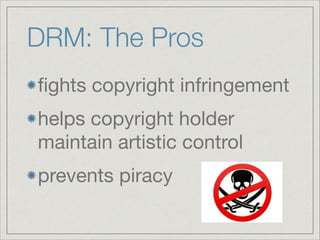
DRM: The Pros
fights copyright infringement

helps copyright holder
maintain artistic control

prevents piracy
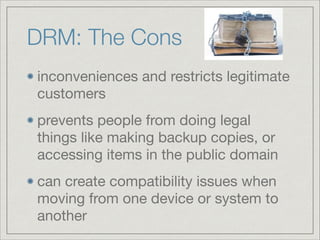
DRM: The Cons
inconveniences and restricts legitimate
customers

prevents people from doing legal
things like making backup copies, or
accessing items in the public domain

can create compatibility issues when
moving from one device or system to
another
THE ANTI-DRM
PHILOSOPHICAL ARGUMENT:
INFORMATION WANTS TO BE FREE
“Piracy is a type of progressive taxation.”
– Tim O’Reilly
O’Reilly’s Argument:
The exposure created by piracy is worth
the few sales points you lose

He compares digital piracy to shoplifting in
bricks-and-mortar stores: an annoying, but
minor inevitable part of doing business

“Free” will eventually be replaced by a
higher quality paid service
Source: http://www.openp2p.com/lpt/a/3015
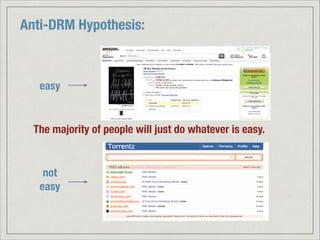
The majority of people will just do whatever is easy.
easy
not
easy
Anti-DRM Hypothesis:
Some DRM-Free
Publishers and Imprints:
Right now, most of the books on
offer in DRM-free format fall into one
of the following genres:
Sci-fi and fantasy (Chizine, tor.com and
Baen)

Romance (Carina Press, Ellora’s Cave,
All Romance Ebooks)

Technology (O’Reilly, Microsoft Press,
Manning)
A THIRD WAY
Social DRM
typically identifies the end consumer in a
visual way, by imprinting or watermarking
the book with the buyer’s name

typically places the customer’s name in a
visible place in the book, and also in a
sneaky, hidden place

allows the retailer/publisher/author to trace
a pirated copy of a book back to the source
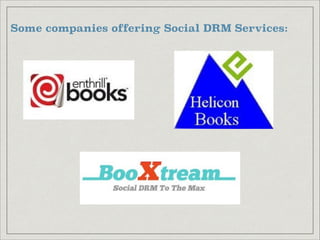
Some companies offering Social DRM Services:
TO DRM, OR NOT TO DRM
Factors to Consider:
Does increasing the digital rights that you grant the
reader increase the perceived value of the book as a
product?

How closely the digital product resembles the physical
one: are you adding value that’s not present in the
hardcover?

Does your target audience care about digital rights?

Is the book easily replicable? What will the quality be
like on a pirated copy?
“The extent to which granting digital
rights affects a seller’s pricing power
is determined by the interplay
between a direct quality effect,
proportional to the increase in the
quality of the legal good, and a
differential piracy effect, proportional
to the increase in the quality of the
pirated good.”
Are Digital Rights Valuable?
Theory and Evidence from Ebook Pricing
CeDER Working Paper No. 06-01
http://papers.ssrn.com/sol3/papers.cfm?abstract_id=871243
Translation:
!
If piracy would cause a degradation in quality,
then you can price the book higher.
!
If it’s relatively easy to duplicate the book at a
comparable quality, then you’ll need to lower
the price.
Right now, the vast majority of trade and
academic titles are being distributed with
DRM encryption. 

!
Aside from the romance, sci-fi/fantasy and
technological markets, the reading population
doesn’t seem to be overly-concerned with the
restrictions imposed by DRM.

!
That could change as ereading habits become
more sophisticated, though.

!
Stay tuned!
Want to talk about whether
you should be applying
DRM on your eBOUND-
distributed ebooks?
Contact Shannon Culver at
shannon_culver@eboundcanada.org

Digital Rights Management for Ebooks

  • 1.
  • 2.
    DRM on eBooks Typicallya code applied to an ebook in order to control who can open it, and how they can use it
  • 3.
    Uses of DRM Retailersuse DRM to limit which user account a downloaded book is linked to Amazon uses DRM to make sure that you can only read .mobi files on your Kindle device Libraries use DRM to limit how many people can access a book at a time, or how many times it can be accessed DRM can also be used to embed the name of the user in the ebook file
  • 4.
    3 Common Typesof DRM Amazon applies its own DRM to Kindle eBooks, and they completely control the system ! Apple applies its FairPlay DRM to all files purchased from the iBookstore ! Adobe’s DRM system, called Adobe Digital Editions Protection Technology (ADEPT) uses a program called Adobe Content Server 4 (ACS4) to manage DRM
  • 5.
    DRM: The Pros fightscopyright infringement helps copyright holder maintain artistic control prevents piracy
  • 6.
    DRM: The Cons inconveniencesand restricts legitimate customers prevents people from doing legal things like making backup copies, or accessing items in the public domain can create compatibility issues when moving from one device or system to another
  • 7.
  • 8.
    “Piracy is atype of progressive taxation.” – Tim O’Reilly
  • 9.
    O’Reilly’s Argument: The exposurecreated by piracy is worth the few sales points you lose He compares digital piracy to shoplifting in bricks-and-mortar stores: an annoying, but minor inevitable part of doing business “Free” will eventually be replaced by a higher quality paid service Source: http://www.openp2p.com/lpt/a/3015
  • 10.
    The majority ofpeople will just do whatever is easy. easy not easy Anti-DRM Hypothesis:
  • 11.
  • 12.
    Right now, mostof the books on offer in DRM-free format fall into one of the following genres: Sci-fi and fantasy (Chizine, tor.com and Baen) Romance (Carina Press, Ellora’s Cave, All Romance Ebooks) Technology (O’Reilly, Microsoft Press, Manning)
  • 13.
  • 14.
    Social DRM typically identifiesthe end consumer in a visual way, by imprinting or watermarking the book with the buyer’s name typically places the customer’s name in a visible place in the book, and also in a sneaky, hidden place allows the retailer/publisher/author to trace a pirated copy of a book back to the source
  • 15.
    Some companies offeringSocial DRM Services:
  • 16.
    TO DRM, ORNOT TO DRM
  • 17.
    Factors to Consider: Doesincreasing the digital rights that you grant the reader increase the perceived value of the book as a product? How closely the digital product resembles the physical one: are you adding value that’s not present in the hardcover? Does your target audience care about digital rights? Is the book easily replicable? What will the quality be like on a pirated copy?
  • 18.
    “The extent towhich granting digital rights affects a seller’s pricing power is determined by the interplay between a direct quality effect, proportional to the increase in the quality of the legal good, and a differential piracy effect, proportional to the increase in the quality of the pirated good.” Are Digital Rights Valuable? Theory and Evidence from Ebook Pricing CeDER Working Paper No. 06-01 http://papers.ssrn.com/sol3/papers.cfm?abstract_id=871243
  • 19.
    Translation: ! If piracy wouldcause a degradation in quality, then you can price the book higher. ! If it’s relatively easy to duplicate the book at a comparable quality, then you’ll need to lower the price.
  • 20.
    Right now, thevast majority of trade and academic titles are being distributed with DRM encryption. ! Aside from the romance, sci-fi/fantasy and technological markets, the reading population doesn’t seem to be overly-concerned with the restrictions imposed by DRM. ! That could change as ereading habits become more sophisticated, though. ! Stay tuned!
  • 21.
    Want to talkabout whether you should be applying DRM on your eBOUND- distributed ebooks? Contact Shannon Culver at shannon_culver@eboundcanada.org