Digital Natives, Digital ImmigrantsMarc PrenskyGroupOne: Adriana Couto - Ana Gabriela - Andressa Gomide - Amanda Antunes - Leonardo Veiga.
Presentation LayoutIntroduction;Digital immigrantsand Digital natives;“What should happen?” and methodology;Examples;Conclusion.
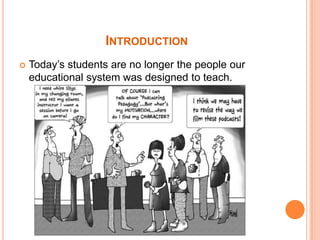
IntroductionToday’sstudents are no longerthepeopleoureducational system wasdesigned to teach.
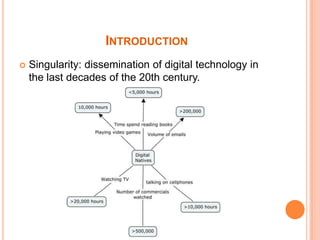
IntroductionSingularity: disseminationof digital technology in thelastdecadesofthe 20th century.
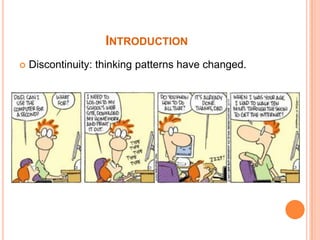
IntroductionDiscontinuity: thinkingpatternshavechanged.
How should we call these “new students” of today ?N-[for Net]-genD-[for Digital]-genDigital Natives X Digital Immigrants
Digital Natives X Digital ImmigrantsAnswer these questions to yourselves:01 – Do you usually turn to the internet for information second rather than first?02 – Do you read the manual for a program rather than assuming that the program itself will teach you how to use it?03 – Do you sometimes print out your email or even a document written on the computer in order to edit it ? 04 – Do you sometimes bring people into your office to see an interesting website ?05- Have you ever phoned someone to ask if they had received your e-mail ?
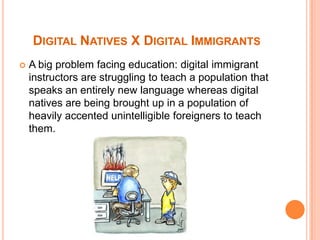
Digital Natives X Digital ImmigrantsA big problem facing education: digital immigrant instructors are struggling to teach a population that speaks an entirely new language whereas digital natives are being brought up in a population of heavily accented unintelligible foreigners to teach them.
Digital Natives are used to receiving information really fast; like parallel process and multi-task; prefer their graphics before their texts; function best when networked; thrive on instant gratification and instant rewards; prefer games to serious work.
Digital Immigrants have very little appreciation for these new skills that natives have acquired through years of interaction and practice; don’t believe their students can learn successfully while watching TV or listening to music; think that learning can’t be fun; assume that the same methods used to teach them in the past will work for their students now. 
whatshouldhappen?Shouldthe Digital Nativestudentslearntheoldways, orshouldtheir Digital Immigranteducatorslearnthenew?Kids Born intoanynewculture, learnthenewlanguageeasily, andforcefullyresistusingtheold.Weneed to reconsiderbothourmethodologyandourcontent.
MethodologyandcontentFirst, ourmethodology. Second, our content . Two kinds: “Legacy” content includes reading, writing , arithmetic, logical thinking, understanding the writings and ideas of the past, etc. – all of our traditional curriculum.“Future” content is to a large extent, not surprisingly, digital and technological. But while it includes software, hardware, robotics, nanotechnology, genomics, etc. it also includes the ethics, politics, sociology, languages and other things that go with them.
MethodologyandcontentAs educators, weneed to bethinkingabouthow to teachboth “Legacy” and “Future” content in the  language of the Digital Natives.Thefirstinvolves a major translationandchangeofmethodology; thesecondinvolvesall that + new content and thinking.
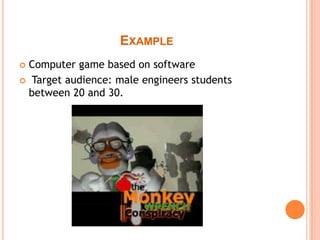
ExampleComputer game basedon softwareTargetaudience: male engineersstudentsbetween 20 and 30.
ExampleThenew digital nativemethodologyAllsubjects in alllevelsIt justdependsonhow it is presented
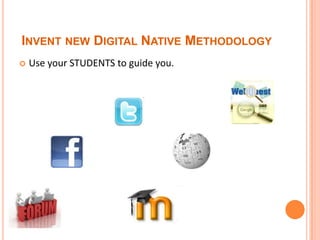
Inventnew Digital NativeMethodologyUse your STUDENTS to guideyou.
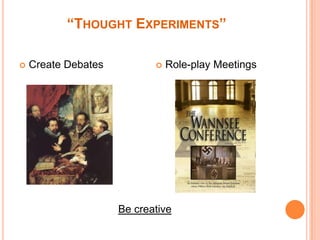
“ThoughtExperiments”Create DebatesRole-play MeetingsBecreative
digital immigrant wayIS NOTthe only way
educators have to CHANGE
Just do it.Andyou WILL succeed.

Digital Natives, Digital Immigrants

  • 1.
    Digital Natives, DigitalImmigrantsMarc PrenskyGroupOne: Adriana Couto - Ana Gabriela - Andressa Gomide - Amanda Antunes - Leonardo Veiga.
  • 2.
    Presentation LayoutIntroduction;Digital immigrantsandDigital natives;“What should happen?” and methodology;Examples;Conclusion.
  • 3.
    IntroductionToday’sstudents are nolongerthepeopleoureducational system wasdesigned to teach.
  • 4.
    IntroductionSingularity: disseminationof digitaltechnology in thelastdecadesofthe 20th century.
  • 5.
  • 6.
    How should wecall these “new students” of today ?N-[for Net]-genD-[for Digital]-genDigital Natives X Digital Immigrants
  • 7.
    Digital Natives XDigital ImmigrantsAnswer these questions to yourselves:01 – Do you usually turn to the internet for information second rather than first?02 – Do you read the manual for a program rather than assuming that the program itself will teach you how to use it?03 – Do you sometimes print out your email or even a document written on the computer in order to edit it ? 04 – Do you sometimes bring people into your office to see an interesting website ?05- Have you ever phoned someone to ask if they had received your e-mail ?
  • 8.
    Digital Natives XDigital ImmigrantsA big problem facing education: digital immigrant instructors are struggling to teach a population that speaks an entirely new language whereas digital natives are being brought up in a population of heavily accented unintelligible foreigners to teach them.
  • 9.
    Digital Natives areused to receiving information really fast; like parallel process and multi-task; prefer their graphics before their texts; function best when networked; thrive on instant gratification and instant rewards; prefer games to serious work.
  • 10.
    Digital Immigrants havevery little appreciation for these new skills that natives have acquired through years of interaction and practice; don’t believe their students can learn successfully while watching TV or listening to music; think that learning can’t be fun; assume that the same methods used to teach them in the past will work for their students now. 
  • 11.
    whatshouldhappen?Shouldthe Digital Nativestudentslearntheoldways,orshouldtheir Digital Immigranteducatorslearnthenew?Kids Born intoanynewculture, learnthenewlanguageeasily, andforcefullyresistusingtheold.Weneed to reconsiderbothourmethodologyandourcontent.
  • 12.
    MethodologyandcontentFirst, ourmethodology. Second,our content . Two kinds: “Legacy” content includes reading, writing , arithmetic, logical thinking, understanding the writings and ideas of the past, etc. – all of our traditional curriculum.“Future” content is to a large extent, not surprisingly, digital and technological. But while it includes software, hardware, robotics, nanotechnology, genomics, etc. it also includes the ethics, politics, sociology, languages and other things that go with them.
  • 13.
    MethodologyandcontentAs educators, weneedto bethinkingabouthow to teachboth “Legacy” and “Future” content in the language of the Digital Natives.Thefirstinvolves a major translationandchangeofmethodology; thesecondinvolvesall that + new content and thinking.
  • 14.
    ExampleComputer game basedonsoftwareTargetaudience: male engineersstudentsbetween 20 and 30.
  • 15.
    ExampleThenew digital nativemethodologyAllsubjectsin alllevelsIt justdependsonhow it is presented
  • 16.
    Inventnew Digital NativeMethodologyUseyour STUDENTS to guideyou.
  • 17.
  • 18.
  • 19.
  • 20.
    Just do it.AndyouWILL succeed.