MODERN
MARKETING
CONCEPTS
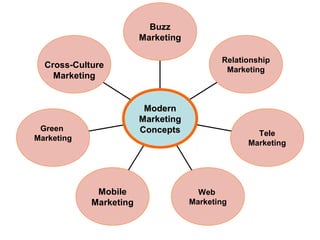
Buzz
Marketing
Relationship
Marketing

Cross-Culture
Marketing

Modern
Marketing
Concepts

Green
Marketing

Mobile
Marketing

Tele
Marketing

Web
Marketing
GREEN MARKETING
Green
or
Environmental
Marketing consists of all
activities designed to generate
and facilitate any exchanges
intended to satisfy human
needs or wants, such that the
satisfaction of these needs and
wants occurs, with minimal
detrimental impact on the
natural environment
GREEN MARKETING
The term Green marketing came into
prominence in the late 1980s and early
1990s.
The American Marketing Association
(AMA) held the first workshop on
"Ecological Marketing" in 1975.The
proceedings of this workshop resulted in
one of the first books on green marketing
entitled "Ecological Marketing".
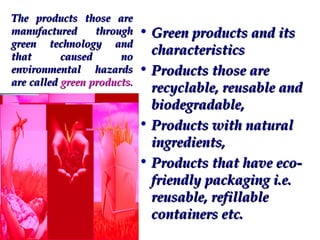
The products those are
manufactured
through
green technology and
that
caused
no
environmental hazards
are called green products.

• Green products and its
characteristics
• Products those are
recyclable, reusable and
biodegradable,
• Products with natural
ingredients,
• Products that have ecofriendly packaging i.e.
reusable, refillable
containers etc.
Digital Tickets by Indian Railways:
Recently IRCTC has allowed its customers to
carry PNR no. of their E-Tickets on their laptop
and mobiles. Customers do not need to carry the
printed version of their ticket anymore.
No Polythene carry bags for free :-Forest &
Environmental Ministry of India has ordered to
retail outlets like BigBazar, D-Mart etc. that
they could provide polythene carry bags to
customers only if customers are ready for pay for
it.
Challenges In Green
Marketing

Need for Standardization
New Concept
Patience and Perseverance
Avoiding Green Myopia
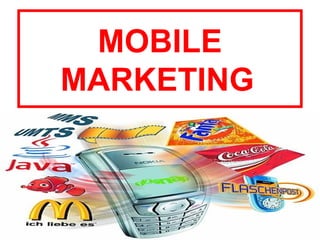
MOBILE
MARKETING
MOBILE MARKETING : Is the use of the
mobile medium as a communications and
entertainment channel between a brand
and an end-user.
Mobile marketing is marketing on or with
a mobile device, such as smart phone
.Mobile marketing can provide customers
with time and location sensitive,
personalized information that promotes
goods, services and ideas. 
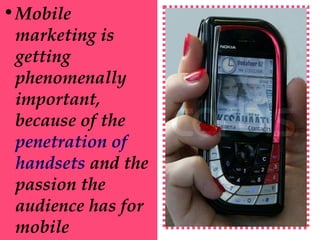
• Mobile
marketing is
getting
phenomenally
important,
because of the
penetration of
handsets and the
passion the
audience has for
mobile
SMS Marketing
Marketing through cell phones' SMS (Short
Message Service)
Became increasingly popular in the early
2000s in Europe and some parts of Asia
when businesses started to collect mobile
phone numbers and send off wanted (or
unwanted) content. On average, SMS
messages are read within four minutes,
making them highly convertible.
MMS Marketing
•

MMS mobile marketing can contain a timed
slideshow of images, text, audio and video. This
mobile content is delivered via MMS (Multimedia
Message Service). Nearly all new phones produced
with a color screen are capable of sending and
receiving standard MMS message.
• Brands are able to both send and receive rich
content through MMS A2P (application-to-person)
mobile networks to mobile subscribers. In some
networks, brands are also able to sponsor
messages that are sent P2P (person-to-person).
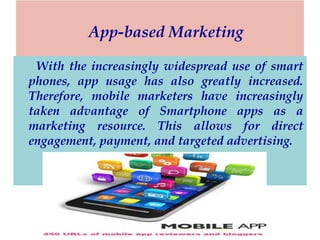
App-based Marketing
With the increasingly widespread use of smart
phones, app usage has also greatly increased.
Therefore, mobile marketers have increasingly
taken advantage of Smartphone apps as a
marketing resource. This allows for direct
engagement, payment, and targeted advertising.
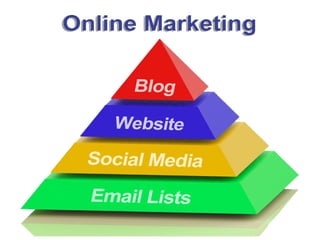
• WEB MARKETING: Encompassing
email marketing, banner advertising,
viral marketing, link exchanges, etc,
internet marketing is a broad field
indeed. Web marketing can be used to
promote brand awareness for brick
and mortar companies, or it can be
used to drive traffic to a web site.

E.g. : Pop-Up On sites
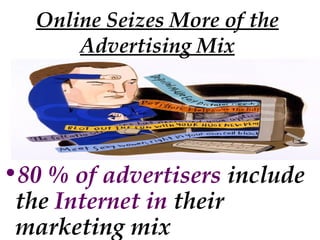
Online Seizes More of the
Advertising Mix

•80 % of advertisers include
the Internet in their
marketing mix
Advantages
• It allows the companies to save money, an aspect
that is really taken into account by the
companies since the online marketing campaigns
don’t require a large amount of investment.
• On the internet everything can be measured, thus
it’s easier for the companies to know almost
instantly if their campaign is working or not,
what company or user is interested in their
products, from what cities or countries are they,
etc.
Advantages
• It allows the companies to save money, an aspect
that is really taken into account by the
companies since the online marketing campaigns
don’t require a large amount of investment.
• On the internet everything can be measured, thus
it’s easier for the companies to know almost
instantly if their campaign is working or not,
what company or user is interested in their
products, from what cities or countries are they,
etc.
Disadvantages
Slow internet connections can cause difficulties.
If the companies build too complex or too large
websites, it will take too long for users to check
them or download them and they will get bored
eventually.
Other disadvantage is the cash on delivery
system, since it doesn’t guarantee the 100%
purchase of the product. This is also the case of
thousands of users that dedicate themselves to
daily mock big companies by ordering on the
internet using false identities.
THE BUZZ
MARKETING
Marketing buzz or simply buzz — a term used in
word-of-mouth marketing — is the interaction of
consumers and users of a product or service which
serves to amplify the original marketing message.
The term "buzz marketing" originally referred to
oral communication but in the age of Web, social
media such as Facebook and Twitter are also being
used to create marketing buzz.
Buzz marketing works because individuals are
easier to trust than organizations that may be
perceived to have vested interests in promoting
their products and/or services.
Examples
• If a celebrity wears a
certain
branded
• Examples of marketing
clothing and attend a
tools include brochures,
public gathering, that
press
releases,
and
will create a buzz
referrals.
among fans of that
particular celebrity
and it will spread
among customers by
word
of
mouth
instantly.
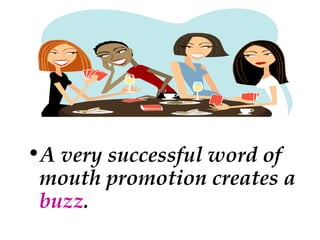
•A very successful word of
mouth promotion creates a
buzz.
advantages
Advantages
• Cost effectiveness
• Speed
• Buzz marketing campaigns are easy to be
set up as it requires less effort such as
initialing the buzz through celerity or
other means.
• It increases the brand awareness and the
reputation of the company quickly.
 
Disadvantages
advantages
• Negative buzz
• Selective attention
• When the company wishes to stop the
buzz campaign it will be impossible to
stop as people will not stop talking about
the products.
• Over buzz created will result in loss of
control where there may be situations
such as stock outs resulting in customer
dissatisfaction 
TELE
MARKETING
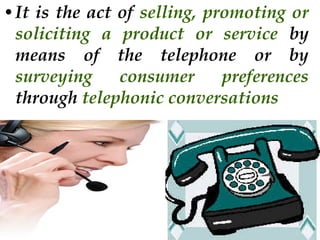
• It is the act of selling, promoting or
soliciting a product or service by
means of the telephone or by
surveying
consumer
preferences
through telephonic conversations
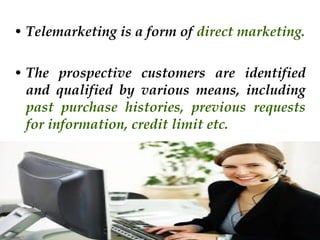
• Telemarketing is a form of direct marketing.
• The prospective customers are identified
and qualified by various means, including
past purchase histories, previous requests
for information, credit limit etc.
• The most importantly used subcategories
of telemarketing today are the Outbound
and the inbound telemarketing.
• Outbound is the proactive marketing in
which the customers either who exist
already or the prospective ones are all
contacted directly for the purpose of the
marketing
Advantages
• provide a more interactive and personal sale
service
• create an immediate rapport with your customers
• explain technical issues more clearly
• generate leads and appointments
• sell from a distance to increase your sales
territory
• reach more customers than with in-person sales
calls
• sell to both existing and new customers
• achieve results that are measurable
Disadvantages
• telemarketing can be resented - particularly when
dealing with business-to-consumer customers.
• customer lists may not always be clean and
opted-out - this leaves you with a potential risk
of breaking the law
• telemarketing has a negative image that could
damage your business' reputation - if carried out
poorly
• telemarketing has the potential to replace a sales
team and this could lead to negative feelings
among employees
• training staff can be time-consuming and costly
RELATIONSHIP
MARKETING
Relationship marketing is a marketing
strategy in which a company seeks to build
long-term relationships with its customers
by providing consistent satisfaction.
Relationship marketing is designed to
develop strong connections with customers
by providing them with information
directly suited to their needs and interests
and by promoting open communication.
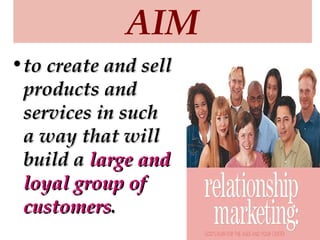
AIM
•to create and sell
products and
services in such
a way that will
build a large and
loyal group of
customers.
•

Relationship marketing is the process of
attracting, maintaining, and enhancing
relationships with key people
Relationship Marketing approach
•
achieves very high customer satisfaction
and is highly profitable
Relationship Mktg.,
is based on the
philosophy
that
customers are longterm assets that
must be valued.
•Profitability
comes
from
making existing customers
happy, so they become loyal
repeat customers.
•Profitability also comes from
identifying
your
most
profitable
customers
and
having the courage to focus
your efforts on them
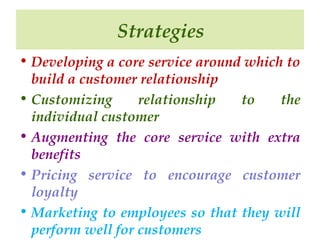
Strategies
• Developing a core service around which to
build a customer relationship
• Customizing
relationship
to
the
individual customer
• Augmenting the core service with extra
benefits
• Pricing service to encourage customer
loyalty
• Marketing to employees so that they will
perform well for customers
CROSS
CULTURAL
MARKETING
Cross-cultural marketing is defined as the
strategic process of marketing among
consumers whose culture differs from that
of the marketer's own culture at least in
one of the fundamental cultural aspects,
such as language, religion, social norms
and values, education, and the living
style.
Some Real World Examples for
Cross-cultural Marketing
1. Product
Pizza Hut and Domino’s in India
• 1992: Paneer on a pizza!
• 1997: Paneer on a pizza?
• 2002: Paneer on a pizza.
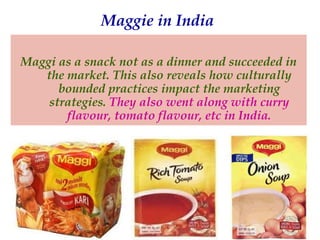
Maggie in India
Maggi as a snack not as a dinner and succeeded in
the market. This also reveals how culturally
bounded practices impact the marketing
strategies. They also went along with curry
flavour, tomato flavour, etc in India.
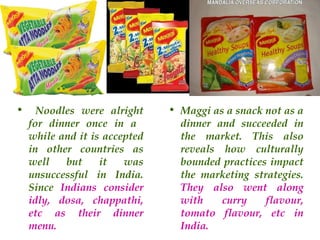
•

Noodles were alright
for dinner once in a
while and it is accepted
in other countries as
well
but
it
was
unsuccessful in India.
Since Indians consider
idly, dosa, chappathi,
etc as their dinner
menu.

• Maggi as a snack not as a
dinner and succeeded in
the market. This also
reveals how culturally
bounded practices impact
the marketing strategies.
They also went along
with
curry
flavour,
tomato flavour, etc in
India.
KFC and McDonalds in Sri Lanka
MNCs like KFC and McDonald are giving their
primary concern to the price they charge from
Sri Lankans since people in Sri Lanka are more
conscious about the prices of product than the
quality. Even the displays they use to show
their products, specifically display the price of
each product. This proves that these MNCs are
amending their marketing strategies regarding
price to suit Sri Lankan market.
Modern marketing concepts

Modern marketing concepts

  • 1.
  • 2.
  • 3.
    GREEN MARKETING Green or Environmental Marketing consistsof all activities designed to generate and facilitate any exchanges intended to satisfy human needs or wants, such that the satisfaction of these needs and wants occurs, with minimal detrimental impact on the natural environment
  • 4.
    GREEN MARKETING The termGreen marketing came into prominence in the late 1980s and early 1990s. The American Marketing Association (AMA) held the first workshop on "Ecological Marketing" in 1975.The proceedings of this workshop resulted in one of the first books on green marketing entitled "Ecological Marketing".
  • 5.
    The products thoseare manufactured through green technology and that caused no environmental hazards are called green products. • Green products and its characteristics • Products those are recyclable, reusable and biodegradable, • Products with natural ingredients, • Products that have ecofriendly packaging i.e. reusable, refillable containers etc.
  • 6.
    Digital Tickets byIndian Railways: Recently IRCTC has allowed its customers to carry PNR no. of their E-Tickets on their laptop and mobiles. Customers do not need to carry the printed version of their ticket anymore. No Polythene carry bags for free :-Forest & Environmental Ministry of India has ordered to retail outlets like BigBazar, D-Mart etc. that they could provide polythene carry bags to customers only if customers are ready for pay for it.
  • 7.
    Challenges In Green Marketing Needfor Standardization New Concept Patience and Perseverance Avoiding Green Myopia
  • 8.
  • 9.
    MOBILE MARKETING :Is the use of the mobile medium as a communications and entertainment channel between a brand and an end-user. Mobile marketing is marketing on or with a mobile device, such as smart phone .Mobile marketing can provide customers with time and location sensitive, personalized information that promotes goods, services and ideas. 
  • 10.
    • Mobile marketing is getting phenomenally important, becauseof the penetration of handsets and the passion the audience has for mobile
  • 11.
    SMS Marketing Marketing throughcell phones' SMS (Short Message Service) Became increasingly popular in the early 2000s in Europe and some parts of Asia when businesses started to collect mobile phone numbers and send off wanted (or unwanted) content. On average, SMS messages are read within four minutes, making them highly convertible.
  • 12.
    MMS Marketing • MMS mobilemarketing can contain a timed slideshow of images, text, audio and video. This mobile content is delivered via MMS (Multimedia Message Service). Nearly all new phones produced with a color screen are capable of sending and receiving standard MMS message. • Brands are able to both send and receive rich content through MMS A2P (application-to-person) mobile networks to mobile subscribers. In some networks, brands are also able to sponsor messages that are sent P2P (person-to-person).
  • 13.
    App-based Marketing With theincreasingly widespread use of smart phones, app usage has also greatly increased. Therefore, mobile marketers have increasingly taken advantage of Smartphone apps as a marketing resource. This allows for direct engagement, payment, and targeted advertising.
  • 15.
    • WEB MARKETING:Encompassing email marketing, banner advertising, viral marketing, link exchanges, etc, internet marketing is a broad field indeed. Web marketing can be used to promote brand awareness for brick and mortar companies, or it can be used to drive traffic to a web site. E.g. : Pop-Up On sites
  • 16.
    Online Seizes Moreof the Advertising Mix •80 % of advertisers include the Internet in their marketing mix
  • 17.
    Advantages • It allowsthe companies to save money, an aspect that is really taken into account by the companies since the online marketing campaigns don’t require a large amount of investment. • On the internet everything can be measured, thus it’s easier for the companies to know almost instantly if their campaign is working or not, what company or user is interested in their products, from what cities or countries are they, etc.
  • 18.
    Advantages • It allowsthe companies to save money, an aspect that is really taken into account by the companies since the online marketing campaigns don’t require a large amount of investment. • On the internet everything can be measured, thus it’s easier for the companies to know almost instantly if their campaign is working or not, what company or user is interested in their products, from what cities or countries are they, etc.
  • 19.
    Disadvantages Slow internet connectionscan cause difficulties. If the companies build too complex or too large websites, it will take too long for users to check them or download them and they will get bored eventually. Other disadvantage is the cash on delivery system, since it doesn’t guarantee the 100% purchase of the product. This is also the case of thousands of users that dedicate themselves to daily mock big companies by ordering on the internet using false identities.
  • 20.
  • 21.
    Marketing buzz orsimply buzz — a term used in word-of-mouth marketing — is the interaction of consumers and users of a product or service which serves to amplify the original marketing message. The term "buzz marketing" originally referred to oral communication but in the age of Web, social media such as Facebook and Twitter are also being used to create marketing buzz. Buzz marketing works because individuals are easier to trust than organizations that may be perceived to have vested interests in promoting their products and/or services.
  • 22.
    Examples • If acelebrity wears a certain branded • Examples of marketing clothing and attend a tools include brochures, public gathering, that press releases, and will create a buzz referrals. among fans of that particular celebrity and it will spread among customers by word of mouth instantly.
  • 23.
    •A very successfulword of mouth promotion creates a buzz.
  • 24.
    advantages Advantages • Cost effectiveness •Speed • Buzz marketing campaigns are easy to be set up as it requires less effort such as initialing the buzz through celerity or other means. • It increases the brand awareness and the reputation of the company quickly.  
  • 25.
    Disadvantages advantages • Negative buzz •Selective attention • When the company wishes to stop the buzz campaign it will be impossible to stop as people will not stop talking about the products. • Over buzz created will result in loss of control where there may be situations such as stock outs resulting in customer dissatisfaction 
  • 26.
  • 27.
    • It isthe act of selling, promoting or soliciting a product or service by means of the telephone or by surveying consumer preferences through telephonic conversations
  • 28.
    • Telemarketing isa form of direct marketing. • The prospective customers are identified and qualified by various means, including past purchase histories, previous requests for information, credit limit etc.
  • 29.
    • The mostimportantly used subcategories of telemarketing today are the Outbound and the inbound telemarketing. • Outbound is the proactive marketing in which the customers either who exist already or the prospective ones are all contacted directly for the purpose of the marketing
  • 30.
    Advantages • provide amore interactive and personal sale service • create an immediate rapport with your customers • explain technical issues more clearly • generate leads and appointments • sell from a distance to increase your sales territory • reach more customers than with in-person sales calls • sell to both existing and new customers • achieve results that are measurable
  • 31.
    Disadvantages • telemarketing canbe resented - particularly when dealing with business-to-consumer customers. • customer lists may not always be clean and opted-out - this leaves you with a potential risk of breaking the law • telemarketing has a negative image that could damage your business' reputation - if carried out poorly • telemarketing has the potential to replace a sales team and this could lead to negative feelings among employees • training staff can be time-consuming and costly
  • 32.
  • 33.
    Relationship marketing isa marketing strategy in which a company seeks to build long-term relationships with its customers by providing consistent satisfaction. Relationship marketing is designed to develop strong connections with customers by providing them with information directly suited to their needs and interests and by promoting open communication.
  • 34.
    AIM •to create andsell products and services in such a way that will build a large and loyal group of customers.
  • 35.
    • Relationship marketing isthe process of attracting, maintaining, and enhancing relationships with key people Relationship Marketing approach • achieves very high customer satisfaction and is highly profitable
  • 36.
    Relationship Mktg., is basedon the philosophy that customers are longterm assets that must be valued.
  • 37.
    •Profitability comes from making existing customers happy,so they become loyal repeat customers. •Profitability also comes from identifying your most profitable customers and having the courage to focus your efforts on them
  • 38.
    Strategies • Developing acore service around which to build a customer relationship • Customizing relationship to the individual customer • Augmenting the core service with extra benefits • Pricing service to encourage customer loyalty • Marketing to employees so that they will perform well for customers
  • 39.
  • 40.
    Cross-cultural marketing isdefined as the strategic process of marketing among consumers whose culture differs from that of the marketer's own culture at least in one of the fundamental cultural aspects, such as language, religion, social norms and values, education, and the living style.
  • 41.
    Some Real WorldExamples for Cross-cultural Marketing 1. Product Pizza Hut and Domino’s in India • 1992: Paneer on a pizza! • 1997: Paneer on a pizza? • 2002: Paneer on a pizza.
  • 42.
    Maggie in India Maggias a snack not as a dinner and succeeded in the market. This also reveals how culturally bounded practices impact the marketing strategies. They also went along with curry flavour, tomato flavour, etc in India.
  • 43.
    • Noodles were alright fordinner once in a while and it is accepted in other countries as well but it was unsuccessful in India. Since Indians consider idly, dosa, chappathi, etc as their dinner menu. • Maggi as a snack not as a dinner and succeeded in the market. This also reveals how culturally bounded practices impact the marketing strategies. They also went along with curry flavour, tomato flavour, etc in India.
  • 44.
    KFC and McDonaldsin Sri Lanka MNCs like KFC and McDonald are giving their primary concern to the price they charge from Sri Lankans since people in Sri Lanka are more conscious about the prices of product than the quality. Even the displays they use to show their products, specifically display the price of each product. This proves that these MNCs are amending their marketing strategies regarding price to suit Sri Lankan market.