
CUSTOMER RETENTION
&
RELATIONSHIP MARKETING
PRESENTED BY
SHUBHAM AHIRWAR
(Y151805335)
DR. HARISINGH GOUR CENTRAL UNIVERSITY, SAGAR
DEPARTMENT OF BUSINESS MANAGEMENT
Customer
Retention
Customer Retention
● Customer retention is the ability of a business to retain
customers. It is both a measure of customer loyalty and the
capacity of the business to keep customers satisfied by good
service and quality of the product sold.
● The best customer for any business is the returning one. It
shows that the customer is happy with both the service and
the product but there are other benefits too.
● A returning customer is cheaper to the business, as they will
need to spend less on advertising or inducements such as
price cutting and giveaways.
● A happy customer will also tell other potential customers of
a product and service; doing a job of marketing for the store.
Benefits of Customer Retention
● Improved Customer Lifetime Value (CLV)
● Earn more word of mouth referrals
● Engaged customers provide more feedback
● Customers will explore your brand
● Customers will welcome your marketing
● Loyal customers are more forgiving
● Loyal customers are more profitable
● Brand will stand out from the crowd
● Reviews and Ratings
● Recommendations
Customer Retention Strategies
● Set customer expectations:
Set customer expectations early and a little lower than you can
provide to eliminate uncertainty about the level of your service
and ensure you always deliver on your promises.
● Use social media to build relationships:
Use LinkedIn, Twitter, and Facebook to connect and
communicate with customers and give them a space for sharing
experiences with your company, so they can become brand
ambassadors.
● Make it personal:
Personalized service improves customer experience and is
something customers are expecting and demanding. Make their
experience personal to strengthen the bond with your brand.
Cont……
● Become the customers’ trusted advisor:
You need to be the expert in your particular field, so that you
can gain customers’ trust and build customer loyalty.
● Use relationships to build trust:
Build relationships with customers in a way that fosters trust.
Do this through shared values and fostering customer
relationships.
● Take a proactive approach to customer service:
Implement anticipatory service so that you can eliminate
problems before they occur.
● Go the extra mile:
Going above and beyond will build strong relationships with
customers and build long-term loyalty by paying attention to
their needs and issues.
Ways to Increase Customer Retention
● Selling Quality Product
● Selling Quality Product at Reasonable Price
● Provide Good Customer Service
● Making a Store Easy to Navigate
● Keeping your VIP customers
● Target customers with Special Offers
● Rewarding your most profitable customers
● Personalizing your follow-ups
● Scheduling time with your customers
Relationship
Marketing
Relationship Marketing
● Relationship marketing is strategy that emphasizes customer
retention, satisfaction, and lifetime customer value.
● Relationship marketing can be defined as marketing to
current customers vs. new customer acquisition through
sales and advertising.
● The goal of relationship marketing (or customer relationship
marketing) is to create strong, even emotional, customer
connections to a brand that can lead to ongoing business,
free word-of-mouth promotion and information from
customers that can generate leads.
Elements of Relationship Marketing
● Gather information about their customers
● Monitor interactions with customers
● Use customers’ preferences and knowledge
● Analyze the data and use it to modify the marketing mix
Firms build long-term relationships in four ways:
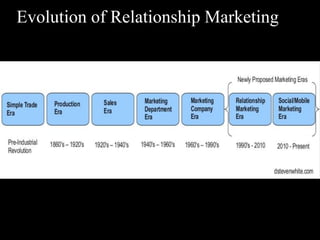
Evolution of Relationship Marketing
The old days
● Back in the day, businesses didn't need to develop relationships
with their customers in order to keep their business afloat; they
simply needed to have the largest, boldest ad in the yellow pages.
● Whilst this is a broad over-simplification, there was no
information superhighway in the 20th century. Consumers
fulfilled their needs using businesses they found in the phone
book, on the radio, or through a commercial on television.
Because channels of communication were so sparse, marketers
were able to simply talk at consumers.
● Furthermore, marketers were able to retain a very large amount
of control over what information consumers had about their
brands.
Cont……
Cont……
Early 2000s (Internet 2.0)
● In the early 2000s, a shift took place in the marketing landscape -
the voice of the customer became more important than ever
before, and word of mouth marketing became the de facto king
of marketing methods.
Now what?
● Relationship marketing now means that businesses must engage
with customers and offer meaningful, useful (not to mention
authentic!) information or be left behind - customers no longer
want to be talked at or marketing to. Instead, savvy marketers
must understand that businesses no longer control the
conversation surrounding their brand.
● Customers hold the reins, and brands can't wait another minute to
begin building real relationships and entering into the
conversation when and where the customer demands it.
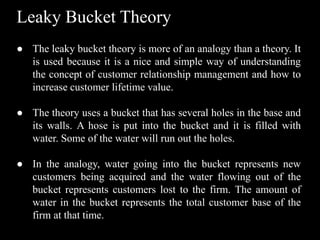
Levels of Relationship Marketing
● Basic Marketing:
The marketer simply sells the product without call backs or feed-
back from the customers. Here, there is no effort to build the
relationship.
● Reactive Marketing:
After selling the product, the marketer encourages customers to
report their comments, complaints, and suggestions. Here, there
is some effort to build the relationship.
● Accountable Marketing:
After selling the product, the marketer calls back the customer
after a short time to find out if the customer is satisfied or not.
Here, there is increased level of effort in building the
relationship.
Cont……
● Proactive Marketing:
After selling the product, the marketer remains in regular contact
with the customer and provide suggestions for better use of the
product, servicing, and repairs. The marketer also informs the
customer about the firm's new products, improved quality and
services. Here, the marketer is working harder to enhance the
level of relationship.
● Partnership Marketing:
Under partnership marketing, the marketer continuously works
with its customers and other stakeholders for mutual benefits.
Here, the marketer works jointly with the customer to find ways
and means to help customer perform better, effect savings, and
increase the level of satisfaction. Thus, partnership marketing is
the best form of relationship marketing.
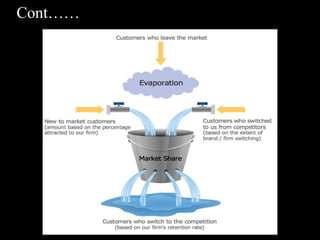
Leaky Bucket Theory
● The leaky bucket theory is more of an analogy than a theory. It
is used because it is a nice and simple way of understanding
the concept of customer relationship management and how to
increase customer lifetime value.
● The theory uses a bucket that has several holes in the base and
its walls. A hose is put into the bucket and it is filled with
water. Some of the water will run out the holes.
● In the analogy, water going into the bucket represents new
customers being acquired and the water flowing out of the
bucket represents customers lost to the firm. The amount of
water in the bucket represents the total customer base of the
firm at that time.
Cont……
Reference
● Business Encycolopidia. (2013, Mar 16) Retrieved Oct 08, 2017, from
www.shopify.com: https://www.shopify.com/encyclopedia/customer-retention
● Business Marketing. (2014, Fab 02). Retrieved Oct 08, 2017, from
marketinglord.blogspot.in: https://marketinglord.blogspot.in/2014/02/levels-
of-relationship-marketing.html
● Carter, B. (2013, Jun 13). The Top Ten Benefits of Customer Retention.
Retrieved Oct 08, 2017, from blog.accessdevelopment.com:
https://blog.accessdevelopment.com/the-top-ten-benefits-of-customer-
retention
● Ciotti, G. (2016, July 11). The Business Case for Building Real Relationships
with Customers. Retrieved Oct 08, 2017, from www.helpscout.net:
https://www.helpscout.net/blog/relationship-marketing/
● Kulbyte, T. (2017, Aug 02). 5 Unique Ways to Increase Customer Retention.
Retrieved Oct 08, 2017, from www.superoffice.com:
https://www.superoffice.com/blog/customer-retention-tips-with-crm-
software/
● Garst, K. (2016, July 18). 5 Reasons Why Relationship Marketing is
Important in Business. Retrieved Oct 08, 2017, from kimgarst.com:
https://kimgarst.com/5-reasons-why-relationship-marketing-is-important-in-
business
Cont……
Thank You !

Customer retention and relationship marketing

  • 1.
    CUSTOMER RETENTION & RELATIONSHIP MARKETING PRESENTEDBY SHUBHAM AHIRWAR (Y151805335) DR. HARISINGH GOUR CENTRAL UNIVERSITY, SAGAR DEPARTMENT OF BUSINESS MANAGEMENT
  • 2.
  • 3.
    Customer Retention ● Customerretention is the ability of a business to retain customers. It is both a measure of customer loyalty and the capacity of the business to keep customers satisfied by good service and quality of the product sold. ● The best customer for any business is the returning one. It shows that the customer is happy with both the service and the product but there are other benefits too. ● A returning customer is cheaper to the business, as they will need to spend less on advertising or inducements such as price cutting and giveaways. ● A happy customer will also tell other potential customers of a product and service; doing a job of marketing for the store.
  • 4.
    Benefits of CustomerRetention ● Improved Customer Lifetime Value (CLV) ● Earn more word of mouth referrals ● Engaged customers provide more feedback ● Customers will explore your brand ● Customers will welcome your marketing ● Loyal customers are more forgiving ● Loyal customers are more profitable ● Brand will stand out from the crowd ● Reviews and Ratings ● Recommendations
  • 5.
    Customer Retention Strategies ●Set customer expectations: Set customer expectations early and a little lower than you can provide to eliminate uncertainty about the level of your service and ensure you always deliver on your promises. ● Use social media to build relationships: Use LinkedIn, Twitter, and Facebook to connect and communicate with customers and give them a space for sharing experiences with your company, so they can become brand ambassadors. ● Make it personal: Personalized service improves customer experience and is something customers are expecting and demanding. Make their experience personal to strengthen the bond with your brand.
  • 6.
    Cont…… ● Become thecustomers’ trusted advisor: You need to be the expert in your particular field, so that you can gain customers’ trust and build customer loyalty. ● Use relationships to build trust: Build relationships with customers in a way that fosters trust. Do this through shared values and fostering customer relationships. ● Take a proactive approach to customer service: Implement anticipatory service so that you can eliminate problems before they occur. ● Go the extra mile: Going above and beyond will build strong relationships with customers and build long-term loyalty by paying attention to their needs and issues.
  • 7.
    Ways to IncreaseCustomer Retention ● Selling Quality Product ● Selling Quality Product at Reasonable Price ● Provide Good Customer Service ● Making a Store Easy to Navigate ● Keeping your VIP customers ● Target customers with Special Offers ● Rewarding your most profitable customers ● Personalizing your follow-ups ● Scheduling time with your customers
  • 8.
  • 9.
    Relationship Marketing ● Relationshipmarketing is strategy that emphasizes customer retention, satisfaction, and lifetime customer value. ● Relationship marketing can be defined as marketing to current customers vs. new customer acquisition through sales and advertising. ● The goal of relationship marketing (or customer relationship marketing) is to create strong, even emotional, customer connections to a brand that can lead to ongoing business, free word-of-mouth promotion and information from customers that can generate leads.
  • 10.
    Elements of RelationshipMarketing ● Gather information about their customers ● Monitor interactions with customers ● Use customers’ preferences and knowledge ● Analyze the data and use it to modify the marketing mix Firms build long-term relationships in four ways:
  • 11.
  • 12.
    The old days ●Back in the day, businesses didn't need to develop relationships with their customers in order to keep their business afloat; they simply needed to have the largest, boldest ad in the yellow pages. ● Whilst this is a broad over-simplification, there was no information superhighway in the 20th century. Consumers fulfilled their needs using businesses they found in the phone book, on the radio, or through a commercial on television. Because channels of communication were so sparse, marketers were able to simply talk at consumers. ● Furthermore, marketers were able to retain a very large amount of control over what information consumers had about their brands. Cont……
  • 13.
    Cont…… Early 2000s (Internet2.0) ● In the early 2000s, a shift took place in the marketing landscape - the voice of the customer became more important than ever before, and word of mouth marketing became the de facto king of marketing methods. Now what? ● Relationship marketing now means that businesses must engage with customers and offer meaningful, useful (not to mention authentic!) information or be left behind - customers no longer want to be talked at or marketing to. Instead, savvy marketers must understand that businesses no longer control the conversation surrounding their brand. ● Customers hold the reins, and brands can't wait another minute to begin building real relationships and entering into the conversation when and where the customer demands it.
  • 14.
    Levels of RelationshipMarketing ● Basic Marketing: The marketer simply sells the product without call backs or feed- back from the customers. Here, there is no effort to build the relationship. ● Reactive Marketing: After selling the product, the marketer encourages customers to report their comments, complaints, and suggestions. Here, there is some effort to build the relationship. ● Accountable Marketing: After selling the product, the marketer calls back the customer after a short time to find out if the customer is satisfied or not. Here, there is increased level of effort in building the relationship.
  • 15.
    Cont…… ● Proactive Marketing: Afterselling the product, the marketer remains in regular contact with the customer and provide suggestions for better use of the product, servicing, and repairs. The marketer also informs the customer about the firm's new products, improved quality and services. Here, the marketer is working harder to enhance the level of relationship. ● Partnership Marketing: Under partnership marketing, the marketer continuously works with its customers and other stakeholders for mutual benefits. Here, the marketer works jointly with the customer to find ways and means to help customer perform better, effect savings, and increase the level of satisfaction. Thus, partnership marketing is the best form of relationship marketing.
  • 16.
    Leaky Bucket Theory ●The leaky bucket theory is more of an analogy than a theory. It is used because it is a nice and simple way of understanding the concept of customer relationship management and how to increase customer lifetime value. ● The theory uses a bucket that has several holes in the base and its walls. A hose is put into the bucket and it is filled with water. Some of the water will run out the holes. ● In the analogy, water going into the bucket represents new customers being acquired and the water flowing out of the bucket represents customers lost to the firm. The amount of water in the bucket represents the total customer base of the firm at that time.
  • 17.
  • 18.
    Reference ● Business Encycolopidia.(2013, Mar 16) Retrieved Oct 08, 2017, from www.shopify.com: https://www.shopify.com/encyclopedia/customer-retention ● Business Marketing. (2014, Fab 02). Retrieved Oct 08, 2017, from marketinglord.blogspot.in: https://marketinglord.blogspot.in/2014/02/levels- of-relationship-marketing.html ● Carter, B. (2013, Jun 13). The Top Ten Benefits of Customer Retention. Retrieved Oct 08, 2017, from blog.accessdevelopment.com: https://blog.accessdevelopment.com/the-top-ten-benefits-of-customer- retention ● Ciotti, G. (2016, July 11). The Business Case for Building Real Relationships with Customers. Retrieved Oct 08, 2017, from www.helpscout.net: https://www.helpscout.net/blog/relationship-marketing/
  • 19.
    ● Kulbyte, T.(2017, Aug 02). 5 Unique Ways to Increase Customer Retention. Retrieved Oct 08, 2017, from www.superoffice.com: https://www.superoffice.com/blog/customer-retention-tips-with-crm- software/ ● Garst, K. (2016, July 18). 5 Reasons Why Relationship Marketing is Important in Business. Retrieved Oct 08, 2017, from kimgarst.com: https://kimgarst.com/5-reasons-why-relationship-marketing-is-important-in- business Cont……
  • 20.