







Dr Aleksej Heinze @AleksejHeinze
6th
December 2016 10:30am – 12 noon (London time zone)
Results-driven Approaches to Help you
Stand out From the Crowd:
Digital Marketing Strategy Evaluation and
Reverse Engineering
http://mastersindigitalmarketing.org/book/
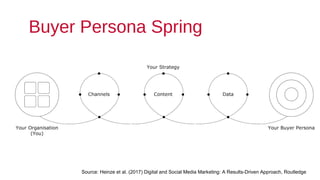
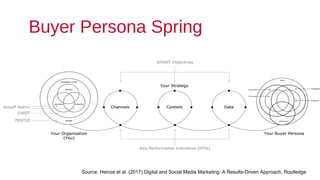
Buyer Persona Spring
Source: Heinze et al. (2017) Digital and Social Media Marketing: A Results-Driven Approach, Routledge
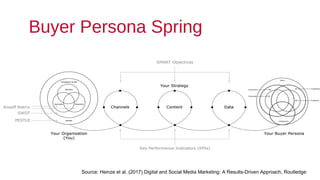
Buyer Persona Spring
Source: Heinze et al. (2017) Digital and Social Media Marketing: A Results-Driven Approach, Routledge
Assessing the quality of you digital marketing strategy
Test adapted with kind permission
from Prof Brian D Smith –
www.pragmedic.com
12 questions – focusing on key
aspects of strategic planning
Please answer these honestly
1. Our digital marketing strategy makes it clear what markets or
parts of the market we will concentrate our efforts on
if your digital marketing strategy attacks all of the market sector equally = 0
if your digital strategy is focused by the “descriptor groups” = 1
If your digital strategy attacks needs-based segments = 2
If you don’t know = -1
2. Our digital marketing strategy makes clear what actions fit
with the marketing strategy and what does not
If your digital strategy allows complete freedom of action = 0
If your digital strategy allows a high degree of freedom of action = 1
If your digital strategy makes most of your action plan decisions for you = 2
If you don’t know = -1
3. Our digital marketing strategy clearly defines our intended
competitive advantage for our buyer personas
If there is no strong and supported reason why the buyer persona should
choose you = 0
If there is a reason why buyer persona buy from you but there is no strong
proof = 1
If you can clearly state the reason the buyer persona should buy from you
and not the competitor and substantiate that reason = 2
If you don’t know = -1
4. Our digital marketing strategy allows synergy between the
activities of the different parts of the organisation
If the strategy is a compromise of what each department is capable of = 0
If the strategy uses the strengths of only one or two departments = 1
If the strategy uses the best strengths of all departments = 2
If you don’t know = -1
5. Our digital marketing strategy is significantly different from
that of our competitors for our buyer personas
If you attack the same buyer personas with the same value proposition = 0
If you attack the same buyer personas OR use the same value proposition =
1
If you attack different buyer personas with different value proposition = 2
If you don’t know = -1
6. Our digital marketing strategy recognises and
makes full allowance for the needs and wants of our
buyer personas
If you only meet the basic functional needs = 0
If you also meet the higher functional needs = 1
If you also meet the emotional and ego needs = 2
If you don’t know = -1
7. Our digital marketing strategy recognises and makes full
allowance for the strategy of our competitors
If you are ignoring competitors digital marketing strategy = 0
If you are allowing for some of the competitor digital marketing strategy = 1
If you are allowing for all of the competitors’ digital marketing strategy = 2
If you don’t know = -1
8. Our digital marketing strategy recognises and makes full
allowance for the changes in the business environment that are
beyond our control, such as technological, legislation or social
change
If your digital marketing strategy is designed for today’s conditions = 0
If your digital marketing strategy allows for one or two changes = 1
If your digital marketing strategy considers the combined effects of all the
external factors = 2
If you don’t know = -1
9. Our digital marketing strategy avoids or compensates for
those areas where we are relatively weak compared to our
competition
If you have taken little or no account of your relative weaknesses = 0
If you are trying to fix your relative weaknesses = 1
If your strategy means that your relative weaknesses don’t matter = 2
If you don’t know = -1
10. Our digital marketing strategy makes full use of those areas
where we are relatively strong compared to our competition
If you have taken little or no account of your relative strengths = 0
If you are trying to use your relative strengths = 1
If your digital marketing strategy means that your relative strengths become
more important = 2
If you don’t know = -1
11. Our digital marketing strategy, if successfully
implemented, will meet all the objectives of the
organisation
If your digital marketing strategy, fully and successfully
implemented, does not deliver your financial and non-financial
objectives = 0
If your digital marketing strategy, fully and successfully
implemented, delivers only your financial objectives = 1
If your digital marketing strategy, fully and successfully
implemented, delivers your financial and non-financial
objectives = 2
If you don’t know = -1
12. The resources available to the organisation are sufficient to
implement the digital marketing strategy successfully
If you have neither the tangible nor the intangible resources to implement the
digital marketing strategy = 0
If you have only the tangible or the intangible resources to implement the
digital marketing strategy, but not both = 1
If you have both the tangible and the intangible resources to implement the
digital marketing strategy = 2
If you don’t know = -1
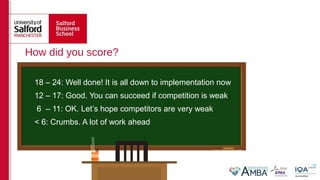
How did you score?
18 – 24: Well done! It is all down to implementation now
12 – 17: Good. You can succeed if competition is weak
6 – 11: OK. Let’s hope competitors are very weak
< 6: Crumbs. A lot of work ahead
Buyer Persona Spring
Source: Heinze et al. (2017) Digital and Social Media Marketing: A Results-Driven Approach, Routledge
Any questions? Please share!
http://mastersindigitalmarketing.org/book/

Digital marketing strategy evaluation and reverse engineering #passion4digital

  • 1.
    Dr Aleksej Heinze@AleksejHeinze 6th December 2016 10:30am – 12 noon (London time zone) Results-driven Approaches to Help you Stand out From the Crowd: Digital Marketing Strategy Evaluation and Reverse Engineering http://mastersindigitalmarketing.org/book/
  • 4.
    Buyer Persona Spring Source:Heinze et al. (2017) Digital and Social Media Marketing: A Results-Driven Approach, Routledge
  • 5.
    Buyer Persona Spring Source:Heinze et al. (2017) Digital and Social Media Marketing: A Results-Driven Approach, Routledge
  • 7.
    Assessing the qualityof you digital marketing strategy Test adapted with kind permission from Prof Brian D Smith – www.pragmedic.com 12 questions – focusing on key aspects of strategic planning Please answer these honestly
  • 8.
    1. Our digitalmarketing strategy makes it clear what markets or parts of the market we will concentrate our efforts on if your digital marketing strategy attacks all of the market sector equally = 0 if your digital strategy is focused by the “descriptor groups” = 1 If your digital strategy attacks needs-based segments = 2 If you don’t know = -1
  • 9.
    2. Our digitalmarketing strategy makes clear what actions fit with the marketing strategy and what does not If your digital strategy allows complete freedom of action = 0 If your digital strategy allows a high degree of freedom of action = 1 If your digital strategy makes most of your action plan decisions for you = 2 If you don’t know = -1
  • 10.
    3. Our digitalmarketing strategy clearly defines our intended competitive advantage for our buyer personas If there is no strong and supported reason why the buyer persona should choose you = 0 If there is a reason why buyer persona buy from you but there is no strong proof = 1 If you can clearly state the reason the buyer persona should buy from you and not the competitor and substantiate that reason = 2 If you don’t know = -1
  • 11.
    4. Our digitalmarketing strategy allows synergy between the activities of the different parts of the organisation If the strategy is a compromise of what each department is capable of = 0 If the strategy uses the strengths of only one or two departments = 1 If the strategy uses the best strengths of all departments = 2 If you don’t know = -1
  • 12.
    5. Our digitalmarketing strategy is significantly different from that of our competitors for our buyer personas If you attack the same buyer personas with the same value proposition = 0 If you attack the same buyer personas OR use the same value proposition = 1 If you attack different buyer personas with different value proposition = 2 If you don’t know = -1
  • 13.
    6. Our digitalmarketing strategy recognises and makes full allowance for the needs and wants of our buyer personas If you only meet the basic functional needs = 0 If you also meet the higher functional needs = 1 If you also meet the emotional and ego needs = 2 If you don’t know = -1
  • 14.
    7. Our digitalmarketing strategy recognises and makes full allowance for the strategy of our competitors If you are ignoring competitors digital marketing strategy = 0 If you are allowing for some of the competitor digital marketing strategy = 1 If you are allowing for all of the competitors’ digital marketing strategy = 2 If you don’t know = -1
  • 15.
    8. Our digitalmarketing strategy recognises and makes full allowance for the changes in the business environment that are beyond our control, such as technological, legislation or social change If your digital marketing strategy is designed for today’s conditions = 0 If your digital marketing strategy allows for one or two changes = 1 If your digital marketing strategy considers the combined effects of all the external factors = 2 If you don’t know = -1
  • 16.
    9. Our digitalmarketing strategy avoids or compensates for those areas where we are relatively weak compared to our competition If you have taken little or no account of your relative weaknesses = 0 If you are trying to fix your relative weaknesses = 1 If your strategy means that your relative weaknesses don’t matter = 2 If you don’t know = -1
  • 17.
    10. Our digitalmarketing strategy makes full use of those areas where we are relatively strong compared to our competition If you have taken little or no account of your relative strengths = 0 If you are trying to use your relative strengths = 1 If your digital marketing strategy means that your relative strengths become more important = 2 If you don’t know = -1
  • 18.
    11. Our digitalmarketing strategy, if successfully implemented, will meet all the objectives of the organisation If your digital marketing strategy, fully and successfully implemented, does not deliver your financial and non-financial objectives = 0 If your digital marketing strategy, fully and successfully implemented, delivers only your financial objectives = 1 If your digital marketing strategy, fully and successfully implemented, delivers your financial and non-financial objectives = 2 If you don’t know = -1
  • 19.
    12. The resourcesavailable to the organisation are sufficient to implement the digital marketing strategy successfully If you have neither the tangible nor the intangible resources to implement the digital marketing strategy = 0 If you have only the tangible or the intangible resources to implement the digital marketing strategy, but not both = 1 If you have both the tangible and the intangible resources to implement the digital marketing strategy = 2 If you don’t know = -1
  • 20.
    How did youscore? 18 – 24: Well done! It is all down to implementation now 12 – 17: Good. You can succeed if competition is weak 6 – 11: OK. Let’s hope competitors are very weak < 6: Crumbs. A lot of work ahead
  • 21.
    Buyer Persona Spring Source:Heinze et al. (2017) Digital and Social Media Marketing: A Results-Driven Approach, Routledge
  • 22.
    Any questions? Pleaseshare! http://mastersindigitalmarketing.org/book/

Editor's Notes

  • #6 Figure 1.6: The relationship of strategic analysis tools to the Buyer Persona Spring
  • #22 Figure 1.6: The relationship of strategic analysis tools to the Buyer Persona Spring