How to establish a successful brand
by building a strong foundation.
9 STEP
Digital
Marketing
Strategy
9 Step Digital Marketing Strategy ©
2
Table of contents
Introduction 3
Let’s introduce our example business 5
STEP 1
Know your destination 6
STEP 2
Pick your fish in the sea 8
STEP 3
Know who you are and own it		 10
STEP 4
Identify where the critical action takes place 12
STEP 5
Turn strangers into loyal customers 14
STEP 6
Content is King 17
STEP 7
Your secret weapon. Martech 20
STEP 8
The nitty-gritty details 22
STEP 9
One source of truth 23
Implementing the 9 Step Digital Marketing Strategy 25
9 Step Digital Marketing Strategy ©
3
Introduction
Do you want to create a well-known and respected
brand? Are you aware of the steps that go into
creating one?
In this fast-paced and ever-changing digital world,
understanding the importance of and then implementing
a powerful digital marketing strategy is vital for every
business.
What is a digital marketing strategy?
A digital marketing strategy is an overarching roadmap
that outlines the actions a business needs to take to
achieve its digital marketing goals. Based on factors
like business objectives, vision statements, customer
personas and budget, it highlights the building blocks
needed to drive the business towards achieving those
set goals.
Who should build a digital marketing strategy?
In a highly competitive global marketplace, with
continually evolving trends, and constant challenges, it
is imperative that the development of a digital strategy
must be devised and implemented by an experienced
senior marketing leader.
Similarly, common internal problems like the marketing
function being siloed, internal junior teams lacking
strategy expertise and leadership, and the need for
visibility and control, have also resulted in business
leaders calling for a digital marketing strategy they
can trust.
Strategic marketing plans need to be built by experts
who will not only ensure true alignment with the
overarching business goals but who possess a deep
understanding of the current marketing landscape,
the relevant technologies and tools, as well as how
to best resource the roadmap to achieve results.
When is the right time to develop a
digital strategy?
Digital matters now more than ever.
Marketing has become a major business function
globally, and thanks to technological advancements,
its significance knows no geographical or cultural
bounds. Businesses large and small can now get online
to infiltrate and attract any market at any time or place,
through smart digital strategies.
If your business
isn’t prioritising its
digital presence and
capabilities, you’re
already falling behind.
9 Step Digital Marketing Strategy ©
4
With 4.7 billion people online daily, brands now have
the opportunity to connect with over 60% of the
global population. The global pandemic from 2020
onwards has abruptly accelerated the need for many
businesses to rethink their activities, budgets, digital
presence and bottom line. With humanity more digitally
connected than ever, digital marketing has never been
so important.
So in a nutshell, the right time to develop a digital
marketing strategy was yesterday.
A digital marketing strategy will build the foundation
of your marketing function, accelerating your
company’s online presence, increasing leads,
customer satisfaction, brand loyalty and overall
business efficiency, and is the first step towards
growth for modern businesses.
What does a great digital marketing
strategy dictate?
A great digital marketing strategy includes both the
strategy itself and the best approach on how to
execute it effectively.
As a business leader, it’s important to understand all
of the key components of a comprehensive digital
strategy, which are outlined below. We will go into detail
below about the key components of a digital strategy,
but as a business leader, it is important to, first and
foremost, understand what this strategy will influence.
Resourcing needs
A digital strategy should provide an objective
recommendation about the best approach for execution,
based on the channels and tactics within the strategy.
This includes:
1. Recruitment of an internal marketing team, or
appropriate delegation to existing internal marketers
2. Engagement with any specific digital agencies
3. Opting for a blended approach using a combination
of both of the above
Content needs
Being the backbone of all marketing, the digital
strategy must outline all content requirements
in order to be able to execute the marketing. For
instance, it’s important to explore what content
needs to be created, for what purpose or objective,
for which channel, on what timeline and with what
budget.
Technology needs
Without technology, the content that forms
the strategy cannot be developed, hosted
or measured. A clear plan for marketing
technology must be included to
simplify processes, measure the
impact of marketing activities and
drive efficient spending.
9 Step Digital Marketing Strategy ©
5
Let’s introduce our
example business
At Ask Marketing, we have worked with hundreds
of businesses, small and large, to develop their
digital marketing strategies. Each business that
approaches us has varying levels of maturity, a
different technology stack and requires different
tactics, channels, budget and more.
So, to keep this practical, let’s introduce a
hypothetical company and dive into the key
components required to create and implement an
effective Digital Marketing Strategy.
To help you understand the 9 steps to building
an effective digital strategy, we have created a
fictitious business which represents many of those
who come to us for assistance in creating and
implementing their own.
Through this hypothetical case study, you’ll learn
more about how a digital marketing strategy can
strengthen your organisation’s performance and
overall productivity.
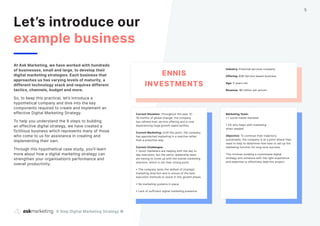
Marketing Team:
• 1 social media marketer
• EA who helps with marketing
when needed
Objective: To continue their trajectory
sustainably, the company is at a point where they
need to help to determine how best to set up the
marketing function for long term success.
This involves building a customised digital
strategy and someone with the right experience
and expertise to effectively lead this project.
Current Situation: Throughout the past 12-
18 months of global change, the company
has refined their service offering and is now
experiencing huge growth opportunities.
Current Marketing: Until this point, the company
has approached marketing in a reactive rather
than a proactive way.
Current Challenges:
• Junior marketers are helping with the day to
day execution, but the senior leadership team
are having to come up with the overall marketing
direction, which is not their strong point.
• The company lacks the skillset of strategic
marketing direction and is unsure of the best
execution methods to assist in this growth phase.
• No marketing systems in place.
• Lack of sufficient digital marketing presence.
Industry: Financial services company
Offering: B2B Service based business
Age: 5 years old
Revenue: $6 million per annum
ENNIS
INVESTMENTS
9 Step Digital Marketing Strategy ©
6
S T EP 1
Know your destination:
Overall Digital Strategy Objectives
Before formulating a path towards success, we
need to know the final destination. This allows your
organisation to build a roadmap in a relevant direction.
The driving forces behind digital marketing strategies
are the company goals. They are essentially the reason
why we recommend the actions we do.
It’s imperative that the brand establishes both long term
and short term goals, with qualitative and quantitative
milestones or checkpoints along the way.
In the marketing world, we will often hear the terms
“goal”, strategy”, “channels” and “tactics” used
interchangeably when referring to marketing objectives.
However, they are not all the same thing and it is
important to understand what they are, how they are
different from one another, when each is relevant and in
what context.
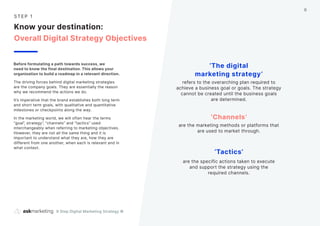
‘The digital
marketing strategy’
refers to the overarching plan required to
achieve a business goal or goals. The strategy
cannot be created until the business goals
are determined.
‘Channels’
are the marketing methods or platforms that
are used to market through.
‘Tactics’
are the specific actions taken to execute
and support the strategy using the
required channels.
As our example Ennis Investments is a business-to-
business (B2B) company, the digital marketing efforts
are likely to be centred around online lead generation
(Marketing Qualified Leads - MQLs), which are then
passed over to the sales team to nurture and determine
if they are a Sales Qualified Lead - SQL. For that reason,
the role of the marketing strategy is to attract and
convert the highest quality leads for their salespeople
to then nurture and convert via the website and
supporting digital channels.
As well as the website, Marketing will probably choose
to focus their efforts on business-focused channels like
LinkedIn where their target demographic is spending
their time online. Perhaps the objective would be: to
increase qualified leads from Linkedin Sales Navigator
by 30% this year.
Additionally, their B2B business goal is to increase their
customers by 5 each month. They know that their sales
team has a track record of closing around 50% of the
qualified leads, so it will take 10 new marketing qualified
leads to reach the target of 5 new customers.
Now that Ennis Investments has its objectives, they can
look at the actions required to achieve them. It’s the
same for your own business: the objectives you define
here will be the basis for the actions executed.
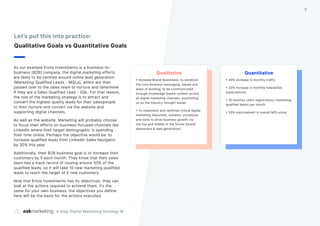
Let’s put this into practice:
Qualitative Goals vs Quantitative Goals
9 Step Digital Marketing Strategy ©
7
Quantitative
• 40% increase in monthly traffic
• 20% increase in monthly newsletter
subscriptions
• 10 monthly client registrations (marketing
qualified leads) per month
• 50% improvement in overall NPS score
Qualitative
• Increase Brand Awareness: re-establish
the core business messaging, values and
ways of working, to be communicated
through knowledge-based content across
all digital marketing channels, positioning
us as the industry thought leader.
• To implement and optimise critical digital
marketing resources, systems, processes
and tools to drive business growth via
the top and middle of the funnel (brand
awareness & lead generation).
9 Step Digital Marketing Strategy ©
8
S T EP 2
Pick your fish in the sea.
Target Market - Priority Customer Personas
We have all heard the saying “there’s plenty of fish in
the sea”, but why go chasing salmon when your brand
needs to catch a shark?
The same applies to your business and determining
what kind of customer you want to “land”. Customer
personas help you do this by allowing you to
understand and then target, convert and retain them.
Customer personas form the backbone of all digital
marketing activity. They will be referred to in pretty
much every digital marketing scenario to continuously
ensure that a proposed idea (like a specific digital
marketing campaign), will be aligned to the relevant
persona.
The most accurate customer personas are based on
primary market research gathered from your actual
customer base via questionnaires, interviews, feedback
surveys and so on. They can also be supported by
third-party insights found online and studies conducted
by other organisations.
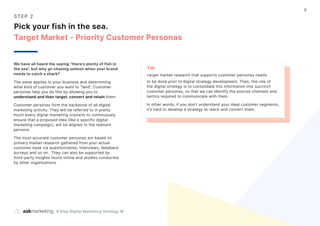
TIP:
Target market research that supports customer personas needs
to be done prior to digital strategy development. Then, the role of
the digital strategy is to consolidate this information into succinct
customer personas, so that we can identify the precise channels and
tactics required to communicate with them.
In other words, if you don’t understand your ideal customer segments,
it’s hard to develop a strategy to reach and convert them.
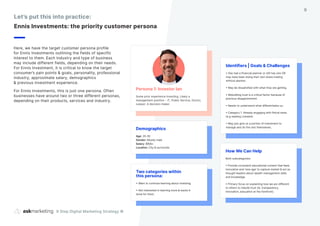
Here, we have the target customer persona profile
for Ennis Investments outlining the fields of specific
interest to them. Each industry and type of business
may include different fields, depending on their needs.
For Ennis Investment, it is critical to know the target
consumer’s pain points & goals, personality, professional
industry, approximate salary, demographics
& previous investment experience.
For Ennis Investments, this is just one persona. Often
businesses have around two or three different personas,
depending on their products, services and industry.
Let’s put this into practice:
Ennis Investments: the priority customer persona
9 Step Digital Marketing Strategy ©
9
Identifiers | Goals & Challenges
• Has had a financial planner or still has one OR
may have been doing their own share trading
without planner.
• May be dissatisfied with what they are getting.
• Rebuilding trust is a critical factor because of
previous disappointment.
• Needs to understand what differentiates us.
• Category 1: Already engaging with finical news
(e.g reading Livewire)
• May just give us a portion of investment to
manage and do the rest themselves.
How We Can Help
Both subcategories:
• Provide consistent educational content that feels
innovative and ‘new age’ to capture market & act as
thought leaders about wealth management skills
and knowledge.
• Primary focus on explaining how we are different
to others to rebuild trust (ie. transparency,
innovation, education at the forefront).
Demographics
Age: 35-55
Gender: Mostly male
Salary: $90k+
Location: City & surrounds
Persona 1: Investor Ian
Some prior experience investing. Likely a
management position - IT, Public Service, Doctor,
Lawyer. A decision maker.
Two categories within
this persona:
• Want to continue learning about investing.
• Not interested in learning more & wants it
done for them.
9 Step Digital Marketing Strategy ©
10
S T EP 3
Know who you are and own it.
Confirmation of Key Brand Marketing Components
Brand marketing is the overarching story that
represents a brand or business: who they are, what
they do, their vision or purpose and the messaging
they use to convey this to the market.
Digital marketing allows brands to spread their
message far and wide, and tell their brand story to
make an impression on their target customers. So
it is imperative that the digital strategy is executed
with continual and consistent brand messaging that is
strong, clear and in true alignment with the business’
operations in order for digital marketing
to be successful.
TIP: Before engaging some help with your digital
marketing strategy, it is vital that you have the
following brand marketing components finalised
and ready to share:
Product Or Service Vision
What is the purpose and vision for the product or service?
Strapline
Also often referred to as a slogan, which appears directly
beside or below a brand logo and sums up the essence of
the brand’s messaging. The best straplines are the ones
you can remember.
Unique Value Proposition (otherwise known as
USP or UVP) This is a clear statement that describes
the benefit of your offer, how you solve your
customer’s needs and what distinguishes you
from the competition.
Brand marketing
before digital
marketing checklist
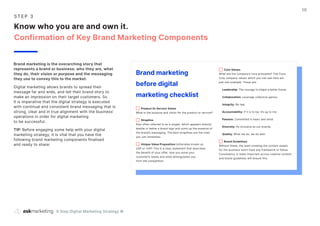
Core Values
What are the company’s core principles? The Coca
Cola company values which you can see here are
just one example. These are:
Leadership: The courage to shape a better future.
Collaboration: Leverage collective genius.
Integrity: Be real.
Accountability: If it is to be, it’s up to me.
Passion: Committed in heart and mind.
Diversity: As inclusive as our brands.
Quality: What we do, we do well.
Brand Guidelines
Without these, the team creating the content assets
for the business won’t have any framework to follow.
Consistency is really important across creative content
and brand guidelines will ensure this.
The most successful brand marketing strategies
are those which can shift in the name of relevance,
depending on important influences like trends
and fluctuations.
A great example of this is Airbnb. In 2020, Airbnb
shifted its business strategy to domestic travel to meet
the needs of the market in line with a global pandemic.
In alignment with launching this new strategy came
new brand messaging which included the strapline “Go
near”. By launching this new brand messaging together
with their new business focus, their digital marketing
message was not only clear and concise, but it was also
incredibly relevant. As a result, it served Airbnb well and
helped them during what would have otherwise been a
highly disruptive time.
Let’s put this into practice:
Effective brand marketing is consistent but adaptive
The bottom line is, if a brand’s marketing
isn’t clear, concise and consistent
across all digital platforms, the result
will heavily impact brand recognition
and Return On Investment (ROI).
9 Step Digital Marketing Strategy ©
11
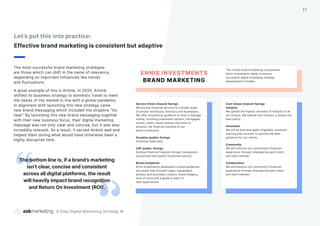
Core Values (inward-facing):
Integrity
We uphold the highest standard of integrity in all
our actions. We believe that honesty is always the
best policy.
Innovation
We will be bold and apply originality, continual
learning and curiosity to provide the best
guidance for our clients.
Community
We will enhance our community’s financial
experience through empowering each client
and team member.
Collaboration
We will enhance our community’s financial
experience through empowering each client
and team member.
Service Vision (inward-facing):
We provide financial services to a broad range
of private individuals, investors and businesses.
We offer exceptional guidance on how to manage
money, including investment options, mortgages,
stocks, credit, equity options and more to
enhance the financial standing of our
entire community.
Strapline (public-facing):
Investing made easy
USP (public-facing):
Achieve financial freedom through transparent,
customised and quality investment advice.
Brand Guidelines:
Ennis Investments developed a brand guidelines
document that included logos, typography,
primary and secondary colours, brand imagery,
tone of voice and a guide to each of
their applications.
The critical brand marketing components
Ennis Investments needs to ensure
successful digital marketing strategy
development includes:
ENNIS INVESTMENTS
BRAND MARKETING
9 Step Digital Marketing Strategy ©
12
S T EP 4
Identify where the
critical action takes place
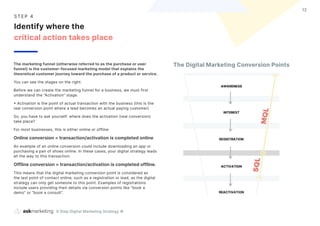
The marketing funnel (otherwise referred to as the purchase or user
funnel) is the customer-focused marketing model that explains the
theoretical customer journey toward the purchase of a product or service.
You can see the stages on the right.
Before we can create the marketing funnel for a business, we must first
understand the “Activation” stage.
• Activation is the point of actual transaction with the business (this is the
real conversion point where a lead becomes an actual paying customer)
So, you have to ask yourself: where does the activation (real conversion)
take place?
For most businesses, this is either online or offline
Online conversion = transaction/activation is completed online
An example of an online conversion could include downloading an app or
purchasing a pair of shoes online. In these cases, your digital strategy leads
all the way to this transaction.
Offline conversion = transaction/activation is completed offline.
This means that the digital marketing conversion point is considered as
the last point of contact online, such as a registration or lead, as the digital
strategy can only get someone to this point. Examples of registrations
include users providing their details via conversion points like “book a
demo” or “book a consult”.
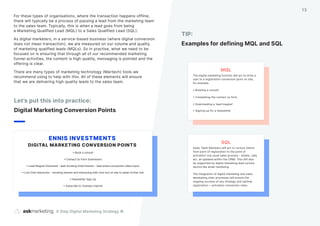
The Digital Marketing Conversion Points
For these types of organisations, where the transaction happens offline,
there will typically be a process of passing a lead from the marketing team
to the sales team. Typically, this is when a lead goes from being
a Marketing Qualified Lead (MQL) to a Sales Qualified Lead (SQL).
As digital marketers, in a service-based business (where digital conversion
does not mean transaction), we are measured on our volume and quality
of marketing qualified leads (MQLs). So in practise, what we need to be
focused on is ensuring that through all of our recommended marketing
funnel activities, the content is high quality, messaging is pointed and the
offering is clear.
There are many types of marketing technology (Martech) tools we
recommend using to help with this. All of these elements will ensure
that we are delivering high quality leads to the sales team.
Let’s put this into practice:
Digital Marketing Conversion Points
TIP:
Examples for defining MQL and SQL
9 Step Digital Marketing Strategy ©
13
SQL
Sales Team Members will act to nurture clients
from point of registration to the point of
activation (via usual sales process - emails, calls
etc. all updated within the CRM). This will also
be supported by digital marketing lead nurture
tactics like email marketing.
The integration of digital marketing and sales
developing clear processes will ensure the
ongoing success of any strategy and optimal
registration > activation conversion rates.
• Book a consult
• Contact Us Form Submission
• Lead Magnet Download - lead showing initial interest - lead enters ecosystem (data input)
• Live Chat Interaction - showing interest and interacting with chat tool on site to attain further info
• Newsletter Sign Up
• Subscribe to Youtube channel
ENNIS INVESTMENTS
DIGITAL MARKETING CONVERSION POINTS
MQL
The digital marketing function will act to drive a
user to a registration conversion point on site,
for example:
• Booking a consult
• Completing the contact us form
• Downloading a ‘lead magnet’
• Signing up for a newsletter
9 Step Digital Marketing Strategy ©
14
S T EP 5
Turn strangers into loyal customers:
User Funnel and all relevant tactics
Once the digital conversion points are identified, the relevant tactics
can be developed within that marketing funnel, across all stages.
Different marketing tactics apply to each corresponding stage according to
the strength of the customer’s relationship with your brand. Your tactics are
designed to help each customer progress towards the conversion point.
AWARENESS
Get your message in front of the right eyes
A user searches for or is open to general information.
Awareness is the largest and earliest stage of the marketing funnel the
starts the relationship process with your customer and your business.
Potential customers are drawn into this stage through targeted marketing
executions and strong brand messaging that they resonate with. Tactics
at this level of the funnel can include organic and paid social media
campaigns, digital PR activities, strong SEO and Google Ads. It may also
include some traditional marketing tactics.
INTEREST & CONSIDERATION
Make your brand stand out.
The user shows interest, undertakes problem identification and
compares options.
Once a potential user is aware of your brand, they may begin to show
genuine interest, actively finding out more about the company, its products
and services, primarily using your website for this. At this point, the target
customer is interested but not quite ready to buy – perhaps comparing
you against the competition or learning more about their options. That’s
why websites, social media, Google My Business reviews and other review
platforms are vital. Tactics at this level of the funnel can include things like
website chat & Google Reviews.
REGISTRATION
Turning a user into a lead.
All of the hard work is paying off.
For many businesses, at this stage, the user becomes a Marketing
Qualified Lead (MQL) via a digital marketing conversion point by
taking a desired action, such as:
• Subscribing to a newsletter
• Downloading a piece of content
• Creating a free account
• Requesting a demo
• Completing an enquiry form
• Booking an initial consult
Once the MQL is captured (usually with the help of a CRM tool
like Hubspot), depending on the business type, the lead may
then be passed onto the sales teams to become a Sales
Qualified Lead.
9 Step Digital Marketing Strategy ©
15
ACTIVATION
Decrease roadblocks and turn registration into activation.
This is the fun part. The activation is where the financial transaction
takes place, meaning they convert from lead to paying customer.
Examples include that the customer:
• initiates a paid monthly subscription for marketing software
(online transaction)
• orders and pays for their Uber Eats delivery (online transaction)
• commences paying for a gym membership via direct debit
(online transaction)
• makes their first investment into a wealth management fund (online
transaction)
• attends their first tax return appointment with a new accountant and
pays for it (offline transaction)
REACTIVATION
Treat your customers well and they will treat you well.
Now for the best part. A repeat activation is a sign that the brand has
provided an exceptional user experience and level of customer service.
Reactivation can single-handedly make or break a business’ bottom line.
Reactivation could be that the customer:
• continues to pay a subscription for an exceptional social
scheduling software (online transaction)
• orders and pays for another meal via Uber Eats
(online transaction)
• renews and re-commences paying for their gym
membership (online transaction)
• continues to invest small amounts into the small wealth
management fund (online transaction)
• attends and pays for their second tax appointment
(offline transaction)
By reducing customer churn rates (the rate of
customers who don’t reactivate), a brand will
earn a greater return on investment for their
marketing spend.
Further steps of the marketing funnel
include advocacy, where the customer
goes one step further and actively
recommends you to other
potential buyers.
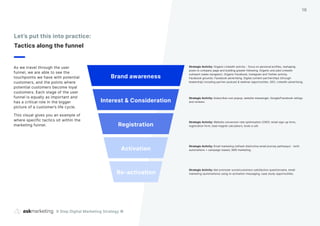
As we travel through the user
funnel, we are able to see the
touchpoints we have with potential
customers, and the points where
potential customers become loyal
customers. Each stage of the user
funnel is equally as important and
has a critical role in the bigger
picture of a customer’s life cycle.
This visual gives you an example of
where specific tactics sit within the
marketing funnel.
Let’s put this into practice:
Tactics along the funnel
9 Step Digital Marketing Strategy ©
16
Strategic Activity: Organic LinkedIn activity - focus on personal profiles, reshaping
posts to company page and building greater following. Organic and paid LinkedIn
outreach (sales navigator). Organic Facebook, Instagram and Twitter activity.
Facebook grounds. Facebook advertising. Digital content partnerships (through
leadership) including partner podcast & webinar opportunities. SEO. LinkedIn advertising.
Strategic Activity: Subscriber.com popup, website messenger, Google/Facebook ratings
and reviews.
Strategic Activity: Website conversion rate optimisation (CRO): email sign-up form,
registration form, lead magnet calculators, book a call.
Strategic Activity: Email marketing (refresh distinctive email journey pathways) - both
automations + campaign-based, SMS marketing.
Strategic Activity: Net promoter score/customers satisfaction questionnaire, email
marketing (automations) using re-activation messaging, case study opportunities.
Brand awareness
Interest & Consideration
Registration
Activation
Re-activation
9 Step Digital Marketing Strategy ©
17
S T EP 6
Content is King:
Your overarching content strategy
One of modern marketing’s most popular powerhouses today is content.
Marketing content is all of the visual, textual and audible forms of marketing
materials that your brand creates to connect with customers, from blogs to
explainer videos, podcasts to news articles.
A content strategy refers to the development of any tangible media that you
create and own: whether written (for example, articles, ebooks, research-
based white papers, case studies or testimonials), visual (such as images or
videos), or audio (like podcasts) content.
Based on the confirmed strategy, and resultant campaign periods, themes,
or focus areas, the content needs to be conceptualised, planned and
mapped out into a calendar for the respective team members to then
create and publish - whether that be copywriters, graphic designers,
videographers, photographers or web developers.
Without content, we can’t execute the majority of the
marketing plan, hence why content is a golden nugget
at the core of any digital strategy. The bottom line is,
you cannot share your brand’s story, value or offering,
without readily accessible content.
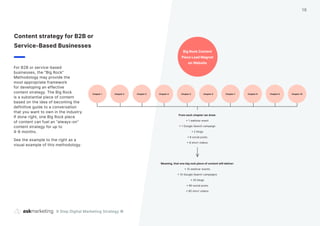
For B2B or service-based
businesses, the “Big Rock”
Methodology may provide the
most appropriate framework
for developing an effective
content strategy. The Big Rock
is a substantial piece of content
based on the idea of becoming the
definitive guide to a conversation
that you want to own in the industry.
If done right, one Big Rock piece
of content can fuel an “always-on”
content strategy for up to
4-6 months.
See the example to the right as a
visual example of this methodology.
Content strategy for B2B or
Service-Based Businesses
9 Step Digital Marketing Strategy ©
18
From each chapter we draw:
• 1 webinar event
• 1 Google Search campaign
• 2 blogs
• 8 social posts
• 8 short videos
Meaning, that one big rock piece of content will deliver:
• 10 webinar events
• 10 Google Search campaigns
• 20 blogs
• 80 social posts
• 80 short videos
Big Rock Content
Piece Lead Magnet
on Website
Chapter 1 Chapter 5
Chapter 3 Chapter 7 Chapter 9
Chapter 2 Chapter 6
Chapter 4 Chapter 8 Chapter 10
For products, apps or eCommerce businesses, the content strategy may
be best approached with a more traditional calendar-based method.
For example:
• Create a Content Calendar table
• Break up the calendar into campaign periods, whether that be monthly,
quarterly, bi-monthly, etc.
• Per campaign period, specify the volume requirements for each type of
content that will be distributed within each channel and tactic within the
greater digital strategy. For instance:
Content strategy for Product Based
or eCommerce Businesses
Let’s put this into practice
Content: the approach to content
• 6 blogs/articles - hosted onsite and used within organic social, paid
social media campaigns, email campaigns, Google search ad campaigns
• 4 videos (in various specs) - used within organic social, paid social
media campaigns, digital PR activity
• 30 graphic assets - used within organic social, paid social media
campaigns, email campaigns, display advertising, digital PR activity
• 2 podcasts - hosted on Apple podcasts and Spotify and used within
organic social
For every piece of content created and distributed within the greater digital
strategy, there will be an analysis of performance (tracking metrics like
impressions, clicks, views, listens and more) to ensure insights that will
then influence future strategic content planning decisions.
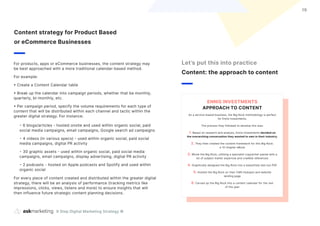
ENNIS INVESTMENTS
APPROACH TO CONTENT
As a service-based business, the Big Rock methodology is perfect
for Ennis Investments.
The process they followed to develop this was:
1. Based on research and analysis, Ennis Investments decided on
the overarching conversation they wanted to own in their industry.
2. They then created the content framework for this Big Rock:
a 10 chapter eBook
3. Wrote the Big Rock, utilising a specialist copywriter paired with a
lot of subject matter expertise and credible references
4. Graphically designed the Big Rock into a beautifully laid-out PDF
5. Hosted the Big Rock on their CMS Hubspot and website
landing page
6. Carved up the Big Rock into a content calendar for the rest
of the year
9 Step Digital Marketing Strategy ©
19
9 Step Digital Marketing Strategy ©
20
S T EP 7
Your secret weapon:
Martech
Marketing technology (or MarTech), describes
the digital tools that assist in achieving marketing
objectives using sophisticated platforms and systems.
Martech allows businesses to augment their marketing
initiatives by creating seamless and smarter strategies
targeted at each phase of the marketing funnel: from
brand awareness to activation and back again.
Martech also helps to streamline processes and
identifies ways to make your marketing communications
as personalised as possible. In a nutshell, Martech is
essential if you want to remain efficient, profitable,
and competitive in today’s highly saturated and
fast-changing business landscape.
A solid Martech stack can improve efficiencies
across the following functions:
• Website platform and CMS
• Performance tracking
• Email marketing platform and CRM
• Advertising activity
• Content scheduling
In our ever-advancing digital world, there is an endless
amount of Martech tools and software to choose from,
making it feel overwhelming for many marketers and
business teams. So, before actively onboarding a new
tool, senior marketing managers should assess the
value each tool will provide, its specific functions,
cost, team access and reliability.
It is important to begin by
understanding a business’ current
technology stack and what tools are
currently used for what purpose. This
will help to identify any gaps for where
innovative Martech tools could be
implemented to achieve both some
quick wins and longer-term successes.
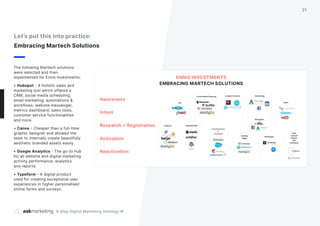
The following Martech solutions
were selected and then
implemented for Ennis Investments:
• Hubspot - A holistic sales and
marketing tool which offered a
CRM, social media scheduling,
email marketing, automations &
workflows, website messenger,
metrics dashboard, sales tools,
customer service functionalities
and more.
• Canva - Cheaper than a full-time
graphic designer and allowed the
team to internally create beautifully
aesthetic branded assets easily.
• Google Analytics - The go-to hub
for all website and digital marketing
activity performance, analytics
and reports.
• Typeform - A digital product
used for creating exceptional user
experiences in higher personalised
online forms and surveys.
Let’s put this into practice:
Embracing Martech Solutions
ENNIS INVESTMENTS
EMBRACING MARTECH SOLUTIONS
9 Step Digital Marketing Strategy ©
21
Awareness
Intest
Research + Registration
Activation
Reactivation
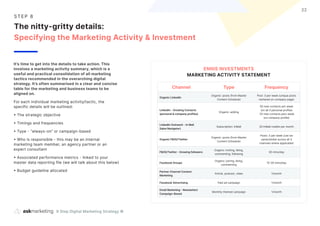
Channel Type Frequency
Organic LinkedIn
Organic: posts (from Master
Content Schedule)
Post: 3 per week (unique posts
reshared on company page)
LinkedIn - Growing Contacts
(personal & company profiles)
Organic: adding
50 new contacts per week
(on all 3 personal profiles
25 new contacts pers week
(on company profile)
LinkedIn Outreach - In Mail
Sales Navigator)
Subscription: InMail 20 InMail credits per month
Organic FB/IG/Twitter
Organic: posts (from Master
Content Schedule)
Posts: 3 per week (can be
same/similar across all 3
channels where applicable)
FB/IG/Twitter - Growing followers
Organic: inviting, liking,
commenting, following
30 mins/day
Facebook Groups
Organic: joining, liking,
commenting
15-30 mins/day
Partner Channel Content
Marketing
Article, podcast, video 1/month
Facebook Advertising Paid ad campaign 1/month
Email Marketing - Newsletter/
Campaign-Based
Monthly themed campaign 1/month
ENNIS INVESTMENTS
MARKETING ACTIVITY STATEMENT
9 Step Digital Marketing Strategy ©
22
S T EP 8
The nitty-gritty details:
Specifying the Marketing Activity & Investment
It’s time to get into the details to take action. This
involves a marketing activity summary, which is a
useful and practical consolidation of all marketing
tactics recommended in the overarching digital
strategy. It’s often summarised in a clear and concise
table for the marketing and business teams to be
aligned on.
For each individual marketing activity/tactic, the
specific details will be outlined:
• The strategic objective
• Timings and frequencies
• Type - “always-on” or campaign-based
• Who is responsible - this may be an internal
marketing team member, an agency partner or an
expert consultant
• Associated performance metrics - linked to your
master data reporting file (we will talk about this below)
• Budget guideline allocated
9 Step Digital Marketing Strategy ©
23
S T EP 9
Data, data, data and the importance of one source of truth:
Setting up Digital Marketing KPIs and Metrics
With over 40 different types of marketing and
counting, it is becoming increasingly difficult for
marketers to pull all of the pieces of information
together from multiple data streams into one
centralised repository.
After over a decade of trialling different dashboard
tools, all promising to integrate and report on all digital
marketing activities, we can now confidently say
that a tool which amalgamates all reporting data into
one single source of truth just does not exist. So, as
marketers, we must create this repository and maintain
it ourselves.
It’s important, as without this data, you’re leaving
yourself uninformed about the results of campaigns
and basing your decisions on assumptions or
inaccurate information.
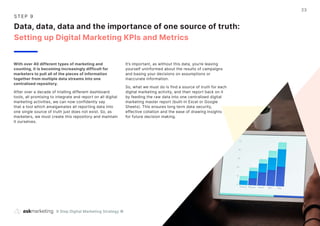
So, what we must do is find a source of truth for each
digital marketing activity, and then report back on it
by feeding the raw data into one centralised digital
marketing master report (built-in Excel or Google
Sheets). This ensures long term data security,
effective collation and the ease of drawing insights
for future decision making.
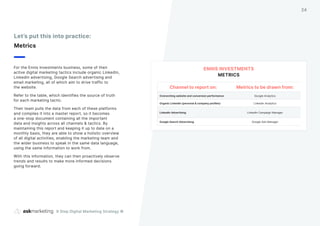
For the Ennis Investments business, some of their
active digital marketing tactics include organic LinkedIn,
LinkedIn advertising, Google Search advertising and
email marketing, all of which aim to drive traffic to
the website.
Refer to the table, which identifies the source of truth
for each marketing tactic.
Their team pulls the data from each of these platforms
and compiles it into a master report, so it becomes
a one-stop document containing all the important
data and insights across all channels & tactics. By
maintaining this report and keeping it up to date on a
monthly basis, they are able to show a holistic overview
of all digital activities, enabling the marketing team and
the wider business to speak in the same data language,
using the same information to work from.
With this information, they can then proactively observe
trends and results to make more informed decisions
going forward.
Let’s put this into practice:
Metrics
Channel to report on: Metrics to be drawn from:
Overarching website and conversion performance Google Analytics
Organic LinkedIn (personal & company profiles) LinkedIn Analytics
LinkedIn Advertising LinkedIn Campaign Manager
Google Search Advertising Google Ads Manager
ENNIS INVESTMENTS
METRICS
9 Step Digital Marketing Strategy ©
24
9 Step Digital Marketing Strategy ©
25
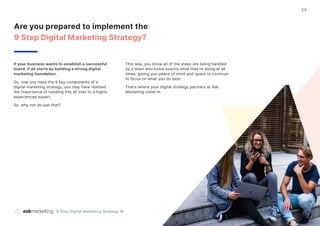
Are you prepared to implement the
9 Step Digital Marketing Strategy?
If your business wants to establish a successful
brand, it all starts by building a strong digital
marketing foundation.
So, now you have the 9 key components of a
digital marketing strategy, you may have realised
the importance of handing this all over to a highly
experienced expert.
So, why not do just that?
This way, you know all of the steps are being handled
by a team who know exactly what they’re doing at all
times, giving you peace of mind and space to continue
to focus on what you do best.
That’s where your digital strategy partners at Ask
Marketing come in.
Ask Marketing are the digital strategy experts and your
digital transformation partner.
We build exemplary marketing functions with a focus on
digital strategy, tools & people, and pride ourselves on
being strategic, practical and transparent from
the outset.
At Ask Marketing, we offer a strategy-first approach,
which defines the resourcing structure and tools
needed to execute your marketing plan. This approach
builds the foundations of your digital marketing function
and ensures alignment with, and the ability to deliver on
overarching business goals.
All Ask Marketing clients have exclusive access to
our network of trusted partners. From groundbreaking
content production companies, leading brand &
advertising agencies, to marketing
recruitment specialists.
Place your digital strategy in the hands of experts.
Whether you need ongoing strategic direction or
guidance on a specific project, we can help you.
We’d love to join you on your digital
marketing journey
Ask Marketing, everything that we do is underpinned
by our desire to educate and explain ‘the why’ behind
our strategic recommendations. Our vision has always
been and will always be about guiding business owners
around how they should best execute their marketing,
directly based on the strategy itself.
Our latest venture, Ask Marketing Academy, reflects
this position that we uphold within the industry,
providing a platform to pass on this strategic guidance
and practical advice to the next generation of emerging
marketers - the CMOs of tomorrow.
In a nutshell, we build
your comprehensive
digital strategy.
Then, you execute
this strategy day-to-
day using either your
internal marketing
team or partnerships
with relevant
marketing agencies.
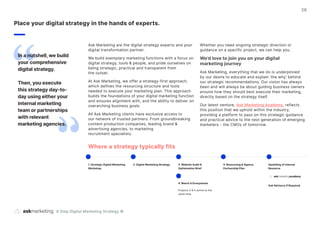
Where a strategy typically fits
1. Strategic Digital Marketing
Workshop
2. Digital Marketing Strategy 5. Resourcing & Agency
Partnership Plan
Upskilling of Internal
Resource
Ask Advisory if Required.
3. Website Audit &
Optimisation Brief
4. March & Ecosystems
Projects 3 & 4 active at the
same time.
9 Step Digital Marketing Strategy ©
26
Vist us at
askmarketing.com.au/contact-us
or Level 1, 364 Kent Street Sydney

Group 4 Step Digital Marketing Strategy_compressed (1).pdf

  • 1.
    How to establisha successful brand by building a strong foundation. 9 STEP Digital Marketing Strategy
  • 2.
    9 Step DigitalMarketing Strategy © 2 Table of contents Introduction 3 Let’s introduce our example business 5 STEP 1 Know your destination 6 STEP 2 Pick your fish in the sea 8 STEP 3 Know who you are and own it 10 STEP 4 Identify where the critical action takes place 12 STEP 5 Turn strangers into loyal customers 14 STEP 6 Content is King 17 STEP 7 Your secret weapon. Martech 20 STEP 8 The nitty-gritty details 22 STEP 9 One source of truth 23 Implementing the 9 Step Digital Marketing Strategy 25
  • 3.
    9 Step DigitalMarketing Strategy © 3 Introduction Do you want to create a well-known and respected brand? Are you aware of the steps that go into creating one? In this fast-paced and ever-changing digital world, understanding the importance of and then implementing a powerful digital marketing strategy is vital for every business. What is a digital marketing strategy? A digital marketing strategy is an overarching roadmap that outlines the actions a business needs to take to achieve its digital marketing goals. Based on factors like business objectives, vision statements, customer personas and budget, it highlights the building blocks needed to drive the business towards achieving those set goals. Who should build a digital marketing strategy? In a highly competitive global marketplace, with continually evolving trends, and constant challenges, it is imperative that the development of a digital strategy must be devised and implemented by an experienced senior marketing leader. Similarly, common internal problems like the marketing function being siloed, internal junior teams lacking strategy expertise and leadership, and the need for visibility and control, have also resulted in business leaders calling for a digital marketing strategy they can trust. Strategic marketing plans need to be built by experts who will not only ensure true alignment with the overarching business goals but who possess a deep understanding of the current marketing landscape, the relevant technologies and tools, as well as how to best resource the roadmap to achieve results. When is the right time to develop a digital strategy? Digital matters now more than ever. Marketing has become a major business function globally, and thanks to technological advancements, its significance knows no geographical or cultural bounds. Businesses large and small can now get online to infiltrate and attract any market at any time or place, through smart digital strategies. If your business isn’t prioritising its digital presence and capabilities, you’re already falling behind.
  • 4.
    9 Step DigitalMarketing Strategy © 4 With 4.7 billion people online daily, brands now have the opportunity to connect with over 60% of the global population. The global pandemic from 2020 onwards has abruptly accelerated the need for many businesses to rethink their activities, budgets, digital presence and bottom line. With humanity more digitally connected than ever, digital marketing has never been so important. So in a nutshell, the right time to develop a digital marketing strategy was yesterday. A digital marketing strategy will build the foundation of your marketing function, accelerating your company’s online presence, increasing leads, customer satisfaction, brand loyalty and overall business efficiency, and is the first step towards growth for modern businesses. What does a great digital marketing strategy dictate? A great digital marketing strategy includes both the strategy itself and the best approach on how to execute it effectively. As a business leader, it’s important to understand all of the key components of a comprehensive digital strategy, which are outlined below. We will go into detail below about the key components of a digital strategy, but as a business leader, it is important to, first and foremost, understand what this strategy will influence. Resourcing needs A digital strategy should provide an objective recommendation about the best approach for execution, based on the channels and tactics within the strategy. This includes: 1. Recruitment of an internal marketing team, or appropriate delegation to existing internal marketers 2. Engagement with any specific digital agencies 3. Opting for a blended approach using a combination of both of the above Content needs Being the backbone of all marketing, the digital strategy must outline all content requirements in order to be able to execute the marketing. For instance, it’s important to explore what content needs to be created, for what purpose or objective, for which channel, on what timeline and with what budget. Technology needs Without technology, the content that forms the strategy cannot be developed, hosted or measured. A clear plan for marketing technology must be included to simplify processes, measure the impact of marketing activities and drive efficient spending.
  • 5.
    9 Step DigitalMarketing Strategy © 5 Let’s introduce our example business At Ask Marketing, we have worked with hundreds of businesses, small and large, to develop their digital marketing strategies. Each business that approaches us has varying levels of maturity, a different technology stack and requires different tactics, channels, budget and more. So, to keep this practical, let’s introduce a hypothetical company and dive into the key components required to create and implement an effective Digital Marketing Strategy. To help you understand the 9 steps to building an effective digital strategy, we have created a fictitious business which represents many of those who come to us for assistance in creating and implementing their own. Through this hypothetical case study, you’ll learn more about how a digital marketing strategy can strengthen your organisation’s performance and overall productivity. Marketing Team: • 1 social media marketer • EA who helps with marketing when needed Objective: To continue their trajectory sustainably, the company is at a point where they need to help to determine how best to set up the marketing function for long term success. This involves building a customised digital strategy and someone with the right experience and expertise to effectively lead this project. Current Situation: Throughout the past 12- 18 months of global change, the company has refined their service offering and is now experiencing huge growth opportunities. Current Marketing: Until this point, the company has approached marketing in a reactive rather than a proactive way. Current Challenges: • Junior marketers are helping with the day to day execution, but the senior leadership team are having to come up with the overall marketing direction, which is not their strong point. • The company lacks the skillset of strategic marketing direction and is unsure of the best execution methods to assist in this growth phase. • No marketing systems in place. • Lack of sufficient digital marketing presence. Industry: Financial services company Offering: B2B Service based business Age: 5 years old Revenue: $6 million per annum ENNIS INVESTMENTS
  • 6.
    9 Step DigitalMarketing Strategy © 6 S T EP 1 Know your destination: Overall Digital Strategy Objectives Before formulating a path towards success, we need to know the final destination. This allows your organisation to build a roadmap in a relevant direction. The driving forces behind digital marketing strategies are the company goals. They are essentially the reason why we recommend the actions we do. It’s imperative that the brand establishes both long term and short term goals, with qualitative and quantitative milestones or checkpoints along the way. In the marketing world, we will often hear the terms “goal”, strategy”, “channels” and “tactics” used interchangeably when referring to marketing objectives. However, they are not all the same thing and it is important to understand what they are, how they are different from one another, when each is relevant and in what context. ‘The digital marketing strategy’ refers to the overarching plan required to achieve a business goal or goals. The strategy cannot be created until the business goals are determined. ‘Channels’ are the marketing methods or platforms that are used to market through. ‘Tactics’ are the specific actions taken to execute and support the strategy using the required channels.
  • 7.
    As our exampleEnnis Investments is a business-to- business (B2B) company, the digital marketing efforts are likely to be centred around online lead generation (Marketing Qualified Leads - MQLs), which are then passed over to the sales team to nurture and determine if they are a Sales Qualified Lead - SQL. For that reason, the role of the marketing strategy is to attract and convert the highest quality leads for their salespeople to then nurture and convert via the website and supporting digital channels. As well as the website, Marketing will probably choose to focus their efforts on business-focused channels like LinkedIn where their target demographic is spending their time online. Perhaps the objective would be: to increase qualified leads from Linkedin Sales Navigator by 30% this year. Additionally, their B2B business goal is to increase their customers by 5 each month. They know that their sales team has a track record of closing around 50% of the qualified leads, so it will take 10 new marketing qualified leads to reach the target of 5 new customers. Now that Ennis Investments has its objectives, they can look at the actions required to achieve them. It’s the same for your own business: the objectives you define here will be the basis for the actions executed. Let’s put this into practice: Qualitative Goals vs Quantitative Goals 9 Step Digital Marketing Strategy © 7 Quantitative • 40% increase in monthly traffic • 20% increase in monthly newsletter subscriptions • 10 monthly client registrations (marketing qualified leads) per month • 50% improvement in overall NPS score Qualitative • Increase Brand Awareness: re-establish the core business messaging, values and ways of working, to be communicated through knowledge-based content across all digital marketing channels, positioning us as the industry thought leader. • To implement and optimise critical digital marketing resources, systems, processes and tools to drive business growth via the top and middle of the funnel (brand awareness & lead generation).
  • 8.
    9 Step DigitalMarketing Strategy © 8 S T EP 2 Pick your fish in the sea. Target Market - Priority Customer Personas We have all heard the saying “there’s plenty of fish in the sea”, but why go chasing salmon when your brand needs to catch a shark? The same applies to your business and determining what kind of customer you want to “land”. Customer personas help you do this by allowing you to understand and then target, convert and retain them. Customer personas form the backbone of all digital marketing activity. They will be referred to in pretty much every digital marketing scenario to continuously ensure that a proposed idea (like a specific digital marketing campaign), will be aligned to the relevant persona. The most accurate customer personas are based on primary market research gathered from your actual customer base via questionnaires, interviews, feedback surveys and so on. They can also be supported by third-party insights found online and studies conducted by other organisations. TIP: Target market research that supports customer personas needs to be done prior to digital strategy development. Then, the role of the digital strategy is to consolidate this information into succinct customer personas, so that we can identify the precise channels and tactics required to communicate with them. In other words, if you don’t understand your ideal customer segments, it’s hard to develop a strategy to reach and convert them.
  • 9.
    Here, we havethe target customer persona profile for Ennis Investments outlining the fields of specific interest to them. Each industry and type of business may include different fields, depending on their needs. For Ennis Investment, it is critical to know the target consumer’s pain points & goals, personality, professional industry, approximate salary, demographics & previous investment experience. For Ennis Investments, this is just one persona. Often businesses have around two or three different personas, depending on their products, services and industry. Let’s put this into practice: Ennis Investments: the priority customer persona 9 Step Digital Marketing Strategy © 9 Identifiers | Goals & Challenges • Has had a financial planner or still has one OR may have been doing their own share trading without planner. • May be dissatisfied with what they are getting. • Rebuilding trust is a critical factor because of previous disappointment. • Needs to understand what differentiates us. • Category 1: Already engaging with finical news (e.g reading Livewire) • May just give us a portion of investment to manage and do the rest themselves. How We Can Help Both subcategories: • Provide consistent educational content that feels innovative and ‘new age’ to capture market & act as thought leaders about wealth management skills and knowledge. • Primary focus on explaining how we are different to others to rebuild trust (ie. transparency, innovation, education at the forefront). Demographics Age: 35-55 Gender: Mostly male Salary: $90k+ Location: City & surrounds Persona 1: Investor Ian Some prior experience investing. Likely a management position - IT, Public Service, Doctor, Lawyer. A decision maker. Two categories within this persona: • Want to continue learning about investing. • Not interested in learning more & wants it done for them.
  • 10.
    9 Step DigitalMarketing Strategy © 10 S T EP 3 Know who you are and own it. Confirmation of Key Brand Marketing Components Brand marketing is the overarching story that represents a brand or business: who they are, what they do, their vision or purpose and the messaging they use to convey this to the market. Digital marketing allows brands to spread their message far and wide, and tell their brand story to make an impression on their target customers. So it is imperative that the digital strategy is executed with continual and consistent brand messaging that is strong, clear and in true alignment with the business’ operations in order for digital marketing to be successful. TIP: Before engaging some help with your digital marketing strategy, it is vital that you have the following brand marketing components finalised and ready to share: Product Or Service Vision What is the purpose and vision for the product or service? Strapline Also often referred to as a slogan, which appears directly beside or below a brand logo and sums up the essence of the brand’s messaging. The best straplines are the ones you can remember. Unique Value Proposition (otherwise known as USP or UVP) This is a clear statement that describes the benefit of your offer, how you solve your customer’s needs and what distinguishes you from the competition. Brand marketing before digital marketing checklist Core Values What are the company’s core principles? The Coca Cola company values which you can see here are just one example. These are: Leadership: The courage to shape a better future. Collaboration: Leverage collective genius. Integrity: Be real. Accountability: If it is to be, it’s up to me. Passion: Committed in heart and mind. Diversity: As inclusive as our brands. Quality: What we do, we do well. Brand Guidelines Without these, the team creating the content assets for the business won’t have any framework to follow. Consistency is really important across creative content and brand guidelines will ensure this.
  • 11.
    The most successfulbrand marketing strategies are those which can shift in the name of relevance, depending on important influences like trends and fluctuations. A great example of this is Airbnb. In 2020, Airbnb shifted its business strategy to domestic travel to meet the needs of the market in line with a global pandemic. In alignment with launching this new strategy came new brand messaging which included the strapline “Go near”. By launching this new brand messaging together with their new business focus, their digital marketing message was not only clear and concise, but it was also incredibly relevant. As a result, it served Airbnb well and helped them during what would have otherwise been a highly disruptive time. Let’s put this into practice: Effective brand marketing is consistent but adaptive The bottom line is, if a brand’s marketing isn’t clear, concise and consistent across all digital platforms, the result will heavily impact brand recognition and Return On Investment (ROI). 9 Step Digital Marketing Strategy © 11 Core Values (inward-facing): Integrity We uphold the highest standard of integrity in all our actions. We believe that honesty is always the best policy. Innovation We will be bold and apply originality, continual learning and curiosity to provide the best guidance for our clients. Community We will enhance our community’s financial experience through empowering each client and team member. Collaboration We will enhance our community’s financial experience through empowering each client and team member. Service Vision (inward-facing): We provide financial services to a broad range of private individuals, investors and businesses. We offer exceptional guidance on how to manage money, including investment options, mortgages, stocks, credit, equity options and more to enhance the financial standing of our entire community. Strapline (public-facing): Investing made easy USP (public-facing): Achieve financial freedom through transparent, customised and quality investment advice. Brand Guidelines: Ennis Investments developed a brand guidelines document that included logos, typography, primary and secondary colours, brand imagery, tone of voice and a guide to each of their applications. The critical brand marketing components Ennis Investments needs to ensure successful digital marketing strategy development includes: ENNIS INVESTMENTS BRAND MARKETING
  • 12.
    9 Step DigitalMarketing Strategy © 12 S T EP 4 Identify where the critical action takes place The marketing funnel (otherwise referred to as the purchase or user funnel) is the customer-focused marketing model that explains the theoretical customer journey toward the purchase of a product or service. You can see the stages on the right. Before we can create the marketing funnel for a business, we must first understand the “Activation” stage. • Activation is the point of actual transaction with the business (this is the real conversion point where a lead becomes an actual paying customer) So, you have to ask yourself: where does the activation (real conversion) take place? For most businesses, this is either online or offline Online conversion = transaction/activation is completed online An example of an online conversion could include downloading an app or purchasing a pair of shoes online. In these cases, your digital strategy leads all the way to this transaction. Offline conversion = transaction/activation is completed offline. This means that the digital marketing conversion point is considered as the last point of contact online, such as a registration or lead, as the digital strategy can only get someone to this point. Examples of registrations include users providing their details via conversion points like “book a demo” or “book a consult”. The Digital Marketing Conversion Points
  • 13.
    For these typesof organisations, where the transaction happens offline, there will typically be a process of passing a lead from the marketing team to the sales team. Typically, this is when a lead goes from being a Marketing Qualified Lead (MQL) to a Sales Qualified Lead (SQL). As digital marketers, in a service-based business (where digital conversion does not mean transaction), we are measured on our volume and quality of marketing qualified leads (MQLs). So in practise, what we need to be focused on is ensuring that through all of our recommended marketing funnel activities, the content is high quality, messaging is pointed and the offering is clear. There are many types of marketing technology (Martech) tools we recommend using to help with this. All of these elements will ensure that we are delivering high quality leads to the sales team. Let’s put this into practice: Digital Marketing Conversion Points TIP: Examples for defining MQL and SQL 9 Step Digital Marketing Strategy © 13 SQL Sales Team Members will act to nurture clients from point of registration to the point of activation (via usual sales process - emails, calls etc. all updated within the CRM). This will also be supported by digital marketing lead nurture tactics like email marketing. The integration of digital marketing and sales developing clear processes will ensure the ongoing success of any strategy and optimal registration > activation conversion rates. • Book a consult • Contact Us Form Submission • Lead Magnet Download - lead showing initial interest - lead enters ecosystem (data input) • Live Chat Interaction - showing interest and interacting with chat tool on site to attain further info • Newsletter Sign Up • Subscribe to Youtube channel ENNIS INVESTMENTS DIGITAL MARKETING CONVERSION POINTS MQL The digital marketing function will act to drive a user to a registration conversion point on site, for example: • Booking a consult • Completing the contact us form • Downloading a ‘lead magnet’ • Signing up for a newsletter
  • 14.
    9 Step DigitalMarketing Strategy © 14 S T EP 5 Turn strangers into loyal customers: User Funnel and all relevant tactics Once the digital conversion points are identified, the relevant tactics can be developed within that marketing funnel, across all stages. Different marketing tactics apply to each corresponding stage according to the strength of the customer’s relationship with your brand. Your tactics are designed to help each customer progress towards the conversion point. AWARENESS Get your message in front of the right eyes A user searches for or is open to general information. Awareness is the largest and earliest stage of the marketing funnel the starts the relationship process with your customer and your business. Potential customers are drawn into this stage through targeted marketing executions and strong brand messaging that they resonate with. Tactics at this level of the funnel can include organic and paid social media campaigns, digital PR activities, strong SEO and Google Ads. It may also include some traditional marketing tactics. INTEREST & CONSIDERATION Make your brand stand out. The user shows interest, undertakes problem identification and compares options. Once a potential user is aware of your brand, they may begin to show genuine interest, actively finding out more about the company, its products and services, primarily using your website for this. At this point, the target customer is interested but not quite ready to buy – perhaps comparing you against the competition or learning more about their options. That’s why websites, social media, Google My Business reviews and other review platforms are vital. Tactics at this level of the funnel can include things like website chat & Google Reviews. REGISTRATION Turning a user into a lead. All of the hard work is paying off. For many businesses, at this stage, the user becomes a Marketing Qualified Lead (MQL) via a digital marketing conversion point by taking a desired action, such as: • Subscribing to a newsletter • Downloading a piece of content • Creating a free account • Requesting a demo • Completing an enquiry form • Booking an initial consult Once the MQL is captured (usually with the help of a CRM tool like Hubspot), depending on the business type, the lead may then be passed onto the sales teams to become a Sales Qualified Lead.
  • 15.
    9 Step DigitalMarketing Strategy © 15 ACTIVATION Decrease roadblocks and turn registration into activation. This is the fun part. The activation is where the financial transaction takes place, meaning they convert from lead to paying customer. Examples include that the customer: • initiates a paid monthly subscription for marketing software (online transaction) • orders and pays for their Uber Eats delivery (online transaction) • commences paying for a gym membership via direct debit (online transaction) • makes their first investment into a wealth management fund (online transaction) • attends their first tax return appointment with a new accountant and pays for it (offline transaction) REACTIVATION Treat your customers well and they will treat you well. Now for the best part. A repeat activation is a sign that the brand has provided an exceptional user experience and level of customer service. Reactivation can single-handedly make or break a business’ bottom line. Reactivation could be that the customer: • continues to pay a subscription for an exceptional social scheduling software (online transaction) • orders and pays for another meal via Uber Eats (online transaction) • renews and re-commences paying for their gym membership (online transaction) • continues to invest small amounts into the small wealth management fund (online transaction) • attends and pays for their second tax appointment (offline transaction) By reducing customer churn rates (the rate of customers who don’t reactivate), a brand will earn a greater return on investment for their marketing spend. Further steps of the marketing funnel include advocacy, where the customer goes one step further and actively recommends you to other potential buyers.
  • 16.
    As we travelthrough the user funnel, we are able to see the touchpoints we have with potential customers, and the points where potential customers become loyal customers. Each stage of the user funnel is equally as important and has a critical role in the bigger picture of a customer’s life cycle. This visual gives you an example of where specific tactics sit within the marketing funnel. Let’s put this into practice: Tactics along the funnel 9 Step Digital Marketing Strategy © 16 Strategic Activity: Organic LinkedIn activity - focus on personal profiles, reshaping posts to company page and building greater following. Organic and paid LinkedIn outreach (sales navigator). Organic Facebook, Instagram and Twitter activity. Facebook grounds. Facebook advertising. Digital content partnerships (through leadership) including partner podcast & webinar opportunities. SEO. LinkedIn advertising. Strategic Activity: Subscriber.com popup, website messenger, Google/Facebook ratings and reviews. Strategic Activity: Website conversion rate optimisation (CRO): email sign-up form, registration form, lead magnet calculators, book a call. Strategic Activity: Email marketing (refresh distinctive email journey pathways) - both automations + campaign-based, SMS marketing. Strategic Activity: Net promoter score/customers satisfaction questionnaire, email marketing (automations) using re-activation messaging, case study opportunities. Brand awareness Interest & Consideration Registration Activation Re-activation
  • 17.
    9 Step DigitalMarketing Strategy © 17 S T EP 6 Content is King: Your overarching content strategy One of modern marketing’s most popular powerhouses today is content. Marketing content is all of the visual, textual and audible forms of marketing materials that your brand creates to connect with customers, from blogs to explainer videos, podcasts to news articles. A content strategy refers to the development of any tangible media that you create and own: whether written (for example, articles, ebooks, research- based white papers, case studies or testimonials), visual (such as images or videos), or audio (like podcasts) content. Based on the confirmed strategy, and resultant campaign periods, themes, or focus areas, the content needs to be conceptualised, planned and mapped out into a calendar for the respective team members to then create and publish - whether that be copywriters, graphic designers, videographers, photographers or web developers. Without content, we can’t execute the majority of the marketing plan, hence why content is a golden nugget at the core of any digital strategy. The bottom line is, you cannot share your brand’s story, value or offering, without readily accessible content.
  • 18.
    For B2B orservice-based businesses, the “Big Rock” Methodology may provide the most appropriate framework for developing an effective content strategy. The Big Rock is a substantial piece of content based on the idea of becoming the definitive guide to a conversation that you want to own in the industry. If done right, one Big Rock piece of content can fuel an “always-on” content strategy for up to 4-6 months. See the example to the right as a visual example of this methodology. Content strategy for B2B or Service-Based Businesses 9 Step Digital Marketing Strategy © 18 From each chapter we draw: • 1 webinar event • 1 Google Search campaign • 2 blogs • 8 social posts • 8 short videos Meaning, that one big rock piece of content will deliver: • 10 webinar events • 10 Google Search campaigns • 20 blogs • 80 social posts • 80 short videos Big Rock Content Piece Lead Magnet on Website Chapter 1 Chapter 5 Chapter 3 Chapter 7 Chapter 9 Chapter 2 Chapter 6 Chapter 4 Chapter 8 Chapter 10
  • 19.
    For products, appsor eCommerce businesses, the content strategy may be best approached with a more traditional calendar-based method. For example: • Create a Content Calendar table • Break up the calendar into campaign periods, whether that be monthly, quarterly, bi-monthly, etc. • Per campaign period, specify the volume requirements for each type of content that will be distributed within each channel and tactic within the greater digital strategy. For instance: Content strategy for Product Based or eCommerce Businesses Let’s put this into practice Content: the approach to content • 6 blogs/articles - hosted onsite and used within organic social, paid social media campaigns, email campaigns, Google search ad campaigns • 4 videos (in various specs) - used within organic social, paid social media campaigns, digital PR activity • 30 graphic assets - used within organic social, paid social media campaigns, email campaigns, display advertising, digital PR activity • 2 podcasts - hosted on Apple podcasts and Spotify and used within organic social For every piece of content created and distributed within the greater digital strategy, there will be an analysis of performance (tracking metrics like impressions, clicks, views, listens and more) to ensure insights that will then influence future strategic content planning decisions. ENNIS INVESTMENTS APPROACH TO CONTENT As a service-based business, the Big Rock methodology is perfect for Ennis Investments. The process they followed to develop this was: 1. Based on research and analysis, Ennis Investments decided on the overarching conversation they wanted to own in their industry. 2. They then created the content framework for this Big Rock: a 10 chapter eBook 3. Wrote the Big Rock, utilising a specialist copywriter paired with a lot of subject matter expertise and credible references 4. Graphically designed the Big Rock into a beautifully laid-out PDF 5. Hosted the Big Rock on their CMS Hubspot and website landing page 6. Carved up the Big Rock into a content calendar for the rest of the year 9 Step Digital Marketing Strategy © 19
  • 20.
    9 Step DigitalMarketing Strategy © 20 S T EP 7 Your secret weapon: Martech Marketing technology (or MarTech), describes the digital tools that assist in achieving marketing objectives using sophisticated platforms and systems. Martech allows businesses to augment their marketing initiatives by creating seamless and smarter strategies targeted at each phase of the marketing funnel: from brand awareness to activation and back again. Martech also helps to streamline processes and identifies ways to make your marketing communications as personalised as possible. In a nutshell, Martech is essential if you want to remain efficient, profitable, and competitive in today’s highly saturated and fast-changing business landscape. A solid Martech stack can improve efficiencies across the following functions: • Website platform and CMS • Performance tracking • Email marketing platform and CRM • Advertising activity • Content scheduling In our ever-advancing digital world, there is an endless amount of Martech tools and software to choose from, making it feel overwhelming for many marketers and business teams. So, before actively onboarding a new tool, senior marketing managers should assess the value each tool will provide, its specific functions, cost, team access and reliability. It is important to begin by understanding a business’ current technology stack and what tools are currently used for what purpose. This will help to identify any gaps for where innovative Martech tools could be implemented to achieve both some quick wins and longer-term successes.
  • 21.
    The following Martechsolutions were selected and then implemented for Ennis Investments: • Hubspot - A holistic sales and marketing tool which offered a CRM, social media scheduling, email marketing, automations & workflows, website messenger, metrics dashboard, sales tools, customer service functionalities and more. • Canva - Cheaper than a full-time graphic designer and allowed the team to internally create beautifully aesthetic branded assets easily. • Google Analytics - The go-to hub for all website and digital marketing activity performance, analytics and reports. • Typeform - A digital product used for creating exceptional user experiences in higher personalised online forms and surveys. Let’s put this into practice: Embracing Martech Solutions ENNIS INVESTMENTS EMBRACING MARTECH SOLUTIONS 9 Step Digital Marketing Strategy © 21 Awareness Intest Research + Registration Activation Reactivation
  • 22.
    Channel Type Frequency OrganicLinkedIn Organic: posts (from Master Content Schedule) Post: 3 per week (unique posts reshared on company page) LinkedIn - Growing Contacts (personal & company profiles) Organic: adding 50 new contacts per week (on all 3 personal profiles 25 new contacts pers week (on company profile) LinkedIn Outreach - In Mail Sales Navigator) Subscription: InMail 20 InMail credits per month Organic FB/IG/Twitter Organic: posts (from Master Content Schedule) Posts: 3 per week (can be same/similar across all 3 channels where applicable) FB/IG/Twitter - Growing followers Organic: inviting, liking, commenting, following 30 mins/day Facebook Groups Organic: joining, liking, commenting 15-30 mins/day Partner Channel Content Marketing Article, podcast, video 1/month Facebook Advertising Paid ad campaign 1/month Email Marketing - Newsletter/ Campaign-Based Monthly themed campaign 1/month ENNIS INVESTMENTS MARKETING ACTIVITY STATEMENT 9 Step Digital Marketing Strategy © 22 S T EP 8 The nitty-gritty details: Specifying the Marketing Activity & Investment It’s time to get into the details to take action. This involves a marketing activity summary, which is a useful and practical consolidation of all marketing tactics recommended in the overarching digital strategy. It’s often summarised in a clear and concise table for the marketing and business teams to be aligned on. For each individual marketing activity/tactic, the specific details will be outlined: • The strategic objective • Timings and frequencies • Type - “always-on” or campaign-based • Who is responsible - this may be an internal marketing team member, an agency partner or an expert consultant • Associated performance metrics - linked to your master data reporting file (we will talk about this below) • Budget guideline allocated
  • 23.
    9 Step DigitalMarketing Strategy © 23 S T EP 9 Data, data, data and the importance of one source of truth: Setting up Digital Marketing KPIs and Metrics With over 40 different types of marketing and counting, it is becoming increasingly difficult for marketers to pull all of the pieces of information together from multiple data streams into one centralised repository. After over a decade of trialling different dashboard tools, all promising to integrate and report on all digital marketing activities, we can now confidently say that a tool which amalgamates all reporting data into one single source of truth just does not exist. So, as marketers, we must create this repository and maintain it ourselves. It’s important, as without this data, you’re leaving yourself uninformed about the results of campaigns and basing your decisions on assumptions or inaccurate information. So, what we must do is find a source of truth for each digital marketing activity, and then report back on it by feeding the raw data into one centralised digital marketing master report (built-in Excel or Google Sheets). This ensures long term data security, effective collation and the ease of drawing insights for future decision making.
  • 24.
    For the EnnisInvestments business, some of their active digital marketing tactics include organic LinkedIn, LinkedIn advertising, Google Search advertising and email marketing, all of which aim to drive traffic to the website. Refer to the table, which identifies the source of truth for each marketing tactic. Their team pulls the data from each of these platforms and compiles it into a master report, so it becomes a one-stop document containing all the important data and insights across all channels & tactics. By maintaining this report and keeping it up to date on a monthly basis, they are able to show a holistic overview of all digital activities, enabling the marketing team and the wider business to speak in the same data language, using the same information to work from. With this information, they can then proactively observe trends and results to make more informed decisions going forward. Let’s put this into practice: Metrics Channel to report on: Metrics to be drawn from: Overarching website and conversion performance Google Analytics Organic LinkedIn (personal & company profiles) LinkedIn Analytics LinkedIn Advertising LinkedIn Campaign Manager Google Search Advertising Google Ads Manager ENNIS INVESTMENTS METRICS 9 Step Digital Marketing Strategy © 24
  • 25.
    9 Step DigitalMarketing Strategy © 25 Are you prepared to implement the 9 Step Digital Marketing Strategy? If your business wants to establish a successful brand, it all starts by building a strong digital marketing foundation. So, now you have the 9 key components of a digital marketing strategy, you may have realised the importance of handing this all over to a highly experienced expert. So, why not do just that? This way, you know all of the steps are being handled by a team who know exactly what they’re doing at all times, giving you peace of mind and space to continue to focus on what you do best. That’s where your digital strategy partners at Ask Marketing come in.
  • 26.
    Ask Marketing arethe digital strategy experts and your digital transformation partner. We build exemplary marketing functions with a focus on digital strategy, tools & people, and pride ourselves on being strategic, practical and transparent from the outset. At Ask Marketing, we offer a strategy-first approach, which defines the resourcing structure and tools needed to execute your marketing plan. This approach builds the foundations of your digital marketing function and ensures alignment with, and the ability to deliver on overarching business goals. All Ask Marketing clients have exclusive access to our network of trusted partners. From groundbreaking content production companies, leading brand & advertising agencies, to marketing recruitment specialists. Place your digital strategy in the hands of experts. Whether you need ongoing strategic direction or guidance on a specific project, we can help you. We’d love to join you on your digital marketing journey Ask Marketing, everything that we do is underpinned by our desire to educate and explain ‘the why’ behind our strategic recommendations. Our vision has always been and will always be about guiding business owners around how they should best execute their marketing, directly based on the strategy itself. Our latest venture, Ask Marketing Academy, reflects this position that we uphold within the industry, providing a platform to pass on this strategic guidance and practical advice to the next generation of emerging marketers - the CMOs of tomorrow. In a nutshell, we build your comprehensive digital strategy. Then, you execute this strategy day-to- day using either your internal marketing team or partnerships with relevant marketing agencies. Where a strategy typically fits 1. Strategic Digital Marketing Workshop 2. Digital Marketing Strategy 5. Resourcing & Agency Partnership Plan Upskilling of Internal Resource Ask Advisory if Required. 3. Website Audit & Optimisation Brief 4. March & Ecosystems Projects 3 & 4 active at the same time. 9 Step Digital Marketing Strategy © 26
  • 27.
    Vist us at askmarketing.com.au/contact-us orLevel 1, 364 Kent Street Sydney