INTRODUCTION TO
EMERGING
TECHNOLOGIES
LEARNING
OUTCOMES:
• Develop knowledge about the era of industrial
evolutions
• Identify the technological advances that made the
industrial revolution possible
• Describe the technological innovations that
spurred industrialization
• Identifies and understand the programmable
device
• Understand concepts relating to the design of
human-computer interfaces in ways making
computer-based systems comprehensive, friendly
and usable.
EVOLUTION OF TECHNOLOGIES
• Emerging technology is a term generally used to describe a new technology,
but it may also refer to the continuing development of existing technology; it
can have slightly different meanings when used in different areas, such as
media, business, science, or education.
• The term commonly refers to technologies that are currently developing, or
that are expected to be available within the next five to ten years, and is
usually reserved for technologies that are creating or are expected to create
significant social or economic effects. Technological evolution is a theory of
radical transformation of society through technological development.
WHAT IS THE ROOT WORD OF
TECHNOLOGY AND EVOLUTION?
• Technology: 1610s, "discourse or treatise on an art or the arts," from Greek
tekhnologia "systematic treatment of an art, craft, or technique," originally
referring to grammar, from tekhno- (see techno-) + -logy. The meaning
"science of the mechanical and industrial arts" is first recorded in 1859.
• Evolution: evolution means the process of developing by gradual changes.
This noun is from Latin evolutio, "an unrolling or opening," combined from the
prefix e-, "out," plus volvere, "to roll."
LIST OF SOME CURRENTLY AVAILABLE
EMERGED TECHNOLOGIES
• Artificial Intelligence
• Blockchain
• Augmented Reality and Virtual
Reality
• Cloud Computing
• Angular and React
• DevOps
• Internet of Things (IoT)
• Intelligent Apps (I-Apps)
• Big Data
• Robotic Processor Automation
(RPA)
INTRODUCTION TO THE INDUSTRIAL
REVOLUTION (IR
• The Industrial Revolution was a period of major industrialization and
innovation that took place during the late 1700s and early 1800s. An Industrial
Revolution at its core occurs when a society shifts from using tools to make
products to use new sources of energy, such as coal, to power machines in
factories. The revolution started in England, with a series of innovations to
make labor more efficient and productive. The Industrial Revolution was a time
when the manufacturing of goods moved from small shops and homes to large
factories. This shift brought about changes in culture as people moved from
rural areas to big cities in order to work.
INTRODUCTION TO THE INDUSTRIAL
REVOLUTION (IR
• The American Industrial Revolution commonly referred to as the Second Industrial
Revolution, started sometime between 1820 and 1870. The impact of changing the
way items was manufactured had a wide reach. Industries such as textile
manufacturing, mining, glass making, and agriculture all had undergone changes. For
example, prior to the Industrial Revolution, textiles were primarily made of wool and
were handspun. From the first industrial revolution (mechanization through water and
steam power) to the mass production and assembly lines using electricity in the
second, the fourth industrial revolution will take what was started in the third with the
adoption of computers and automation and enhance it with smart and autonomous
systems fueled by data and machine learning.
INTRODUCTION TO THE INDUSTRIAL
REVOLUTION (IR)
• Generally, the following industrial revolutions fundamentally changed and
transfer the world around us into modern society.
• The steam engine,
• The age of science and mass production, and
• The rise of digital technology
• Smart and autonomous systems fueled by data and machine learning.
THE MOST IMPORTANT INVENTIONS OF THE
INDUSTRIAL REVOLUTION
• Transportation: The Steam Engine, The Railroad, The Diesel
Engine, The Airplane.
• Communication.: The Telegraph. The Transatlantic Cable. The
Phonograph. The Telephone.
• Industry: The Cotton Gin. The Sewing Machine. Electric Lights.
THE FOUR TYPES OF INDUSTRIES ARE:
• The primary industry involves getting raw materials e.g. mining,
farming, and fishing.
• The secondary industry involves manufacturing e.g. making cars
and steel.
• Tertiary industries provide a service e.g. teaching and nursing.
• The quaternary industry involves research and development
industries e.g. IT.
1. INDUSTRIAL REVOLUTION (IR 1.0)
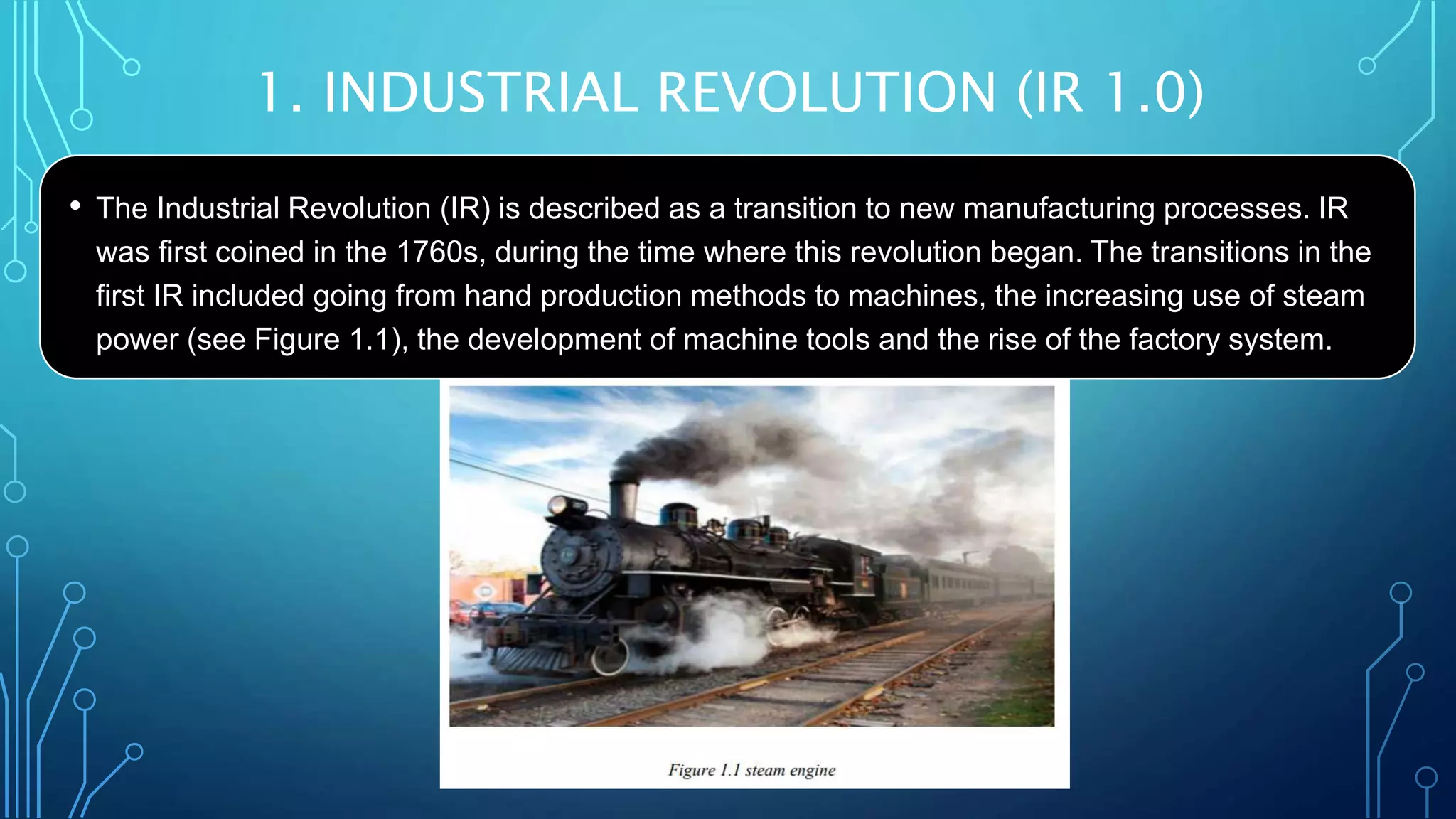
• The Industrial Revolution (IR) is described as a transition to new manufacturing processes. IR
was first coined in the 1760s, during the time where this revolution began. The transitions in the
first IR included going from hand production methods to machines, the increasing use of steam
power (see Figure 1.1), the development of machine tools and the rise of the factory system.
2. INDUSTRIAL REVOLUTION (IR 2.0)
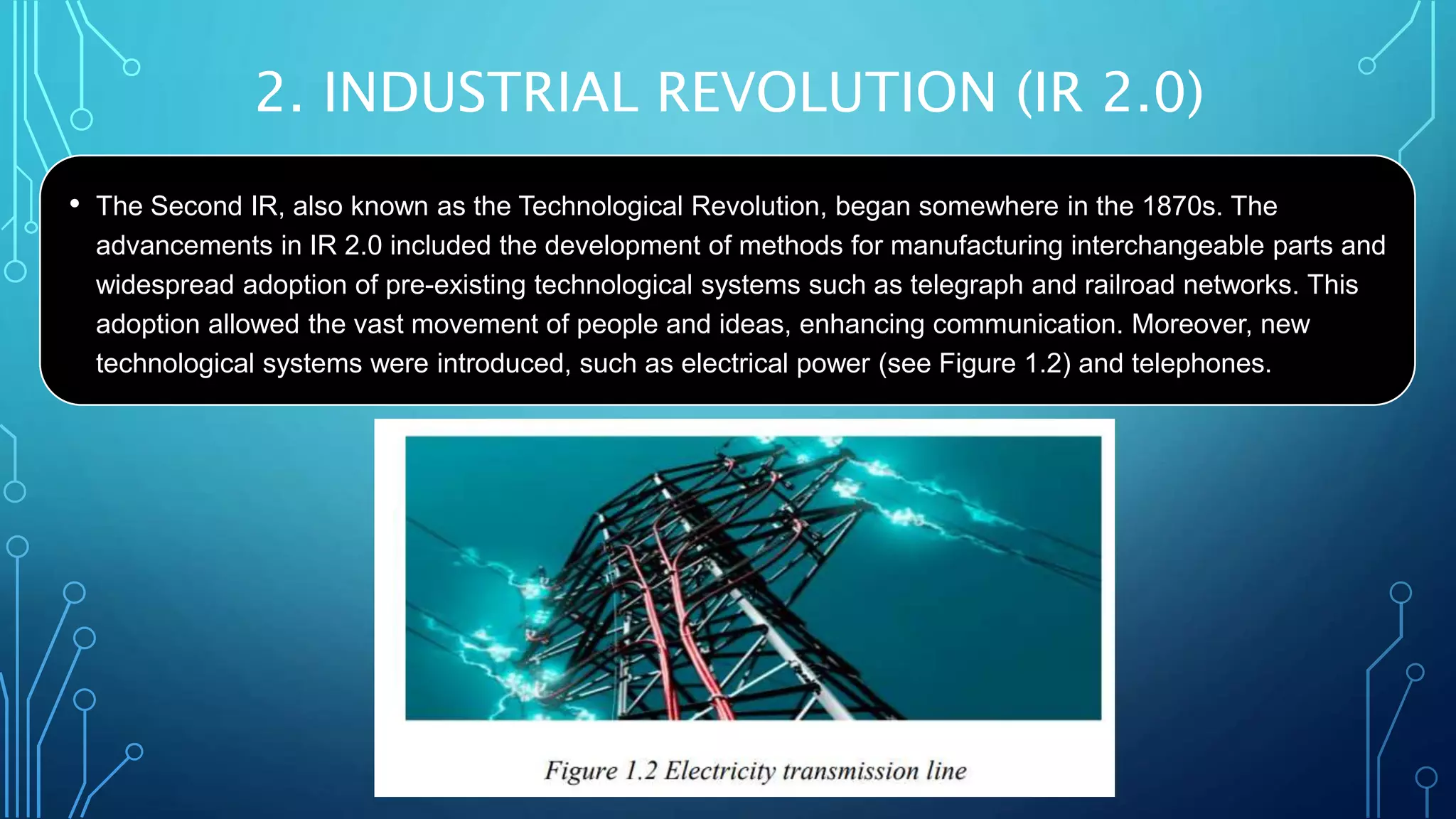
• The Second IR, also known as the Technological Revolution, began somewhere in the 1870s. The
advancements in IR 2.0 included the development of methods for manufacturing interchangeable parts and
widespread adoption of pre-existing technological systems such as telegraph and railroad networks. This
adoption allowed the vast movement of people and ideas, enhancing communication. Moreover, new
technological systems were introduced, such as electrical power (see Figure 1.2) and telephones.
3. INDUSTRIAL REVOLUTION (IR 3.0)
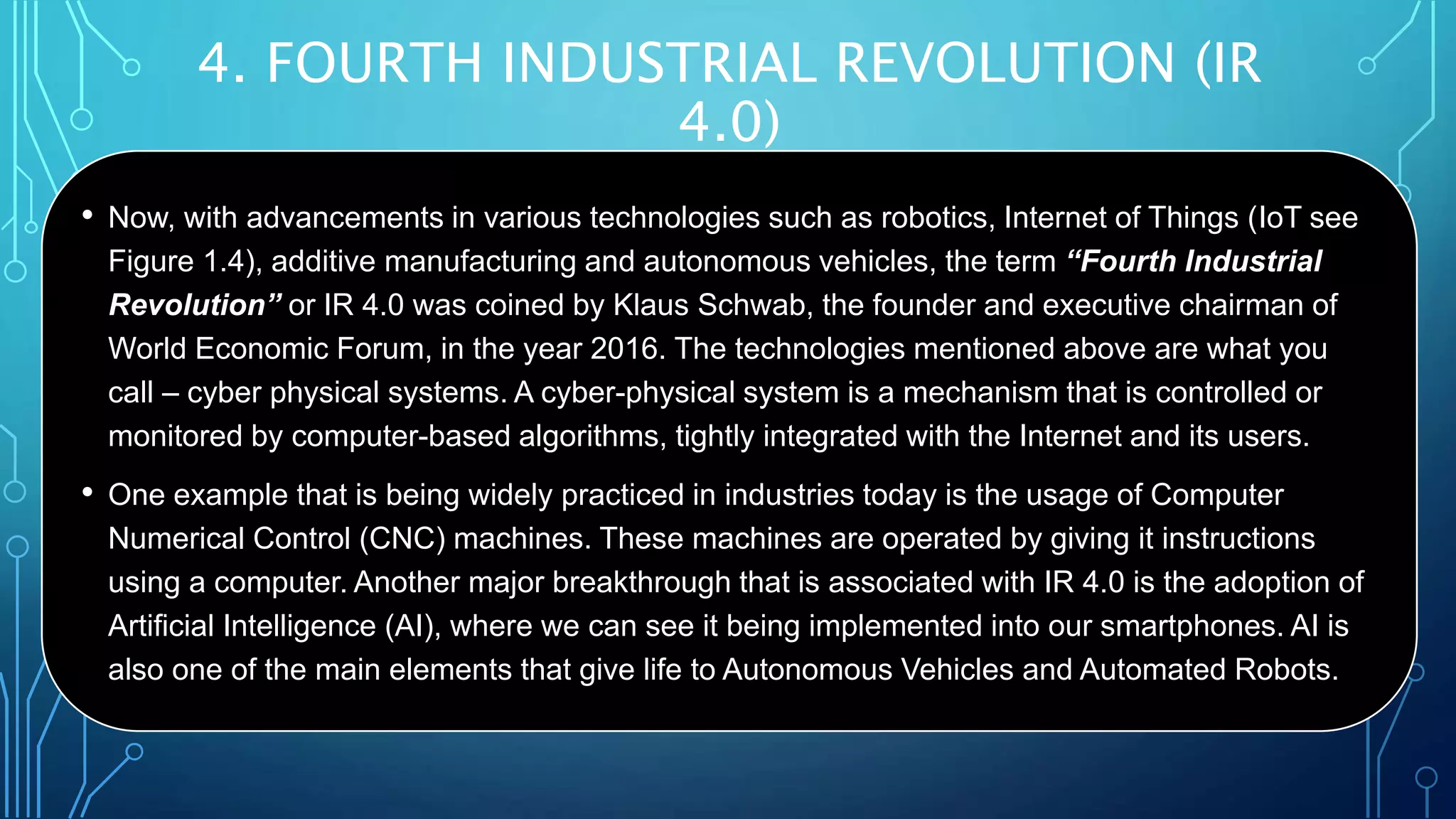
• Then came the Third Industrial Revolution (IR 3.0). IR 3.0 introduced the
transition from mechanical and analog electronic technology to digital
electronics (see Figure 1.3) which began from the late 1950s. Due to the shift
towards digitalization, IR 3.0 was given the nickname, “Digital Revolution”.
The core factor of this revolution is the mass production and widespread use of
digital logic circuits and its derived technologies such as the computer, hand
phones and the Internet. These technological innovations have arguably
transformed traditional production and business techniques enabling people to
communicate with another without the need of being physically present. Certain
practices that were enabled during IR 3.0 is still being practiced until this current
day, for example – the proliferation of digital computers and digital record.
3. INDUSTRIAL REVOLUTION (IR 3.0)
4. FOURTH INDUSTRIAL REVOLUTION (IR
4.0)
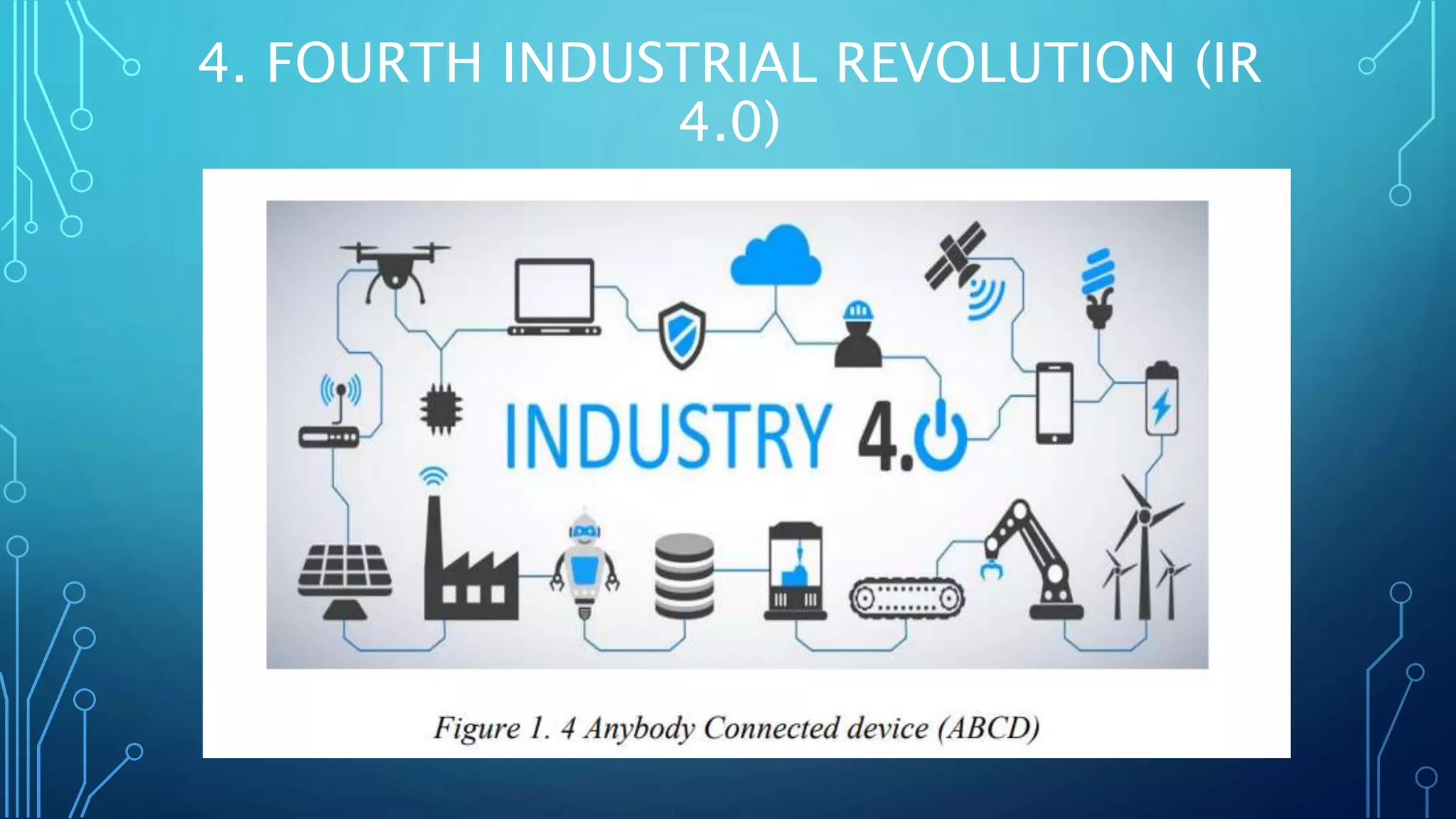
• Now, with advancements in various technologies such as robotics, Internet of Things (IoT see
Figure 1.4), additive manufacturing and autonomous vehicles, the term “Fourth Industrial
Revolution” or IR 4.0 was coined by Klaus Schwab, the founder and executive chairman of
World Economic Forum, in the year 2016. The technologies mentioned above are what you
call – cyber physical systems. A cyber-physical system is a mechanism that is controlled or
monitored by computer-based algorithms, tightly integrated with the Internet and its users.
• One example that is being widely practiced in industries today is the usage of Computer
Numerical Control (CNC) machines. These machines are operated by giving it instructions
using a computer. Another major breakthrough that is associated with IR 4.0 is the adoption of
Artificial Intelligence (AI), where we can see it being implemented into our smartphones. AI is
also one of the main elements that give life to Autonomous Vehicles and Automated Robots.
4. FOURTH INDUSTRIAL REVOLUTION (IR
4.0)
ROLE OF DATA FOR EMERGING
TECHNOLOGIES
• Data is regarded as the new oil and strategic asset since we are living
in the age of big data, and drives or even determines the future of
science, technology, the economy, and possibly everything in our world
today and tomorrow. Data have not only triggered tremendous hype
and buzz but more importantly, presents enormous challenges that in
turn bring incredible innovation and economic opportunities. This
reshaping and paradigm-shifting are driven not just by data itself but all
other aspects that could be created, transformed, and/or adjusted by
understanding, exploring, and utilizing data.
ENABLING DEVICES AND NETWORK
(PROGRAMMABLE DEVICES)
• In the world of digital electronic systems, there are four basic kinds of
devices: memory, microprocessors, logic, and networks.
• Memory devices store random information such as the contents of a
spreadsheet or database.
• Microprocessors execute software instructions to perform a wide variety of
tasks such as running a word processing program or video game.
• Logic devices provide specific functions, including device-to-device
interfacing, data communication, signal processing, data display, timing and
control operations, and almost every other function a system must perform.
• The network is a collection of computers, servers, mainframes, network
devices, peripherals, or other devices connected to one another to allow the
sharing of data.
ENABLING DEVICES AND NETWORK
(PROGRAMMABLE DEVICES)
WHY IS A COMPUTER REFERRED TO AS A
PROGRAMMABLE DEVICE?
Because what makes a computer a computer is that it
follows a set of instructions. Many electronic devices are
computers that perform only one operation, but they are still
following instructions that reside permanently in the unit.
LIST OF SOME PROGRAMMABLE DEVICES
• Achronix Speedster SPD60
• Actel’s
• Altera Stratix IV GT and Arria II GX
• Atmel’s AT91CAP7L
• Cypress Semiconductor’s
programmable system-on-chip
(PSoC) family
• Lattice Semiconductor’s ECP3
• Lime Microsystems’ LMS6002
• Silicon Blue Technologies
• Xilinx Virtex 6 and Spartan 6
• Xmos Semiconductor L series
A FULL RANGE OF NETWORK-RELATED
EQUIPMENT REFERRED TO AS SERVICE
ENABLING DEVICES (SEDS), WHICH CAN
INCLUDE:
• Traditional channel service unit
(CSU) and data service unit (DSU)
• Modems
• Routers
• Switches
• Conferencing equipment
• Network appliances (NIDs and
SIDs)
• Hosting equipment and servers
HUMAN TO MACHINE INTERACTION
Human-machine interaction (HMI) refers to the
communication and interaction between a human and
a machine via a user interface. Nowadays, natural user
interfaces such as gestures have gained increasing
attention as they allow humans to control machines
through natural and intuitive behaviors.
WHAT IS INTERACTION IN HUMAN-COMPUTER
INTERACTION?
HCI (human-computer interaction) is the study of how
people interact with computers and to what extent
computers are or are not developed for successful
interaction with human beings. As its name implies,
HCI consists of three parts: the user, the computer
itself, and the ways they work together.
HOW DO USERS INTERACT WITH
COMPUTERS?
The user interacts directly with hardware for the
human input and output such as displays, e.g.
through a graphical user interface. The user interacts
with the computer over this software interface using
the given input and output (I/O) hardware.
HOW IMPORTANT IS HUMAN-COMPUTER
INTERACTION?
The goal of HCI is to improve the interaction between
users and computers by making computers more
user-friendly and receptive to the user's needs. The
main advantages of HCI are simplicity, ease of
deployment & operations and cost savings for smaller
set-ups. They also reduce solution design time and
integration complexity.
DISCIPLINES CONTRIBUTING TO HUMAN-
COMPUTER INTERACTION (HCI)
• Cognitive psychology: Limitations, information
processing, performance prediction, cooperative
working, and capabilities.
• Computer science: Including graphics, technology,
prototyping tools, user interface management
systems.
• Linguistics.
• Engineering and design.
• Artificial intelligence.
• Human factors
FUTURE TRENDS IN EMERGING TECHNOLOGIES
EMERGING TECHNOLOGY TRENDS IN 2022
• Artificial Intelligence (AI) and Machine Learning (ML)
• Robotic Process Automation (RPA)
• Edge Computing.
• Quantum Computing.
• Virtual Reality (VR) and Augmented Reality (AR)
• Blockchain.
• Internet of Things (IoT)
• 5G Networks
Lesson 1 -  Introduction to Emerging Technologies.pptx

Lesson 1 - Introduction to Emerging Technologies.pptx

  • 1.
  • 2.
    LEARNING OUTCOMES: • Develop knowledgeabout the era of industrial evolutions • Identify the technological advances that made the industrial revolution possible • Describe the technological innovations that spurred industrialization • Identifies and understand the programmable device • Understand concepts relating to the design of human-computer interfaces in ways making computer-based systems comprehensive, friendly and usable.
  • 3.
    EVOLUTION OF TECHNOLOGIES •Emerging technology is a term generally used to describe a new technology, but it may also refer to the continuing development of existing technology; it can have slightly different meanings when used in different areas, such as media, business, science, or education. • The term commonly refers to technologies that are currently developing, or that are expected to be available within the next five to ten years, and is usually reserved for technologies that are creating or are expected to create significant social or economic effects. Technological evolution is a theory of radical transformation of society through technological development.
  • 4.
    WHAT IS THEROOT WORD OF TECHNOLOGY AND EVOLUTION? • Technology: 1610s, "discourse or treatise on an art or the arts," from Greek tekhnologia "systematic treatment of an art, craft, or technique," originally referring to grammar, from tekhno- (see techno-) + -logy. The meaning "science of the mechanical and industrial arts" is first recorded in 1859. • Evolution: evolution means the process of developing by gradual changes. This noun is from Latin evolutio, "an unrolling or opening," combined from the prefix e-, "out," plus volvere, "to roll."
  • 5.
    LIST OF SOMECURRENTLY AVAILABLE EMERGED TECHNOLOGIES • Artificial Intelligence • Blockchain • Augmented Reality and Virtual Reality • Cloud Computing • Angular and React • DevOps • Internet of Things (IoT) • Intelligent Apps (I-Apps) • Big Data • Robotic Processor Automation (RPA)
  • 6.
    INTRODUCTION TO THEINDUSTRIAL REVOLUTION (IR • The Industrial Revolution was a period of major industrialization and innovation that took place during the late 1700s and early 1800s. An Industrial Revolution at its core occurs when a society shifts from using tools to make products to use new sources of energy, such as coal, to power machines in factories. The revolution started in England, with a series of innovations to make labor more efficient and productive. The Industrial Revolution was a time when the manufacturing of goods moved from small shops and homes to large factories. This shift brought about changes in culture as people moved from rural areas to big cities in order to work.
  • 7.
    INTRODUCTION TO THEINDUSTRIAL REVOLUTION (IR • The American Industrial Revolution commonly referred to as the Second Industrial Revolution, started sometime between 1820 and 1870. The impact of changing the way items was manufactured had a wide reach. Industries such as textile manufacturing, mining, glass making, and agriculture all had undergone changes. For example, prior to the Industrial Revolution, textiles were primarily made of wool and were handspun. From the first industrial revolution (mechanization through water and steam power) to the mass production and assembly lines using electricity in the second, the fourth industrial revolution will take what was started in the third with the adoption of computers and automation and enhance it with smart and autonomous systems fueled by data and machine learning.
  • 8.
    INTRODUCTION TO THEINDUSTRIAL REVOLUTION (IR) • Generally, the following industrial revolutions fundamentally changed and transfer the world around us into modern society. • The steam engine, • The age of science and mass production, and • The rise of digital technology • Smart and autonomous systems fueled by data and machine learning.
  • 9.
    THE MOST IMPORTANTINVENTIONS OF THE INDUSTRIAL REVOLUTION • Transportation: The Steam Engine, The Railroad, The Diesel Engine, The Airplane. • Communication.: The Telegraph. The Transatlantic Cable. The Phonograph. The Telephone. • Industry: The Cotton Gin. The Sewing Machine. Electric Lights.
  • 10.
    THE FOUR TYPESOF INDUSTRIES ARE: • The primary industry involves getting raw materials e.g. mining, farming, and fishing. • The secondary industry involves manufacturing e.g. making cars and steel. • Tertiary industries provide a service e.g. teaching and nursing. • The quaternary industry involves research and development industries e.g. IT.
  • 11.
    1. INDUSTRIAL REVOLUTION(IR 1.0) • The Industrial Revolution (IR) is described as a transition to new manufacturing processes. IR was first coined in the 1760s, during the time where this revolution began. The transitions in the first IR included going from hand production methods to machines, the increasing use of steam power (see Figure 1.1), the development of machine tools and the rise of the factory system.
  • 12.
    2. INDUSTRIAL REVOLUTION(IR 2.0) • The Second IR, also known as the Technological Revolution, began somewhere in the 1870s. The advancements in IR 2.0 included the development of methods for manufacturing interchangeable parts and widespread adoption of pre-existing technological systems such as telegraph and railroad networks. This adoption allowed the vast movement of people and ideas, enhancing communication. Moreover, new technological systems were introduced, such as electrical power (see Figure 1.2) and telephones.
  • 13.
    3. INDUSTRIAL REVOLUTION(IR 3.0) • Then came the Third Industrial Revolution (IR 3.0). IR 3.0 introduced the transition from mechanical and analog electronic technology to digital electronics (see Figure 1.3) which began from the late 1950s. Due to the shift towards digitalization, IR 3.0 was given the nickname, “Digital Revolution”. The core factor of this revolution is the mass production and widespread use of digital logic circuits and its derived technologies such as the computer, hand phones and the Internet. These technological innovations have arguably transformed traditional production and business techniques enabling people to communicate with another without the need of being physically present. Certain practices that were enabled during IR 3.0 is still being practiced until this current day, for example – the proliferation of digital computers and digital record.
  • 14.
  • 15.
    4. FOURTH INDUSTRIALREVOLUTION (IR 4.0) • Now, with advancements in various technologies such as robotics, Internet of Things (IoT see Figure 1.4), additive manufacturing and autonomous vehicles, the term “Fourth Industrial Revolution” or IR 4.0 was coined by Klaus Schwab, the founder and executive chairman of World Economic Forum, in the year 2016. The technologies mentioned above are what you call – cyber physical systems. A cyber-physical system is a mechanism that is controlled or monitored by computer-based algorithms, tightly integrated with the Internet and its users. • One example that is being widely practiced in industries today is the usage of Computer Numerical Control (CNC) machines. These machines are operated by giving it instructions using a computer. Another major breakthrough that is associated with IR 4.0 is the adoption of Artificial Intelligence (AI), where we can see it being implemented into our smartphones. AI is also one of the main elements that give life to Autonomous Vehicles and Automated Robots.
  • 16.
    4. FOURTH INDUSTRIALREVOLUTION (IR 4.0)
  • 17.
    ROLE OF DATAFOR EMERGING TECHNOLOGIES • Data is regarded as the new oil and strategic asset since we are living in the age of big data, and drives or even determines the future of science, technology, the economy, and possibly everything in our world today and tomorrow. Data have not only triggered tremendous hype and buzz but more importantly, presents enormous challenges that in turn bring incredible innovation and economic opportunities. This reshaping and paradigm-shifting are driven not just by data itself but all other aspects that could be created, transformed, and/or adjusted by understanding, exploring, and utilizing data.
  • 18.
    ENABLING DEVICES ANDNETWORK (PROGRAMMABLE DEVICES) • In the world of digital electronic systems, there are four basic kinds of devices: memory, microprocessors, logic, and networks. • Memory devices store random information such as the contents of a spreadsheet or database. • Microprocessors execute software instructions to perform a wide variety of tasks such as running a word processing program or video game. • Logic devices provide specific functions, including device-to-device interfacing, data communication, signal processing, data display, timing and control operations, and almost every other function a system must perform. • The network is a collection of computers, servers, mainframes, network devices, peripherals, or other devices connected to one another to allow the sharing of data.
  • 19.
    ENABLING DEVICES ANDNETWORK (PROGRAMMABLE DEVICES)
  • 20.
    WHY IS ACOMPUTER REFERRED TO AS A PROGRAMMABLE DEVICE? Because what makes a computer a computer is that it follows a set of instructions. Many electronic devices are computers that perform only one operation, but they are still following instructions that reside permanently in the unit.
  • 21.
    LIST OF SOMEPROGRAMMABLE DEVICES • Achronix Speedster SPD60 • Actel’s • Altera Stratix IV GT and Arria II GX • Atmel’s AT91CAP7L • Cypress Semiconductor’s programmable system-on-chip (PSoC) family • Lattice Semiconductor’s ECP3 • Lime Microsystems’ LMS6002 • Silicon Blue Technologies • Xilinx Virtex 6 and Spartan 6 • Xmos Semiconductor L series
  • 22.
    A FULL RANGEOF NETWORK-RELATED EQUIPMENT REFERRED TO AS SERVICE ENABLING DEVICES (SEDS), WHICH CAN INCLUDE: • Traditional channel service unit (CSU) and data service unit (DSU) • Modems • Routers • Switches • Conferencing equipment • Network appliances (NIDs and SIDs) • Hosting equipment and servers
  • 23.
    HUMAN TO MACHINEINTERACTION Human-machine interaction (HMI) refers to the communication and interaction between a human and a machine via a user interface. Nowadays, natural user interfaces such as gestures have gained increasing attention as they allow humans to control machines through natural and intuitive behaviors.
  • 24.
    WHAT IS INTERACTIONIN HUMAN-COMPUTER INTERACTION? HCI (human-computer interaction) is the study of how people interact with computers and to what extent computers are or are not developed for successful interaction with human beings. As its name implies, HCI consists of three parts: the user, the computer itself, and the ways they work together.
  • 25.
    HOW DO USERSINTERACT WITH COMPUTERS? The user interacts directly with hardware for the human input and output such as displays, e.g. through a graphical user interface. The user interacts with the computer over this software interface using the given input and output (I/O) hardware.
  • 26.
    HOW IMPORTANT ISHUMAN-COMPUTER INTERACTION? The goal of HCI is to improve the interaction between users and computers by making computers more user-friendly and receptive to the user's needs. The main advantages of HCI are simplicity, ease of deployment & operations and cost savings for smaller set-ups. They also reduce solution design time and integration complexity.
  • 27.
    DISCIPLINES CONTRIBUTING TOHUMAN- COMPUTER INTERACTION (HCI) • Cognitive psychology: Limitations, information processing, performance prediction, cooperative working, and capabilities. • Computer science: Including graphics, technology, prototyping tools, user interface management systems. • Linguistics. • Engineering and design. • Artificial intelligence. • Human factors
  • 28.
    FUTURE TRENDS INEMERGING TECHNOLOGIES EMERGING TECHNOLOGY TRENDS IN 2022 • Artificial Intelligence (AI) and Machine Learning (ML) • Robotic Process Automation (RPA) • Edge Computing. • Quantum Computing. • Virtual Reality (VR) and Augmented Reality (AR) • Blockchain. • Internet of Things (IoT) • 5G Networks

Editor's Notes

  • #2 In this chapter evolution of technology, the role of data for emerging technology, enabling devices and networks for technologies (programmable devices), Human to Machine Interaction (HCI) and future trends of technologies are discussed.
  • #18 The preceding trend and its potential have triggered new debate about data-intensive scientific discovery as an emerging technology, the so-called “fourth industrial revolution,” There is no doubt, nevertheless, that the potential of data science and analytics to enable data-driven theory, economy, and professional development is increasingly being recognized. This involves not only core disciplines such as computing, informatics, and statistics, but also the broad-based fields of business, social science, and health/medical science.
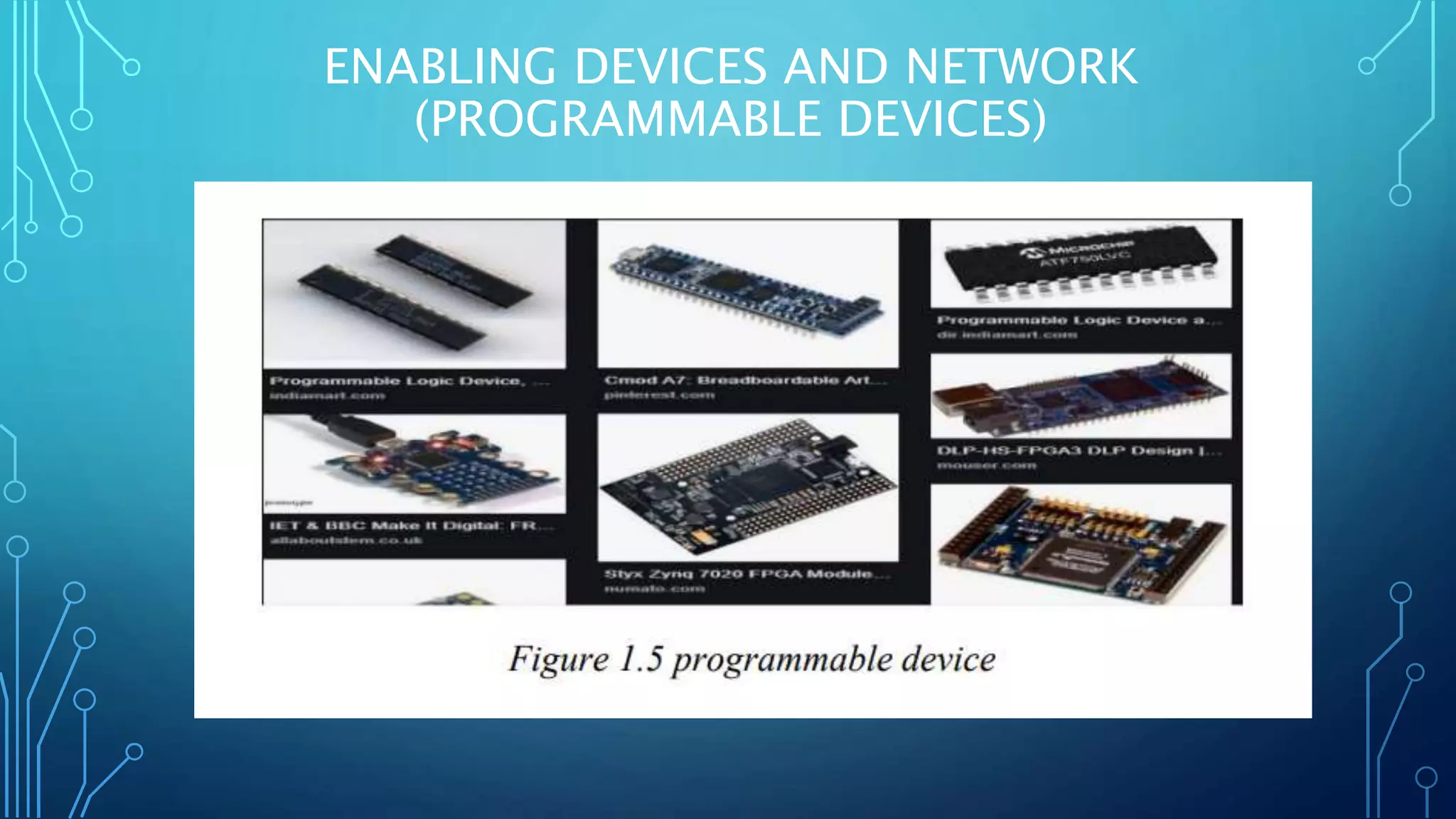
  • #19 An excellent example of a network is the Internet, which connects millions of people all over the world Programmable devices (see Figure 1.5) usually refer to chips that incorporate field programmable logic devices (FPGAs), complex programmable logic devices (CPLD) and programmable logic devices (PLD). There are also devices that are the analog equivalent of these called field programmable analog arrays.