#jiscdiglit


Developing Digital Skills and
Training to Boost Employment
Paul Bailey, Learning and Teaching Programme,
Joint Information Systems Committee (JISC)
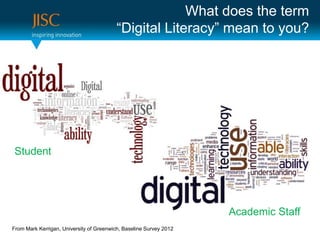
What does the term
                                          “Digital Literacy” mean to you?


 Student


                                                                    Academic Staff
From Mark Kerrigan, University of Greenwich, Baseline Survey 2012
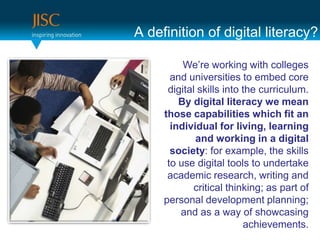
A definition of digital literacy?

          We’re working with colleges
       and universities to embed core
      digital skills into the curriculum.
         By digital literacy we mean
     those capabilities which fit an
       individual for living, learning
             and working in a digital
       society: for example, the skills
      to use digital tools to undertake
      academic research, writing and
             critical thinking; as part of
     personal development planning;
         and as a way of showcasing
                          achievements.
Employable Graduates are Digitally Literate

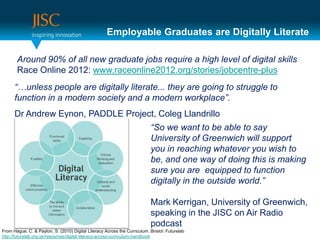
       Around 90% of all new graduate jobs require a high level of digital skills
       Race Online 2012: www.raceonline2012.org/stories/jobcentre-plus
      “…unless people are digitally literate... they are going to struggle to
      function in a modern society and a modern workplace”.
      Dr Andrew Eynon, PADDLE Project, Coleg Llandrillo
                                                                           “So we want to be able to say
                                                                           University of Greenwich will support
                                                                           you in reaching whatever you wish to
                                                                           be, and one way of doing this is making
                                                                           sure you are equipped to function
                                                                           digitally in the outside world.”

                                                                           Mark Kerrigan, University of Greenwich,
                                                                           speaking in the JISC on Air Radio
                                                                           podcast
From Hague, C. & Payton, S. (2010) Digital Literacy Across the Curriculum. Bristol: Futurelab
http://futurelab.org.uk/resources/digital-literacy-across-curriculum-handbook
Developing skills for employment

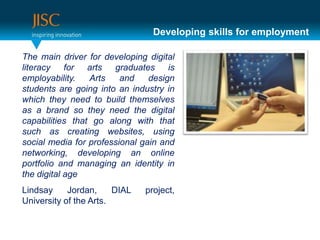
The main driver for developing digital
literacy for arts graduates is
employability.   Arts    and    design
students are going into an industry in
which they need to build themselves
as a brand so they need the digital
capabilities that go along with that
such as creating websites, using
social media for professional gain and
networking, developing an online
portfolio and managing an identity in
the digital age
Lindsay     Jordan,     DIAL   project,
University of the Arts.
Digital Literacies in the Subject Discipline


 “A digitally literate person in the Faculty of
 Humanities and Social Science is critically
and ethically aware, confident in engaging in
      a wide array of digital practices,
     resources/tools and academic and
professional environments, and establishing
               coherent identities”
PRiDE project, University of Bath        “The use of digital technologies and
                                          media by researchers potentially is
                                           changing what it means to be an
                                            effective researcher or skilled
                                           academic/professional in higher
                                                       education”
                                       John Igoe, Developing Digital Literacies
                                       Baseline Report, Vitae.
Digital Literacies of Staff


 “The Digital Department focus is on teaching assistants and recognises
  their importance as a staff group to supporting the development of the
   digital environment in departments but also contributing to the digital
        literacies of other academic and support staff and students”
Alison Gilry, The Digital Department project, University College London
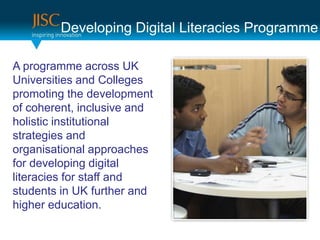
Developing Digital Literacies Programme

A programme across UK
Universities and Colleges
promoting the development
of coherent, inclusive and
holistic institutional
strategies and
organisational approaches
for developing digital
literacies for staff and
students in UK further and
higher education.
Working with Professional Associations

The sector bodies and professional    Organisational Development
associations JISC is working with        in Higher Education Group
initially include:                       (ODHE)
                                        Standing Conference on
 Association for Learning               Academic Practice (SCAP)
  Development in Higher                 Staff Development Forum
  Education (ALDinHE)                    (SDF)
 Association for Learning              Staff and Educational
  Technology (ALT)                       Development Association
 Association of University              (SEDA)
  Administrators (AUA)                  Society of College, National
 Heads of Educational                   and University Libraries
  Development Group (HEDG)               (SCONUL)
                                        Vitae
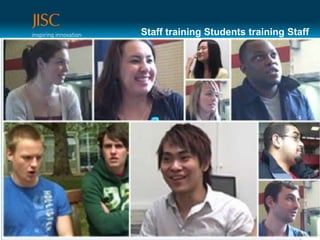
Staff training Students training Staff
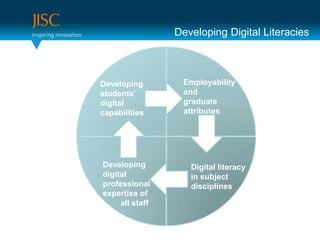
Developing Digital Literacies


Developing        Employability
students’         and
digital           graduate
capabilities      attributes


Developing          Digital literacy
digital             in subject
professional        disciplines
expertise of
     all staff
#jiscdiglit


Developing Digital Literacies
Keeping Informed Getting Involved
Developing Digital Literacies - http://bit.ly/ddl-prog

 JISC on Air online radio programmes
    – Part 1 - Digital Literacy – delivering the agenda within colleges and
      universities
    – Part 2 - Developing digital literacies for working in a digital world
    – Available from: www.jisc.ac.uk/jisconair
 Developing Digital Literacies webinar series 2012-13
 Summary of the projects baseline reports. Available online:
  http://bit.ly/JiUV0m
 Summary of the professional association baseline reports.
  Available online: http://bit.ly/KWFJUo
 Institutional videos from the Developing Digital Literacies projects
  visit http://bit.ly/jiscdlprogvideos to hear about how they are
  implementing digital literacies at a strategic level
Developing Digital Literacies
                                                  briefing paper

 Developing Digital Literacies Briefing
  paper available in June 2012, from
  http://bit.ly/ddl-prog and available to
  order from publications@jisc.ac.uk
 Provides a summary of the context and
                  .
  emerging outcomes of the programme
  together with links to relevant
  resources.
 Author Sarah Payton, Freelance
  Education Researcher and Facilitator

“Digital literacy is the intersection between
digital knowhow and academic practice. Or, if
you want to frame it differently, the ability to
learn, the ability to learn well.”
Helen Beetham, Synthesis consultant                    12/06/2012 | Slide 14
Further information and resources
 Programme blog - http://elearningprogs.jiscinvolve.org
 Digital Literacies Webinars - http://bit.ly/HKbYoy
 Join JISC-DIGLIT-PUBLIC@jiscmail.ac.uk
 Follow #jiscdiglit
 Come and speak to us – the programme will be represented at the
  Blended Learning Conference, HE Academy
  Conference, Greenwich e-Learning Conference, ALT-C with
  proposals submitted to SEDA Annual conference ( to add)
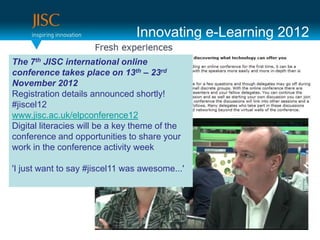
Innovating e-Learning 2012
The 7th JISC international online
conference takes place on 13th – 23rd
November 2012
Registration details announced shortly!
#jiscel12
www.jisc.ac.uk/elpconference12
Digital literacies will be a key theme of the
conference and opportunities to share your
work in the conference activity week

'I just want to say #jiscel11 was awesome...'

Jisc towards-a-digital-future-14 june2012-i1

  • 1.
    #jiscdiglit Developing Digital Skillsand Training to Boost Employment Paul Bailey, Learning and Teaching Programme, Joint Information Systems Committee (JISC)
  • 2.
    What does theterm “Digital Literacy” mean to you? Student Academic Staff From Mark Kerrigan, University of Greenwich, Baseline Survey 2012
  • 3.
    A definition ofdigital literacy? We’re working with colleges and universities to embed core digital skills into the curriculum. By digital literacy we mean those capabilities which fit an individual for living, learning and working in a digital society: for example, the skills to use digital tools to undertake academic research, writing and critical thinking; as part of personal development planning; and as a way of showcasing achievements.
  • 4.
    Employable Graduates areDigitally Literate Around 90% of all new graduate jobs require a high level of digital skills Race Online 2012: www.raceonline2012.org/stories/jobcentre-plus “…unless people are digitally literate... they are going to struggle to function in a modern society and a modern workplace”. Dr Andrew Eynon, PADDLE Project, Coleg Llandrillo “So we want to be able to say University of Greenwich will support you in reaching whatever you wish to be, and one way of doing this is making sure you are equipped to function digitally in the outside world.” Mark Kerrigan, University of Greenwich, speaking in the JISC on Air Radio podcast From Hague, C. & Payton, S. (2010) Digital Literacy Across the Curriculum. Bristol: Futurelab http://futurelab.org.uk/resources/digital-literacy-across-curriculum-handbook
  • 5.
    Developing skills foremployment The main driver for developing digital literacy for arts graduates is employability. Arts and design students are going into an industry in which they need to build themselves as a brand so they need the digital capabilities that go along with that such as creating websites, using social media for professional gain and networking, developing an online portfolio and managing an identity in the digital age Lindsay Jordan, DIAL project, University of the Arts.
  • 6.
    Digital Literacies inthe Subject Discipline “A digitally literate person in the Faculty of Humanities and Social Science is critically and ethically aware, confident in engaging in a wide array of digital practices, resources/tools and academic and professional environments, and establishing coherent identities” PRiDE project, University of Bath “The use of digital technologies and media by researchers potentially is changing what it means to be an effective researcher or skilled academic/professional in higher education” John Igoe, Developing Digital Literacies Baseline Report, Vitae.
  • 7.
    Digital Literacies ofStaff “The Digital Department focus is on teaching assistants and recognises their importance as a staff group to supporting the development of the digital environment in departments but also contributing to the digital literacies of other academic and support staff and students” Alison Gilry, The Digital Department project, University College London
  • 8.
    Developing Digital LiteraciesProgramme A programme across UK Universities and Colleges promoting the development of coherent, inclusive and holistic institutional strategies and organisational approaches for developing digital literacies for staff and students in UK further and higher education.
  • 9.
    Working with ProfessionalAssociations The sector bodies and professional  Organisational Development associations JISC is working with in Higher Education Group initially include: (ODHE)  Standing Conference on  Association for Learning Academic Practice (SCAP) Development in Higher  Staff Development Forum Education (ALDinHE) (SDF)  Association for Learning  Staff and Educational Technology (ALT) Development Association  Association of University (SEDA) Administrators (AUA)  Society of College, National  Heads of Educational and University Libraries Development Group (HEDG) (SCONUL)  Vitae
  • 10.
  • 11.
    Developing Digital Literacies Developing Employability students’ and digital graduate capabilities attributes Developing Digital literacy digital in subject professional disciplines expertise of all staff
  • 12.
  • 13.
    Developing Digital Literacies- http://bit.ly/ddl-prog  JISC on Air online radio programmes – Part 1 - Digital Literacy – delivering the agenda within colleges and universities – Part 2 - Developing digital literacies for working in a digital world – Available from: www.jisc.ac.uk/jisconair  Developing Digital Literacies webinar series 2012-13  Summary of the projects baseline reports. Available online: http://bit.ly/JiUV0m  Summary of the professional association baseline reports. Available online: http://bit.ly/KWFJUo  Institutional videos from the Developing Digital Literacies projects visit http://bit.ly/jiscdlprogvideos to hear about how they are implementing digital literacies at a strategic level
  • 14.
    Developing Digital Literacies briefing paper  Developing Digital Literacies Briefing paper available in June 2012, from http://bit.ly/ddl-prog and available to order from publications@jisc.ac.uk  Provides a summary of the context and . emerging outcomes of the programme together with links to relevant resources.  Author Sarah Payton, Freelance Education Researcher and Facilitator “Digital literacy is the intersection between digital knowhow and academic practice. Or, if you want to frame it differently, the ability to learn, the ability to learn well.” Helen Beetham, Synthesis consultant 12/06/2012 | Slide 14
  • 15.
    Further information andresources  Programme blog - http://elearningprogs.jiscinvolve.org  Digital Literacies Webinars - http://bit.ly/HKbYoy  Join JISC-DIGLIT-PUBLIC@jiscmail.ac.uk  Follow #jiscdiglit  Come and speak to us – the programme will be represented at the Blended Learning Conference, HE Academy Conference, Greenwich e-Learning Conference, ALT-C with proposals submitted to SEDA Annual conference ( to add)
  • 16.
    Innovating e-Learning 2012 The7th JISC international online conference takes place on 13th – 23rd November 2012 Registration details announced shortly! #jiscel12 www.jisc.ac.uk/elpconference12 Digital literacies will be a key theme of the conference and opportunities to share your work in the conference activity week 'I just want to say #jiscel11 was awesome...'

Editor's Notes

  • #3 Mark Kerrigan, University if Greenwich from responses from 79 staff and 223 students, “These graphical representations of both staff and students indicate an interesting perception of whatdigital literacies are. There was a strong indicator of ‘ability’ and ‘understanding’ with commentsaround ‘learning’ and ‘knowledge’ A lot of the responses refer to being able to use a technology, i.e.buttons to press and thus combined indicate areas of work for the project i.e. to develop and culture abetter intuitional understanding of DL.”
  • #5  “So we want to be able to say University of Greenwich will support you in reaching whatever you wish to be, and one way of doing this is making sure you are equipped to function digitally in the outside world.” Mark Kerrigan, University of Greenwich, JISC on AirMany learners enter further and higher education lacking the skills needed to apply digital technologies to education. As 90% of new jobs will require excellent digital skills, improving digital literacy is an essential component of developing employable graduates.Universities and Colleges recognise that Digital literacies are required for graduates to be employable. At Greenwich, digital literacies are being incorporated into the curriculum, they are involving students and employers to help them achieve this across all course. The University of Reading are also using work placements, skills assessment tools to ensure graduates develop the necessary employability skills.
  • #6 The University of Bath recognizes that digitally literacies can be specific to the subject discipline and are looking at faculty specific digital literacy frameworks to define the DL attributes of learners/graduates in a subject context. Digital literacies are also changing what it means to be a researcher, it is becoming increasingly difficult to learn or research effectively without digital skills in a modern university or college The implications and challenges for Universities and Colleges are two fold, 1. They need to ensure their students/graduates develop digital literacies to be employable2. That their own staff academic, research, library, administration are also developing digital literacy skills to be able to function within the digital university, and to support the development of digital literacies of their own students.
  • #7 The University of Bath recognizes that digitally literacies can be specific to the subject discipline and are looking at faculty specific digital literacy frameworks to define the DL attributes of learners/graduates in a subject context. Digital literacies are also changing what it means to be a researcher, it is becoming increasingly difficult to learn or research effectively without digital skills in a modern university or college The Digital Department focus is on teaching assistants and recognises theirimportance as a staff group to supporting the development of the digital environment in departments but also contributing to the digital literacies of other academic and support staff and studentsAlison Gilry, The Digital Department project, University College LondonThe implications and challenges for Universities and Colleges are two fold, 1. They need to ensure their students/graduates develop digital literacies to be employable2. That their own staff academic, research, library, administration are also developing digital literacy skills to be able to function within the digital university, and to support the development of digital literacies of their own students.
  • #8 The University of Bath recognizes that digitally literacies can be specific to the subject discipline and are looking at faculty specific digital literacy frameworks to define the DL attributes of learners/graduates in a subject context. Digital literacies are also changing what it means to be a researcher, it is becoming increasingly difficult to learn or research effectively without digital skills in a modern university or college The implications and challenges for Universities and Colleges are two fold, 1. They need to ensure their students/graduates develop digital literacies to be employable2. That their own staff academic, research, library, administration are also developing digital literacy skills to be able to function within the digital university, and to support the development of digital literacies of their own students.
  • #9 The JISC are working with 12 institutions covering a wide spectrum of staff roles (academic, library, admin, researcher, etc.) and students from college students through to post graduates, to promote the development of strategic organisation approaches to developing digital literacies. The institutions are looking at several aspects ranging from employability and graduate attributes to learning and information skills. They are also looking at the technical and infrastructure issues such as use of personal devices, implications for wireless networks, a the BYO culture.
  • #10 To support embedding of digital literacies we are also working with sector bodies and professional associations, through their member networks to promote and facilitate change. Informing the development of recognition frameworks for staff in higher and further education, through the associations own professional frameworks such as the AUA CPD Framework , SCONUL 7 pillars model which now has a DL lens, also producing guidelines on the UK Professional Standards Framework. A national qualification is also been developed for FE through OCN.
  • #11 Although students are coming with increasing digital skills and competencies, they still require guidance in developing learning related and academic digital practices. Some students may be arriving with good social digital skills (facebook, twitter, smart phone, etc) but they may not be familiar with the tools and digital practices required for academic learning whether using a referencing tool or effectively researching information. Excellent learners used to be those who read beyond the core texts, they are now also those who both reference and use additional materials.Student expectations of staff digital skills are high, the reality is more varied. Staff expect students to have digital skills where in many case they don’t or are unable to apply them to learning activities. Employers report similar experiences with graduates in the work place. Students’ with digital literacies are being offered the opportunity to both support and influence the institutional approaches to developing digital literacies.At Oxford Brookes University student pioneers are being used, working with in partnership with staff, to develop resources, mentor and support staff – the benefits are mutual, learning from each other, a net gain for the institution. The students are offered recognition and reward through a scheme recognized by the Institute for Leadership and Management and can gain academic credit.We’re just about to start some work with the NUS, QAA, and others around supporting and recognition for students working as change agents and e-pioneers across our projects.