SUPPORTING DIGITAL LITERACY
  DEVELOPMENT IN OUR STUDENTS


Dr. Rhona Sharpe
rsharpe@brookes.ac.uk

For Highbury College, Portsmouth
12 December 2012


Oxford Centre for Staff and Learning Development
brookes.ac.uk/services/ocsld
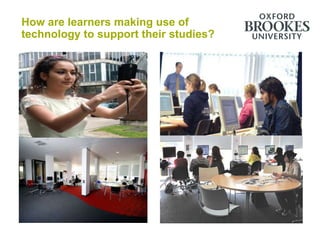
How are learners making use of
technology to support their studies?
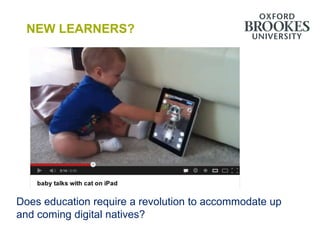
NEW LEARNERS?


Does education require a revolution to accommodate up
and coming digital natives?
OVERVIEW OF CURRENT
  RESEARCH

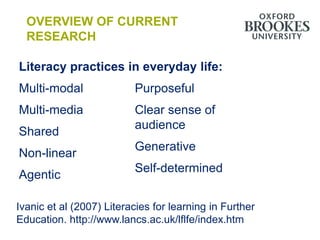
Literacy practices in everyday life:
Multi-modal               Purposeful
Multi-media               Clear sense of
                          audience
Shared
                          Generative
Non-linear
                          Self-determined
Agentic

Ivanic et al (2007) Literacies for learning in Further
Education. http://www.lancs.ac.uk/lflfe/index.htm
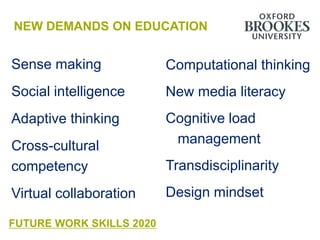
NEW DEMANDS ON EDUCATION


Sense making              Computational thinking
Social intelligence       New media literacy
Adaptive thinking         Cognitive load
Cross-cultural             management
competency                Transdisciplinarity
Virtual collaboration     Design mindset

FUTURE WORK SKILLS 2020
OVERVIEW OF CURRENT
 RESEARCH


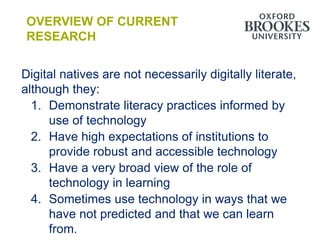
Digital natives are not necessarily digitally literate,
although they:
  1. Demonstrate literacy practices informed by
     use of technology
  2. Have high expectations of institutions to
     provide robust and accessible technology
  3. Have a very broad view of the role of
     technology in learning
  4. Sometimes use technology in ways that we
     have not predicted and that we can learn
     from.
How would you characterize
a digitally literate learner?
DEFINITIONS


“The use of the term literacy implies a broader
form of education about media that is not
restricted to mechanical skills or narrow forms of
functional competence. It suggests a more
rounded, humanistic conception‟
(Buckingham, 2006)
“Digital literacy expresses the sum of capabilities
an individual needs to live, learn and work in a
digital society” (JISC, Developing Digital Literacy
Workshops, 2011)
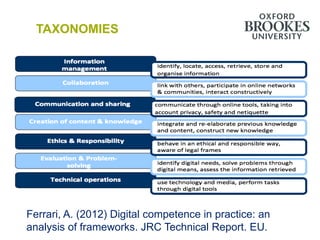
TAXONOMIES


Ferrari, A. (2012) Digital competence in practice: an
analysis of frameworks. JRC Technical Report. EU.
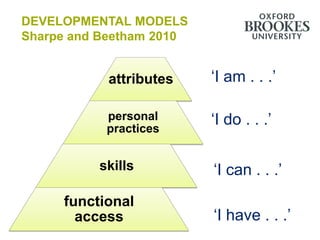
DEVELOPMENTAL MODELS
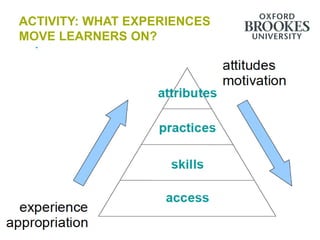
Sharpe and Beetham 2010


            attributes    „I am . . .‟

           personal
           practices
                          „I do . . .‟

          skills          „I can . . .‟
     functional
       access             „I have . . .‟
BRINGING IT ALL TOGETHER


At Oxford Brookes University, digital and
information literacy is defined as ..
The functional access, skills and practices
necessary to become a confident, agile
adopter of a range of technologies for
personal, academic and professional use

https://wiki.brookes.ac.uk/display/slidacases/Oxford+Brookes
REFLECTION POINT 1


What definition of digital literacy would
make sense and help people to take
action, in your context of work?


     Tweet your thoughts using the tag
               #dlhighbury
WHOSE RESPONSIBILITY?
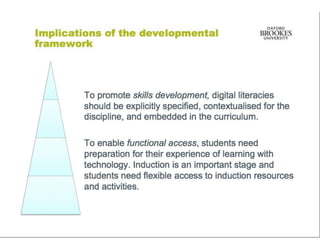
Implications of the developmental framework 1

From ISL
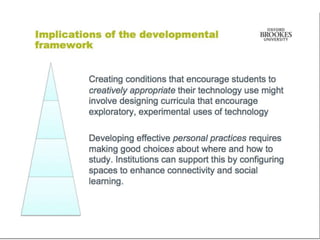
Implications of the developmental framework 2

From ISL
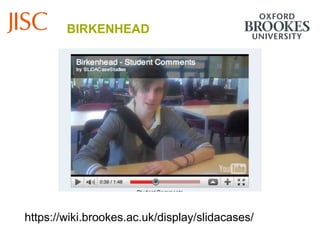
BIRKENHEAD


https://wiki.brookes.ac.uk/display/slidacases/
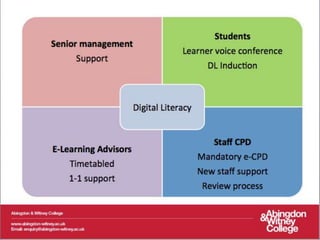
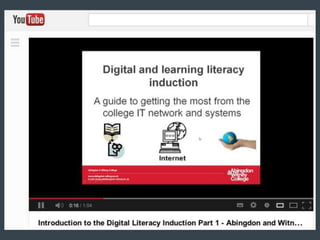
ABINGDON AND WITNEY
DALLI
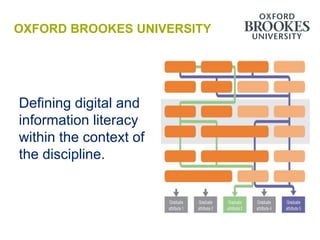
OXFORD BROOKES UNIVERSITY


Defining digital and
information literacy
within the context of
the discipline.
What does it mean to be
digitally literate in . . .?
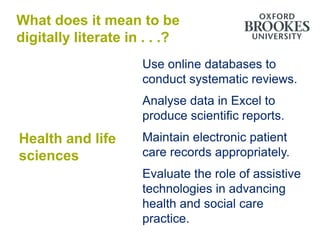
                     Use online databases to
                     conduct systematic reviews.
                     Analyse data in Excel to
                     produce scientific reports.
Health and life      Maintain electronic patient
sciences             care records appropriately.
                     Evaluate the role of assistive
                     technologies in advancing
                     health and social care
                     practice.
What does it mean to be
digitally literate in . . .?

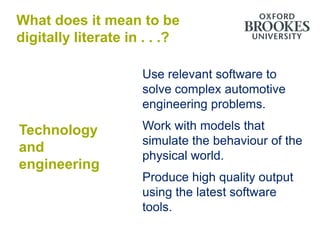
                     Use relevant software to
                     solve complex automotive
                     engineering problems.

Technology           Work with models that
                     simulate the behaviour of the
and
                     physical world.
engineering
                     Produce high quality output
                     using the latest software
                     tools.
ACTIVITY: WHAT EXPERIENCES
MOVE LEARNERS ON?
REFLECTION POINT 2


What experiences which move students on
already exist at Highbury?
What more could you be doing?


Tweet your thoughts to #dlhighbury
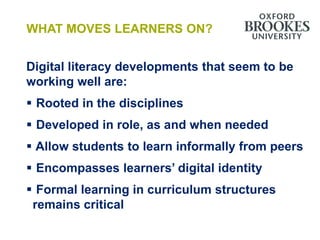
WHAT MOVES LEARNERS ON?


Digital literacy developments that seem to be
working well are:
 Rooted in the disciplines
 Developed in role, as and when needed
 Allow students to learn informally from peers
 Encompasses learners’ digital identity
 Formal learning in curriculum structures
 remains critical
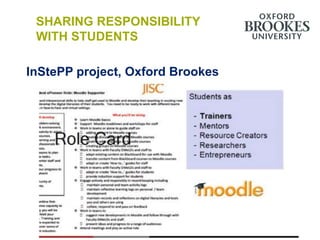
SHARING RESPONSIBILITY
 WITH STUDENTS

InStePP project, Oxford Brookes
SHARING RESPONSIBILITY
           WITH STUDENTS

InStePP project, Oxford Brookes
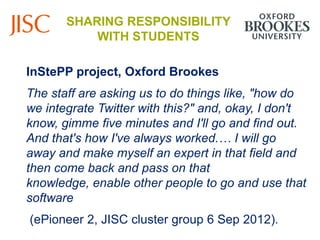
The staff are asking us to do things like, "how do
we integrate Twitter with this?" and, okay, I don't
know, gimme five minutes and I'll go and find out.
And that's how I've always worked.… I will go
away and make myself an expert in that field and
then come back and pass on that
knowledge, enable other people to go and use that
software
(ePioneer 2, JISC cluster group 6 Sep 2012).
ACTIVITY: ACTION PLANNING


Divide into four equally sized groups ….
REFLECTION POINT 3


What will you personally do next to move
this agenda on?


Tweet your thoughts to #dlhighbury
SUMMARY

Graduates who will thrive in the digital age
  will need the confidence and agility to
  respond to complex and changing
  circumstance.
The powerful influence of context means that
  teachers and their institutions should take
  the lead in developing their learners.
Learner development can be understood as
  developing functional access, skills,
  personal practices and attributes.
CREDITS


Much of the research on which this presentation is
based was funded by the JISC, including
• The Learners Experiences of e-learning programme
• The Supporting Learners in a Digital Age project
• The InSTePP project

The images used in this presentation are taken from
the JISC Learner Experiences with E-learning key
messages slides, available from
https://mw.brookes.ac.uk/display/JISCLE2

Sources can be found on my Delicious account, tagged
„Highbury‟.

Developing digital literacy, Highbury College

  • 1.
    SUPPORTING DIGITAL LITERACY DEVELOPMENT IN OUR STUDENTS Dr. Rhona Sharpe rsharpe@brookes.ac.uk For Highbury College, Portsmouth 12 December 2012 Oxford Centre for Staff and Learning Development brookes.ac.uk/services/ocsld
  • 2.
    How are learnersmaking use of technology to support their studies?
  • 3.
    NEW LEARNERS? Does educationrequire a revolution to accommodate up and coming digital natives?
  • 4.
    OVERVIEW OF CURRENT RESEARCH Literacy practices in everyday life: Multi-modal Purposeful Multi-media Clear sense of audience Shared Generative Non-linear Self-determined Agentic Ivanic et al (2007) Literacies for learning in Further Education. http://www.lancs.ac.uk/lflfe/index.htm
  • 5.
    NEW DEMANDS ONEDUCATION Sense making Computational thinking Social intelligence New media literacy Adaptive thinking Cognitive load Cross-cultural management competency Transdisciplinarity Virtual collaboration Design mindset FUTURE WORK SKILLS 2020
  • 6.
    OVERVIEW OF CURRENT RESEARCH Digital natives are not necessarily digitally literate, although they: 1. Demonstrate literacy practices informed by use of technology 2. Have high expectations of institutions to provide robust and accessible technology 3. Have a very broad view of the role of technology in learning 4. Sometimes use technology in ways that we have not predicted and that we can learn from.
  • 7.
    How would youcharacterize a digitally literate learner?
  • 8.
    DEFINITIONS “The use ofthe term literacy implies a broader form of education about media that is not restricted to mechanical skills or narrow forms of functional competence. It suggests a more rounded, humanistic conception‟ (Buckingham, 2006) “Digital literacy expresses the sum of capabilities an individual needs to live, learn and work in a digital society” (JISC, Developing Digital Literacy Workshops, 2011)
  • 9.
    TAXONOMIES Ferrari, A. (2012)Digital competence in practice: an analysis of frameworks. JRC Technical Report. EU.
  • 10.
    DEVELOPMENTAL MODELS Sharpe andBeetham 2010 attributes „I am . . .‟ personal practices „I do . . .‟ skills „I can . . .‟ functional access „I have . . .‟
  • 11.
    BRINGING IT ALLTOGETHER At Oxford Brookes University, digital and information literacy is defined as .. The functional access, skills and practices necessary to become a confident, agile adopter of a range of technologies for personal, academic and professional use https://wiki.brookes.ac.uk/display/slidacases/Oxford+Brookes
  • 12.
    REFLECTION POINT 1 Whatdefinition of digital literacy would make sense and help people to take action, in your context of work? Tweet your thoughts using the tag #dlhighbury
  • 13.
  • 14.
    Implications of thedevelopmental framework 1 From ISL
  • 15.
    Implications of thedevelopmental framework 2 From ISL
  • 16.
  • 17.
  • 18.
  • 19.
    OXFORD BROOKES UNIVERSITY Definingdigital and information literacy within the context of the discipline.
  • 20.
    What does itmean to be digitally literate in . . .? Use online databases to conduct systematic reviews. Analyse data in Excel to produce scientific reports. Health and life Maintain electronic patient sciences care records appropriately. Evaluate the role of assistive technologies in advancing health and social care practice.
  • 21.
    What does itmean to be digitally literate in . . .? Use relevant software to solve complex automotive engineering problems. Technology Work with models that simulate the behaviour of the and physical world. engineering Produce high quality output using the latest software tools.
  • 22.
  • 23.
    REFLECTION POINT 2 Whatexperiences which move students on already exist at Highbury? What more could you be doing? Tweet your thoughts to #dlhighbury
  • 24.
    WHAT MOVES LEARNERSON? Digital literacy developments that seem to be working well are:  Rooted in the disciplines  Developed in role, as and when needed  Allow students to learn informally from peers  Encompasses learners’ digital identity  Formal learning in curriculum structures remains critical
  • 25.
    SHARING RESPONSIBILITY WITHSTUDENTS InStePP project, Oxford Brookes
  • 26.
    SHARING RESPONSIBILITY WITH STUDENTS InStePP project, Oxford Brookes The staff are asking us to do things like, "how do we integrate Twitter with this?" and, okay, I don't know, gimme five minutes and I'll go and find out. And that's how I've always worked.… I will go away and make myself an expert in that field and then come back and pass on that knowledge, enable other people to go and use that software (ePioneer 2, JISC cluster group 6 Sep 2012).
  • 27.
    ACTIVITY: ACTION PLANNING Divideinto four equally sized groups ….
  • 28.
    REFLECTION POINT 3 Whatwill you personally do next to move this agenda on? Tweet your thoughts to #dlhighbury
  • 29.
    SUMMARY Graduates who willthrive in the digital age will need the confidence and agility to respond to complex and changing circumstance. The powerful influence of context means that teachers and their institutions should take the lead in developing their learners. Learner development can be understood as developing functional access, skills, personal practices and attributes.
  • 30.
    CREDITS Much of theresearch on which this presentation is based was funded by the JISC, including • The Learners Experiences of e-learning programme • The Supporting Learners in a Digital Age project • The InSTePP project The images used in this presentation are taken from the JISC Learner Experiences with E-learning key messages slides, available from https://mw.brookes.ac.uk/display/JISCLE2 Sources can be found on my Delicious account, tagged „Highbury‟.

Editor's Notes

  • #7 What we do know is that -
  • #10 All agree? Are these statements enough?Probably not, in fact the 2012 European Commission report on expert’s view of digital competence, starts from the premise that educators require more clarity from such definitions.
  • #17 Students appreciate being allowed - encouraged – to use their own devices, and similar cheap accessible devices (flip cams) purchased by the college.
  • #25 It’s about authentic, informal learningBUT, until this happening well, formal learning remains critical.
  • #26 In other words, in a multiplicity of ways some of the existing ePioneers exemplify the Oxford Brookes digital and information literacy graduate attribute, being ‘confident, agile adopter(s) of a range of technologies for personal, academic and professional use’. It is this confidence and agility, rather than specific knowledge of software or devices, that is of greatest value to the project and to developing the digital literacies of others. The ePioneers suggested that as far as possible supplementary ePioneer training on how to use various digital tools should be made available online so that ePioneers can ‘do all the training in their own time and then in their e-portfolio tick off the training when it's done’ (ePioneer 1, 14 Sep 2012).
  • #27 In other words, in a multiplicity of ways some of the existing ePioneers exemplify the Oxford Brookes digital and information literacy graduate attribute, being ‘confident, agile adopter(s) of a range of technologies for personal, academic and professional use’. It is this confidence and agility, rather than specific knowledge of software or devices, that is of greatest value to the project and to developing the digital literacies of others. The ePioneers suggested that as far as possible supplementary ePioneer training on how to use various digital tools should be made available online so that ePioneers can ‘do all the training in their own time and then in their e-portfolio tick off the training when it's done’ (ePioneer 1, 14 Sep 2012).
  • #28 Flipcharts headed…Teaching staffStudents Support staffSenior Management
  • #30 .. Rather than mastery of specific system. . Of course all students need baseline skills, but graduates need to have applied these skills in challenging contexts and with high-level tasks. (GRADUATE ATTRIBUTES)Digital skills should not be bolted onto existing provision. Rather, the institution needs to renew its core practices in the light of new digital challenges and opportunities. Digital literacy can be incorporated into the student experience as an aspect of professionalism, employability, citizenship, and other core values and attributes of becoming a graduate.Students' technology skills are shared very readily, including with academic staff! Students may lack experience in professional and academic practice, but their technical know-how can be harnessed through peer working, paid support roles, internships and mentoring schemes.Students needopportunities to express and develop their personal preferences for technology. Use of their own devices and services for study should be encouraged and supported. Social and personal uses of technology are important in their own right to help students fit learning into their lives and maintain their commitment to study.  Institutions should find different ways to involve students in shaping their experience of learning with technology. This might be directly, for example giving choices about technology, or asking for and responding to feedback in class. Or it might be indirectly, such as working with course representatives and the Students Union to improve the learning experience.All of the institutions involved in SLIDA were taking a long-term view of development. They were not interested in quick fix investments but an iterative process of consultation and review, embedding new practices of student support in ways that could be sustained.