Digital Financial Services for
Cocoa Farmers in Côte d’Ivoire
July 2016
MARKET CONTEXT
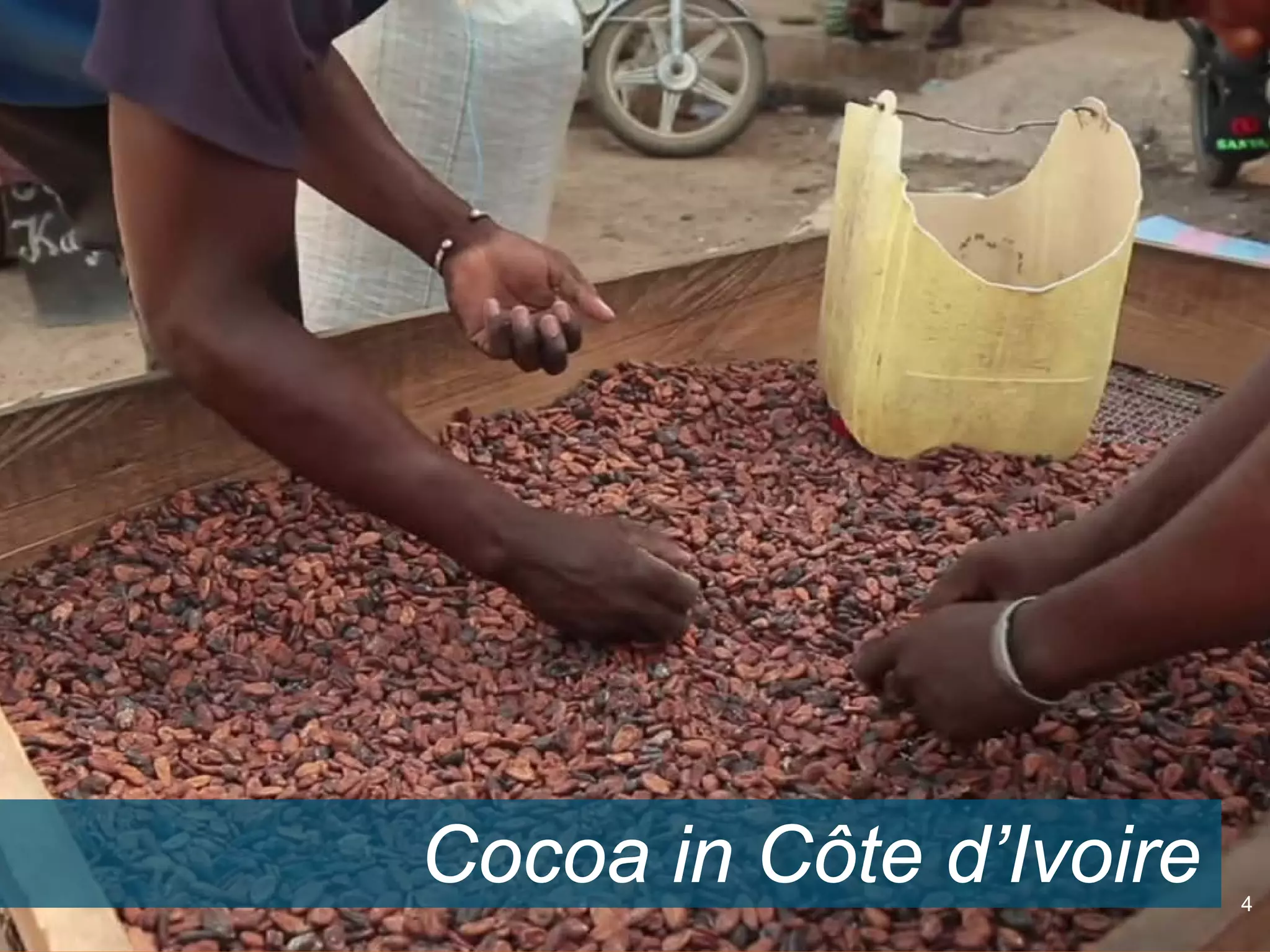
Cocoa in Côte d’Ivoire
Advans Côte d’Ivoire
PROJECT OVERVIEW
Feasibility Study
Solution Development
Pilot Implementation
CHALLENGES AND LESSONS LEARNED
Challenges
Lessons Learned
3
4
7
9
12
17
22
26
27
29
Contents
3
MARKET CONTEXT
Cocoa in Côte d’Ivoire 4
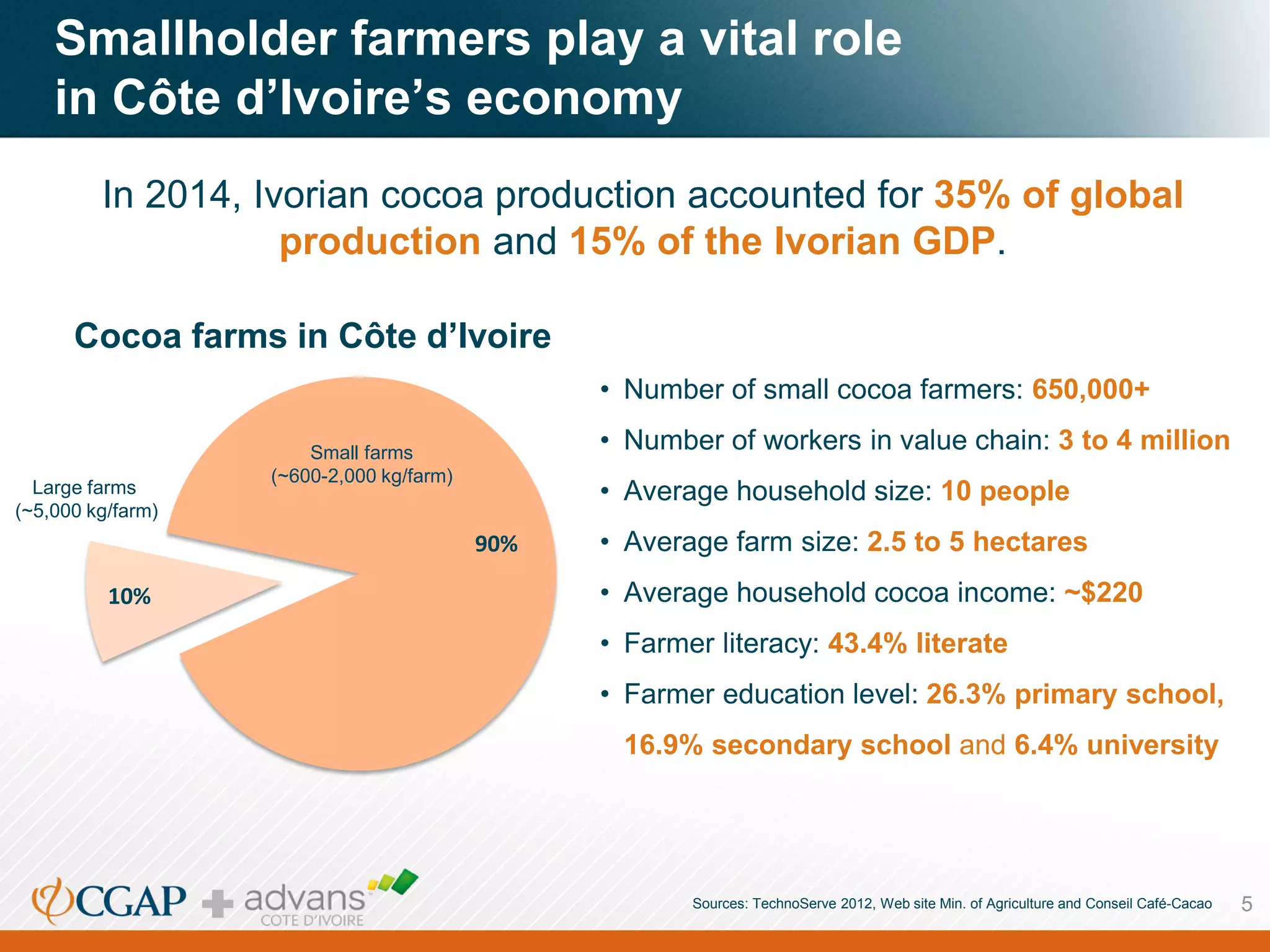
In 2014, Ivorian cocoa production accounted for 35% of global
production and 15% of the Ivorian GDP.
5Sources: TechnoServe 2012, Web site Min. of Agriculture and Conseil Café-Cacao
• Number of small cocoa farmers: 650,000+
• Number of workers in value chain: 3 to 4 million
• Average household size: 10 people
• Average farm size: 2.5 to 5 hectares
• Average household cocoa income: ~$220
• Farmer literacy: 43.4% literate
• Farmer education level: 26.3% primary school,
16.9% secondary school and 6.4% university
10%
90%
Smallholder farmers play a vital role
in Côte d’Ivoire’s economy
Cocoa farms in Côte d’Ivoire
Small farms
(~600-2,000 kg/farm)
Large farms
(~5,000 kg/farm)
These farmers remain largely excluded
from formal financial services
6
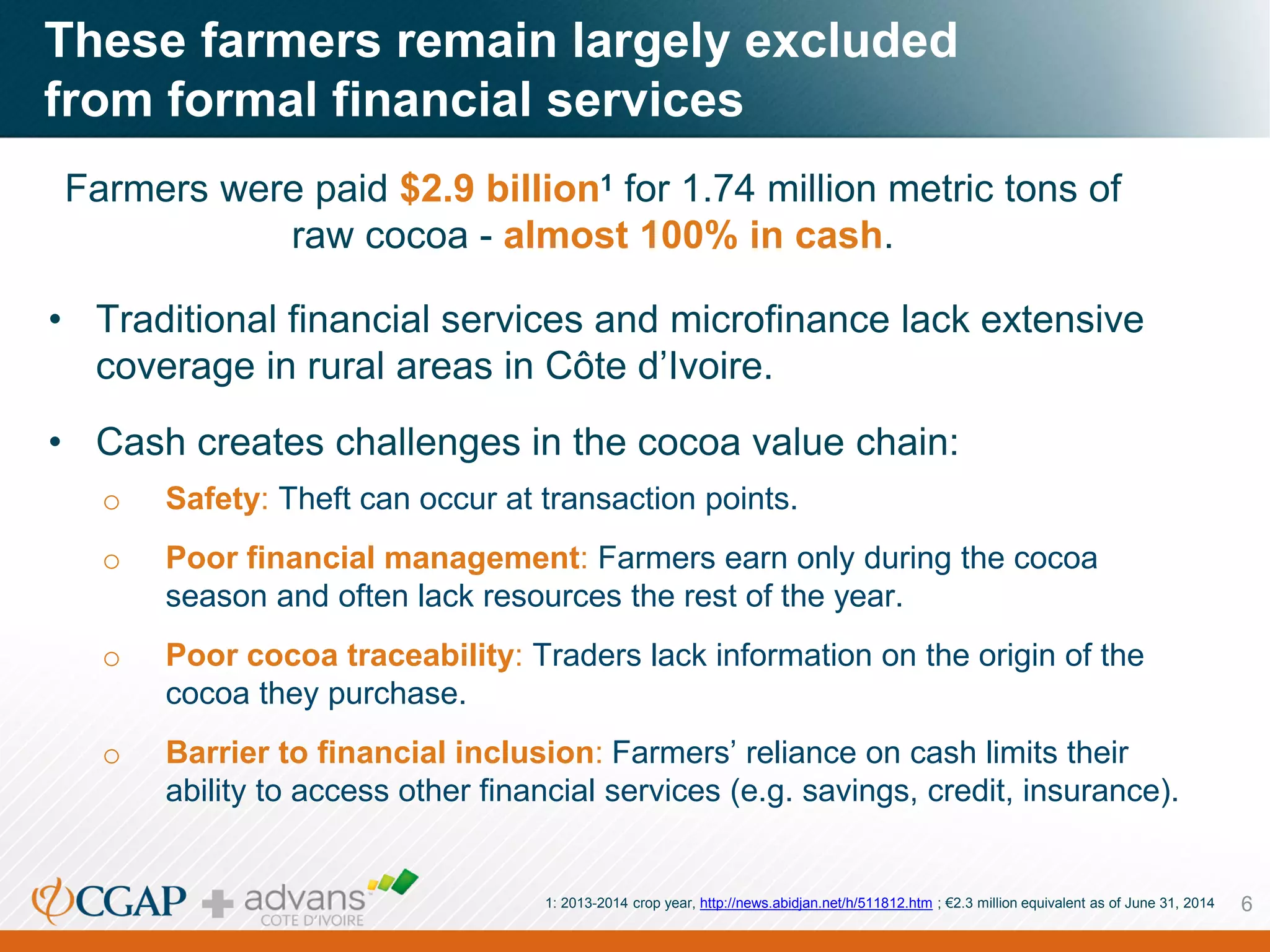
Farmers were paid $2.9 billion1 for 1.74 million metric tons of
raw cocoa - almost 100% in cash.
• Traditional financial services and microfinance lack extensive
coverage in rural areas in Côte d’Ivoire.
• Cash creates challenges in the cocoa value chain:
o Safety: Theft can occur at transaction points.
o Poor financial management: Farmers earn only during the cocoa
season and often lack resources the rest of the year.
o Poor cocoa traceability: Traders lack information on the origin of the
cocoa they purchase.
o Barrier to financial inclusion: Farmers’ reliance on cash limits their
ability to access other financial services (e.g. savings, credit, insurance).
1: 2013-2014 crop year, http://news.abidjan.net/h/511812.htm ; €2.3 million equivalent as of June 31, 2014
Advans Côte d’Ivoire 7
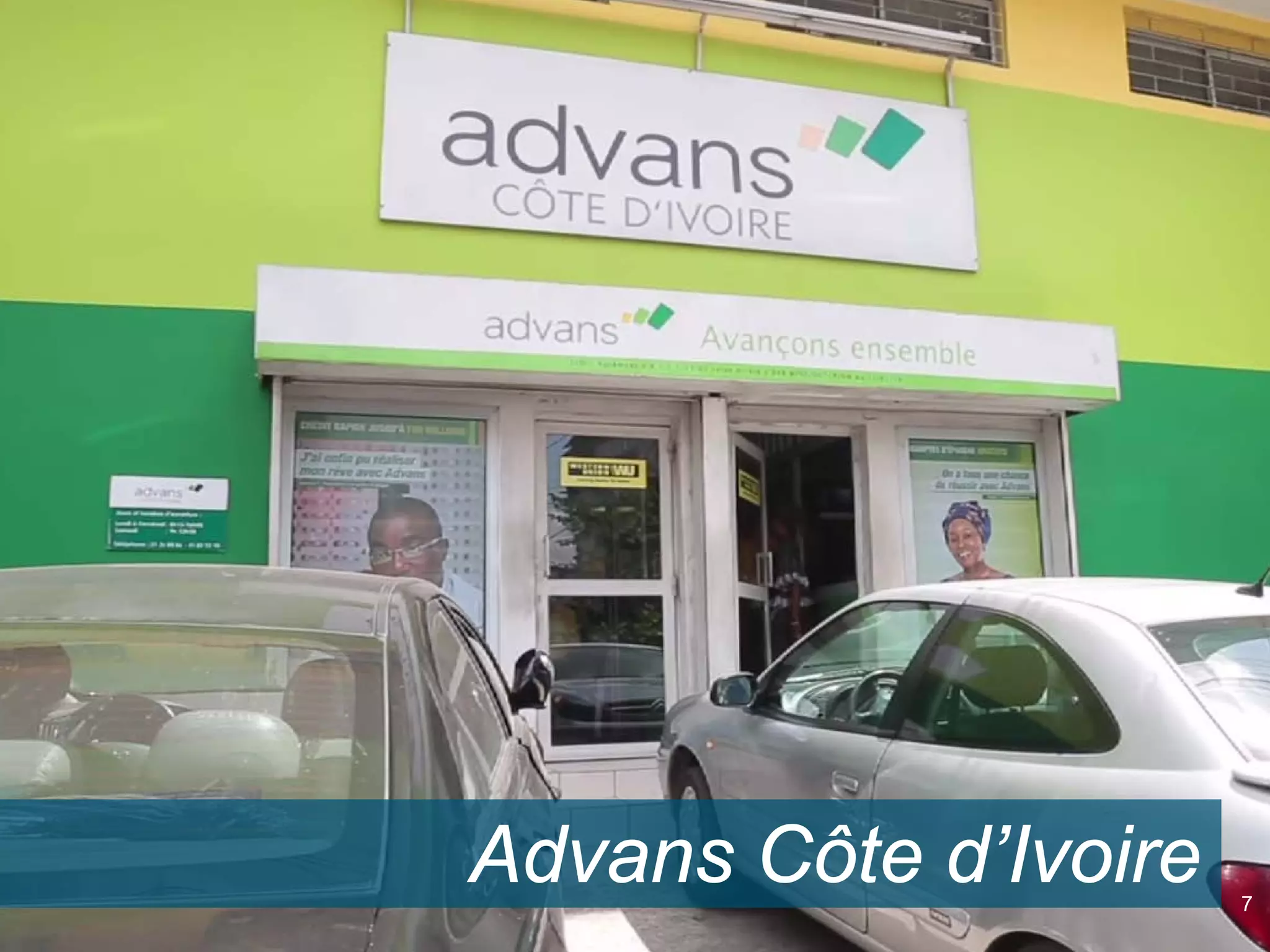
Advans Côte d’Ivoire (Advans CI) is a microfinance
institution offering credit, savings, and related financial
services to micro, small, and medium-sized enterprises in
Côte d’Ivoire. It is the fifth greenfield institution
established by the Advans Group.
Advans CI has served over 20,000 cocoa farmers from
116 cooperatives with financing, lending approximately
$8.6 million.
Advans Côte d’Ivoire: A leading provider of
financial services to smallholder cocoa farmers
Advans CI at the end of 2015:
 38,394 clients
 17,029 active borrowers
 12,500 cocoa farmers
 $20.7 million in deposits
 $39.8 million in loans
 374 staff members
 7 branches, 6 in Abidjan
March 2012
Advans CI opens to serve
the Côte d’Ivoire MSME market.
September 2012
Partners with TechnoServe to become the first financial
institution to provide credit to cocoa farmers in Côte d’Ivoire.
November 2014
Piloted savings product in 12 cooperatives,
reaching over 1,800 farmers. Advans CI
Timeline
September 2015
Begin pilot for branchless
banking for cocoa farmers.
8
PROJECT
OVERVIEW
9
Advans undertook a 22 month project to develop a branchless
banking solution adapted to cocoa farmers and their
cooperatives, which would allow a zero-cost transfer for end-users.
Branchless banking for smallholder
cocoa farmers in Côte d’Ivoire
Project goals:
• Digitize payment flows from cooperatives to producers, securing funds in
personal bank accounts.
• Maximize reach and impact while minimizing cost through effective
technology.
• Provide interoperability of payments between bank and wallet.
• Testing the technology with 7,500 cocoa farmers distributed among 40
cooperatives.
• Training Advans CI staff to manage the expansion of services in the cocoa
and other agricultural sectors.
10
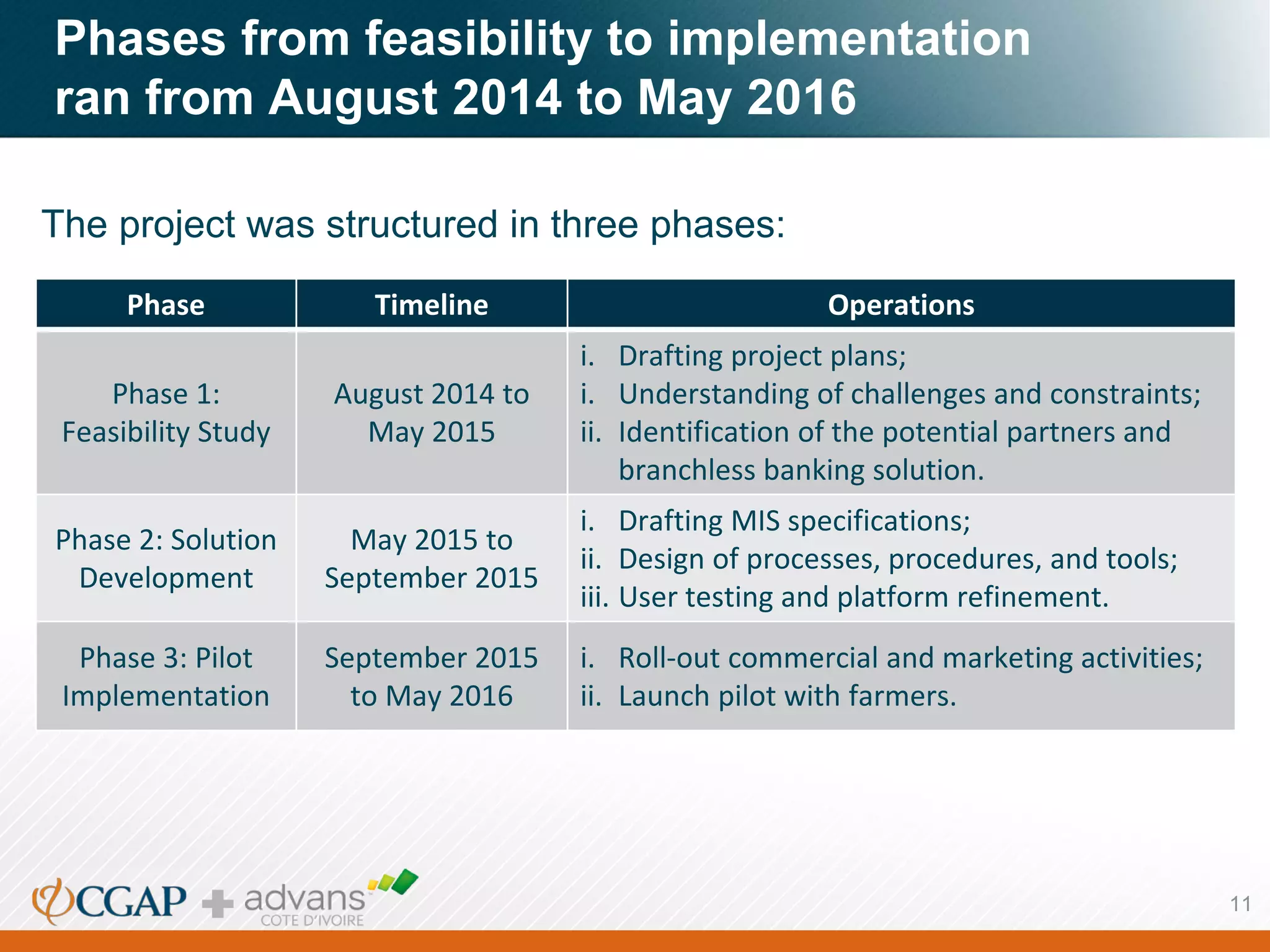
The project was structured in three phases:
Phases from feasibility to implementation
ran from August 2014 to May 2016
Phase Timeline Operations
Phase 1:
Feasibility Study
August 2014 to
May 2015
i. Drafting project plans;
i. Understanding of challenges and constraints;
ii. Identification of the potential partners and
branchless banking solution.
Phase 2: Solution
Development
May 2015 to
September 2015
i. Drafting MIS specifications;
ii. Design of processes, procedures, and tools;
iii. User testing and platform refinement.
Phase 3: Pilot
Implementation
September 2015
to May 2016
i. Roll-out commercial and marketing activities;
ii. Launch pilot with farmers.
11
12
Feasibility Study
The feasibility study asked key questions about
the market and potential for digital solutions
The feasibility study had three key priorities:
1. Understand the traditional cocoa payment scheme.
2. Determine the willingness of cooperatives and farmers to
use digital payments and savings facilities.
3. Determine the capabilities for alternative delivery
channels including ATMs and mobile money.
The feasibility study included a survey that sampled 23
cooperatives and 67 individual cocoa farmers from different
cocoa production areas.
13
Both cooperatives and farmers
showed high levels of interest
100% of cooperatives showed
interest in branchless banking,
citing security (e.g. theft reduction)
as a key consideration.
90% of farmers showed interest
in branchless banking, citing
insufficient savings as a key
consideration.
14Source: Advans market study in 2014-2015
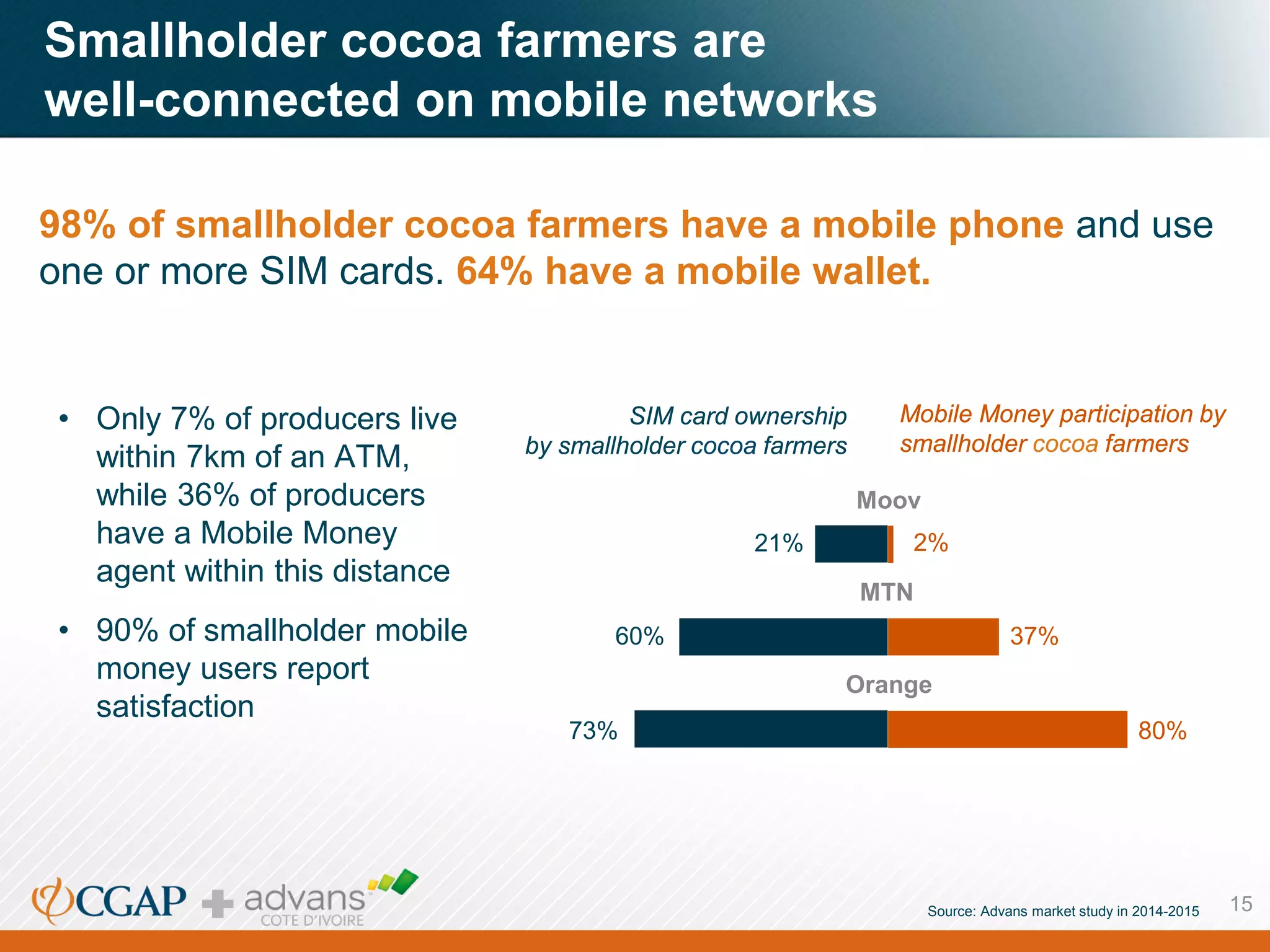
98% of smallholder cocoa farmers have a mobile phone and use
one or more SIM cards. 64% have a mobile wallet.
Smallholder cocoa farmers are
well-connected on mobile networks
15
• Only 7% of producers live
within 7km of an ATM,
while 36% of producers
have a Mobile Money
agent within this distance
• 90% of smallholder mobile
money users report
satisfaction
21%
60%
73%
2%
37%
80%
Mobile Money participation by
smallholder cocoa farmers
SIM card ownership
by smallholder cocoa farmers
Orange
MTN
Moov
Source: Advans market study in 2014-2015
The opportunity was largely untapped,
yet faced potentially limited acceptance
Little competition exists for digital payments.
Only two other schemes were identified for the cocoa value chain, and both
launched with only a small pilot. None of the farmers interviewed had yet
participated in a digital scheme.
However, low participation was initially expected…
• Producers are accustomed to being paid in cash. Only 50% of producers surveyed
trust financial institutions, and 56% of cocoa producers are illiterate, meaning they would
need training and time to adopt the new technology.
• Producers need a means to access their money. Only 19% of farmers have an ATM or
bank within 7km, and only 36% have similar access to mobile money agents. Paying
electronically for goods is not yet an option in rural areas. Agents also face regular liquidity
problems, which could be amplified if producers withdrew the total amount paid for their
cocoa harvest.
• Producers require benefits worth the fees of digital. Value-added services such as
savings and loans are required to make fee based services attractive.
16
Solution Development 17
Development of the solution was based
on findings from the feasibility study
Advans chose gradual implementation of a cashless solution, to
build trust and awareness among users and to accommodate the still-
developing mobile money ecosystem. The level of digitization would be
dictated by the amount farmers wanted to save.
USSD channels were chosen, as the technology is accessible on
all phones and more usable for illiterate farmers, even though the
technology presented potential challenges.
The service would be offered free to farmers. A free service was
believed to be a necessary incentive to drive adoption by smallholder
cocoa farmers.
18
1
3
2
Technology provider Neptune worked with Advans
to adapt their system to support the program
Advans CI selected Neptune as technology provider (Advans CI
group Core Banking System provider) based upon:
• USSD Gateway as a module for Advans CBS
• Eliminating the need for third party involvement
• Business model not based on charging for each transaction
The solution required three key developments:
• Batch import
• USSD self-service Mobile Banking solution
• Interface between Advans CI Core banking system and MNO mobile wallets
In Côte d’Ivoire, no USSD aggregator exists to provide a USSD self-service Mobile
Banking menu with the three MNO providers, so only a platform and interface could
be obtained from technology providers. The USSD channels required negotiation
directly with MNOs. ARTCI (Autorité de Régulation des Telecoms/TIC de Côte
d’Ivoire) confirmed that they could provide a USSD short code, but it still required
an agreement with the MNOs.
19
The solution was developed with multiple
stakeholders to meet the needs of farmers
Telecommunication operator
• MTN and Advans CI contracted to
provide a dedicated USSD channel.
• MTN estimated network quality for the
coverage area helped guide
cooperatives recruitment.
• Free SIM cards would be provided to
non-MTN customers.
• MTN agreed to rule changes including
adapted pricing and a process change
revising deactivation inactivity because
of the seasonal nature of farmer work.
Traders
• Worked with three traders to target
farmer cooperatives: Cargill, CEMOI
and Barry Callebaut.
• Barry Callebaut engaged their own
staff in supporting subscriptions and
training.
20
Cooperatives
• 58 total cooperatives participated in
the pilot.
• Cooperatives helped farmers gain trust
in the solution and better understand
the product.
Key:
The digital solution for cocoa farmers
consists of seven steps
Farmer Cooperative
Section Delegate
Farmers
1
2
3 4
5
5
6
7
1. Trader grants an advance on cocoa payments to the
farmer cooperative.
2. The cooperative deposits part of the advance on its
Advans account (equivalent to the estimated amount
of producers’ savings).
3. From a mobile phone, the cooperative makes a
transfer from its Advans account to each Advans
section delegate account. For some cooperatives the
transfer is direct to the farmers’ accounts.
4. The cooperative gives the rest of the advance in
cash to its section delegates.
5. When the delegate buys cocoa, the farmer decides
the percentage of cash and digital payment he wants
to receive. The section delegate transfers funds in
real time from his Advans account to the farmer’s
account using his mobile phone, and gives the rest
of the payment in cash. The farmer receives a
confirmation by SMS in real time.
6. When the farmer wishes to withdraw money, he
makes a transfer from his Advans account to his
MTN Mobile Money account.
7. The farmer can then withdraw money with an MTN
mobile money agent.
MTN Mobile Money
(Producer Account,
cash-out via agent)
Cash
Digital payment
Information
Trader
5
21
Pilot Implementation 22
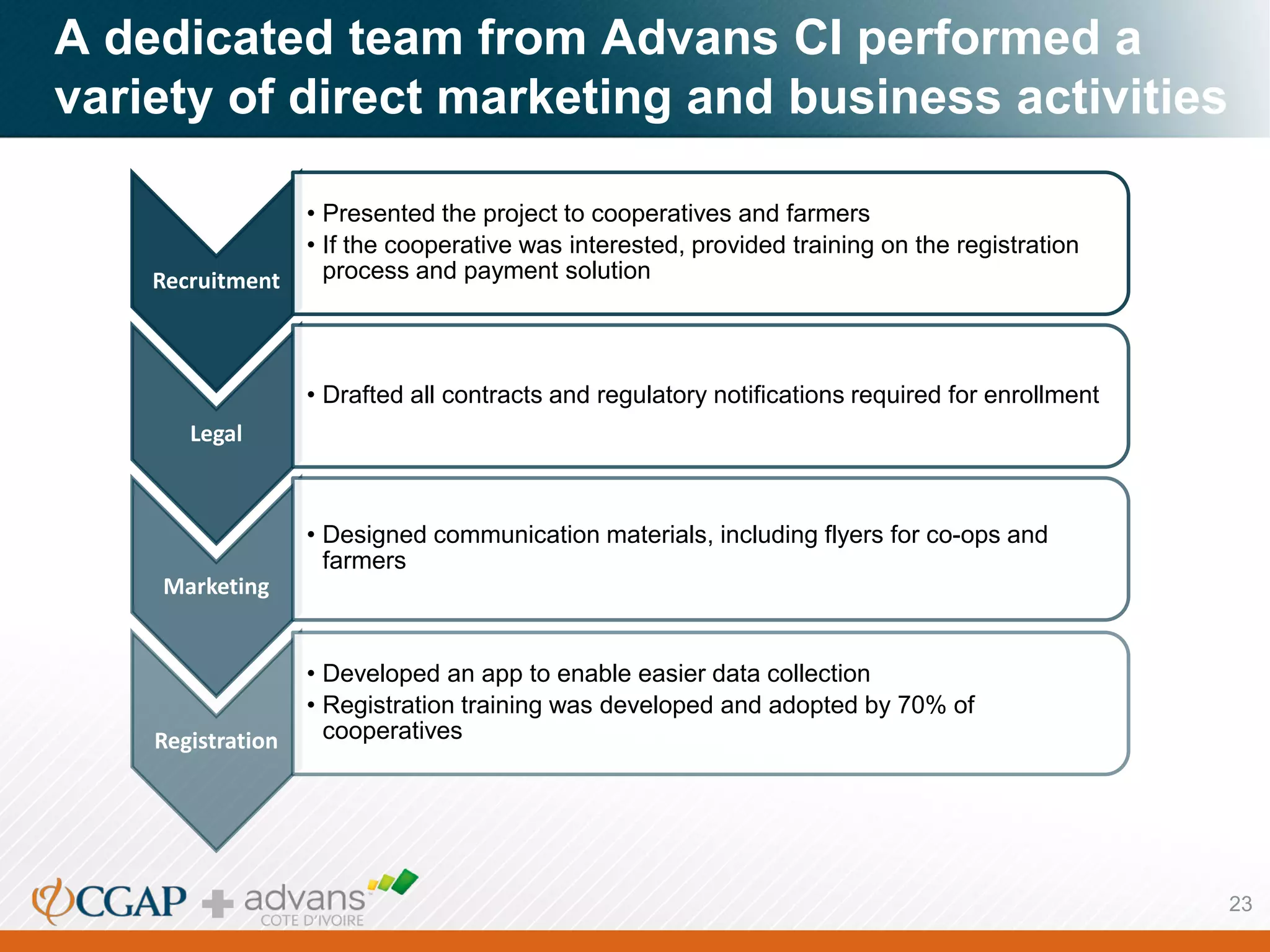
A dedicated team from Advans CI performed a
variety of direct marketing and business activities
Recruitment
• Presented the project to cooperatives and farmers
• If the cooperative was interested, provided training on the registration
process and payment solution
Legal
• Drafted all contracts and regulatory notifications required for enrollment
Marketing
• Designed communication materials, including flyers for co-ops and
farmers
Registration
• Developed an app to enable easier data collection
• Registration training was developed and adopted by 70% of
cooperatives
23
Pricing mechanisms were adjusted to
optimize farmer uptake
• For Bank to Wallet, Wallet to Bank: Advans CI and MTN
negotiated a free cost of the transaction for farmers.
• For the dedicated USSD channel: Advans CI and MTN
negotiated an adapted pricing.
• For the deposit account: Advans decided to charge only one
fixed annual account fee of 2,500FCFA (approx. $4.30) and no
transaction fee, so that the pricing would incentivize the farmers
to use their accounts.
24
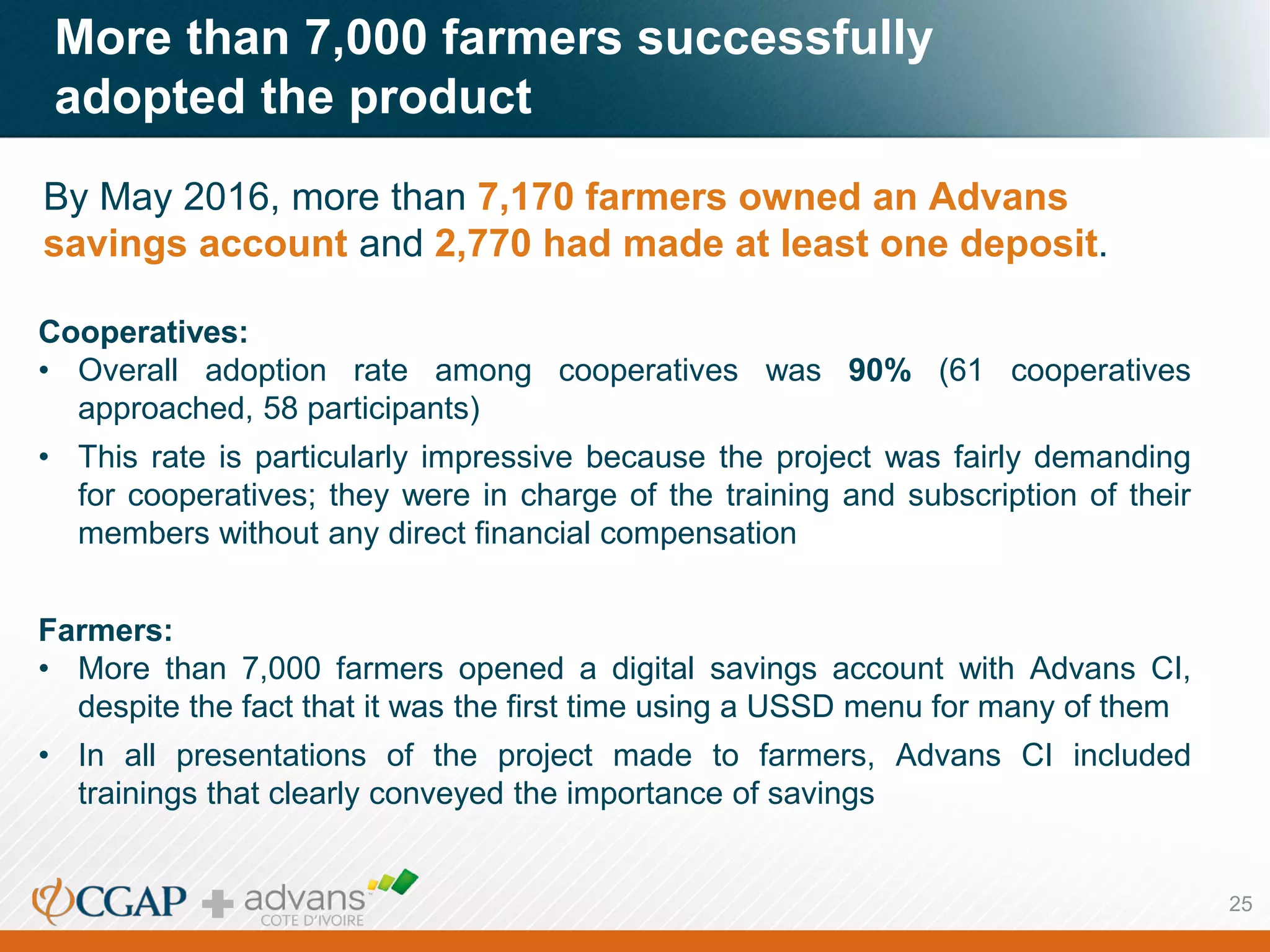
More than 7,000 farmers successfully
adopted the product
By May 2016, more than 7,170 farmers owned an Advans
savings account and 2,770 had made at least one deposit.
Cooperatives:
• Overall adoption rate among cooperatives was 90% (61 cooperatives
approached, 58 participants)
• This rate is particularly impressive because the project was fairly demanding
for cooperatives; they were in charge of the training and subscription of their
members without any direct financial compensation
Farmers:
• More than 7,000 farmers opened a digital savings account with Advans CI,
despite the fact that it was the first time using a USSD menu for many of them
• In all presentations of the project made to farmers, Advans CI included
trainings that clearly conveyed the importance of savings
25
26
CHALLENGES AND
LESSONS LEARNED
Challenges 27
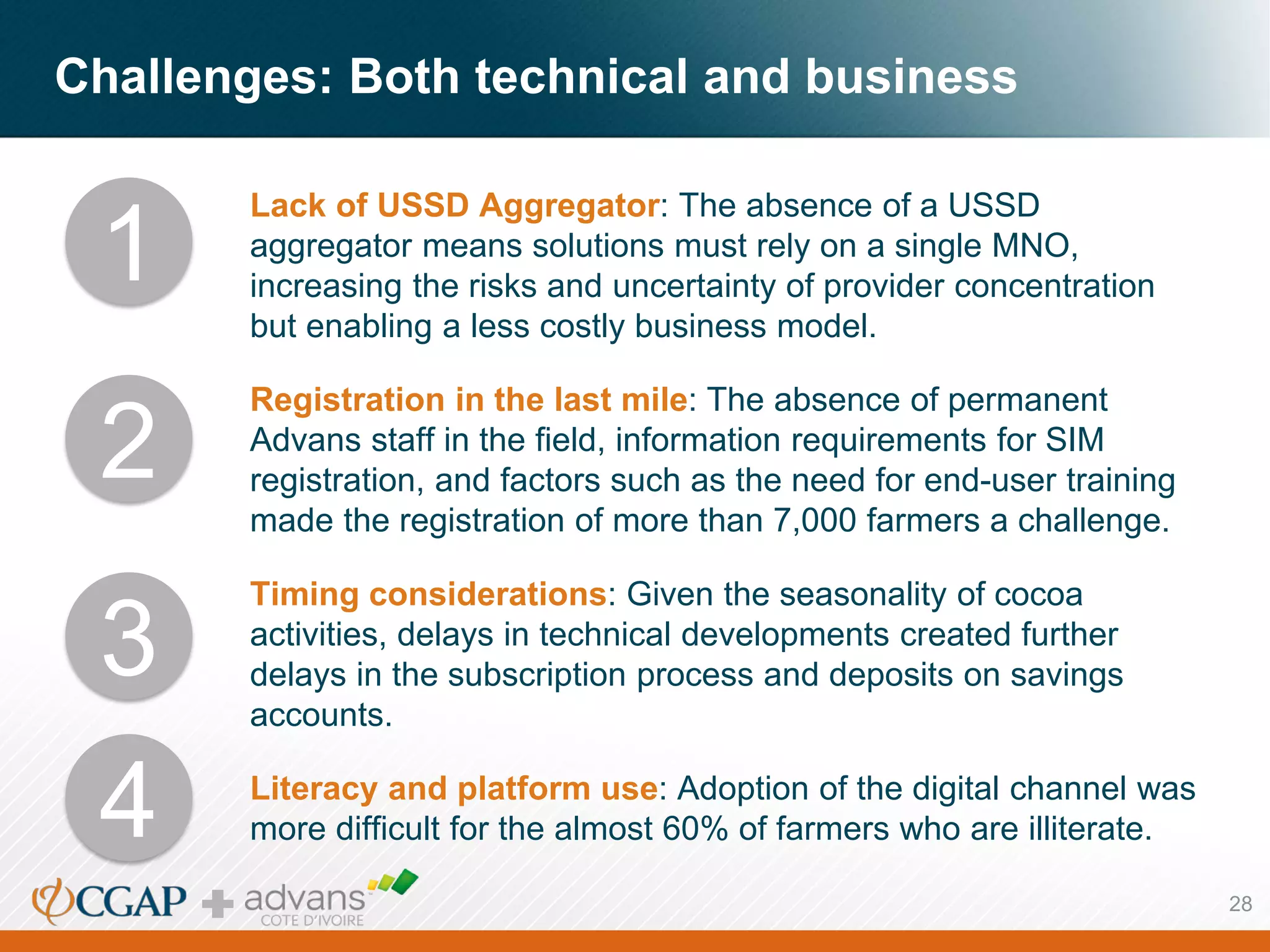
Challenges: Both technical and business
Lack of USSD Aggregator: The absence of a USSD
aggregator means solutions must rely on a single MNO,
increasing the risks and uncertainty of provider concentration
but enabling a less costly business model.
Registration in the last mile: The absence of permanent
Advans staff in the field, information requirements for SIM
registration, and factors such as the need for end-user training
made the registration of more than 7,000 farmers a challenge.
Timing considerations: Given the seasonality of cocoa
activities, delays in technical developments created further
delays in the subscription process and deposits on savings
accounts.
Literacy and platform use: Adoption of the digital channel was
more difficult for the almost 60% of farmers who are illiterate.
1
3
2
4
28
Lessons Learned 29
Lessons Learned
30
1. Farmers still need to be trained. Despite 98% of farmers having a mobile phone,
training is required to empower farmers to use mobile services.
2. USSD channels for rural areas are essential. USSD works best for cocoa
farmers. It works with any mobile phone, only a limited number of steps are needed,
and numeric menus limit the need for literacy among users.
3. Adaptive pricing is key. Pricing was aligned to help ensure the total cost for cocoa
farmers would be less that the expected benefit (financial and non-financial) of their
participation to the project. This meant limiting fees and simplifying transfer costs.
4. Effective partnerships take time. A critical success factor was Advans’ support
from key stakeholders in the cocoa value chain. Advans benefited from MNO,
trader, and cooperative partners who acted as advocates for the project and
adapted business models to promote acceptance by cocoa farmers. These
relationships and agreements take time to build and effectively structure.
5. A progressive, staged approach for adoption is required. Agent networks are
less dense in rural areas and liquidity remains challenge. Advans CI rolled out the
solution in a staged approach to mitigate the risks of cash-outs and agent
unavailability.
Lessons Learned (continued)
31
6. Human resources should be structured for the long term. A dedicated team to
manage the relationships with cooperatives and farmers is essential. The launch of a
project seeking to reach 7,500 farmers spread across different regions required a
separate cocoa team, including a back office function.
7. A strong capacity to innovate is necessary, especially with regards to process.
Advans CI had to innovate to reach its objectives. This required flexibility in adapting
imagined processes to fit reality.
8. Providing only savings accounts and payments services will not be sufficient
to retain farmers. Farmers’ needs for financial services go beyond savings products
and they express the wish to access other services. The scheme outlined here has
the potential to serve as a gateway to other financial services for cocoa farmers.
Advancing financial inclusion to improve the lives of the poor
www.cgap.org

Digital Financial Services for Cocoa Farmers in Côte d'Ivoire

  • 1.
    Digital Financial Servicesfor Cocoa Farmers in Côte d’Ivoire July 2016
  • 2.
    MARKET CONTEXT Cocoa inCôte d’Ivoire Advans Côte d’Ivoire PROJECT OVERVIEW Feasibility Study Solution Development Pilot Implementation CHALLENGES AND LESSONS LEARNED Challenges Lessons Learned 3 4 7 9 12 17 22 26 27 29 Contents
  • 3.
  • 4.
    Cocoa in Côted’Ivoire 4
  • 5.
    In 2014, Ivoriancocoa production accounted for 35% of global production and 15% of the Ivorian GDP. 5Sources: TechnoServe 2012, Web site Min. of Agriculture and Conseil Café-Cacao • Number of small cocoa farmers: 650,000+ • Number of workers in value chain: 3 to 4 million • Average household size: 10 people • Average farm size: 2.5 to 5 hectares • Average household cocoa income: ~$220 • Farmer literacy: 43.4% literate • Farmer education level: 26.3% primary school, 16.9% secondary school and 6.4% university 10% 90% Smallholder farmers play a vital role in Côte d’Ivoire’s economy Cocoa farms in Côte d’Ivoire Small farms (~600-2,000 kg/farm) Large farms (~5,000 kg/farm)
  • 6.
    These farmers remainlargely excluded from formal financial services 6 Farmers were paid $2.9 billion1 for 1.74 million metric tons of raw cocoa - almost 100% in cash. • Traditional financial services and microfinance lack extensive coverage in rural areas in Côte d’Ivoire. • Cash creates challenges in the cocoa value chain: o Safety: Theft can occur at transaction points. o Poor financial management: Farmers earn only during the cocoa season and often lack resources the rest of the year. o Poor cocoa traceability: Traders lack information on the origin of the cocoa they purchase. o Barrier to financial inclusion: Farmers’ reliance on cash limits their ability to access other financial services (e.g. savings, credit, insurance). 1: 2013-2014 crop year, http://news.abidjan.net/h/511812.htm ; €2.3 million equivalent as of June 31, 2014
  • 7.
  • 8.
    Advans Côte d’Ivoire(Advans CI) is a microfinance institution offering credit, savings, and related financial services to micro, small, and medium-sized enterprises in Côte d’Ivoire. It is the fifth greenfield institution established by the Advans Group. Advans CI has served over 20,000 cocoa farmers from 116 cooperatives with financing, lending approximately $8.6 million. Advans Côte d’Ivoire: A leading provider of financial services to smallholder cocoa farmers Advans CI at the end of 2015:  38,394 clients  17,029 active borrowers  12,500 cocoa farmers  $20.7 million in deposits  $39.8 million in loans  374 staff members  7 branches, 6 in Abidjan March 2012 Advans CI opens to serve the Côte d’Ivoire MSME market. September 2012 Partners with TechnoServe to become the first financial institution to provide credit to cocoa farmers in Côte d’Ivoire. November 2014 Piloted savings product in 12 cooperatives, reaching over 1,800 farmers. Advans CI Timeline September 2015 Begin pilot for branchless banking for cocoa farmers. 8
  • 9.
  • 10.
    Advans undertook a22 month project to develop a branchless banking solution adapted to cocoa farmers and their cooperatives, which would allow a zero-cost transfer for end-users. Branchless banking for smallholder cocoa farmers in Côte d’Ivoire Project goals: • Digitize payment flows from cooperatives to producers, securing funds in personal bank accounts. • Maximize reach and impact while minimizing cost through effective technology. • Provide interoperability of payments between bank and wallet. • Testing the technology with 7,500 cocoa farmers distributed among 40 cooperatives. • Training Advans CI staff to manage the expansion of services in the cocoa and other agricultural sectors. 10
  • 11.
    The project wasstructured in three phases: Phases from feasibility to implementation ran from August 2014 to May 2016 Phase Timeline Operations Phase 1: Feasibility Study August 2014 to May 2015 i. Drafting project plans; i. Understanding of challenges and constraints; ii. Identification of the potential partners and branchless banking solution. Phase 2: Solution Development May 2015 to September 2015 i. Drafting MIS specifications; ii. Design of processes, procedures, and tools; iii. User testing and platform refinement. Phase 3: Pilot Implementation September 2015 to May 2016 i. Roll-out commercial and marketing activities; ii. Launch pilot with farmers. 11
  • 12.
  • 13.
    The feasibility studyasked key questions about the market and potential for digital solutions The feasibility study had three key priorities: 1. Understand the traditional cocoa payment scheme. 2. Determine the willingness of cooperatives and farmers to use digital payments and savings facilities. 3. Determine the capabilities for alternative delivery channels including ATMs and mobile money. The feasibility study included a survey that sampled 23 cooperatives and 67 individual cocoa farmers from different cocoa production areas. 13
  • 14.
    Both cooperatives andfarmers showed high levels of interest 100% of cooperatives showed interest in branchless banking, citing security (e.g. theft reduction) as a key consideration. 90% of farmers showed interest in branchless banking, citing insufficient savings as a key consideration. 14Source: Advans market study in 2014-2015
  • 15.
    98% of smallholdercocoa farmers have a mobile phone and use one or more SIM cards. 64% have a mobile wallet. Smallholder cocoa farmers are well-connected on mobile networks 15 • Only 7% of producers live within 7km of an ATM, while 36% of producers have a Mobile Money agent within this distance • 90% of smallholder mobile money users report satisfaction 21% 60% 73% 2% 37% 80% Mobile Money participation by smallholder cocoa farmers SIM card ownership by smallholder cocoa farmers Orange MTN Moov Source: Advans market study in 2014-2015
  • 16.
    The opportunity waslargely untapped, yet faced potentially limited acceptance Little competition exists for digital payments. Only two other schemes were identified for the cocoa value chain, and both launched with only a small pilot. None of the farmers interviewed had yet participated in a digital scheme. However, low participation was initially expected… • Producers are accustomed to being paid in cash. Only 50% of producers surveyed trust financial institutions, and 56% of cocoa producers are illiterate, meaning they would need training and time to adopt the new technology. • Producers need a means to access their money. Only 19% of farmers have an ATM or bank within 7km, and only 36% have similar access to mobile money agents. Paying electronically for goods is not yet an option in rural areas. Agents also face regular liquidity problems, which could be amplified if producers withdrew the total amount paid for their cocoa harvest. • Producers require benefits worth the fees of digital. Value-added services such as savings and loans are required to make fee based services attractive. 16
  • 17.
  • 18.
    Development of thesolution was based on findings from the feasibility study Advans chose gradual implementation of a cashless solution, to build trust and awareness among users and to accommodate the still- developing mobile money ecosystem. The level of digitization would be dictated by the amount farmers wanted to save. USSD channels were chosen, as the technology is accessible on all phones and more usable for illiterate farmers, even though the technology presented potential challenges. The service would be offered free to farmers. A free service was believed to be a necessary incentive to drive adoption by smallholder cocoa farmers. 18 1 3 2
  • 19.
    Technology provider Neptuneworked with Advans to adapt their system to support the program Advans CI selected Neptune as technology provider (Advans CI group Core Banking System provider) based upon: • USSD Gateway as a module for Advans CBS • Eliminating the need for third party involvement • Business model not based on charging for each transaction The solution required three key developments: • Batch import • USSD self-service Mobile Banking solution • Interface between Advans CI Core banking system and MNO mobile wallets In Côte d’Ivoire, no USSD aggregator exists to provide a USSD self-service Mobile Banking menu with the three MNO providers, so only a platform and interface could be obtained from technology providers. The USSD channels required negotiation directly with MNOs. ARTCI (Autorité de Régulation des Telecoms/TIC de Côte d’Ivoire) confirmed that they could provide a USSD short code, but it still required an agreement with the MNOs. 19
  • 20.
    The solution wasdeveloped with multiple stakeholders to meet the needs of farmers Telecommunication operator • MTN and Advans CI contracted to provide a dedicated USSD channel. • MTN estimated network quality for the coverage area helped guide cooperatives recruitment. • Free SIM cards would be provided to non-MTN customers. • MTN agreed to rule changes including adapted pricing and a process change revising deactivation inactivity because of the seasonal nature of farmer work. Traders • Worked with three traders to target farmer cooperatives: Cargill, CEMOI and Barry Callebaut. • Barry Callebaut engaged their own staff in supporting subscriptions and training. 20 Cooperatives • 58 total cooperatives participated in the pilot. • Cooperatives helped farmers gain trust in the solution and better understand the product.
  • 21.
    Key: The digital solutionfor cocoa farmers consists of seven steps Farmer Cooperative Section Delegate Farmers 1 2 3 4 5 5 6 7 1. Trader grants an advance on cocoa payments to the farmer cooperative. 2. The cooperative deposits part of the advance on its Advans account (equivalent to the estimated amount of producers’ savings). 3. From a mobile phone, the cooperative makes a transfer from its Advans account to each Advans section delegate account. For some cooperatives the transfer is direct to the farmers’ accounts. 4. The cooperative gives the rest of the advance in cash to its section delegates. 5. When the delegate buys cocoa, the farmer decides the percentage of cash and digital payment he wants to receive. The section delegate transfers funds in real time from his Advans account to the farmer’s account using his mobile phone, and gives the rest of the payment in cash. The farmer receives a confirmation by SMS in real time. 6. When the farmer wishes to withdraw money, he makes a transfer from his Advans account to his MTN Mobile Money account. 7. The farmer can then withdraw money with an MTN mobile money agent. MTN Mobile Money (Producer Account, cash-out via agent) Cash Digital payment Information Trader 5 21
  • 22.
  • 23.
    A dedicated teamfrom Advans CI performed a variety of direct marketing and business activities Recruitment • Presented the project to cooperatives and farmers • If the cooperative was interested, provided training on the registration process and payment solution Legal • Drafted all contracts and regulatory notifications required for enrollment Marketing • Designed communication materials, including flyers for co-ops and farmers Registration • Developed an app to enable easier data collection • Registration training was developed and adopted by 70% of cooperatives 23
  • 24.
    Pricing mechanisms wereadjusted to optimize farmer uptake • For Bank to Wallet, Wallet to Bank: Advans CI and MTN negotiated a free cost of the transaction for farmers. • For the dedicated USSD channel: Advans CI and MTN negotiated an adapted pricing. • For the deposit account: Advans decided to charge only one fixed annual account fee of 2,500FCFA (approx. $4.30) and no transaction fee, so that the pricing would incentivize the farmers to use their accounts. 24
  • 25.
    More than 7,000farmers successfully adopted the product By May 2016, more than 7,170 farmers owned an Advans savings account and 2,770 had made at least one deposit. Cooperatives: • Overall adoption rate among cooperatives was 90% (61 cooperatives approached, 58 participants) • This rate is particularly impressive because the project was fairly demanding for cooperatives; they were in charge of the training and subscription of their members without any direct financial compensation Farmers: • More than 7,000 farmers opened a digital savings account with Advans CI, despite the fact that it was the first time using a USSD menu for many of them • In all presentations of the project made to farmers, Advans CI included trainings that clearly conveyed the importance of savings 25
  • 26.
  • 27.
  • 28.
    Challenges: Both technicaland business Lack of USSD Aggregator: The absence of a USSD aggregator means solutions must rely on a single MNO, increasing the risks and uncertainty of provider concentration but enabling a less costly business model. Registration in the last mile: The absence of permanent Advans staff in the field, information requirements for SIM registration, and factors such as the need for end-user training made the registration of more than 7,000 farmers a challenge. Timing considerations: Given the seasonality of cocoa activities, delays in technical developments created further delays in the subscription process and deposits on savings accounts. Literacy and platform use: Adoption of the digital channel was more difficult for the almost 60% of farmers who are illiterate. 1 3 2 4 28
  • 29.
  • 30.
    Lessons Learned 30 1. Farmersstill need to be trained. Despite 98% of farmers having a mobile phone, training is required to empower farmers to use mobile services. 2. USSD channels for rural areas are essential. USSD works best for cocoa farmers. It works with any mobile phone, only a limited number of steps are needed, and numeric menus limit the need for literacy among users. 3. Adaptive pricing is key. Pricing was aligned to help ensure the total cost for cocoa farmers would be less that the expected benefit (financial and non-financial) of their participation to the project. This meant limiting fees and simplifying transfer costs. 4. Effective partnerships take time. A critical success factor was Advans’ support from key stakeholders in the cocoa value chain. Advans benefited from MNO, trader, and cooperative partners who acted as advocates for the project and adapted business models to promote acceptance by cocoa farmers. These relationships and agreements take time to build and effectively structure. 5. A progressive, staged approach for adoption is required. Agent networks are less dense in rural areas and liquidity remains challenge. Advans CI rolled out the solution in a staged approach to mitigate the risks of cash-outs and agent unavailability.
  • 31.
    Lessons Learned (continued) 31 6.Human resources should be structured for the long term. A dedicated team to manage the relationships with cooperatives and farmers is essential. The launch of a project seeking to reach 7,500 farmers spread across different regions required a separate cocoa team, including a back office function. 7. A strong capacity to innovate is necessary, especially with regards to process. Advans CI had to innovate to reach its objectives. This required flexibility in adapting imagined processes to fit reality. 8. Providing only savings accounts and payments services will not be sufficient to retain farmers. Farmers’ needs for financial services go beyond savings products and they express the wish to access other services. The scheme outlined here has the potential to serve as a gateway to other financial services for cocoa farmers.
  • 32.
    Advancing financial inclusionto improve the lives of the poor www.cgap.org