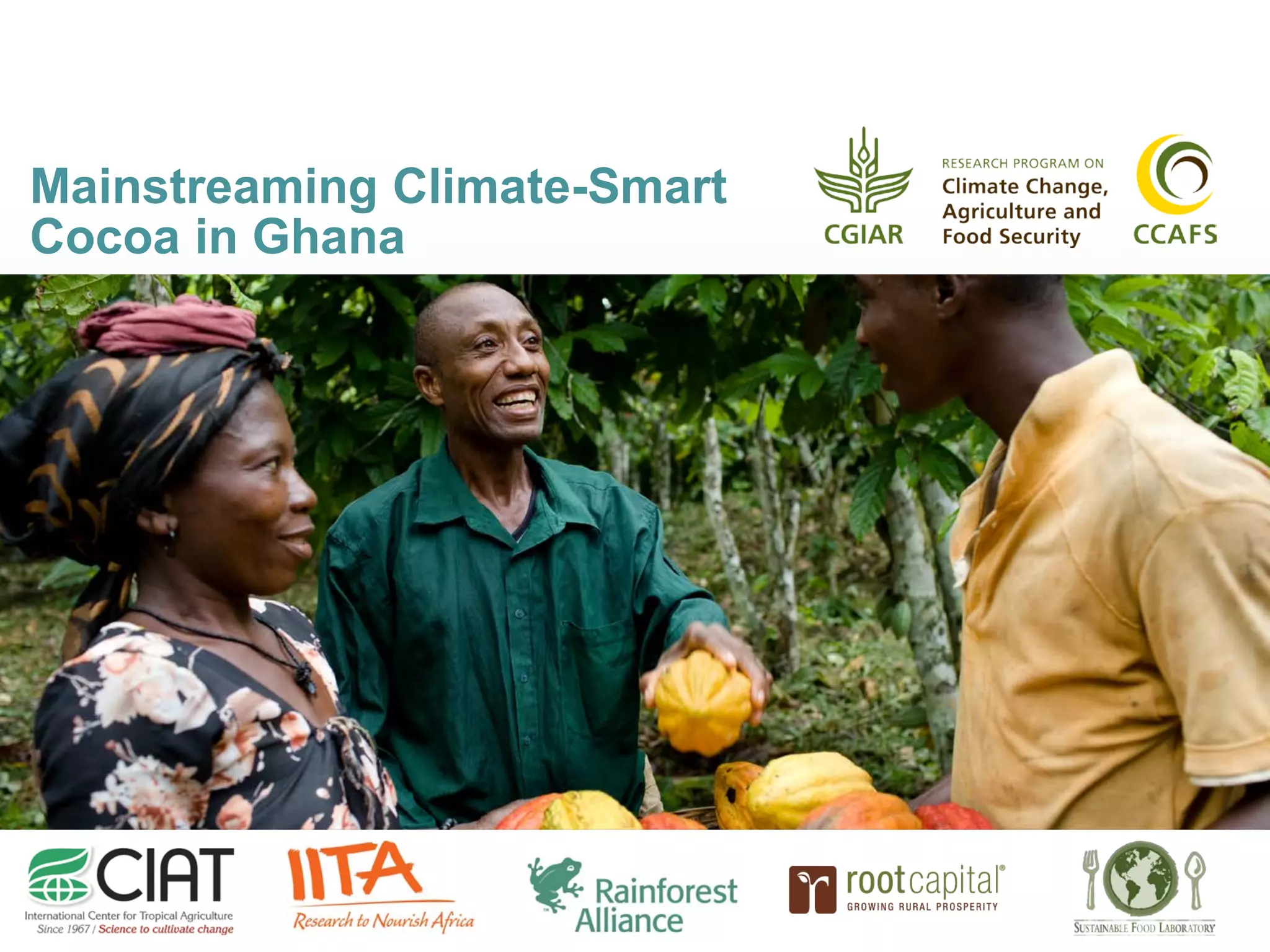
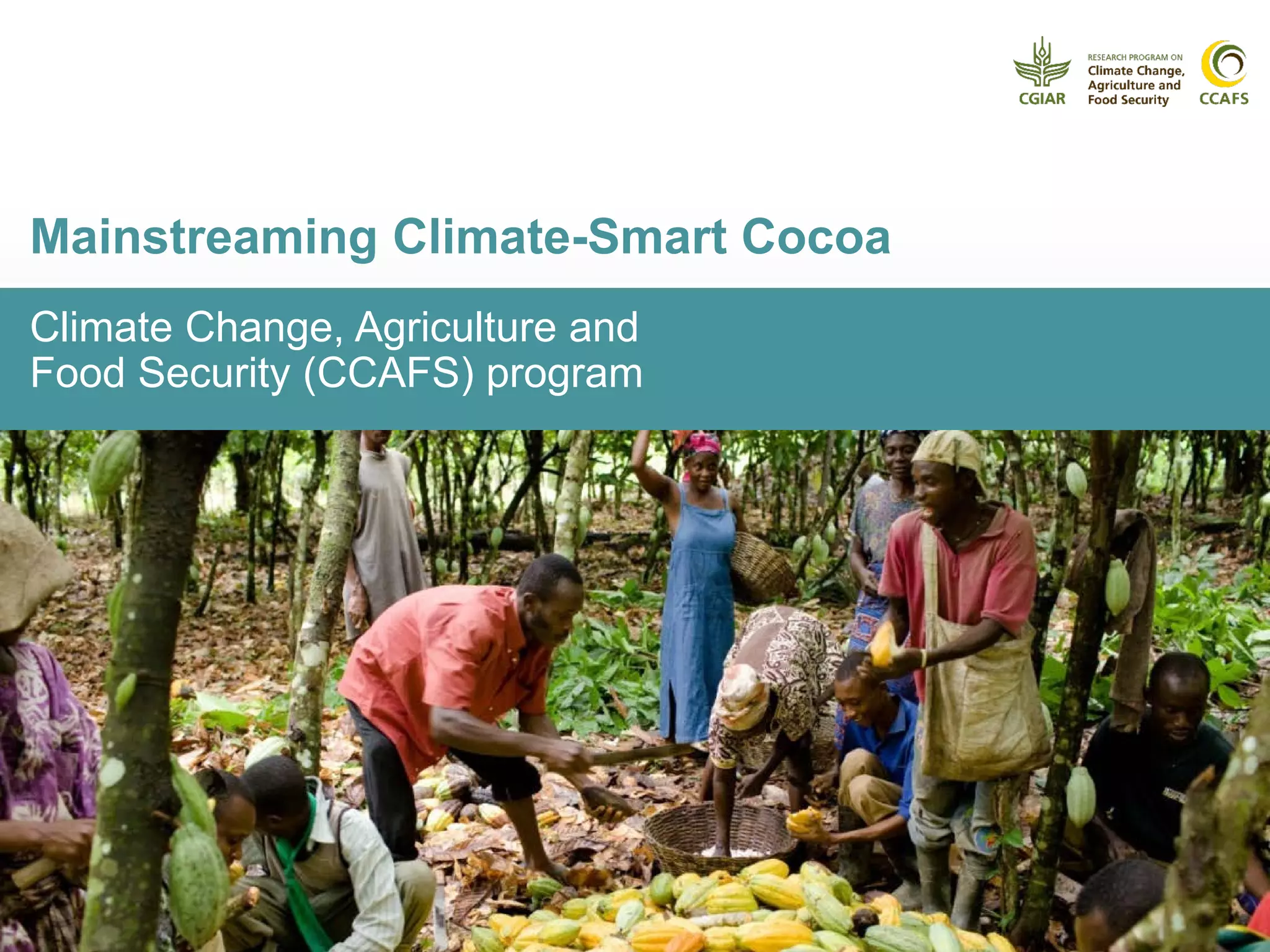
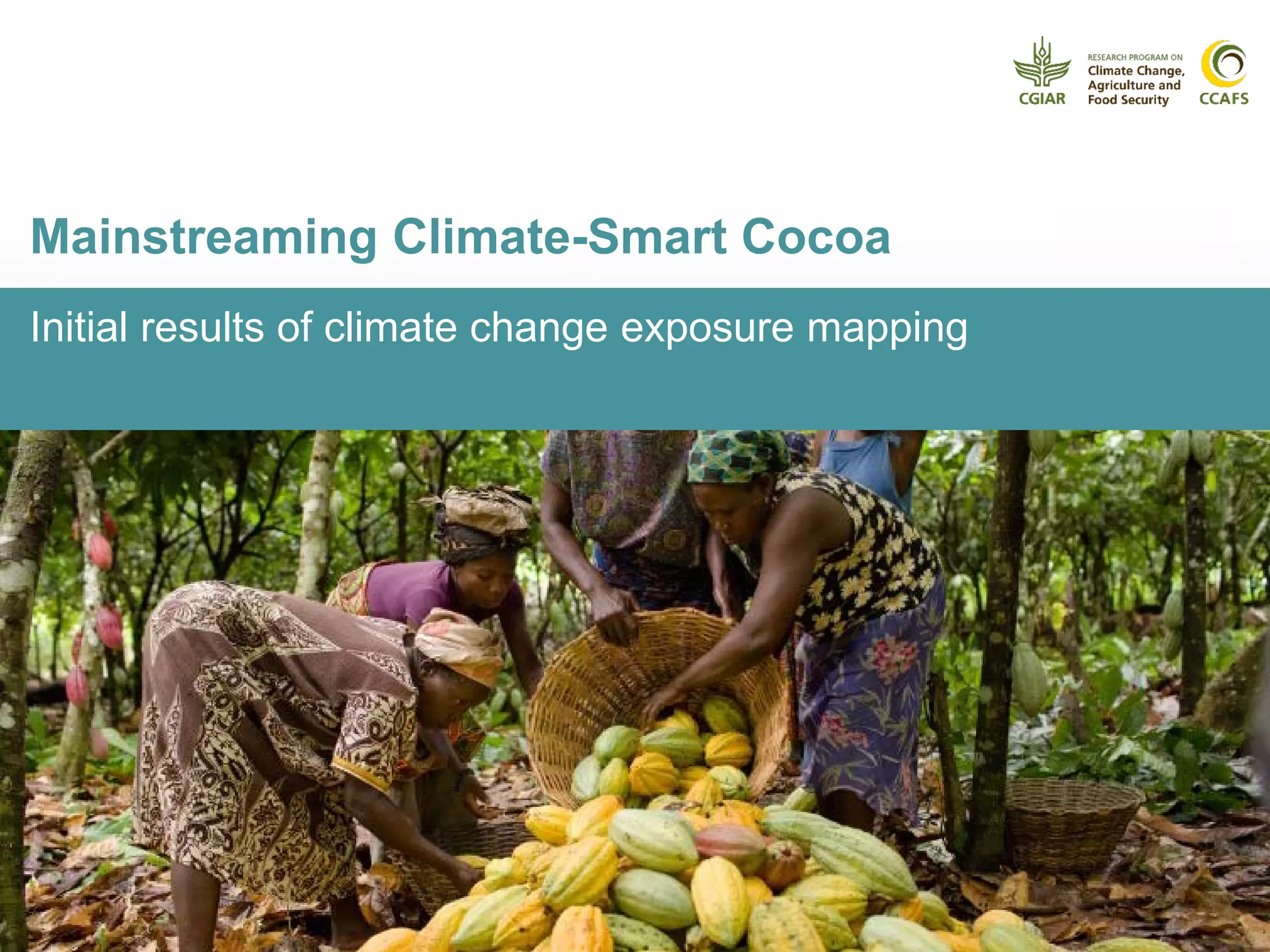
Mainstreaming Climate-Smart
Cocoa in Ghana
Presentation outline
• Climate change and climate variability for cocoa in
West Africa
• Climate Change, Agriculture and Food Security
(CCAFS) program
• Project goals
• Project consortium members
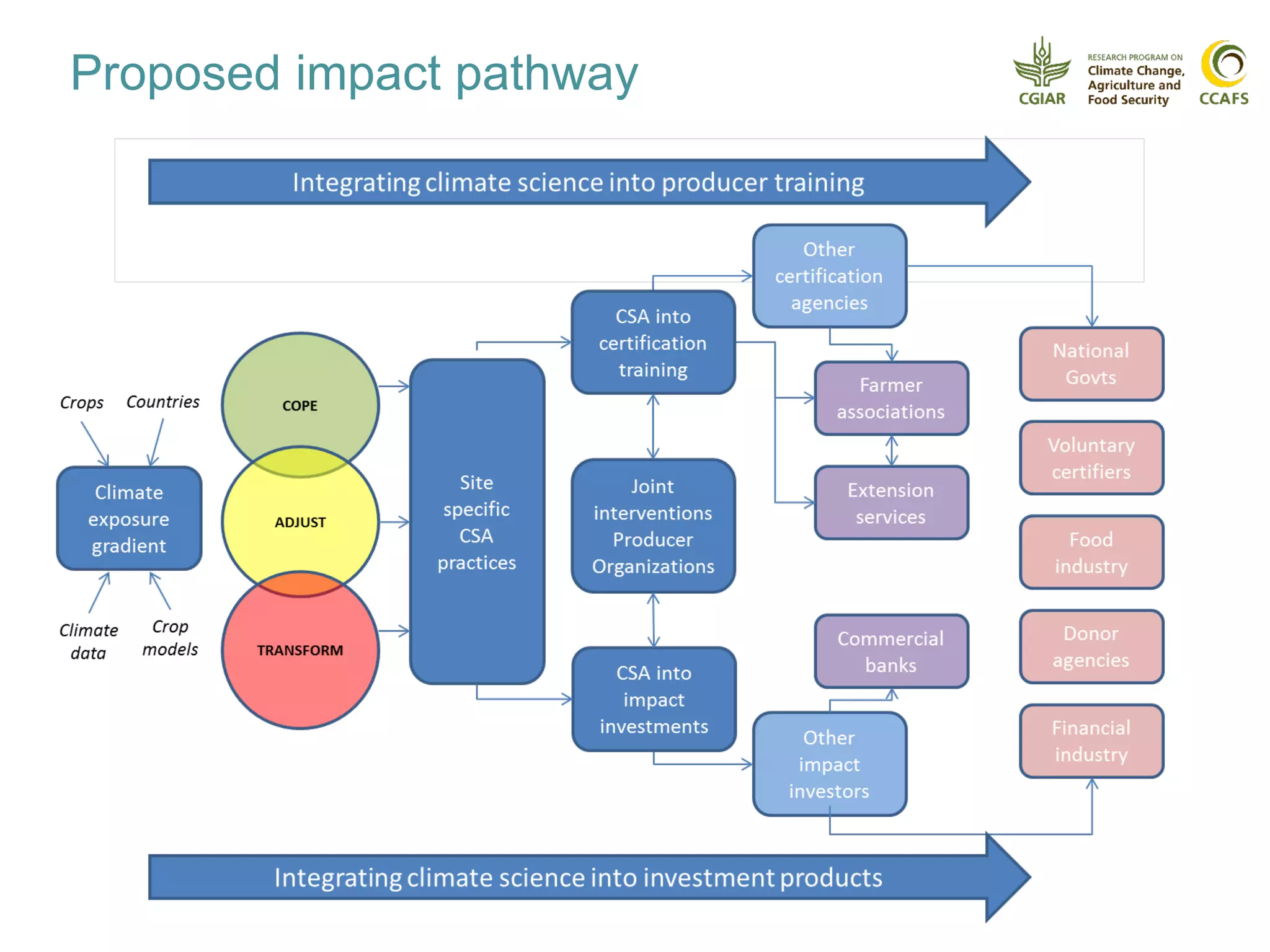
• How we propose to work
• Initial results of climate change exposure mapping
• Final thoughts
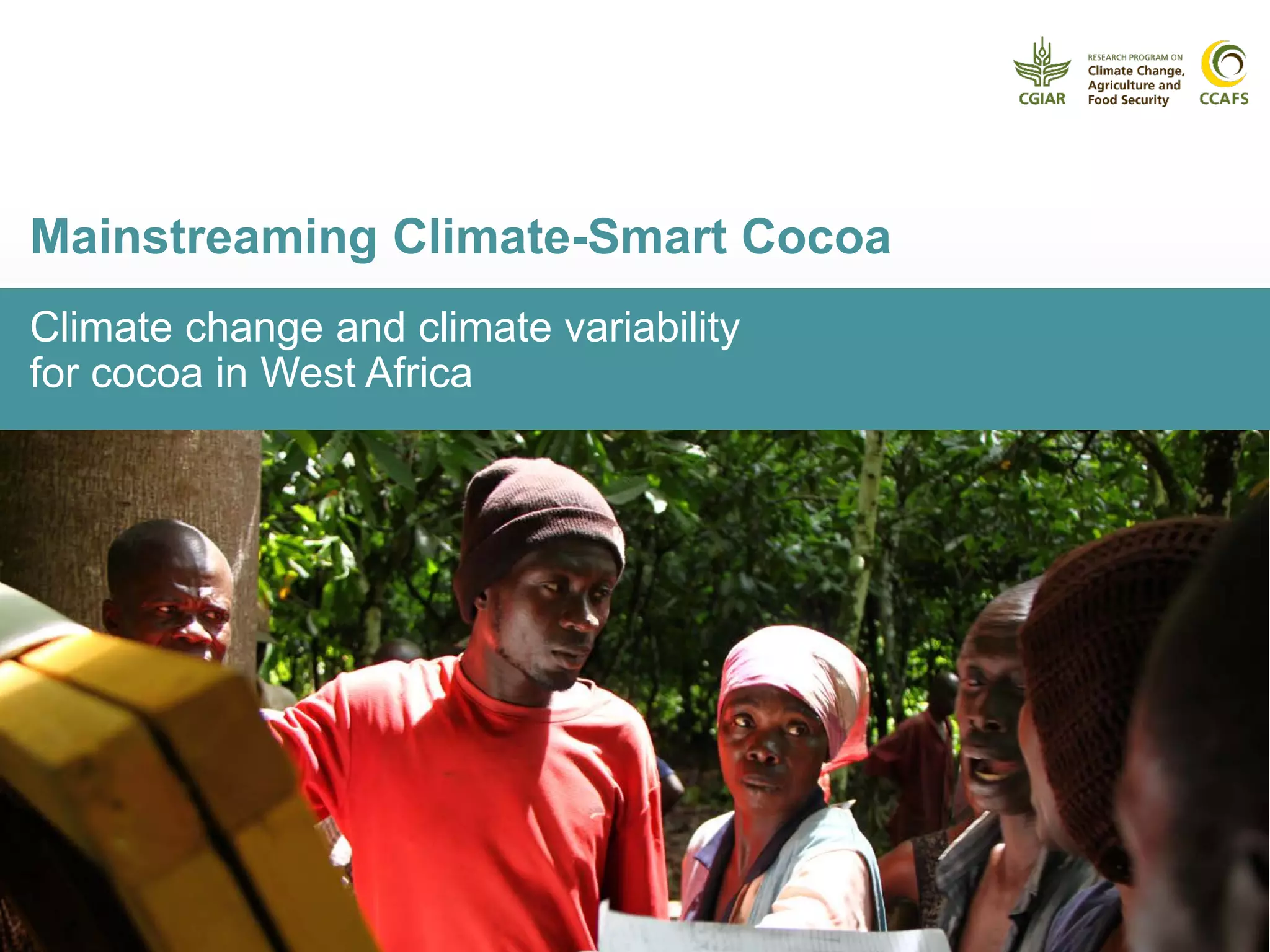
Climate change and climate variability
for cocoa in West Africa
Mainstreaming Climate-Smart Cocoa
Climate change and climate variability
for cocoa in West Africa
• Cocoa increasingly vulnerable to climate change
and climate variability.
• In the cocoa-growing regions yearly and monthly
minimum and maximum temperatures will
increase by up to 2.0°C by 2050.
• Yearly and monthly precipitation changes trivial.
• Result: suitability for current cocoa-growing areas
will decrease seriously by 2050.
• Climate change will increase pressure on forest
areas.
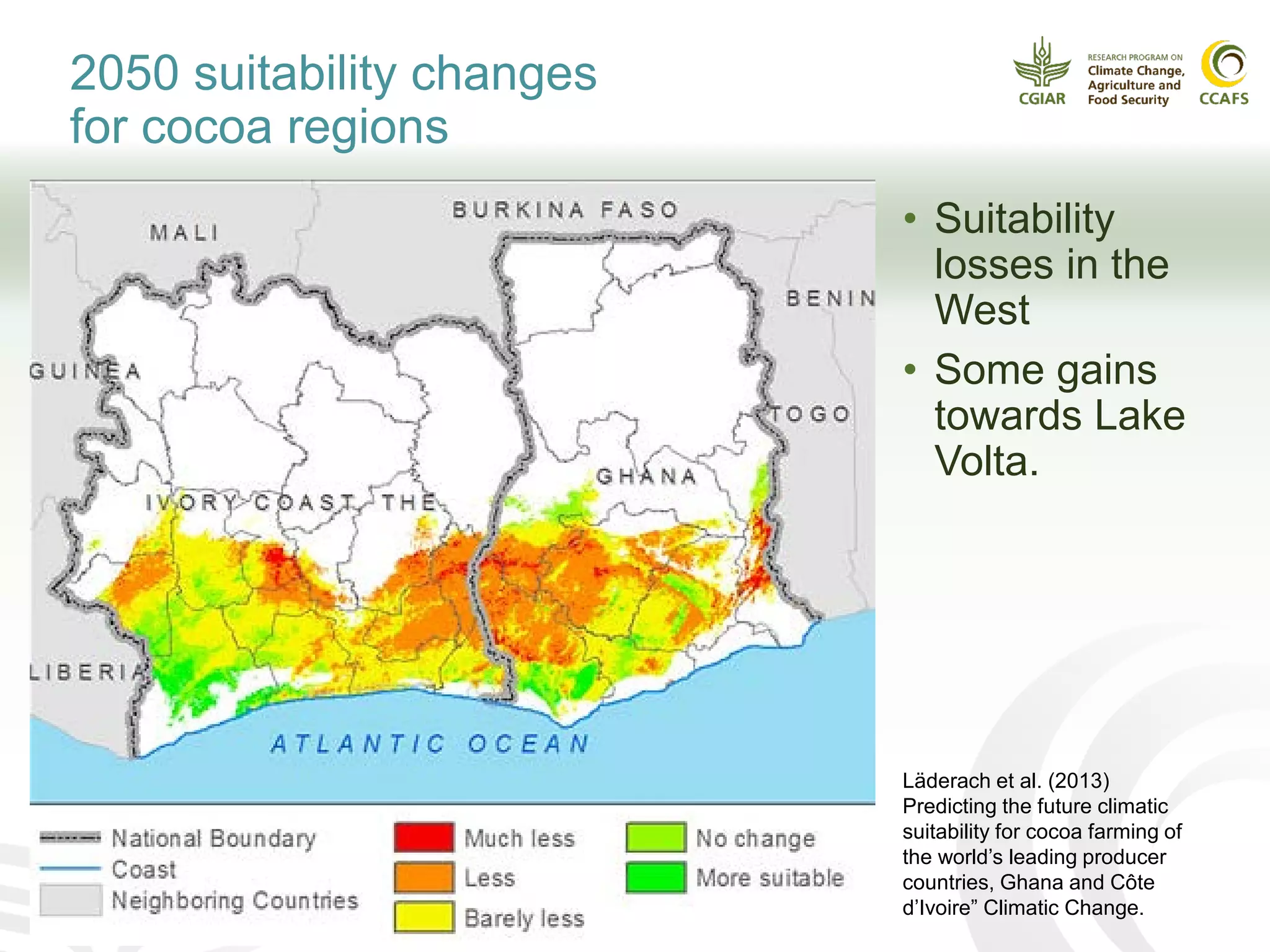
2050 suitability changes
for cocoa regions
• Suitability
losses in the
West
• Some gains
towards Lake
Volta.
Läderach et al. (2013)
Predicting the future climatic
suitability for cocoa farming of
the world’s leading producer
countries, Ghana and Côte
d’Ivoire” Climatic Change.
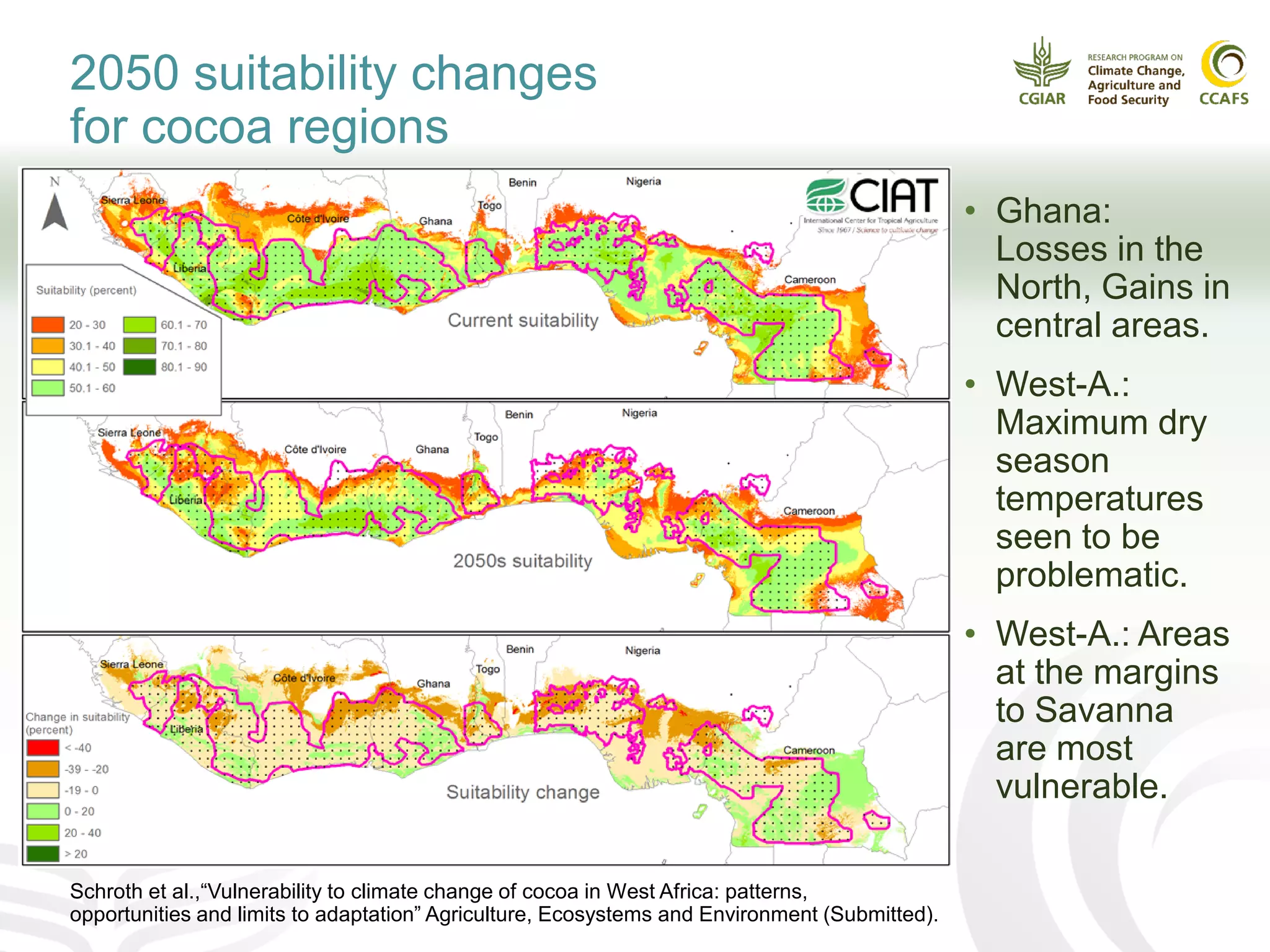
2050 suitability changes
for cocoa regions
• Ghana:
Losses in the
North, Gains in
central areas.
• West-A.:
Maximum dry
season
temperatures
seen to be
problematic.
• West-A.: Areas
at the margins
to Savanna
are most
vulnerable.
Schroth et al.,“Vulnerability to climate change of cocoa in West Africa: patterns,
opportunities and limits to adaptation” Agriculture, Ecosystems and Environment (Submitted).
Climate Change, Agriculture and
Food Security (CCAFS) program
Mainstreaming Climate-Smart Cocoa
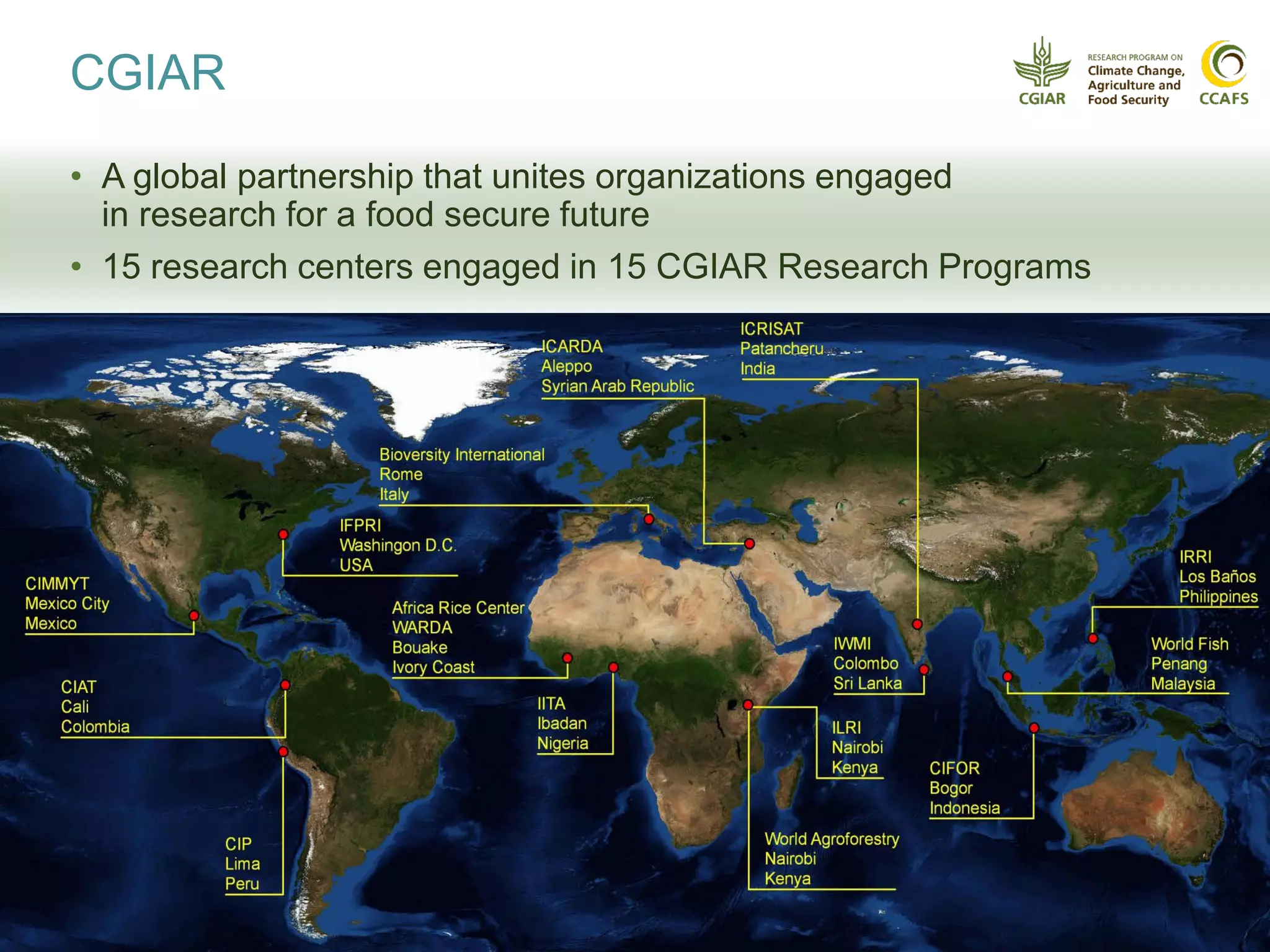
CGIAR
• A global partnership that unites organizations engaged
in research for a food secure future
• 15 research centers engaged in 15 CGIAR Research Programs
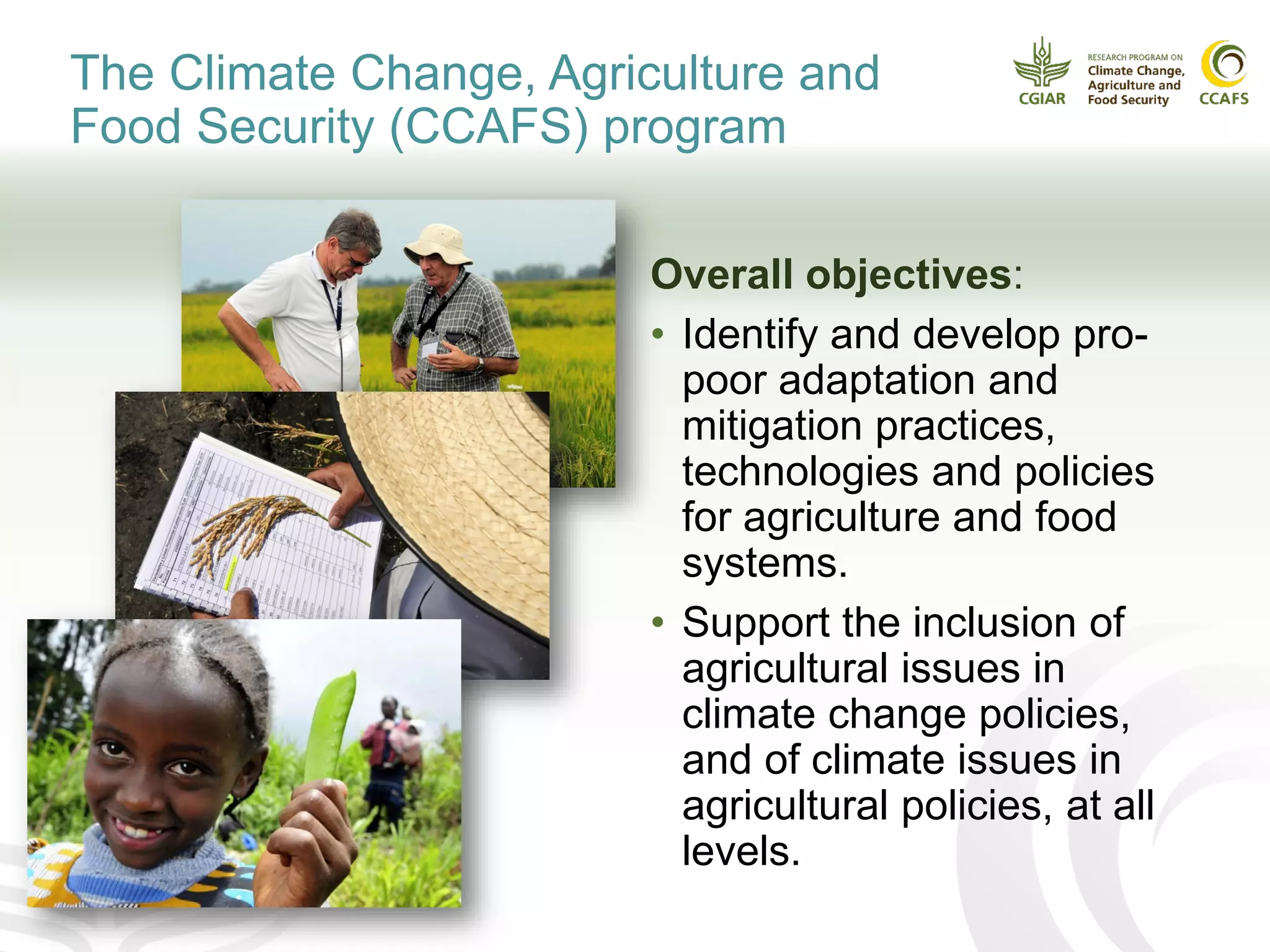
Overall objectives:
• Identify and develop pro-
poor adaptation and
mitigation practices,
technologies and policies
for agriculture and food
systems.
• Support the inclusion of
agricultural issues in
climate change policies,
and of climate issues in
agricultural policies, at all
levels.
The Climate Change, Agriculture and
Food Security (CCAFS) program
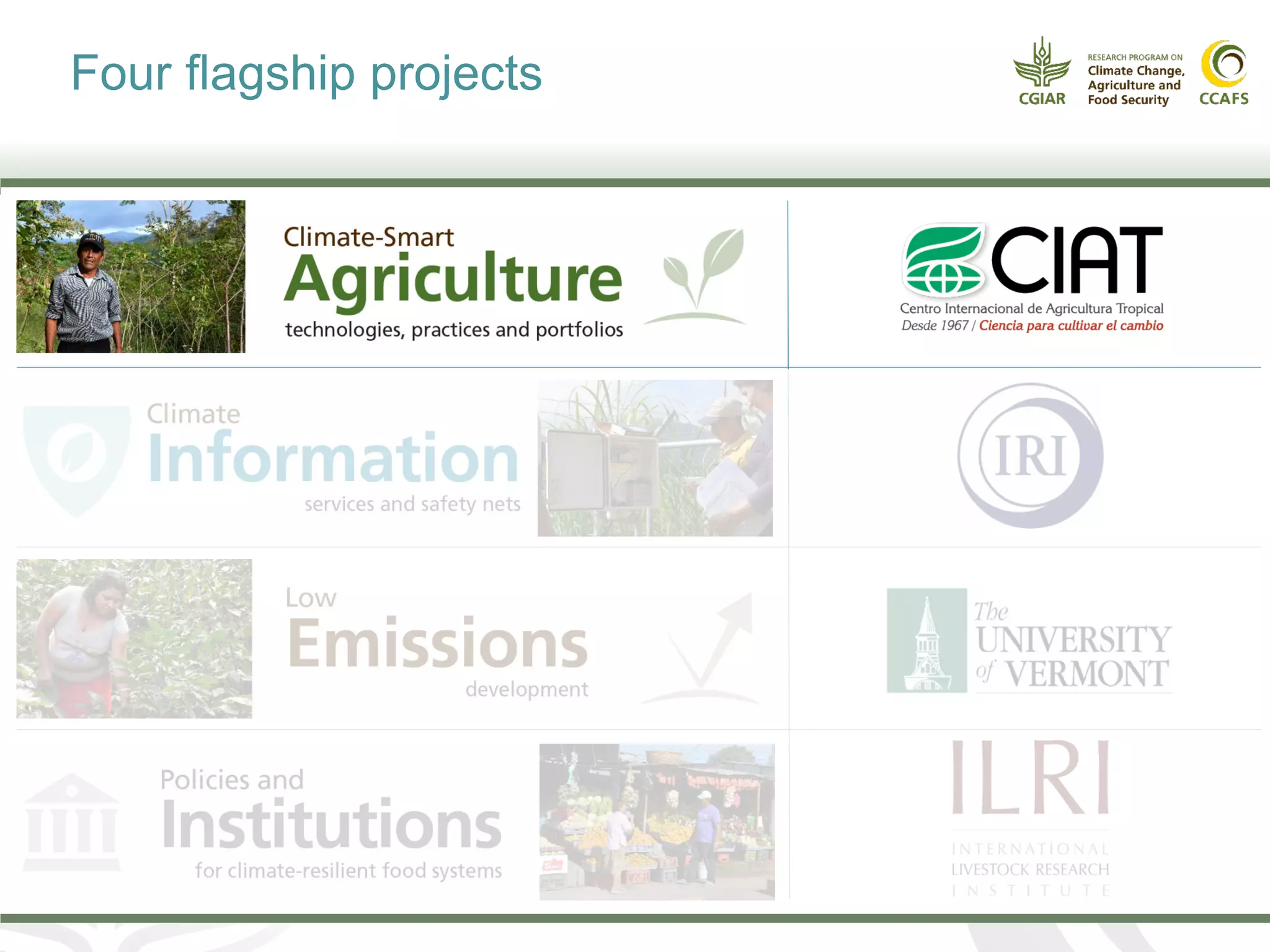
Four flagship projects
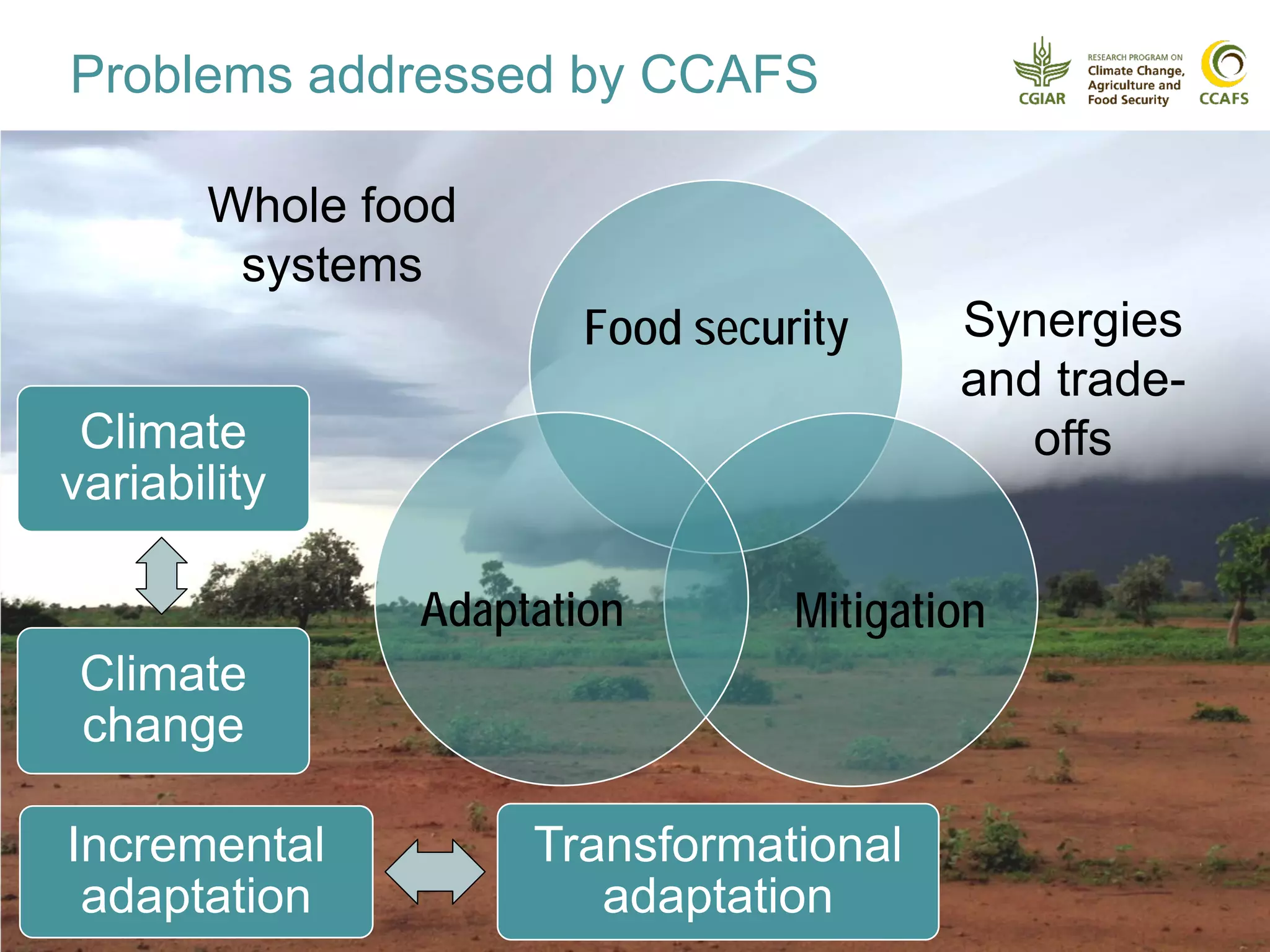
Incremental
adaptation
Transformational
adaptation
Food security
MitigationAdaptation
Climate
variability
Climate
change
Synergies
and trade-
offs
Whole food
systems
Problems addressed by CCAFS
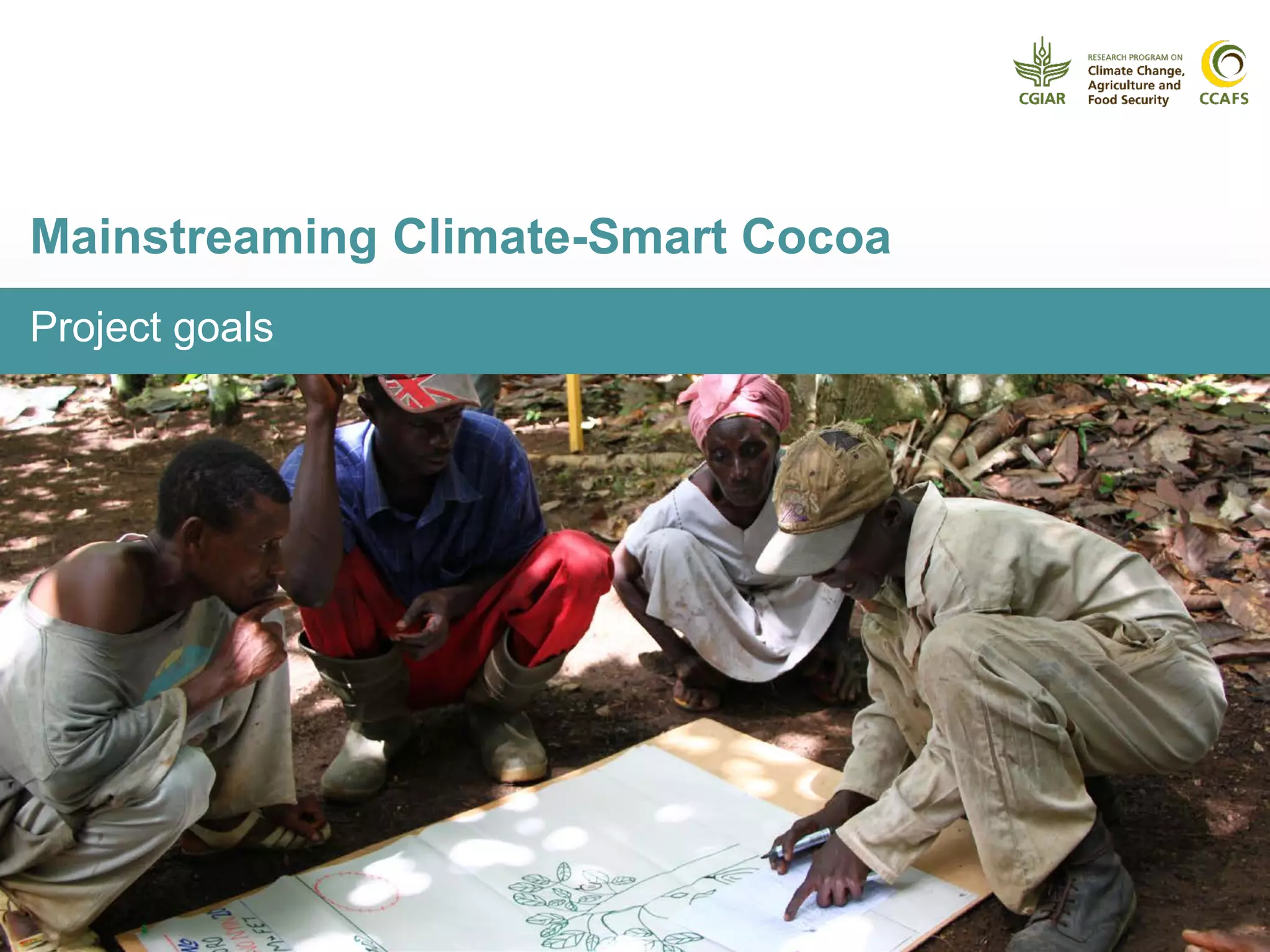
Project goals
Mainstreaming Climate-Smart Cocoa
Project goals (1)
What we know
• The impacts of climate change are not uniform across the
cocoa belt of West Africa.
• The differentiated nature of the risks means differentiated
strategies for managing adaptation.
• There is no one-size fits all strategy.
What we will do
• Use a transect approach to account for spatial and temporal
differences
• Select sites with high, medium and low climate change impacts
and develop appropriate strategies -- in collaboration with
others -- for each
• Assess adequate adaptation strategies with producers and
value chain actors (right varieties, diversification, shading, site
specific recommendations, new generation of farmers, smart
replanting strategies, etc.)
Project goals (2)
What we will do (continued)
• Test ways to drive CSA adoption at scale with appropriate
support and incentives:
a) Integration of site specific CSA practices into extension services
tied to voluntary certification schemes; and, I
b) Integration of site specific CSA practices into producer
organization financing models.
• Engage local actors in the above process through multi-
stakeholder platforms (such as this meeting) in an on-going
way from now until (at least) 2019.
• We do not want to reinvent the wheel but rather support / build
on existing activities and hope you will find what we can
provide useful to achieving your business, research and policy
goals.
Project consortium members
Mainstreaming Climate-Smart Cocoa
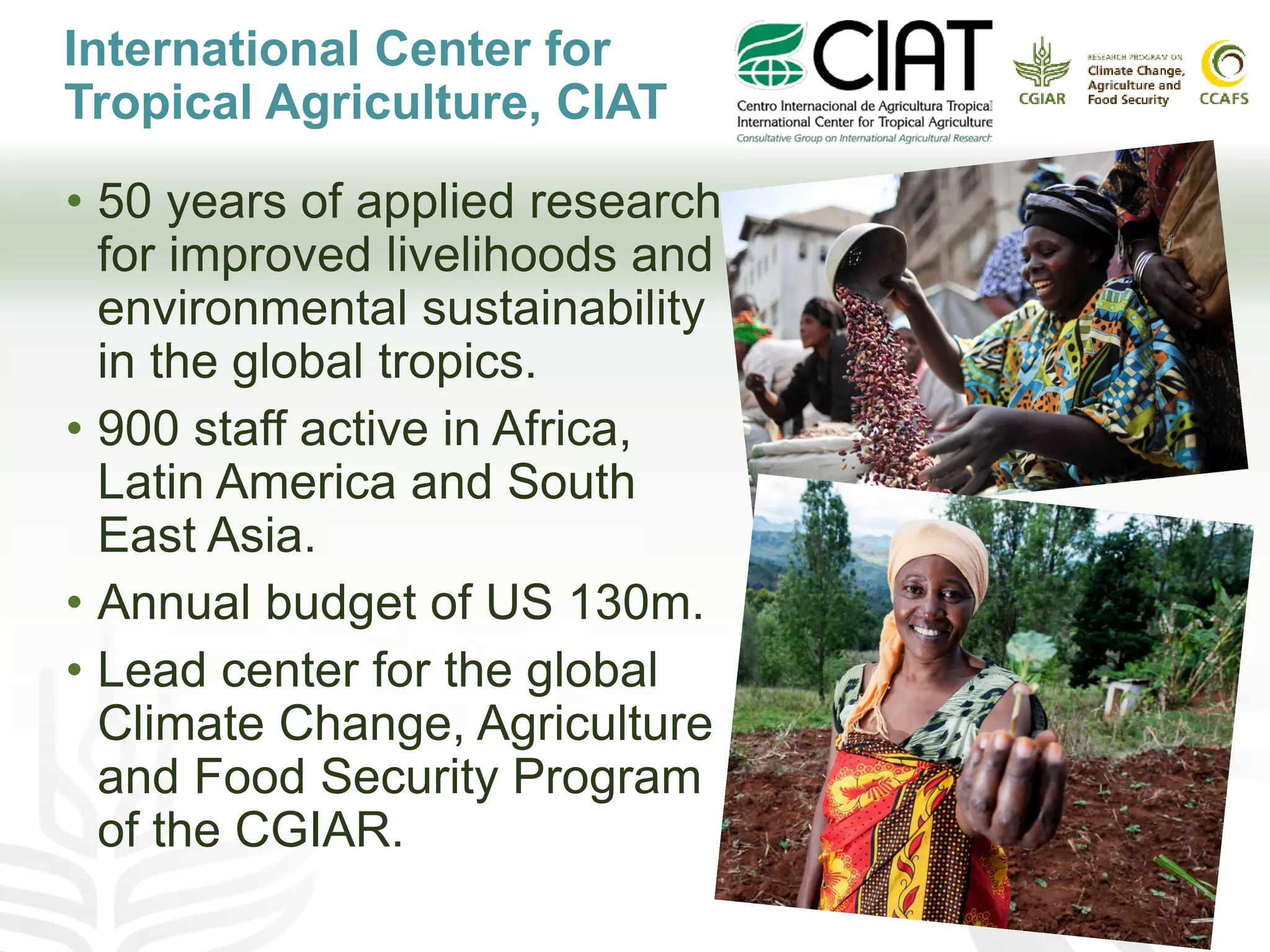
International Center for
Tropical Agriculture, CIAT
• 50 years of applied research
for improved livelihoods and
environmental sustainability
in the global tropics.
• 900 staff active in Africa,
Latin America and South
East Asia.
• Annual budget of US 130m.
• Lead center for the global
Climate Change, Agriculture
and Food Security Program
of the CGIAR.
International Center for
Tropical Agriculture, CIAT
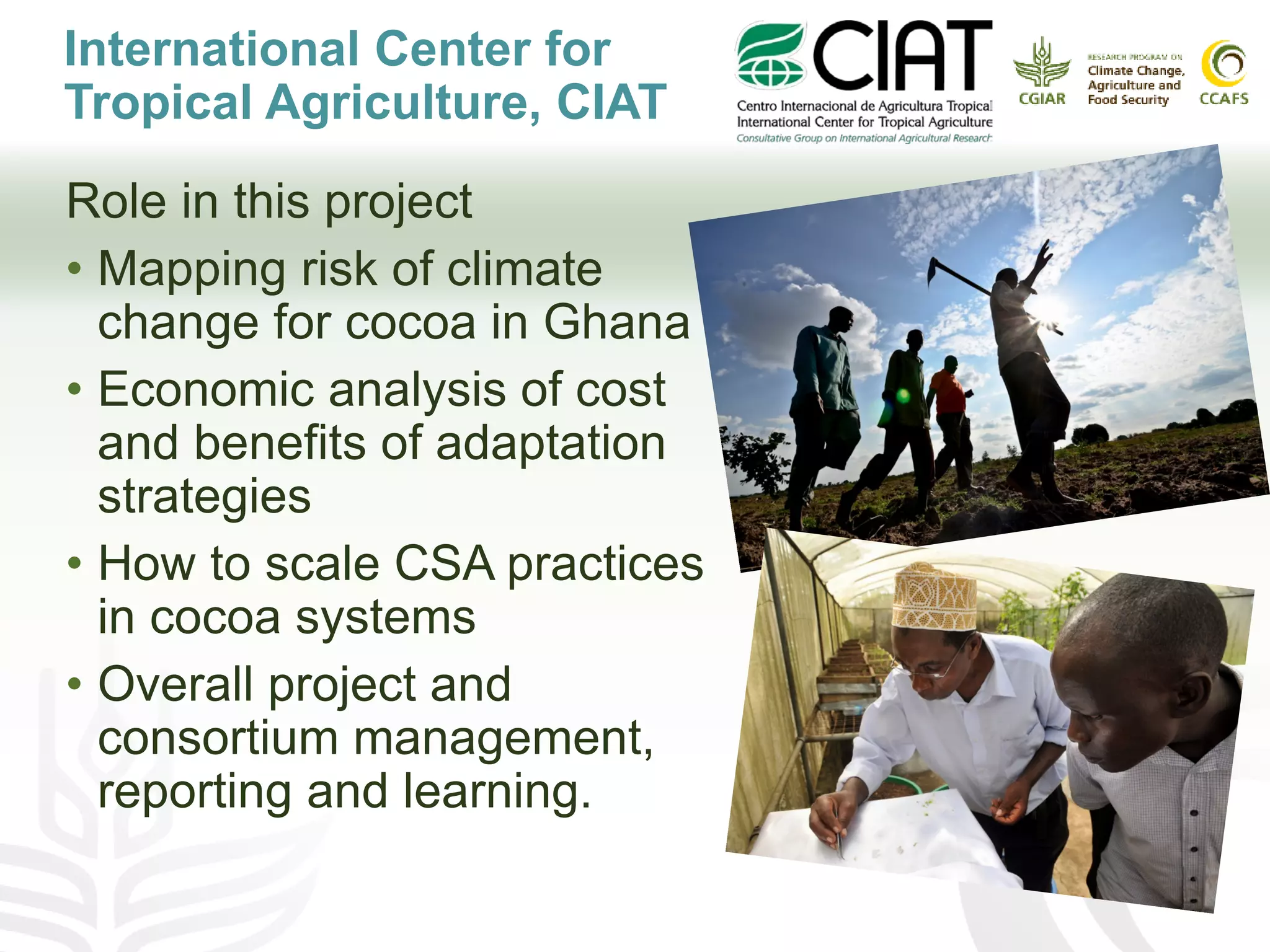
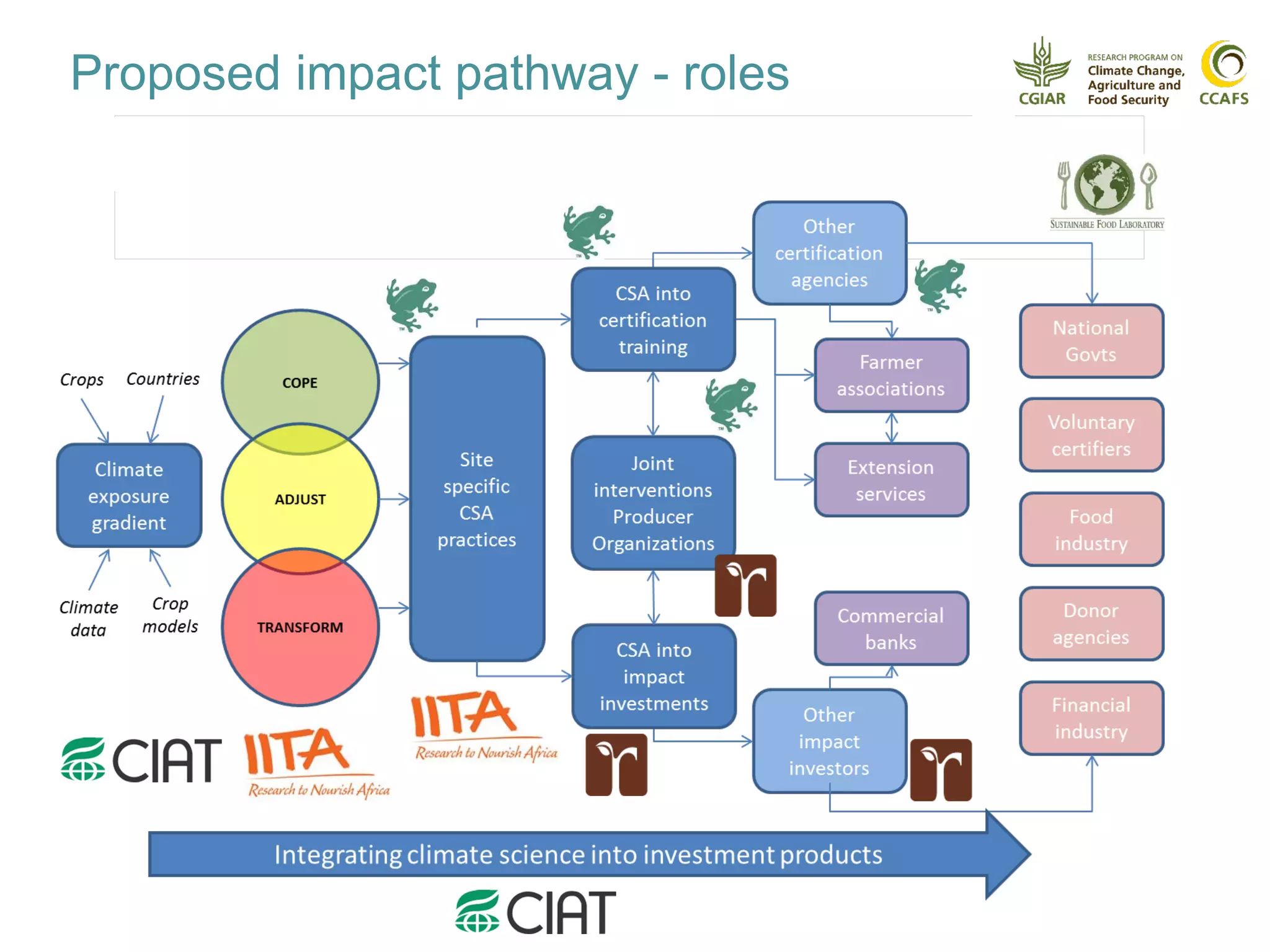
Role in this project
• Mapping risk of climate
change for cocoa in Ghana
• Economic analysis of cost
and benefits of adaptation
strategies
• How to scale CSA practices
in cocoa systems
• Overall project and
consortium management,
reporting and learning.
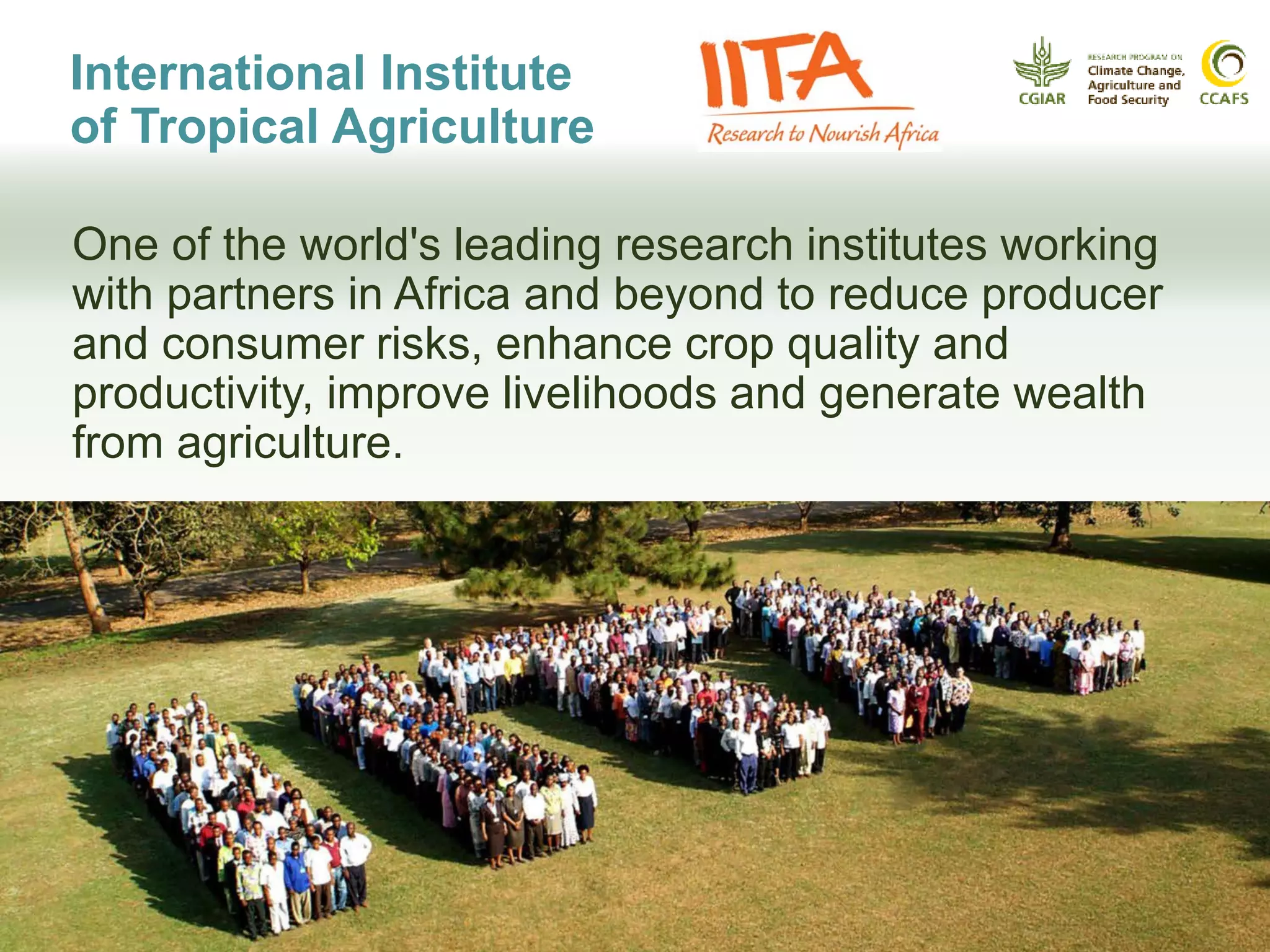
International Institute
of Tropical Agriculture
One of the world's leading research institutes working
with partners in Africa and beyond to reduce producer
and consumer risks, enhance crop quality and
productivity, improve livelihoods and generate wealth
from agriculture.
International Institute
of Tropical Agriculture
Project role
• Coordination in Ghana together with RA
• Situational analysis
• Stakeholder engagement
• Social learning
• Identify strategic learning sites along climate gradients
• Develop relevant adaptation practices for cocoa
• Climate Smart Agriculture planning that fosters gradual
change/transition in the identified high impact zones
• Match CSA to value chain actors’ needs according to the
agreed identified adaptation zones
International Institute
of Tropical Agriculture
CSA pilot in Ghana
Three CSA research pilot sites along climate gradient:
Focus:
• Situational analysis
• Agricultural information systems
• Farm modernisation and sustainable intensification
• Farm rejuvenation, diversification and rehabilitation
• Productive cocoa systems and cocoa farm investment scenarios
in the face of climate change and climate variability
• Biological control
• Youth in cocoa farming and cocoa service provision
21
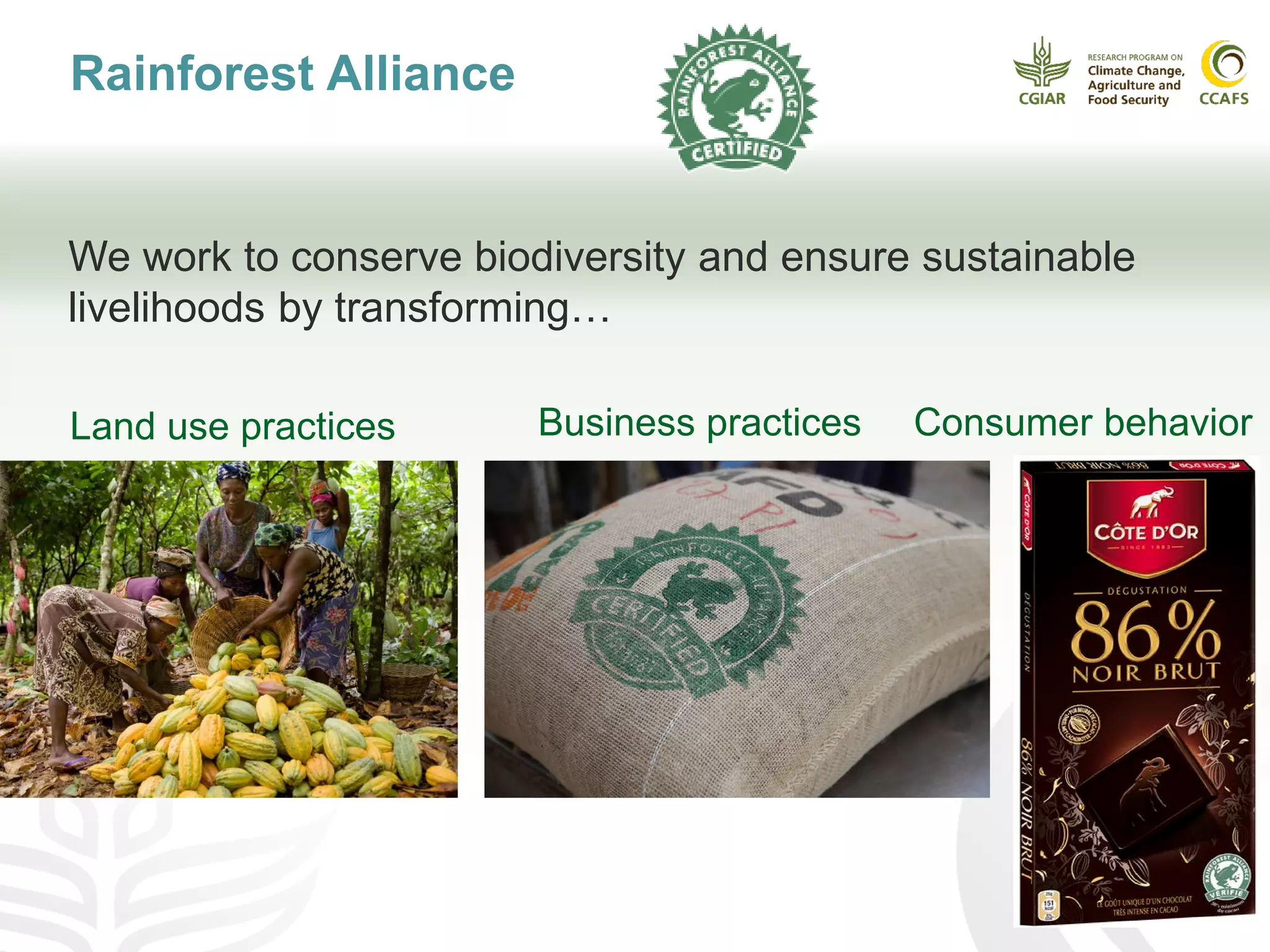
Rainforest Alliance
We work to conserve biodiversity and ensure sustainable
livelihoods by transforming…
Consumer behaviorBusiness practicesLand use practices
Rainforest Alliance
Project role
• Identify site & cocoa-based farming system specific
CSA practices by exposure and investment gradient
• Identify site and crop specific CSA practices that are
most promising for inclusion into certification and
training
• Incorporation into Rainforest Alliance training materials
• Replicate this process with other voluntary certification
bodies
• Influence uptake of methods and approaches more
broadly with other relevant stakeholders
Root Capital
An Impact
Investment Pioneer
Seeks a financial return AND socio-economic and
environmental benefits for clients and their members
Provides a range of credit and financial advisory
services to rural enterprises in the “missing middle”
15 years old, over $120M under management,$850M
lent cumulatively; 97% repayment rate; 100% return of
funds to investors
Lends along supply chains where contracts serve as the
primary form of collateral
Major focus on measuring impacts; standard metrics
and deeper analysis for a sub-sample of clients
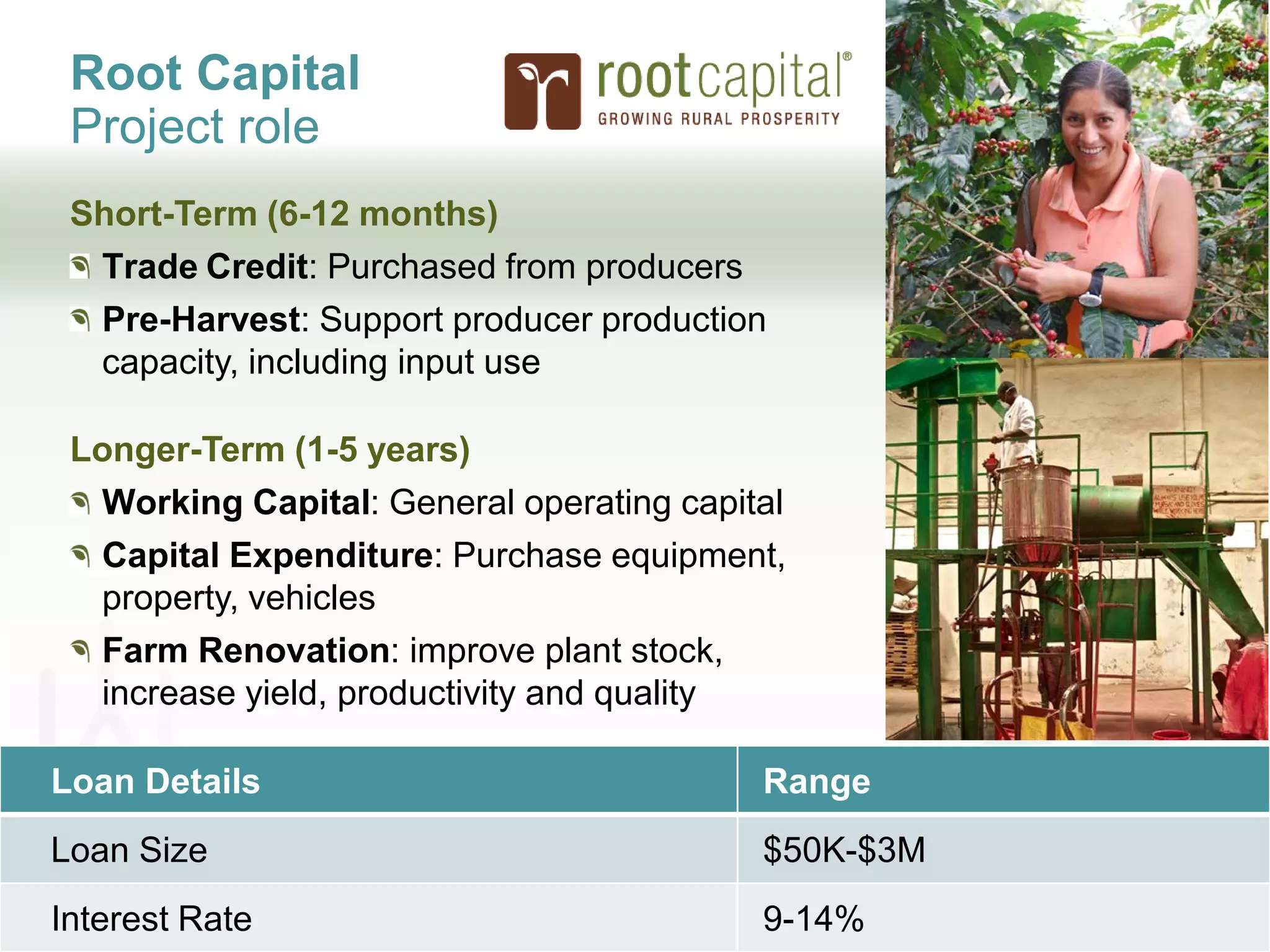
Root Capital
Project role
Loan Details Range
Loan Size $50K-$3M
Interest Rate 9-14%
Short-Term (6-12 months)
Trade Credit: Purchased from producers
Pre-Harvest: Support producer production
capacity, including input use
Longer-Term (1-5 years)
Working Capital: General operating capital
Capital Expenditure: Purchase equipment,
property, vehicles
Farm Renovation: improve plant stock,
increase yield, productivity and quality
Mainstreaming CSA
into agricultural finance
• Root Capital will assess how to
adapt its financial products to
facilitate adoption of CSA in the
cocoa sector
• Positive experience with coffee in
Latin America
• Multiple challenges to date working
in the cocoa sector in Ghana, so
these will need to be addressed
A Global Learning Platform to
Mainstream Sustainability
Sustainable Food Lab
The Business Case
for Climate Smart Agriculture
• The Food Lab’s role is to engage global and
national companies to understand how their
strategic sourcing priorities are effected by
climate risk.
• How might better analytics and tailored adaptation
guidelines strengthen their value chains?
• How might companies integrate adaptation into their
carbon reduction goals?
• Where is the win win and synergy with government
efforts at the national level?
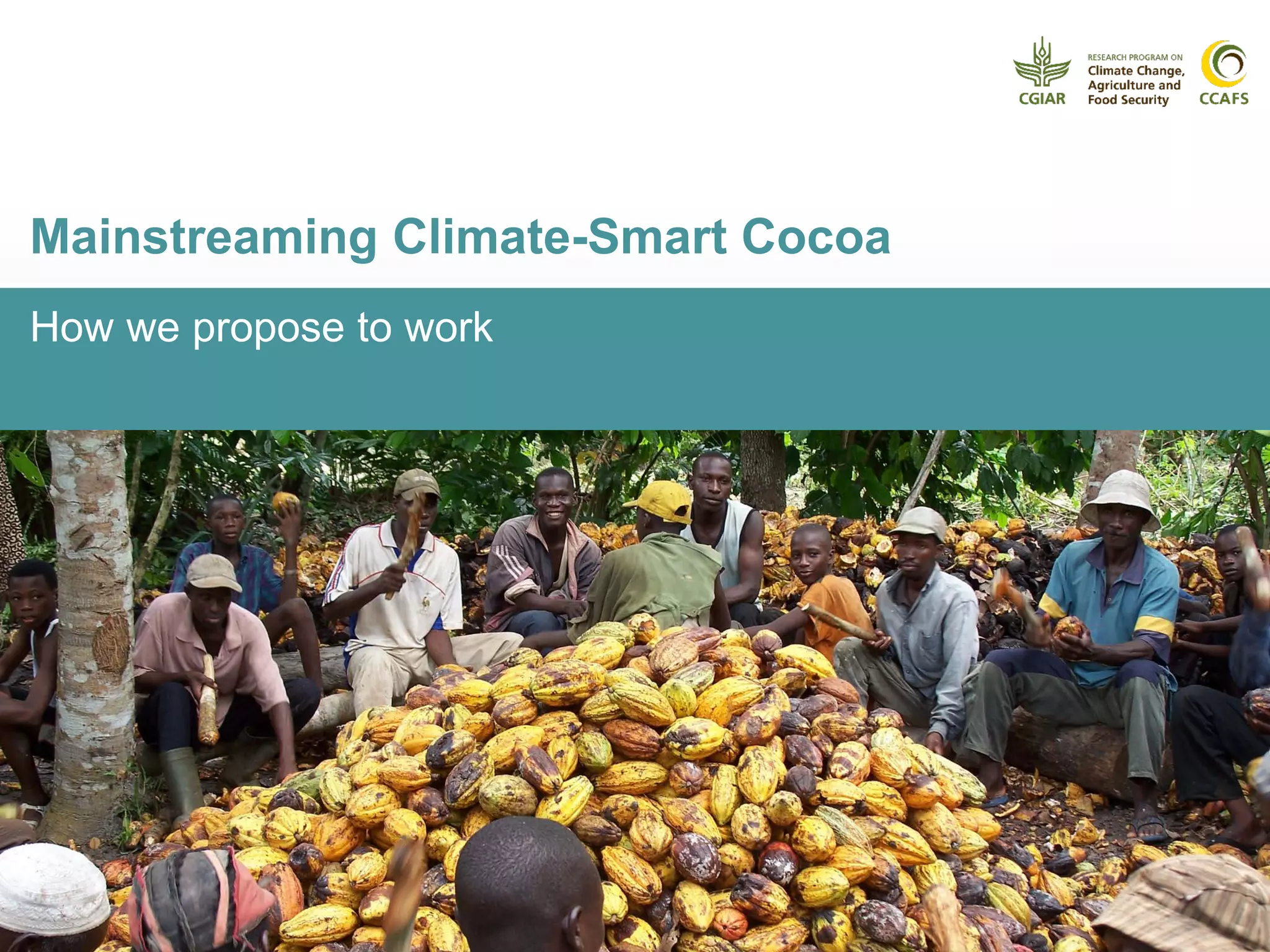
How we propose to work
Mainstreaming Climate-Smart Cocoa
Proposed impact pathway
Proposed impact pathway - roles
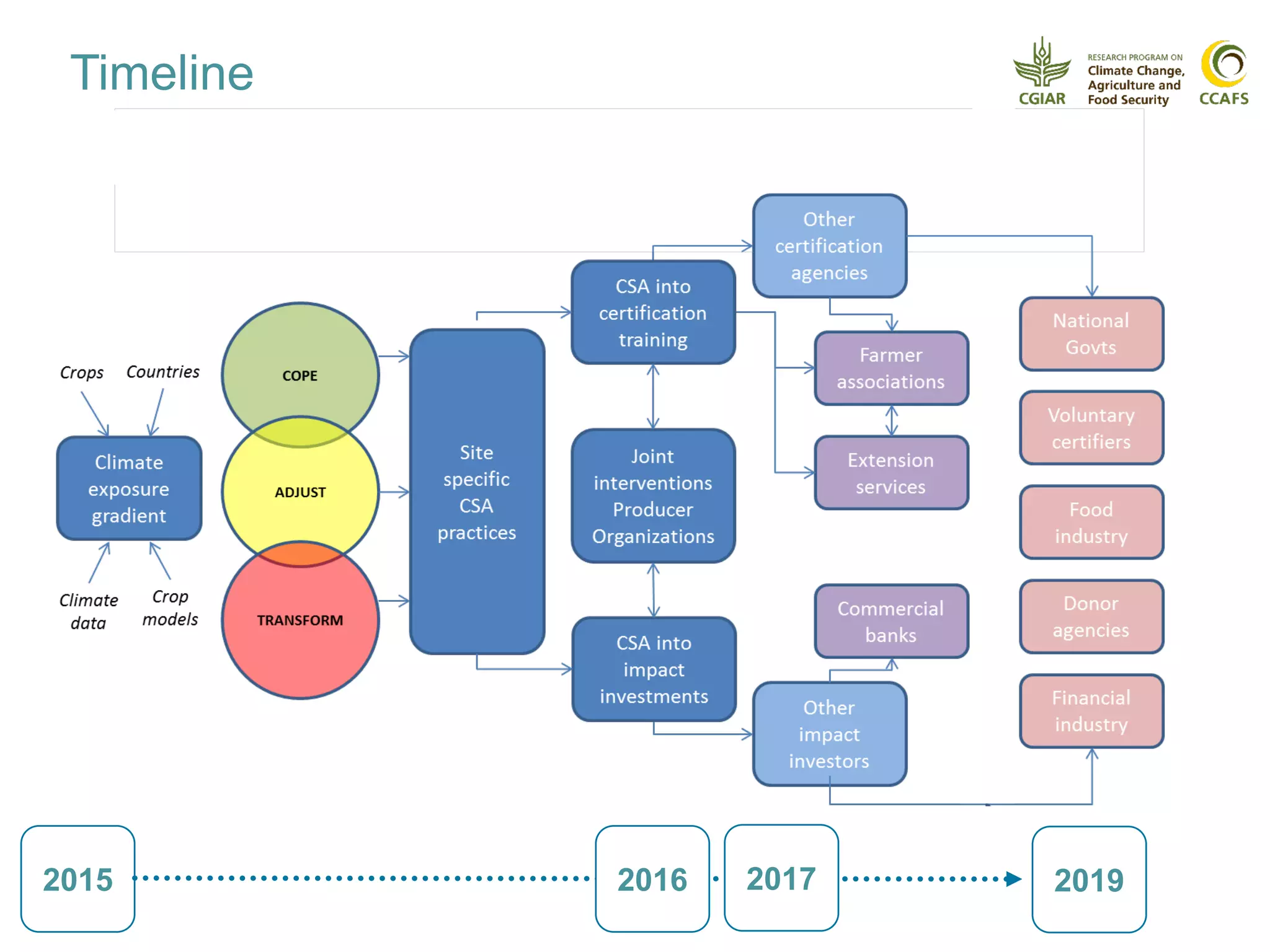
Timeline
2015 20192016 2017
Initial results of climate change exposure mapping
Mainstreaming Climate-Smart Cocoa
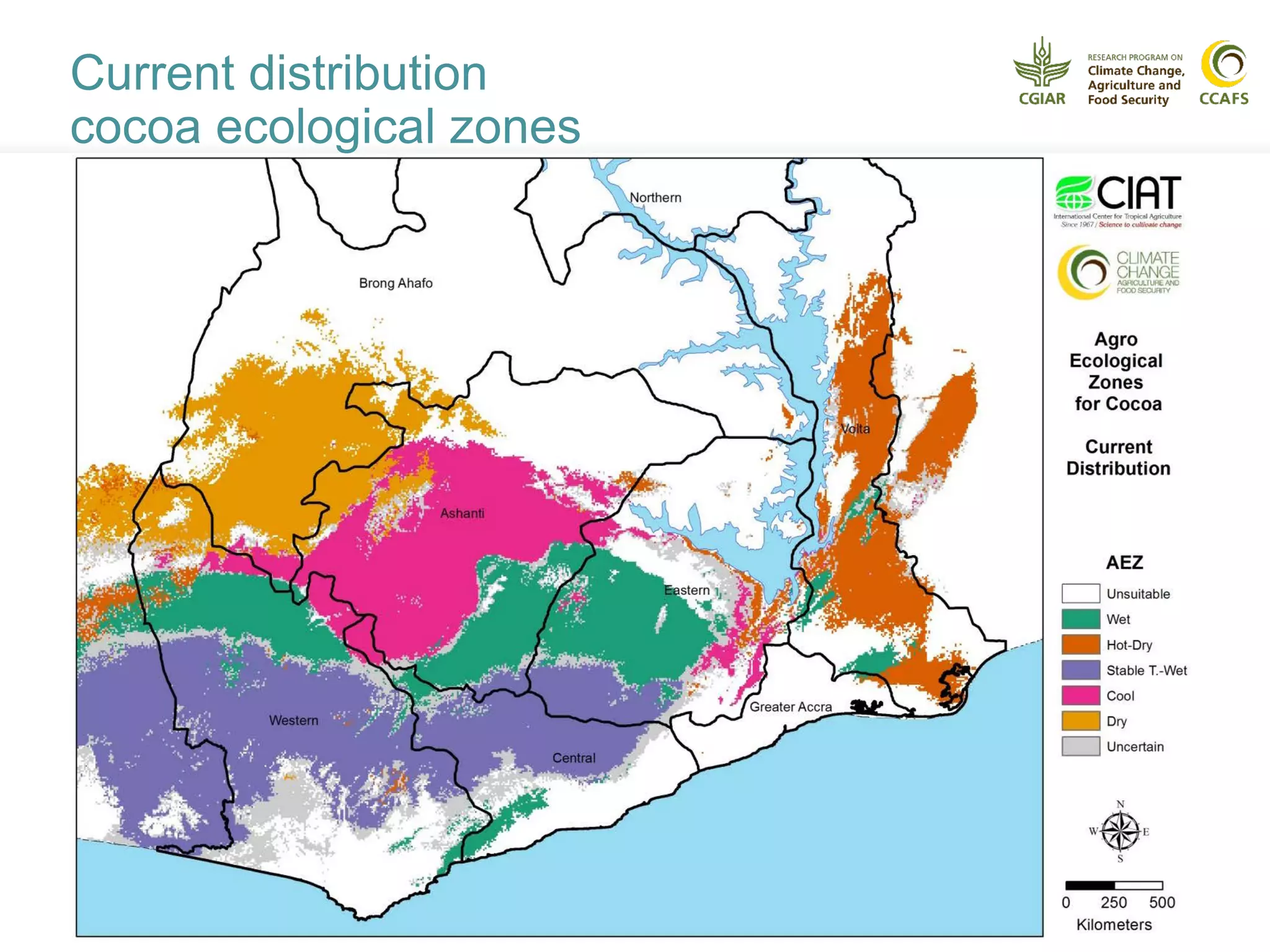
Current distribution
cocoa ecological zones
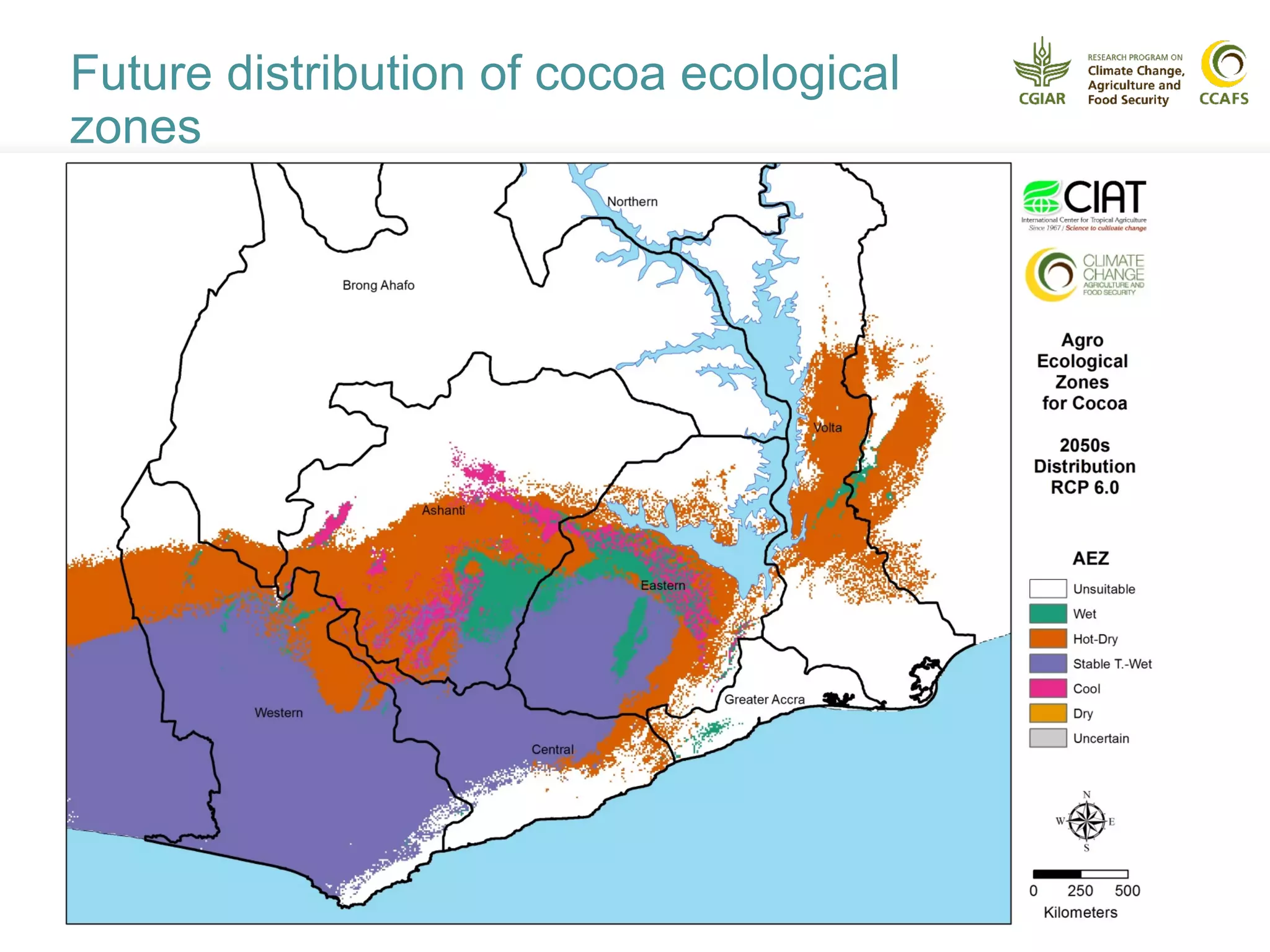
Future distribution of cocoa ecological
zones
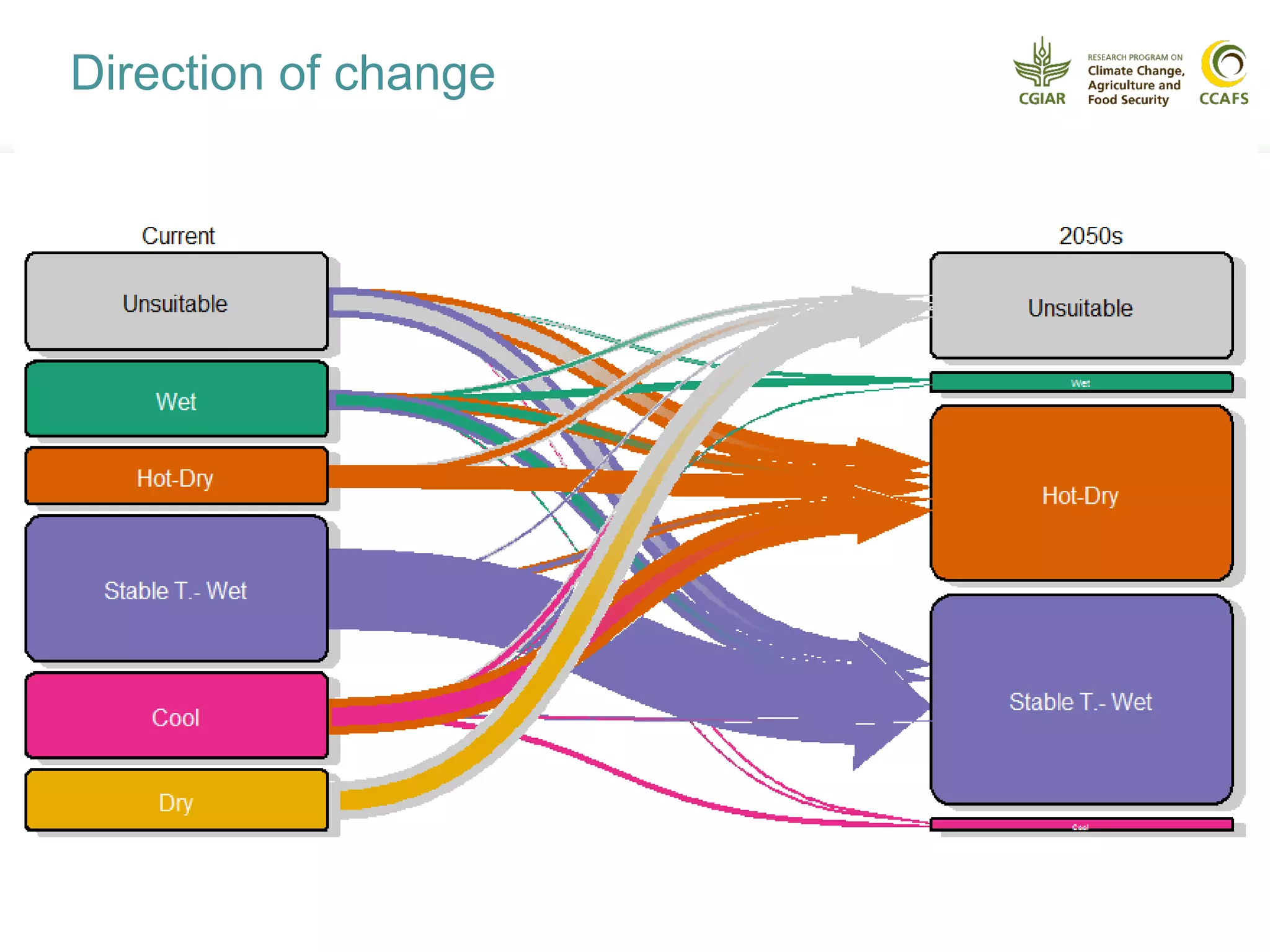
Direction of change
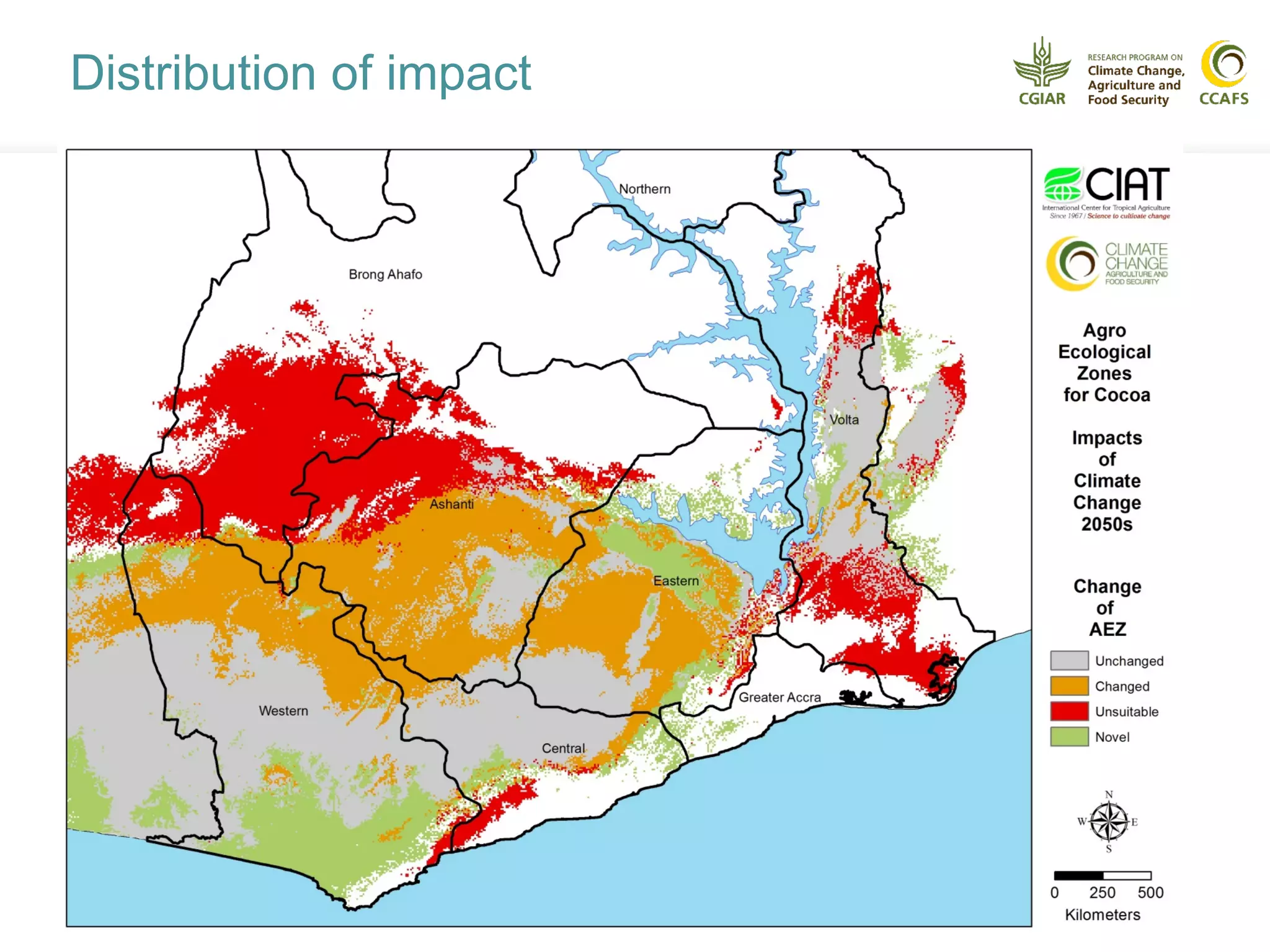
Distribution of impact
Final thougths
Mainstreaming Climate-Smart Cocoa
Final thoughts
The project expects to contribute to:
 Clear knowledge of what types of CSA practices to promote
where, for whom and with what return on investment
 Knowledge of under what conditions extension and PO
investments function as incentives for CSA uptake at scale
 Identification of additional public, private or public-private
incentives needed to promote widespread CSA adoption in the
cocoa sector
 Functional multi-stakeholder platforms that combines climate
science with industry knowledge to reduce risk faced by cocoa
in Ghana going forward.
• We seek to add value to what all of you are already
doing around climate change and look forward to
hearing what you think, how we might best collaborate
and what additional issues should be considered.
Any question for clarification?
Thank you

Climate Smart Cocoa in Ghana Kick-off Workshop

  • 1.
  • 2.
    Presentation outline • Climatechange and climate variability for cocoa in West Africa • Climate Change, Agriculture and Food Security (CCAFS) program • Project goals • Project consortium members • How we propose to work • Initial results of climate change exposure mapping • Final thoughts
  • 3.
    Climate change andclimate variability for cocoa in West Africa Mainstreaming Climate-Smart Cocoa
  • 4.
    Climate change andclimate variability for cocoa in West Africa • Cocoa increasingly vulnerable to climate change and climate variability. • In the cocoa-growing regions yearly and monthly minimum and maximum temperatures will increase by up to 2.0°C by 2050. • Yearly and monthly precipitation changes trivial. • Result: suitability for current cocoa-growing areas will decrease seriously by 2050. • Climate change will increase pressure on forest areas.
  • 5.
    2050 suitability changes forcocoa regions • Suitability losses in the West • Some gains towards Lake Volta. Läderach et al. (2013) Predicting the future climatic suitability for cocoa farming of the world’s leading producer countries, Ghana and Côte d’Ivoire” Climatic Change.
  • 6.
    2050 suitability changes forcocoa regions • Ghana: Losses in the North, Gains in central areas. • West-A.: Maximum dry season temperatures seen to be problematic. • West-A.: Areas at the margins to Savanna are most vulnerable. Schroth et al.,“Vulnerability to climate change of cocoa in West Africa: patterns, opportunities and limits to adaptation” Agriculture, Ecosystems and Environment (Submitted).
  • 7.
    Climate Change, Agricultureand Food Security (CCAFS) program Mainstreaming Climate-Smart Cocoa
  • 8.
    CGIAR • A globalpartnership that unites organizations engaged in research for a food secure future • 15 research centers engaged in 15 CGIAR Research Programs
  • 9.
    Overall objectives: • Identifyand develop pro- poor adaptation and mitigation practices, technologies and policies for agriculture and food systems. • Support the inclusion of agricultural issues in climate change policies, and of climate issues in agricultural policies, at all levels. The Climate Change, Agriculture and Food Security (CCAFS) program
  • 10.
  • 11.
  • 12.
  • 13.
    Project goals (1) Whatwe know • The impacts of climate change are not uniform across the cocoa belt of West Africa. • The differentiated nature of the risks means differentiated strategies for managing adaptation. • There is no one-size fits all strategy. What we will do • Use a transect approach to account for spatial and temporal differences • Select sites with high, medium and low climate change impacts and develop appropriate strategies -- in collaboration with others -- for each • Assess adequate adaptation strategies with producers and value chain actors (right varieties, diversification, shading, site specific recommendations, new generation of farmers, smart replanting strategies, etc.)
  • 14.
    Project goals (2) Whatwe will do (continued) • Test ways to drive CSA adoption at scale with appropriate support and incentives: a) Integration of site specific CSA practices into extension services tied to voluntary certification schemes; and, I b) Integration of site specific CSA practices into producer organization financing models. • Engage local actors in the above process through multi- stakeholder platforms (such as this meeting) in an on-going way from now until (at least) 2019. • We do not want to reinvent the wheel but rather support / build on existing activities and hope you will find what we can provide useful to achieving your business, research and policy goals.
  • 15.
  • 16.
    International Center for TropicalAgriculture, CIAT • 50 years of applied research for improved livelihoods and environmental sustainability in the global tropics. • 900 staff active in Africa, Latin America and South East Asia. • Annual budget of US 130m. • Lead center for the global Climate Change, Agriculture and Food Security Program of the CGIAR.
  • 17.
    International Center for TropicalAgriculture, CIAT Role in this project • Mapping risk of climate change for cocoa in Ghana • Economic analysis of cost and benefits of adaptation strategies • How to scale CSA practices in cocoa systems • Overall project and consortium management, reporting and learning.
  • 18.
    International Institute of TropicalAgriculture One of the world's leading research institutes working with partners in Africa and beyond to reduce producer and consumer risks, enhance crop quality and productivity, improve livelihoods and generate wealth from agriculture.
  • 19.
    International Institute of TropicalAgriculture Project role • Coordination in Ghana together with RA • Situational analysis • Stakeholder engagement • Social learning • Identify strategic learning sites along climate gradients • Develop relevant adaptation practices for cocoa • Climate Smart Agriculture planning that fosters gradual change/transition in the identified high impact zones • Match CSA to value chain actors’ needs according to the agreed identified adaptation zones
  • 20.
    International Institute of TropicalAgriculture CSA pilot in Ghana Three CSA research pilot sites along climate gradient: Focus: • Situational analysis • Agricultural information systems • Farm modernisation and sustainable intensification • Farm rejuvenation, diversification and rehabilitation • Productive cocoa systems and cocoa farm investment scenarios in the face of climate change and climate variability • Biological control • Youth in cocoa farming and cocoa service provision
  • 21.
    21 Rainforest Alliance We workto conserve biodiversity and ensure sustainable livelihoods by transforming… Consumer behaviorBusiness practicesLand use practices
  • 22.
    Rainforest Alliance Project role •Identify site & cocoa-based farming system specific CSA practices by exposure and investment gradient • Identify site and crop specific CSA practices that are most promising for inclusion into certification and training • Incorporation into Rainforest Alliance training materials • Replicate this process with other voluntary certification bodies • Influence uptake of methods and approaches more broadly with other relevant stakeholders
  • 23.
    Root Capital An Impact InvestmentPioneer Seeks a financial return AND socio-economic and environmental benefits for clients and their members Provides a range of credit and financial advisory services to rural enterprises in the “missing middle” 15 years old, over $120M under management,$850M lent cumulatively; 97% repayment rate; 100% return of funds to investors Lends along supply chains where contracts serve as the primary form of collateral Major focus on measuring impacts; standard metrics and deeper analysis for a sub-sample of clients
  • 24.
    Root Capital Project role LoanDetails Range Loan Size $50K-$3M Interest Rate 9-14% Short-Term (6-12 months) Trade Credit: Purchased from producers Pre-Harvest: Support producer production capacity, including input use Longer-Term (1-5 years) Working Capital: General operating capital Capital Expenditure: Purchase equipment, property, vehicles Farm Renovation: improve plant stock, increase yield, productivity and quality
  • 25.
    Mainstreaming CSA into agriculturalfinance • Root Capital will assess how to adapt its financial products to facilitate adoption of CSA in the cocoa sector • Positive experience with coffee in Latin America • Multiple challenges to date working in the cocoa sector in Ghana, so these will need to be addressed
  • 26.
    A Global LearningPlatform to Mainstream Sustainability
  • 27.
    Sustainable Food Lab TheBusiness Case for Climate Smart Agriculture • The Food Lab’s role is to engage global and national companies to understand how their strategic sourcing priorities are effected by climate risk. • How might better analytics and tailored adaptation guidelines strengthen their value chains? • How might companies integrate adaptation into their carbon reduction goals? • Where is the win win and synergy with government efforts at the national level?
  • 28.
    How we proposeto work Mainstreaming Climate-Smart Cocoa
  • 29.
  • 30.
  • 31.
  • 32.
    Initial results ofclimate change exposure mapping Mainstreaming Climate-Smart Cocoa
  • 33.
  • 34.
    Future distribution ofcocoa ecological zones
  • 35.
  • 36.
  • 37.
  • 38.
    Final thoughts The projectexpects to contribute to:  Clear knowledge of what types of CSA practices to promote where, for whom and with what return on investment  Knowledge of under what conditions extension and PO investments function as incentives for CSA uptake at scale  Identification of additional public, private or public-private incentives needed to promote widespread CSA adoption in the cocoa sector  Functional multi-stakeholder platforms that combines climate science with industry knowledge to reduce risk faced by cocoa in Ghana going forward. • We seek to add value to what all of you are already doing around climate change and look forward to hearing what you think, how we might best collaborate and what additional issues should be considered.
  • 39.
    Any question forclarification? Thank you