Digital Evolutions
Startups, Platforms and Ecosystems
Mentorship Lecture - 25th/26th Sept. 2013
by Simone Cicero - meedabyte.com - @meedabyte
Exponential Times
Digital Ecologies
Platform Design Thinking
Digital Evolutions
Understanding Dynamics
Exponential
Times
everyone is networked with everithing
everyone is networked with everything
Tech Cycles
(every 10 years)
Now it’s time for Wearable
Image from KPCB Internet Trends ‘13
Two main disruption drivers
A growing
computing
density in
matter
Growing
possibilities in AI
and Machine
Learning
Connectedness
=
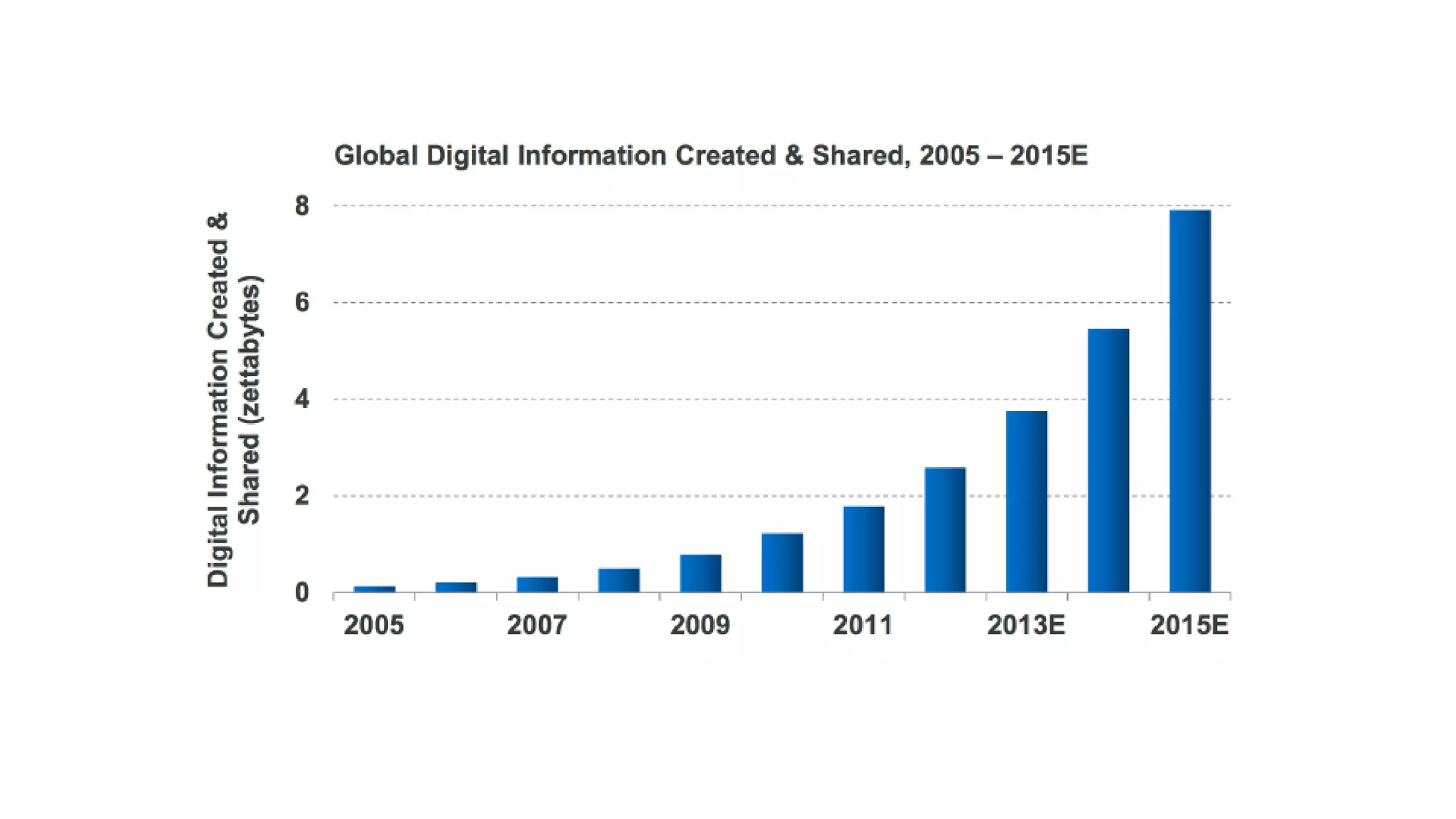
Sharing more and more
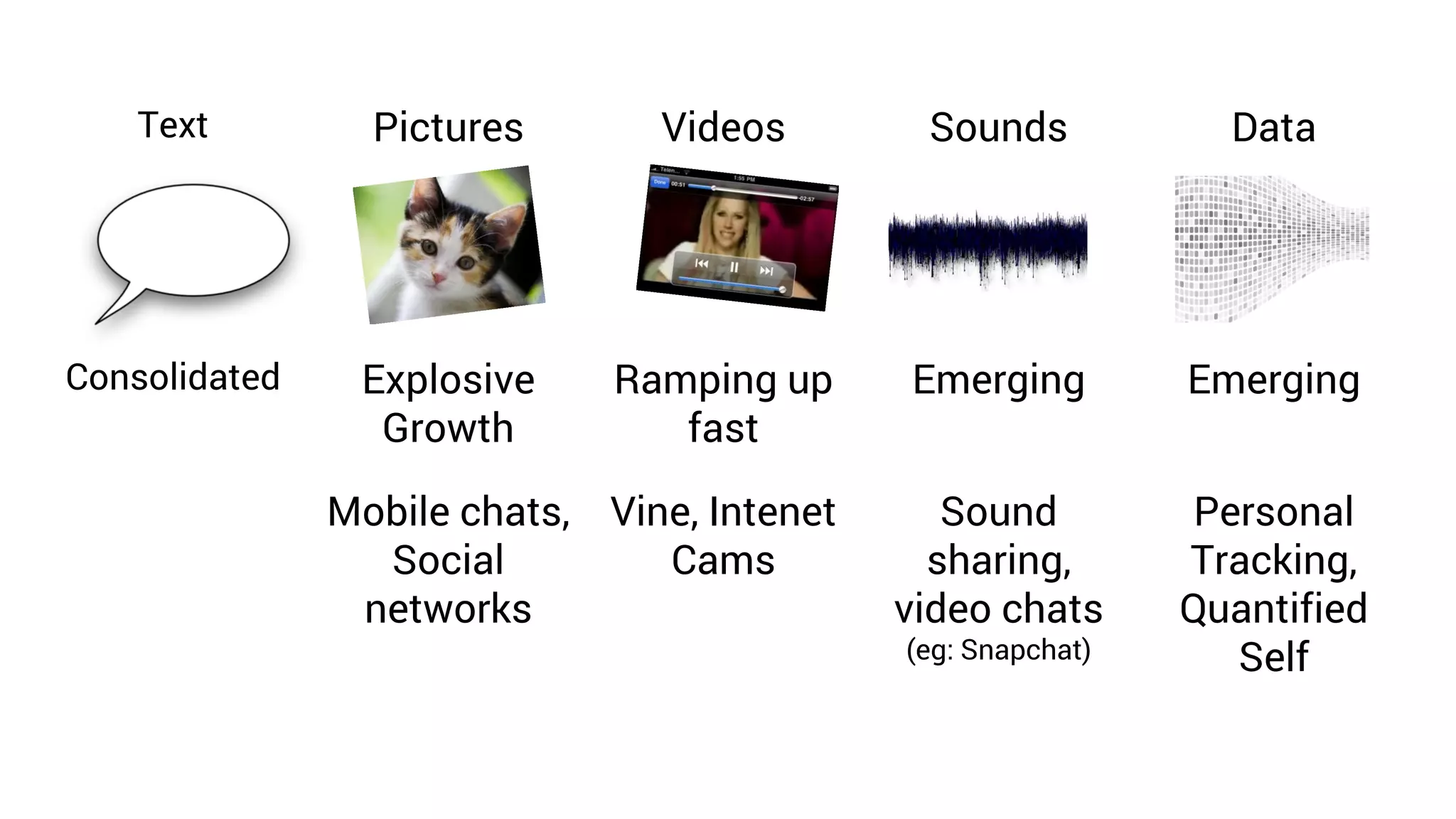
Text Pictures Videos Sounds Data
Consolidated Explosive
Growth
Ramping up
fast
Emerging Emerging
Mobile chats,
Social
networks
Vine, Intenet
Cams
Sound
sharing,
video chats
(eg: Snapchat)
Personal
Tracking,
Quantified
Self
Lifelogging!
Data is all & all is Data
Everything it’s personalized.
Data are connected and socialized.
Devices are allover the place.
It’s the Digital Market today.
Nature
Humans
Technology
Interactions
“Order doesn't come by itself”
Benoit Mandelbrot
chaos
“We're just increasing our
humanness and our ability to
connect with each other, regardless
of geography”
Amber Case, (Cyborg Anthropologist) - SXSW Keynote 2012
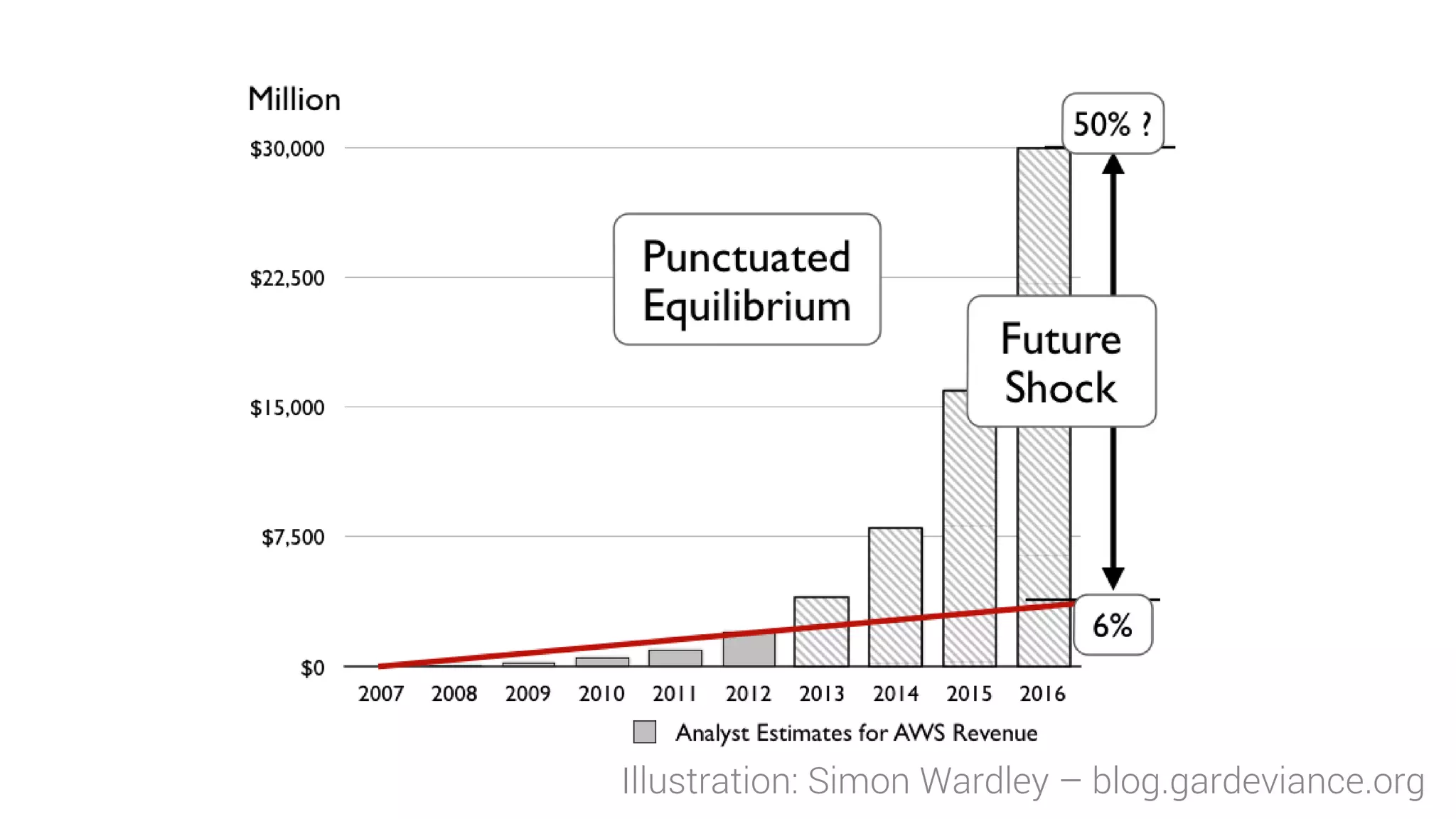
Non linear dynamics
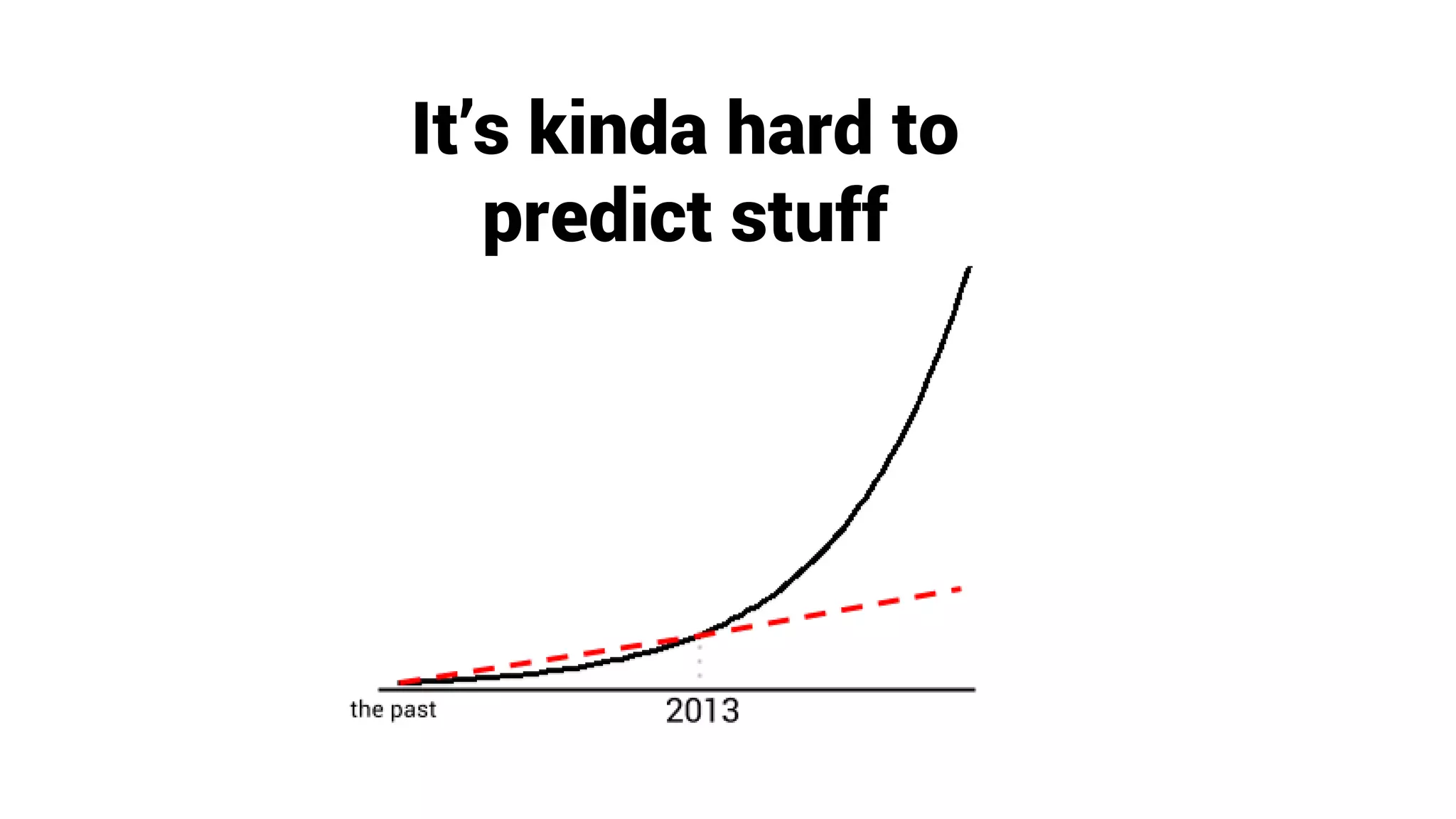
It’s kinda hard to
predict stuff
Illustration: Simon Wardley – blog.gardeviance.org
Digital
Ecologies
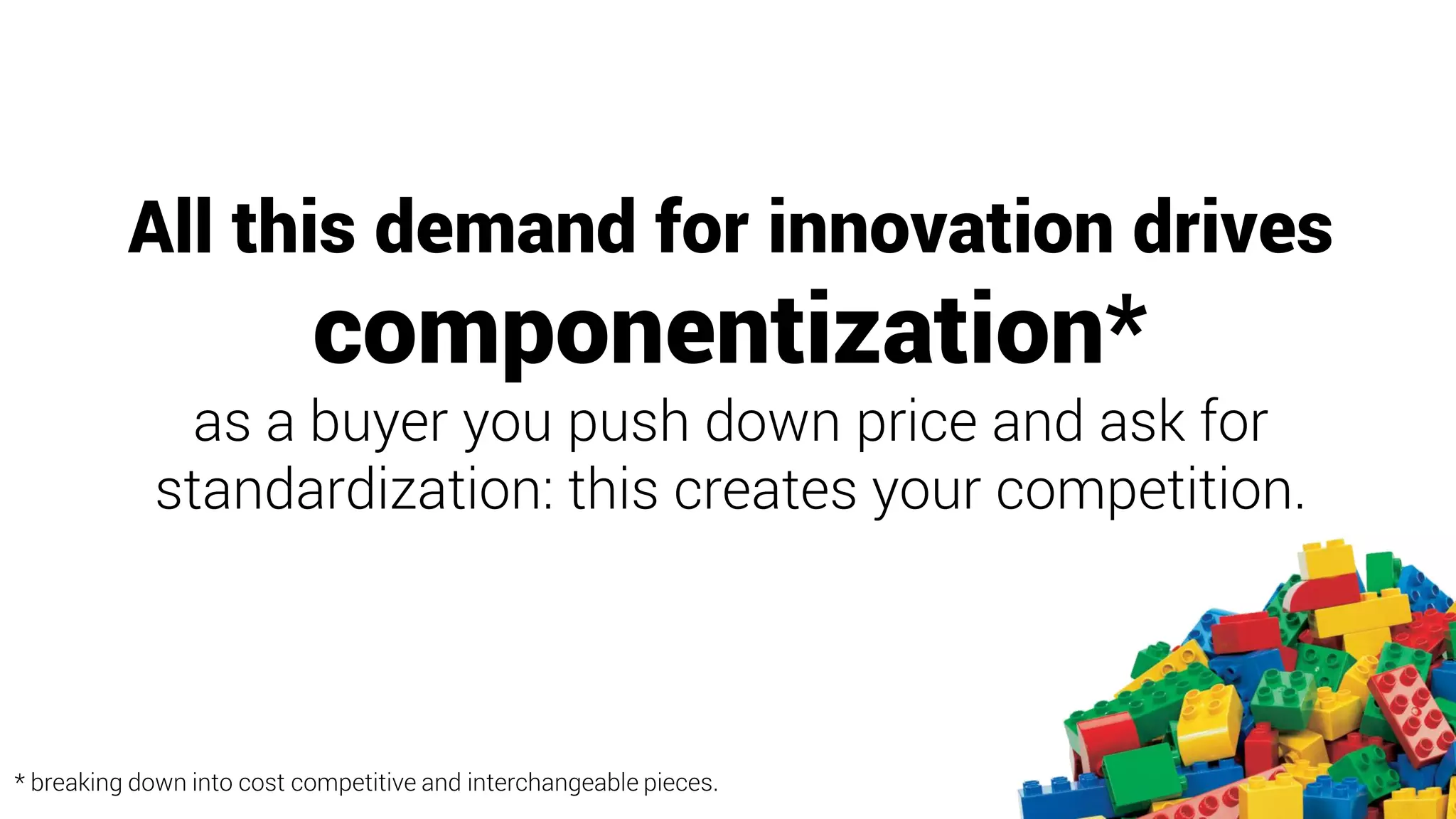
All this demand for innovation drives
componentization*
as a buyer you push down price and ask for
standardization: this creates your competition.
* breaking down into cost competitive and interchangeable pieces.
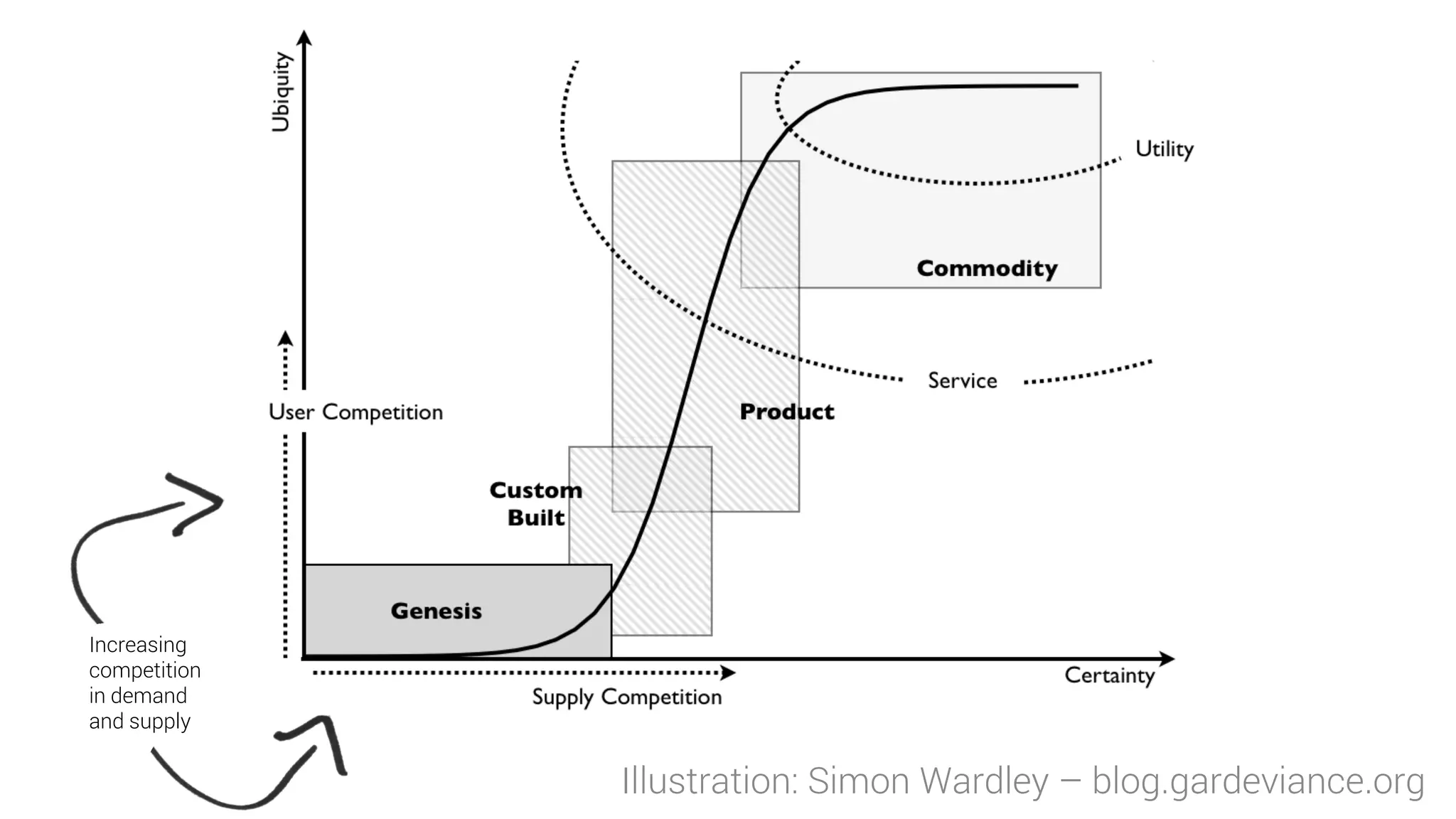
Illustration: Simon Wardley – blog.gardeviance.org
Increasing
competition
in demand
and supply
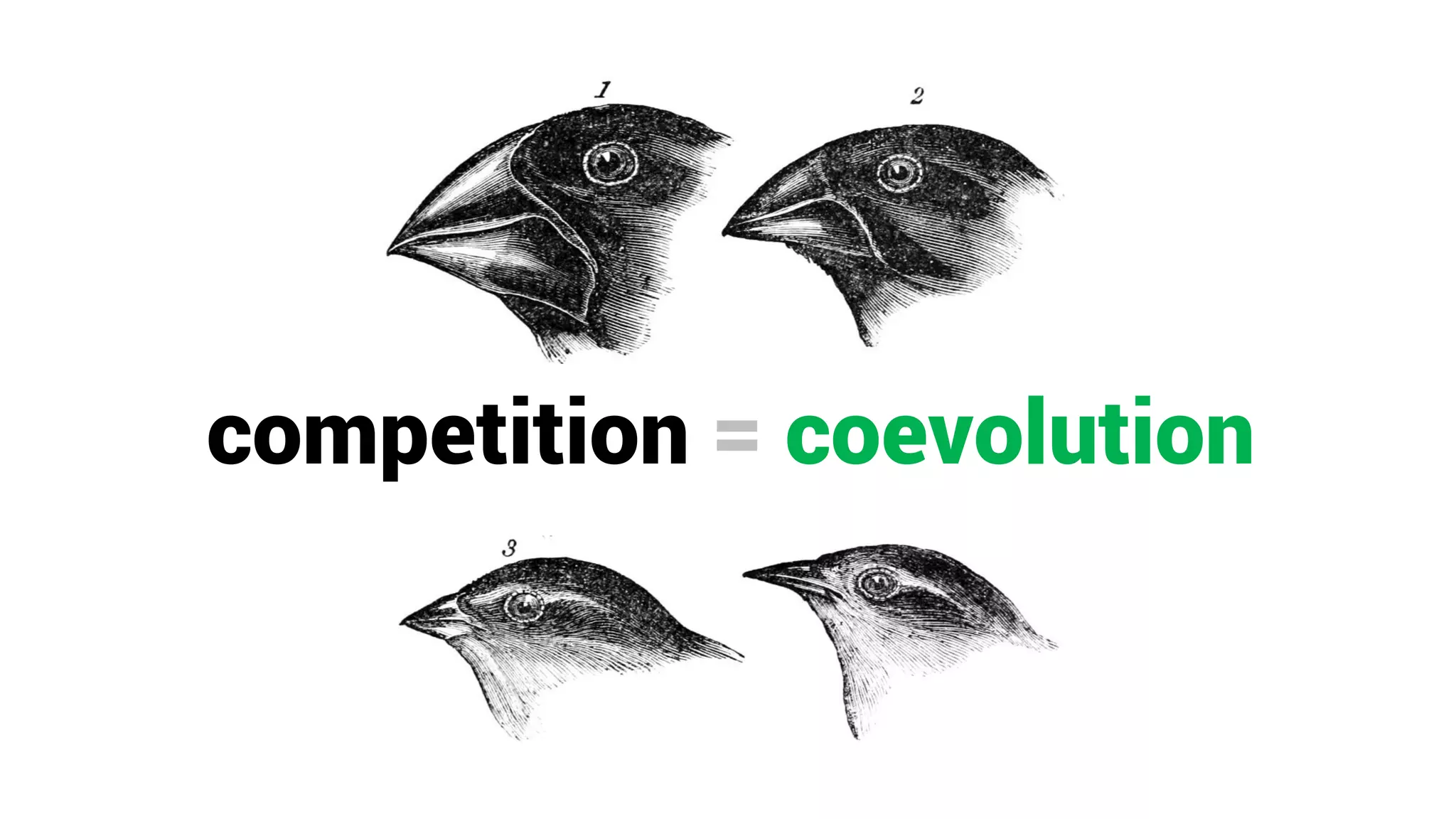
Red Queen Effect
(evolutionary biology)
Regardless of how well a species adapts to its current
environment, it must keep evolving to keep up with its
(also evolving) competitors.
competition = coevolution
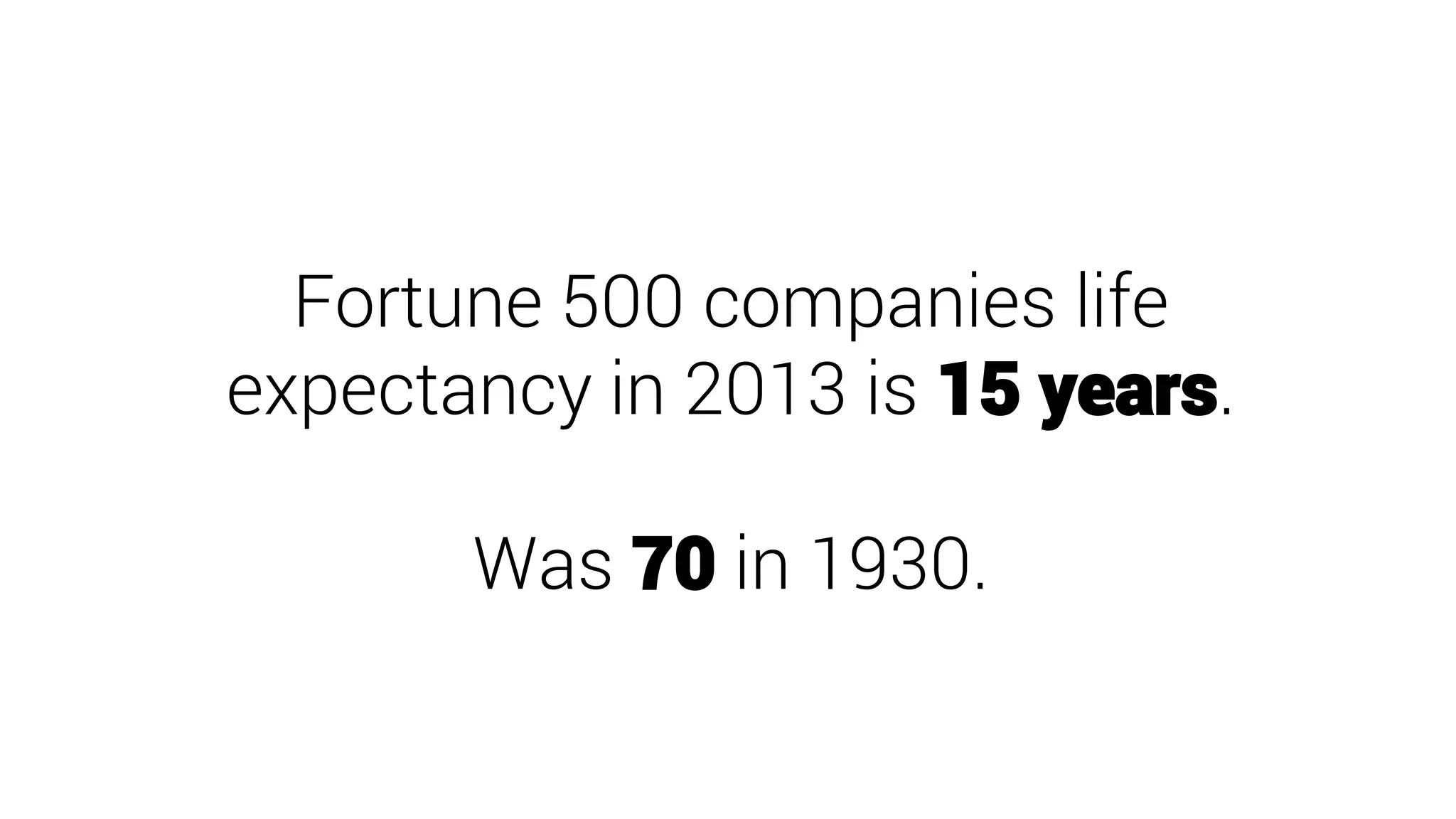
Fortune 500 companies life
expectancy in 2013 is 15 years.
Was 70 in 1930.
“Software is eating the world”
Marc Andreessen
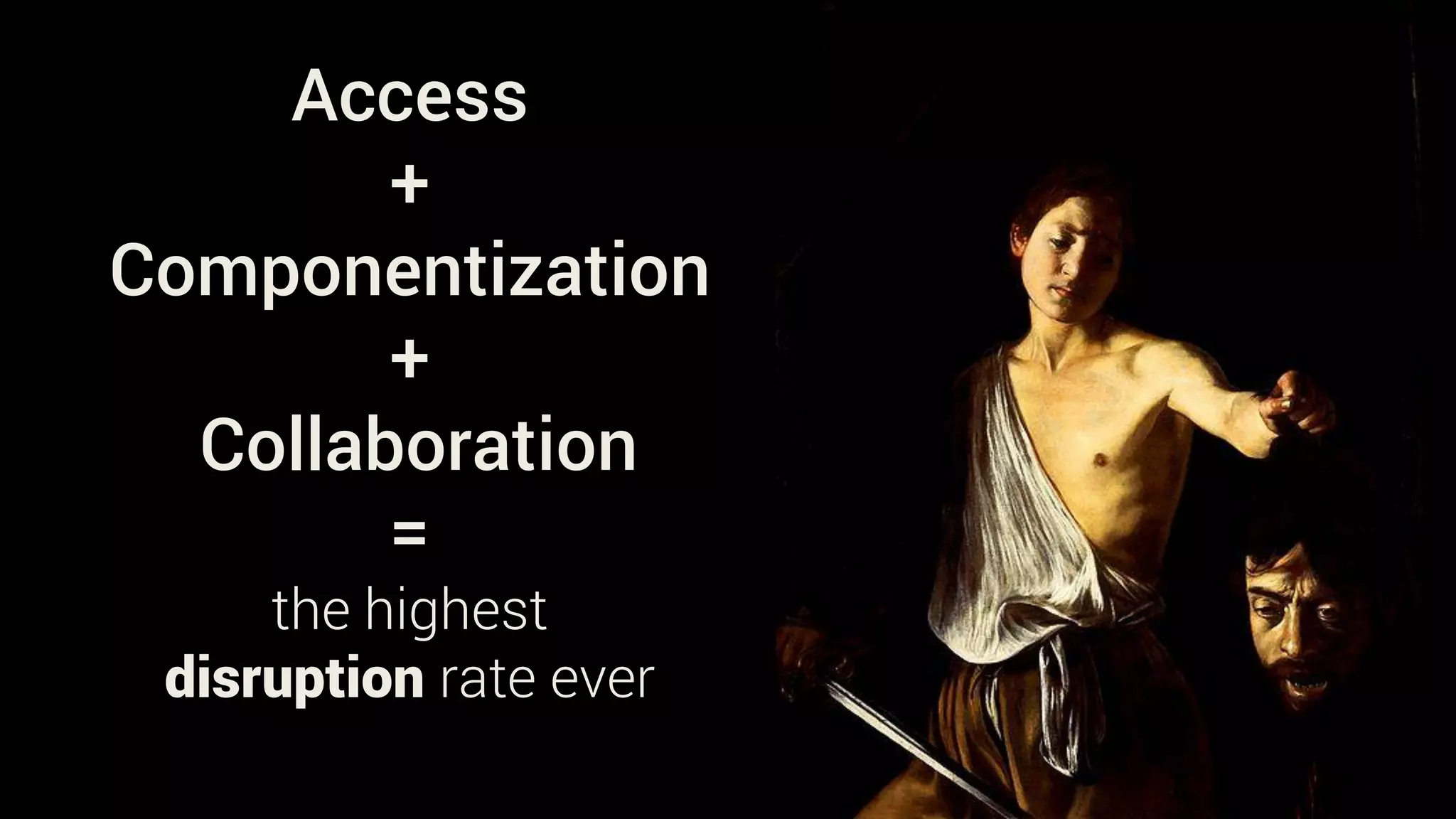
Access
+
Componentization
+
Collaboration
=
the highest
disruption rate ever
Long tail = Diversification
Diversification = Niches
Niches = Economies of Scope
“Whereas economies of scale for a firm
primarily refers to reductions in the average
cost (cost per unit) associated with
increasing the scale of production for
a single product type, economies of scope
refers to lowering the average cost for a firm
in producing two or more products”
The Age of Economies of Scope
Designers are increasingly dealing with
designing tools that allow users to create
value on their own (and within a
community).
Switching from Economies of scope (multiple
products) to User Centric experiences (user
customizable products)
“Toolkits for user innovation allow
producers to abandon attempts to
understand user needs in favor of
transferring need-related aspects of
product and service development to users
along with an appropriate toolkit".
Eric Von Hippel
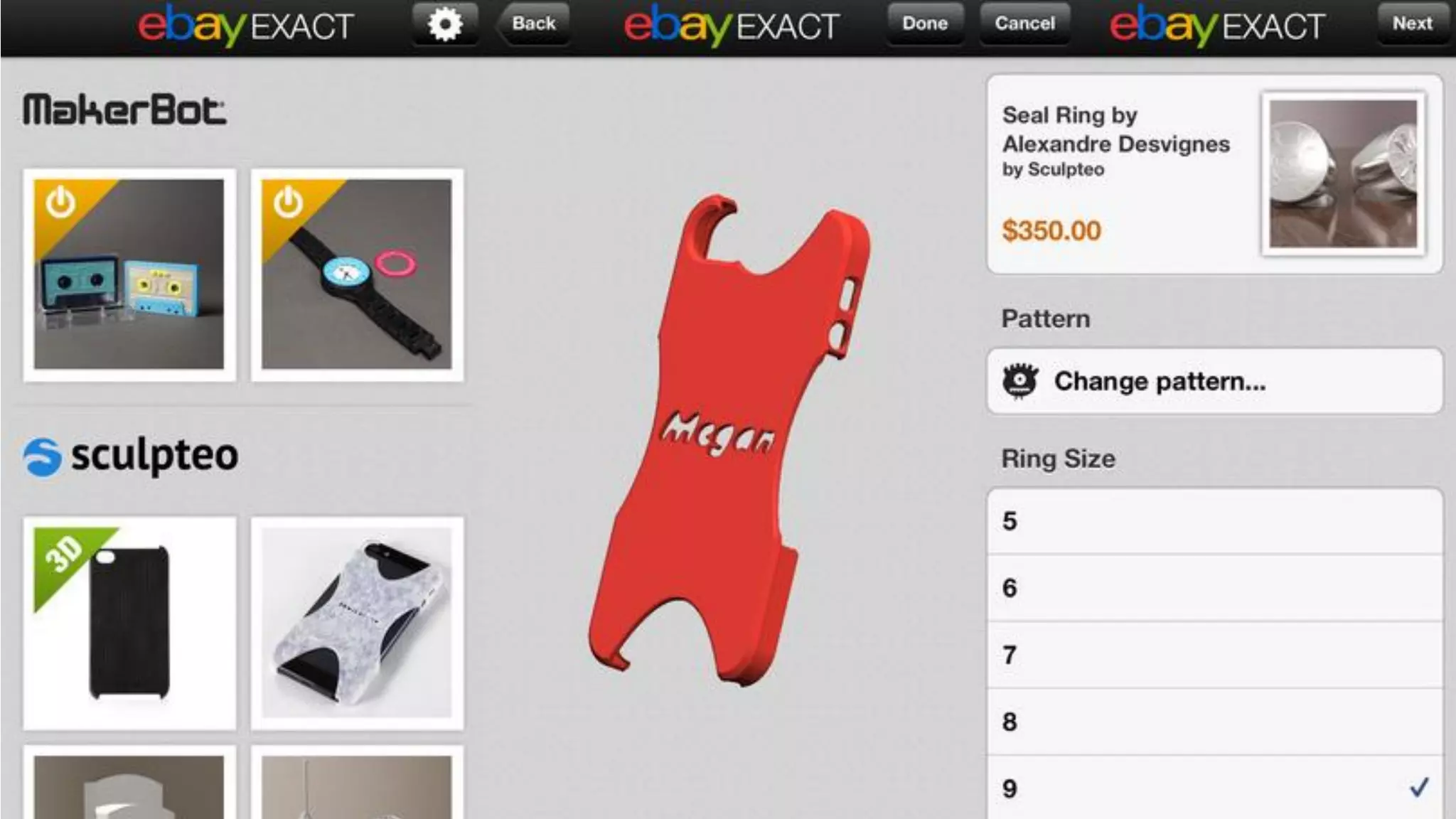
“Unleash your creativity by customizing
select products to create exactly what you
want with eBay Exact. Simply select a
product, choose a design, and add your
own personal flair to create a unique item
for yourself or someone special”
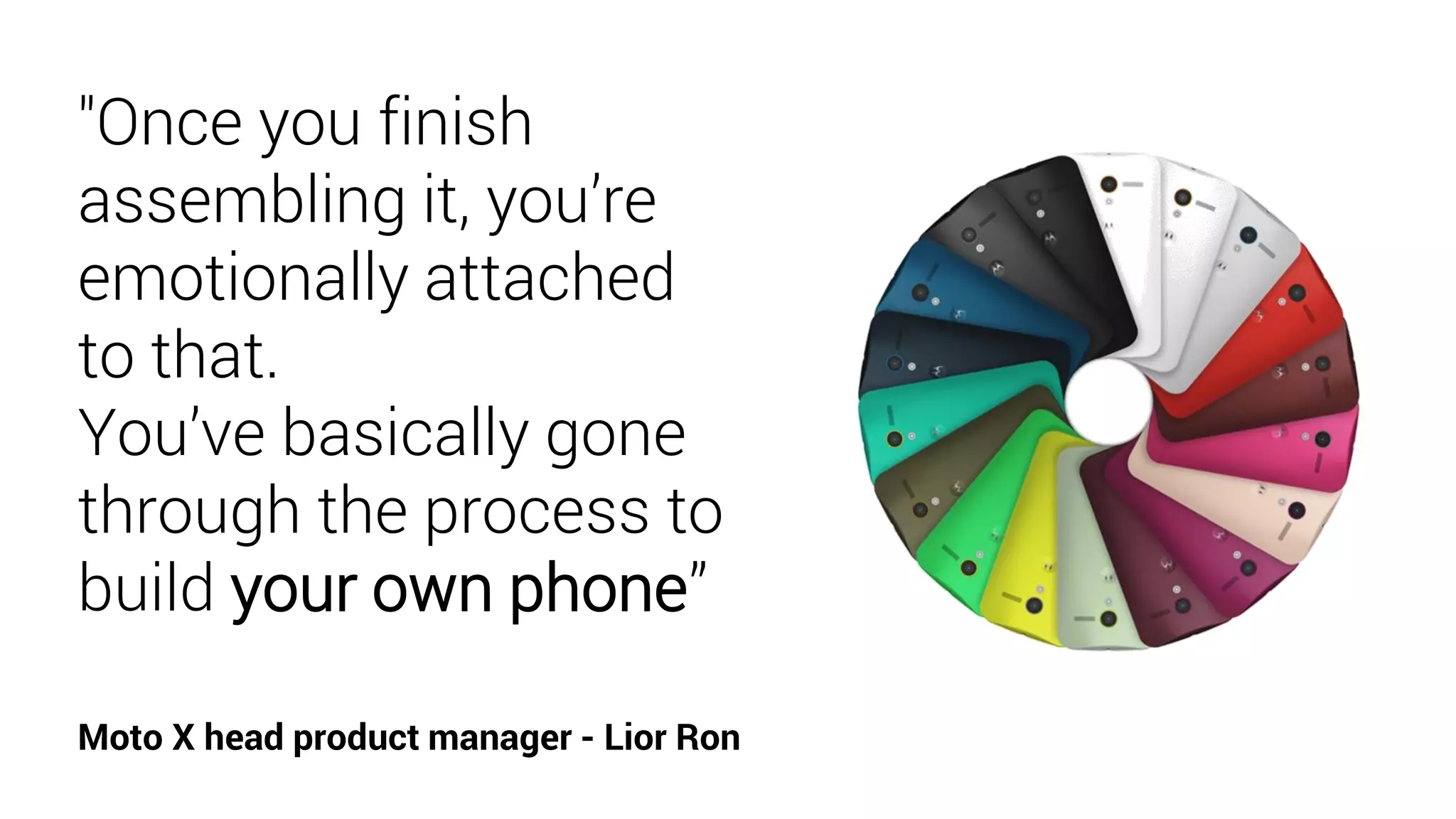
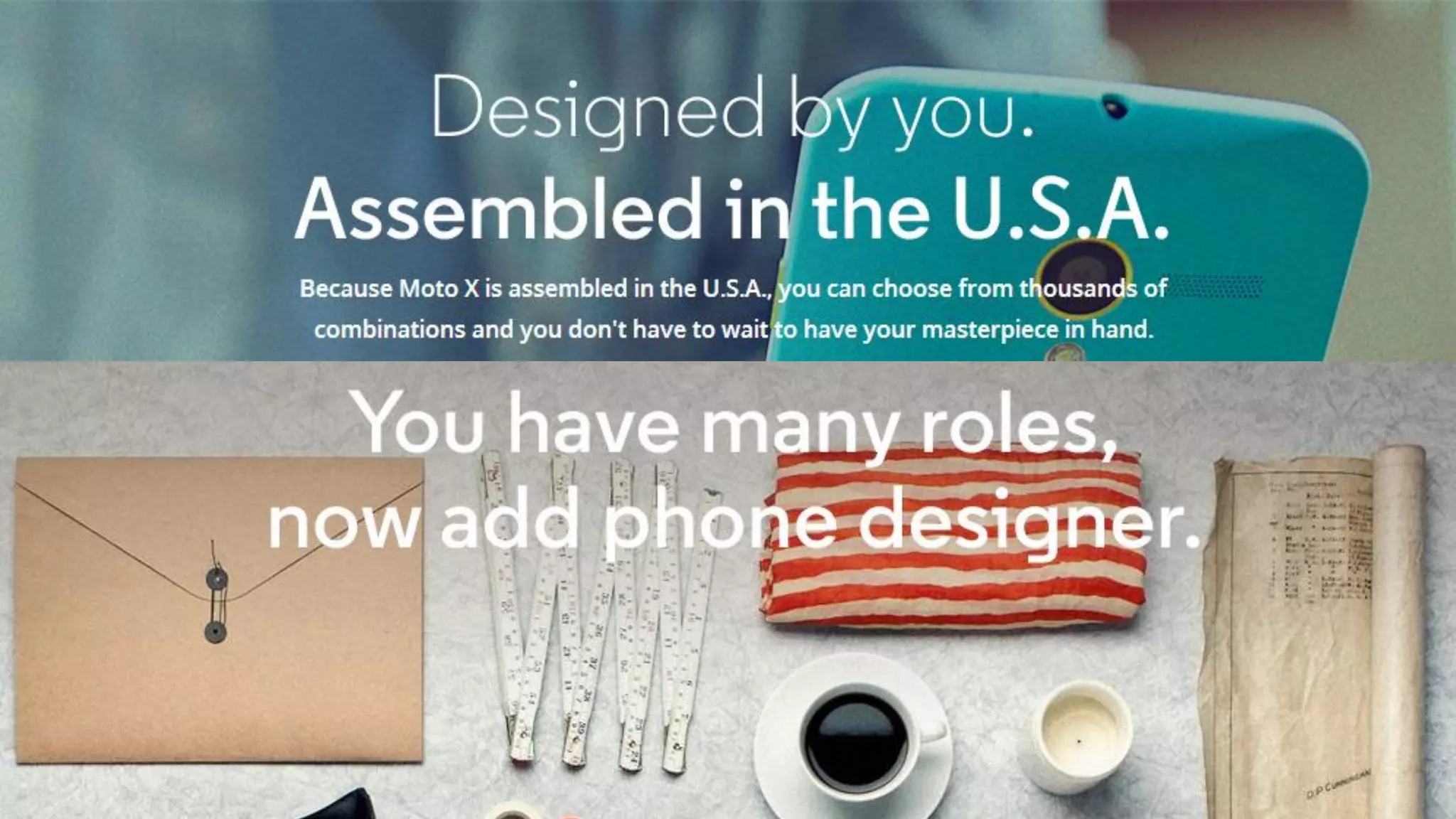
"Once you finish
assembling it, you’re
emotionally attached
to that.
You’ve basically gone
through the process to
build your own phone”
Moto X head product manager - Lior Ron
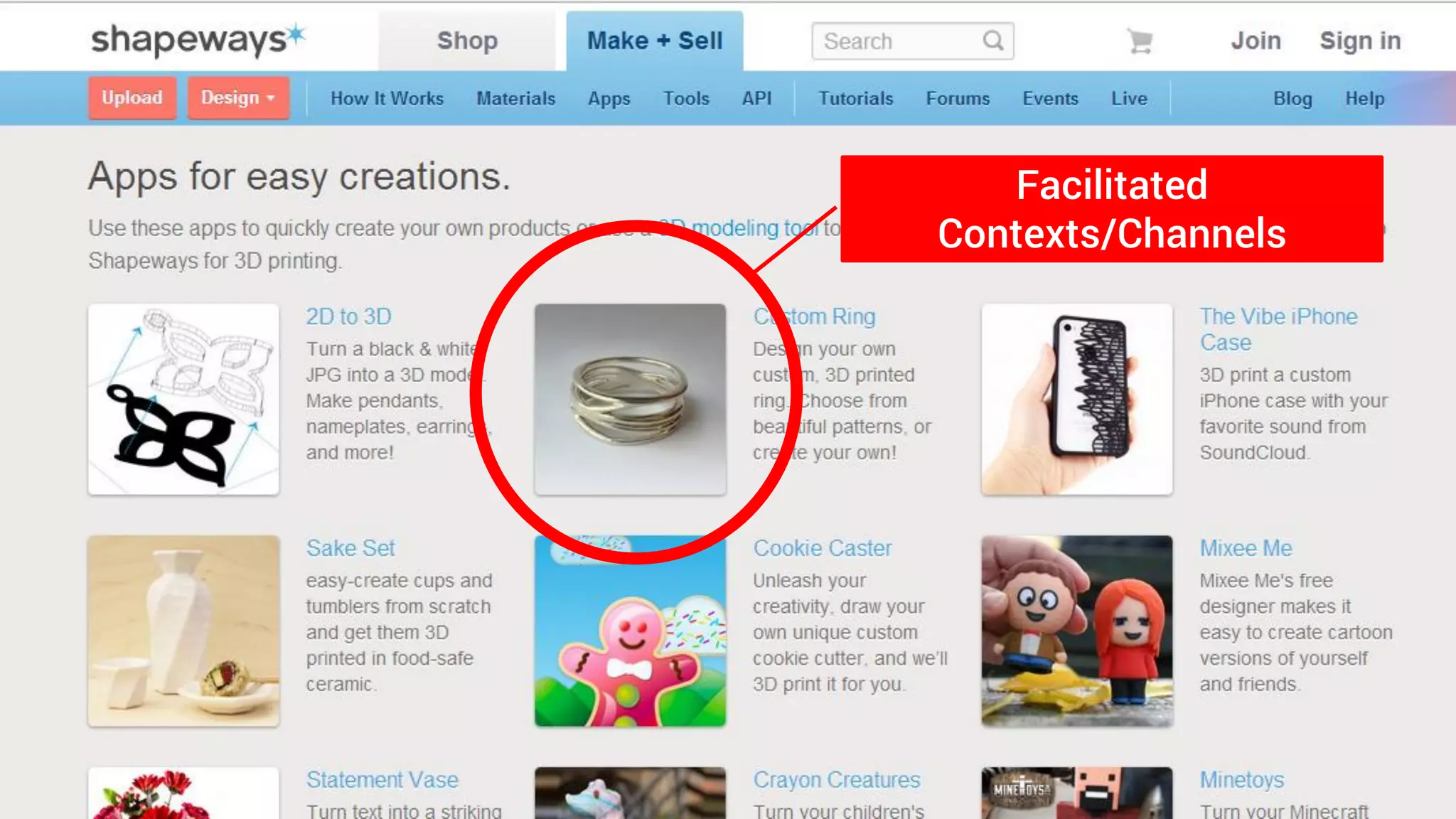
tools
Facilitated
Contexts/Channels
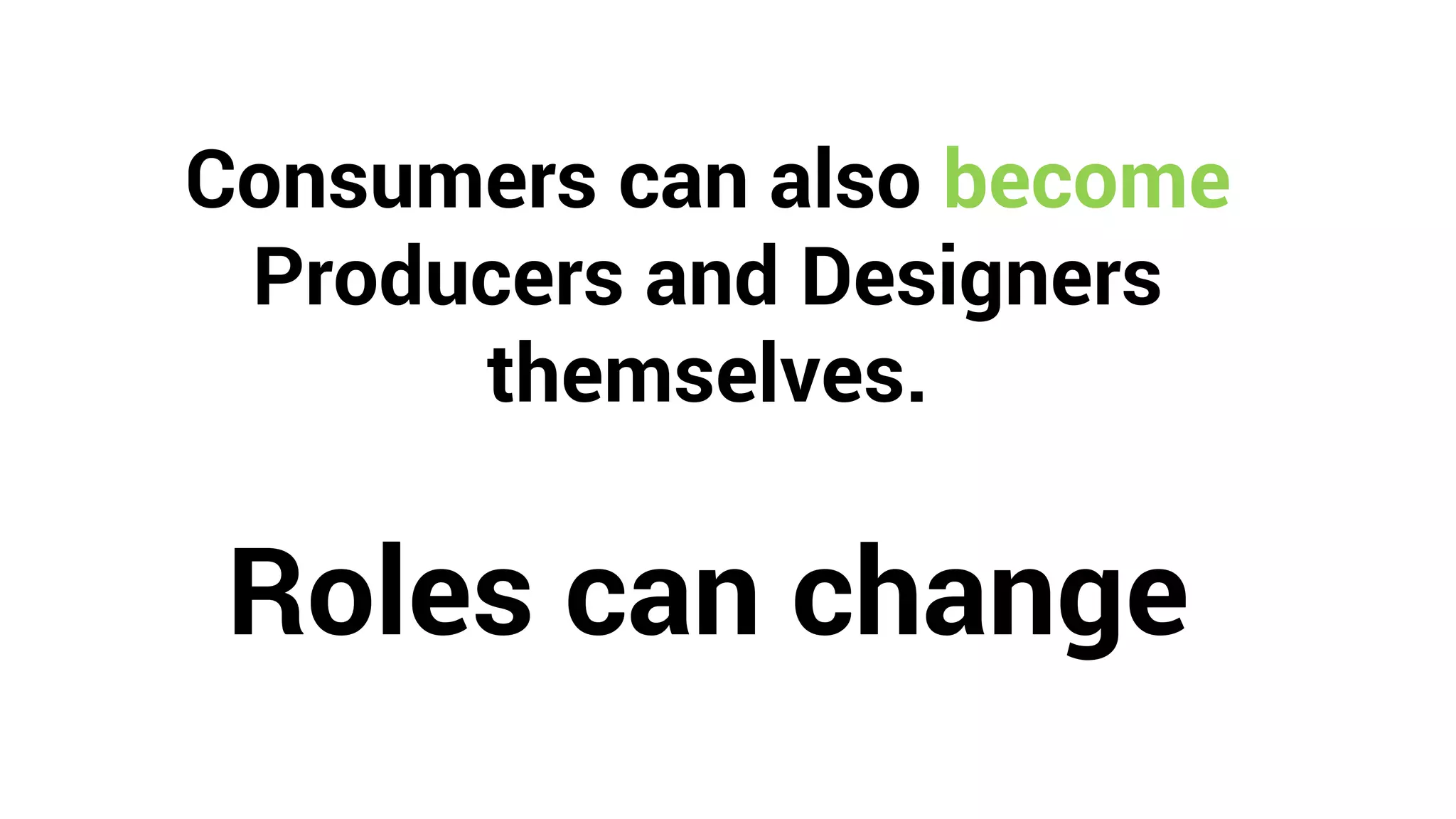
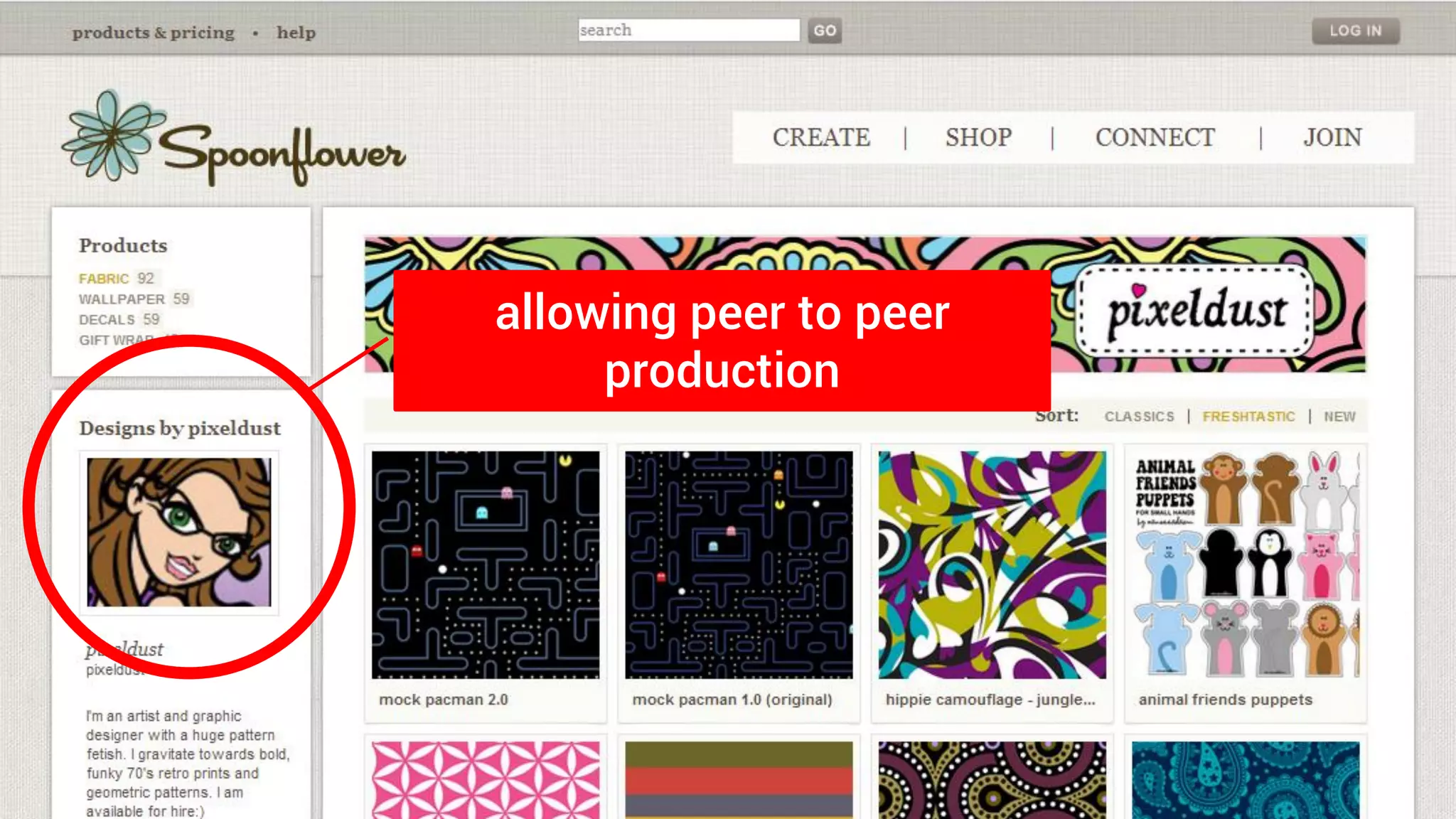
Consumers can also become
Producers and Designers
themselves.
Roles can change
allowing peer to peer
production
Understanding
Dynamics
Digital Market: opportunities & huge competition
What Dynamics?
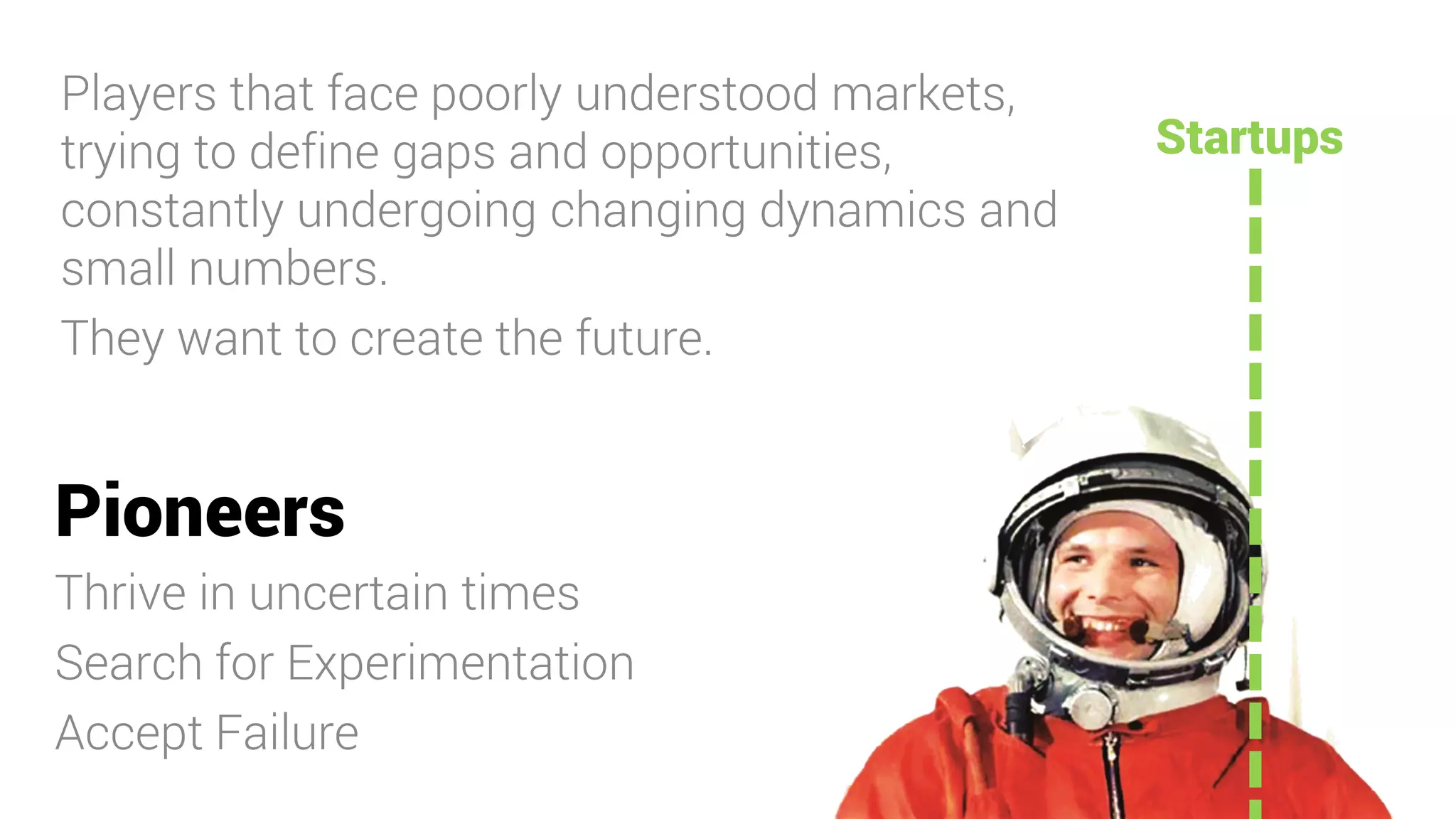
Pioneers
Thrive in uncertain times
Search for Experimentation
Accept Failure
Players that face poorly understood markets,
trying to define gaps and opportunities,
constantly undergoing changing dynamics and
small numbers.
They want to create the future.
Startups
Settlers
Learn from feedbacks
Investigate needs
Spot new trends
Players that face increasing demand, growing
market opportunities for mature products and
revenues that grow accordingly
Platforms
& Ecosystems
Town Planners
Search for self disruptions
Base business on measures and scientific models
Optimize for operations
Leaders/players that face standardized
demand and fight growing competition
on mature markets. Always focus on
essential cost of doing Business.
Ecosystems
& Industrialization
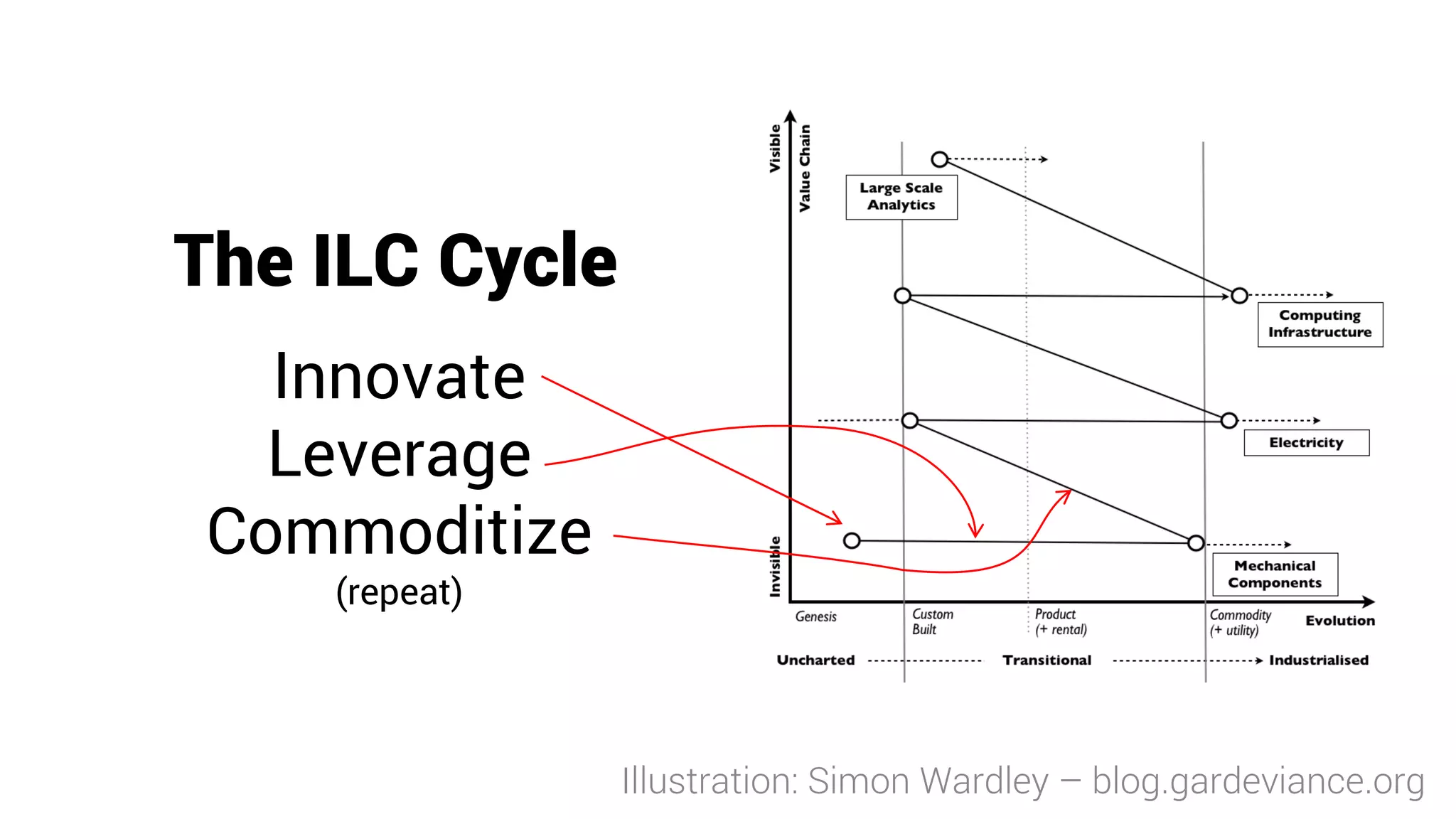
The ILC Cycle
Illustration: Simon Wardley – blog.gardeviance.org
Innovate
Leverage
Commoditize
(repeat)
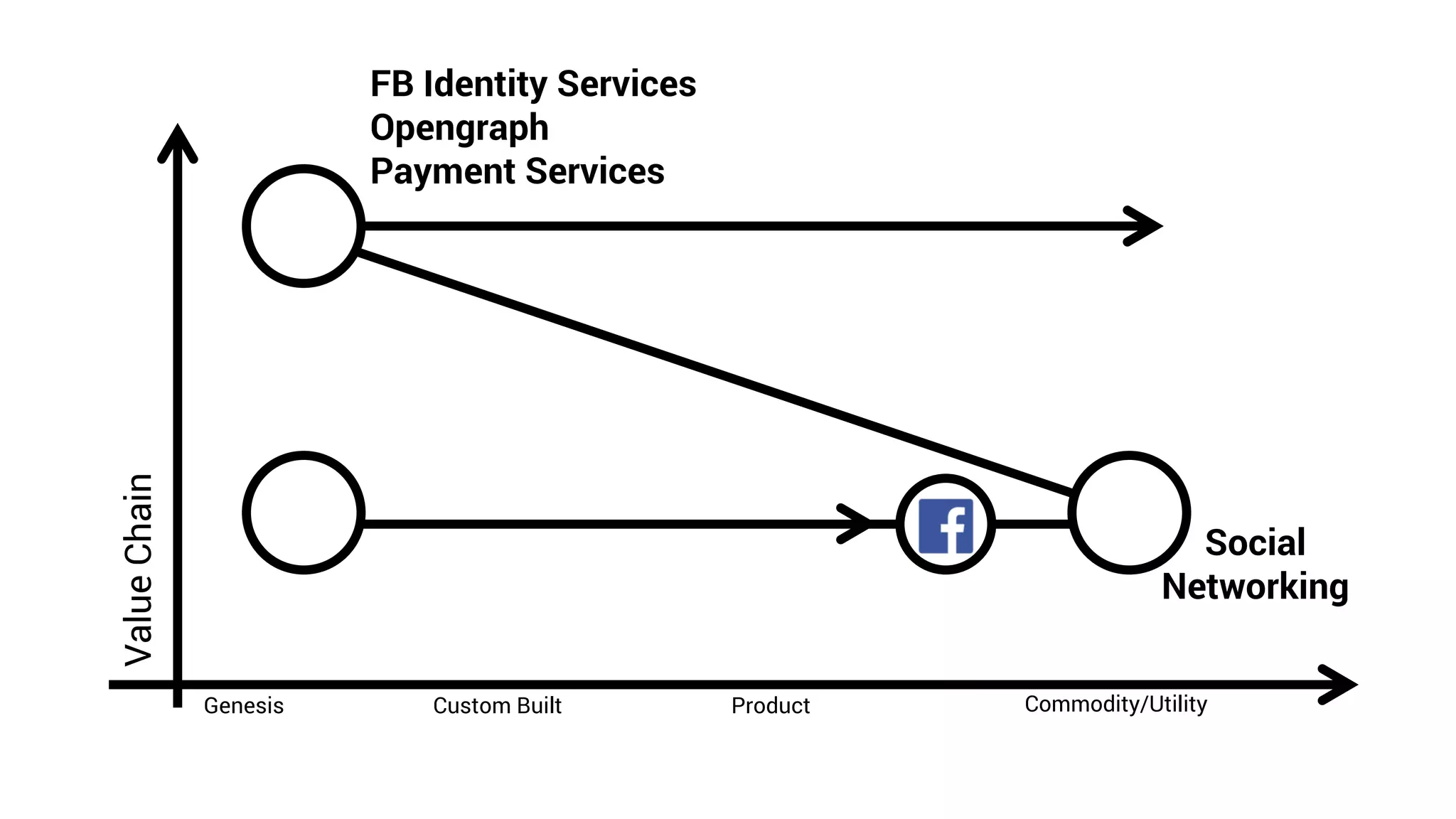
Facebook Doesn’t
Want To Be Cool, It
Wants To Be
Electricity
FB Identity Services
Opengraph
Payment Services
ValueChain
Genesis Custom Built Product Commodity/Utility
Social
Networking
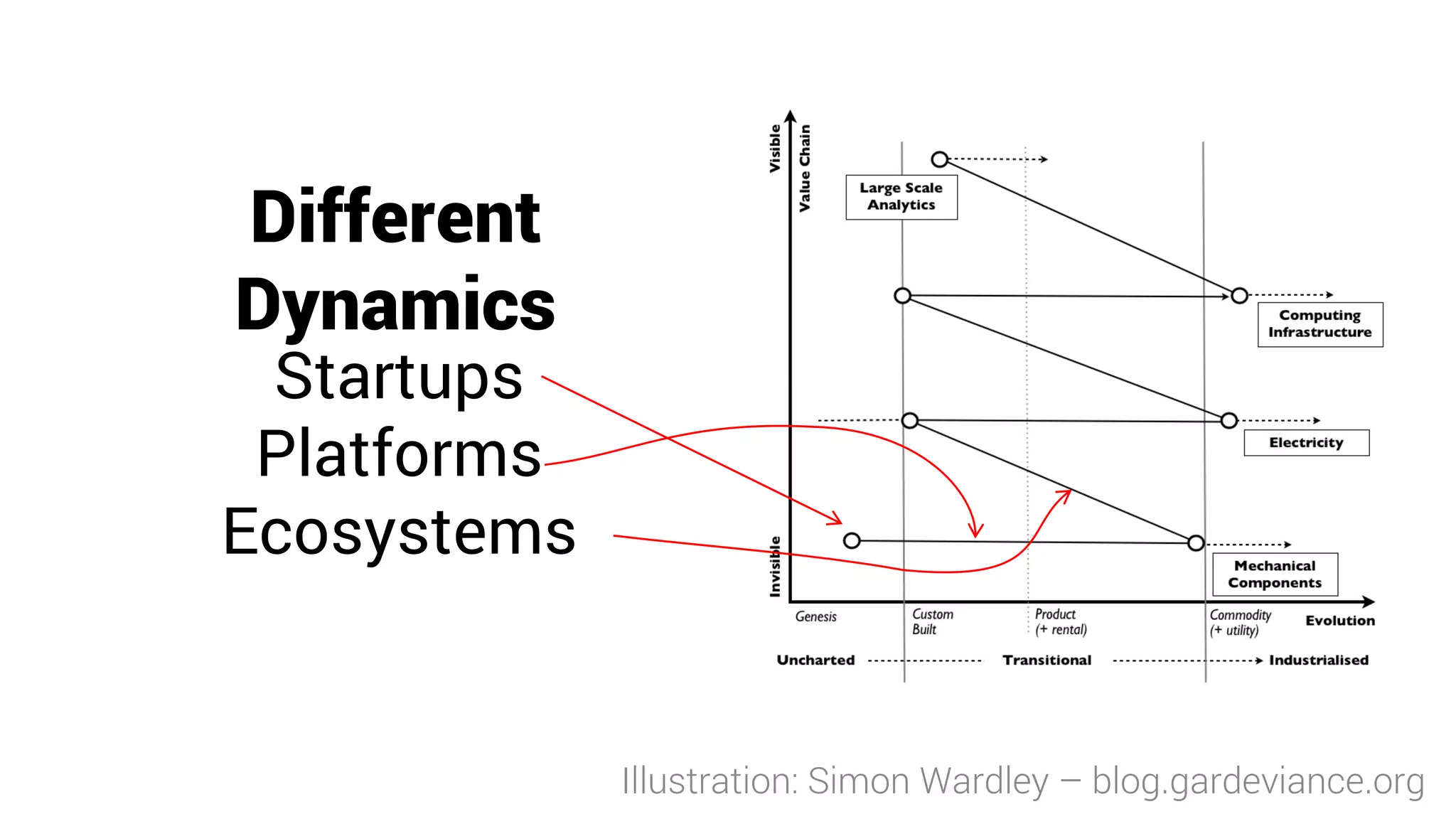
Different
Dynamics
Illustration: Simon Wardley – blog.gardeviance.org
Startups
Platforms
Ecosystems
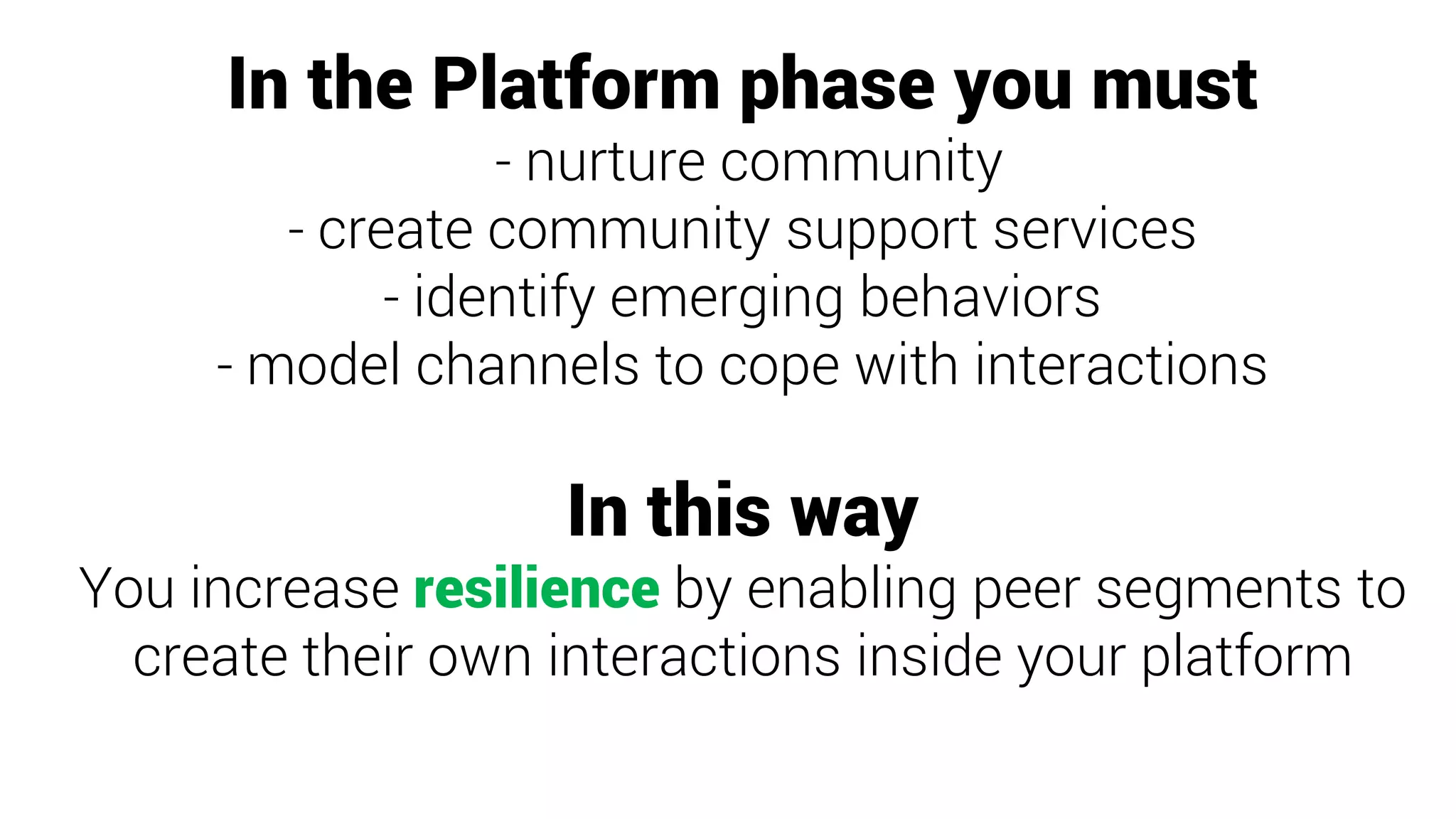
In the Platform phase you must
- nurture community
- create community support services
- identify emerging behaviors
- model channels to cope with interactions
In this way
You increase resilience by enabling peer segments to
create their own interactions inside your platform
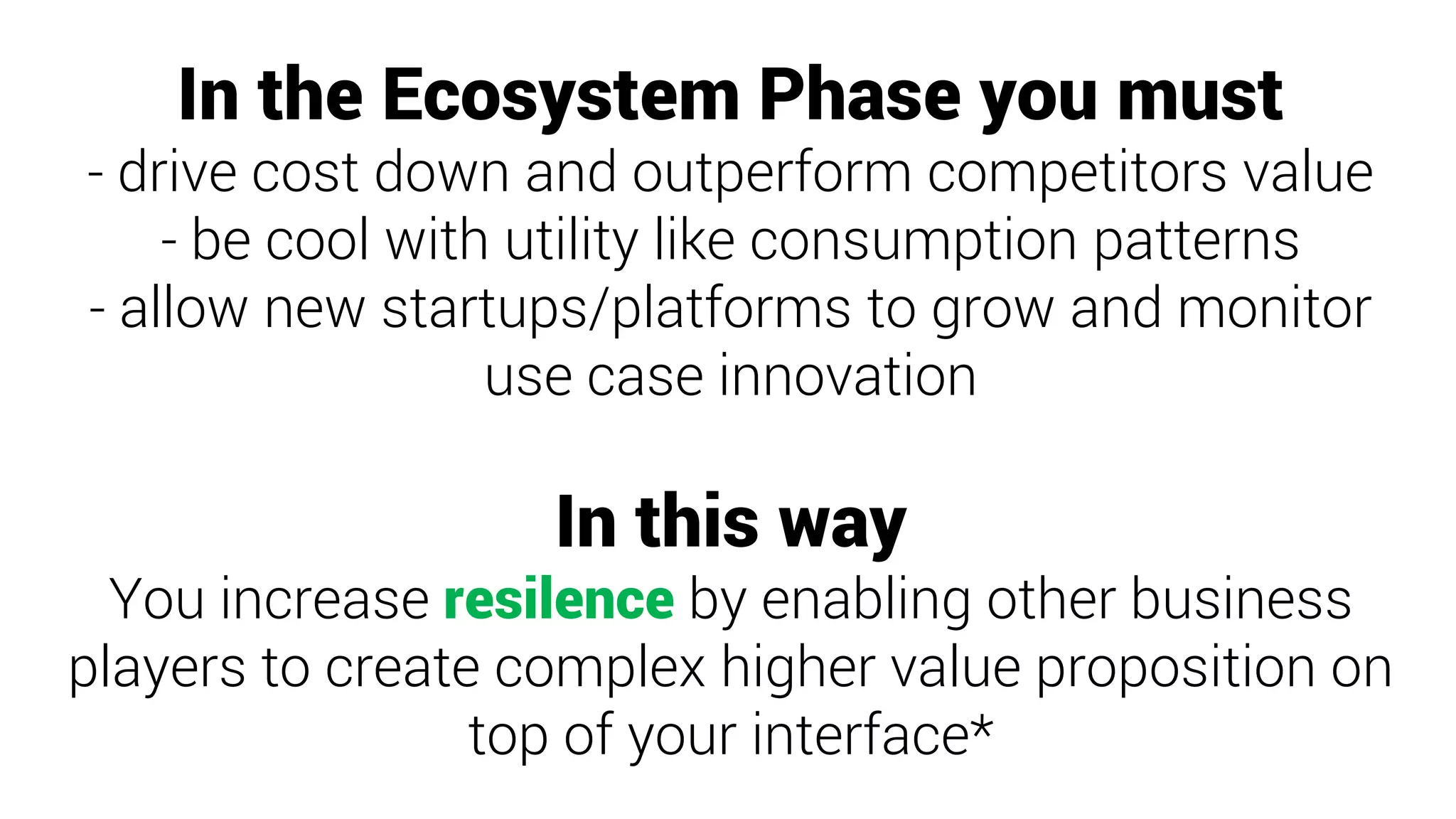
In the Ecosystem Phase you must
- drive cost down and outperform competitors value
- be cool with utility like consumption patterns
- allow new startups/platforms to grow and monitor
use case innovation
In this way
You increase resilence by enabling other business
players to create complex higher value proposition on
top of your interface*
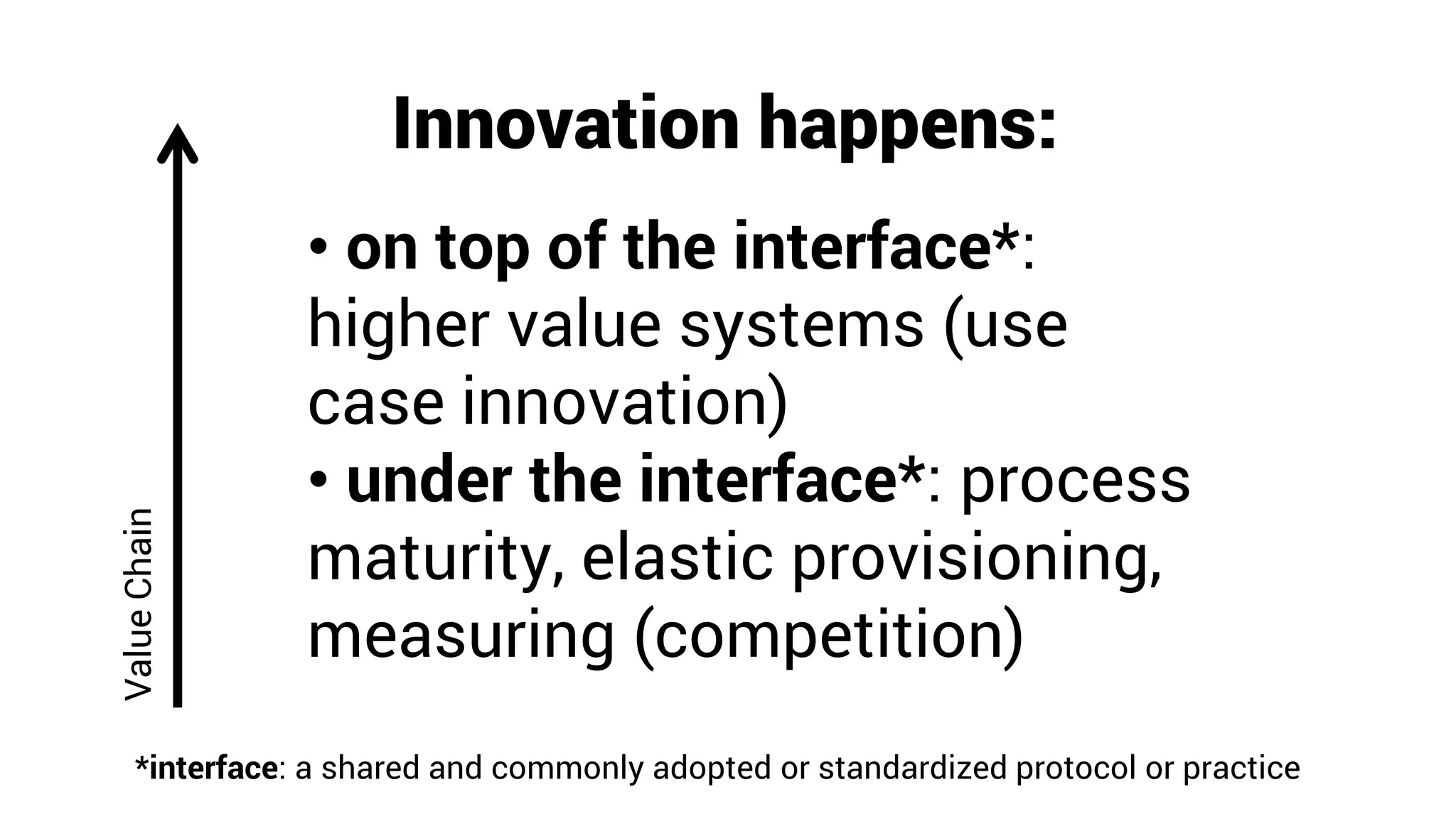
Innovation happens:
• on top of the interface*:
higher value systems (use
case innovation)
• under the interface*: process
maturity, elastic provisioning,
measuring (competition)
ValueChain
*interface: a shared and commonly adopted or standardized protocol or practice
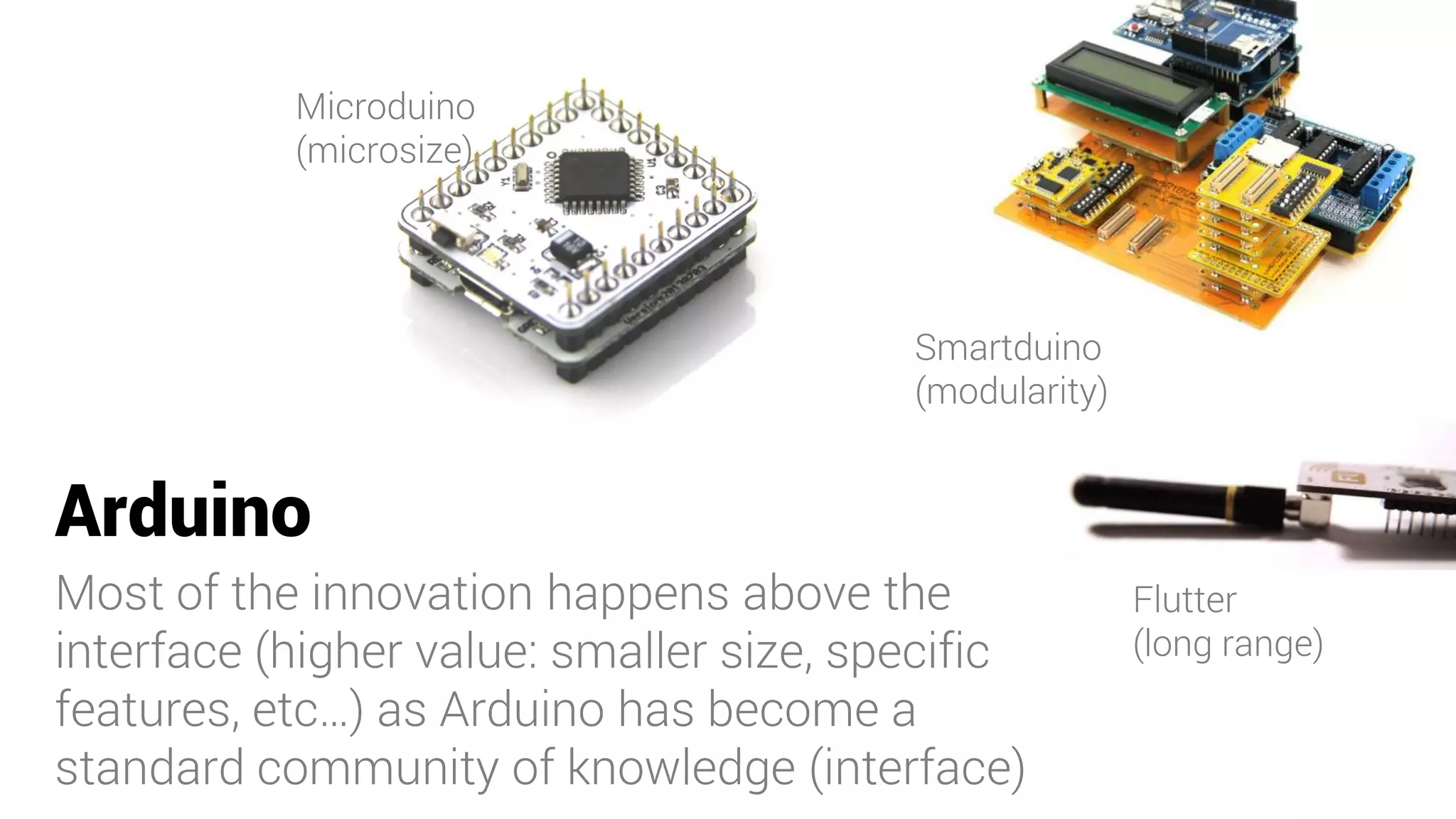
Arduino
Most of the innovation happens above the
interface (higher value: smaller size, specific
features, etc…) as Arduino has become a
standard community of knowledge (interface)
Microduino
(microsize)
Flutter
(long range)
Smartduino
(modularity)
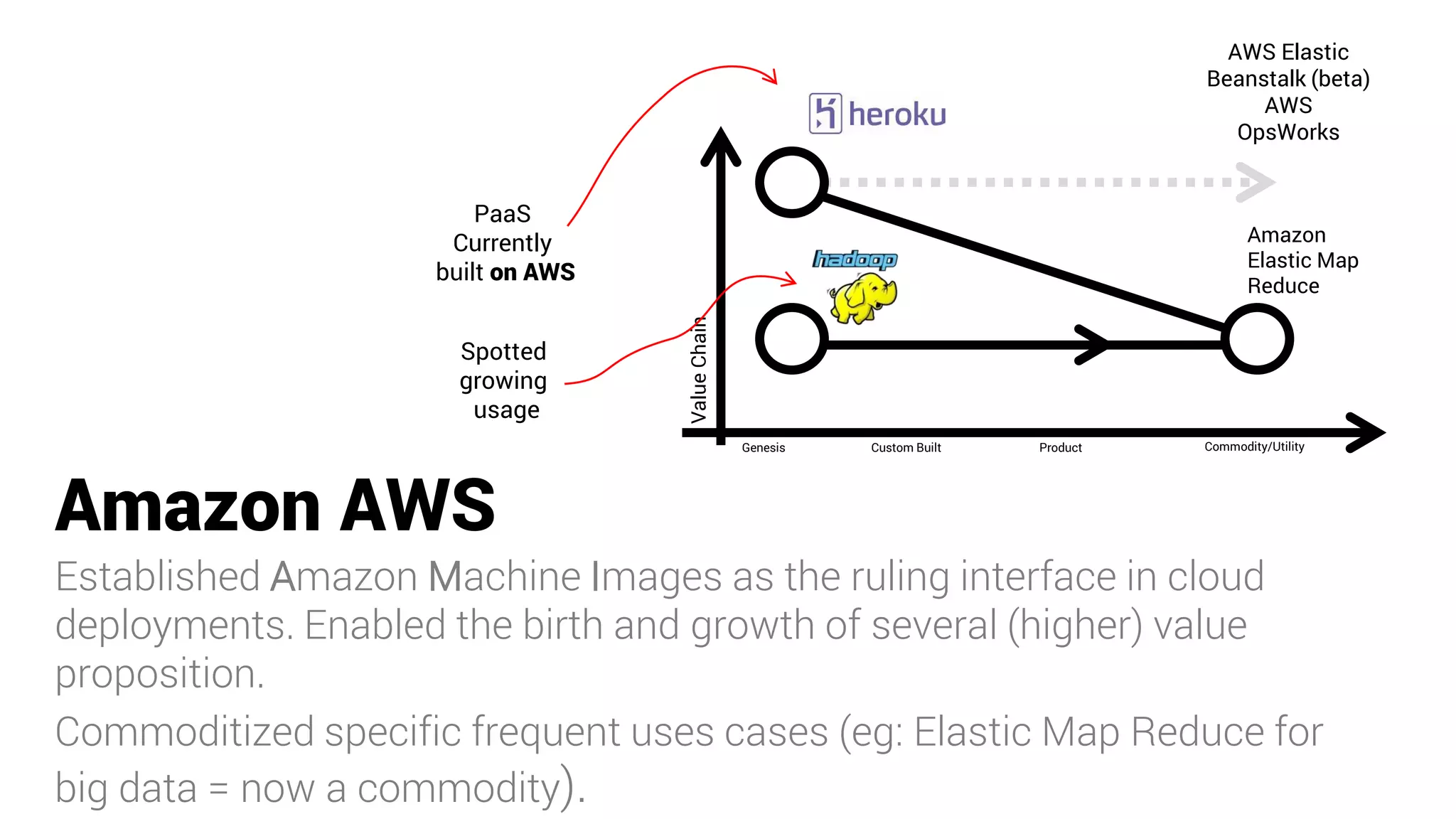
Amazon AWS
Established Amazon Machine Images as the ruling interface in cloud
deployments. Enabled the birth and growth of several (higher) value
proposition.
Commoditized specific frequent uses cases (eg: Elastic Map Reduce for
big data = now a commodity).
ValueChain
Genesis Custom Built Product Commodity/Utility
Amazon
Elastic Map
Reduce
AWS Elastic
Beanstalk (beta)
AWS
OpsWorks
PaaS
Currently
built on AWS
Spotted
growing
usage
Joining an existing
Platform and Ecosystem
(outstanding opportunities)
Typical Stakeholders and contexts:
Over The Top players ecosystems
Brand related initiatives
Corporate innovation strategies
Open ecosystems (rare)
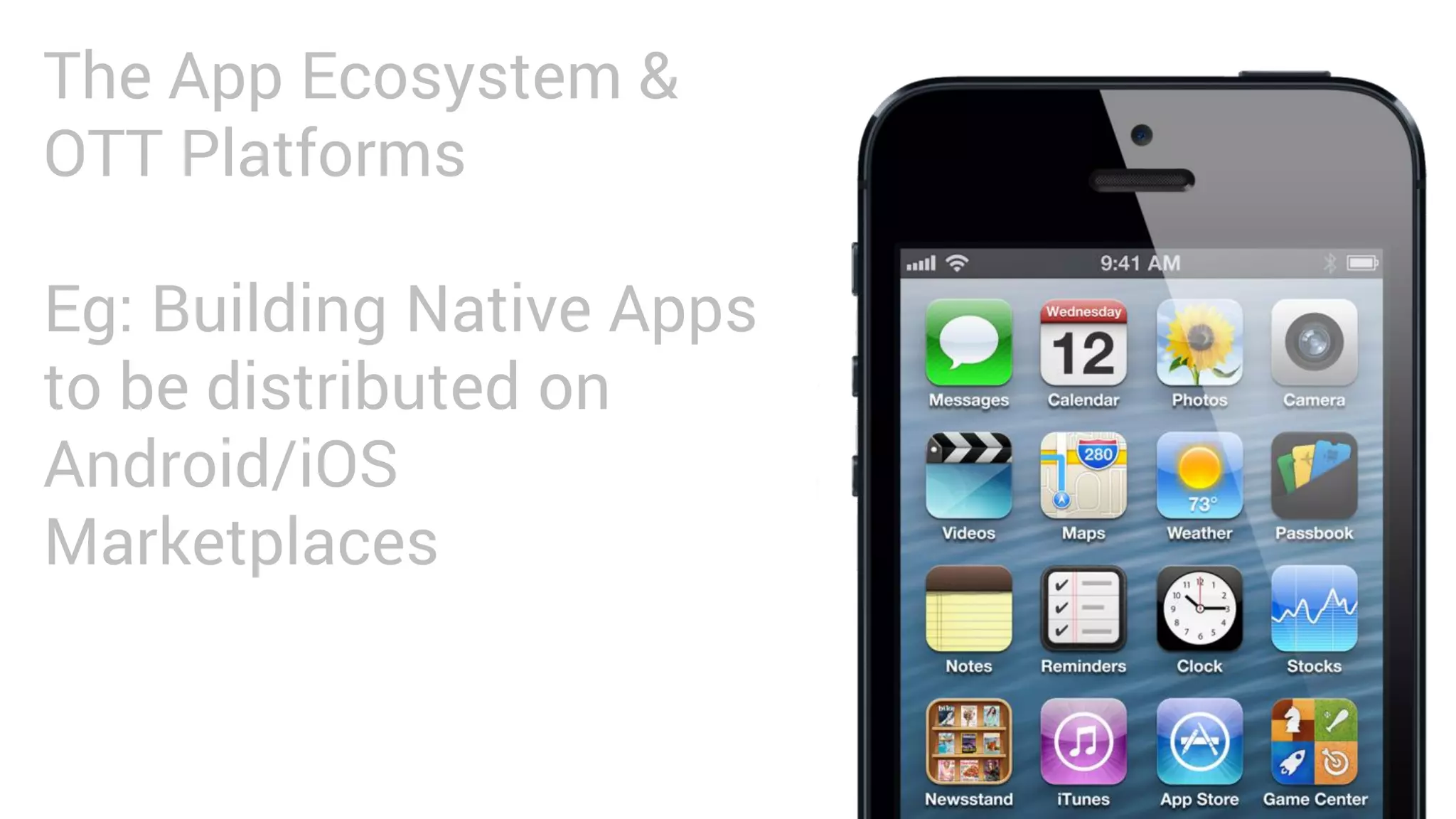
The App Ecosystem &
OTT Platforms
Eg: Building Native Apps
to be distributed on
Android/iOS
Marketplaces
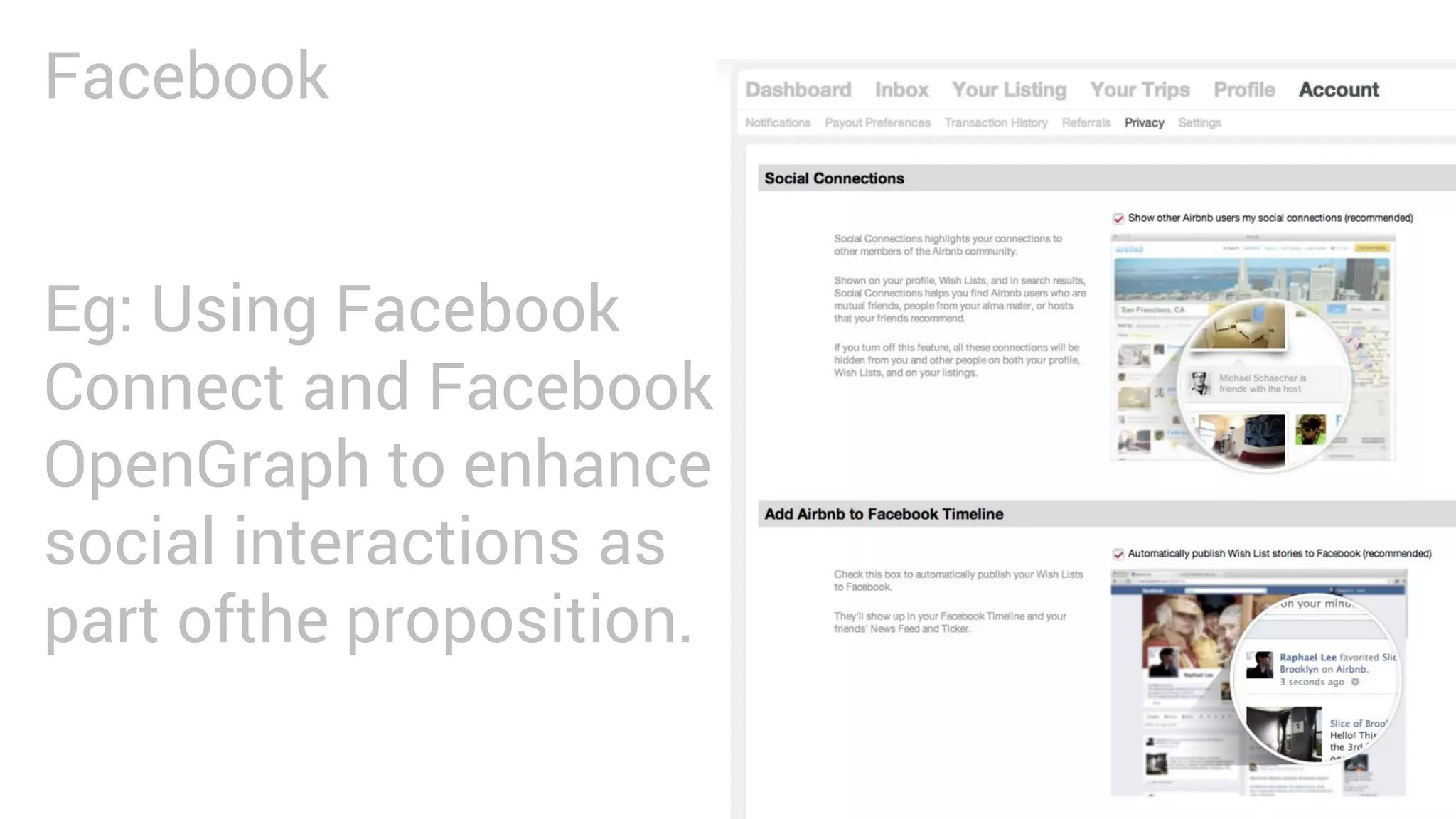
Facebook
Eg: Using Facebook
Connect and Facebook
OpenGraph to enhance
social interactions as
part ofthe proposition.
It’s not only about APIs:
corporate players are
increasingly looking for
innovation *ecosystems*
Telco players looking for
service innovation
Manufacturers creating
new interfaces and ways
to interact with their
producs.
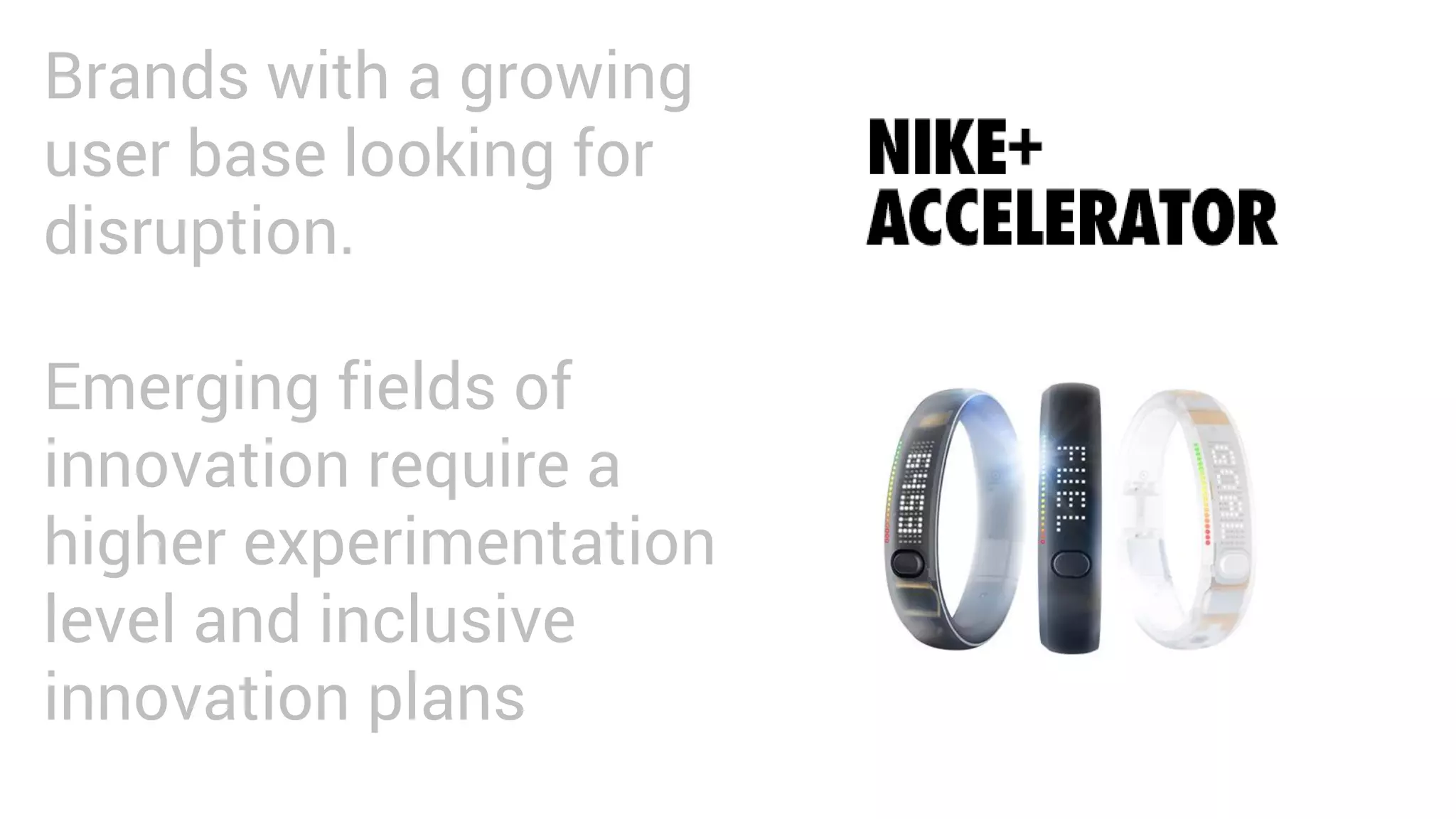
Brands with a growing
user base looking for
disruption.
Emerging fields of
innovation require a
higher experimentation
level and inclusive
innovation plans
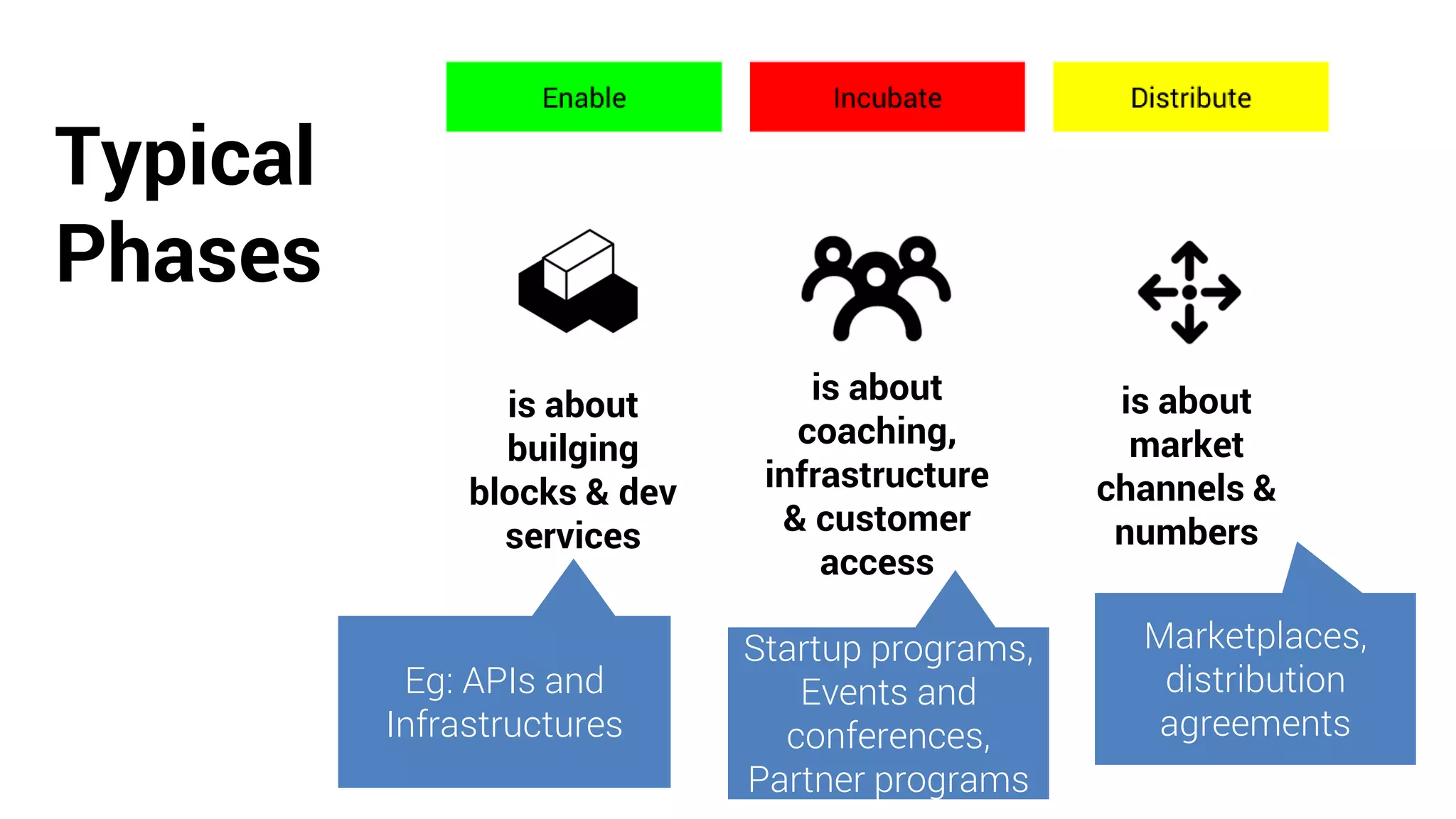
Typical
Phases
is about
builging
blocks & dev
services
is about
coaching,
infrastructure
& customer
access
is about
market
channels &
numbers
Eg: APIs and
Infrastructures
Startup programs,
Events and
conferences,
Partner programs
Marketplaces,
distribution
agreements
Platform
Design
Thinking
Grow your startup/product into
a Platform (and then, Ecosystem)
Transform from a linear/single
gap perspective into multilinear
engine of value creation enabling
Peer Segments to co-create value
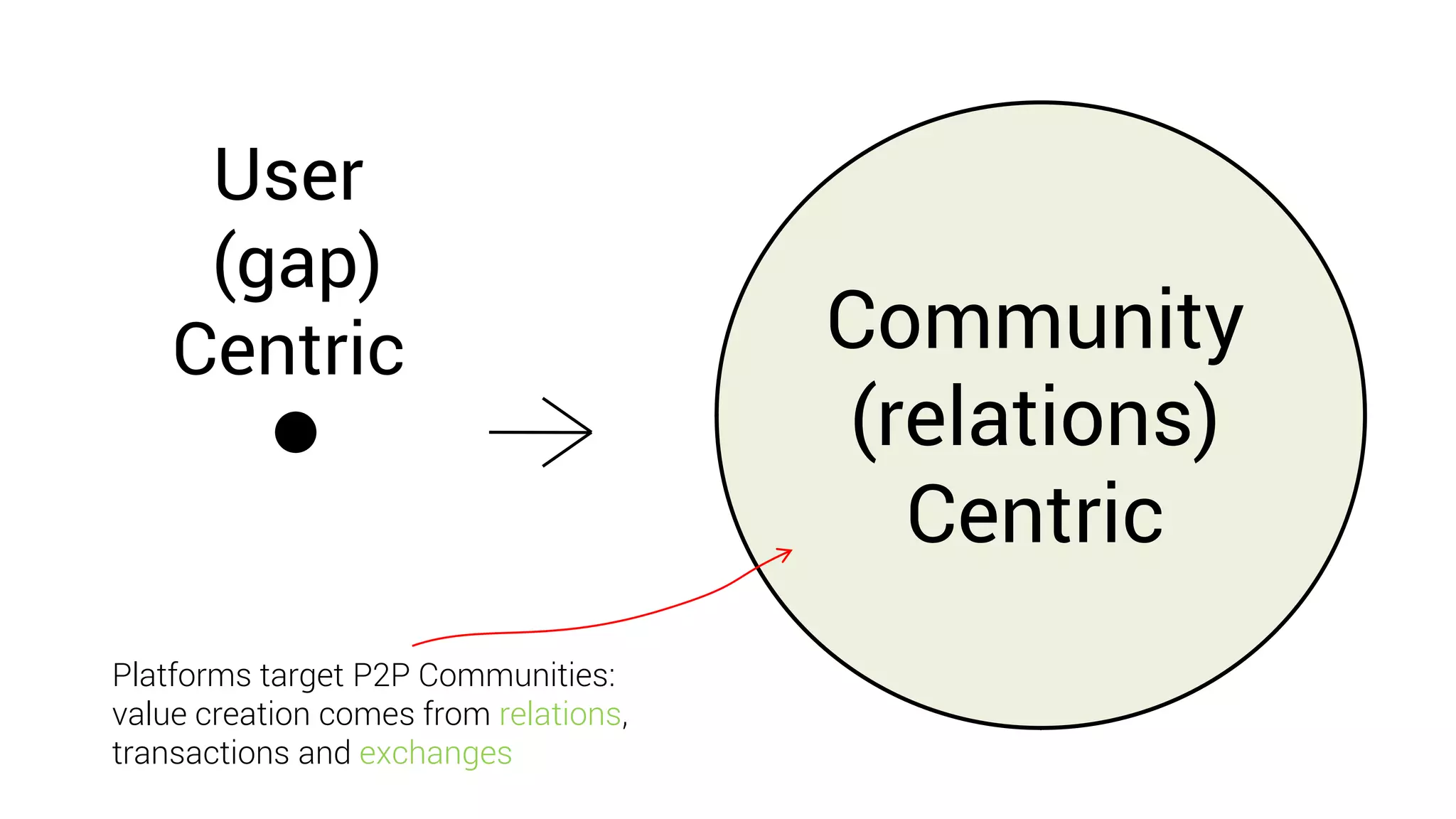
Community
(relations)
Centric
User
(gap)
Centric
Platforms target P2P Communities:
value creation comes from relations,
transactions and exchanges
How to lower
Platform opt in cost?
The cost/friction for a user to adopt your
platform and start creating value
It’s a (co) Design challenge
about understanding user contexts and
motivations and enabling vaue creation
Some big issues in Peer Platforms:
Marketplace Liquidity
Exchange Currencies
Coincidence of Interests
Reaching Tipping Point
Some tricks
Start from building single user utility
“It might seem odd that systems designed to leverage
interactions between people should have single person utility.
The first users of delicious were barely aware of and rarely used
its social aspects. They just wanted to store their bookmarks in
the cloud instead of in their browser. And they liked the tag
based classification system. And they liked being able to use
their links from any device.
That was the single person utility delicious was built on.”
Fred Wilson (avc.com)
Add mutual value
“Users hate spamming friends. It was all fine to begin with
when only a few services required them to send out invites but
as every new service asks for an invite to be sent out, users get
more discerning.
Dropbox had a brilliant way around this by incentivizing not only
the user but also the invitee when he signs up.”
Sangeet Paul Choudary (platformed.info)
Spillover (across clusters)
Sangeet Paul Choudary (platformed.info)
“The networks with the fastest growth are the ones that freely allow
spillover. AirBnB, unlike Uber and OpenTable, has tremendous potential
for spillover.
The fact that the use case is travel makes such spillover organic to the
network. The host and traveler will most likely be part of different city
networks. Such cross-cluster interaction allows growth to occur
without having to be confined within geographical boundaries.”
Though tricks may work, most of growth
problem are contextual:
there’s no one size fits all recipe
(though best practices count)
The right approach:
methodologically focus on
identifying value exchanges
and motivations
Design Thinking &
Platform Design
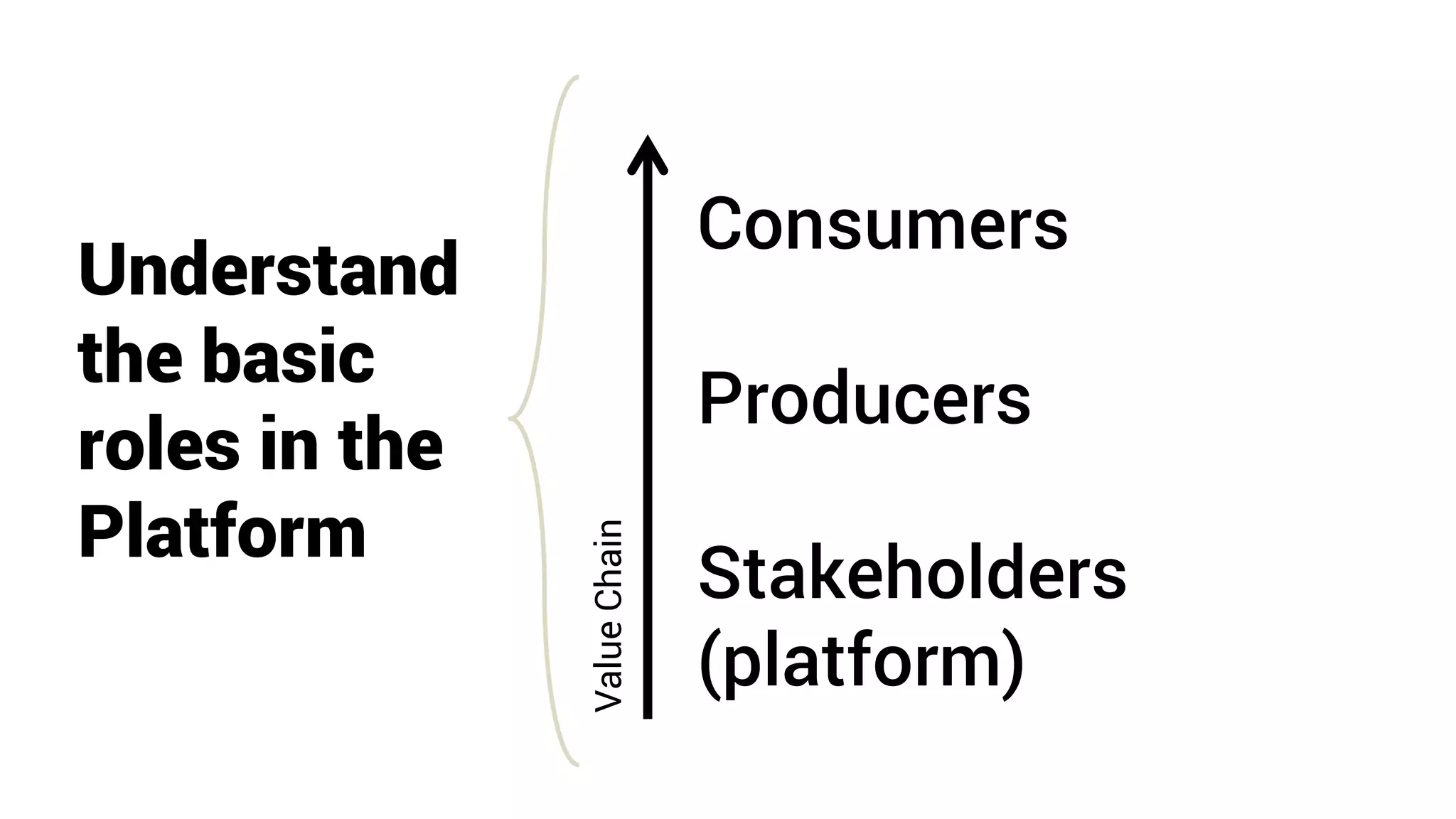
Understand
the basic
roles in the
Platform
Consumers
Producers
Stakeholders
(platform)
ValueChain
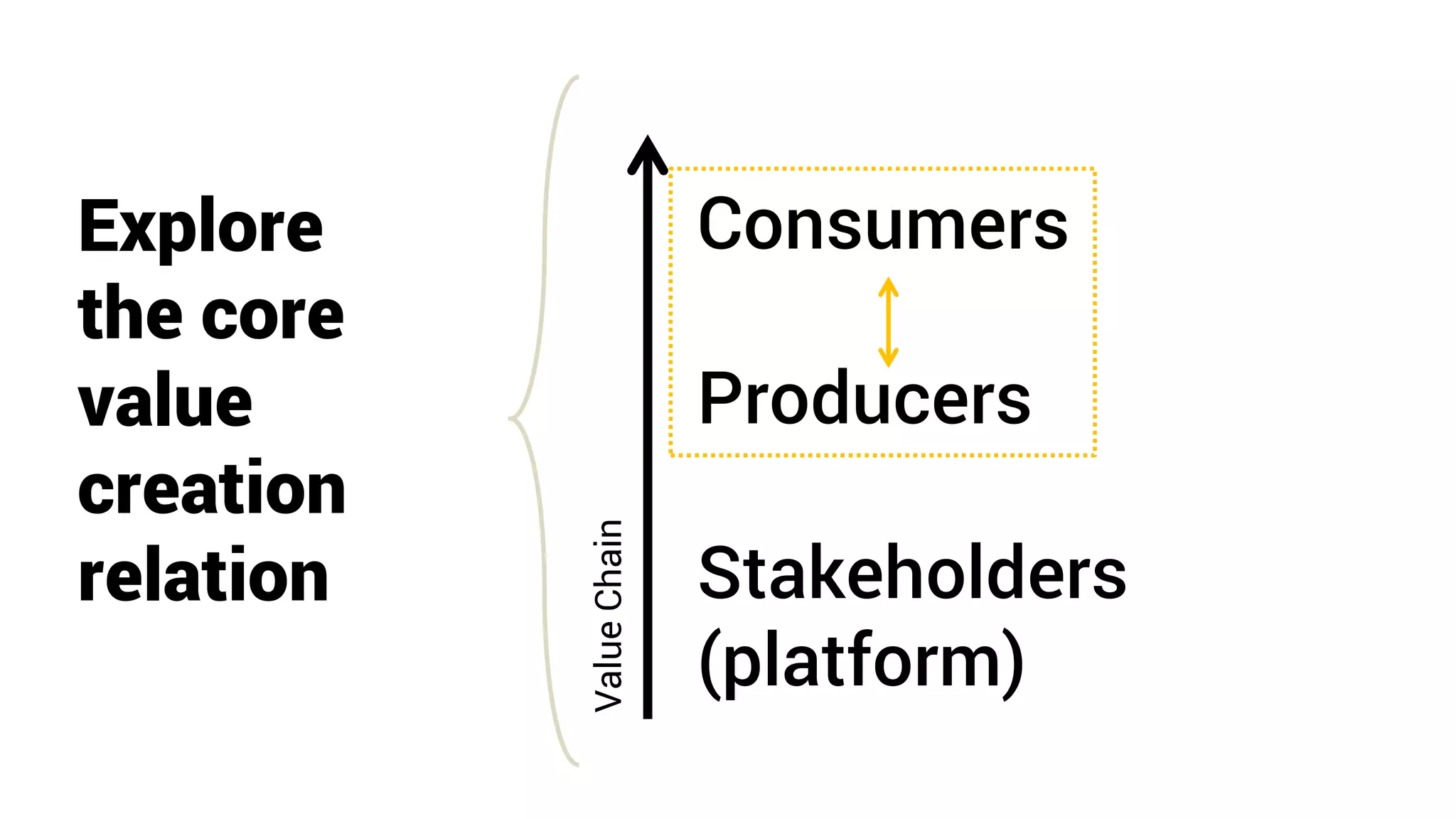
Explore
the core
value
creation
relation
Consumers
Producers
Stakeholders
(platform)
ValueChain
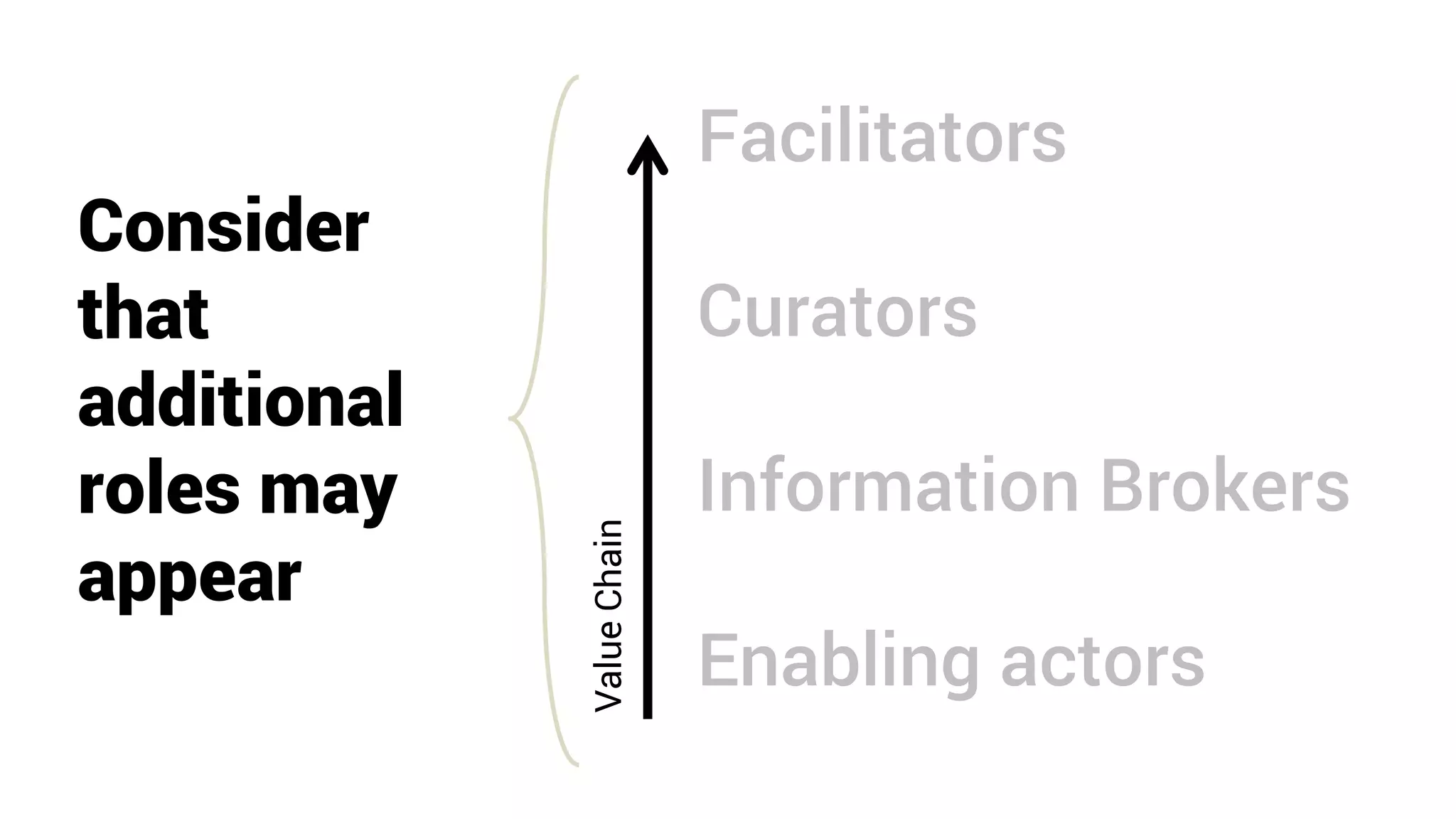
Consider
that
additional
roles may
appear
Facilitators
Curators
Information Brokers
Enabling actors
ValueChain
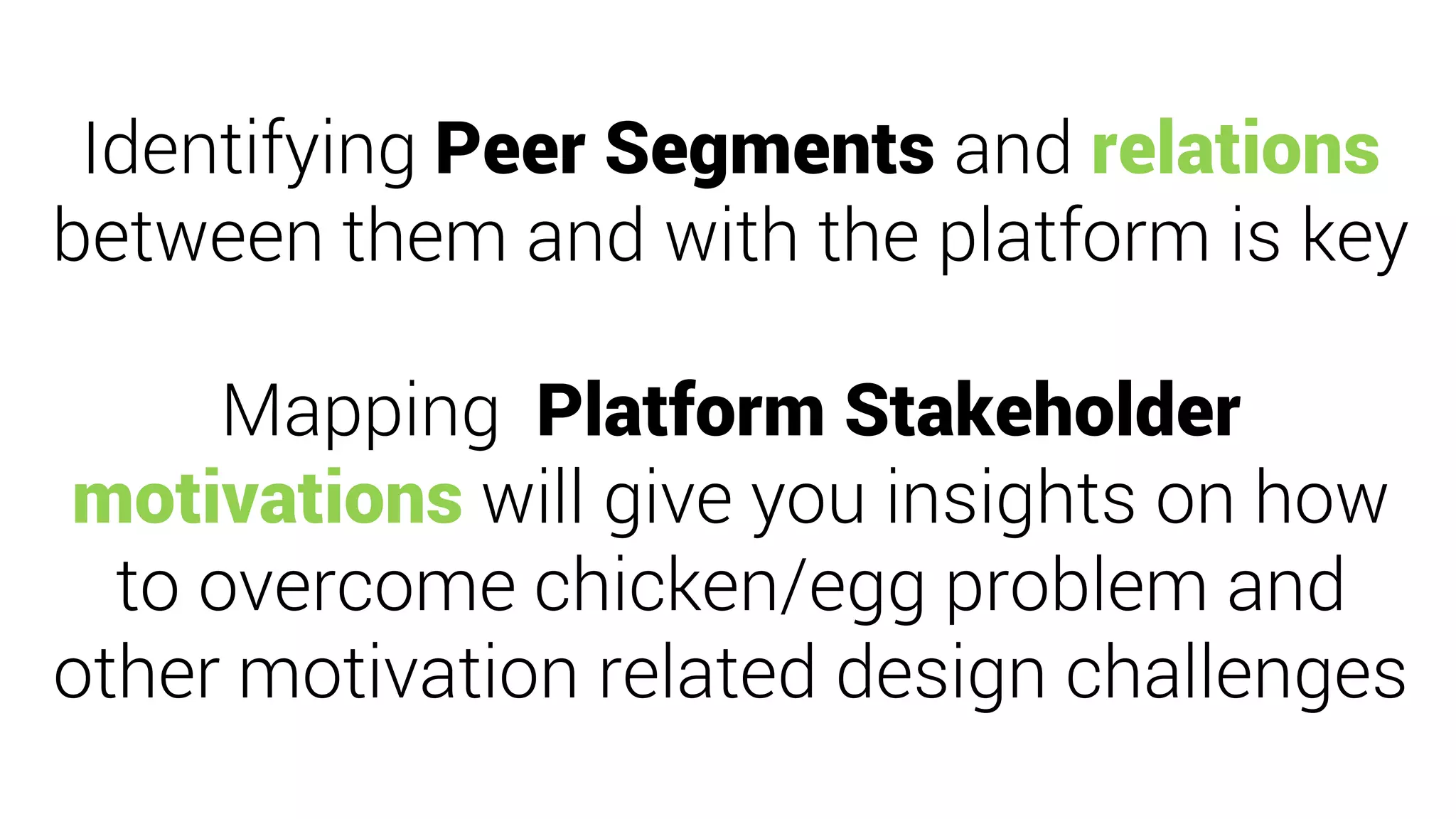
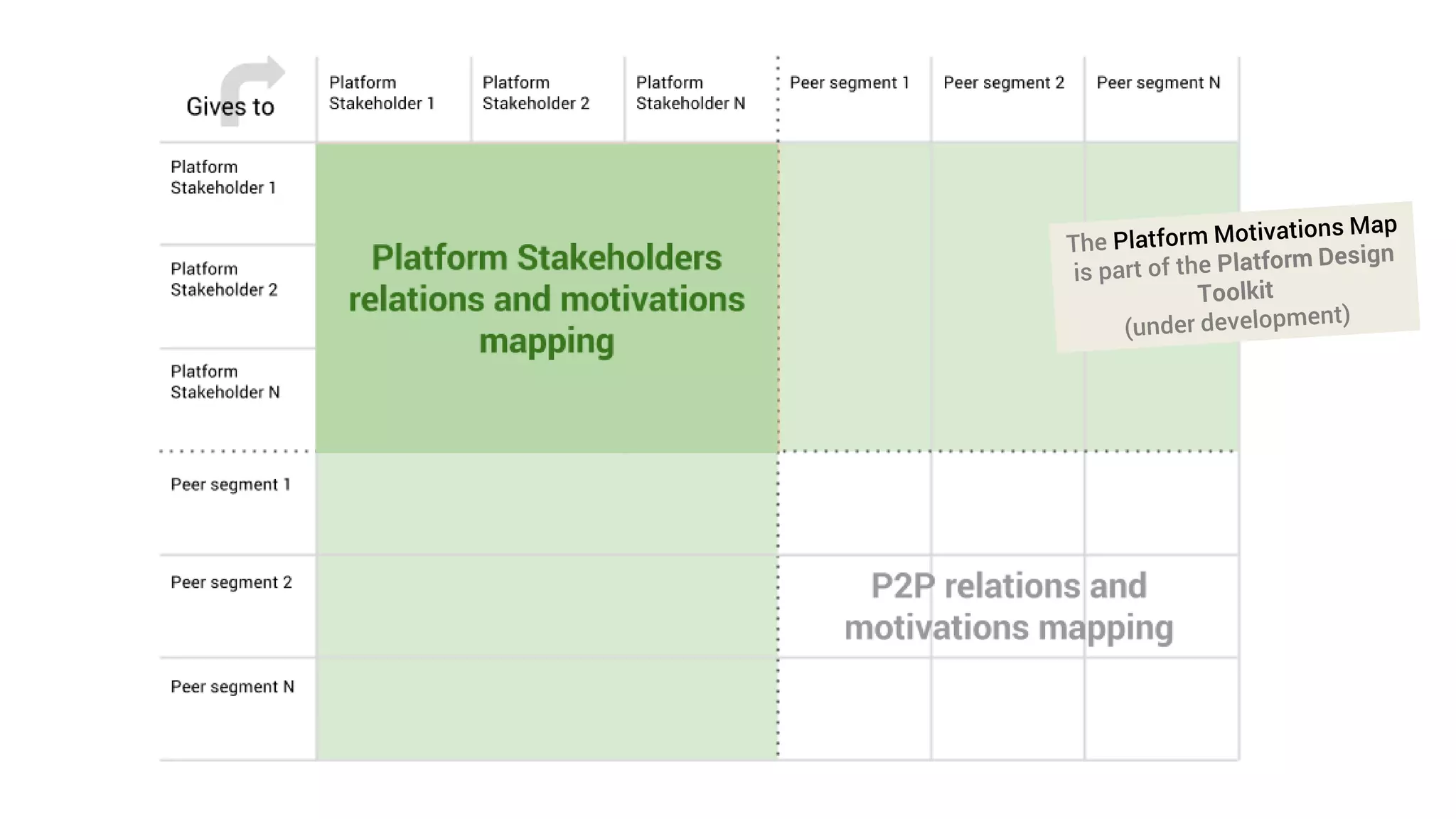
Identifying Peer Segments and relations
between them and with the platform is key
Mapping Platform Stakeholder
motivations will give you insights on how
to overcome chicken/egg problem and
other motivation related design challenges
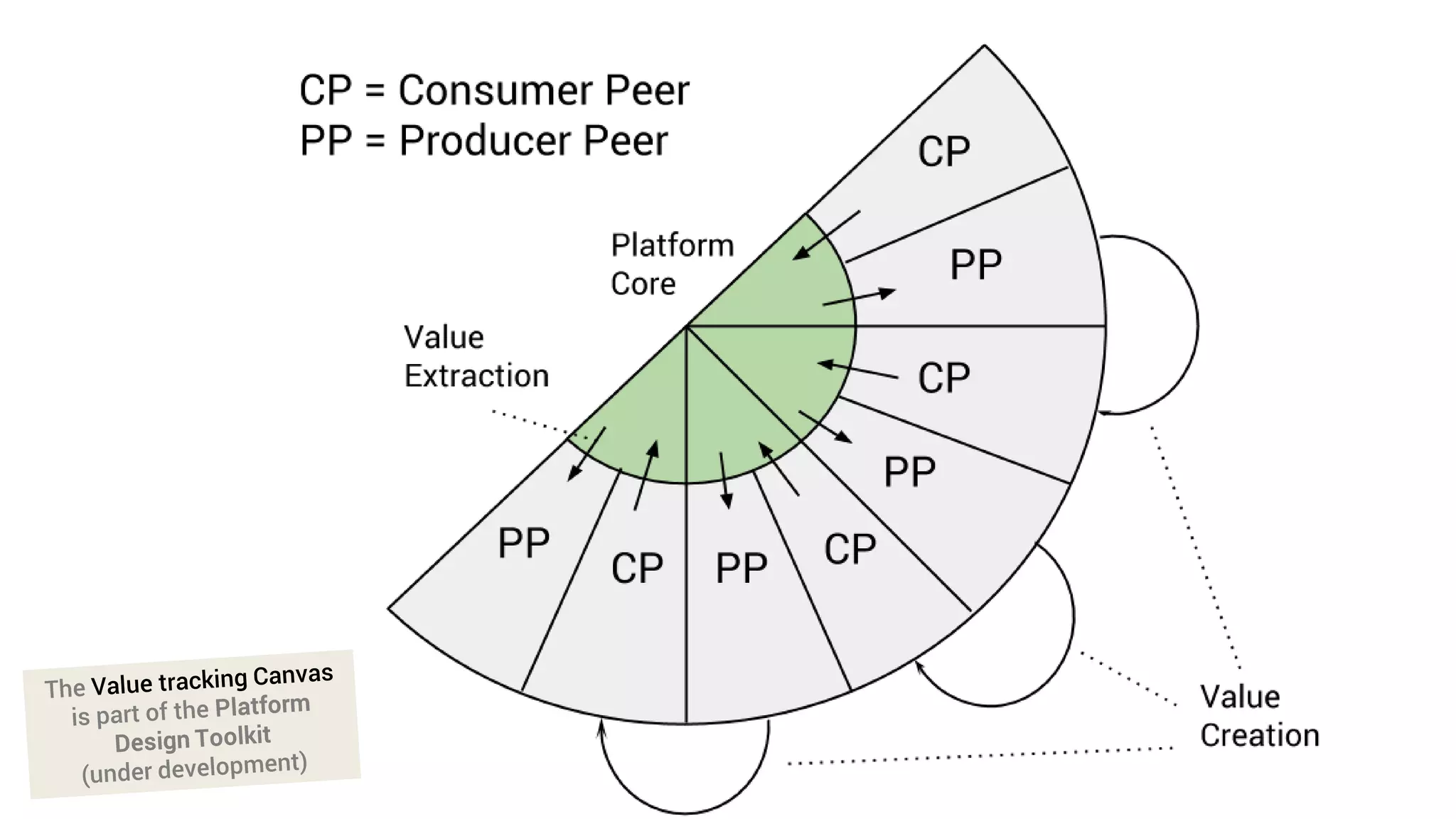
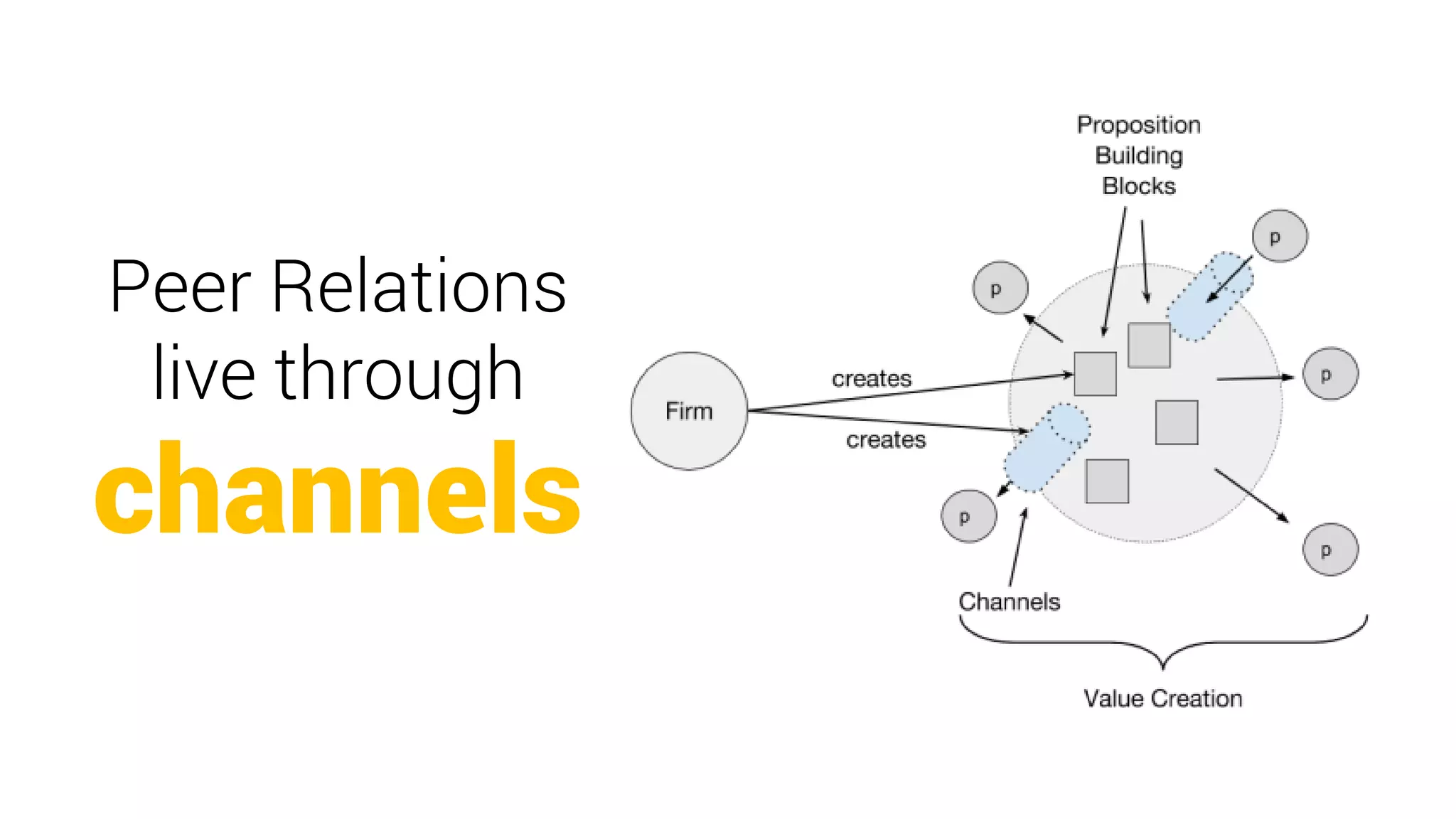
Peer Relations
live through
channels
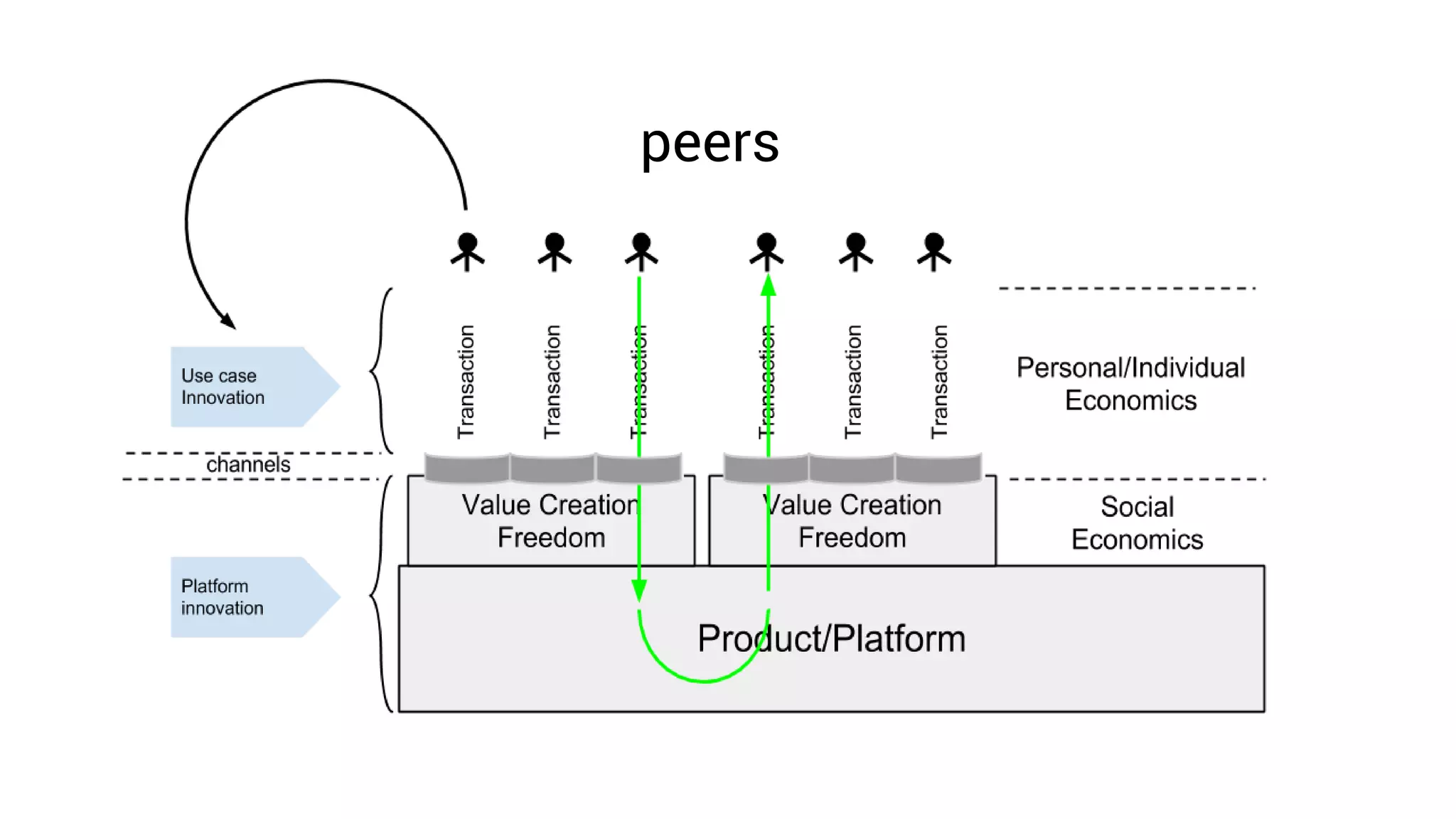
peers
Channels must be implemented to
facilitate emerging value exchanges.
In platforms, currencies such as trust
and reputation may be required to
facilitate transactions and should be
clearly valued.
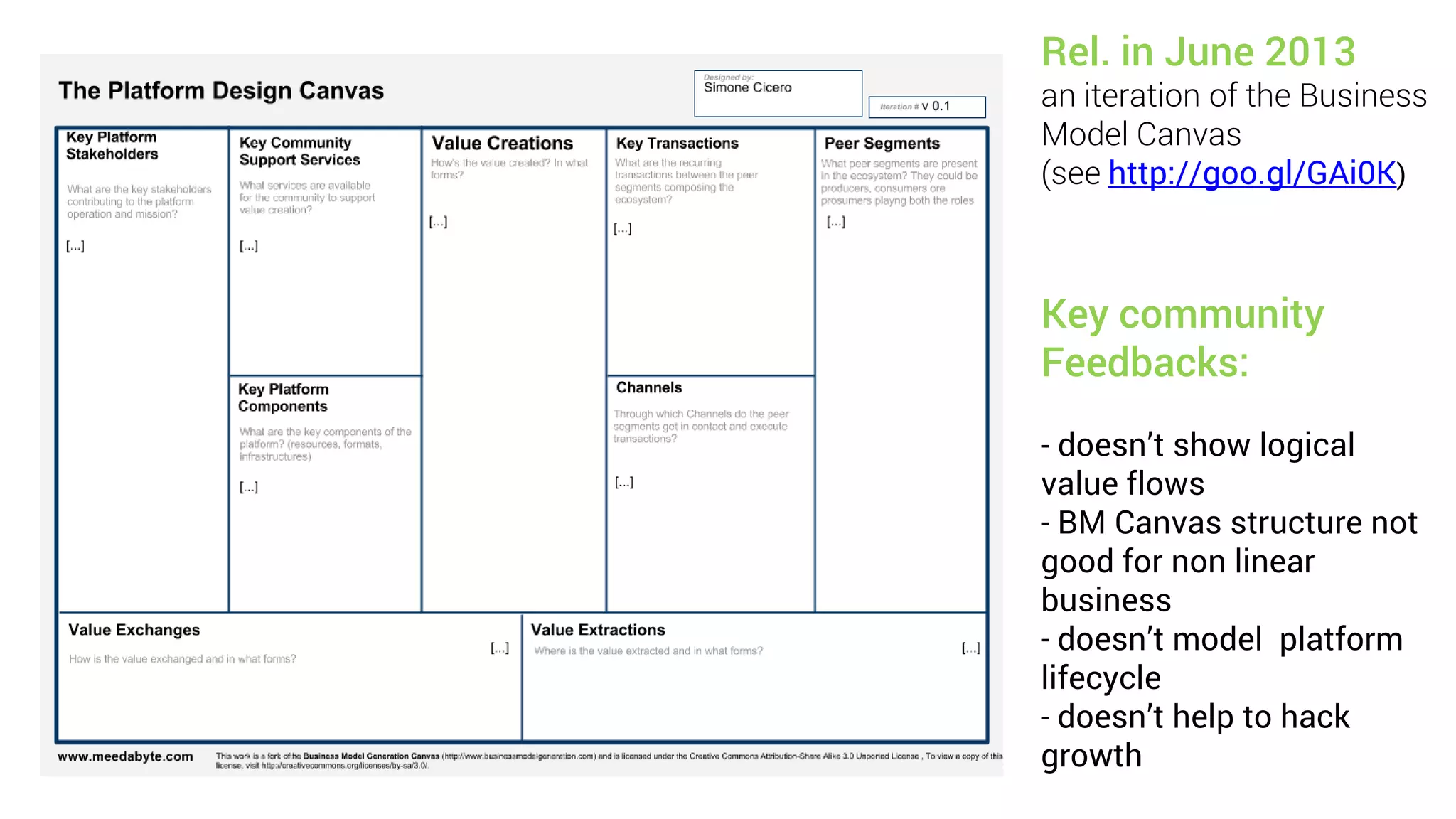
the Platform
Design Canvas
(see http://goo.gl/GAi0K)
Rel. in June 2013
an iteration of the Business
Model Canvas
(see http://goo.gl/GAi0K)
Key community
Feedbacks:
- doesn’t show logical
value flows
- BM Canvas structure not
good for non linear
business
- doesn’t model platform
lifecycle
- doesn’t help to hack
growth
Currently in the works:
Plaform & Ecosystem
Design Toolkit
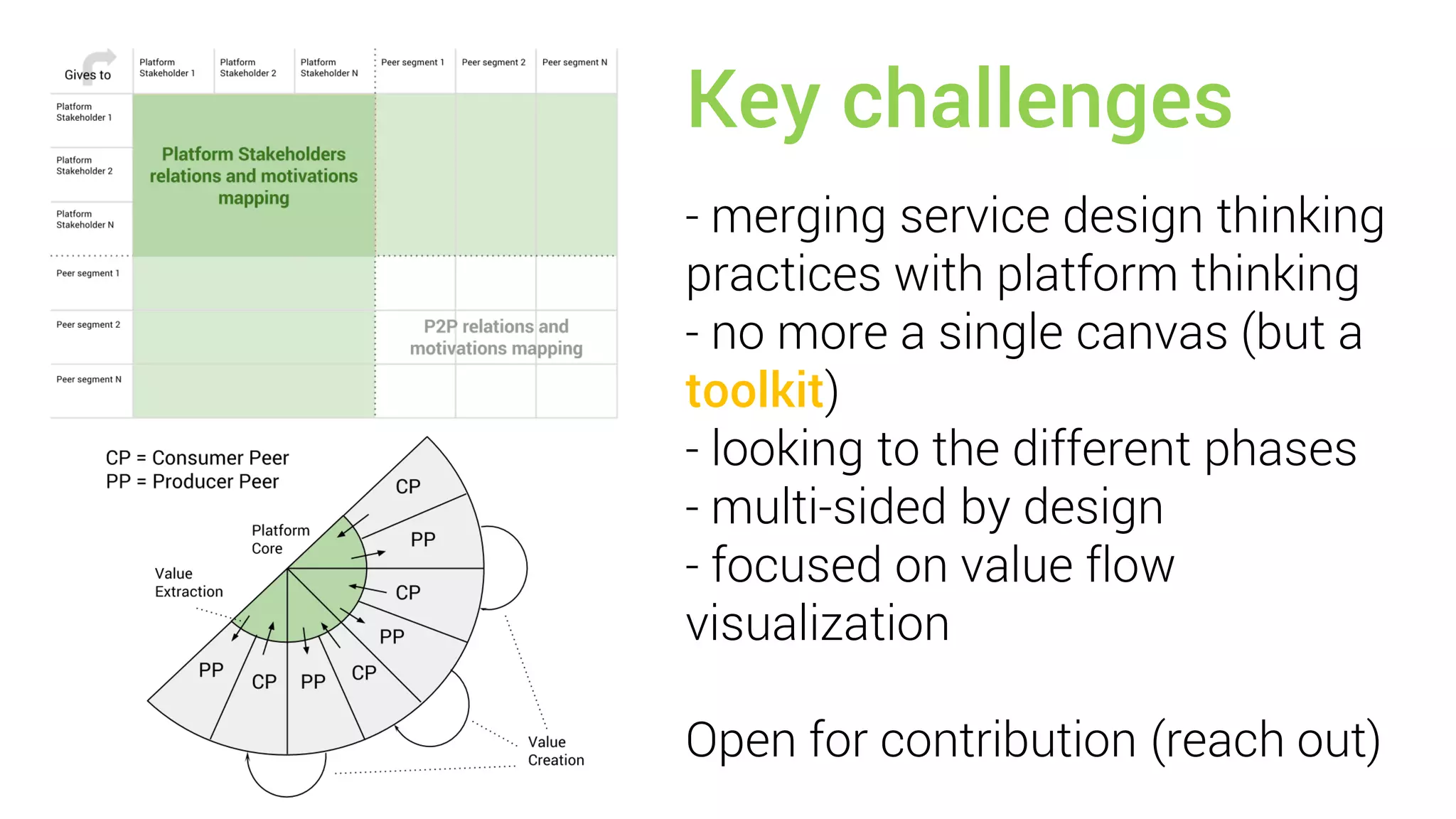
Key challenges
- merging service design thinking
practices with platform thinking
- no more a single canvas (but a
toolkit)
- looking to the different phases
- multi-sided by design
- focused on value flow
visualization
Open for contribution (reach out)
3 Takeouts
Work like a Startup
solve gaps and hack growth
Grow like a Platform
nurture relations and exchanges
Think like an Ecosystem
always disrupt yourself
Thanks!
Get in touch and hire me for talks
and workshops on meedabyte.com
Follow me on Twitter
@meedabyte
workshops & consulting
If you enjoyed this don’t forget to
like the presentation!
…and share on Social Media!
Special Thanks to:
Simon Wardley as lots of this is based on his insights
Sangeet P. Chaudhary for the exchanges we had on platforms
Raffaele Mauro for the inspiration on trends
Pictures used (Creative Commons):
Thanks Grzegorz Łobiński for the traffic light picture
Thanks alphabetta for the cat picture
Thanks USFS Region 5 for the butterfly picture
Thanks ben britten for the rainforest picture
Thanks Andrew Feinberg for Zuckerberg picture

Digital Evolutions: Startups, Platforms and Ecosystems

  • 1.
    Digital Evolutions Startups, Platformsand Ecosystems Mentorship Lecture - 25th/26th Sept. 2013 by Simone Cicero - meedabyte.com - @meedabyte
  • 2.
    Exponential Times Digital Ecologies PlatformDesign Thinking Digital Evolutions Understanding Dynamics
  • 3.
  • 4.
    everyone is networkedwith everithing
  • 5.
    everyone is networkedwith everything
  • 6.
    Tech Cycles (every 10years) Now it’s time for Wearable Image from KPCB Internet Trends ‘13
  • 7.
    Two main disruptiondrivers A growing computing density in matter Growing possibilities in AI and Machine Learning
  • 8.
  • 9.
    Text Pictures VideosSounds Data Consolidated Explosive Growth Ramping up fast Emerging Emerging Mobile chats, Social networks Vine, Intenet Cams Sound sharing, video chats (eg: Snapchat) Personal Tracking, Quantified Self
  • 10.
  • 12.
    Data is all& all is Data
  • 13.
    Everything it’s personalized. Dataare connected and socialized. Devices are allover the place. It’s the Digital Market today.
  • 14.
  • 15.
  • 16.
    “We're just increasingour humanness and our ability to connect with each other, regardless of geography” Amber Case, (Cyborg Anthropologist) - SXSW Keynote 2012
  • 18.
  • 19.
    It’s kinda hardto predict stuff
  • 20.
    Illustration: Simon Wardley– blog.gardeviance.org
  • 21.
  • 22.
    All this demandfor innovation drives componentization* as a buyer you push down price and ask for standardization: this creates your competition. * breaking down into cost competitive and interchangeable pieces.
  • 23.
    Illustration: Simon Wardley– blog.gardeviance.org Increasing competition in demand and supply
  • 24.
    Red Queen Effect (evolutionarybiology) Regardless of how well a species adapts to its current environment, it must keep evolving to keep up with its (also evolving) competitors.
  • 25.
  • 26.
    Fortune 500 companieslife expectancy in 2013 is 15 years. Was 70 in 1930.
  • 27.
    “Software is eatingthe world” Marc Andreessen
  • 28.
  • 29.
    Long tail =Diversification Diversification = Niches Niches = Economies of Scope
  • 30.
    “Whereas economies ofscale for a firm primarily refers to reductions in the average cost (cost per unit) associated with increasing the scale of production for a single product type, economies of scope refers to lowering the average cost for a firm in producing two or more products” The Age of Economies of Scope
  • 31.
    Designers are increasinglydealing with designing tools that allow users to create value on their own (and within a community). Switching from Economies of scope (multiple products) to User Centric experiences (user customizable products)
  • 32.
    “Toolkits for userinnovation allow producers to abandon attempts to understand user needs in favor of transferring need-related aspects of product and service development to users along with an appropriate toolkit". Eric Von Hippel
  • 34.
    “Unleash your creativityby customizing select products to create exactly what you want with eBay Exact. Simply select a product, choose a design, and add your own personal flair to create a unique item for yourself or someone special”
  • 36.
    "Once you finish assemblingit, you’re emotionally attached to that. You’ve basically gone through the process to build your own phone” Moto X head product manager - Lior Ron
  • 37.
  • 38.
    Consumers can alsobecome Producers and Designers themselves. Roles can change
  • 39.
    allowing peer topeer production
  • 40.
  • 41.
    Digital Market: opportunities& huge competition What Dynamics?
  • 42.
    Pioneers Thrive in uncertaintimes Search for Experimentation Accept Failure Players that face poorly understood markets, trying to define gaps and opportunities, constantly undergoing changing dynamics and small numbers. They want to create the future. Startups
  • 43.
    Settlers Learn from feedbacks Investigateneeds Spot new trends Players that face increasing demand, growing market opportunities for mature products and revenues that grow accordingly Platforms & Ecosystems
  • 44.
    Town Planners Search forself disruptions Base business on measures and scientific models Optimize for operations Leaders/players that face standardized demand and fight growing competition on mature markets. Always focus on essential cost of doing Business. Ecosystems & Industrialization
  • 45.
    The ILC Cycle Illustration:Simon Wardley – blog.gardeviance.org Innovate Leverage Commoditize (repeat)
  • 46.
    Facebook Doesn’t Want ToBe Cool, It Wants To Be Electricity
  • 47.
    FB Identity Services Opengraph PaymentServices ValueChain Genesis Custom Built Product Commodity/Utility Social Networking
  • 48.
    Different Dynamics Illustration: Simon Wardley– blog.gardeviance.org Startups Platforms Ecosystems
  • 49.
    In the Platformphase you must - nurture community - create community support services - identify emerging behaviors - model channels to cope with interactions In this way You increase resilience by enabling peer segments to create their own interactions inside your platform
  • 50.
    In the EcosystemPhase you must - drive cost down and outperform competitors value - be cool with utility like consumption patterns - allow new startups/platforms to grow and monitor use case innovation In this way You increase resilence by enabling other business players to create complex higher value proposition on top of your interface*
  • 51.
    Innovation happens: • ontop of the interface*: higher value systems (use case innovation) • under the interface*: process maturity, elastic provisioning, measuring (competition) ValueChain *interface: a shared and commonly adopted or standardized protocol or practice
  • 52.
    Arduino Most of theinnovation happens above the interface (higher value: smaller size, specific features, etc…) as Arduino has become a standard community of knowledge (interface) Microduino (microsize) Flutter (long range) Smartduino (modularity)
  • 53.
    Amazon AWS Established AmazonMachine Images as the ruling interface in cloud deployments. Enabled the birth and growth of several (higher) value proposition. Commoditized specific frequent uses cases (eg: Elastic Map Reduce for big data = now a commodity). ValueChain Genesis Custom Built Product Commodity/Utility Amazon Elastic Map Reduce AWS Elastic Beanstalk (beta) AWS OpsWorks PaaS Currently built on AWS Spotted growing usage
  • 54.
    Joining an existing Platformand Ecosystem (outstanding opportunities) Typical Stakeholders and contexts: Over The Top players ecosystems Brand related initiatives Corporate innovation strategies Open ecosystems (rare)
  • 55.
    The App Ecosystem& OTT Platforms Eg: Building Native Apps to be distributed on Android/iOS Marketplaces
  • 56.
    Facebook Eg: Using Facebook Connectand Facebook OpenGraph to enhance social interactions as part ofthe proposition.
  • 57.
    It’s not onlyabout APIs: corporate players are increasingly looking for innovation *ecosystems*
  • 58.
    Telco players lookingfor service innovation Manufacturers creating new interfaces and ways to interact with their producs.
  • 59.
    Brands with agrowing user base looking for disruption. Emerging fields of innovation require a higher experimentation level and inclusive innovation plans
  • 60.
    Typical Phases is about builging blocks &dev services is about coaching, infrastructure & customer access is about market channels & numbers Eg: APIs and Infrastructures Startup programs, Events and conferences, Partner programs Marketplaces, distribution agreements
  • 61.
  • 62.
    Grow your startup/productinto a Platform (and then, Ecosystem) Transform from a linear/single gap perspective into multilinear engine of value creation enabling Peer Segments to co-create value
  • 63.
    Community (relations) Centric User (gap) Centric Platforms target P2PCommunities: value creation comes from relations, transactions and exchanges
  • 64.
    How to lower Platformopt in cost? The cost/friction for a user to adopt your platform and start creating value
  • 65.
    It’s a (co)Design challenge about understanding user contexts and motivations and enabling vaue creation
  • 66.
    Some big issuesin Peer Platforms: Marketplace Liquidity Exchange Currencies Coincidence of Interests Reaching Tipping Point
  • 67.
  • 68.
    Start from buildingsingle user utility “It might seem odd that systems designed to leverage interactions between people should have single person utility. The first users of delicious were barely aware of and rarely used its social aspects. They just wanted to store their bookmarks in the cloud instead of in their browser. And they liked the tag based classification system. And they liked being able to use their links from any device. That was the single person utility delicious was built on.” Fred Wilson (avc.com)
  • 69.
    Add mutual value “Usershate spamming friends. It was all fine to begin with when only a few services required them to send out invites but as every new service asks for an invite to be sent out, users get more discerning. Dropbox had a brilliant way around this by incentivizing not only the user but also the invitee when he signs up.” Sangeet Paul Choudary (platformed.info)
  • 70.
    Spillover (across clusters) SangeetPaul Choudary (platformed.info) “The networks with the fastest growth are the ones that freely allow spillover. AirBnB, unlike Uber and OpenTable, has tremendous potential for spillover. The fact that the use case is travel makes such spillover organic to the network. The host and traveler will most likely be part of different city networks. Such cross-cluster interaction allows growth to occur without having to be confined within geographical boundaries.”
  • 71.
    Though tricks maywork, most of growth problem are contextual: there’s no one size fits all recipe (though best practices count)
  • 72.
    The right approach: methodologicallyfocus on identifying value exchanges and motivations Design Thinking & Platform Design
  • 73.
    Understand the basic roles inthe Platform Consumers Producers Stakeholders (platform) ValueChain
  • 74.
  • 75.
  • 77.
    Identifying Peer Segmentsand relations between them and with the platform is key Mapping Platform Stakeholder motivations will give you insights on how to overcome chicken/egg problem and other motivation related design challenges
  • 79.
  • 80.
  • 81.
    Channels must beimplemented to facilitate emerging value exchanges. In platforms, currencies such as trust and reputation may be required to facilitate transactions and should be clearly valued.
  • 82.
    the Platform Design Canvas (seehttp://goo.gl/GAi0K)
  • 83.
    Rel. in June2013 an iteration of the Business Model Canvas (see http://goo.gl/GAi0K) Key community Feedbacks: - doesn’t show logical value flows - BM Canvas structure not good for non linear business - doesn’t model platform lifecycle - doesn’t help to hack growth
  • 84.
    Currently in theworks: Plaform & Ecosystem Design Toolkit
  • 85.
    Key challenges - mergingservice design thinking practices with platform thinking - no more a single canvas (but a toolkit) - looking to the different phases - multi-sided by design - focused on value flow visualization Open for contribution (reach out)
  • 86.
  • 87.
    Work like aStartup solve gaps and hack growth
  • 88.
    Grow like aPlatform nurture relations and exchanges
  • 89.
    Think like anEcosystem always disrupt yourself
  • 90.
    Thanks! Get in touchand hire me for talks and workshops on meedabyte.com Follow me on Twitter @meedabyte workshops & consulting If you enjoyed this don’t forget to like the presentation! …and share on Social Media!
  • 91.
    Special Thanks to: SimonWardley as lots of this is based on his insights Sangeet P. Chaudhary for the exchanges we had on platforms Raffaele Mauro for the inspiration on trends Pictures used (Creative Commons): Thanks Grzegorz Łobiński for the traffic light picture Thanks alphabetta for the cat picture Thanks USFS Region 5 for the butterfly picture Thanks ben britten for the rainforest picture Thanks Andrew Feinberg for Zuckerberg picture