Everything you need
to know about
Customer Data Platforms
CDP101
BONUS
CDP, DMP & CRM
Comparison &
Other Resources
2
First things first,
let's talk about data!
DATA 101
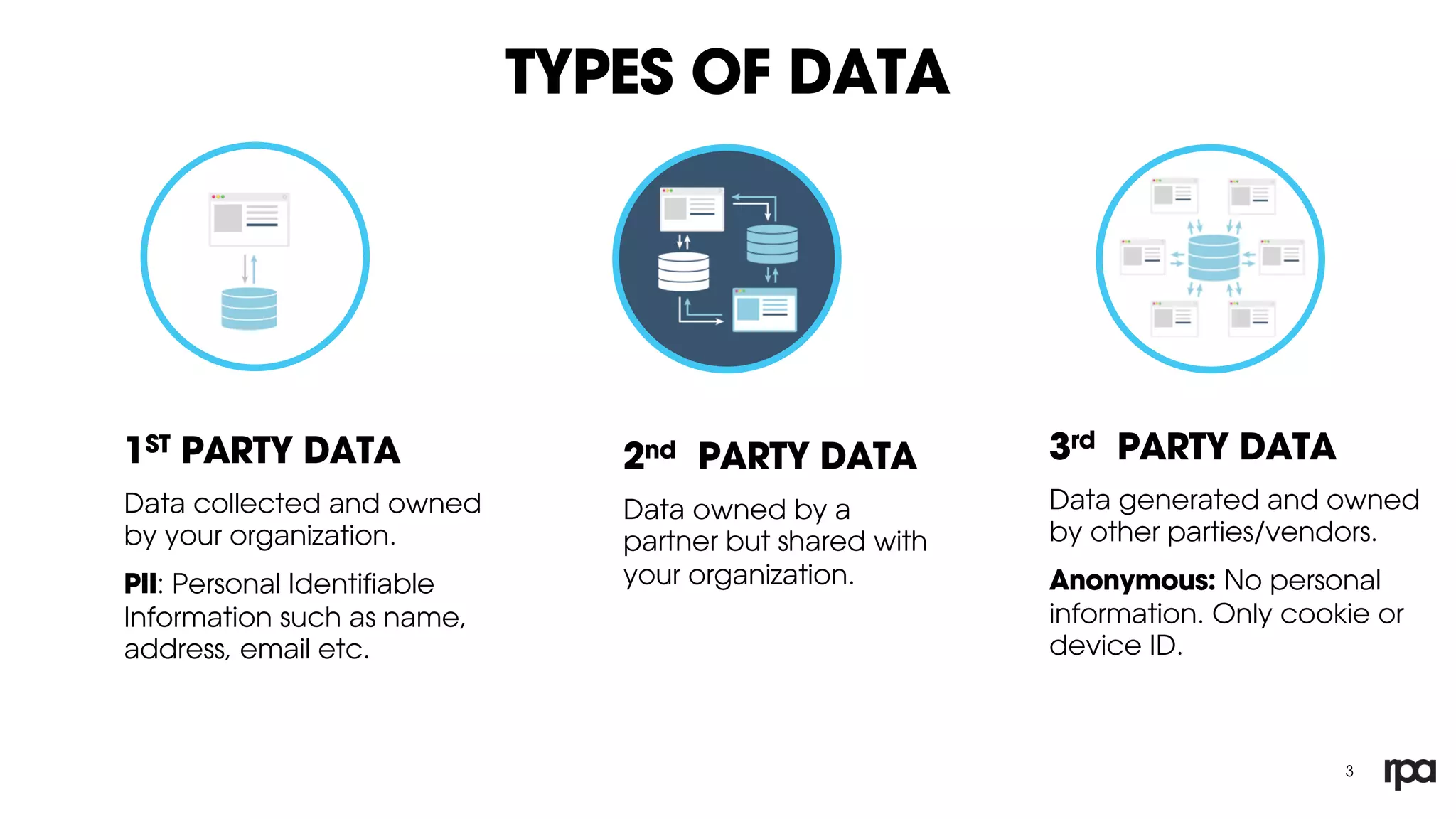
TYPES OF DATA
3
2nd PARTY DATA
Data owned by a
partner but shared with
your organization.
1ST PARTY DATA
Data collected and owned
by your organization.
PII: Personal Identifiable
Information such as name,
address, email etc.
3rd PARTY DATA
Data generated and owned
by other parties/vendors.
Anonymous: No personal
information. Only cookie or
device ID.
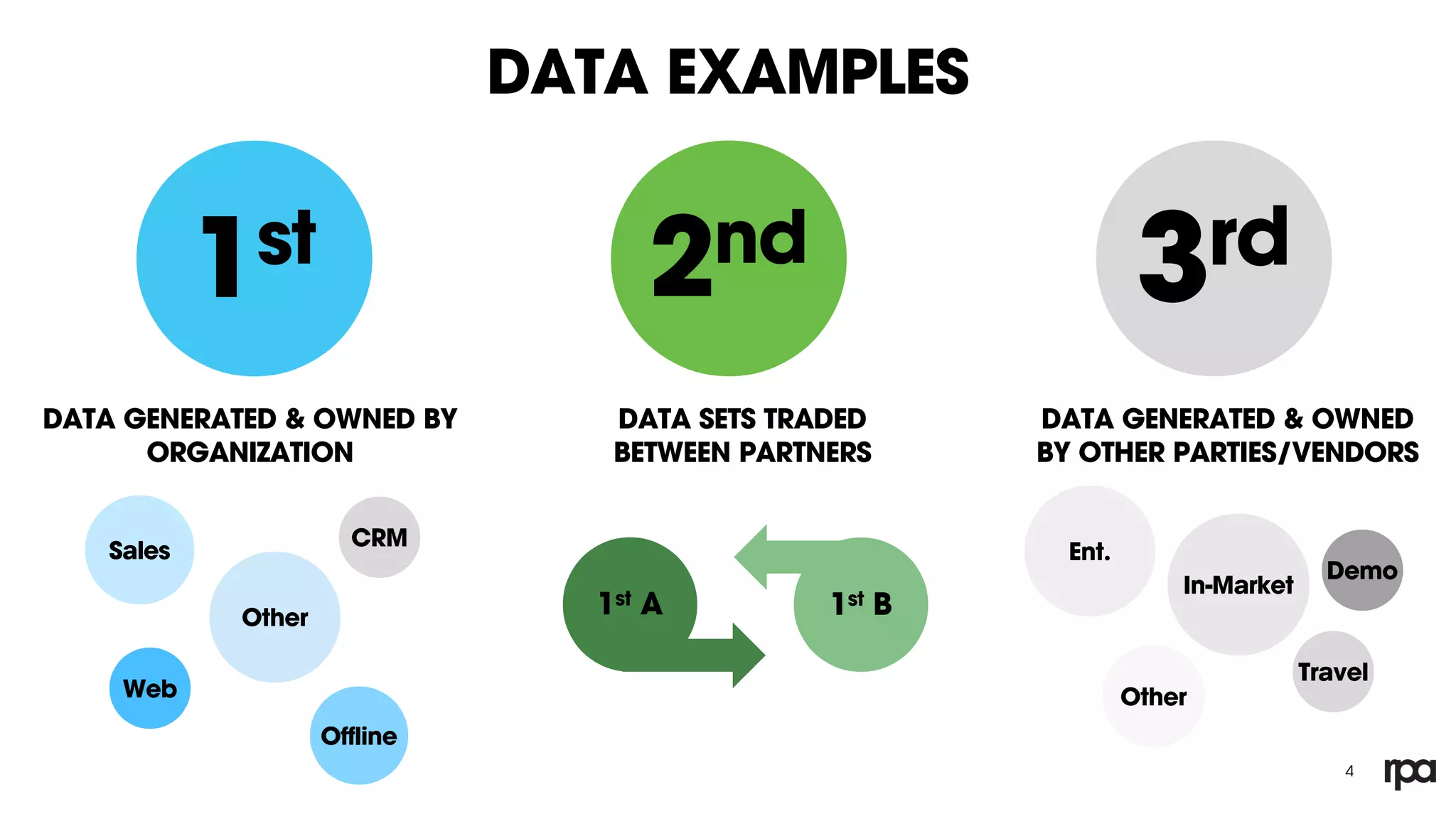
DATA EXAMPLES
4
1st 2nd
3rd
Web
Offline
CRM
Sales
Other
Demo
Other
Ent.
In-Market
Travel
1st A 1st B
DATA GENERATED & OWNED BY
ORGANIZATION
DATA SETS TRADED
BETWEEN PARTNERS
DATA GENERATED & OWNED
BY OTHER PARTIES/VENDORS
DATA EXAMPLES
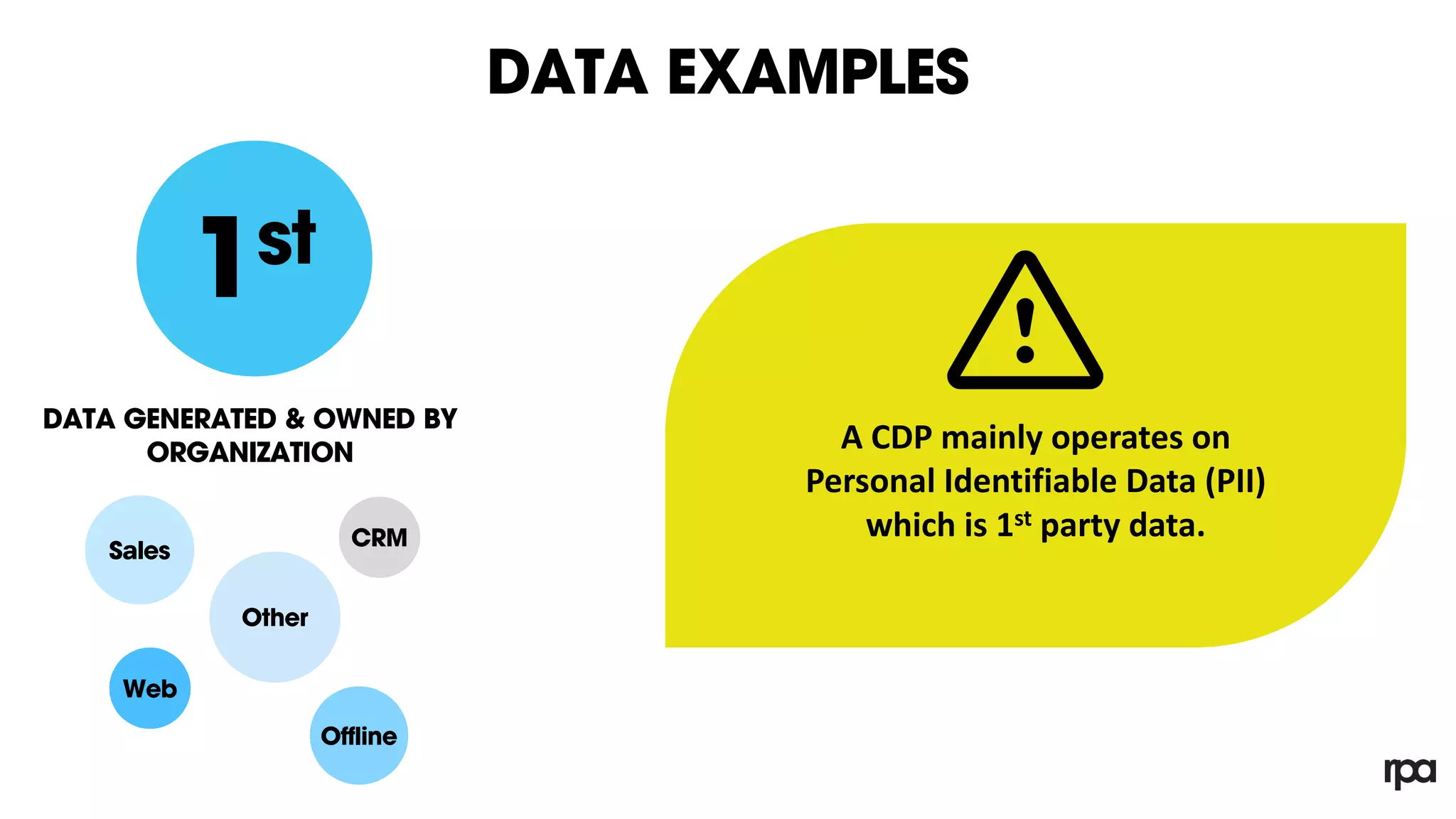
1st
Web
Offline
CRM
Sales
Other
DATA GENERATED & OWNED BY
ORGANIZATION A CDP mainly operates on
Personal Identifiable Data (PII)
which is 1st party data.
6
Now, let’s learn about the
Customer Data Platform CDP.
CDP 101
WHAT IS A CUSTOMER DATA PLATFORM?
“A customer data platform is a marketer-managed
system that creates a persistent, unified customer
database that is accessible to other systems”
7
David Raab, Founder of the
Customer Data Platform (CDP) Institute
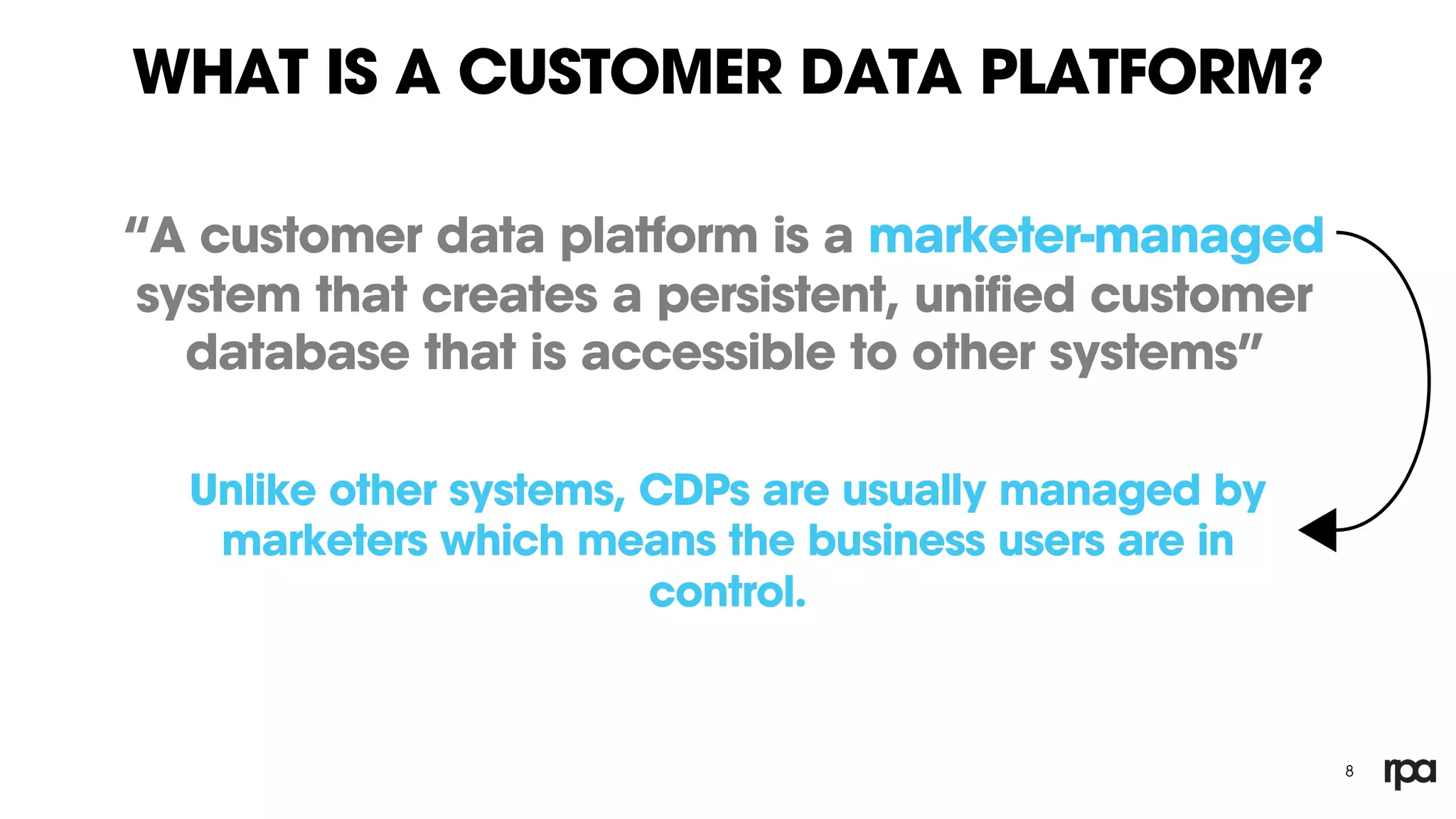
WHAT IS A CUSTOMER DATA PLATFORM?
“A customer data platform is a marketer-managed
system that creates a persistent, unified customer
database that is accessible to other systems”
8
Unlike other systems, CDPs are usually managed by
marketers which means the business users are in
control.
WHAT IS A CUSTOMER DATA PLATFORM?
“A customer data platform is a marketer-managed
system that creates a persistent, unified customer
database that is accessible to other systems”
9
A CDP creates an actual database of its own, rather
than accessing information that is stored in other
systems or acting as a hub that transfers data from one
system to another.
WHAT IS A CUSTOMER DATA PLATFORM?
“A customer data platform is a marketer-managed
system that creates a persistent, unified customer
database that is accessible to other systems”
10
CDP connects all data related to the same customer
to present a Single Customer View
WHAT IS A CUSTOMER DATA PLATFORM?
“A customer data platform is a marketer-managed
system that creates a persistent, unified customer
database that is accessible to other systems”
11
A CDP data base is organized around people rather
than objects like web pages or products. Users are
stored on an individual level with personal
identifiable information (PII) like name, phone
number account number etc.
WHAT IS A CUSTOMER DATA PLATFORM?
“A customer data platform is a marketer-managed
system that creates a persistent, unified customer
database that is accessible to other systems”
12
A CDP can share its data with other systems via API
(Application Program Interface) or database queries.
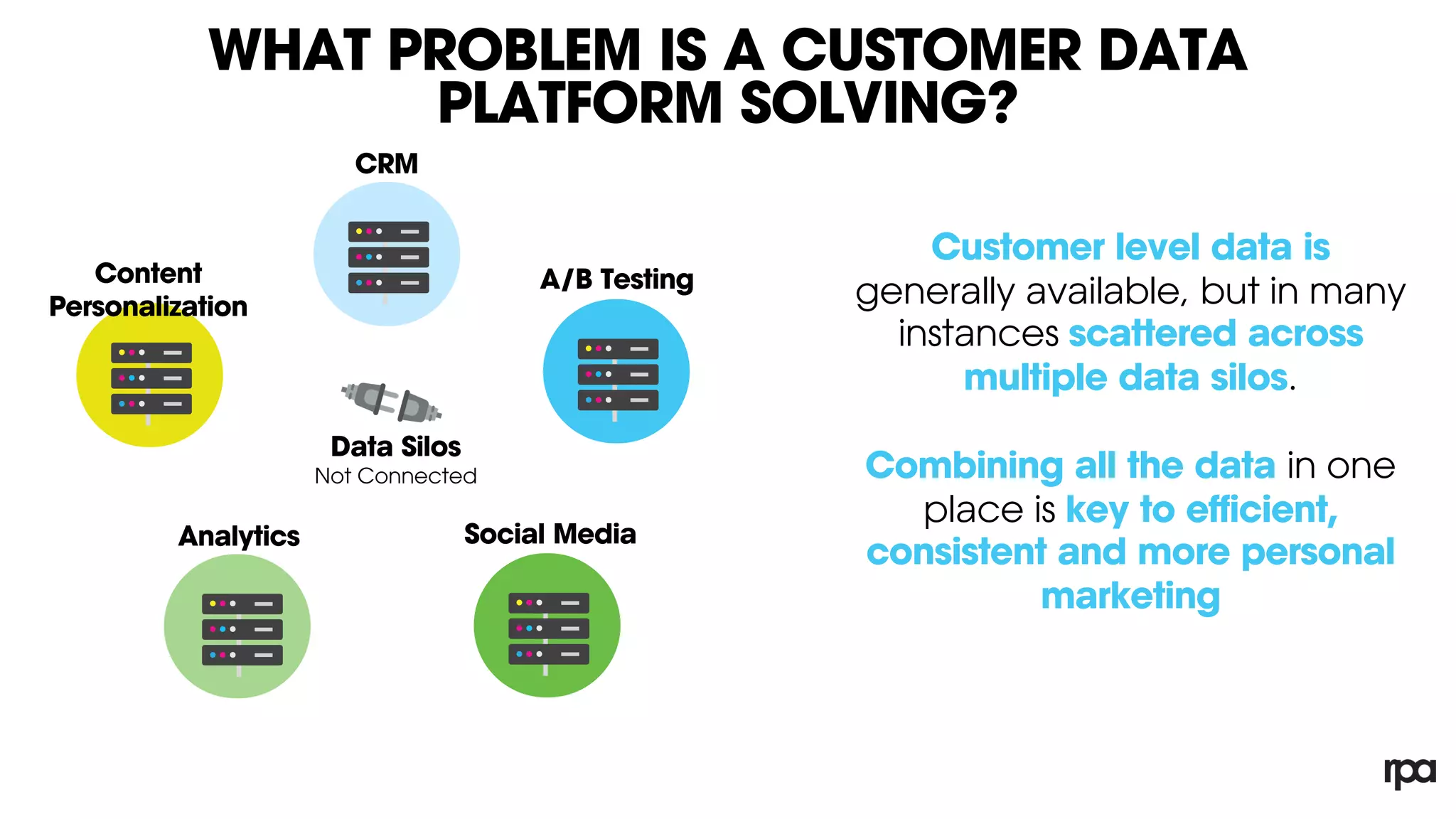
Combining all the data in one place is key to efficient marketing. While the information
is generally available, it is usually scattered across multiple silos—databases, platforms,
and systems that store a company’s data but aren’t connected with one another.
WHAT PROBLEM IS A CUSTOMER DATA
PLATFORM SOLVING?
Data Silos
Not Connected
Customer level data is
generally available, but in many
instances scattered across
multiple data silos.
Combining all the data in one
place is key to efficient,
consistent and more personal
marketing
CRM
A/B Testing
Analytics Social Media
Content
Personalization
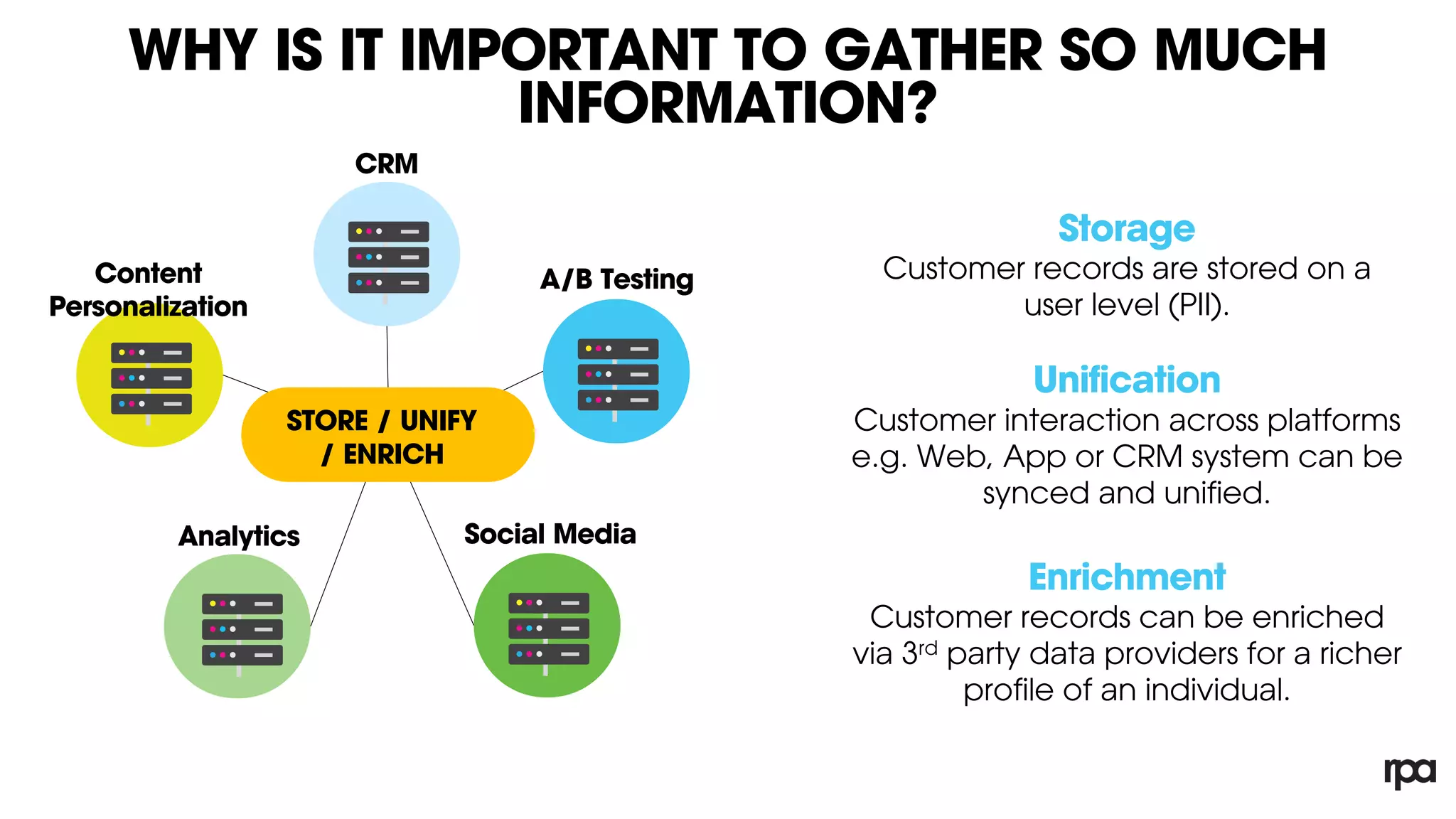
WHY IS IT IMPORTANT TO GATHER SO MUCH
INFORMATION?
CRM
A/B Testing
Analytics Social Media
Content
Personalization
Storage
Customer records are stored on a
user level (PII).
Unification
Customer interaction across platforms
e.g. Web, App or CRM system can be
synced and unified.
Enrichment
Customer records can be enriched
via 3rd party data providers for a richer
profile of an individual.
STORE / UNIFY
/ ENRICH
15
Now, let’s learn about the
differences across multiple systems.
CDP vs. DMP vs. CRM
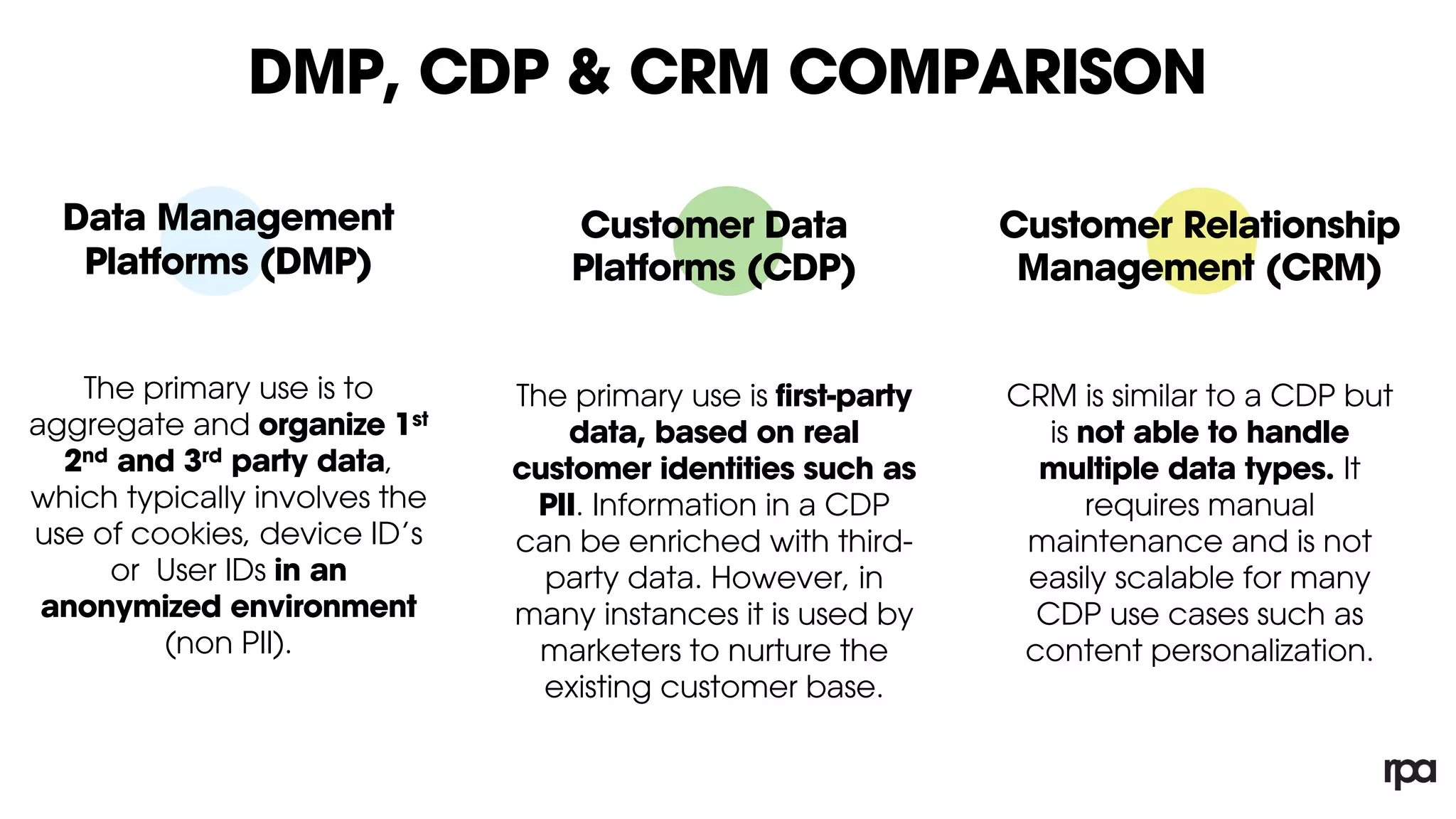
DMP, CDP & CRM COMPARISON
Data Management
Platforms (DMP)
The primary use is to
aggregate and organize 1st
2nd and 3rd party data,
which typically involves the
use of cookies, device ID’s
or User IDs in an
anonymized environment
(non PII).
Customer Data
Platforms (CDP)
The primary use is first-party
data, based on real
customer identities such as
PII. Information in a CDP
can be enriched with third-
party data. However, in
many instances it is used by
marketers to nurture the
existing customer base.
Customer Relationship
Management (CRM)
CRM is similar to a CDP but
is not able to handle
multiple data types. It
requires manual
maintenance and is not
easily scalable for many
CDP use cases such as
content personalization.
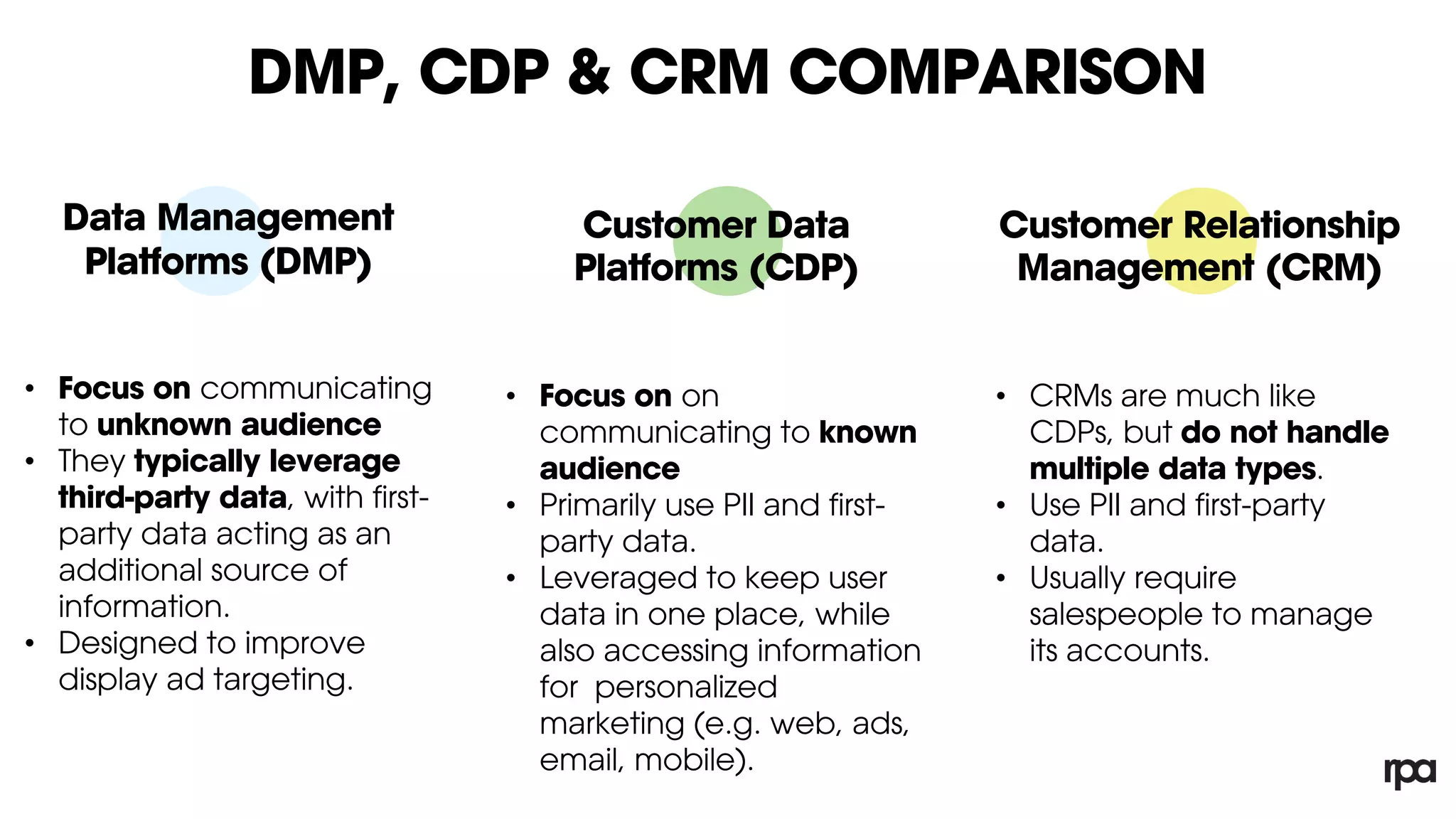
DMP, CDP & CRM COMPARISON
Data Management
Platforms (DMP)
• Focus on communicating
to unknown audience
• They typically leverage
third-party data, with first-
party data acting as an
additional source of
information.
• Designed to improve
display ad targeting.
Customer Data
Platforms (CDP)
• Focus on on
communicating to known
audience
• Primarily use PII and first-
party data.
• Leveraged to keep user
data in one place, while
also accessing information
for personalized
marketing (e.g. web, ads,
email, mobile).
Customer Relationship
Management (CRM)
• CRMs are much like
CDPs, but do not handle
multiple data types.
• Use PII and first-party
data.
• Usually require
salespeople to manage
its accounts.
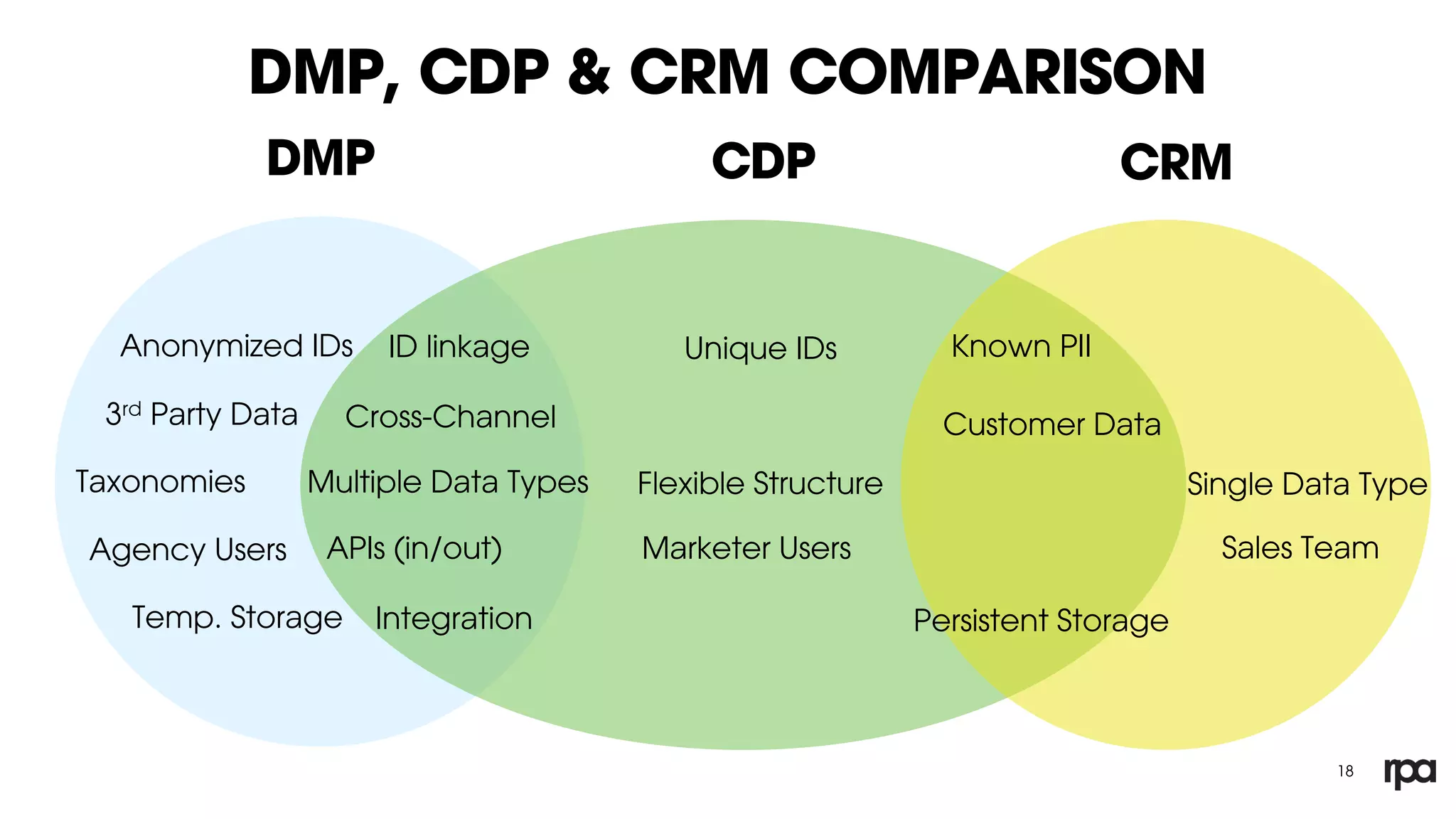
18
DMP CDP CRM
Anonymized IDs
3rd Party Data
Taxonomies
Agency Users
Temp. Storage
ID linkage
Cross-Channel
Multiple Data Types
APIs (in/out)
Integration
Unique IDs
Flexible Structure
Marketer Users
Known PII
Customer Data
Sales Team
Persistent Storage
Single Data Type
DMP, CDP & CRM COMPARISON
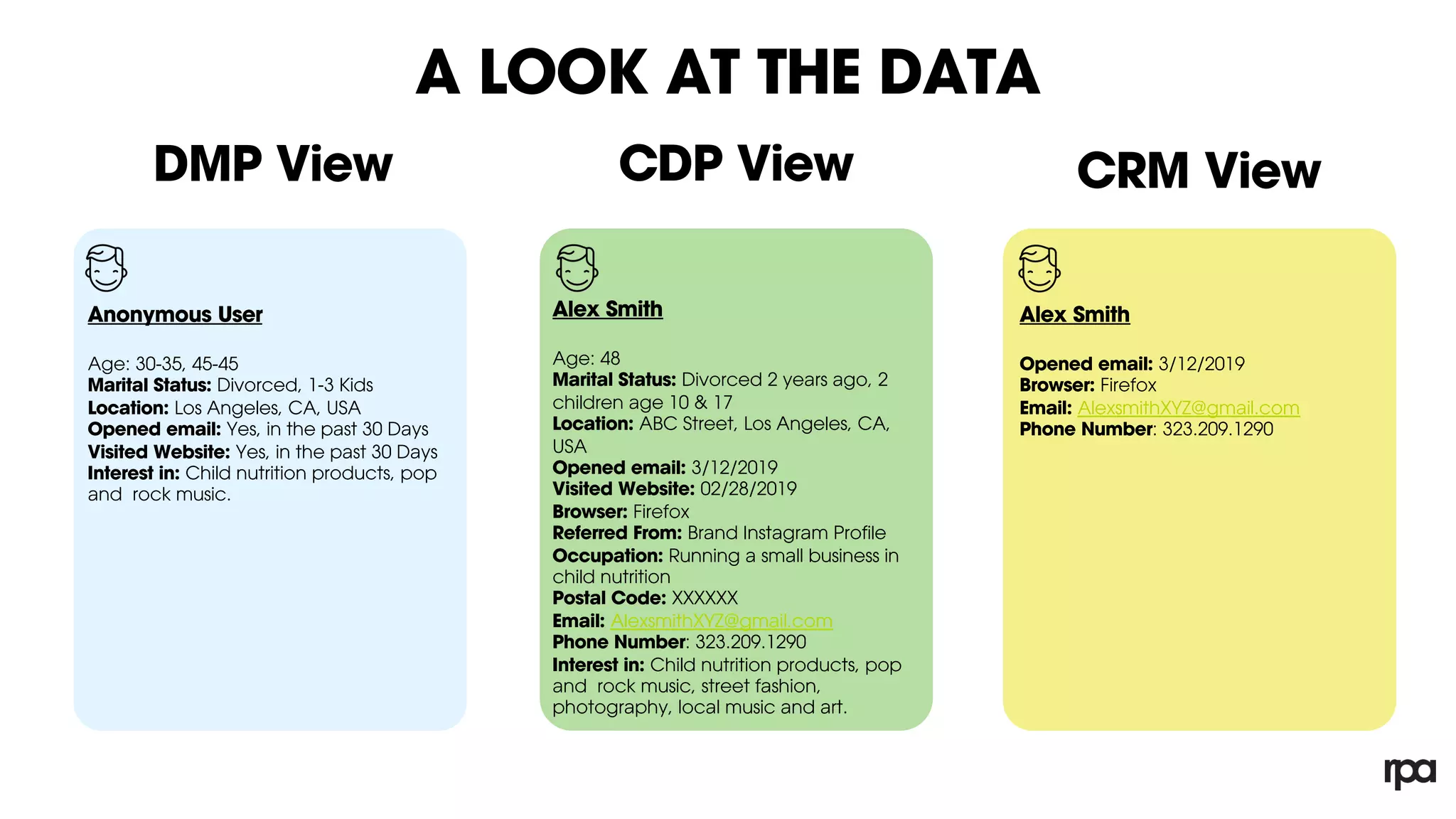
What type of data is housed in each of the systems?
The type of data that is captured and housed in a Data Management Platform (DMP), a Customer Data Platform (CDP) and a Customer Relationship Management System vary drastically. This is a simplified view of the type of data each system captures.
DMP View CDP View
A LOOK AT THE DATA
CRM View
Alex Smith
Age: 48
Marital Status: Divorced 2 years ago, 2
children age 10 & 17
Location: ABC Street, Los Angeles, CA,
USA
Opened email: 3/12/2019
Visited Website: 02/28/2019
Browser: Firefox
Referred From: Brand Instagram Profile
Occupation: Running a small business in
child nutrition
Postal Code: XXXXXX
Email: AlexsmithXYZ@gmail.com
Phone Number: 323.209.1290
Interest in: Child nutrition products, pop
and rock music, street fashion,
photography, local music and art.
Alex Smith
Opened email: 3/12/2019
Browser: Firefox
Email: AlexsmithXYZ@gmail.com
Phone Number: 323.209.1290
Anonymous User
Age: 30-35, 45-45
Marital Status: Divorced, 1-3 Kids
Location: Los Angeles, CA, USA
Opened email: Yes, in the past 30 Days
Visited Website: Yes, in the past 30 Days
Interest in: Child nutrition products, pop
and rock music.
20
Now, let’s talk use-cases.
CDP IN ACTION
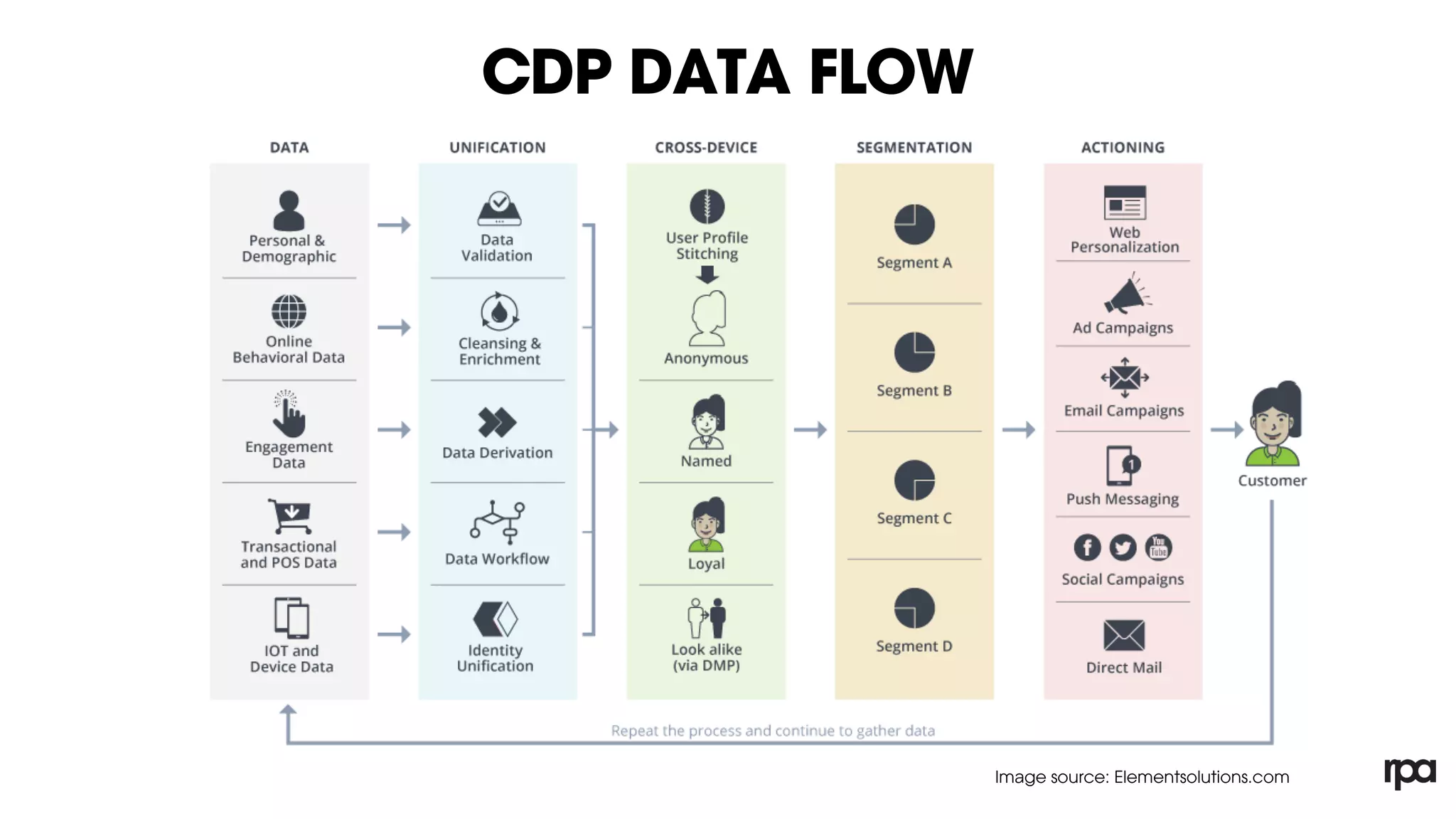
Despite the many
capabilities and functions
of a Customer Data
Platform, the premise on
which they work is fairly
simple. They function by
pulling data from multiple
sources, cleaning it, and
re-structuring it in a way
that makes it available to
other marketing systems
for personalized marketing
activities. Depending upon
the capabilities of a
specific platform, they may
also have additional
functions such as
advanced data analytics,
content marketing,
predictive capabilities, etc.
CDP DATA FLOW
Image source: Elementsolutions.com
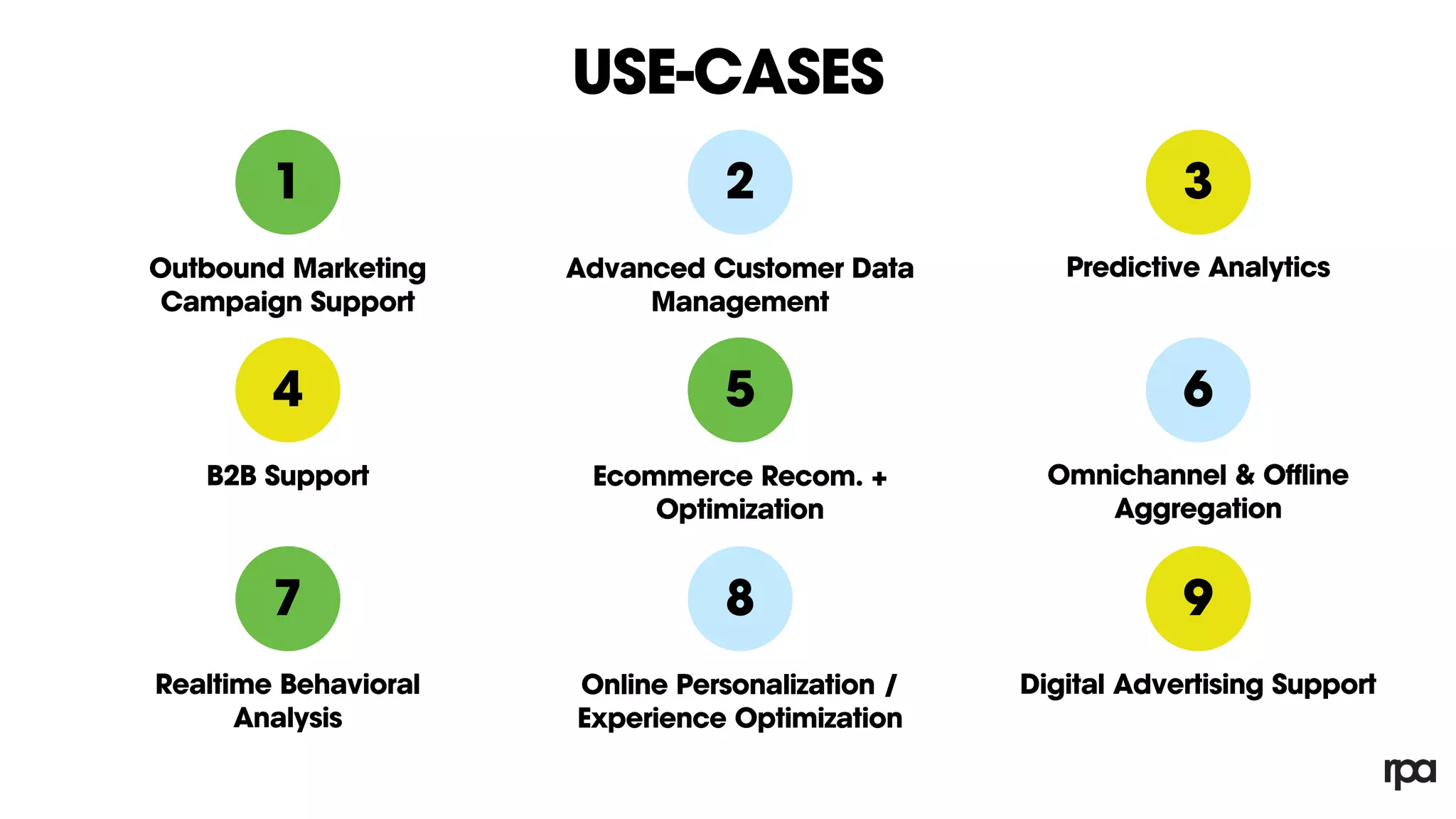
USE-CASES
1
Outbound Marketing
Campaign Support
2
Advanced Customer Data
Management
3
Predictive Analytics
4
B2B Support
5
Ecommerce Recom. +
Optimization
6
Omnichannel & Offline
Aggregation
7
Realtime Behavioral
Analysis
8
Online Personalization /
Experience Optimization
9
Digital Advertising Support
23
Let’s talk business
ROI ON CDPs
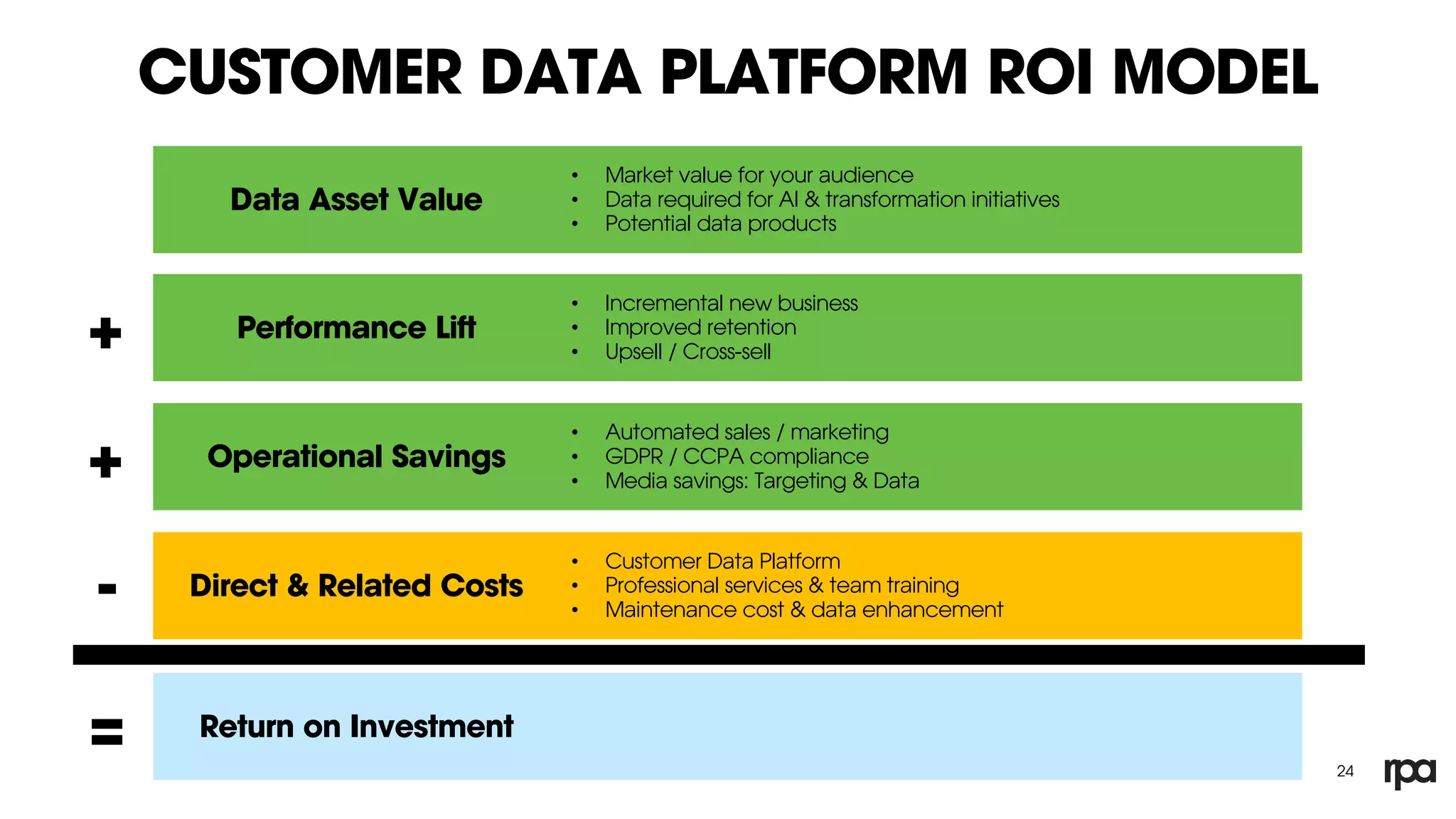
In order to calculate the RoI of a Customer Data Platform, businesses need to look at various costs & benefits that a CDP can bring to the table. First,
understanding the value of your audience profile is important. This data enable businesses make better decisions leveraging data. CDP allows you to
create better initiatives, such as advanced segmentation, better media buying choices, personalization that better meets customer needs, enabling
automation, and many others. It is important to realize cost savings attributable to these functions.
CUSTOMER DATA PLATFORM ROI MODEL
24
• Market value for your audience
• Data required for AI & transformation initiatives
• Potential data products
Data Asset Value
• Incremental new business
• Improved retention
• Upsell / Cross-sell
Performance Lift
• Automated sales / marketing
• GDPR / CCPA compliance
• Media savings: Targeting & Data
Operational Savings
• Customer Data Platform
• Professional services & team training
• Maintenance cost & data enhancement
Direct & Related Costs
Return on Investment
+
+
-
=
25
Sooo… Does your organization
need a CDP?
ASK THE RIGHT QUESTIONS
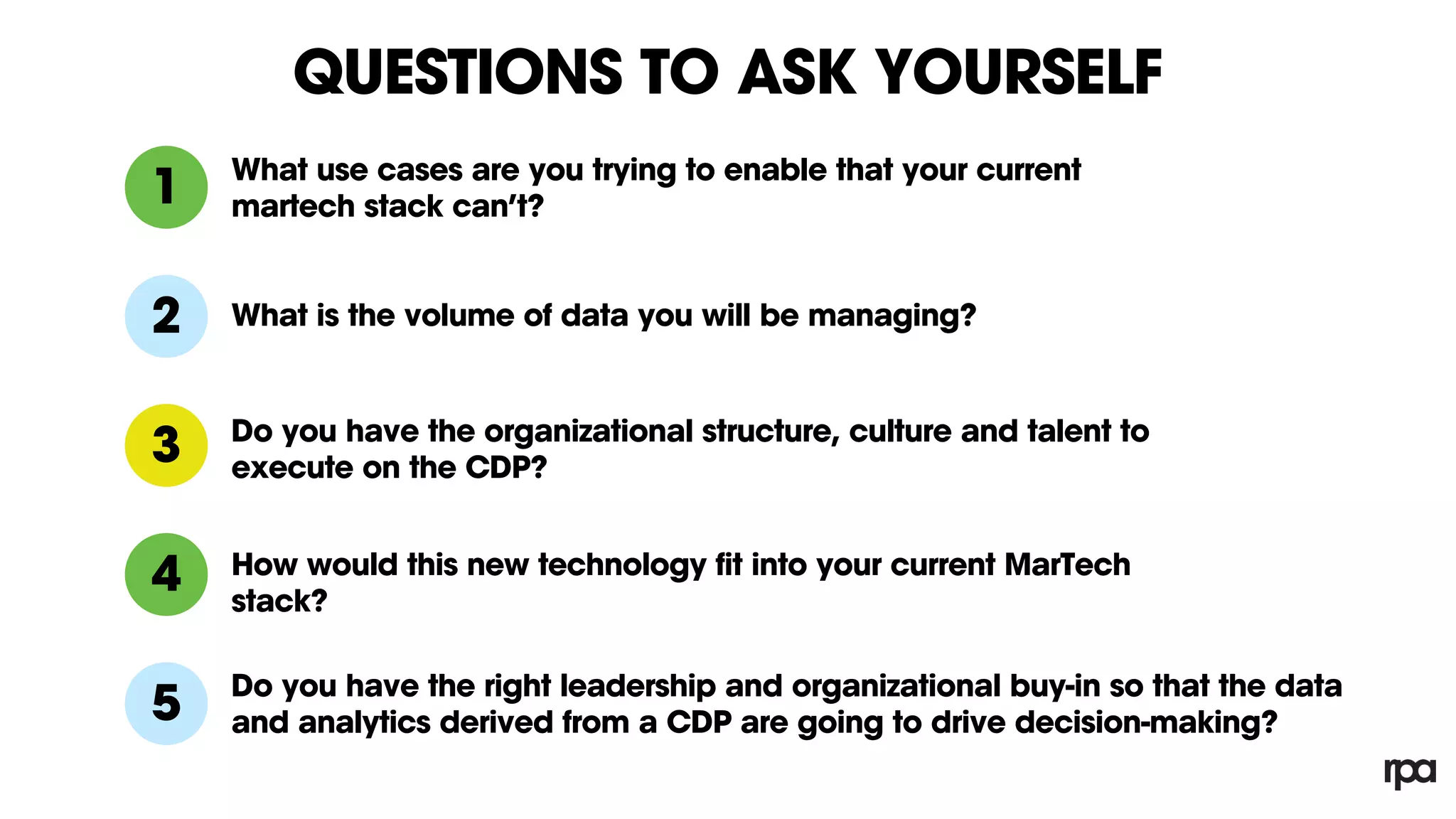
QUESTIONS TO ASK YOURSELF
1
2
What use cases are you trying to enable that your current
martech stack can’t?
3
What is the volume of data you will be managing?
Do you have the organizational structure, culture and talent to
execute on the CDP?
4 How would this new technology fit into your current MarTech
stack?
Do you have the right leadership and organizational buy-in so that the data
and analytics derived from a CDP are going to drive decision-making?5
27
I would like to learn more…
RESOURCES
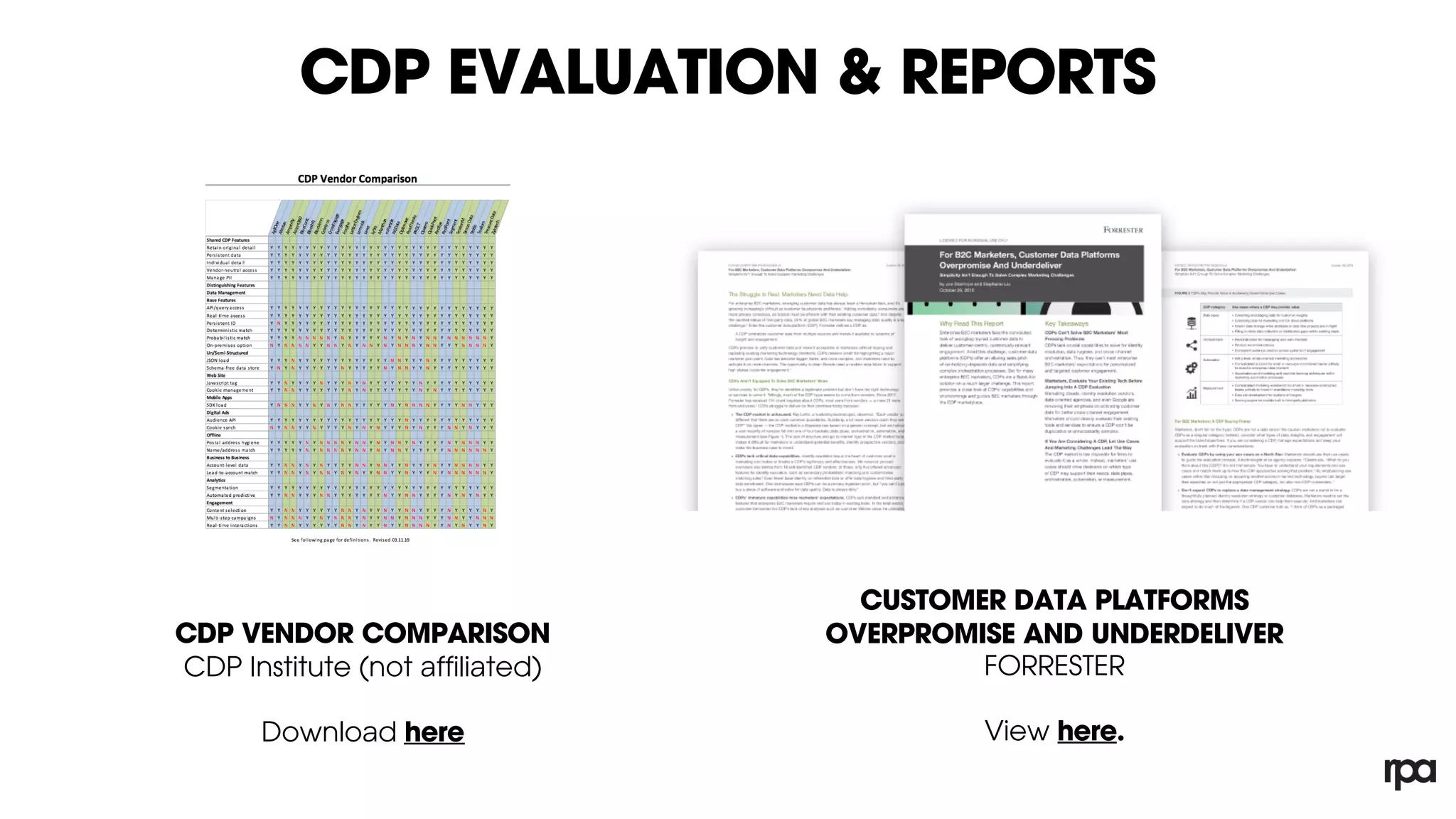
CDP EVALUATION & REPORTS
CDP VENDOR COMPARISON
CDP Institute (not affiliated)
Download here
CUSTOMER DATA PLATFORMS
OVERPROMISE AND UNDERDELIVER
FORRESTER
View here.
CDP Evaluation Resources – CDP Institute:
Customer Data Platform systems vary greatly in the features they provide. This document
helps buyers to identify systems whose features match their needs. It does this by showing
which vendors provide features that support specific use cases. We assume buyers have
identified their use cases in advance.
This report does not rank systems. More features isn’t better. Unnecessary features add cost
and complexity without creating value. If you use this report to rank systems, assign one
point for each Yes on a feature you need and subtract one point for each Yes on features you
don’t need.
The definitions of each item are presented in the section following the table. “Yes” answers
mean only that the system meets the minimum requirement in that definition. This may not
be adequate for a particular buyer’s needs. Buyers will need to explore the details of
individual systems to find out.
The table is divided into two major sections.
Shared CDP Features lists features present in all CDP systems. This section is included to
provide a context and to help distinguish CDPs from other types of systems that buyers may
be considering.
Distinguishing Features lists features present in some CDPs that support specific use cases.
This group is divided into Data Management, Analytics, and Engagement features. The
expectation is the readers of this document will understand which of these features relate to
their needs.
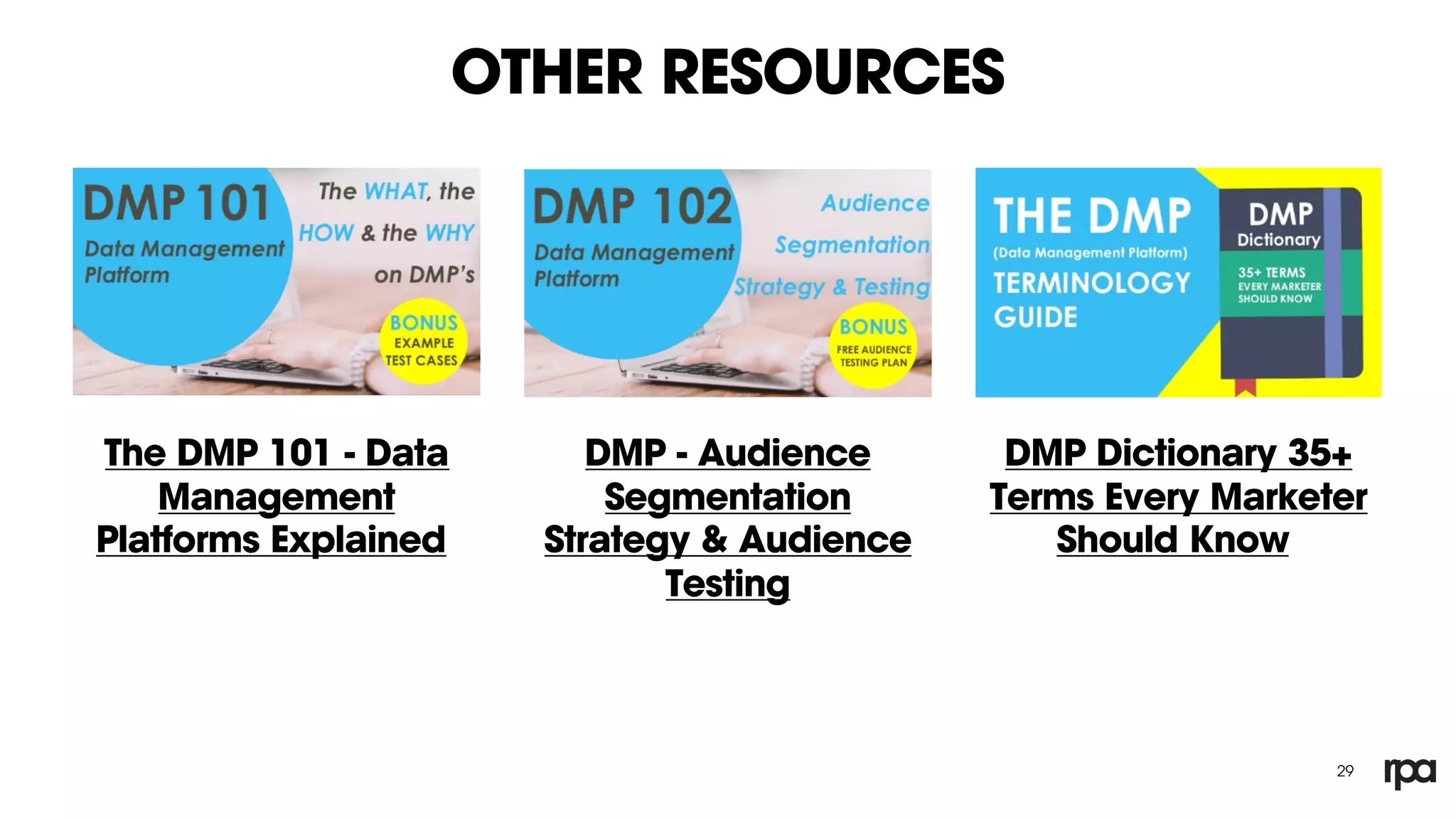
OTHER RESOURCES
29
DMP Dictionary 35+
Terms Every Marketer
Should Know
DMP - Audience
Segmentation
Strategy & Audience
Testing
The DMP 101 - Data
Management
Platforms Explained
THANK YOU
30
@eddywiEddy Widerker

CDP - 101 Everything you need to know about Customer Data Platforms

  • 1.
    Everything you need toknow about Customer Data Platforms CDP101 BONUS CDP, DMP & CRM Comparison & Other Resources
  • 2.
    2 First things first, let'stalk about data! DATA 101
  • 3.
    TYPES OF DATA 3 2ndPARTY DATA Data owned by a partner but shared with your organization. 1ST PARTY DATA Data collected and owned by your organization. PII: Personal Identifiable Information such as name, address, email etc. 3rd PARTY DATA Data generated and owned by other parties/vendors. Anonymous: No personal information. Only cookie or device ID.
  • 4.
    DATA EXAMPLES 4 1st 2nd 3rd Web Offline CRM Sales Other Demo Other Ent. In-Market Travel 1stA 1st B DATA GENERATED & OWNED BY ORGANIZATION DATA SETS TRADED BETWEEN PARTNERS DATA GENERATED & OWNED BY OTHER PARTIES/VENDORS
  • 5.
    DATA EXAMPLES 1st Web Offline CRM Sales Other DATA GENERATED& OWNED BY ORGANIZATION A CDP mainly operates on Personal Identifiable Data (PII) which is 1st party data.
  • 6.
    6 Now, let’s learnabout the Customer Data Platform CDP. CDP 101
  • 7.
    WHAT IS ACUSTOMER DATA PLATFORM? “A customer data platform is a marketer-managed system that creates a persistent, unified customer database that is accessible to other systems” 7 David Raab, Founder of the Customer Data Platform (CDP) Institute
  • 8.
    WHAT IS ACUSTOMER DATA PLATFORM? “A customer data platform is a marketer-managed system that creates a persistent, unified customer database that is accessible to other systems” 8 Unlike other systems, CDPs are usually managed by marketers which means the business users are in control.
  • 9.
    WHAT IS ACUSTOMER DATA PLATFORM? “A customer data platform is a marketer-managed system that creates a persistent, unified customer database that is accessible to other systems” 9 A CDP creates an actual database of its own, rather than accessing information that is stored in other systems or acting as a hub that transfers data from one system to another.
  • 10.
    WHAT IS ACUSTOMER DATA PLATFORM? “A customer data platform is a marketer-managed system that creates a persistent, unified customer database that is accessible to other systems” 10 CDP connects all data related to the same customer to present a Single Customer View
  • 11.
    WHAT IS ACUSTOMER DATA PLATFORM? “A customer data platform is a marketer-managed system that creates a persistent, unified customer database that is accessible to other systems” 11 A CDP data base is organized around people rather than objects like web pages or products. Users are stored on an individual level with personal identifiable information (PII) like name, phone number account number etc.
  • 12.
    WHAT IS ACUSTOMER DATA PLATFORM? “A customer data platform is a marketer-managed system that creates a persistent, unified customer database that is accessible to other systems” 12 A CDP can share its data with other systems via API (Application Program Interface) or database queries.
  • 13.
    Combining all thedata in one place is key to efficient marketing. While the information is generally available, it is usually scattered across multiple silos—databases, platforms, and systems that store a company’s data but aren’t connected with one another. WHAT PROBLEM IS A CUSTOMER DATA PLATFORM SOLVING? Data Silos Not Connected Customer level data is generally available, but in many instances scattered across multiple data silos. Combining all the data in one place is key to efficient, consistent and more personal marketing CRM A/B Testing Analytics Social Media Content Personalization
  • 14.
    WHY IS ITIMPORTANT TO GATHER SO MUCH INFORMATION? CRM A/B Testing Analytics Social Media Content Personalization Storage Customer records are stored on a user level (PII). Unification Customer interaction across platforms e.g. Web, App or CRM system can be synced and unified. Enrichment Customer records can be enriched via 3rd party data providers for a richer profile of an individual. STORE / UNIFY / ENRICH
  • 15.
    15 Now, let’s learnabout the differences across multiple systems. CDP vs. DMP vs. CRM
  • 16.
    DMP, CDP &CRM COMPARISON Data Management Platforms (DMP) The primary use is to aggregate and organize 1st 2nd and 3rd party data, which typically involves the use of cookies, device ID’s or User IDs in an anonymized environment (non PII). Customer Data Platforms (CDP) The primary use is first-party data, based on real customer identities such as PII. Information in a CDP can be enriched with third- party data. However, in many instances it is used by marketers to nurture the existing customer base. Customer Relationship Management (CRM) CRM is similar to a CDP but is not able to handle multiple data types. It requires manual maintenance and is not easily scalable for many CDP use cases such as content personalization.
  • 17.
    DMP, CDP &CRM COMPARISON Data Management Platforms (DMP) • Focus on communicating to unknown audience • They typically leverage third-party data, with first- party data acting as an additional source of information. • Designed to improve display ad targeting. Customer Data Platforms (CDP) • Focus on on communicating to known audience • Primarily use PII and first- party data. • Leveraged to keep user data in one place, while also accessing information for personalized marketing (e.g. web, ads, email, mobile). Customer Relationship Management (CRM) • CRMs are much like CDPs, but do not handle multiple data types. • Use PII and first-party data. • Usually require salespeople to manage its accounts.
  • 18.
    18 DMP CDP CRM AnonymizedIDs 3rd Party Data Taxonomies Agency Users Temp. Storage ID linkage Cross-Channel Multiple Data Types APIs (in/out) Integration Unique IDs Flexible Structure Marketer Users Known PII Customer Data Sales Team Persistent Storage Single Data Type DMP, CDP & CRM COMPARISON
  • 19.
    What type ofdata is housed in each of the systems? The type of data that is captured and housed in a Data Management Platform (DMP), a Customer Data Platform (CDP) and a Customer Relationship Management System vary drastically. This is a simplified view of the type of data each system captures. DMP View CDP View A LOOK AT THE DATA CRM View Alex Smith Age: 48 Marital Status: Divorced 2 years ago, 2 children age 10 & 17 Location: ABC Street, Los Angeles, CA, USA Opened email: 3/12/2019 Visited Website: 02/28/2019 Browser: Firefox Referred From: Brand Instagram Profile Occupation: Running a small business in child nutrition Postal Code: XXXXXX Email: AlexsmithXYZ@gmail.com Phone Number: 323.209.1290 Interest in: Child nutrition products, pop and rock music, street fashion, photography, local music and art. Alex Smith Opened email: 3/12/2019 Browser: Firefox Email: AlexsmithXYZ@gmail.com Phone Number: 323.209.1290 Anonymous User Age: 30-35, 45-45 Marital Status: Divorced, 1-3 Kids Location: Los Angeles, CA, USA Opened email: Yes, in the past 30 Days Visited Website: Yes, in the past 30 Days Interest in: Child nutrition products, pop and rock music.
  • 20.
    20 Now, let’s talkuse-cases. CDP IN ACTION
  • 21.
    Despite the many capabilitiesand functions of a Customer Data Platform, the premise on which they work is fairly simple. They function by pulling data from multiple sources, cleaning it, and re-structuring it in a way that makes it available to other marketing systems for personalized marketing activities. Depending upon the capabilities of a specific platform, they may also have additional functions such as advanced data analytics, content marketing, predictive capabilities, etc. CDP DATA FLOW Image source: Elementsolutions.com
  • 22.
    USE-CASES 1 Outbound Marketing Campaign Support 2 AdvancedCustomer Data Management 3 Predictive Analytics 4 B2B Support 5 Ecommerce Recom. + Optimization 6 Omnichannel & Offline Aggregation 7 Realtime Behavioral Analysis 8 Online Personalization / Experience Optimization 9 Digital Advertising Support
  • 23.
  • 24.
    In order tocalculate the RoI of a Customer Data Platform, businesses need to look at various costs & benefits that a CDP can bring to the table. First, understanding the value of your audience profile is important. This data enable businesses make better decisions leveraging data. CDP allows you to create better initiatives, such as advanced segmentation, better media buying choices, personalization that better meets customer needs, enabling automation, and many others. It is important to realize cost savings attributable to these functions. CUSTOMER DATA PLATFORM ROI MODEL 24 • Market value for your audience • Data required for AI & transformation initiatives • Potential data products Data Asset Value • Incremental new business • Improved retention • Upsell / Cross-sell Performance Lift • Automated sales / marketing • GDPR / CCPA compliance • Media savings: Targeting & Data Operational Savings • Customer Data Platform • Professional services & team training • Maintenance cost & data enhancement Direct & Related Costs Return on Investment + + - =
  • 25.
    25 Sooo… Does yourorganization need a CDP? ASK THE RIGHT QUESTIONS
  • 26.
    QUESTIONS TO ASKYOURSELF 1 2 What use cases are you trying to enable that your current martech stack can’t? 3 What is the volume of data you will be managing? Do you have the organizational structure, culture and talent to execute on the CDP? 4 How would this new technology fit into your current MarTech stack? Do you have the right leadership and organizational buy-in so that the data and analytics derived from a CDP are going to drive decision-making?5
  • 27.
    27 I would liketo learn more… RESOURCES
  • 28.
    CDP EVALUATION &REPORTS CDP VENDOR COMPARISON CDP Institute (not affiliated) Download here CUSTOMER DATA PLATFORMS OVERPROMISE AND UNDERDELIVER FORRESTER View here. CDP Evaluation Resources – CDP Institute: Customer Data Platform systems vary greatly in the features they provide. This document helps buyers to identify systems whose features match their needs. It does this by showing which vendors provide features that support specific use cases. We assume buyers have identified their use cases in advance. This report does not rank systems. More features isn’t better. Unnecessary features add cost and complexity without creating value. If you use this report to rank systems, assign one point for each Yes on a feature you need and subtract one point for each Yes on features you don’t need. The definitions of each item are presented in the section following the table. “Yes” answers mean only that the system meets the minimum requirement in that definition. This may not be adequate for a particular buyer’s needs. Buyers will need to explore the details of individual systems to find out. The table is divided into two major sections. Shared CDP Features lists features present in all CDP systems. This section is included to provide a context and to help distinguish CDPs from other types of systems that buyers may be considering. Distinguishing Features lists features present in some CDPs that support specific use cases. This group is divided into Data Management, Analytics, and Engagement features. The expectation is the readers of this document will understand which of these features relate to their needs.
  • 29.
    OTHER RESOURCES 29 DMP Dictionary35+ Terms Every Marketer Should Know DMP - Audience Segmentation Strategy & Audience Testing The DMP 101 - Data Management Platforms Explained
  • 30.