Digital Ecosystems and
Dynamic Competition
IEEE ICTE Dynamic Competition Keynote and Round Table
10 October, 2023
David J. Teece
dteece@thinkbrg.com
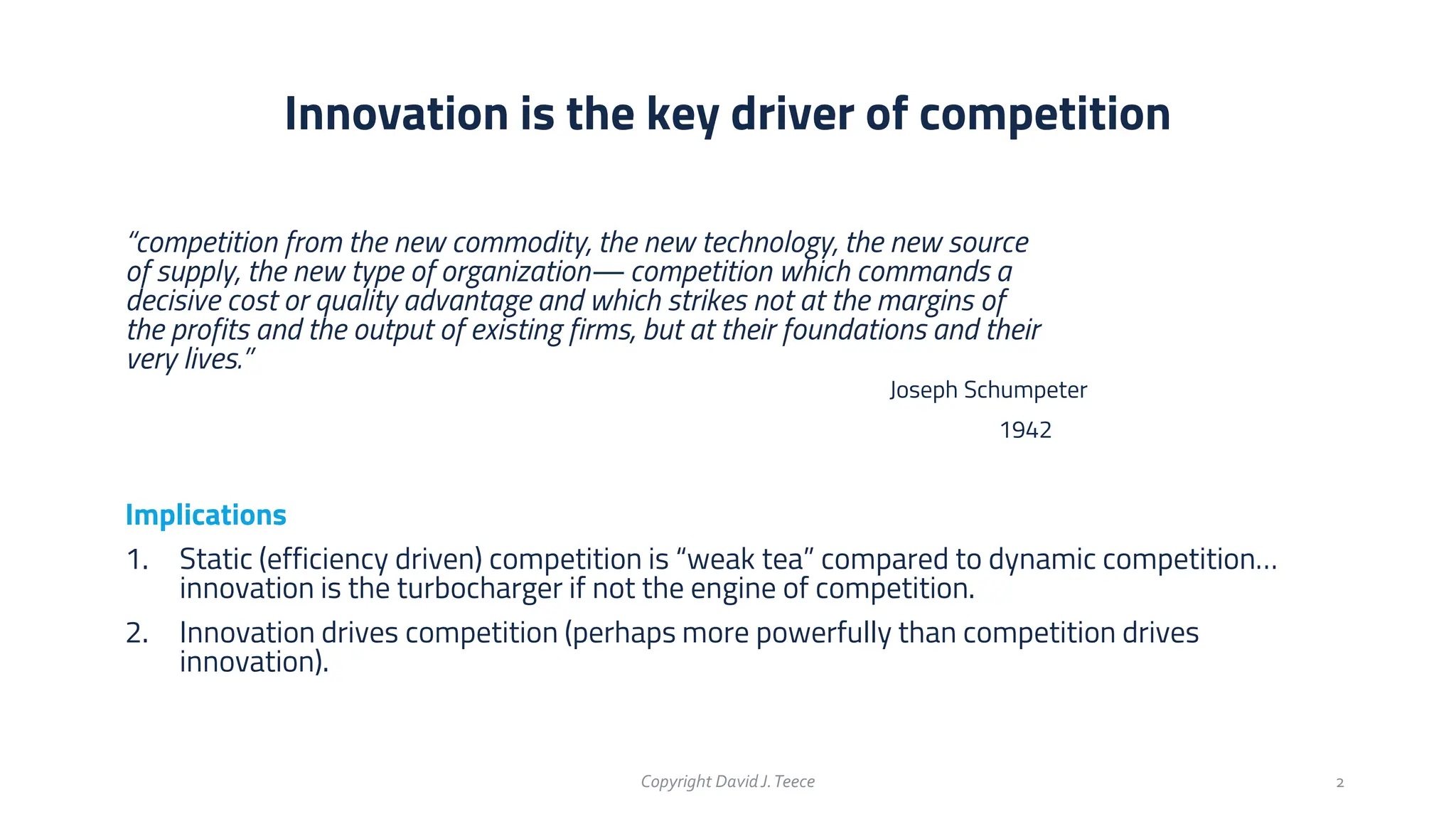
“competition from the new commodity, the new technology, the new source
of supply, the new type of organization— competition which commands a
decisive cost or quality advantage and which strikes not at the margins of
the profits and the output of existing firms, but at their foundations and their
very lives.”
Joseph Schumpeter
1942
Implications
1. Static (efficiency driven) competition is “weak tea” compared to dynamic competition…
innovation is the turbocharger if not the engine of competition.
2. Innovation drives competition (perhaps more powerfully than competition drives
innovation).
Innovation is the key driver of competition
Copyright DavidJ.Teece 2
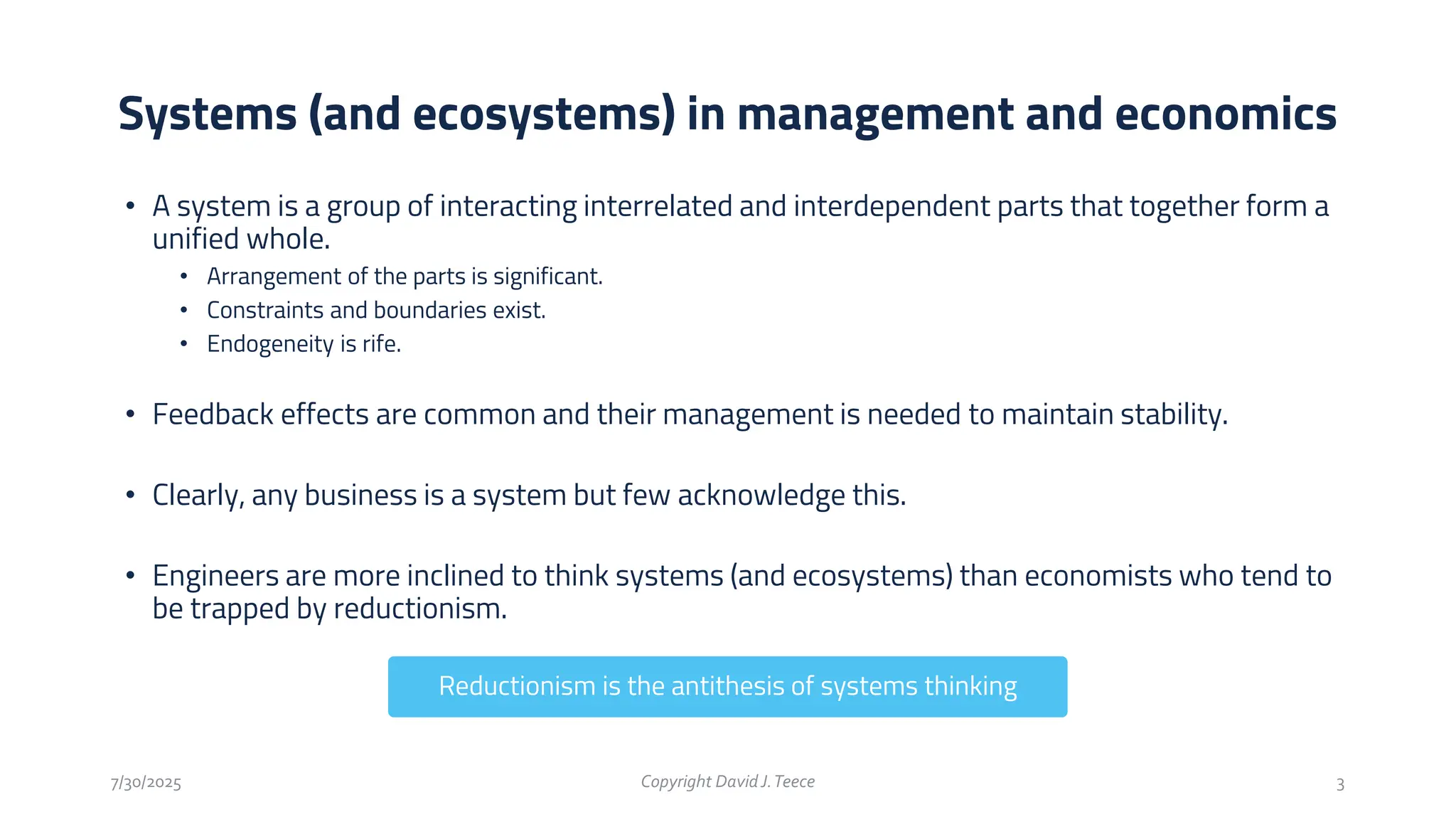
• A system is a group of interacting interrelated and interdependent parts that together form a
unified whole.
• Arrangement of the parts is significant.
• Constraints and boundaries exist.
• Endogeneity is rife.
• Feedback effects are common and their management is needed to maintain stability.
• Clearly, any business is a system but few acknowledge this.
• Engineers are more inclined to think systems (and ecosystems) than economists who tend to
be trapped by reductionism.
Systems (and ecosystems) in management and economics
7/30/2025 Copyright DavidJ.Teece 3
Reductionism is the antithesis of systems thinking
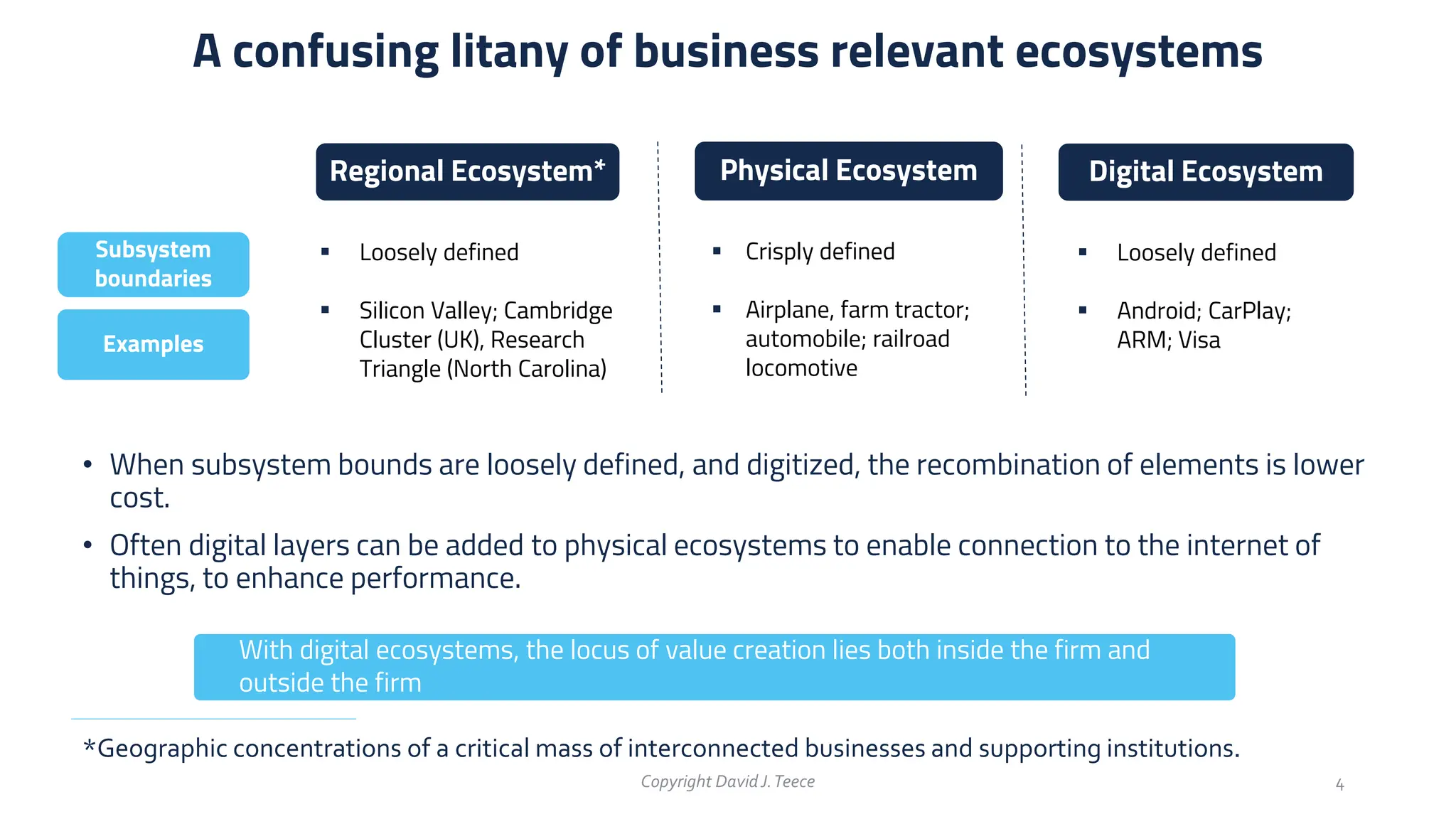
 Crisply defined
 Airplane, farm tractor;
automobile; railroad
locomotive
Physical Ecosystem
A confusing litany of business relevant ecosystems
Examples
Subsystem
boundaries
Digital Ecosystem
 Loosely defined
 Android; CarPlay;
ARM; Visa
Copyright DavidJ.Teece 4
• When subsystem bounds are loosely defined, and digitized, the recombination of elements is lower
cost.
• Often digital layers can be added to physical ecosystems to enable connection to the internet of
things, to enhance performance.
Regional Ecosystem*
 Loosely defined
 Silicon Valley; Cambridge
Cluster (UK), Research
Triangle (North Carolina)
*Geographic concentrations of a critical mass of interconnected businesses and supporting institutions.
With digital ecosystems, the locus of value creation lies both inside the firm and
outside the firm
• Industrial innovation typically involves products or process development and involves both
radical and continuous improvement. However, it often leaves the business model unchanged.
There are exception (railroads, electricity).
• Digital innovation refers to the development of digital products, services, and business
models. It began in earnest in the 1970’s (e.g., digital telecommunications switching).
• Almost always enables, and eventually (if not initially), involves a reengineering of the firm’s business model.
Innovation is not always… and historically has not been…
digital (systems) in nature
Copyright DavidJ.Teece 5
• Second industrial revolution: The subsequent development of national, continental, and
international communication (and transport) via the telegraph (and the railroad) changed the
locus of economic organization and led to large vertically integrated firms, some of them
global in scope e.g., General Motors, Ford, GE.
• Digital revolution: With ecosystems, firms can create digital platforms, match buyers and
sellers, and harness a global networks of partners who can anonymously, on top of a core set
of platform assets, create valuable products and services.
The digital revolution has unique organizational (and
therefore competitive) ramifications
Copyright DavidJ.Teece 6
Implication: managers are often bamboozled with respect to how to
manage digital (platform) ecosystems… but Steve Jobs was clear eyed
about it.
• It is multidimensional and must take into account the interests of complementors and others.
• An enterprise strategy must take into account (1) own capabilities (2) capabilities of complementors and
supplier (3) capabilities of competitors and their complementors and suppliers.
• Any single business enterprise is unlikely to have all the capabilities needed to compete.
Modular open system architectures enable them to access the capabilities of others.
• Stand alone enterprises using their own proprietary design rules may compete with firms
using open system architecture e.g., Apple v Google/Samsung.
Within ecosystems, strategy formulation is very different
Copyright DavidJ.Teece 7
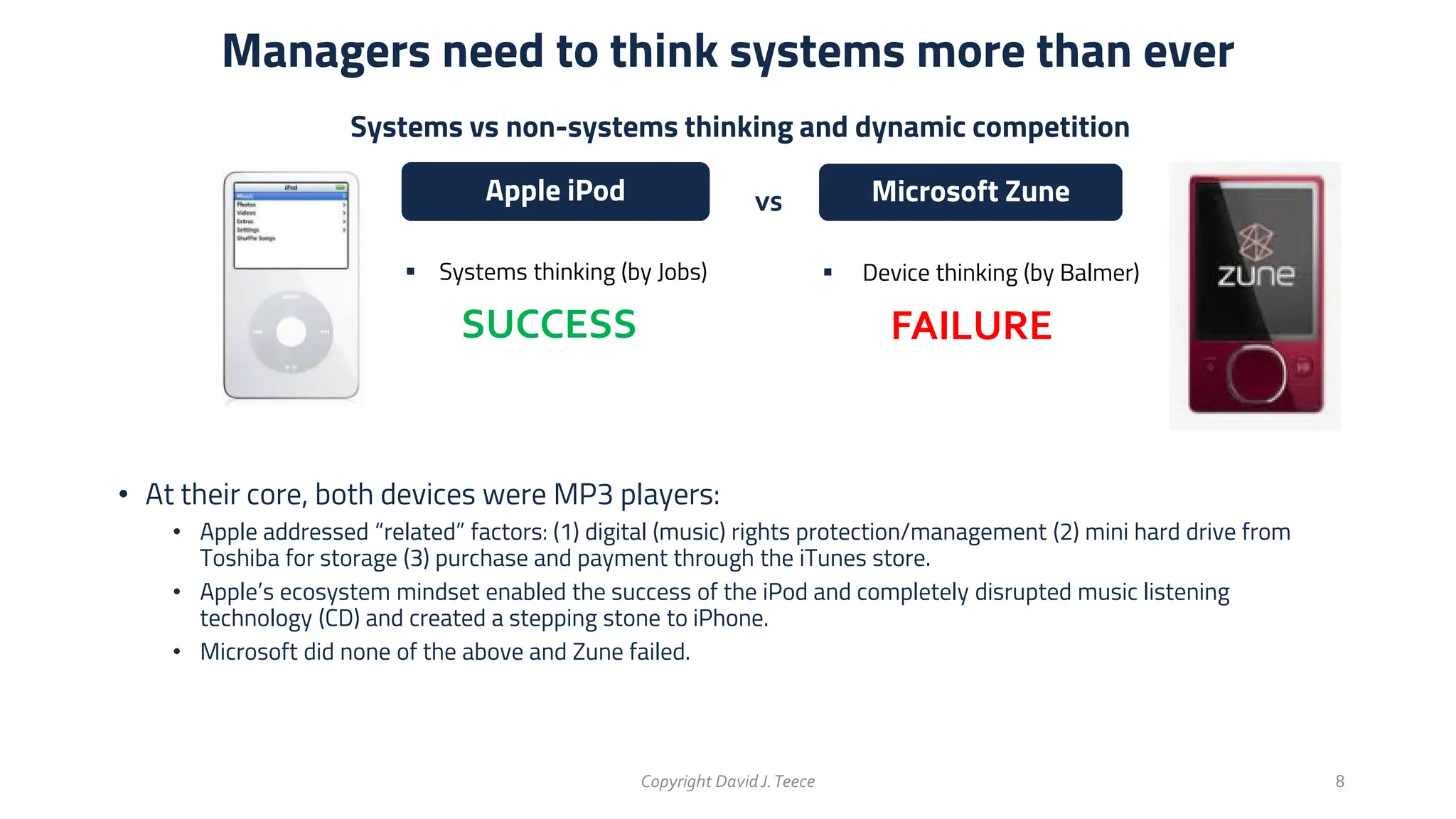
 Systems thinking (by Jobs)
Apple iPod
Managers need to think systems more than ever
Copyright DavidJ.Teece 8
• At their core, both devices were MP3 players:
• Apple addressed “related” factors: (1) digital (music) rights protection/management (2) mini hard drive from
Toshiba for storage (3) purchase and payment through the iTunes store.
• Apple’s ecosystem mindset enabled the success of the iPod and completely disrupted music listening
technology (CD) and created a stepping stone to iPhone.
• Microsoft did none of the above and Zune failed.
Microsoft Zune
 Device thinking (by Balmer)
vs
Systems vs non-systems thinking and dynamic competition
SUCCESS FAILURE
• Requires holistic thinking/mindset
• The best minds always think holistically (systems view).
• Not easily reduced to hands-on rules and policies
• Loop diagram
• Cause and effect maps
• Persuasion and incentives must work because the authority structure over an
ecosystem/platform is relatively weak.
The management of digital ecosystems is always challenging
Copyright DavidJ.Teece 9
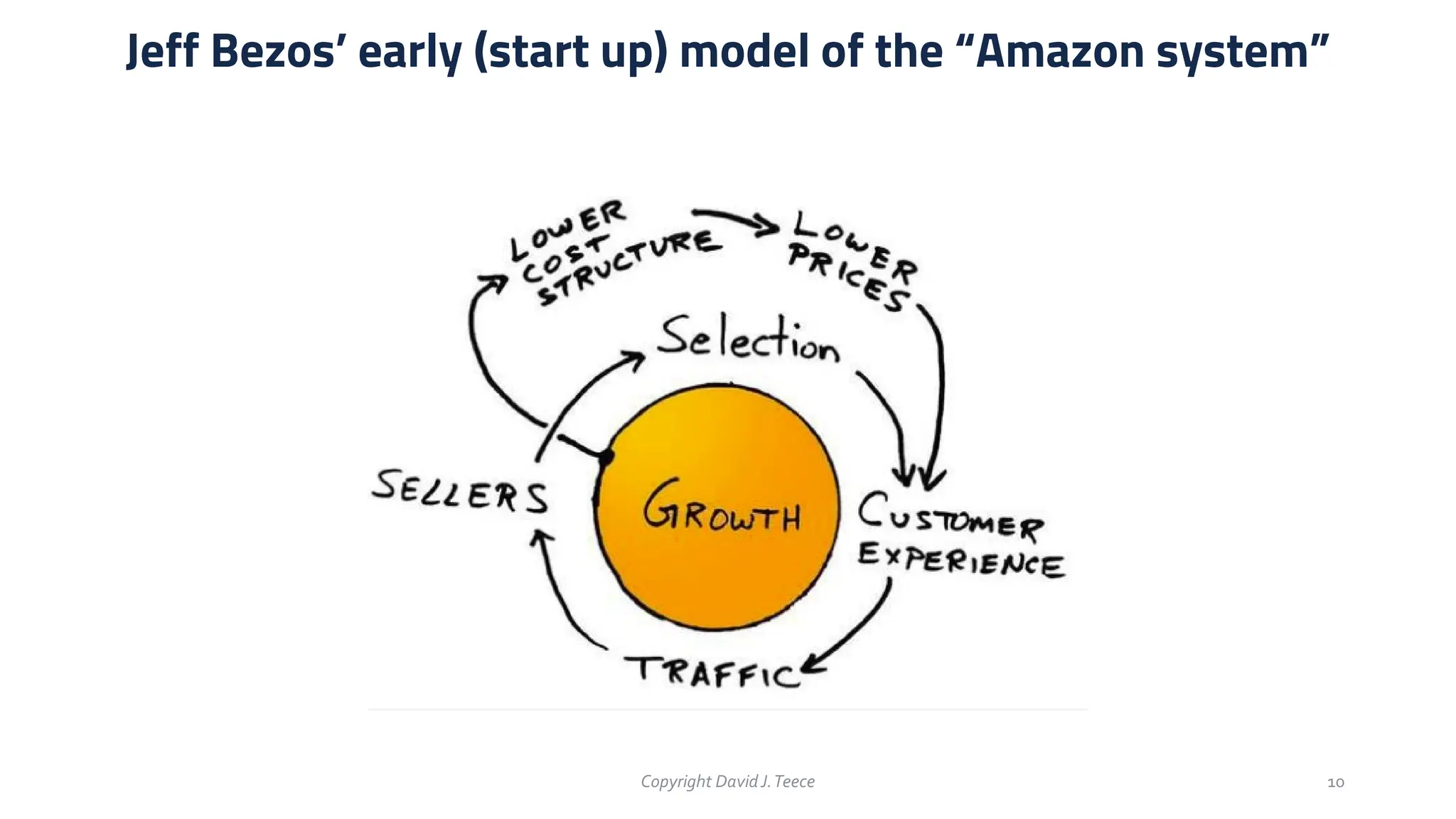
Jeff Bezos’ early (start up) model of the “Amazon system”
Copyright DavidJ.Teece 10
• Great companies, not just digital platform companies, pay attention to the success of their
complementors too (e.g., Boeing, Walmart, WL Gore, Cosco) sometimes by creating tools,
services, and technologies that other members of the ecosystems can use.
• Good platform leaders focus on and assist those companies/organizations/institutions that
can most help shape their future.
In a deeply cospecialized ecosystem, the success of one
depends on the success of all
Copyright DavidJ.Teece 11
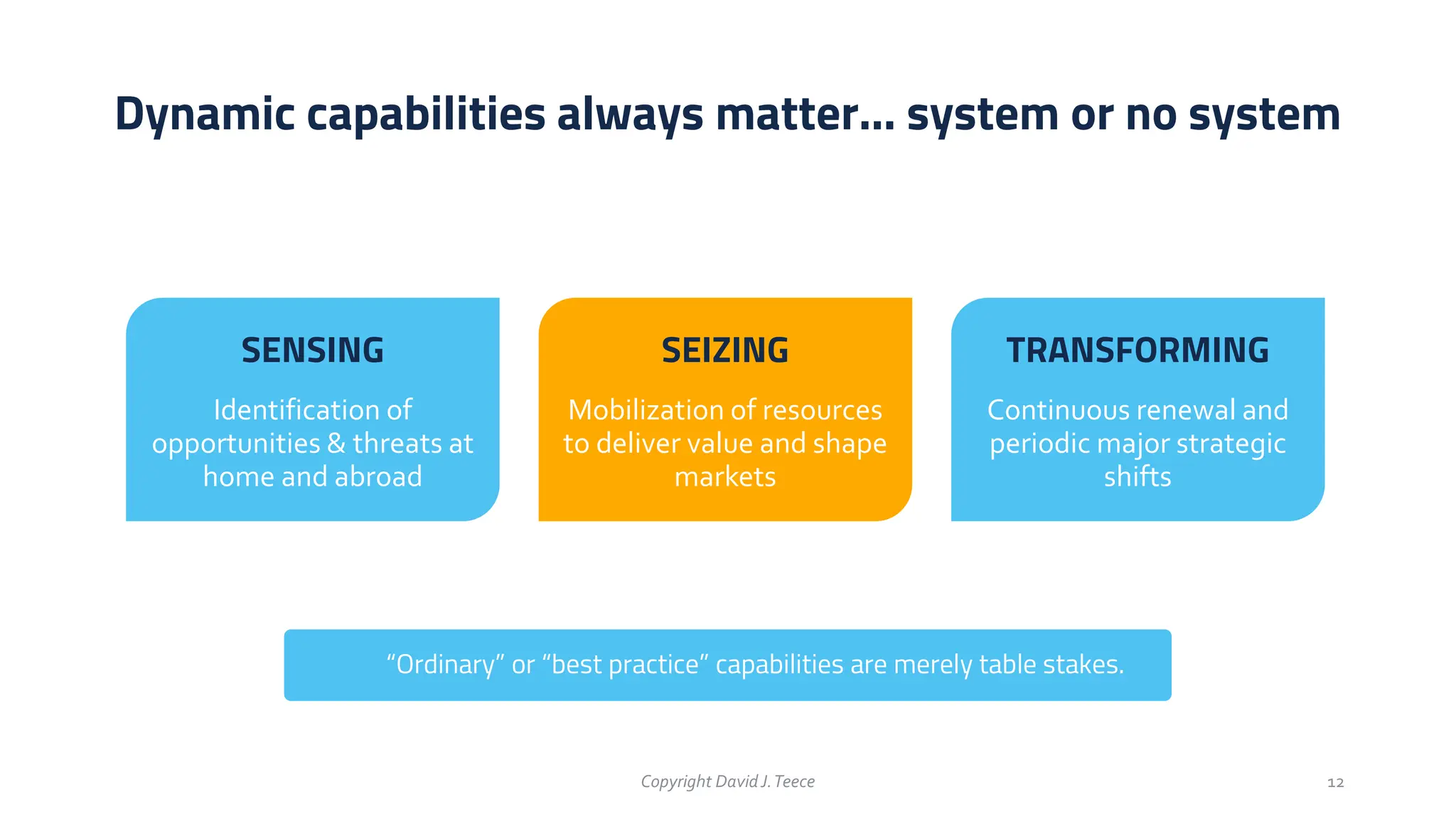
Dynamic capabilities always matter… system or no system
Copyright DavidJ.Teece 12
SENSING
Identification of
opportunities & threats at
home and abroad
SEIZING
Mobilization of resources
to deliver value and shape
markets
TRANSFORMING
Continuous renewal and
periodic major strategic
shifts
“Ordinary” or “best practice” capabilities are merely table stakes.
• Real time data orchestration is a crucial organizational capability.
• The most valuable data lakes combine behavioral customer data with machine data and
environmental data.
Data matters too
Copyright DavidJ.Teece 13
• Digital platforms facilitate:
• Matching*
• Going global (minimultinationals)
• Innovation by (a) own R&D (b) R&D development activities of complementors e.g., millions of apps.
• Lack in/high switching costs possible if (1) multihoming difficult (2) high user switching costs
(due to interoperability).
• Public criticisms of platforms range far and wide (usually amplified by competitors):
• Self preferencing
• Predatory pricing
• Exchanging conduct
With digital platforms, scale, scope, and network effects are
present but not inexorable… management, data, and
ecosystem matter
Copyright DavidJ.Teece 14
*See David Evans, Richard Schmalensee “Matchmakers: The New Economics of Multisided Platforms” Harvard Business
Review Press, 2016
• Allows unprecedented connectivity amongst and across individuals and organizations with
minimal frictions.
• Reduces transactional awkwardness e.g., Airbnb and renting a vacation home.
• Allows resources outside the firm can be monitored and accessed.
• Allows a configuration of value creation and value capture through new business models.
• Generates data that can be generated, stored, shared at low cost.
• Digital assets are reprogrammable allowing:
a) Reduced cospecialization e.g., usage of computer chips
b) The facilitation of broad spectrum competition
Competitive impacts of the digital revolution: summary
Copyright DavidJ.Teece 15
Indicia of robustness
• Return on capita of critical complementors as well as the platform owner itself.
• Number of firms and new entry into ecosystem.
• Survival rate of ecosystem partners.
• Opening up and serving of new niches.
• Gatekeepers providing good governance and promoting ecosystem innovation.
• Gatekeeper rewards: platform share must not be too little or too much.
New welfare criteria for competition policy:
a robust ecosystem
Copyright DavidJ.Teece 16
Robust ecosystems are a good proxy for long
run consumer welfare.
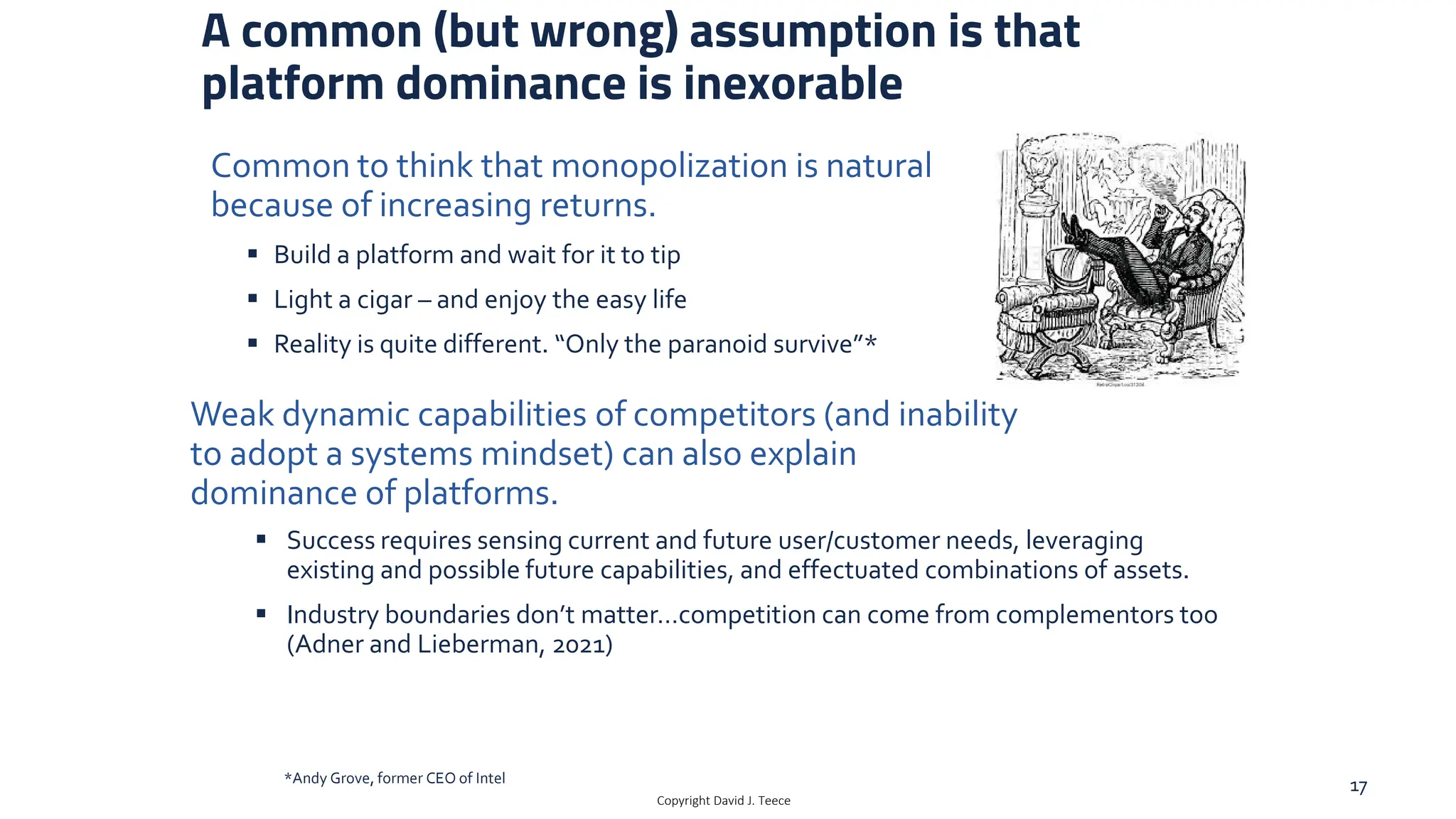
A common (but wrong) assumption is that
platform dominance is inexorable
 Build a platform and wait for it to tip
 Light a cigar – and enjoy the easy life
 Reality is quite different. “Only the paranoid survive”*
Copyright David J. Teece
 Success requires sensing current and future user/customer needs, leveraging
existing and possible future capabilities, and effectuated combinations of assets.
 Industry boundaries don’t matter…competition can come from complementors too
(Adner and Lieberman, 2021)
Weak dynamic capabilities of competitors (and inability
to adopt a systems mindset) can also explain
dominance of platforms.
*Andy Grove, former CEO of Intel 17
Common to think that monopolization is natural
because of increasing returns.
• Excite and Lycos lost the search engine game to Yahoo. Then Yahoo lost out to Google.
• Meta and Google and Apple compete for advertising dollars.
• Google is now challenged by ChaptGPT.
• Incumbency only gives you a seat at the table for the next round of innovation… usually shorter
than the time to initiate and complete an antitrust lawsuit
• There is no automatic “tipping point;” management and capabilities matter.
Platforms (and incumbents) that do not innovate will be
overtaken by others offering something better
Copyright DavidJ.Teece 18
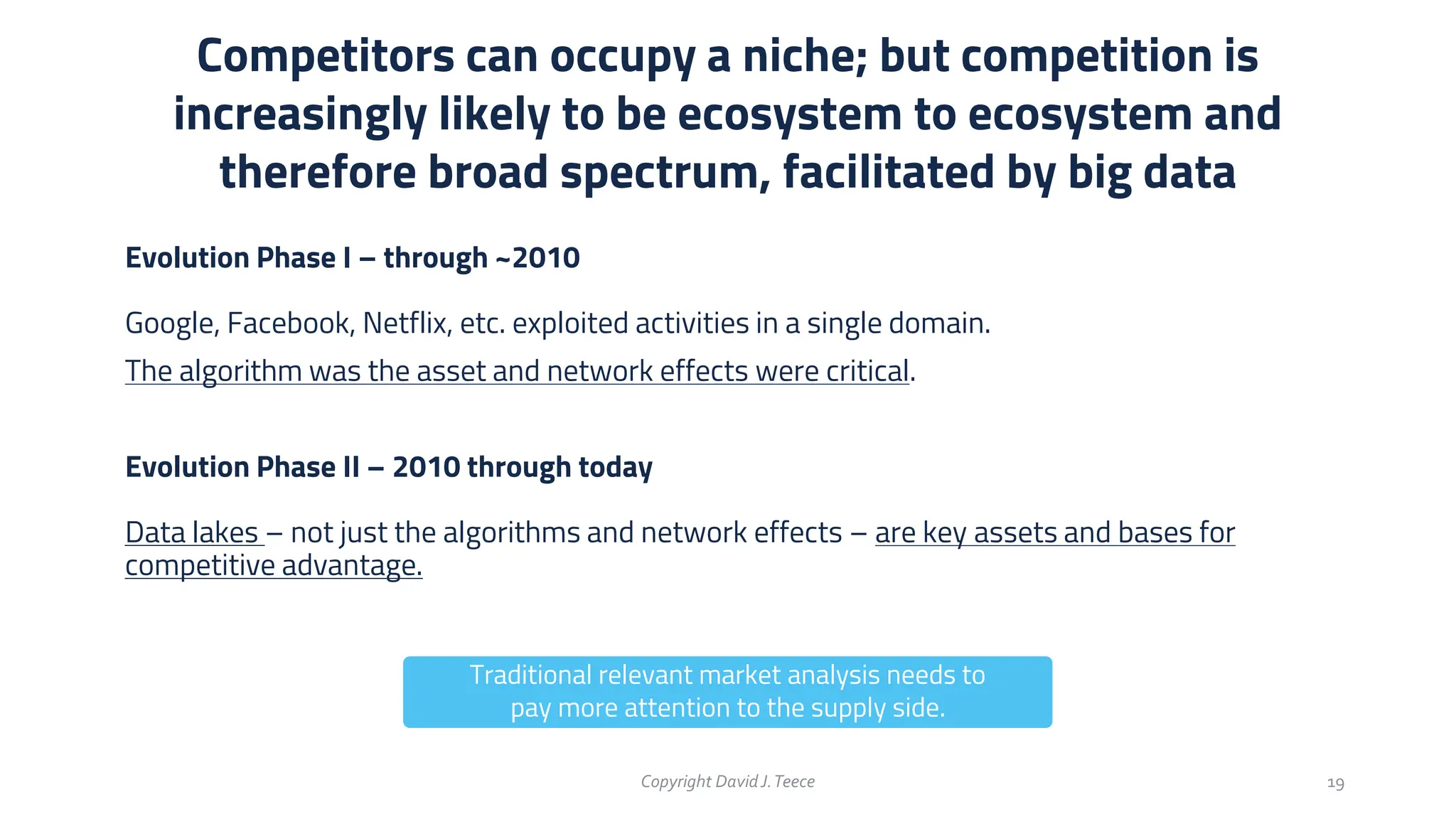
Evolution Phase I – through ~2010
Google, Facebook, Netflix, etc. exploited activities in a single domain.
The algorithm was the asset and network effects were critical.
Evolution Phase II – 2010 through today
Data lakes – not just the algorithms and network effects – are key assets and bases for
competitive advantage.
Competitors can occupy a niche; but competition is
increasingly likely to be ecosystem to ecosystem and
therefore broad spectrum, facilitated by big data
Copyright DavidJ.Teece 19
Traditional relevant market analysis needs to
pay more attention to the supply side.
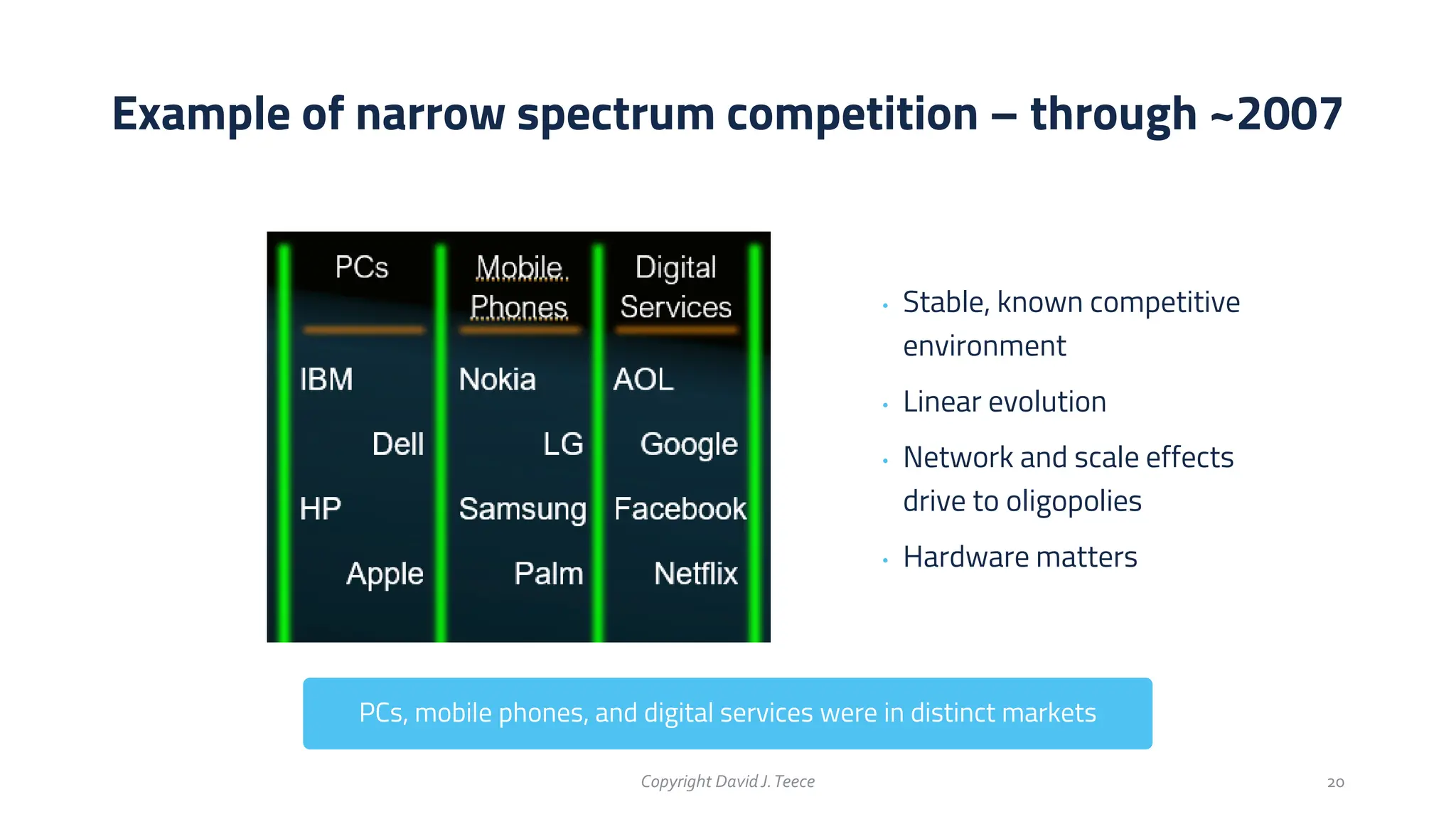
Example of narrow spectrum competition – through ~2007
Copyright DavidJ.Teece 20
• Stable, known competitive
environment
• Linear evolution
• Network and scale effects
drive to oligopolies
• Hardware matters
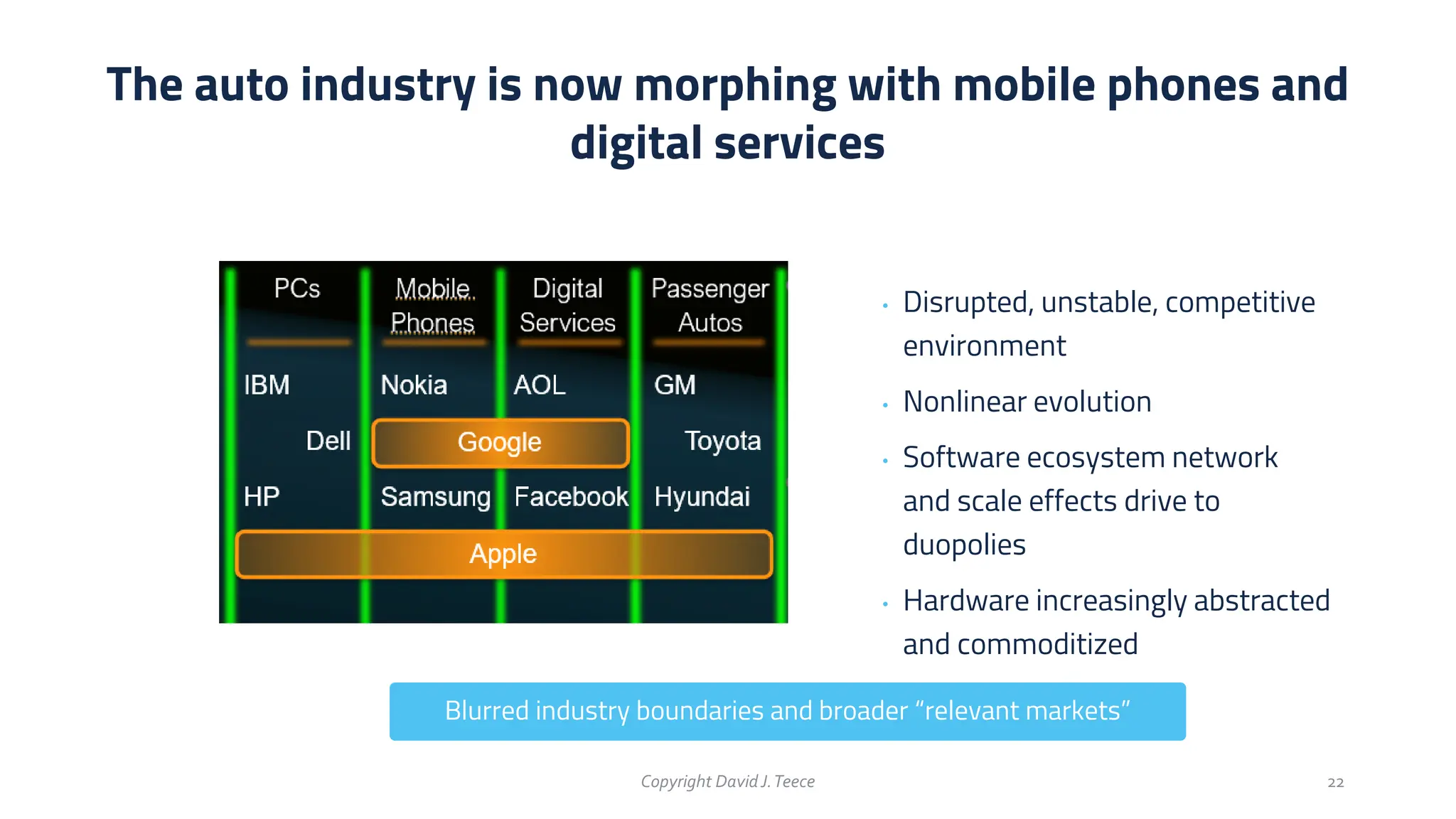
PCs, mobile phones, and digital services were in distinct markets
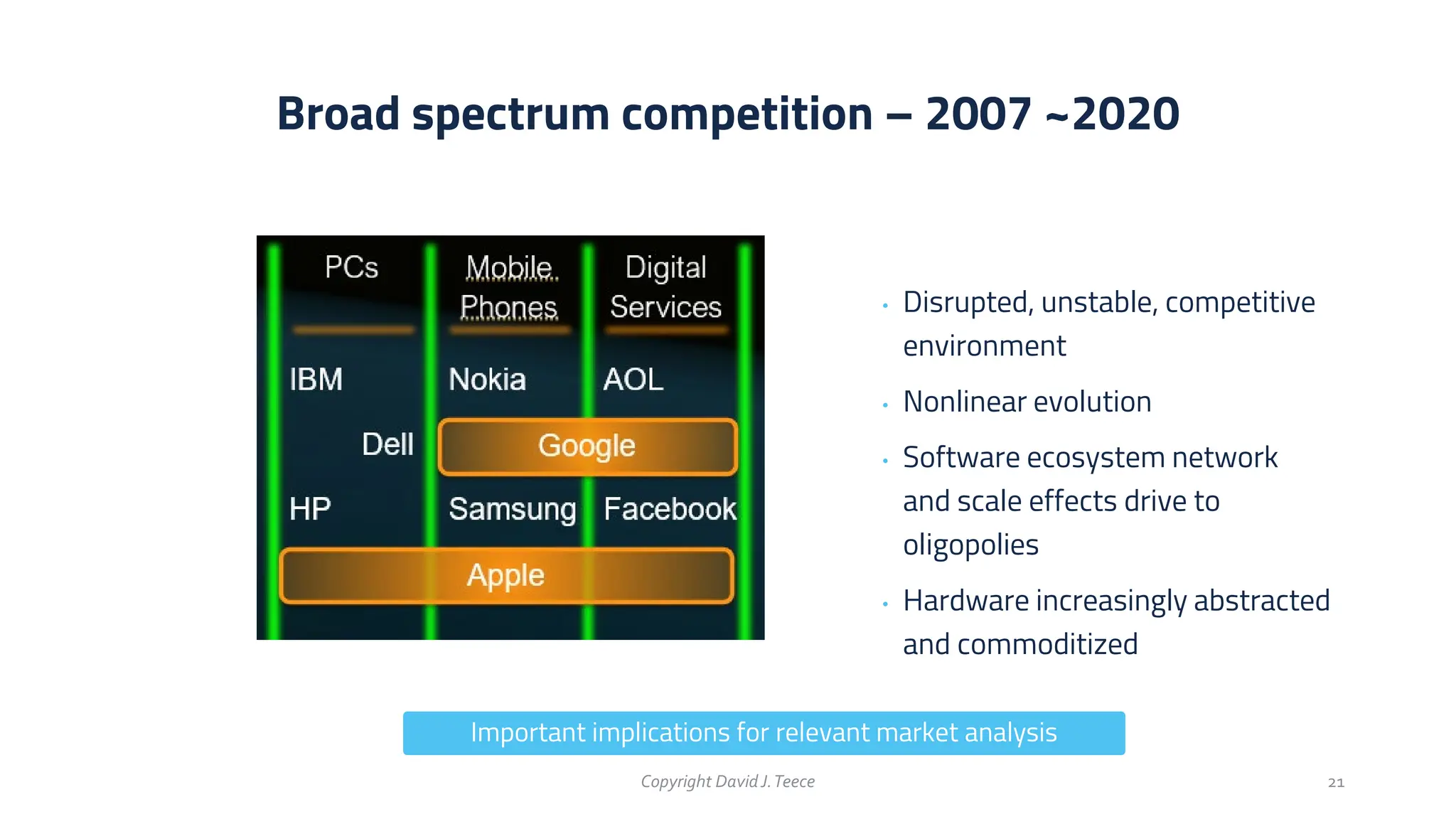
Broad spectrum competition – 2007 ~2020
Copyright DavidJ.Teece 21
• Disrupted, unstable, competitive
environment
• Nonlinear evolution
• Software ecosystem network
and scale effects drive to
oligopolies
• Hardware increasingly abstracted
and commoditized
Important implications for relevant market analysis
The auto industry is now morphing with mobile phones and
digital services
Copyright DavidJ.Teece 22
• Disrupted, unstable, competitive
environment
• Nonlinear evolution
• Software ecosystem network
and scale effects drive to
duopolies
• Hardware increasingly abstracted
and commoditized
Blurred industry boundaries and broader “relevant markets”
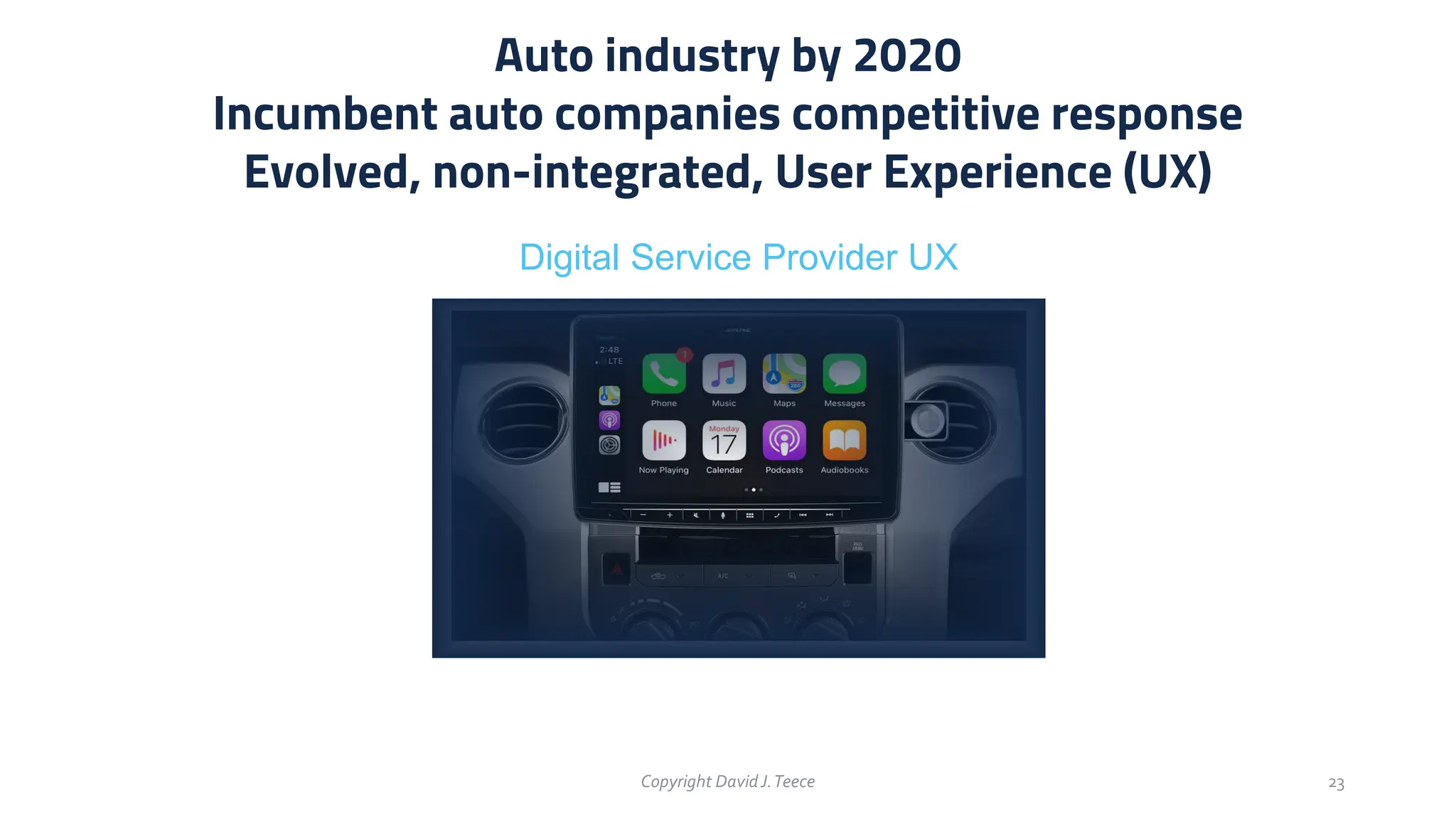
Auto industry by 2020
Incumbent auto companies competitive response
Evolved, non-integrated, User Experience (UX)
Copyright DavidJ.Teece 23
Digital Service Provider UX
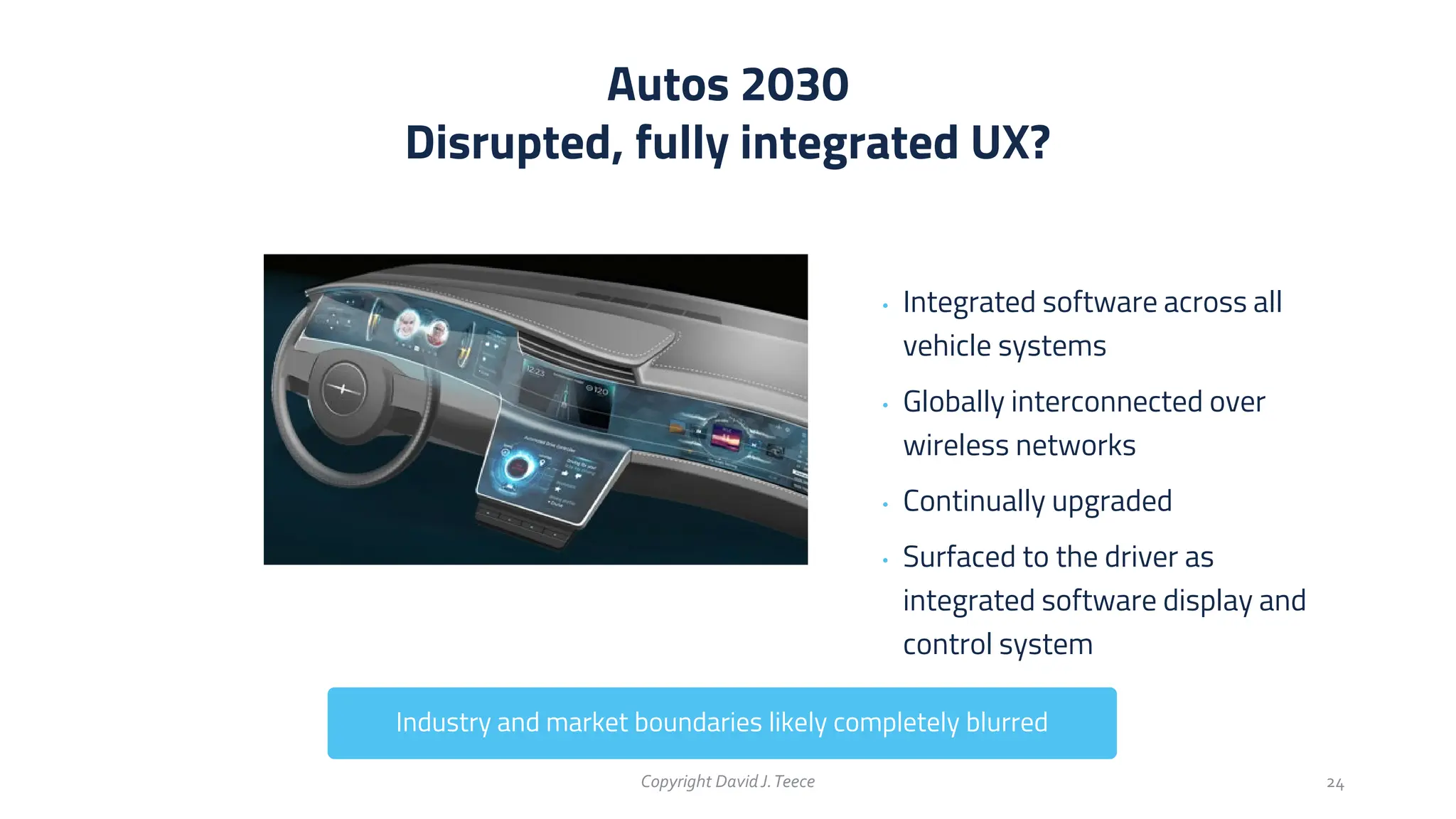
Autos 2030
Disrupted, fully integrated UX?
Copyright DavidJ.Teece 24
• Integrated software across all
vehicle systems
• Globally interconnected over
wireless networks
• Continually upgraded
• Surfaced to the driver as
integrated software display and
control system
Industry and market boundaries likely completely blurred
1. For incumbents:
• Most established firms in traditional industries are challenged, unless they are careful, they
will move from being brand leaders to becoming subcontractors.
• The only way to survive is to adopt a systems mindset, form alliances, invest heavily to build
new dynamic capabilities.
2. For competition authorities:
• The nature of competition has changed and the (static) framework of the past need to be
modified… otherwise more harm than good will follow government action (and inaction).
• Much more research is needed to understand competitive outcomes. It’s not just about scale,
scope, and network effects…
Implication of dynamic (digital competition) and the
emergence of ecosystems
Copyright DavidJ.Teece 25
Traditional “relevant market” definition is demand side focused and gives insufficient attention
to the supply side.
• Platforms can quickly become broad spectrum competitors.
• Data driven complementarities enables platform to cross traditional market boundaries, often
with alacrity.
A fundamental flaw in antitrust analysis
Copyright DavidJ.Teece 26
*See David Evans, Richard Schmalensee “Matchmakers: The New Economics of Multisided Platforms” Harvard Business
Review Press, 2016
• The decentralized nature of innovation in an ecosystem changes the nature of competition
and weakens the hand of the platforms (they must bring partners along when there is a
change in strategy).
• It’s not Apple v Google or Apple v Samsung but strategy and competition and likely outcomes
depends on complementors too.
• Platform strategy must take the interests of partners into account.
Competitive engagements are frequently
ecosystem to ecosystem
Copyright DavidJ.Teece 27
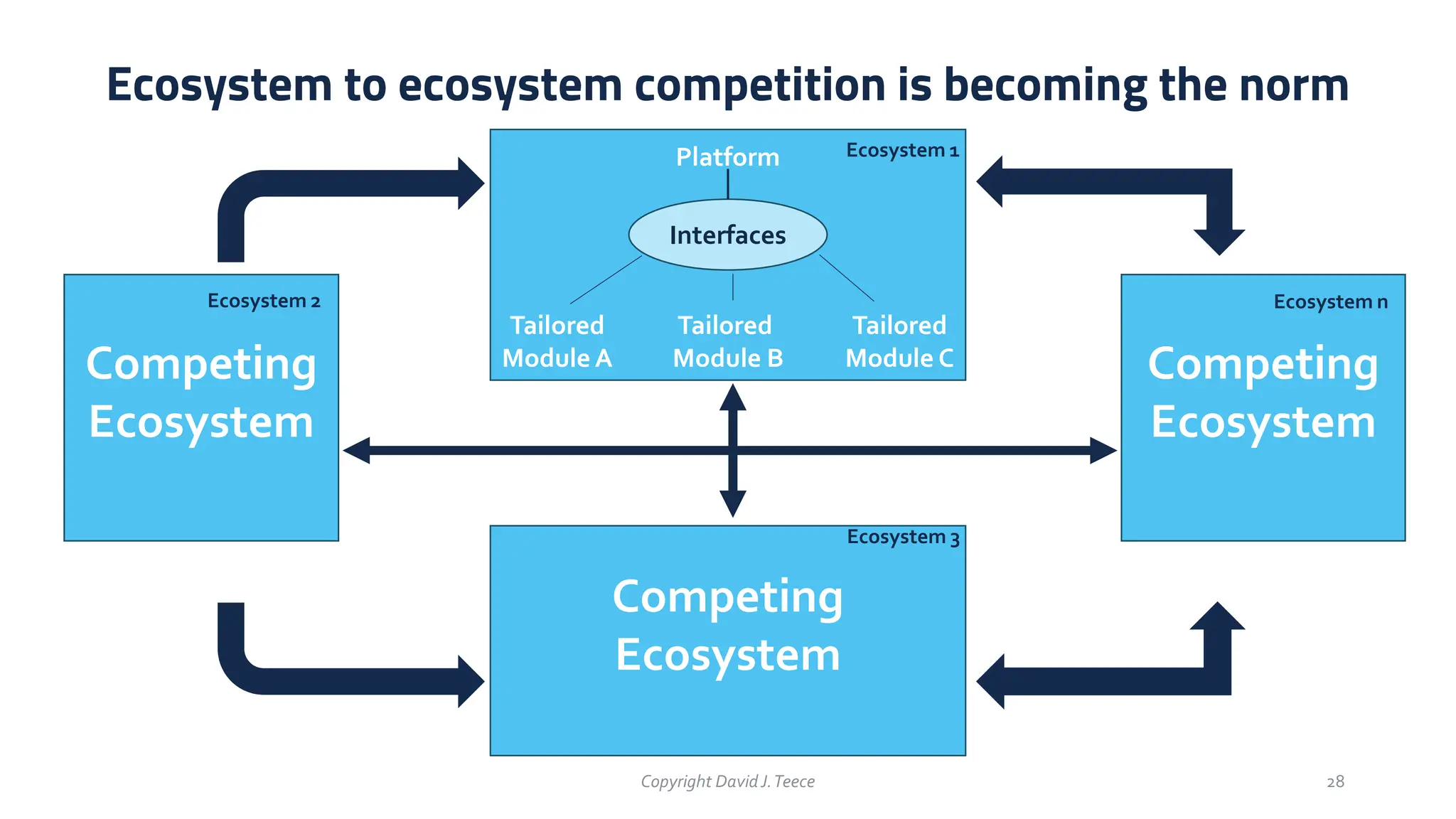
Ecosystem to ecosystem competition is becoming the norm
Copyright DavidJ.Teece 28
Platform
Interfaces
Tailored
Module A
Tailored
Module B
Tailored
Module C
Ecosystem 1
Competing
Ecosystem
Competing
Ecosystem
Competing
Ecosystem
Ecosystem 2
Ecosystem 3
Ecosystem n
• Problem isn’t with antitrust law (e.g., Klobuchar Bill) but with antitrust economics. Regulation
will likely:
• Force platform developers to share the benefits of their investments with business users and rivals.
• Blunts investment incentives.
• Allow rivals to free ride on the incumbent or innovating firms.
• Requires companies to provide a helping hand to competitors.
• Creates diverging and confusing obligations on digital platforms… including with respect to consumer and
business users.
Heavy handed regulation will likely chill dynamic competition
Copyright DavidJ.Teece 29
Appendix
7/30/2025 Copyright DavidJ.Teece 30
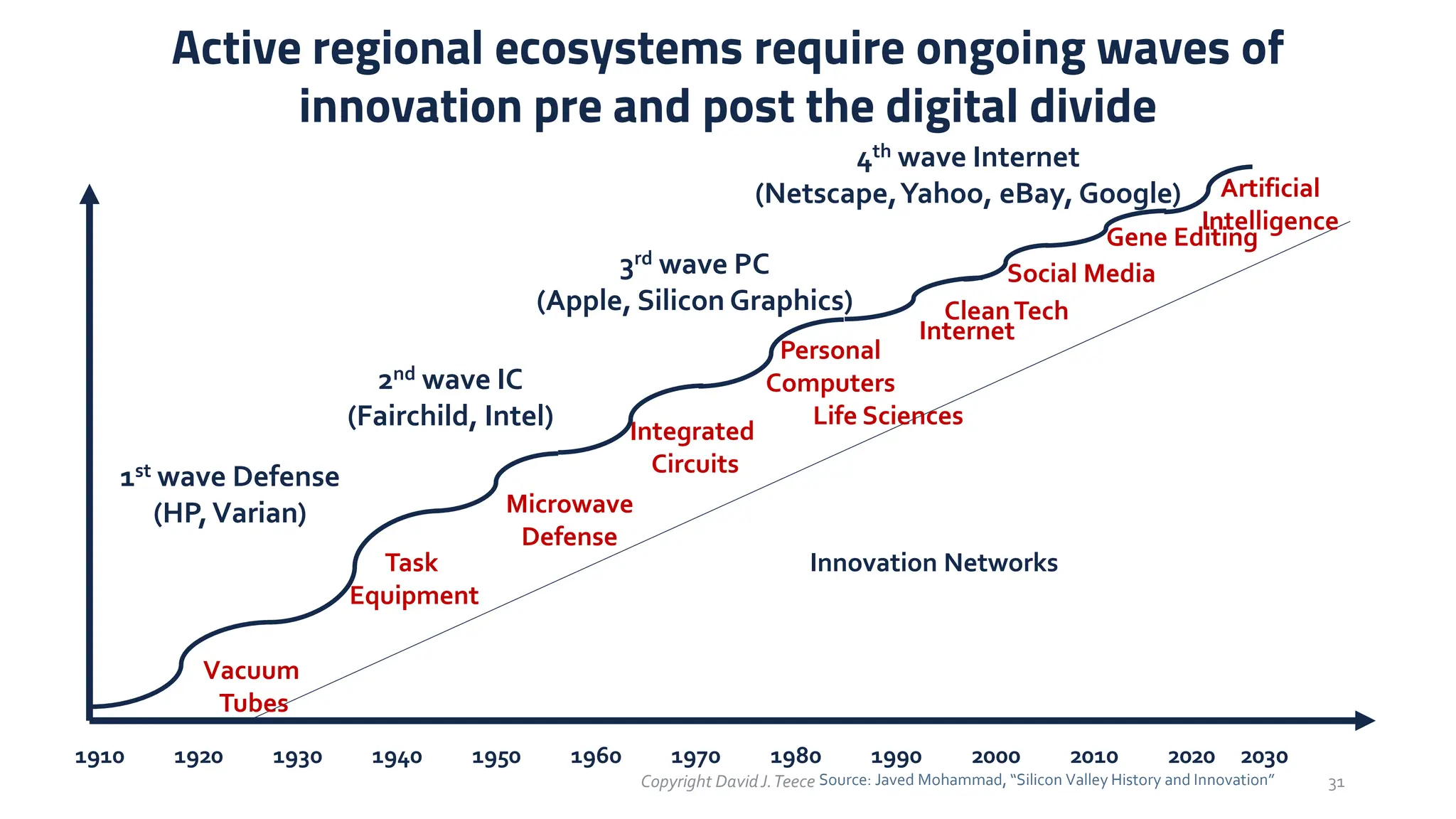
Active regional ecosystems require ongoing waves of
innovation pre and post the digital divide
Copyright DavidJ.Teece 31
Source: Javed Mohammad, “Silicon Valley History and Innovation”
1910 1920 1930 1940 1950 1960 1970 1980 1990 2000 2010 2020 2030
Vacuum
Tubes
Task
Equipment
Microwave
Defense
Integrated
Circuits
Personal
Computers
Life Sciences
Internet
CleanTech
Social Media
Gene Editing
Artificial
Intelligence
1st wave Defense
(HP,Varian)
2nd wave IC
(Fairchild, Intel)
3rd wave PC
(Apple, Silicon Graphics)
4th wave Internet
(Netscape,Yahoo, eBay, Google)
Innovation Networks
• Chip design
• Semiconductor manufacturing and packaging
• Assembly
• Operating systems
• Application software
Digital ecosystems are often modular e.g.,
personal computers and mobile phones
7/30/2025 Copyright DavidJ.Teece 32

Digital Ecosystems and Dynamic Competition

  • 1.
    Digital Ecosystems and DynamicCompetition IEEE ICTE Dynamic Competition Keynote and Round Table 10 October, 2023 David J. Teece dteece@thinkbrg.com
  • 2.
    “competition from thenew commodity, the new technology, the new source of supply, the new type of organization— competition which commands a decisive cost or quality advantage and which strikes not at the margins of the profits and the output of existing firms, but at their foundations and their very lives.” Joseph Schumpeter 1942 Implications 1. Static (efficiency driven) competition is “weak tea” compared to dynamic competition… innovation is the turbocharger if not the engine of competition. 2. Innovation drives competition (perhaps more powerfully than competition drives innovation). Innovation is the key driver of competition Copyright DavidJ.Teece 2
  • 3.
    • A systemis a group of interacting interrelated and interdependent parts that together form a unified whole. • Arrangement of the parts is significant. • Constraints and boundaries exist. • Endogeneity is rife. • Feedback effects are common and their management is needed to maintain stability. • Clearly, any business is a system but few acknowledge this. • Engineers are more inclined to think systems (and ecosystems) than economists who tend to be trapped by reductionism. Systems (and ecosystems) in management and economics 7/30/2025 Copyright DavidJ.Teece 3 Reductionism is the antithesis of systems thinking
  • 4.
     Crisply defined Airplane, farm tractor; automobile; railroad locomotive Physical Ecosystem A confusing litany of business relevant ecosystems Examples Subsystem boundaries Digital Ecosystem  Loosely defined  Android; CarPlay; ARM; Visa Copyright DavidJ.Teece 4 • When subsystem bounds are loosely defined, and digitized, the recombination of elements is lower cost. • Often digital layers can be added to physical ecosystems to enable connection to the internet of things, to enhance performance. Regional Ecosystem*  Loosely defined  Silicon Valley; Cambridge Cluster (UK), Research Triangle (North Carolina) *Geographic concentrations of a critical mass of interconnected businesses and supporting institutions. With digital ecosystems, the locus of value creation lies both inside the firm and outside the firm
  • 5.
    • Industrial innovationtypically involves products or process development and involves both radical and continuous improvement. However, it often leaves the business model unchanged. There are exception (railroads, electricity). • Digital innovation refers to the development of digital products, services, and business models. It began in earnest in the 1970’s (e.g., digital telecommunications switching). • Almost always enables, and eventually (if not initially), involves a reengineering of the firm’s business model. Innovation is not always… and historically has not been… digital (systems) in nature Copyright DavidJ.Teece 5
  • 6.
    • Second industrialrevolution: The subsequent development of national, continental, and international communication (and transport) via the telegraph (and the railroad) changed the locus of economic organization and led to large vertically integrated firms, some of them global in scope e.g., General Motors, Ford, GE. • Digital revolution: With ecosystems, firms can create digital platforms, match buyers and sellers, and harness a global networks of partners who can anonymously, on top of a core set of platform assets, create valuable products and services. The digital revolution has unique organizational (and therefore competitive) ramifications Copyright DavidJ.Teece 6 Implication: managers are often bamboozled with respect to how to manage digital (platform) ecosystems… but Steve Jobs was clear eyed about it.
  • 7.
    • It ismultidimensional and must take into account the interests of complementors and others. • An enterprise strategy must take into account (1) own capabilities (2) capabilities of complementors and supplier (3) capabilities of competitors and their complementors and suppliers. • Any single business enterprise is unlikely to have all the capabilities needed to compete. Modular open system architectures enable them to access the capabilities of others. • Stand alone enterprises using their own proprietary design rules may compete with firms using open system architecture e.g., Apple v Google/Samsung. Within ecosystems, strategy formulation is very different Copyright DavidJ.Teece 7
  • 8.
     Systems thinking(by Jobs) Apple iPod Managers need to think systems more than ever Copyright DavidJ.Teece 8 • At their core, both devices were MP3 players: • Apple addressed “related” factors: (1) digital (music) rights protection/management (2) mini hard drive from Toshiba for storage (3) purchase and payment through the iTunes store. • Apple’s ecosystem mindset enabled the success of the iPod and completely disrupted music listening technology (CD) and created a stepping stone to iPhone. • Microsoft did none of the above and Zune failed. Microsoft Zune  Device thinking (by Balmer) vs Systems vs non-systems thinking and dynamic competition SUCCESS FAILURE
  • 9.
    • Requires holisticthinking/mindset • The best minds always think holistically (systems view). • Not easily reduced to hands-on rules and policies • Loop diagram • Cause and effect maps • Persuasion and incentives must work because the authority structure over an ecosystem/platform is relatively weak. The management of digital ecosystems is always challenging Copyright DavidJ.Teece 9
  • 10.
    Jeff Bezos’ early(start up) model of the “Amazon system” Copyright DavidJ.Teece 10
  • 11.
    • Great companies,not just digital platform companies, pay attention to the success of their complementors too (e.g., Boeing, Walmart, WL Gore, Cosco) sometimes by creating tools, services, and technologies that other members of the ecosystems can use. • Good platform leaders focus on and assist those companies/organizations/institutions that can most help shape their future. In a deeply cospecialized ecosystem, the success of one depends on the success of all Copyright DavidJ.Teece 11
  • 12.
    Dynamic capabilities alwaysmatter… system or no system Copyright DavidJ.Teece 12 SENSING Identification of opportunities & threats at home and abroad SEIZING Mobilization of resources to deliver value and shape markets TRANSFORMING Continuous renewal and periodic major strategic shifts “Ordinary” or “best practice” capabilities are merely table stakes.
  • 13.
    • Real timedata orchestration is a crucial organizational capability. • The most valuable data lakes combine behavioral customer data with machine data and environmental data. Data matters too Copyright DavidJ.Teece 13
  • 14.
    • Digital platformsfacilitate: • Matching* • Going global (minimultinationals) • Innovation by (a) own R&D (b) R&D development activities of complementors e.g., millions of apps. • Lack in/high switching costs possible if (1) multihoming difficult (2) high user switching costs (due to interoperability). • Public criticisms of platforms range far and wide (usually amplified by competitors): • Self preferencing • Predatory pricing • Exchanging conduct With digital platforms, scale, scope, and network effects are present but not inexorable… management, data, and ecosystem matter Copyright DavidJ.Teece 14 *See David Evans, Richard Schmalensee “Matchmakers: The New Economics of Multisided Platforms” Harvard Business Review Press, 2016
  • 15.
    • Allows unprecedentedconnectivity amongst and across individuals and organizations with minimal frictions. • Reduces transactional awkwardness e.g., Airbnb and renting a vacation home. • Allows resources outside the firm can be monitored and accessed. • Allows a configuration of value creation and value capture through new business models. • Generates data that can be generated, stored, shared at low cost. • Digital assets are reprogrammable allowing: a) Reduced cospecialization e.g., usage of computer chips b) The facilitation of broad spectrum competition Competitive impacts of the digital revolution: summary Copyright DavidJ.Teece 15
  • 16.
    Indicia of robustness •Return on capita of critical complementors as well as the platform owner itself. • Number of firms and new entry into ecosystem. • Survival rate of ecosystem partners. • Opening up and serving of new niches. • Gatekeepers providing good governance and promoting ecosystem innovation. • Gatekeeper rewards: platform share must not be too little or too much. New welfare criteria for competition policy: a robust ecosystem Copyright DavidJ.Teece 16 Robust ecosystems are a good proxy for long run consumer welfare.
  • 17.
    A common (butwrong) assumption is that platform dominance is inexorable  Build a platform and wait for it to tip  Light a cigar – and enjoy the easy life  Reality is quite different. “Only the paranoid survive”* Copyright David J. Teece  Success requires sensing current and future user/customer needs, leveraging existing and possible future capabilities, and effectuated combinations of assets.  Industry boundaries don’t matter…competition can come from complementors too (Adner and Lieberman, 2021) Weak dynamic capabilities of competitors (and inability to adopt a systems mindset) can also explain dominance of platforms. *Andy Grove, former CEO of Intel 17 Common to think that monopolization is natural because of increasing returns.
  • 18.
    • Excite andLycos lost the search engine game to Yahoo. Then Yahoo lost out to Google. • Meta and Google and Apple compete for advertising dollars. • Google is now challenged by ChaptGPT. • Incumbency only gives you a seat at the table for the next round of innovation… usually shorter than the time to initiate and complete an antitrust lawsuit • There is no automatic “tipping point;” management and capabilities matter. Platforms (and incumbents) that do not innovate will be overtaken by others offering something better Copyright DavidJ.Teece 18
  • 19.
    Evolution Phase I– through ~2010 Google, Facebook, Netflix, etc. exploited activities in a single domain. The algorithm was the asset and network effects were critical. Evolution Phase II – 2010 through today Data lakes – not just the algorithms and network effects – are key assets and bases for competitive advantage. Competitors can occupy a niche; but competition is increasingly likely to be ecosystem to ecosystem and therefore broad spectrum, facilitated by big data Copyright DavidJ.Teece 19 Traditional relevant market analysis needs to pay more attention to the supply side.
  • 20.
    Example of narrowspectrum competition – through ~2007 Copyright DavidJ.Teece 20 • Stable, known competitive environment • Linear evolution • Network and scale effects drive to oligopolies • Hardware matters PCs, mobile phones, and digital services were in distinct markets
  • 21.
    Broad spectrum competition– 2007 ~2020 Copyright DavidJ.Teece 21 • Disrupted, unstable, competitive environment • Nonlinear evolution • Software ecosystem network and scale effects drive to oligopolies • Hardware increasingly abstracted and commoditized Important implications for relevant market analysis
  • 22.
    The auto industryis now morphing with mobile phones and digital services Copyright DavidJ.Teece 22 • Disrupted, unstable, competitive environment • Nonlinear evolution • Software ecosystem network and scale effects drive to duopolies • Hardware increasingly abstracted and commoditized Blurred industry boundaries and broader “relevant markets”
  • 23.
    Auto industry by2020 Incumbent auto companies competitive response Evolved, non-integrated, User Experience (UX) Copyright DavidJ.Teece 23 Digital Service Provider UX
  • 24.
    Autos 2030 Disrupted, fullyintegrated UX? Copyright DavidJ.Teece 24 • Integrated software across all vehicle systems • Globally interconnected over wireless networks • Continually upgraded • Surfaced to the driver as integrated software display and control system Industry and market boundaries likely completely blurred
  • 25.
    1. For incumbents: •Most established firms in traditional industries are challenged, unless they are careful, they will move from being brand leaders to becoming subcontractors. • The only way to survive is to adopt a systems mindset, form alliances, invest heavily to build new dynamic capabilities. 2. For competition authorities: • The nature of competition has changed and the (static) framework of the past need to be modified… otherwise more harm than good will follow government action (and inaction). • Much more research is needed to understand competitive outcomes. It’s not just about scale, scope, and network effects… Implication of dynamic (digital competition) and the emergence of ecosystems Copyright DavidJ.Teece 25
  • 26.
    Traditional “relevant market”definition is demand side focused and gives insufficient attention to the supply side. • Platforms can quickly become broad spectrum competitors. • Data driven complementarities enables platform to cross traditional market boundaries, often with alacrity. A fundamental flaw in antitrust analysis Copyright DavidJ.Teece 26 *See David Evans, Richard Schmalensee “Matchmakers: The New Economics of Multisided Platforms” Harvard Business Review Press, 2016
  • 27.
    • The decentralizednature of innovation in an ecosystem changes the nature of competition and weakens the hand of the platforms (they must bring partners along when there is a change in strategy). • It’s not Apple v Google or Apple v Samsung but strategy and competition and likely outcomes depends on complementors too. • Platform strategy must take the interests of partners into account. Competitive engagements are frequently ecosystem to ecosystem Copyright DavidJ.Teece 27
  • 28.
    Ecosystem to ecosystemcompetition is becoming the norm Copyright DavidJ.Teece 28 Platform Interfaces Tailored Module A Tailored Module B Tailored Module C Ecosystem 1 Competing Ecosystem Competing Ecosystem Competing Ecosystem Ecosystem 2 Ecosystem 3 Ecosystem n
  • 29.
    • Problem isn’twith antitrust law (e.g., Klobuchar Bill) but with antitrust economics. Regulation will likely: • Force platform developers to share the benefits of their investments with business users and rivals. • Blunts investment incentives. • Allow rivals to free ride on the incumbent or innovating firms. • Requires companies to provide a helping hand to competitors. • Creates diverging and confusing obligations on digital platforms… including with respect to consumer and business users. Heavy handed regulation will likely chill dynamic competition Copyright DavidJ.Teece 29
  • 30.
  • 31.
    Active regional ecosystemsrequire ongoing waves of innovation pre and post the digital divide Copyright DavidJ.Teece 31 Source: Javed Mohammad, “Silicon Valley History and Innovation” 1910 1920 1930 1940 1950 1960 1970 1980 1990 2000 2010 2020 2030 Vacuum Tubes Task Equipment Microwave Defense Integrated Circuits Personal Computers Life Sciences Internet CleanTech Social Media Gene Editing Artificial Intelligence 1st wave Defense (HP,Varian) 2nd wave IC (Fairchild, Intel) 3rd wave PC (Apple, Silicon Graphics) 4th wave Internet (Netscape,Yahoo, eBay, Google) Innovation Networks
  • 32.
    • Chip design •Semiconductor manufacturing and packaging • Assembly • Operating systems • Application software Digital ecosystems are often modular e.g., personal computers and mobile phones 7/30/2025 Copyright DavidJ.Teece 32