

PURPOSE 
A Leader in High Value Consultancy Services in Africa 
VISION 
Sincerity -Honesty -Passion -Excellence 
VALUES
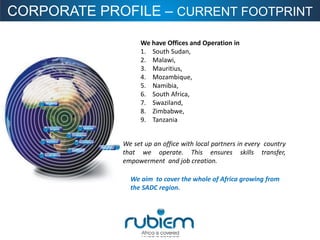
CORPORATE PROFILE –CURRENT FOOTPRINT 
Wesetupanofficewithlocalpartnersineverycountrythatweoperate.Thisensuresskillstransfer, empowermentandjobcreation. 
We aim to cover the whole of Africa growing from the SADC region. 
We have Offices and Operation in 
1.South Sudan, 
2.Malawi, 
3.Mauritius, 
4.Mozambique, 
5.Namibia, 
6.South Africa, 
7.Swaziland, 
8.Zimbabwe, 
9.Tanzania
What is e-government 
It is the transformationof government 
to provide Services to the Citizens& Businesses 
through Information & Communication Technologies 
e-governance is defined as the application of electronic means in theinteraction between government and citizens and government and businesses, as well as internal government operationsto simplify and improve democratic, government and business aspects of governance.
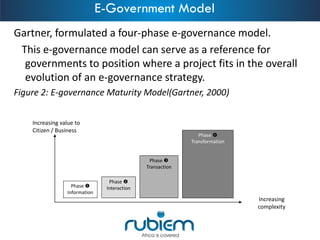
Gartner, formulated a four-phase e-governance model. 
This e-governance model can serve as a reference for governments to position where a project fits in the overall evolution of an e-governance strategy. 
Figure 2: E-governance Maturity Model(Gartner, 2000) 
Phase  Information 
Increasing value to Citizen / Business 
Increasing complexity 
Phase  Interaction 
Phase  Transaction 
Phase  Transformation 
E-Government Model
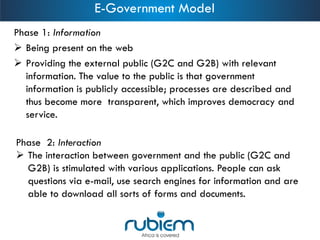
Phase 1: Information 
Being present on the web 
Providing the external public (G2C and G2B) with relevant information. The value to the public is that government information is publicly accessible; processes are described and thus become more transparent, which improves democracy and service. 
E-Government Model 
Phase 2: Interaction 
The interaction between government and the public (G2C and G2B) is stimulated with various applications. People can ask questions via e-mail, use search engines for information and are able to download all sorts of forms and documents.
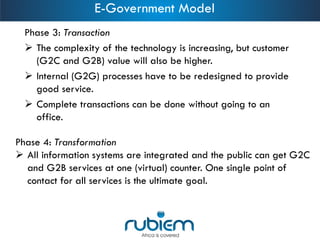
Phase 3: Transaction 
The complexity of the technology is increasing, but customer (G2C and G2B) value will also be higher. 
Internal (G2G) processes have to be redesigned to provide good service. 
Complete transactions can be done without going to an office. 
E-Government Model 
Phase 4: Transformation 
All information systems are integrated and the public can get G2C and G2B services at one (virtual) counter. One single point of contact for all services is the ultimate goal.
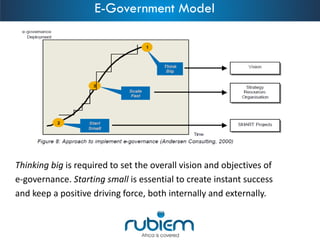
Thinking big is required to set the overall vision and objectives of 
e-governance. Starting small is essential to create instant success 
and keep a positive driving force, both internally and externally. 
E-Government Model
Scaling fast is only possible with a profound strategy that secures that: 
•all necessary resources are available in time 
•bottlenecks are known and taken care of 
•project planning and phasing is aligned with the overall vision and objectives. 
E-Government Model
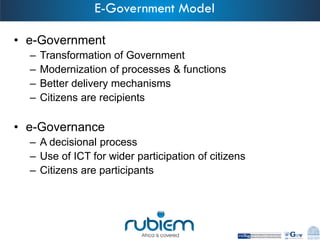
•e-Government 
–Transformation of Government 
–Modernization of processes & functions 
–Better delivery mechanisms 
–Citizens are recipients 
•e-Governance 
–A decisional process 
–Use of ICT for wider participation of citizens 
–Citizens are participants 
E-Government Model
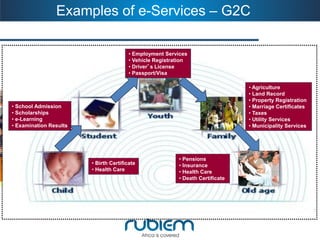
Examples of e-Services –G2C 
•Birth Certificate 
•Health Care 
•School Admission 
•Scholarships 
•e-Learning 
•Examination Results 
•Employment Services 
•Vehicle Registration 
•Driver’s License 
•Passport/Visa 
•Agriculture 
•Land Record 
•Property Registration 
•Marriage Certificates 
•Taxes 
•Utility Services 
•Municipality Services 
•Pensions 
•Insurance 
•Health Care 
•Death Certificate
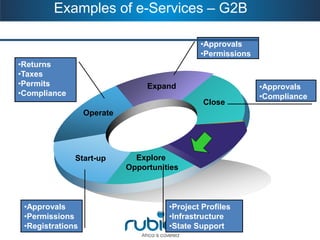
Examples of e-Services –G2B 
Close 
Expand 
Operate 
Start-up 
Explore 
Opportunities 
•Approvals 
•Permissions 
•Registrations 
•Returns 
•Taxes 
•Permits 
•Compliance 
•Approvals 
•Permissions 
•Project Profiles 
•Infrastructure 
•State Support 
•Approvals 
•Compliance
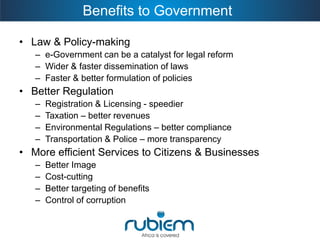
Benefits to Government 
•Law & Policy-making 
–e-Government can be a catalyst for legal reform 
–Wider & faster dissemination of laws 
–Faster & better formulation of policies 
•Better Regulation 
–Registration & Licensing -speedier 
–Taxation –better revenues 
–Environmental Regulations –better compliance 
–Transportation & Police –more transparency 
•More efficient Services to Citizens & Businesses 
–Better Image 
–Cost-cutting 
–Better targeting of benefits 
–Control of corruption
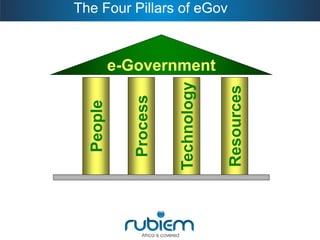
The Four Pillars of eGov 
People 
Process 
Technology 
Resources 
e-Government
Access to Clean Water
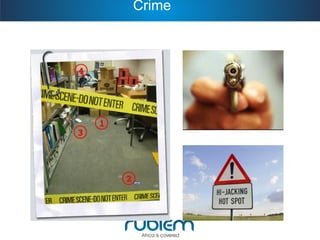
Crime
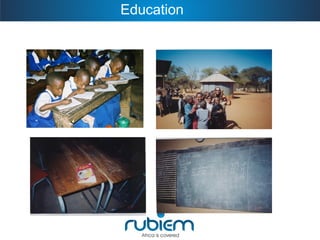
Education
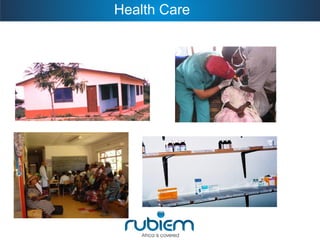
Health Care
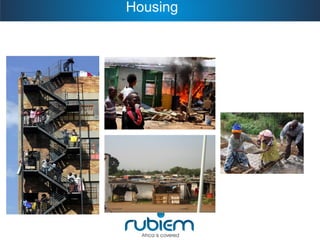
Housing
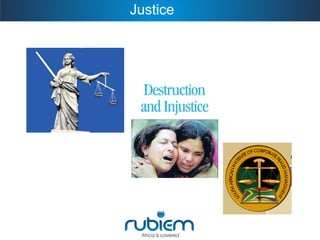
Justice
Literacy
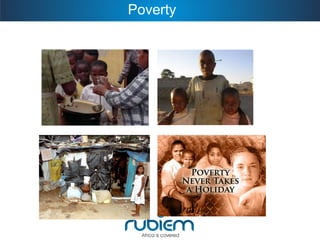
Poverty
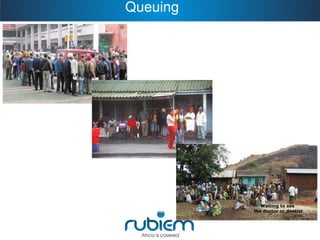
Queuing
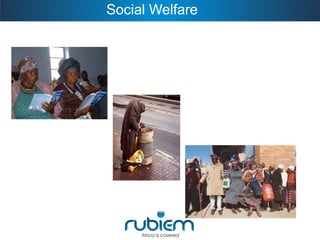
Social Welfare
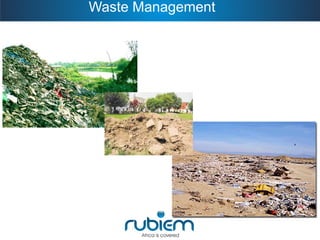
Waste Management
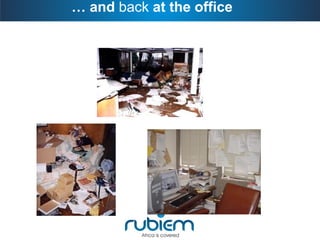
… and backat the office
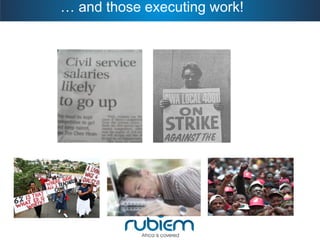
… and those executing work!
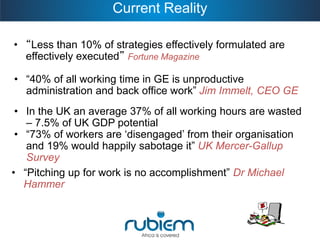
Current Reality 
• “Less than 10% of strategies effectively formulated are 
effectively executed” Fortune Magazine 
• “40% of all working time in GE is unproductive 
administration and back office work” Jim Immelt, CEO GE 
• In the UK an average 37% of all working hours are wasted 
– 7.5% of UK GDP potential 
• “73% of workers are ‘disengaged’ from their organisation 
and 19% would happily sabotage it” UK Mercer-Gallup 
Survey 
• “Pitching up for work is no accomplishment” Dr Michael 
Hammer
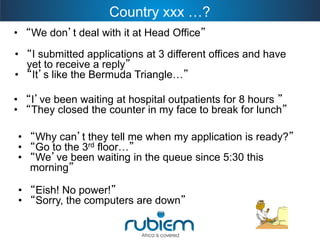
Country xxx …? 
• “We don’t deal with it at Head Office” 
• “I submitted applications at 3 different offices and have 
yet to receive a reply” 
• “It’s like the Bermuda Triangle…” 
• “I’ve been waiting at hospital outpatients for 8 hours ” 
• “They closed the counter in my face to break for lunch” 
• “Why can’t they tell me when my application is ready?” 
• “Go to the 3rd floor…” 
• “We’ve been waiting in the queue since 5:30 this 
morning” 
• “Eish! No power!” 
• “Sorry, the computers are down”
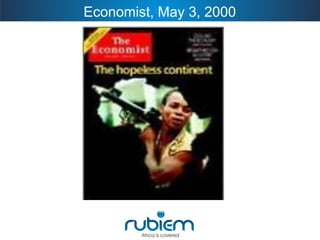
Economist, May 3, 2000
Economist, Dec 3, 2011 
The Hopeful Continent: Africa rising
Conclusion 
Quoting Nigeria’s Communications Technology Minister, Dr Omobola Johnson. 
“ICT holds hope of a better future for the African continent” Thank You

Digital Engagement eGovernment

  • 1.
    PURPOSE A Leaderin High Value Consultancy Services in Africa VISION Sincerity -Honesty -Passion -Excellence VALUES
  • 2.
    CORPORATE PROFILE –CURRENTFOOTPRINT Wesetupanofficewithlocalpartnersineverycountrythatweoperate.Thisensuresskillstransfer, empowermentandjobcreation. We aim to cover the whole of Africa growing from the SADC region. We have Offices and Operation in 1.South Sudan, 2.Malawi, 3.Mauritius, 4.Mozambique, 5.Namibia, 6.South Africa, 7.Swaziland, 8.Zimbabwe, 9.Tanzania
  • 3.
    What is e-government It is the transformationof government to provide Services to the Citizens& Businesses through Information & Communication Technologies e-governance is defined as the application of electronic means in theinteraction between government and citizens and government and businesses, as well as internal government operationsto simplify and improve democratic, government and business aspects of governance.
  • 4.
    Gartner, formulated afour-phase e-governance model. This e-governance model can serve as a reference for governments to position where a project fits in the overall evolution of an e-governance strategy. Figure 2: E-governance Maturity Model(Gartner, 2000) Phase  Information Increasing value to Citizen / Business Increasing complexity Phase  Interaction Phase  Transaction Phase  Transformation E-Government Model
  • 5.
    Phase 1: Information Being present on the web Providing the external public (G2C and G2B) with relevant information. The value to the public is that government information is publicly accessible; processes are described and thus become more transparent, which improves democracy and service. E-Government Model Phase 2: Interaction The interaction between government and the public (G2C and G2B) is stimulated with various applications. People can ask questions via e-mail, use search engines for information and are able to download all sorts of forms and documents.
  • 6.
    Phase 3: Transaction The complexity of the technology is increasing, but customer (G2C and G2B) value will also be higher. Internal (G2G) processes have to be redesigned to provide good service. Complete transactions can be done without going to an office. E-Government Model Phase 4: Transformation All information systems are integrated and the public can get G2C and G2B services at one (virtual) counter. One single point of contact for all services is the ultimate goal.
  • 7.
    Thinking big isrequired to set the overall vision and objectives of e-governance. Starting small is essential to create instant success and keep a positive driving force, both internally and externally. E-Government Model
  • 8.
    Scaling fast isonly possible with a profound strategy that secures that: •all necessary resources are available in time •bottlenecks are known and taken care of •project planning and phasing is aligned with the overall vision and objectives. E-Government Model
  • 9.
    •e-Government –Transformation ofGovernment –Modernization of processes & functions –Better delivery mechanisms –Citizens are recipients •e-Governance –A decisional process –Use of ICT for wider participation of citizens –Citizens are participants E-Government Model
  • 10.
    Examples of e-Services–G2C •Birth Certificate •Health Care •School Admission •Scholarships •e-Learning •Examination Results •Employment Services •Vehicle Registration •Driver’s License •Passport/Visa •Agriculture •Land Record •Property Registration •Marriage Certificates •Taxes •Utility Services •Municipality Services •Pensions •Insurance •Health Care •Death Certificate
  • 11.
    Examples of e-Services–G2B Close Expand Operate Start-up Explore Opportunities •Approvals •Permissions •Registrations •Returns •Taxes •Permits •Compliance •Approvals •Permissions •Project Profiles •Infrastructure •State Support •Approvals •Compliance
  • 12.
    Benefits to Government •Law & Policy-making –e-Government can be a catalyst for legal reform –Wider & faster dissemination of laws –Faster & better formulation of policies •Better Regulation –Registration & Licensing -speedier –Taxation –better revenues –Environmental Regulations –better compliance –Transportation & Police –more transparency •More efficient Services to Citizens & Businesses –Better Image –Cost-cutting –Better targeting of benefits –Control of corruption
  • 13.
    The Four Pillarsof eGov People Process Technology Resources e-Government
  • 14.
  • 15.
  • 16.
  • 17.
  • 18.
  • 19.
  • 20.
  • 21.
  • 22.
  • 23.
  • 24.
  • 25.
    … and backatthe office
  • 26.
    … and thoseexecuting work!
  • 27.
    Current Reality •“Less than 10% of strategies effectively formulated are effectively executed” Fortune Magazine • “40% of all working time in GE is unproductive administration and back office work” Jim Immelt, CEO GE • In the UK an average 37% of all working hours are wasted – 7.5% of UK GDP potential • “73% of workers are ‘disengaged’ from their organisation and 19% would happily sabotage it” UK Mercer-Gallup Survey • “Pitching up for work is no accomplishment” Dr Michael Hammer
  • 28.
    Country xxx …? • “We don’t deal with it at Head Office” • “I submitted applications at 3 different offices and have yet to receive a reply” • “It’s like the Bermuda Triangle…” • “I’ve been waiting at hospital outpatients for 8 hours ” • “They closed the counter in my face to break for lunch” • “Why can’t they tell me when my application is ready?” • “Go to the 3rd floor…” • “We’ve been waiting in the queue since 5:30 this morning” • “Eish! No power!” • “Sorry, the computers are down”
  • 29.
  • 30.
    Economist, Dec 3,2011 The Hopeful Continent: Africa rising
  • 31.
    Conclusion Quoting Nigeria’sCommunications Technology Minister, Dr Omobola Johnson. “ICT holds hope of a better future for the African continent” Thank You