Brian R. Gutierrez
Department of English
 Instructor in the English Department
 Teach English 101, 102, and Shakespeare
 Doctoral Candidate (PhD) and graduate
instructor at the University of Washington
 How my teaching and research intersect
 What are the digital humanities?
 What does it (or could it) look like at North
Seattle?
 18th/19th century British literature
 Dissertation looks at how poets used the
newly forming celebrity apparatus for both
self-promotion and to reimagine literary
forms, especially poetics
 18th century media studies: literature,
newspapers and periodicals, and paintings
and prints.
Critical pedagogy is an “educational
movement, guided by passion and
principle, to help students develop
consciousness of freedom, recognize
authoritarian tendencies, and
connect knowledge to power and the
ability to take constructive action.”
 Epigraph by Michel Foucault from The
Archeology of Knowledge :
◦ “Education may well be, as of right, the instrument
whereby every individual, in a society like our own,
can gain access to any kind of discourse. But we
well know that in its distribution, in what it permits
and in what it prevents, it follows the well-trodden
battle-lines of social conflict. Every educational
system is a political means of maintaining or of
modifying the appropriation of discourse, with the
knowledge and the powers it carries with it.”
 First called “humanities computing”:
 Digital humanities (DH) currently incorporate
both digitized and born-digital materials and
combine the methodologies from traditional
humanities disciplines and social sciences
with tools provided by computing (such as
data visualization, information retrieval, data
mining, statistics, text mining) and digital
publishing.
 Collaboration
 Iterative development
 Open-Source
 DIY
 Autodidacticism
 Public Scholarship
and Peer Review
 Dissemination
 Failure as valuable
 Ad Hoc
 Transparency
*DH Values found at dmdh.org
 Definitive beginnings: 1946 with Roberto
Busa
◦ Index Thomisticus
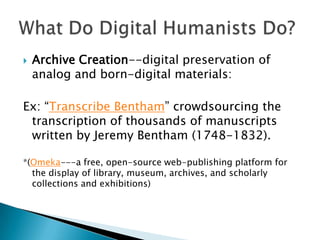
 Archive Creation--digital preservation of
analog and born-digital materials:
Ex: “Transcribe Bentham” crowdsourcing the
transcription of thousands of manuscripts
written by Jeremy Bentham (1748-1832).
*(Omeka---a free, open-source web-publishing platform for
the display of library, museum, archives, and scholarly
collections and exhibitions)
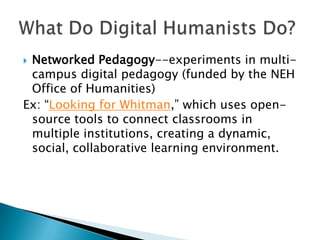
 Networked Pedagogy--experiments in multi-
campus digital pedagogy (funded by the NEH
Office of Humanities)
Ex: “Looking for Whitman,” which uses open-
source tools to connect classrooms in
multiple institutions, creating a dynamic,
social, collaborative learning environment.
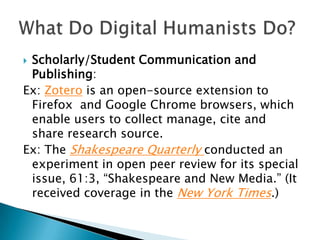
 Scholarly/Student Communication and
Publishing:
Ex: Zotero is an open-source extension to
Firefox and Google Chrome browsers, which
enable users to collect manage, cite and
share research source.
Ex: The Shakespeare Quarterly conducted an
experiment in open peer review for its special
issue, 61:3, “Shakespeare and New Media.” (It
received coverage in the New York Times.)
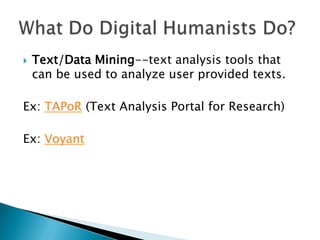
 Text/Data Mining--text analysis tools that
can be used to analyze user provided texts.
Ex: TAPoR (Text Analysis Portal for Research)
Ex: Voyant
 Analysis and Visualization:
Ex: Stanford University’s “Republic of Letters”
the project visualizes the “social network” of
Enlightenment Writers through analysis of
their correspondence.
Ex: HyperCities self defined as “a collaborative
research and educational platform for
traveling back in time to explore the
historical layers of city spaces in an
interactive, hypermedia environment.”
“Spatial Humanities” where spatial methods,
especially geographical information systems
(GIS) are being used in humanistic inquiry
 Project Bamboo: Bamboo Dirt
 dmdh.org
 DH Commons
 dhsi.org
 ThatCamp
 DH Pedagogy
 Twitter (#dh)
 The "Position Statement on Multimodal
Literacies" approved by the National Council
of Teachers of English (NCTE) which holds
that "Skills, approaches, and attitudes toward
media literacy, visual and aural rhetorics, and
critical literacy should be taught in
English/language arts classrooms"
 “Outcomes statement for First-Year
Composition" adopted by the Council of
Writing Program Administrators (WPA),
students should understand and exploit the
differences in rhetorical strategies and in the
affordances available for both print and
electronic composing processes and text.
 Essential Learning Outcomes
 North Seattle Community College serves a diverse student
population with a wide variety of educational backgrounds
and goals. As a learning community, we foster and
promote the following outcomes:
 Knowledge
 Facts, theories, perspectives and methodologies within
and across disciplines
 Intellectual & Practical Skills, including
 critical thinking and problem solving
 communication and self-expression
 quantitative reasoning
 information literacy
 technological proficiency
 collaboration: group and team work
 Stanford to offer new undergraduate majors
integrating humanities, computer science
http://news.stanford.edu/news/2014/march/f
acsen-joint-majors-030614.html
 Modern Language Association has recently
added criteria for evaluating tenure for
professors who pursue DH projects
 We are a community of “makers”
 Coordinated Studies Requirement
 Offers new ways to think about humanities
 Provides students with access to another
academic (and professional) discourse*
◦ (*Michel Foucault’s quote on education)
Are you a DH’er already?
What Are the Digital Humanities and Why Should I Care

What Are the Digital Humanities and Why Should I Care

  • 1.
  • 2.
     Instructor inthe English Department  Teach English 101, 102, and Shakespeare  Doctoral Candidate (PhD) and graduate instructor at the University of Washington
  • 3.
     How myteaching and research intersect  What are the digital humanities?  What does it (or could it) look like at North Seattle?
  • 4.
     18th/19th centuryBritish literature  Dissertation looks at how poets used the newly forming celebrity apparatus for both self-promotion and to reimagine literary forms, especially poetics  18th century media studies: literature, newspapers and periodicals, and paintings and prints.
  • 5.
    Critical pedagogy isan “educational movement, guided by passion and principle, to help students develop consciousness of freedom, recognize authoritarian tendencies, and connect knowledge to power and the ability to take constructive action.”
  • 6.
     Epigraph byMichel Foucault from The Archeology of Knowledge : ◦ “Education may well be, as of right, the instrument whereby every individual, in a society like our own, can gain access to any kind of discourse. But we well know that in its distribution, in what it permits and in what it prevents, it follows the well-trodden battle-lines of social conflict. Every educational system is a political means of maintaining or of modifying the appropriation of discourse, with the knowledge and the powers it carries with it.”
  • 7.
     First called“humanities computing”:  Digital humanities (DH) currently incorporate both digitized and born-digital materials and combine the methodologies from traditional humanities disciplines and social sciences with tools provided by computing (such as data visualization, information retrieval, data mining, statistics, text mining) and digital publishing.
  • 8.
     Collaboration  Iterativedevelopment  Open-Source  DIY  Autodidacticism  Public Scholarship and Peer Review  Dissemination  Failure as valuable  Ad Hoc  Transparency *DH Values found at dmdh.org
  • 9.
     Definitive beginnings:1946 with Roberto Busa ◦ Index Thomisticus
  • 10.
     Archive Creation--digitalpreservation of analog and born-digital materials: Ex: “Transcribe Bentham” crowdsourcing the transcription of thousands of manuscripts written by Jeremy Bentham (1748-1832). *(Omeka---a free, open-source web-publishing platform for the display of library, museum, archives, and scholarly collections and exhibitions)
  • 11.
     Networked Pedagogy--experimentsin multi- campus digital pedagogy (funded by the NEH Office of Humanities) Ex: “Looking for Whitman,” which uses open- source tools to connect classrooms in multiple institutions, creating a dynamic, social, collaborative learning environment.
  • 12.
     Scholarly/Student Communicationand Publishing: Ex: Zotero is an open-source extension to Firefox and Google Chrome browsers, which enable users to collect manage, cite and share research source. Ex: The Shakespeare Quarterly conducted an experiment in open peer review for its special issue, 61:3, “Shakespeare and New Media.” (It received coverage in the New York Times.)
  • 13.
     Text/Data Mining--textanalysis tools that can be used to analyze user provided texts. Ex: TAPoR (Text Analysis Portal for Research) Ex: Voyant
  • 14.
     Analysis andVisualization: Ex: Stanford University’s “Republic of Letters” the project visualizes the “social network” of Enlightenment Writers through analysis of their correspondence. Ex: HyperCities self defined as “a collaborative research and educational platform for traveling back in time to explore the historical layers of city spaces in an interactive, hypermedia environment.”
  • 15.
    “Spatial Humanities” wherespatial methods, especially geographical information systems (GIS) are being used in humanistic inquiry
  • 16.
     Project Bamboo:Bamboo Dirt  dmdh.org  DH Commons  dhsi.org  ThatCamp  DH Pedagogy  Twitter (#dh)
  • 17.
     The "PositionStatement on Multimodal Literacies" approved by the National Council of Teachers of English (NCTE) which holds that "Skills, approaches, and attitudes toward media literacy, visual and aural rhetorics, and critical literacy should be taught in English/language arts classrooms"
  • 18.
     “Outcomes statementfor First-Year Composition" adopted by the Council of Writing Program Administrators (WPA), students should understand and exploit the differences in rhetorical strategies and in the affordances available for both print and electronic composing processes and text.
  • 19.
     Essential LearningOutcomes  North Seattle Community College serves a diverse student population with a wide variety of educational backgrounds and goals. As a learning community, we foster and promote the following outcomes:  Knowledge  Facts, theories, perspectives and methodologies within and across disciplines  Intellectual & Practical Skills, including  critical thinking and problem solving  communication and self-expression  quantitative reasoning  information literacy  technological proficiency  collaboration: group and team work
  • 20.
     Stanford tooffer new undergraduate majors integrating humanities, computer science http://news.stanford.edu/news/2014/march/f acsen-joint-majors-030614.html
  • 21.
     Modern LanguageAssociation has recently added criteria for evaluating tenure for professors who pursue DH projects
  • 22.
     We area community of “makers”  Coordinated Studies Requirement  Offers new ways to think about humanities  Provides students with access to another academic (and professional) discourse* ◦ (*Michel Foucault’s quote on education)
  • 23.
    Are you aDH’er already?