UConn Sept. 11th 2024 Enrica Salvatori (UNIPI-AIPH)
The Reenactor as Public Historian
training and participation paths
an overview of the Italian
historical reenactment
documented & reinvented
• Siena Palio: a horse race among
districts (contrade) in the main square of
the city (XIII - since 1904 adopted the
medieval-Renaissance style)
• Calcio Fiorentino - Florentine
historical soccer a very hard game that
is a mix between soccer and rugby;
punching, kicking, tripping, hacking,
tackling, and wrestling is allowed (1530 -
recovery on 1930 by an important fascist
leader)
Historical contests
born in contemporary times
with possible reference to documented or
completely invented origins
• Calendimaggio of Assisi: medieval costumes
(circa 13th century - mid-15th century), re-
enacted scenes of medieval life in the city's alleys
and musical performances; judged by experts
• Gaite Market in Bevagna: competition among 4
gaite (districts) with the aim of reconstructing the
daily life of the Middle Ages (from 1250 to 1350);
judged by experts
• a lot of other contests mostly set in the Middle
Ages-Renaissance (nobody knows how many)
Historical contests
contain several sub-events
parade /
fl
ag-wavers: medieval
and renaissance festivals
battles
food stalls / taverns
sales stalls / trades
conferences
educational labs
exhibitions / shows
historical festivals
mostly but not only medieval
A growing phenomenon
mostly linked to
• historical places that can
be revitalized
• museums that want to
connect with their audience
• potentially a very large area
of
 ​​
action (we have many
historical, archaeological
sites and museums)
Guided tours with reenactors
for the enhancement of cultural heritage
and experimental archaeology
few examples in Italy for these reasons
• they usually better show what is no
longer possible to see, but we have a lot
of important historical-archaeological
remains (the need is not yet felt)
• reenactment in a broad sense is not
viewed kindly by the academic
environment
• universities do not teach the skills
needed to work in this
fi
eld
Open Air Museum
Archeodromo
Poggibonsi
(Siena)
But something is changing
Interest from above and pressure from below
and connected problems
a new law recognizes historical re-enactments as fundamental components of cultural
heritage, as well as a qualifying elements for the education and socio-cultural growth of the
national community (reenactment is a recurring theme of right-wing ideology and the current
government is very right-wing)
growing interest from the world of research: Anthropology, History, Management even if
always secondary compared to the main topics
growing attention from the point of view of tourism and craftsmanship (risk of distorting the
link between reenactment and local communities)
mapping of historical reenactments, project of the Directorate General of Archaeology, Fine
Arts and Landscape and the Central Institute for the Intangible Heritage of the Ministry of
Culture
AIPH reenactment working group (AIPH—> Italian Association of Public History)
Areas of interest for PH
and problems
• Reconstructive reenactment: methods, research, sources (& education)
• Participatory reenactment: methods and forms of community involvement
(what involvement? since when? why? what are the risks of tourism?)
• Re-enactment as a business: professionalization of the role (growing tendency
of communities to rely on professionals)
• Re-enactment as perception and narration of the past (what past? what is
the message? what to do with recent events?)
• Re-enactment as a tool for valorizing tangible and intangible cultural assets
(how to recruit experts? how to make sure they have adequate training?)
AIPH Reenactment Working Group
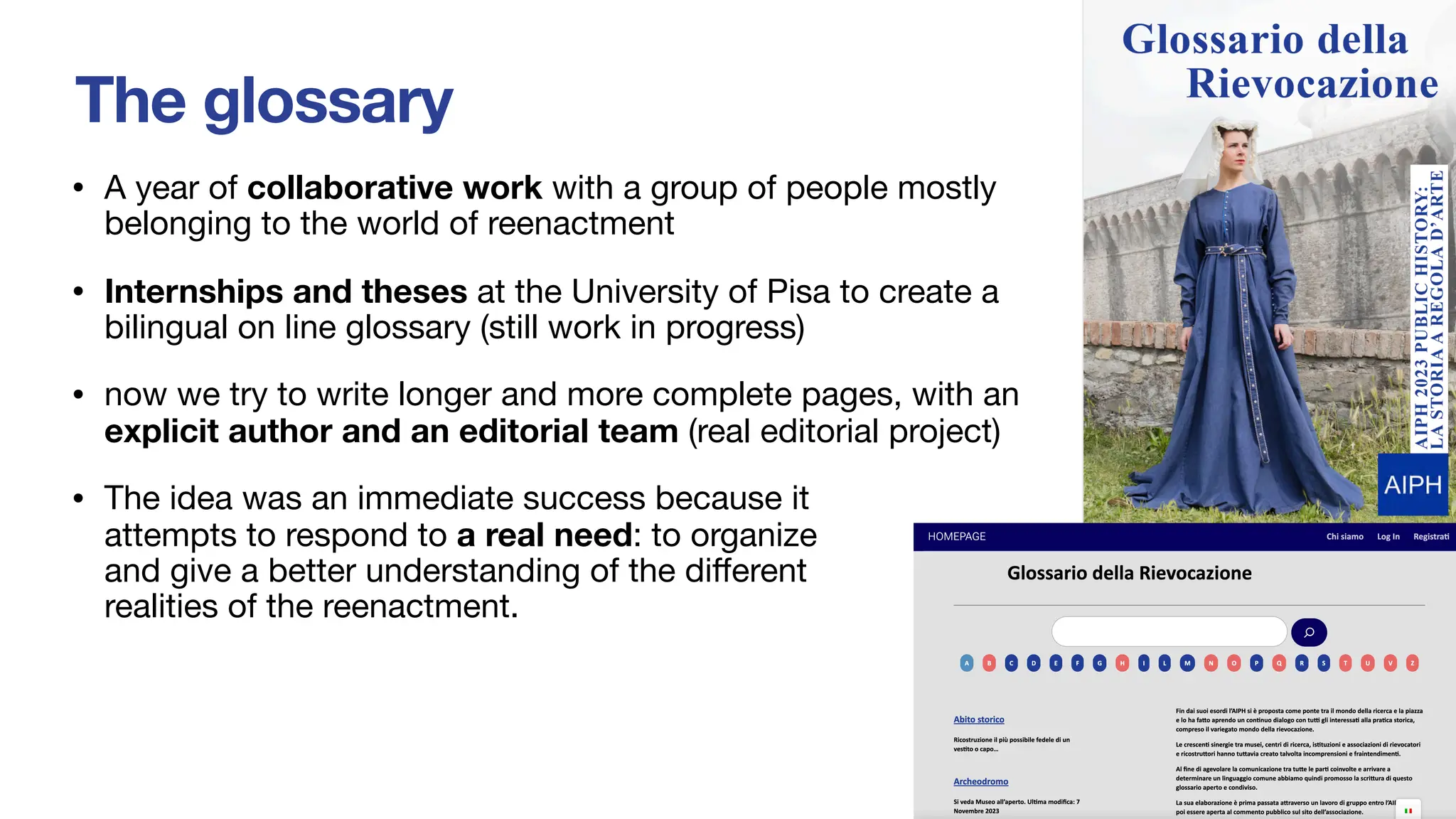
• Glossary of Reenactment
pdf, paper & hypertext (Ita/Eng)
• First university specialization
course, The Reenactor
as Public Historian (Univ. of Pisa)
• Collaboration with Italian
Ministry of Culture
The glossary
• A year of collaborative work with a group of people mostly
belonging to the world of reenactment
• Internships and theses at the University of Pisa to create a
bilingual on line glossary (still work in progress)
• now we try to write longer and more complete pages, with an
explicit author and an editorial team (real editorial project)
• The idea was an immediate success because it
attempts to respond to a real need: to organize
and give a better understanding of the di
ff
erent
realities of the reenactment.
an exemple of controversial items
not easy to translate!
• RIEVOCAZIONE: a festival where an event or artifact is reenacted, not necessarily
with the aim of strictly reconstructing all aspects of it. The term in its very etymology
indicates an attempt to evoke the imagery of an era in public. It can be inspired by
one or more historical periods.
• RICOSTRUZIONE: public or private activity aimed at accurately and rigorously
reconstructing an event or artifact through the study of documentation, mainly from
primary historical sources; it attempts to reproduce as accurately as possible objects,
environments, gestures and behaviors of an historical era. It is not necessarily related
to research, but uses a rigorous method. It can have educational purposes through
theoretical, demonstrative and practical teaching of activities, crafts and habits of daily
life of the historical period of interest.
Specialization course
• blended teaching: Microsoft Teams platform and 3 in-
person meetings in correspondence with important
reenactment events
• online lessons on the weekend: reenactors are workers
for whom re-enactment is often just a hobby
• topics: understanding of ancient, medieval, modern,
contemporary written & iconographic sources - history of
costume - oplology - organization and management -
reconstruction in museum and educational settings
•
fi
nal exam: presentation of a project paper.
• organization: University of Pisa, CERS, AIPH, CISPH,
Municipality of Sarzana, Senza Tempo, Gilda Historian
9 CFU
PIONEERING & PARTICIPATORY
First in Italy at an academic
level
Involvement of institutions,
teachers and associations
different in purpose and nature
Created by an interest group:
themes, teaching methods,
agenda
Council and teachers from the
academic and reenactment
world
teachers: Simone Del Greco (Senza Tempo), Gianluca
Fruci (UNIPI), Maria Antonella Fusco (AIPH), Samuele
Magri (UNIFI), Federico Marangoni (AICS), Jacopo
Matricciani (Spadanera), Bruna Niccoli (UNIPI), Sara
Paci Piccolo (Polimoda di Firenze), Massimiliano
Righini (esperto indipendente), Enrica Salvatori (UNIPI)
project
Thank you!

The Reenactor as Public Historian training and participation paths

  • 1.
    UConn Sept. 11th2024 Enrica Salvatori (UNIPI-AIPH) The Reenactor as Public Historian training and participation paths
  • 2.
    an overview ofthe Italian historical reenactment
  • 3.
    documented & reinvented •Siena Palio: a horse race among districts (contrade) in the main square of the city (XIII - since 1904 adopted the medieval-Renaissance style) • Calcio Fiorentino - Florentine historical soccer a very hard game that is a mix between soccer and rugby; punching, kicking, tripping, hacking, tackling, and wrestling is allowed (1530 - recovery on 1930 by an important fascist leader) Historical contests
  • 4.
    born in contemporarytimes with possible reference to documented or completely invented origins • Calendimaggio of Assisi: medieval costumes (circa 13th century - mid-15th century), re- enacted scenes of medieval life in the city's alleys and musical performances; judged by experts • Gaite Market in Bevagna: competition among 4 gaite (districts) with the aim of reconstructing the daily life of the Middle Ages (from 1250 to 1350); judged by experts • a lot of other contests mostly set in the Middle Ages-Renaissance (nobody knows how many) Historical contests
  • 5.
    contain several sub-events parade/ fl ag-wavers: medieval and renaissance festivals battles food stalls / taverns sales stalls / trades conferences educational labs exhibitions / shows historical festivals mostly but not only medieval
  • 6.
    A growing phenomenon mostlylinked to • historical places that can be revitalized • museums that want to connect with their audience • potentially a very large area of ​​ action (we have many historical, archaeological sites and museums) Guided tours with reenactors for the enhancement of cultural heritage
  • 7.
    and experimental archaeology fewexamples in Italy for these reasons • they usually better show what is no longer possible to see, but we have a lot of important historical-archaeological remains (the need is not yet felt) • reenactment in a broad sense is not viewed kindly by the academic environment • universities do not teach the skills needed to work in this fi eld Open Air Museum Archeodromo Poggibonsi (Siena)
  • 8.
  • 9.
    Interest from aboveand pressure from below and connected problems a new law recognizes historical re-enactments as fundamental components of cultural heritage, as well as a qualifying elements for the education and socio-cultural growth of the national community (reenactment is a recurring theme of right-wing ideology and the current government is very right-wing) growing interest from the world of research: Anthropology, History, Management even if always secondary compared to the main topics growing attention from the point of view of tourism and craftsmanship (risk of distorting the link between reenactment and local communities) mapping of historical reenactments, project of the Directorate General of Archaeology, Fine Arts and Landscape and the Central Institute for the Intangible Heritage of the Ministry of Culture AIPH reenactment working group (AIPH—> Italian Association of Public History)
  • 10.
    Areas of interestfor PH and problems • Reconstructive reenactment: methods, research, sources (& education) • Participatory reenactment: methods and forms of community involvement (what involvement? since when? why? what are the risks of tourism?) • Re-enactment as a business: professionalization of the role (growing tendency of communities to rely on professionals) • Re-enactment as perception and narration of the past (what past? what is the message? what to do with recent events?) • Re-enactment as a tool for valorizing tangible and intangible cultural assets (how to recruit experts? how to make sure they have adequate training?)
  • 11.
    AIPH Reenactment WorkingGroup • Glossary of Reenactment pdf, paper & hypertext (Ita/Eng) • First university specialization course, The Reenactor as Public Historian (Univ. of Pisa) • Collaboration with Italian Ministry of Culture
  • 12.
    The glossary • Ayear of collaborative work with a group of people mostly belonging to the world of reenactment • Internships and theses at the University of Pisa to create a bilingual on line glossary (still work in progress) • now we try to write longer and more complete pages, with an explicit author and an editorial team (real editorial project) • The idea was an immediate success because it attempts to respond to a real need: to organize and give a better understanding of the di ff erent realities of the reenactment.
  • 13.
    an exemple ofcontroversial items not easy to translate! • RIEVOCAZIONE: a festival where an event or artifact is reenacted, not necessarily with the aim of strictly reconstructing all aspects of it. The term in its very etymology indicates an attempt to evoke the imagery of an era in public. It can be inspired by one or more historical periods. • RICOSTRUZIONE: public or private activity aimed at accurately and rigorously reconstructing an event or artifact through the study of documentation, mainly from primary historical sources; it attempts to reproduce as accurately as possible objects, environments, gestures and behaviors of an historical era. It is not necessarily related to research, but uses a rigorous method. It can have educational purposes through theoretical, demonstrative and practical teaching of activities, crafts and habits of daily life of the historical period of interest.
  • 14.
    Specialization course • blendedteaching: Microsoft Teams platform and 3 in- person meetings in correspondence with important reenactment events • online lessons on the weekend: reenactors are workers for whom re-enactment is often just a hobby • topics: understanding of ancient, medieval, modern, contemporary written & iconographic sources - history of costume - oplology - organization and management - reconstruction in museum and educational settings • fi nal exam: presentation of a project paper. • organization: University of Pisa, CERS, AIPH, CISPH, Municipality of Sarzana, Senza Tempo, Gilda Historian 9 CFU
  • 15.
    PIONEERING & PARTICIPATORY Firstin Italy at an academic level Involvement of institutions, teachers and associations different in purpose and nature Created by an interest group: themes, teaching methods, agenda Council and teachers from the academic and reenactment world teachers: Simone Del Greco (Senza Tempo), Gianluca Fruci (UNIPI), Maria Antonella Fusco (AIPH), Samuele Magri (UNIFI), Federico Marangoni (AICS), Jacopo Matricciani (Spadanera), Bruna Niccoli (UNIPI), Sara Paci Piccolo (Polimoda di Firenze), Massimiliano Righini (esperto indipendente), Enrica Salvatori (UNIPI) project
  • 16.