
College & Career Readiness
Problem Solving Skills
Critical Thinking Skills
Vocabulary
Informational Text
The standards will help prepare students with the
knowledge and skill they need to succeed in educational and
job related training after high school.
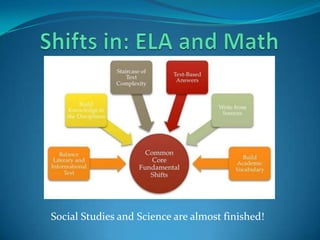
Social Studies and Science are almost finished!
Break into Groups
 Read the Shift given to your group
 Describe the Shift on Chart paper
 Be prepared to share
We are going to UNPACK one together and then
support YOUR small groups to do the same.
Shift 1
Balancing Informational & Literary Texts
 Students read a true balance of informational and
literary texts. Elementary school classrooms are,
therefore, places where students access the world –
science, social studies, the arts and literature –
through text. At least 50% of what students read is
informational.
 Informational Text
 Narrative Non-Fiction
 Literary Text
 Appendix B
 ELA Module list (in a later slide)
 At least 50% is informational
 Research shows students do not read informational
text and remember what they read- College and Career
Ready
Shift 1: What is Read in School
Shift 2
Knowledge in the Disciplines
 Content area teachers outside of the ELA classroom
emphasize literacy experiences in their planning and
instruction. Students learn through domain specific
texts in science and social studies classrooms – rather
than referring to the text, they are expected to learn
from what they read.
Shift 2: Reading in Other Areas
 Read in Science
 Read in Social Studies
 Read in …
 Students will learn from what they read
Shift 3
Staircase of Complexity
 In order to prepare students for the complexity of
college and career ready texts, each grade level
requires a “step” of growth on the “staircase”. Students
read the central, grade appropriate text around which
instruction is centered. Teachers are patient, create
more time and space in the curriculum for this close
and careful reading, and provide appropriate and
necessary scaffolding and supports so that it is possible
for students reading below grade level.
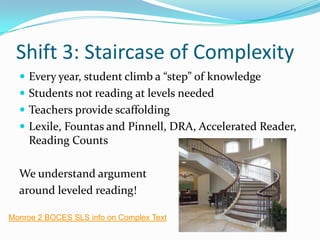
Shift 3: Staircase of Complexity
 Every year, student climb a “step” of knowledge
 Students not reading at levels needed
 Teachers provide scaffolding
 Lexile, Fountas and Pinnell, DRA, Accelerated Reader,
Reading Counts
We understand argument
around leveled reading!
Monroe 2 BOCES SLS info on Complex Text
Shift 4
Text-Based Answers
 Students have rich and rigorous conversations which
are dependent on a common text. Teachers insist that
classroom experiences stay deeply connected to the
text on the page and that students develop habits for
making evidentiary arguments both in conversation,
as well as in writing, to assess comprehension of a text.
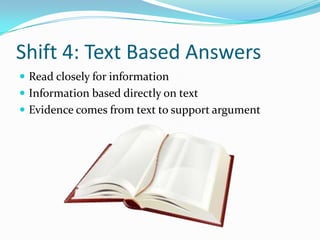
Shift 4: Text Based Answers
 Read closely for information
 Information based directly on text
 Evidence comes from text to support argument
Shift 5
Writing from Sources
 Writing needs to emphasize use of evidence to inform
or make an argument rather than the personal
narrative and other forms of decontextualized
prompts. While the narrative still has an important
role, students develop skills through written
arguments that respond to the ideas, events, facts, and
arguments presented in the texts they read.
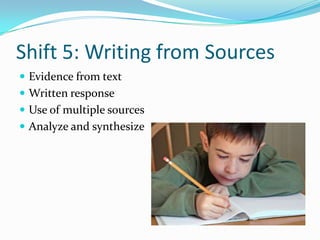
Shift 5: Writing from Sources
 Evidence from text
 Written response
 Use of multiple sources
 Analyze and synthesize
New shift change released earlier
this month!!
Sub Shift 5: This is where Libraries
can easily live!!
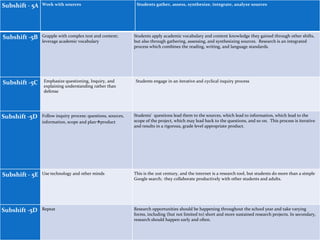
Subshift - 5A Work with sources Students gather, assess, synthesize, integrate, analyze sources
Subshift -5B Grapple with complex text and content;
leverage academic vocabulary
Students apply academic vocabulary and content knowledge they gained through other shifts,
but also through gathering, assessing, and synthesizing sources. Research is an integrated
process which combines the reading, writing, and language standards.
Subshift -5C Emphasize questioning, Inquiry, and
explaining understanding rather than
defense
Students engage in an iterative and cyclical inquiry process
Subshift -5D Follow inquiry process: questions, sources,
information, scope and planproduct
Students' questions lead them to the sources, which lead to information, which lead to the
scope of the project, which may lead back to the questions, and so on. This process is iterative
and results in a rigorous, grade level appropriate product.
Subshift - 5E Use technology and other minds This is the 21st century, and the internet is a research tool, but students do more than a simple
Google search; they collaborate productively with other students and adults.
Subshift -5D Repeat Research opportunities should be happening throughout the school year and take varying
forms, including (but not limited to) short and more sustained research projects. In secondary,
research should happen early and often.
Shift 6
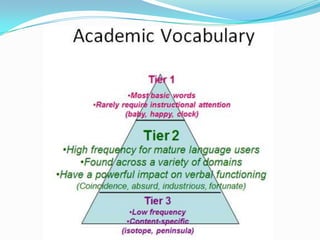
Academic Vocabulary
 Students constantly build the vocabulary they need to
access grade level complex texts. By focusing
strategically on comprehension of pivotal and
commonly found words (such as “discourse,”
“generation,” “theory,” and “principled”) and less on
esoteric literary terms (such as “onomatopoeia” or
“homonym”), teachers constantly build students’
ability to access more complex texts across the content
areas.
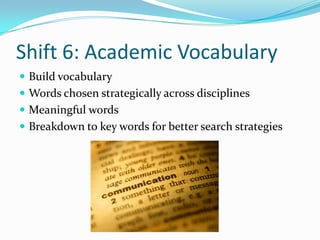
Shift 6: Academic Vocabulary
 Build vocabulary
 Words chosen strategically across disciplines
 Meaningful words
 Breakdown to key words for better search strategies
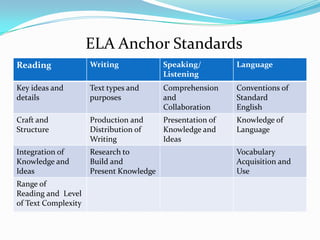
ELA Anchor Standards
 They are the same skills for each grade level
 They indicate what kids should be able to do
 The specific standards are different for each grade
level.
Reading Writing Speaking/
Listening
Language
Key ideas and
details
Text types and
purposes
Comprehension
and
Collaboration
Conventions of
Standard
English
Craft and
Structure
Production and
Distribution of
Writing
Presentation of
Knowledge and
Ideas
Knowledge of
Language
Integration of
Knowledge and
Ideas
Research to
Build and
Present Knowledge
Vocabulary
Acquisition and
Use
Range of
Reading and Level
of Text Complexity
ELA Anchor Standards
Collection Development
 From ENGAGEny: Text List for P-12 ELA
 http://www.engageny.org/resource/text-list-for-p-12-ela
 Click on the Text List for P-12 ELA
 Looking for high quality & interesting informational
texts
 Especially look for history and science
Collection Dev. Cont’d
 Looking for Book Pairing Ideas: Fiction with non
fiction
 Audio books for texts being used
 Books with multiple (opposing) viewpoints
 Online databases- talk to the
schools!
 Still purchase fiction!!!
Programming Ideas for Kids
 Connecting ideas and books to real life (not just for
science or social studies)
 More experiential
 When doing a story time or a program, have
informational texts available or on display
 Ask questions that refer back to book or illustrations
 Content creation classes for kids
 Book trailers
 Video production
 Vodcast book talks
Programming for Adults
 Primary Resources for Parents
 Information Literacy for Parents
 Many think this means informational technology
 How to use online databases
 Website evaluation
 Searching online catalog
 For teachers: What resources are available from Public
Library
Work With the Schools
 Ask for curriculum maps
 Work together on summer reading
 Offer to have a library department meeting at public
library
 Joint non fiction book club for kids
Other Items
 Reading Levels in Online Catalog
 Repeat from earlier: Book Pairing
 Reach out to PTA:
Tell them resources and services YOU can provide
around Common Core
 Text based answers- have kids use them when
discussing a book with them
Lending books to schools
 Schools are very grateful for ILL
 Waive late fees when a school borrows
 Help with finding class sets of a text
 If you have large quantities of the same texts not being used, offer to
loan to schools
 Promote AUDIOBOOK and eBook access (especially for required titles)
 Participate in literacy campaigns, initiatives, contests
Virtual Presence
 Create a virtual presence for kids and parents
 Easy access to online resources
 24-7 access for patrons
 Primary source documents
 eBooks/audiobooks/music
 Institutional websites
 WHAT DO YOU CURRENTLY HAVE???
 WHAT needs better promotion/easier access?
Your Turn!
 What is one thing you can do within the
next two weeks?
 What is one thing you can do over the course of the
next year?
 Who can you connect with to make these goals a
reality?
 Put this into your calendar to remind yourself!
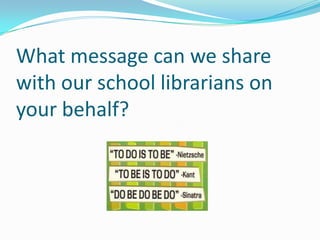
What message can we share
with our school librarians on
your behalf?
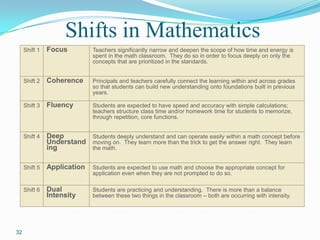
Shifts in Mathematics
32
Shift 1 Focus Teachers significantly narrow and deepen the scope of how time and energy is
spent in the math classroom. They do so in order to focus deeply on only the
concepts that are prioritized in the standards.
Shift 2 Coherence Principals and teachers carefully connect the learning within and across grades
so that students can build new understanding onto foundations built in previous
years.
Shift 3 Fluency Students are expected to have speed and accuracy with simple calculations;
teachers structure class time and/or homework time for students to memorize,
through repetition, core functions.
Shift 4 Deep
Understand
ing
Students deeply understand and can operate easily within a math concept before
moving on. They learn more than the trick to get the answer right. They learn
the math.
Shift 5 Application Students are expected to use math and choose the appropriate concept for
application even when they are not prompted to do so.
Shift 6 Dual
Intensity
Students are practicing and understanding. There is more than a balance
between these two things in the classroom – both are occurring with intensity.
Math Shifts- What’s Different?
 Apply math concepts in “real world” situations. Teachers in
content areas outside of math, particularly science, ensure that
students are using math to make meaning of and access content.
 Students move beyond THE RIGHT ANSWER. They demonstrate deep
conceptual understanding of core math concepts by applying them to
new situations as well as writing and speaking about their
understanding.
 Understand the world mathematically.
 Use mathematics to make decisions and real world connections.
Common Core – Mathematics - KEY IDEAS
http://www.corestandards.org/about-the-standards/key-points-in-mathematics

Common Core Learning Standards - Fayetteville Free Library

  • 1.
    College & CareerReadiness Problem Solving Skills Critical Thinking Skills Vocabulary Informational Text The standards will help prepare students with the knowledge and skill they need to succeed in educational and job related training after high school.
  • 2.
    Social Studies andScience are almost finished!
  • 3.
    Break into Groups Read the Shift given to your group  Describe the Shift on Chart paper  Be prepared to share We are going to UNPACK one together and then support YOUR small groups to do the same.
  • 4.
    Shift 1 Balancing Informational& Literary Texts  Students read a true balance of informational and literary texts. Elementary school classrooms are, therefore, places where students access the world – science, social studies, the arts and literature – through text. At least 50% of what students read is informational.
  • 5.
     Informational Text Narrative Non-Fiction  Literary Text  Appendix B  ELA Module list (in a later slide)  At least 50% is informational  Research shows students do not read informational text and remember what they read- College and Career Ready Shift 1: What is Read in School
  • 6.
    Shift 2 Knowledge inthe Disciplines  Content area teachers outside of the ELA classroom emphasize literacy experiences in their planning and instruction. Students learn through domain specific texts in science and social studies classrooms – rather than referring to the text, they are expected to learn from what they read.
  • 7.
    Shift 2: Readingin Other Areas  Read in Science  Read in Social Studies  Read in …  Students will learn from what they read
  • 8.
    Shift 3 Staircase ofComplexity  In order to prepare students for the complexity of college and career ready texts, each grade level requires a “step” of growth on the “staircase”. Students read the central, grade appropriate text around which instruction is centered. Teachers are patient, create more time and space in the curriculum for this close and careful reading, and provide appropriate and necessary scaffolding and supports so that it is possible for students reading below grade level.
  • 9.
    Shift 3: Staircaseof Complexity  Every year, student climb a “step” of knowledge  Students not reading at levels needed  Teachers provide scaffolding  Lexile, Fountas and Pinnell, DRA, Accelerated Reader, Reading Counts We understand argument around leveled reading! Monroe 2 BOCES SLS info on Complex Text
  • 10.
    Shift 4 Text-Based Answers Students have rich and rigorous conversations which are dependent on a common text. Teachers insist that classroom experiences stay deeply connected to the text on the page and that students develop habits for making evidentiary arguments both in conversation, as well as in writing, to assess comprehension of a text.
  • 11.
    Shift 4: TextBased Answers  Read closely for information  Information based directly on text  Evidence comes from text to support argument
  • 12.
    Shift 5 Writing fromSources  Writing needs to emphasize use of evidence to inform or make an argument rather than the personal narrative and other forms of decontextualized prompts. While the narrative still has an important role, students develop skills through written arguments that respond to the ideas, events, facts, and arguments presented in the texts they read.
  • 13.
    Shift 5: Writingfrom Sources  Evidence from text  Written response  Use of multiple sources  Analyze and synthesize
  • 14.
    New shift changereleased earlier this month!! Sub Shift 5: This is where Libraries can easily live!!
  • 15.
    Subshift - 5AWork with sources Students gather, assess, synthesize, integrate, analyze sources Subshift -5B Grapple with complex text and content; leverage academic vocabulary Students apply academic vocabulary and content knowledge they gained through other shifts, but also through gathering, assessing, and synthesizing sources. Research is an integrated process which combines the reading, writing, and language standards. Subshift -5C Emphasize questioning, Inquiry, and explaining understanding rather than defense Students engage in an iterative and cyclical inquiry process Subshift -5D Follow inquiry process: questions, sources, information, scope and planproduct Students' questions lead them to the sources, which lead to information, which lead to the scope of the project, which may lead back to the questions, and so on. This process is iterative and results in a rigorous, grade level appropriate product. Subshift - 5E Use technology and other minds This is the 21st century, and the internet is a research tool, but students do more than a simple Google search; they collaborate productively with other students and adults. Subshift -5D Repeat Research opportunities should be happening throughout the school year and take varying forms, including (but not limited to) short and more sustained research projects. In secondary, research should happen early and often.
  • 16.
    Shift 6 Academic Vocabulary Students constantly build the vocabulary they need to access grade level complex texts. By focusing strategically on comprehension of pivotal and commonly found words (such as “discourse,” “generation,” “theory,” and “principled”) and less on esoteric literary terms (such as “onomatopoeia” or “homonym”), teachers constantly build students’ ability to access more complex texts across the content areas.
  • 17.
    Shift 6: AcademicVocabulary  Build vocabulary  Words chosen strategically across disciplines  Meaningful words  Breakdown to key words for better search strategies
  • 19.
    ELA Anchor Standards They are the same skills for each grade level  They indicate what kids should be able to do  The specific standards are different for each grade level.
  • 20.
    Reading Writing Speaking/ Listening Language Keyideas and details Text types and purposes Comprehension and Collaboration Conventions of Standard English Craft and Structure Production and Distribution of Writing Presentation of Knowledge and Ideas Knowledge of Language Integration of Knowledge and Ideas Research to Build and Present Knowledge Vocabulary Acquisition and Use Range of Reading and Level of Text Complexity ELA Anchor Standards
  • 22.
    Collection Development  FromENGAGEny: Text List for P-12 ELA  http://www.engageny.org/resource/text-list-for-p-12-ela  Click on the Text List for P-12 ELA  Looking for high quality & interesting informational texts  Especially look for history and science
  • 23.
    Collection Dev. Cont’d Looking for Book Pairing Ideas: Fiction with non fiction  Audio books for texts being used  Books with multiple (opposing) viewpoints  Online databases- talk to the schools!  Still purchase fiction!!!
  • 24.
    Programming Ideas forKids  Connecting ideas and books to real life (not just for science or social studies)  More experiential  When doing a story time or a program, have informational texts available or on display  Ask questions that refer back to book or illustrations  Content creation classes for kids  Book trailers  Video production  Vodcast book talks
  • 25.
    Programming for Adults Primary Resources for Parents  Information Literacy for Parents  Many think this means informational technology  How to use online databases  Website evaluation  Searching online catalog  For teachers: What resources are available from Public Library
  • 26.
    Work With theSchools  Ask for curriculum maps  Work together on summer reading  Offer to have a library department meeting at public library  Joint non fiction book club for kids
  • 27.
    Other Items  ReadingLevels in Online Catalog  Repeat from earlier: Book Pairing  Reach out to PTA: Tell them resources and services YOU can provide around Common Core  Text based answers- have kids use them when discussing a book with them
  • 28.
    Lending books toschools  Schools are very grateful for ILL  Waive late fees when a school borrows  Help with finding class sets of a text  If you have large quantities of the same texts not being used, offer to loan to schools  Promote AUDIOBOOK and eBook access (especially for required titles)  Participate in literacy campaigns, initiatives, contests
  • 29.
    Virtual Presence  Createa virtual presence for kids and parents  Easy access to online resources  24-7 access for patrons  Primary source documents  eBooks/audiobooks/music  Institutional websites  WHAT DO YOU CURRENTLY HAVE???  WHAT needs better promotion/easier access?
  • 30.
    Your Turn!  Whatis one thing you can do within the next two weeks?  What is one thing you can do over the course of the next year?  Who can you connect with to make these goals a reality?  Put this into your calendar to remind yourself!
  • 31.
    What message canwe share with our school librarians on your behalf?
  • 32.
    Shifts in Mathematics 32 Shift1 Focus Teachers significantly narrow and deepen the scope of how time and energy is spent in the math classroom. They do so in order to focus deeply on only the concepts that are prioritized in the standards. Shift 2 Coherence Principals and teachers carefully connect the learning within and across grades so that students can build new understanding onto foundations built in previous years. Shift 3 Fluency Students are expected to have speed and accuracy with simple calculations; teachers structure class time and/or homework time for students to memorize, through repetition, core functions. Shift 4 Deep Understand ing Students deeply understand and can operate easily within a math concept before moving on. They learn more than the trick to get the answer right. They learn the math. Shift 5 Application Students are expected to use math and choose the appropriate concept for application even when they are not prompted to do so. Shift 6 Dual Intensity Students are practicing and understanding. There is more than a balance between these two things in the classroom – both are occurring with intensity.
  • 33.
    Math Shifts- What’sDifferent?  Apply math concepts in “real world” situations. Teachers in content areas outside of math, particularly science, ensure that students are using math to make meaning of and access content.  Students move beyond THE RIGHT ANSWER. They demonstrate deep conceptual understanding of core math concepts by applying them to new situations as well as writing and speaking about their understanding.  Understand the world mathematically.  Use mathematics to make decisions and real world connections. Common Core – Mathematics - KEY IDEAS http://www.corestandards.org/about-the-standards/key-points-in-mathematics