Milk Chemistry
Lecture (1)
Farhang Hamid abdulqadr
Halabja agriculture
Protein milk
Milk protein
• Proteins are an extremely important class of naturally
occurring compounds that are essential to all life
processes.
They perform a variety of functions in living organisms
ranging from providing structure to reproduction.
Milk proteins represent one of the greatest
contributions of milk to human nutrition.
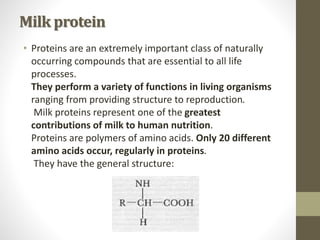
Proteins are polymers of amino acids. Only 20 different
amino acids occur, regularly in proteins.
They have the general structure:
• R represents the organic radical.
Each amino acid has a different radical and this affects the
properties of the acid.
The content and sequence of amino acids in a protein
therefore affect its properties.
Some proteins contain substances other than amino acids,
eg/ Lipoproteins contain fat and protein
Such proteins are called conjugated proteins:
• Phosphoproteins: Phosphate is linked chemically to these
proteins—examples include casein in milk and
phosphoproteins in egg yolk.
• Lipoproteins: These combinations of lipid and protein are
excellent emulsifying agents. Lipoproteins are found in milk
and egg yolk.
• Chromoproteins: These are proteins with a coloured
prosthetic group and include hemoglobin and myoglobin.
Casein
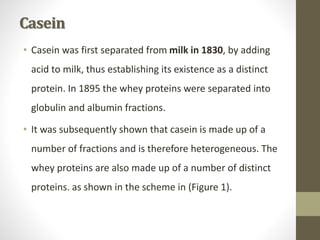
• Casein was first separated from milk in 1830, by adding
acid to milk, thus establishing its existence as a distinct
protein. In 1895 the whey proteins were separated into
globulin and albumin fractions.
• It was subsequently shown that casein is made up of a
number of fractions and is therefore heterogeneous. The
whey proteins are also made up of a number of distinct
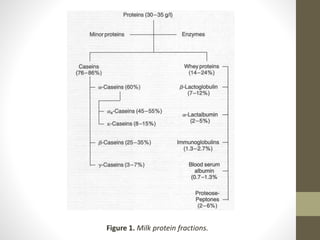
proteins. as shown in the scheme in (Figure 1).
Figure 1. Milk protein fractions.
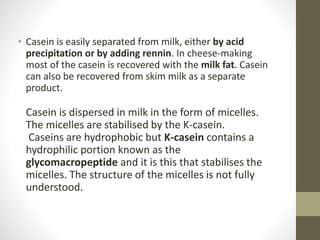
• Casein is easily separated from milk, either by acid
precipitation or by adding rennin. In cheese-making
most of the casein is recovered with the milk fat. Casein
can also be recovered from skim milk as a separate
product.
Casein is dispersed in milk in the form of micelles.
The micelles are stabilised by the Κ-casein.
Caseins are hydrophobic but Κ-casein contains a
hydrophilic portion known as the
glycomacropeptide and it is this that stabilises the
micelles. The structure of the micelles is not fully
understood.
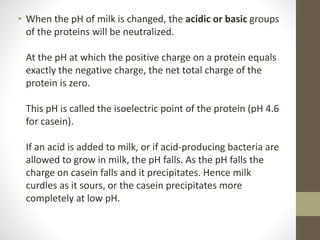
• When the pH of milk is changed, the acidic or basic groups
of the proteins will be neutralized.
At the pH at which the positive charge on a protein equals
exactly the negative charge, the net total charge of the
protein is zero.
This pH is called the isoelectric point of the protein (pH 4.6
for casein).
If an acid is added to milk, or if acid-producing bacteria are
allowed to grow in milk, the pH falls. As the pH falls the
charge on casein falls and it precipitates. Hence milk
curdles as it sours, or the casein precipitates more
completely at low pH.
Whey proteins
• After the fat and casein have been removed from milk, one is
left with whey, which contains the soluble milk salts, milk
sugar and the remainder of the milk proteins. Like the proteins
in eggs, whey proteins can be coagulated by heat. When
coagulated, they can be recovered with caseins in the
manufacture of acid-type cheeses. The whey proteins are
made up of a number of distinct proteins, the most important
of which are b-lactoglobulin and lactoglobulin. b-lactoglobulin
accounts for about 50% of the whey proteins, and has a high
content of essential amino acids. It forms a complex with Κ-
casein when milk is heated to more than 75°C, and this
complex affects the functional properties of milk.
Denaturation of b-lactoglobulin causes the cooked flavour of
heated milk
Other milk proteins
• In addition to the major protein fractions outlined, milk contains
a number of enzymes. The main enzymes present are lipases,
which cause rancidity, particularly in homogenised milk, and
phosphatase enzymes, which catalyse the hydrolysis of organic
phosphates. Measuring the inactivation of alkaline phosphatase
is a method of testing the effectiveness of pasteurisation of milk.
• Peroxidase enzymes, which catalyse the breakdown of hydrogen
peroxide to water and oxygen, are also present. Lactoperoxidase
can be activated and use is made of this for milk preservation.
• Milk also contains protease enzymes, which catalyse the
hydrolysis of proteins, and lactalbumin, bovine serum albumin,
the immune globulins and lactoferrin, which protect the young
calf against infection.

Lectuer 1 protin milk

  • 1.
    Milk Chemistry Lecture (1) FarhangHamid abdulqadr Halabja agriculture Protein milk
  • 2.
    Milk protein • Proteinsare an extremely important class of naturally occurring compounds that are essential to all life processes. They perform a variety of functions in living organisms ranging from providing structure to reproduction. Milk proteins represent one of the greatest contributions of milk to human nutrition. Proteins are polymers of amino acids. Only 20 different amino acids occur, regularly in proteins. They have the general structure:
  • 3.
    • R representsthe organic radical. Each amino acid has a different radical and this affects the properties of the acid. The content and sequence of amino acids in a protein therefore affect its properties. Some proteins contain substances other than amino acids, eg/ Lipoproteins contain fat and protein Such proteins are called conjugated proteins: • Phosphoproteins: Phosphate is linked chemically to these proteins—examples include casein in milk and phosphoproteins in egg yolk. • Lipoproteins: These combinations of lipid and protein are excellent emulsifying agents. Lipoproteins are found in milk and egg yolk. • Chromoproteins: These are proteins with a coloured prosthetic group and include hemoglobin and myoglobin.
  • 4.
    Casein • Casein wasfirst separated from milk in 1830, by adding acid to milk, thus establishing its existence as a distinct protein. In 1895 the whey proteins were separated into globulin and albumin fractions. • It was subsequently shown that casein is made up of a number of fractions and is therefore heterogeneous. The whey proteins are also made up of a number of distinct proteins. as shown in the scheme in (Figure 1).
  • 5.
    Figure 1. Milkprotein fractions.
  • 6.
    • Casein iseasily separated from milk, either by acid precipitation or by adding rennin. In cheese-making most of the casein is recovered with the milk fat. Casein can also be recovered from skim milk as a separate product. Casein is dispersed in milk in the form of micelles. The micelles are stabilised by the Κ-casein. Caseins are hydrophobic but Κ-casein contains a hydrophilic portion known as the glycomacropeptide and it is this that stabilises the micelles. The structure of the micelles is not fully understood.
  • 7.
    • When thepH of milk is changed, the acidic or basic groups of the proteins will be neutralized. At the pH at which the positive charge on a protein equals exactly the negative charge, the net total charge of the protein is zero. This pH is called the isoelectric point of the protein (pH 4.6 for casein). If an acid is added to milk, or if acid-producing bacteria are allowed to grow in milk, the pH falls. As the pH falls the charge on casein falls and it precipitates. Hence milk curdles as it sours, or the casein precipitates more completely at low pH.
  • 8.
    Whey proteins • Afterthe fat and casein have been removed from milk, one is left with whey, which contains the soluble milk salts, milk sugar and the remainder of the milk proteins. Like the proteins in eggs, whey proteins can be coagulated by heat. When coagulated, they can be recovered with caseins in the manufacture of acid-type cheeses. The whey proteins are made up of a number of distinct proteins, the most important of which are b-lactoglobulin and lactoglobulin. b-lactoglobulin accounts for about 50% of the whey proteins, and has a high content of essential amino acids. It forms a complex with Κ- casein when milk is heated to more than 75°C, and this complex affects the functional properties of milk. Denaturation of b-lactoglobulin causes the cooked flavour of heated milk
  • 9.
    Other milk proteins •In addition to the major protein fractions outlined, milk contains a number of enzymes. The main enzymes present are lipases, which cause rancidity, particularly in homogenised milk, and phosphatase enzymes, which catalyse the hydrolysis of organic phosphates. Measuring the inactivation of alkaline phosphatase is a method of testing the effectiveness of pasteurisation of milk. • Peroxidase enzymes, which catalyse the breakdown of hydrogen peroxide to water and oxygen, are also present. Lactoperoxidase can be activated and use is made of this for milk preservation. • Milk also contains protease enzymes, which catalyse the hydrolysis of proteins, and lactalbumin, bovine serum albumin, the immune globulins and lactoferrin, which protect the young calf against infection.