Chyme
The materials which enter into the intestine after leaving
the stomach, known as chyme, is acidic in condition.
(the mixture of food, mucus and gastric juices
became a slurry called chyme)
But intestinal enzymes work in alkaline condition.
In intestine, alkaline condition is created due to :
- Bile, the secretion of liver which is stored in gall bladder
- Bicarbonate buffering compounds from pancreas, which
neutralize the acidic chyme
Digestion Process
Digestion Process
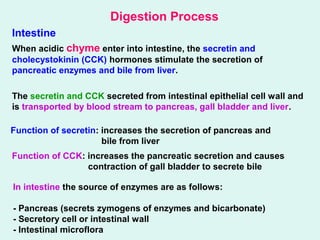
Intestine
When acidic chyme enter into intestine, the secretin and
cholecystokinin (CCK) hormones stimulate the secretion of
pancreatic enzymes and bile from liver.
The secretin and CCK secreted from intestinal epithelial cell wall and
is transported by blood stream to pancreas, gall bladder and liver.
Function of secretin: increases the secretion of pancreas and
bile from liver
Function of CCK: increases the pancreatic secretion and causes
contraction of gall bladder to secrete bile
In intestine the source of enzymes are as follows:
- Pancreas (secrets zymogens of enzymes and bicarbonate)
- Secretory cell or intestinal wall
- Intestinal microflora
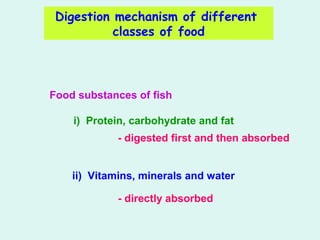
Digestion mechanism of different
classes of food
Food substances of fish
i) Protein, carbohydrate and fat
- digested first and then absorbed
ii) Vitamins, minerals and water
- directly absorbed
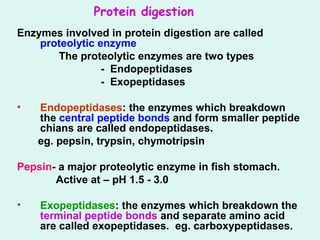
Protein digestion
Enzymes involved in protein digestion are called
proteolytic enzyme
The proteolytic enzymes are two types
- Endopeptidases
- Exopeptidases
• Endopeptidases: the enzymes which breakdown
the central peptide bonds and form smaller peptide
chians are called endopeptidases.
eg. pepsin, trypsin, chymotripsin
Pepsin- a major proteolytic enzyme in fish stomach.
Active at – pH 1.5 - 3.0
• Exopeptidases: the enzymes which breakdown the
terminal peptide bonds and separate amino acid
are called exopeptidases. eg. carboxypeptidases.
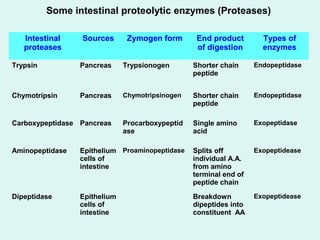
Some intestinal proteolytic enzymes (Proteases)
Intestinal
proteases
Sources Zymogen form End product
of digestion
Types of
enzymes
Trypsin Pancreas Trypsionogen Shorter chain
peptide
Endopeptidase
Chymotripsin Pancreas Chymotripsinogen Shorter chain
peptide
Endopeptidase
Carboxypeptidase Pancreas Procarboxypeptid
ase
Single amino
acid
Exopeptidase
Aminopeptidase Epithelium
cells of
intestine
Proaminopeptidase Splits off
individual A.A.
from amino
terminal end of
peptide chain
Exopeptidease
Dipeptidase Epithelium
cells of
intestine
Breakdown
dipeptides into
constituent AA
Exopeptidease
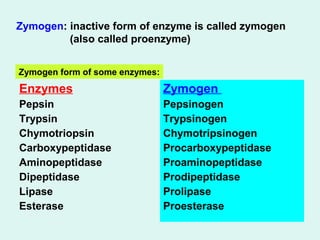
Zymogen: inactive form of enzyme is called zymogen
(also called proenzyme)
Enzymes
Pepsin
Trypsin
Chymotriopsin
Carboxypeptidase
Aminopeptidase
Dipeptidase
Lipase
Esterase
Zymogen
Pepsinogen
Trypsinogen
Chymotripsinogen
Procarboxypeptidase
Proaminopeptidase
Prodipeptidase
Prolipase
Proesterase
Zymogen form of some enzymes:
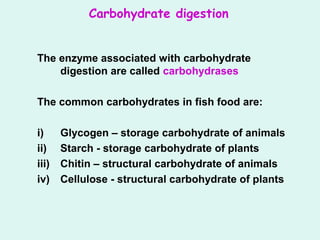
Carbohydrate digestion
The enzyme associated with carbohydrate
digestion are called carbohydrases
The common carbohydrates in fish food are:
i) Glycogen – storage carbohydrate of animals
ii) Starch - storage carbohydrate of plants
iii) Chitin – structural carbohydrate of animals
iv) Cellulose - structural carbohydrate of plants
Starch and Glycogen
Amylase – hydrolyze the starch and glycogen
Amylase are 2 types:
i) α amylase and
ii) β amylase
Digestive amylase of animal is generally α amylase which acts
on α(1,4) glucosidic linkage of both starch and glycogen
and converts into a mixture of glucose and maltose.
Starch contain – amylose and amylopectin [contain both α
(1,4) and α(1,6) linkage]
Glycogen is structurally similar to amylopectin but their only
difference is that glycogen contain more branch than
amylopectin (i.e. contain more α(1,6) linkage)
Chitin
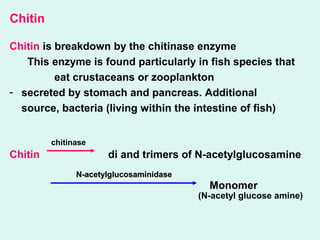
Chitin is breakdown by the chitinase enzyme
This enzyme is found particularly in fish species that
eat crustaceans or zooplankton
- secreted by stomach and pancreas. Additional
source, bacteria (living within the intestine of fish)
Chitin di and trimers of N-acetylglucosamine
Monomer
chitinase
N-acetylglucosaminidaseN-acetylglucosaminidase
(N-acetyl glucose amine)
Cellulose
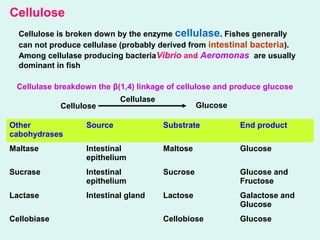
Cellulose is broken down by the enzyme cellulase. Fishes generally
can not produce cellulase (probably derived from intestinal bacteria).
Among cellulase producing bacteriaVibrio and Aeromonas are usually
dominant in fish
Cellulose
Cellulase
Glucose
Cellulase breakdown the β(1,4) linkage of cellulose and produce glucose
Other
cabohydrases
Source Substrate End product
Maltase Intestinal
epithelium
Maltose Glucose
Sucrase Intestinal
epithelium
Sucrose Glucose and
Fructose
Lactase Intestinal gland Lactose Galactose and
Glucose
Cellobiase Cellobiose Glucose
Lipid digestion
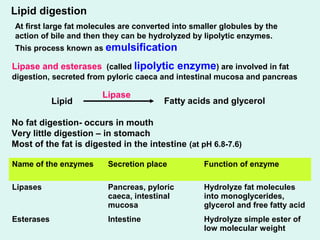
At first large fat molecules are converted into smaller globules by the
action of bile and then they can be hydrolyzed by lipolytic enzymes.
This process known as emulsification
Lipase and esterases (called lipolytic enzyme) are involved in fat
digestion, secreted from pyloric caeca and intestinal mucosa and pancreas
Lipid Fatty acids and glycerol
Lipase
No fat digestion- occurs in mouth
Very little digestion – in stomach
Most of the fat is digested in the intestine (at pH 6.8-7.6)
Name of the enzymes Secretion place Function of enzyme
Lipases Pancreas, pyloric
caeca, intestinal
mucosa
Hydrolyze fat molecules
into monoglycerides,
glycerol and free fatty acid
Esterases Intestine Hydrolyze simple ester of
low molecular weight
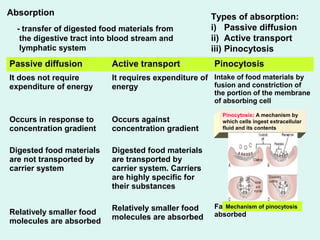
Absorption
- transfer of digested food materials from
the digestive tract into blood stream and
lymphatic system
Types of absorption:
i) Passive diffusion
ii) Active transport
iii) Pinocytosis
Passive diffusion Active transport Pinocytosis
It does not require
expenditure of energy
Occurs in response to
concentration gradient
Digested food materials
are not transported by
carrier system
Relatively smaller food
molecules are absorbed
It requires expenditure of
energy
Occurs against
concentration gradient
Digested food materials
are transported by
carrier system. Carriers
are highly specific for
their substances
Relatively smaller food
molecules are absorbed
Intake of food materials by
fusion and constriction of
the portion of the membrane
of absorbing cell
Fairly large molecules are
absorbed
Pinocytosis: A mechanism by
which cells ingest extracellular
fluid and its contents
Mechanism of pinocytosis
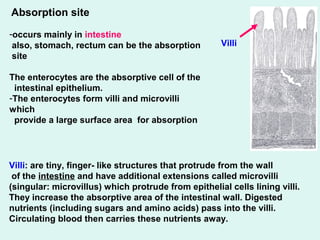
Absorption site
-occurs mainly in intestine
also, stomach, rectum can be the absorption
site
The enterocytes are the absorptive cell of the
intestinal epithelium.
-The enterocytes form villi and microvilli
which
provide a large surface area for absorption
Villi: are tiny, finger- like structures that protrude from the wall
of the intestine and have additional extensions called microvilli
(singular: microvillus) which protrude from epithelial cells lining villi.
They increase the absorptive area of the intestinal wall. Digested
nutrients (including sugars and amino acids) pass into the villi.
Circulating blood then carries these nutrients away.
Villi
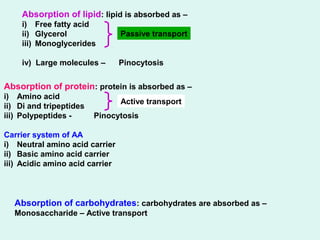
Absorption of lipid: lipid is absorbed as –
i) Free fatty acid
ii) Glycerol
iii) Monoglycerides
iv) Large molecules – Pinocytosis
Absorption of protein: protein is absorbed as –
i) Amino acid
ii) Di and tripeptides
iii) Polypeptides - Pinocytosis
Carrier system of AA
i) Neutral amino acid carrier
ii) Basic amino acid carrier
iii) Acidic amino acid carrier
Absorption of carbohydrates: carbohydrates are absorbed as –
Monosaccharide – Active transport
Passive transport
Active transport
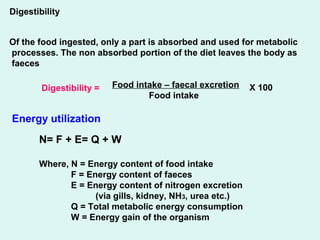
Digestibility
Of the food ingested, only a part is absorbed and used for metabolic
processes. The non absorbed portion of the diet leaves the body as
faeces
Digestibility = Food intake – faecal excretion
Food intake
X 100
Energy utilization
N= F + E= Q + W
Where, N = Energy content of food intake
F = Energy content of faeces
E = Energy content of nitrogen excretion
(via gills, kidney, NH3, urea etc.)
Q = Total metabolic energy consumption
W = Energy gain of the organism
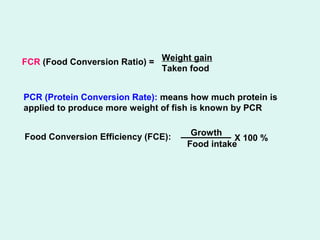
FCR (Food Conversion Ratio) = Weight gain
Taken food
PCR (Protein Conversion Rate): means how much protein is
applied to produce more weight of fish is known by PCR
Food Conversion Efficiency (FCE): Growth
Food intake
X 100 %
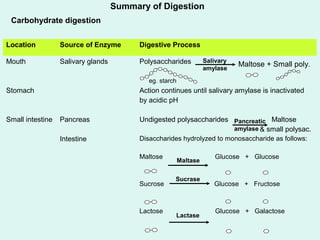
Summary of Digestion
Location Source of Enzyme Digestive Process
Mouth
Stomach
Small intestine
Salivary glands
Pancreas
Intestine
Polysaccharides
Action continues until salivary amylase is inactivated
by acidic pH
Undigested polysaccharides Maltose
& small polysac.
Disaccharides hydrolyzed to monosaccharide as follows:
Maltose Glucose + Glucose
Sucrose Glucose + Fructose
Lactose Glucose + Galactose
Carbohydrate digestion
Maltose + Small poly.
Salivary
amylase
eg. starch
Pancreatic
amylase
Maltase
Sucrase
Lactase
Protein digestion
Location Source of Enzyme Digestive Process
Stomach
Small intestine
Stomach
(gastric gland)
Pancreas
Protein Short polypeptides
Polypeptides
Polypeptides
Peptides + Dipeptides Free a. a.
A - A - A A - A
Pepsin
A – A – A – A – A
A – A – A – A – A
Polypeptides + Dipeptides
A – A – A A – A
Trypsin
Chymotripsin
Polypeptides and free a. a.
A – A – A A A
Carboxy-
peptidase
A – A – A – A
A A
A
Peptideses,
Dipeptidases
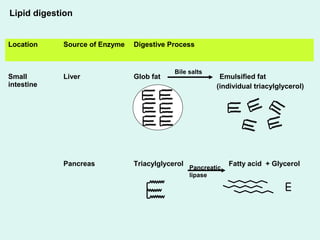
Lipid digestion
Location Source of Enzyme Digestive Process
Small
intestine
Liver
Pancreas
Glob fat Emulsified fat
(individual triacylglycerol)
Triacylglycerol Fatty acid + Glycerol
Bile salts
Pancreatic
lipase

digestion

  • 1.
    Chyme The materials whichenter into the intestine after leaving the stomach, known as chyme, is acidic in condition. (the mixture of food, mucus and gastric juices became a slurry called chyme) But intestinal enzymes work in alkaline condition. In intestine, alkaline condition is created due to : - Bile, the secretion of liver which is stored in gall bladder - Bicarbonate buffering compounds from pancreas, which neutralize the acidic chyme Digestion Process
  • 2.
    Digestion Process Intestine When acidicchyme enter into intestine, the secretin and cholecystokinin (CCK) hormones stimulate the secretion of pancreatic enzymes and bile from liver. The secretin and CCK secreted from intestinal epithelial cell wall and is transported by blood stream to pancreas, gall bladder and liver. Function of secretin: increases the secretion of pancreas and bile from liver Function of CCK: increases the pancreatic secretion and causes contraction of gall bladder to secrete bile In intestine the source of enzymes are as follows: - Pancreas (secrets zymogens of enzymes and bicarbonate) - Secretory cell or intestinal wall - Intestinal microflora
  • 3.
    Digestion mechanism ofdifferent classes of food Food substances of fish i) Protein, carbohydrate and fat - digested first and then absorbed ii) Vitamins, minerals and water - directly absorbed
  • 4.
    Protein digestion Enzymes involvedin protein digestion are called proteolytic enzyme The proteolytic enzymes are two types - Endopeptidases - Exopeptidases • Endopeptidases: the enzymes which breakdown the central peptide bonds and form smaller peptide chians are called endopeptidases. eg. pepsin, trypsin, chymotripsin Pepsin- a major proteolytic enzyme in fish stomach. Active at – pH 1.5 - 3.0 • Exopeptidases: the enzymes which breakdown the terminal peptide bonds and separate amino acid are called exopeptidases. eg. carboxypeptidases.
  • 5.
    Some intestinal proteolyticenzymes (Proteases) Intestinal proteases Sources Zymogen form End product of digestion Types of enzymes Trypsin Pancreas Trypsionogen Shorter chain peptide Endopeptidase Chymotripsin Pancreas Chymotripsinogen Shorter chain peptide Endopeptidase Carboxypeptidase Pancreas Procarboxypeptid ase Single amino acid Exopeptidase Aminopeptidase Epithelium cells of intestine Proaminopeptidase Splits off individual A.A. from amino terminal end of peptide chain Exopeptidease Dipeptidase Epithelium cells of intestine Breakdown dipeptides into constituent AA Exopeptidease
  • 6.
    Zymogen: inactive formof enzyme is called zymogen (also called proenzyme) Enzymes Pepsin Trypsin Chymotriopsin Carboxypeptidase Aminopeptidase Dipeptidase Lipase Esterase Zymogen Pepsinogen Trypsinogen Chymotripsinogen Procarboxypeptidase Proaminopeptidase Prodipeptidase Prolipase Proesterase Zymogen form of some enzymes:
  • 7.
    Carbohydrate digestion The enzymeassociated with carbohydrate digestion are called carbohydrases The common carbohydrates in fish food are: i) Glycogen – storage carbohydrate of animals ii) Starch - storage carbohydrate of plants iii) Chitin – structural carbohydrate of animals iv) Cellulose - structural carbohydrate of plants
  • 8.
    Starch and Glycogen Amylase– hydrolyze the starch and glycogen Amylase are 2 types: i) α amylase and ii) β amylase Digestive amylase of animal is generally α amylase which acts on α(1,4) glucosidic linkage of both starch and glycogen and converts into a mixture of glucose and maltose. Starch contain – amylose and amylopectin [contain both α (1,4) and α(1,6) linkage] Glycogen is structurally similar to amylopectin but their only difference is that glycogen contain more branch than amylopectin (i.e. contain more α(1,6) linkage)
  • 9.
    Chitin Chitin is breakdownby the chitinase enzyme This enzyme is found particularly in fish species that eat crustaceans or zooplankton - secreted by stomach and pancreas. Additional source, bacteria (living within the intestine of fish) Chitin di and trimers of N-acetylglucosamine Monomer chitinase N-acetylglucosaminidaseN-acetylglucosaminidase (N-acetyl glucose amine)
  • 10.
    Cellulose Cellulose is brokendown by the enzyme cellulase. Fishes generally can not produce cellulase (probably derived from intestinal bacteria). Among cellulase producing bacteriaVibrio and Aeromonas are usually dominant in fish Cellulose Cellulase Glucose Cellulase breakdown the β(1,4) linkage of cellulose and produce glucose Other cabohydrases Source Substrate End product Maltase Intestinal epithelium Maltose Glucose Sucrase Intestinal epithelium Sucrose Glucose and Fructose Lactase Intestinal gland Lactose Galactose and Glucose Cellobiase Cellobiose Glucose
  • 11.
    Lipid digestion At firstlarge fat molecules are converted into smaller globules by the action of bile and then they can be hydrolyzed by lipolytic enzymes. This process known as emulsification Lipase and esterases (called lipolytic enzyme) are involved in fat digestion, secreted from pyloric caeca and intestinal mucosa and pancreas Lipid Fatty acids and glycerol Lipase No fat digestion- occurs in mouth Very little digestion – in stomach Most of the fat is digested in the intestine (at pH 6.8-7.6) Name of the enzymes Secretion place Function of enzyme Lipases Pancreas, pyloric caeca, intestinal mucosa Hydrolyze fat molecules into monoglycerides, glycerol and free fatty acid Esterases Intestine Hydrolyze simple ester of low molecular weight
  • 12.
    Absorption - transfer ofdigested food materials from the digestive tract into blood stream and lymphatic system Types of absorption: i) Passive diffusion ii) Active transport iii) Pinocytosis Passive diffusion Active transport Pinocytosis It does not require expenditure of energy Occurs in response to concentration gradient Digested food materials are not transported by carrier system Relatively smaller food molecules are absorbed It requires expenditure of energy Occurs against concentration gradient Digested food materials are transported by carrier system. Carriers are highly specific for their substances Relatively smaller food molecules are absorbed Intake of food materials by fusion and constriction of the portion of the membrane of absorbing cell Fairly large molecules are absorbed Pinocytosis: A mechanism by which cells ingest extracellular fluid and its contents Mechanism of pinocytosis
  • 13.
    Absorption site -occurs mainlyin intestine also, stomach, rectum can be the absorption site The enterocytes are the absorptive cell of the intestinal epithelium. -The enterocytes form villi and microvilli which provide a large surface area for absorption Villi: are tiny, finger- like structures that protrude from the wall of the intestine and have additional extensions called microvilli (singular: microvillus) which protrude from epithelial cells lining villi. They increase the absorptive area of the intestinal wall. Digested nutrients (including sugars and amino acids) pass into the villi. Circulating blood then carries these nutrients away. Villi
  • 14.
    Absorption of lipid:lipid is absorbed as – i) Free fatty acid ii) Glycerol iii) Monoglycerides iv) Large molecules – Pinocytosis Absorption of protein: protein is absorbed as – i) Amino acid ii) Di and tripeptides iii) Polypeptides - Pinocytosis Carrier system of AA i) Neutral amino acid carrier ii) Basic amino acid carrier iii) Acidic amino acid carrier Absorption of carbohydrates: carbohydrates are absorbed as – Monosaccharide – Active transport Passive transport Active transport
  • 15.
    Digestibility Of the foodingested, only a part is absorbed and used for metabolic processes. The non absorbed portion of the diet leaves the body as faeces Digestibility = Food intake – faecal excretion Food intake X 100 Energy utilization N= F + E= Q + W Where, N = Energy content of food intake F = Energy content of faeces E = Energy content of nitrogen excretion (via gills, kidney, NH3, urea etc.) Q = Total metabolic energy consumption W = Energy gain of the organism
  • 16.
    FCR (Food ConversionRatio) = Weight gain Taken food PCR (Protein Conversion Rate): means how much protein is applied to produce more weight of fish is known by PCR Food Conversion Efficiency (FCE): Growth Food intake X 100 %
  • 17.
    Summary of Digestion LocationSource of Enzyme Digestive Process Mouth Stomach Small intestine Salivary glands Pancreas Intestine Polysaccharides Action continues until salivary amylase is inactivated by acidic pH Undigested polysaccharides Maltose & small polysac. Disaccharides hydrolyzed to monosaccharide as follows: Maltose Glucose + Glucose Sucrose Glucose + Fructose Lactose Glucose + Galactose Carbohydrate digestion Maltose + Small poly. Salivary amylase eg. starch Pancreatic amylase Maltase Sucrase Lactase
  • 18.
    Protein digestion Location Sourceof Enzyme Digestive Process Stomach Small intestine Stomach (gastric gland) Pancreas Protein Short polypeptides Polypeptides Polypeptides Peptides + Dipeptides Free a. a. A - A - A A - A Pepsin A – A – A – A – A A – A – A – A – A Polypeptides + Dipeptides A – A – A A – A Trypsin Chymotripsin Polypeptides and free a. a. A – A – A A A Carboxy- peptidase A – A – A – A A A A Peptideses, Dipeptidases
  • 19.
    Lipid digestion Location Sourceof Enzyme Digestive Process Small intestine Liver Pancreas Glob fat Emulsified fat (individual triacylglycerol) Triacylglycerol Fatty acid + Glycerol Bile salts Pancreatic lipase