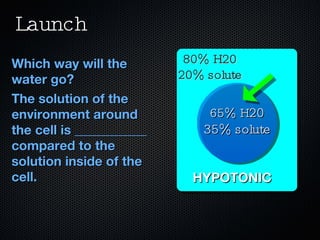
Launch Which way will the water go? The solution of the environment around the cell is ___________ compared to the solution inside of the cell. HYPOTONIC 65% H 20 35% solute 80% H20 20% solute
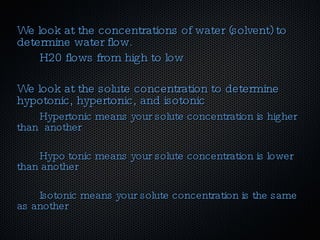
We look at the concentrations of water (solvent) to determine water flow.  H20 flows from high to low We look at the solute concentration to determine hypotonic, hypertonic, and isotonic Hypertonic means your solute concentration is higher than  another Hypo tonic means your solute concentration is lower than another Isotonic means your solute concentration is the same as another
Quiz Tomorrow Cell Membrane Structure Phospholipids Osmosis Passive and Active Transport
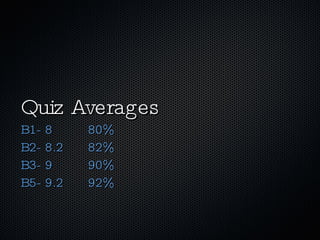
Quiz Averages B1- 8 80% B2- 8.2 82% B3- 9 90% B5- 9.2 92%
Objective I will understand the ways that different things cross the cell membrane to get IN and OUT of the cell.
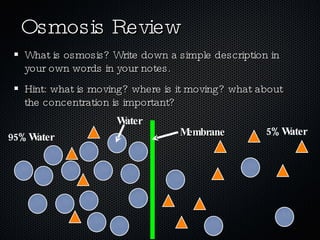
Osmosis Review What is osmosis? Write down a simple description in your own words in your notes.  Hint: what is moving? where is it moving? what about the concentration is important? 95% Water 5% Water Water Membrane
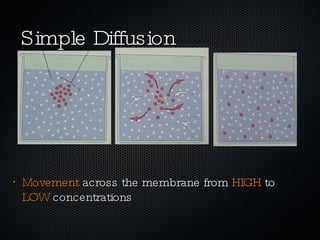
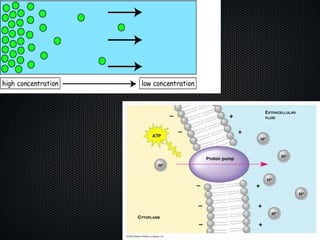
Simple Diffusion Movement  across the membrane from  HIGH  to  LOW  concentrations
Facilitated Diffusion facilitate  = help along.  diffusion that needs a little help Three ways with the cell membrane: Protein Carriers  Endocytosis Exocytosis
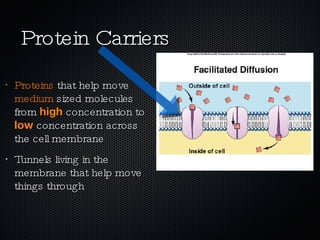
Protein Carriers Proteins  that help move  medium  sized molecules from  high  concentration to  low  concentration across the cell membrane Tunnels living in the membrane that help move things through
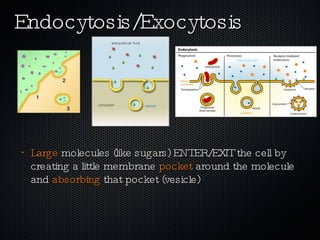
Endocytosis/Exocytosis Large  molecules (like sugars) ENTER/EXIT the cell by creating a little membrane  pocket  around the molecule and  absorbing  that pocket (vesicle)
Endocytosis and Exocytosis http://www.youtube.com/watch?v=s0p1ztrbXPY&feature=related http://www.youtube.com/watch?v=HndmASfmI8Y
Passive Transport Movement across the membrane that is easily done  without energy OSMOSIS, SIMPLE AND FACILITATED DIFFUSION   Passive  = pass right on through
Active Transport The ability of a cell to move particles from region of  LOW  to  HIGH This requires  energy  from the cell This is called  ACTIVE   Transport   = movement across the membrane that is easily done but  with energy (ATP) http://www.youtube.com/watch?v=STzOiRqzzL4
 

Diffusion Transport

  • 1.
    Launch Which waywill the water go? The solution of the environment around the cell is ___________ compared to the solution inside of the cell. HYPOTONIC 65% H 20 35% solute 80% H20 20% solute
  • 2.
    We look atthe concentrations of water (solvent) to determine water flow. H20 flows from high to low We look at the solute concentration to determine hypotonic, hypertonic, and isotonic Hypertonic means your solute concentration is higher than another Hypo tonic means your solute concentration is lower than another Isotonic means your solute concentration is the same as another
  • 3.
    Quiz Tomorrow CellMembrane Structure Phospholipids Osmosis Passive and Active Transport
  • 4.
    Quiz Averages B1-8 80% B2- 8.2 82% B3- 9 90% B5- 9.2 92%
  • 5.
    Objective I willunderstand the ways that different things cross the cell membrane to get IN and OUT of the cell.
  • 6.
    Osmosis Review Whatis osmosis? Write down a simple description in your own words in your notes. Hint: what is moving? where is it moving? what about the concentration is important? 95% Water 5% Water Water Membrane
  • 7.
    Simple Diffusion Movement across the membrane from HIGH to LOW concentrations
  • 8.
    Facilitated Diffusion facilitate = help along. diffusion that needs a little help Three ways with the cell membrane: Protein Carriers Endocytosis Exocytosis
  • 9.
    Protein Carriers Proteins that help move medium sized molecules from high concentration to low concentration across the cell membrane Tunnels living in the membrane that help move things through
  • 10.
    Endocytosis/Exocytosis Large molecules (like sugars) ENTER/EXIT the cell by creating a little membrane pocket around the molecule and absorbing that pocket (vesicle)
  • 11.
    Endocytosis and Exocytosishttp://www.youtube.com/watch?v=s0p1ztrbXPY&feature=related http://www.youtube.com/watch?v=HndmASfmI8Y
  • 12.
    Passive Transport Movementacross the membrane that is easily done without energy OSMOSIS, SIMPLE AND FACILITATED DIFFUSION Passive = pass right on through
  • 13.
    Active Transport Theability of a cell to move particles from region of LOW to HIGH This requires energy from the cell This is called ACTIVE Transport = movement across the membrane that is easily done but with energy (ATP) http://www.youtube.com/watch?v=STzOiRqzzL4
  • 14.