At the endof the class, students
should be able to ...
1.Define
osmosis and
diffusion with
at least 90%
accuracy after
a class
discussion.
2. Students should be
able to set up and carry
out the diffusion
demonstration (using
water, syrup, and food
coloring) and record
their observations in a
comparative table with
at least 80% accuracy.
3. Students should
be able to
demonstrate
curiosity and team
work by taking part
and sharing ideas at
least once during
the group
discussions and
experiments.
3.
It is themovement
of molecules from an area
of high concentration
to an area of low
concentration until the
particles are evenly
distributed and a state of
equilibrium is reached.
Defining Diffusion
High
Concentration
Low Concentration
4.
Diffusion occurs in
gases,liquids, or
across cell
membranes. It does
not require a
membrane.
Equal Concentration
5.
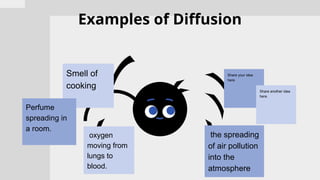
Examples of Diffusion
Smellof
cooking
Perfume
spreading in
a room.
oxygen
moving from
lungs to
blood.
Share your idea
here.
Share another idea
here.
the spreading
of air pollution
into the
atmosphere
6.
The movement ofwater
molecules only across a semi-
permeable membrane from a
region of high water
concentration to low water
concentration. Osmosis is a
special type of diffusion and it
requires a semi-permeable
membrane (e.g., cell membrane).
Defining Osmosis
Process Of Osmosis
1.PRESENCEOF SEMI-
PERMEABLE MEMBRANE
2. ESTABLISHMENT OF A
CONCENTRATION GRADIENT
3. PASSIVE MOVEMENT OF WATER
MOLECULES
5. EFFECT ON PLANT AND
ANIMAL CELL
4. EQULIBRIUM IS REACHED
10.
What do youthink will happen inside the
tude after a while?
Identify the sides of the tube where
you think has a high and low water
concentration
1
2
This is a u-shaped tube
that is separated by a
semi-permeable
membrane.
What do you think will happen
inside the tude after a while?
11.
1.Concentration difference: Twosolutions are
separated by a semipermeable membrane, with one
solution having a higher concentration of solute and
the other having a lower concentration.
2. Water movement: Water molecules move across the
semipermeable membrane from the region of higher
water potential (lower solute concentration) to the region
of lower water potential (higher solute concentration).
THE PROCESS EXPLAINED
12.
Equilibrium: This movementcontinues until the
concentration of solutes is equal on both sides of the
membrane.
Examples:
• Plant cells: When placed in water (hypotonic
solution), water enters the cell by osmosis, making it
turgid (firm).
• Animal cells: If placed in pure water, water enters by
osmosis and may cause the cell to burst (lysis).
THE PROCESS EXPLAINED
14.
Maria accidentally forgotto water her potted plant for a
week. When she checks it, the plant looks wilted, and the
leaves are drooping. She then waters the plant and notices
that after a few hours, the leaves start to stand up again.
Follow-Up Questions
1.Why did the plant wilt initially?
2.How does water move into the plant cells?
3.What role does osmosis play in the recovery?
4.How is this scenario similar to what happens to human
cells when they are dehydrated?
SCENARIO
Effect on diffusion:the greater the
difference in concentration (deeper
gradient), the faster molecules will
move from high to low concentration.
Effect on osmosis: water moves more
rapidly into a region with a higher
salute concentration if the
concentration difference is small,
water movement is slower.
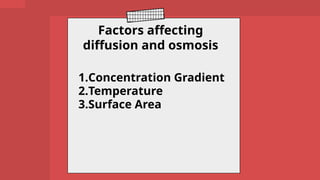
Concentration
Gradient
Example: sugar
dissolves faster in
water when there
is a larger amount
of sugar at one
and compared to
the other.
17.
Effect on diffusion:higher
temperature increases the
kinetic energy of molecules,
causing them to move faster,
speeding up diffusion.
Effect on osmosis: increased
temperature can enhance the
movement of water molecules
through the semi-permeable
membrane.
Temperature
Example:
perfume
spreads faster
in a warm
room than a
cool room.
18.
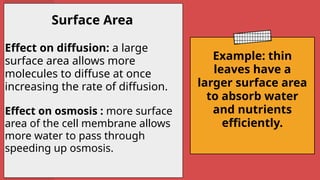
Effect on diffusion:a large
surface area allows more
molecules to diffuse at once
increasing the rate of diffusion.
Effect on osmosis : more surface
area of the cell membrane allows
more water to pass through
speeding up osmosis.
Surface Area
Example: thin
leaves have a
larger surface area
to absorb water
and nutrients
efficiently.
#16 Diffusion: The bigger the difference in concentration, the faster particles spread from high to low concentration.
Osmosis: Water moves faster into areas with more solute when the difference is large. If the difference is small, water moves more slowly.









![[M1.3] READ - Movement In & Out of Cells (PowerPoint) v1a.ppt](https://cdn.slidesharecdn.com/ss_thumbnails/m1-241215211337-6f177a0e-thumbnail.jpg?width=640&height=640&fit=bounds)


![[M1.3] READ - Movement In & Out of Cells (PowerPoint).ppt](https://cdn.slidesharecdn.com/ss_thumbnails/m1-220810222228-ef27ea10-thumbnail.jpg?width=640&height=640&fit=bounds)


