Difficult urethral
catheterisation
Sukhdev, CMC Vellore
Introduction
• Insertion of a smaller tube(catheter) into a native larger tube(urethra)
• Patients will remember catheterisation as either painful or
uneventful, depending on operator’s expertise, confidence and
gentleness
Numbers
• Urethral length – 20 cm
• Urethral volume – 20 cc
• Urethral diameter – 30 Fr(Average)
Patient has phimosis and needs catheterisation
for monitoring of his medical condition. Kindly
help
Difficulty in catheterisation. Tried with 12 and
10F catheter, but is not successful. Please help
Patient is agitated and is in ICU. Kindly catheterise
Patient has bleeding dyscrasias. Please help with
catheterisation
Patient has had multiple urethral surgeries and
patient is in retention. Please help
Patient recently had a radical prostatectomy
and after catheter removal, has come with
retention.
Patient had an RTA and has blood at meatus
Not able to remove catheter. Kindly come and
remove catheter
UROLOGY CONSULTS
FOR DUC
Tips for successful urethral catheterisation
Inject 10-15 ml of lubricant or anesthetic jel into the
urethra and place a urethral clamp 3-5 minutes before
catheterisation
 Anesthesia of mucosa
 Distention of mucosa
 Clamp prevents leaking out of the jel
Elongate penis at 600 angle in line with normal urethral
curve
 Easy passage across bulbar urethra
Slow-dep breaths  Relaxation of EUS
Always complete catheter insertion to the Y hub  Urine drains when the catheter is anywhere proximal
to membranous urethra and inflation of the balloon
at that place injures the urethra
Reduce prepuce after catheterisation  To prevent paraphimosis
Secure catheter to thigh or abdomen(preferable)  To prevent iatrogenic penile spatulation
If 1st attempt fails, repeat with 18Fr Coude catheter. If
that fails, repeat with stiffer 12F silicone catheter
 Coude – ideal for BPH, incorrect technique and
anxious patient
 Silicone – ideal for strictures
• Hold the penis taught and upright till the catheter reaches bulbar
urethra
Secure the catheter to the thigh or the abdomen to avoid penile
spatulation
Difficult Urethral Catheterisation(DUC)
History
• Prior urologic surgeries(TURP, EIU,etc)?
• Distance at which obstruction was felt(<16 cm - ?stricture; >16 cm –
BPH)?
• Was the balloon inflated before urine flow?
• Who catheterised ?
• How many attempts?
• What size catheters?
Examination
• Phimosis/penoscrotal edema
• Pelvic organ prolapse
• Meatal stenosis
• Anasarca
• GU cancers
DUC in females
• More common in post menopausal women
• Meatus can retract up the anterior vaginal wall
Place the patient in lithotomy with a
pillow underneath the pelvis to tilt the
pelvis anteriorly
Place gloved lubricated index and middle
fingers into the vagina and occlude the
vaginal lumen. You can even palpate the
urethral meatus high up in the anterior
vaginal wall. Catheterise
• Alternatively, place the patient in Sims position. Lift the upper leg
little and retract the posterior wall with a vaginal speculum to
visualise the meatus
DUC in males
Phimosis
Attempt gentle retraction to expose the meatus. If successful, sterilise the exposed
glans and catheterise. If not successful,
↓
Pull the prepuce upwards instead. This will reveal an opening into the glans. A
syringe can be used to wash out the area under prepuce with antiseptic solution.
Then jelly can blindly be injected into the urethra after palpation of the meatus using
the syringe tip and catheterise. If not successful,
↓
Penile block and dilate the prepuce using artery forceps and catheterise. If not
successful,
↓
Dorsal slit and catheterise
Penoscrotal edema
• Elastic compression for 10 minutes to squeeze out the edema.
• If it still fails, as in phimosis
External urethral sphincter spasm
• Seen in anxious patients
• External sphincter is made of striated muscle and so, it will fatigue
within a few minutes
• Patience during catheterisation
• Encourage patient to take deep breaths or to plantar flex – which will
relax the pelvic floor
Meatal stenosis
• Trial of a smaller size catheter
• If larger calibre is necessary, meatal dilatation or meatotomy might be
necessary
Urethral obstruction
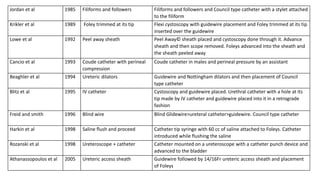
Jordan et al 1985 Filiforms and followers Filiforms and followers and Council type catheter with a stylet attached
to the filiform
Krikler et al 1989 Foley trimmed at its tip Flexi cystoscopy with guidewire placement and Foley trimmed at its tip
inserted over the guidewire
Lowe et al 1992 Peel away sheath Peel Away© sheath placed and cystoscopy done through it. Advance
sheath and then scope removed. Foleys advanced into the sheath and
the sheath peeled away
Cancio et al 1993 Coude catheter with perineal
compression
Coude catheter in males and perineal pressure by an assistant
Beaghler et al 1994 Ureteric dilators Guidewire and Nottingham dilators and then placement of Council
type catheter
Blitz et al 1995 IV catheter Cystoscopy and guidewire placed. Urethral catheter with a hole at its
tip made by IV catheter and guidewire placed into it in a retrograde
fashion
Freid and smith 1996 Blind wire Blind Glidewire>ureteral catheter>guidewire. Council type catheter
Harkin et al 1998 Saline flush and proceed Catheter tip syringe with 60 cc of saline attached to Foleys. Catheter
introduced while flushing the saline
Rozanski et al 1998 Ureteroscope + catheter Catheter mounted on a ureteroscope with a catheter punch device and
advanced to the bladder
Athanassopoulos et al 2005 Ureteric access sheath Guidewire followed by 14/16Fr ureteric access sheath and placement
of Foleys
Peel away© sheath
Blitz technique
Blind glidewire placement
• Place a glidewire blind
• If it effaces the urethra, it is returned back by a stricture or a false
passage
• If it doesn’t return, it is considered to be in the bladder which can be
confirmed by passing a ureteral catheter over it and aspirating urine
Algorithm
Consult for DUC
↓
• Who catheterised ?
• How many attempts?
• What size catheters?
• Was the balloon inflated before urine flow?
• Prior urologic surgeries(TURP, EIU,etc) or catheterisations?
• Distance at which obstruction was felt(<16 cm - ?stricture; >16 cm – BPH)?
DUC in males
↓
18F Coude catheter
↓
12F silicone catheter
↓
Blind glidewire technique(Freid and Smith) or flexiscope
under vision 12 F catheterisation(Blitz technique)
↓
Ureteric dilators or urethral balloon dilators under vision and
catheter placement
Non deflating catheter removal
Try aspirating fluid
↓
Inject air and then aspirate
↓
Cut distal inflation port
↓
Pass a guidewire into the inflation channel
↓
USG guided puncture of balloon in males
Transvaginal balloon puncture in females
References
• Robert and Hedges Clinical procedures in Emergency Medicine
• Emergency Urology – David Thurtle
• Difficult male urethral catheterisation – a review of different approaches – Carlos Villanueva, International Braz J Urol,
2008
• Current trends in management of difficult urinary catheterisations- Willette et al, Western journal of emergency medicine,
2012

Difficult urethral catheterisation.pptx

  • 1.
  • 2.
    Introduction • Insertion ofa smaller tube(catheter) into a native larger tube(urethra) • Patients will remember catheterisation as either painful or uneventful, depending on operator’s expertise, confidence and gentleness
  • 3.
    Numbers • Urethral length– 20 cm • Urethral volume – 20 cc • Urethral diameter – 30 Fr(Average)
  • 4.
    Patient has phimosisand needs catheterisation for monitoring of his medical condition. Kindly help Difficulty in catheterisation. Tried with 12 and 10F catheter, but is not successful. Please help Patient is agitated and is in ICU. Kindly catheterise Patient has bleeding dyscrasias. Please help with catheterisation Patient has had multiple urethral surgeries and patient is in retention. Please help Patient recently had a radical prostatectomy and after catheter removal, has come with retention. Patient had an RTA and has blood at meatus Not able to remove catheter. Kindly come and remove catheter UROLOGY CONSULTS FOR DUC
  • 5.
    Tips for successfulurethral catheterisation Inject 10-15 ml of lubricant or anesthetic jel into the urethra and place a urethral clamp 3-5 minutes before catheterisation  Anesthesia of mucosa  Distention of mucosa  Clamp prevents leaking out of the jel Elongate penis at 600 angle in line with normal urethral curve  Easy passage across bulbar urethra Slow-dep breaths  Relaxation of EUS Always complete catheter insertion to the Y hub  Urine drains when the catheter is anywhere proximal to membranous urethra and inflation of the balloon at that place injures the urethra Reduce prepuce after catheterisation  To prevent paraphimosis Secure catheter to thigh or abdomen(preferable)  To prevent iatrogenic penile spatulation If 1st attempt fails, repeat with 18Fr Coude catheter. If that fails, repeat with stiffer 12F silicone catheter  Coude – ideal for BPH, incorrect technique and anxious patient  Silicone – ideal for strictures
  • 6.
    • Hold thepenis taught and upright till the catheter reaches bulbar urethra
  • 7.
    Secure the catheterto the thigh or the abdomen to avoid penile spatulation
  • 8.
  • 9.
    History • Prior urologicsurgeries(TURP, EIU,etc)? • Distance at which obstruction was felt(<16 cm - ?stricture; >16 cm – BPH)? • Was the balloon inflated before urine flow? • Who catheterised ? • How many attempts? • What size catheters?
  • 10.
    Examination • Phimosis/penoscrotal edema •Pelvic organ prolapse • Meatal stenosis • Anasarca • GU cancers
  • 11.
    DUC in females •More common in post menopausal women • Meatus can retract up the anterior vaginal wall
  • 12.
    Place the patientin lithotomy with a pillow underneath the pelvis to tilt the pelvis anteriorly Place gloved lubricated index and middle fingers into the vagina and occlude the vaginal lumen. You can even palpate the urethral meatus high up in the anterior vaginal wall. Catheterise
  • 13.
    • Alternatively, placethe patient in Sims position. Lift the upper leg little and retract the posterior wall with a vaginal speculum to visualise the meatus
  • 14.
  • 15.
    Phimosis Attempt gentle retractionto expose the meatus. If successful, sterilise the exposed glans and catheterise. If not successful, ↓ Pull the prepuce upwards instead. This will reveal an opening into the glans. A syringe can be used to wash out the area under prepuce with antiseptic solution. Then jelly can blindly be injected into the urethra after palpation of the meatus using the syringe tip and catheterise. If not successful, ↓ Penile block and dilate the prepuce using artery forceps and catheterise. If not successful, ↓ Dorsal slit and catheterise
  • 16.
  • 17.
    • Elastic compressionfor 10 minutes to squeeze out the edema. • If it still fails, as in phimosis
  • 18.
    External urethral sphincterspasm • Seen in anxious patients • External sphincter is made of striated muscle and so, it will fatigue within a few minutes • Patience during catheterisation • Encourage patient to take deep breaths or to plantar flex – which will relax the pelvic floor
  • 19.
    Meatal stenosis • Trialof a smaller size catheter • If larger calibre is necessary, meatal dilatation or meatotomy might be necessary
  • 20.
  • 21.
    Jordan et al1985 Filiforms and followers Filiforms and followers and Council type catheter with a stylet attached to the filiform Krikler et al 1989 Foley trimmed at its tip Flexi cystoscopy with guidewire placement and Foley trimmed at its tip inserted over the guidewire Lowe et al 1992 Peel away sheath Peel Away© sheath placed and cystoscopy done through it. Advance sheath and then scope removed. Foleys advanced into the sheath and the sheath peeled away Cancio et al 1993 Coude catheter with perineal compression Coude catheter in males and perineal pressure by an assistant Beaghler et al 1994 Ureteric dilators Guidewire and Nottingham dilators and then placement of Council type catheter Blitz et al 1995 IV catheter Cystoscopy and guidewire placed. Urethral catheter with a hole at its tip made by IV catheter and guidewire placed into it in a retrograde fashion Freid and smith 1996 Blind wire Blind Glidewire>ureteral catheter>guidewire. Council type catheter Harkin et al 1998 Saline flush and proceed Catheter tip syringe with 60 cc of saline attached to Foleys. Catheter introduced while flushing the saline Rozanski et al 1998 Ureteroscope + catheter Catheter mounted on a ureteroscope with a catheter punch device and advanced to the bladder Athanassopoulos et al 2005 Ureteric access sheath Guidewire followed by 14/16Fr ureteric access sheath and placement of Foleys
  • 23.
  • 24.
  • 26.
    Blind glidewire placement •Place a glidewire blind • If it effaces the urethra, it is returned back by a stricture or a false passage • If it doesn’t return, it is considered to be in the bladder which can be confirmed by passing a ureteral catheter over it and aspirating urine
  • 27.
    Algorithm Consult for DUC ↓ •Who catheterised ? • How many attempts? • What size catheters? • Was the balloon inflated before urine flow? • Prior urologic surgeries(TURP, EIU,etc) or catheterisations? • Distance at which obstruction was felt(<16 cm - ?stricture; >16 cm – BPH)?
  • 28.
    DUC in males ↓ 18FCoude catheter ↓ 12F silicone catheter ↓ Blind glidewire technique(Freid and Smith) or flexiscope under vision 12 F catheterisation(Blitz technique) ↓ Ureteric dilators or urethral balloon dilators under vision and catheter placement
  • 29.
    Non deflating catheterremoval Try aspirating fluid ↓ Inject air and then aspirate ↓ Cut distal inflation port ↓ Pass a guidewire into the inflation channel ↓ USG guided puncture of balloon in males Transvaginal balloon puncture in females
  • 32.
    References • Robert andHedges Clinical procedures in Emergency Medicine • Emergency Urology – David Thurtle • Difficult male urethral catheterisation – a review of different approaches – Carlos Villanueva, International Braz J Urol, 2008 • Current trends in management of difficult urinary catheterisations- Willette et al, Western journal of emergency medicine, 2012