Differentiating Finite Geometric Sequence
from an Infinite Geometric Sequence.
LET’S GROUFIE
With your own set of criteria, group the following:
•Line
•Line segment
•1, 2, 3, 4, 5, … 100
•1, 2, 3, 5, 7, 11, 13, 17, …
•Natural numbers
•Even numbers less than 50
In the previous discussions, geometric sequence
is a sequence where each term after the first is
obtained by multiplying the preceding term by a
nonzero constant called the common ratio.
There are two types of geometric
sequence namely: finite geometric sequence
and infinite geometric sequence.
Into what aspect they differ, that’s for us
to find out.
FINDING OUT
•Group A are items which suggest limit thus it is
considered finite.
•Group B are items whose last value cannot be
determined. It has no limit; therefore, they are
infinite.
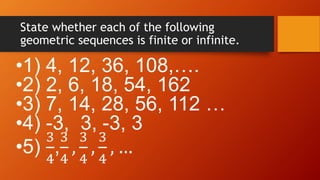
State whether each of the following
geometric sequences is finite or infinite.
•1) 4, 12, 36, 108,….
•2) 2, 6, 18, 54, 162
•3) 7, 14, 28, 56, 112 …
•4) -3, 3, -3, 3
•5)
3
4
,
3
4
,
3
4
,
3
4
, …
•1. How do you find doing the activity?
•2. Which of the items are finite geometric
sequence and which are infinite geometric
sequences?
•3. What are the important characteristics that you
should remember in identifying finite or infinite
geometric sequence?
•Finite sequence is a function whose domain
is the finite set { 1, 2, 3, …, n }. They have a
first and a last term.
•Infinite sequence is a function whose
domain is infinite set { 1, 2, 3, …}. A
sequence that goes on forever, indicated by
three dots following the last listed number.
ASSIGNMENT
•List down 5 examples of
finite geometric sequence
and 5 example of infinite
geometric sequence.
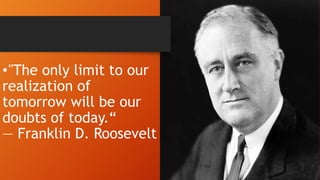
•"The only limit to our
realization of
tomorrow will be our
doubts of today.“
— Franklin D. Roosevelt
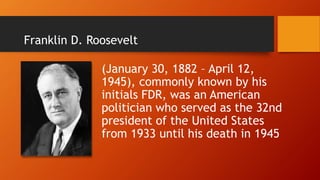
Franklin D. Roosevelt
(January 30, 1882 – April 12,
1945), commonly known by his
initials FDR, was an American
politician who served as the 32nd
president of the United States
from 1933 until his death in 1945

Differentiating Finite Geometric Sequence from an Infinite Geometric.pptx

  • 1.
    Differentiating Finite GeometricSequence from an Infinite Geometric Sequence.
  • 2.
    LET’S GROUFIE With yourown set of criteria, group the following: •Line •Line segment •1, 2, 3, 4, 5, … 100 •1, 2, 3, 5, 7, 11, 13, 17, … •Natural numbers •Even numbers less than 50
  • 3.
    In the previousdiscussions, geometric sequence is a sequence where each term after the first is obtained by multiplying the preceding term by a nonzero constant called the common ratio. There are two types of geometric sequence namely: finite geometric sequence and infinite geometric sequence. Into what aspect they differ, that’s for us to find out.
  • 4.
    FINDING OUT •Group Aare items which suggest limit thus it is considered finite. •Group B are items whose last value cannot be determined. It has no limit; therefore, they are infinite.
  • 5.
    State whether eachof the following geometric sequences is finite or infinite. •1) 4, 12, 36, 108,…. •2) 2, 6, 18, 54, 162 •3) 7, 14, 28, 56, 112 … •4) -3, 3, -3, 3 •5) 3 4 , 3 4 , 3 4 , 3 4 , …
  • 6.
    •1. How doyou find doing the activity? •2. Which of the items are finite geometric sequence and which are infinite geometric sequences? •3. What are the important characteristics that you should remember in identifying finite or infinite geometric sequence?
  • 7.
    •Finite sequence isa function whose domain is the finite set { 1, 2, 3, …, n }. They have a first and a last term. •Infinite sequence is a function whose domain is infinite set { 1, 2, 3, …}. A sequence that goes on forever, indicated by three dots following the last listed number.
  • 8.
    ASSIGNMENT •List down 5examples of finite geometric sequence and 5 example of infinite geometric sequence.
  • 9.
    •"The only limitto our realization of tomorrow will be our doubts of today.“ — Franklin D. Roosevelt
  • 10.
    Franklin D. Roosevelt (January30, 1882 – April 12, 1945), commonly known by his initials FDR, was an American politician who served as the 32nd president of the United States from 1933 until his death in 1945