Differentiated Instruction

       Claudia Mewald


            (c)Mewald        1
Five Major Tasks of Teachers
1. Designing teaching goals & objectives/aims and
   developing learning designs
2. Understanding learner characteristics and
   implementing learning profiles
3. Understanding and implementing ideas about
   the nature of learning and motivation, e.g.
   developing learning profiles
4. Selecting and implementing ways of teaching
   (approaches, methods, strategies) in learning
   designs
5. Assessing learning processes and outcomes
                       (c)Mewald                    2
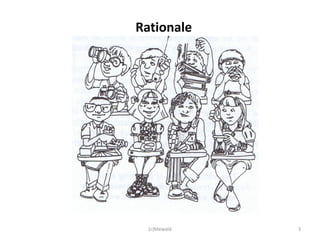
Rationale


  (c)Mewald   3
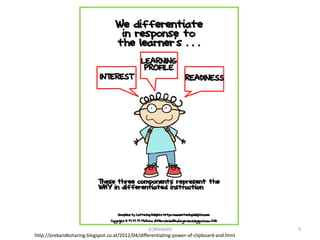
Differentiated instruction is the process of
recognizing the students' various background
knowledge, readiness, language, preferences in
learning, interests, and to react responsively
when planning for instruction. Differentiated
instruction is an approach to teaching and
learning for students of differing abilities in the
same class. The intent of differentiating
instruction is to maximize each student’s
growth and individual success by meeting each
student where he or she is, and assisting in the
learning process.      Source: http://www.efdlrs.com/~crown/di/act-1890.html
                                   (c)Mewald                                   4
(c)Mewald                                5
http://prekandksharing.blogspot.co.at/2012/04/differentiating-power-of-clipboard-and.html
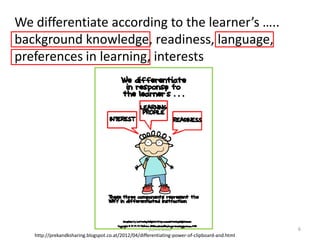
We differentiate according to the learner’s …..
background knowledge, readiness, language,
preferences in learning, interests


                                                      (c)Mewald                                6
   http://prekandksharing.blogspot.co.at/2012/04/differentiating-power-of-clipboard-and.html
Background knowledge & language
Diagnostic testing or Formative assessment
• a range of formal and informal assessment
  procedures
• employed by teachers during the learning process
• to modify teaching and learning activities to
  improve student attainment
• typically involves qualitative feedback (rather
  than scores) for both student and teacher
• feedback focuses on the details of content and
  performance

                      (c)Mewald                  7
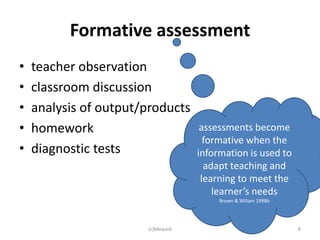
Formative assessment
•   teacher observation
•   classroom discussion
•   analysis of output/products
•   homework                        assessments become
                                     formative when the
•   diagnostic tests               information is used to
                                     adapt teaching and
                                    learning to meet the
                                       learner’s needs
                                        Brown & Wiliam 1998b


                       (c)Mewald                               8
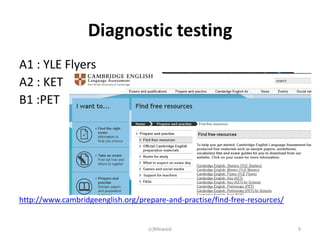
Diagnostic testing
A1 : YLE Flyers
A2 : KET
B1 :PET


http://www.cambridgeenglish.org/prepare-and-practise/find-free-resources/


                                   (c)Mewald                                9
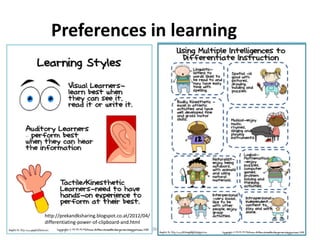
Preferences in learning


http://prekandksharing.blogspot.co.at/2012/04/
differentiating-power-of-clipboard-and.html
                                             (c)Mewald   10
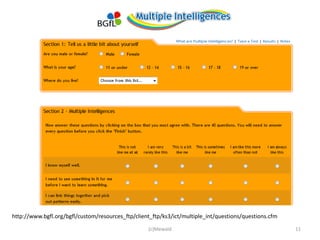
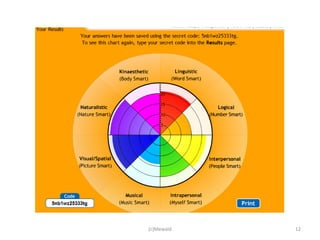
http://www.bgfl.org/bgfl/custom/resources_ftp/client_ftp/ks3/ict/multiple_int/questions/questions.cfm

                                                   (c)Mewald                                            11
(c)Mewald   12
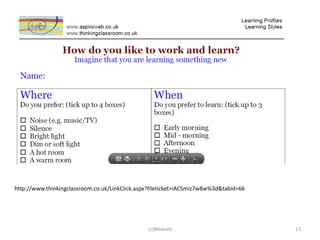
http://www.thinkingclassroom.co.uk/LinkClick.aspx?fileticket=iACSmiz7w8w%3d&tabid=66


                                                (c)Mewald                              13
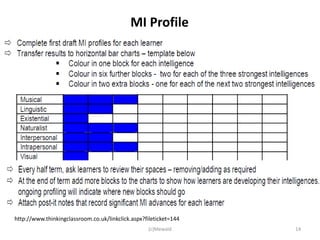
MI Profile


http://www.thinkingclassroom.co.uk/linkclick.aspx?fileticket=144
                                                    (c)Mewald      14
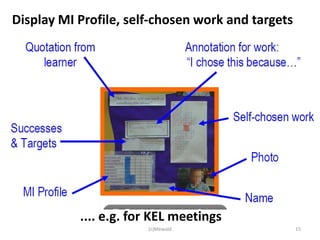
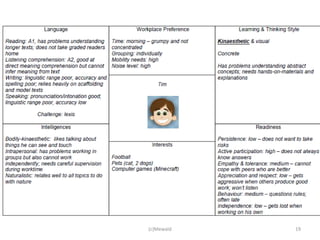
Display MI Profile, self-chosen work and targets


           .... e.g. for KEL meetings
                       (c)Mewald                   15
http://koinonia-all.org/homeschool/learnstyles.htm
                                                     (c)Mewald   16
(c)Mewald   17
(c)Mewald                                    18
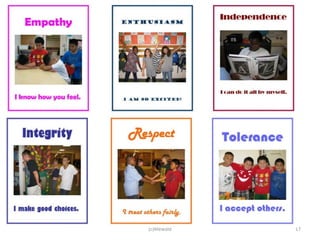
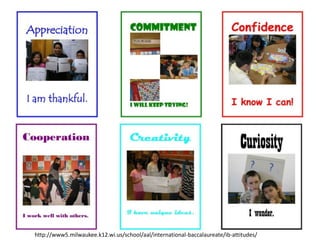
http://www5.milwaukee.k12.wi.us/school/aal/international-baccalaureate/ib-attitudes/
(c)Mewald   19
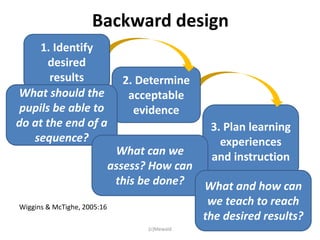
Backward design
    1. Identify
      desired
       results        2. Determine
What should the        acceptable
pupils be able to       evidence
do at the end of a                        3. Plan learning
   sequence?                                experiences
                            What can we   and instruction
                           assess? How can
                            this be done?  What and how can
Wiggins & McTighe, 2005:16
                                            we teach to reach
                                           the desired results?
                            (c)Mewald                        20
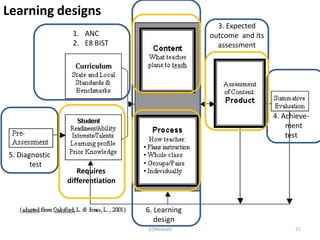
Learning designs
                                                  3. Expected
                 1. ANC                         outcome and its
                 2. E8 BIST                       assessment


                                                                  4. Achieve-
                                                                      ment
                                                                      test

5. Diagnostic
       test
                   Requires
                differentiation


                                  6. Learning
                                     design
                                  (c)Mewald                             21
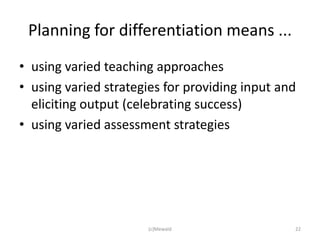
Planning for differentiation means ...
• using varied teaching approaches
• using varied strategies for providing input and
  eliciting output (celebrating success)
• using varied assessment strategies


                      (c)Mewald                 22
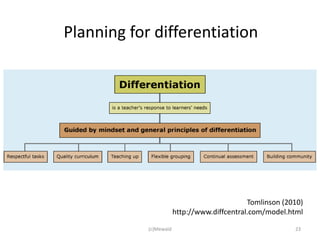
Planning for differentiation


                                              Tomlinson (2010)
                        http://www.diffcentral.com/model.html

            (c)Mewald                                      23
(c)Mewald                                 24
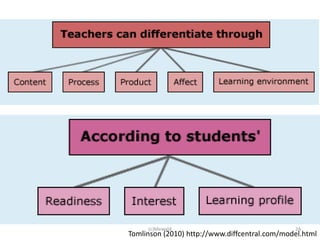
Tomlinson (2010) http://www.diffcentral.com/model.html
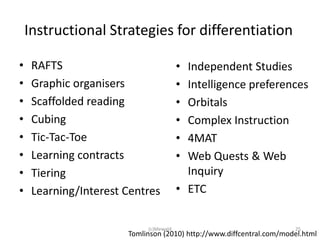
Instructional Strategies for differentiation

•    RAFTS                              • Independent Studies
•    Graphic organisers                 • Intelligence preferences
•    Scaffolded reading                 • Orbitals
•    Cubing                             • Complex Instruction
•    Tic-Tac-Toe                        • 4MAT
•    Learning contracts                 • Web Quests & Web
•    Tiering                              Inquiry
•    Learning/Interest Centres          • ETC


                            (c)Mewald                                 25
                       Tomlinson (2010) http://www.diffcentral.com/model.html
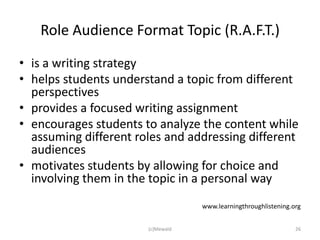
Role Audience Format Topic (R.A.F.T.)

• is a writing strategy
• helps students understand a topic from different
  perspectives
• provides a focused writing assignment
• encourages students to analyze the content while
  assuming different roles and addressing different
  audiences
• motivates students by allowing for choice and
  involving them in the topic in a personal way
                                   www.learningthroughlistening.org


                       (c)Mewald                                 26
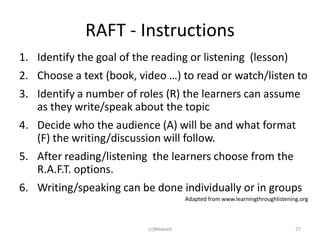
RAFT - Instructions
1. Identify the goal of the reading or listening (lesson)
2. Choose a text (book, video …) to read or watch/listen to
3. Identify a number of roles (R) the learners can assume
   as they write/speak about the topic
4. Decide who the audience (A) will be and what format
   (F) the writing/discussion will follow.
5. After reading/listening the learners choose from the
   R.A.F.T. options.
6. Writing/speaking can be done individually or in groups
                                       Adapted from www.learningthroughlistening.org


                           (c)Mewald                                           27
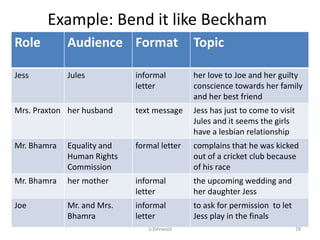
Example: Bend it like Beckham
Role         Audience Format                Topic

Jess         Jules          informal        her love to Joe and her guilty
                            letter          conscience towards her family
                                            and her best friend
Mrs. Praxton her husband    text message    Jess has just to come to visit
                                            Jules and it seems the girls
                                            have a lesbian relationship
Mr. Bhamra   Equality and   formal letter   complains that he was kicked
             Human Rights                   out of a cricket club because
             Commission                     of his race
Mr. Bhamra   her mother     informal        the upcoming wedding and
                            letter          her daughter Jess
Joe          Mr. and Mrs.   informal        to ask for permission to let
             Bhamra         letter          Jess play in the finals
                               (c)Mewald                                     28
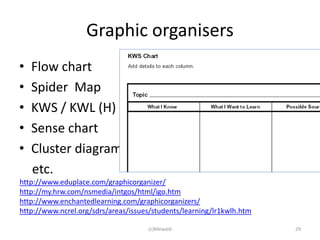
Graphic organisers
•   Flow chart
•   Spider Map
•   KWS / KWL (H)
•   Sense chart
•   Cluster diagram
    etc.
http://www.eduplace.com/graphicorganizer/
http://my.hrw.com/nsmedia/intgos/html/igo.htm
http://www.enchantedlearning.com/graphicorganizers/
http://www.ncrel.org/sdrs/areas/issues/students/learning/lr1kwlh.htm

                                     (c)Mewald                         29
8 most effective strategies to scaffold reading

•   Comprehension monitoring
•   Cooperative learning
•   Graphic organizers
•   Story structure
•   Question answering
•   Question generating
•   Summarization
•   Multiple Strategy
http://www.phschool.com/eteach/language_arts/2002_12/essay.html
http://www.reading.org/advocacy/nrp/index.html

                                   (c)Mewald                      30
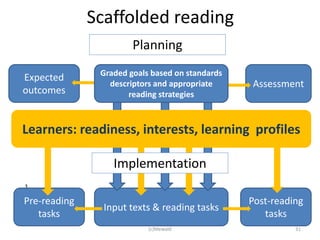
Scaffolded reading
                       Planning
               Graded goals based on standards
Expected
                 descriptors and appropriate     Assessment
outcomes              reading strategies


Learners: readiness, interests, learning profiles

                  Implementation
1

Pre-reading                                      Post-reading
                Input texts & reading tasks
   tasks                                            tasks
                           (c)Mewald                       31
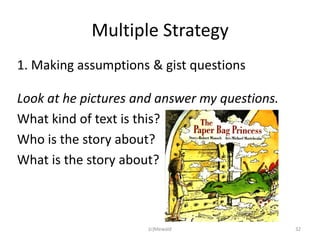
Multiple Strategy
1. Making assumptions & gist questions

Look at he pictures and answer my questions.
What kind of text is this?
Who is the story about?
What is the story about?


                      (c)Mewald                32
Multiple Strategy
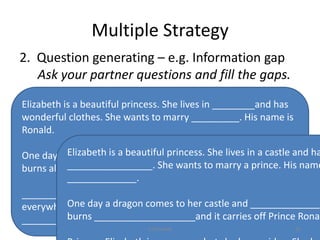
2. Question generating – e.g. Information gap
   Ask your partner questions and fill the gaps.

Elizabeth is a beautiful princess. She lives in ________and has
wonderful clothes. She wants to marry _________. His name is
Ronald.

One day ___________acomes to her castle and lives in a castle and ha
           Elizabeth is beautiful princess. She smashes it. It
burns all her clothes and it carries off __________________.His name
           ________________. She wants to marry a prince.
           _____________.
________________ is very angry but she has an idea. She looks
everywhere forday a dragon comes The only thing she finds is a
         One something to wear. to her castle and _____________.
____________. She puts it on and runs __________________. Ronal
         burns ___________________and it carries off Prince
                             (c)Mewald                            33
Multiple Strategy
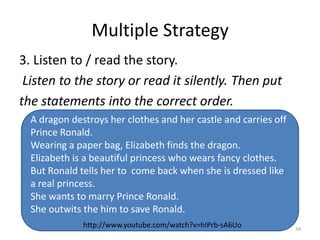
3. Listen to / read the story.
 Listen to the story or read it silently. Then put
the statements into the correct order.
  A dragon destroys her clothes and her castle and carries off
  Prince Ronald.
  Wearing a paper bag, Elizabeth finds the dragon.
  Elizabeth is a beautiful princess who wears fancy clothes.
  But Ronald tells her to come back when she is dressed like
  a real princess.
  She wants to marry Prince Ronald.
  She outwits the him to save Ronald.
              http://www.youtube.com/watch?v=hIPrb-sA6Uo
                               (c)Mewald                         34
Multiple Strategy
4. Summarizing
Summarize the story.
Use key words / phrases / sentence starters /
sample text.
Use linking words, sentence starters etc.
Draw the summary.
Act out the story.
                      (c)Mewald                 35
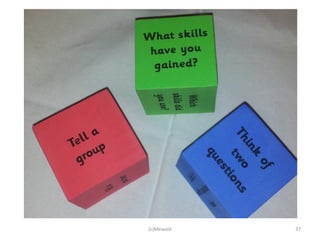
Cubing
Cubing gives students the opportunity to construct
meaning about a topic through six different ways:

•   Description (What is it like?)
•   Comparison (What is it similar to or different from?)
•   Association (What does it make you think of?)
•   Analysis (How is it made or what is it composed of?)
•   Application (What can you do with it? How is it used?)
•   Argumentation (Take a stand, arguing for or against it)
http://sddial.k12.sd.us/esa/doc/teachers/differ_instruc.htm
http://www.readwritethink.org/parent-afterschool-resources/games-tools/mystery-
    cube-a-30188.html

                                     (c)Mewald                                    36
(c)Mewald   37
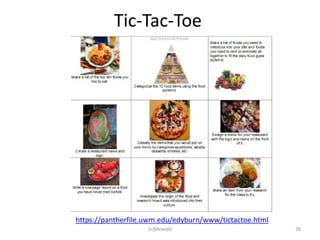
Tic-Tac-Toe


https://pantherfile.uwm.edu/edyburn/www/tictactoe.html
                    (c)Mewald                            38
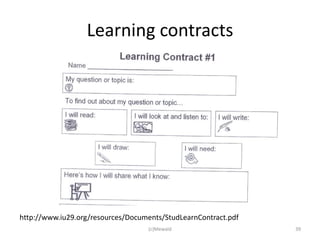
Learning contracts


http://www.iu29.org/resources/Documents/StudLearnContract.pdf
                                   (c)Mewald                    39
(c)Mewald   40
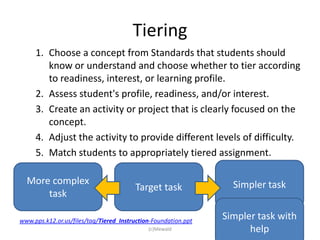
Tiering
     1. Choose a concept from Standards that students should
        know or understand and choose whether to tier according
        to readiness, interest, or learning profile.
     2. Assess student's profile, readiness, and/or interest.
     3. Create an activity or project that is clearly focused on the
        concept.
     4. Adjust the activity to provide different levels of difficulty.
     5. Match students to appropriately tiered assignment.

  More complex                                                    Simpler task
                                        Target task
      task

www.pps.k12.or.us/files/tag/Tiered_Instruction-Foundation.ppt
                                                                Simpler task with
                                             (c)Mewald                help       41
Learning/Interest Centres

• Learning/Interest Centres structure the classroom to allow
   students to work in groups
• Students move through the centres, which are based on a
   set of skills or activities established by the teacher
• Centre rotation can be done in a specific time or based on
   individual student needs
• Learning/Interest Centres structure learner groups and
   skill-based activities to maximize student autonomy and
   time-on-task
www.iatefl.org/component/option.com
http://www.youtube.com/watch?v=CIa0vHdChN8

                            (c)Mewald                          42
Independent Studies
• Topics selected by students for in-depth study
• Students and teacher agree on a statement of student
  objective, research, and planned presentation
• Students design products to demonstrate their
  understanding of a topic
• Independent study encourages student autonomy in
  planning and problem solving

http://www.adifferentplace.org/classroom.htm
http://www.ntuaft.com/TISE/Access%20Folder/Differentiated%20Learning/Differentiated%20Inst
    ruction%20-%20Introduction.htm


                                         (c)Mewald                                      43
Intelligence preferences

http://www.edutopia.org/multiple-intelligences-howard-gardner-video


                                 (c)Mewald                            44
Orbital studies
• done individually or in small groups
• short term (3-6 weeks) projects
• students choose their own topic that orbits
  around the curriculum
• students investigate independently
• presentation to five of their classmates for 10-20
  minutes
• display or demonstration
• 1 page handout

                        (c)Mewald                      45
Complex Instruction

• developed by Elizabeth Cohen, Rachel Lotan, and their
colleagues at the Stanford School of Education

• goal of CI is to provide academic access and success
for all students in heterogeneous classrooms

• 3 major components: Multiple ability curricula,
Instructional strategies, Teachers recognize and treat
status problems

      http://www.stanford.edu/group/pci/images/logo_color.gif
                                 (c)Mewald                      46
Complex Instruction
Multiple ability curricula
• designed to foster the development of higher-order
  thinking skills through group work activities
  organized around a central concept or big idea
• tasks are open-ended
• Students work interdependently to solve problems
• tasks require a wide array of intellectual abilities so
  that students from diverse backgrounds and different
  levels of academic proficiency can make meaningful
  contributions to the group task
      http://www.stanford.edu/group/pci/images/logo_color.gif
                                 (c)Mewald                      47
Complex Instruction
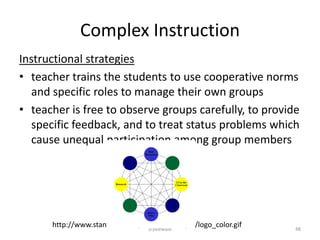
Instructional strategies
• teacher trains the students to use cooperative norms
   and specific roles to manage their own groups
• teacher is free to observe groups carefully, to provide
   specific feedback, and to treat status problems which
   cause unequal participation among group members


      http://www.stanford.edu/group/pci/images/logo_color.gif
                                 (c)Mewald                      48
Complex Instruction
Teachers recognize and treat status problems
• the more that students talk and work together, the more they
  learn
• students who are social isolates or students who are seen as
  lacking academic skills often fail to participate and thus learn
  less than they would if they were more active in the groups
• teachers use status treatments to broaden students'
  perceptions of what it means to be smart, and to convince
  students that they each have important intellectual
  contributions to make to the multiple-ability task


       http://www.stanford.edu/group/pci/images/logo_color.gif
                                  (c)Mewald                      49
4MAT


http://www.4mat.eu/4mat-what-is-it.aspx
                    (c)Mewald             50
4MAT
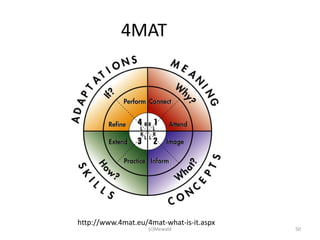
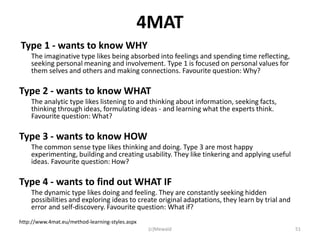
Type 1 - wants to know WHY
    The imaginative type likes being absorbed into feelings and spending time reflecting,
    seeking personal meaning and involvement. Type 1 is focused on personal values for
    them selves and others and making connections. Favourite question: Why?

Type 2 - wants to know WHAT
    The analytic type likes listening to and thinking about information, seeking facts,
    thinking through ideas, formulating ideas - and learning what the experts think.
    Favourite question: What?

Type 3 - wants to know HOW
    The common sense type likes thinking and doing. Type 3 are most happy
    experimenting, building and creating usability. They like tinkering and applying useful
    ideas. Favourite question: How?

Type 4 - wants to find out WHAT IF
    The dynamic type likes doing and feeling. They are constantly seeking hidden
    possibilities and exploring ideas to create original adaptations, they learn by trial and
    error and self-discovery. Favourite question: What if?
http://www.4mat.eu/method-learning-styles.aspx
                                                 (c)Mewald                                      51
WebQuests
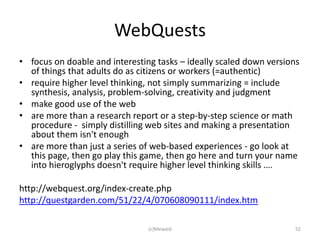
• focus on doable and interesting tasks – ideally scaled down versions
  of things that adults do as citizens or workers (=authentic)
• require higher level thinking, not simply summarizing = include
  synthesis, analysis, problem-solving, creativity and judgment
• make good use of the web
• are more than a research report or a step-by-step science or math
  procedure - simply distilling web sites and making a presentation
  about them isn't enough
• are more than just a series of web-based experiences - go look at
  this page, then go play this game, then go here and turn your name
  into hieroglyphs doesn't require higher level thinking skills ….

http://webquest.org/index-create.php
http://questgarden.com/51/22/4/070608090111/index.htm

                                (c)Mewald                           52
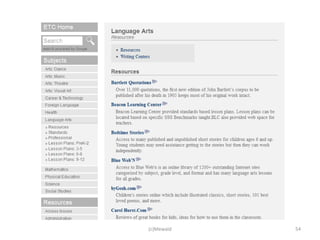
ETC
Educational Technology Clearinghouse
Digital resources for Florida's schools

http://etc.usf.edu/


                      (c)Mewald           53
(c)Mewald   54
Task
• Discus which strategies would suit your
  learning design
• Use them in your learning design


                      (c)Mewald             55
Input through film
Example

“Moments”
http://film-english.com/2013/03/04/moments-2/


                       (c)Mewald                56
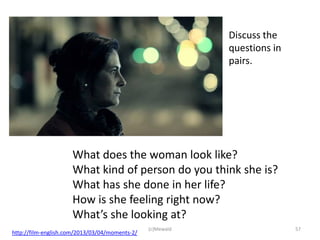
Discuss the
                                                            questions in
                                                            pairs.


                     What does the woman look like?
                     What kind of person do you think she is?
                     What has she done in her life?
                     How is she feeling right now?
                     What’s she looking at?
                                                (c)Mewald                  57
http://film-english.com/2013/03/04/moments-2/
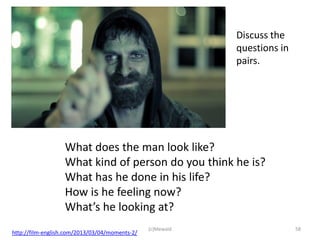
Discuss the
                                                            questions in
                                                            pairs.


                   What does the man look like?
                   What kind of person do you think he is?
                   What has he done in his life?
                   How is he feeling now?
                   What’s he looking at?
                                                (c)Mewald                  58
http://film-english.com/2013/03/04/moments-2/
The two photos are taken from a short film. Work in
groups of 4 and create a story in which the man and
woman are characters.
- 10 minutes to take notes
- one student from each group will present their story

You are going to watch a short film. Sit back to back -
the person facing the screen tells the other what
he/she can see.
Compare your stories with the story you saw in the
film.
http://player.vimeo.com/video/17896628


                                    (c)Mewald             59
Task:
Develop materials to scaffold / differentiate the picture
description.
Develop materials to scaffold / differentiate the story
telling.
Develop materials to scaffold / differentiate the story
viewing.


                          (c)Mewald                     60
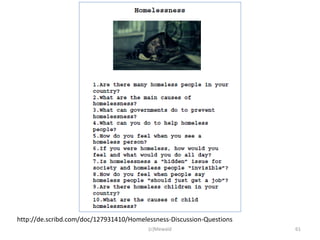
http://de.scribd.com/doc/127931410/Homelessness-Discussion-Questions
                                         (c)Mewald                     61
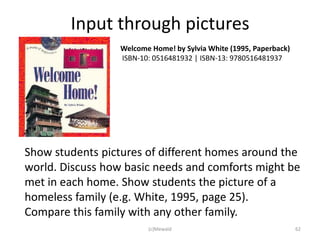
Input through pictures
                  Welcome Home! by Sylvia White (1995, Paperback)
                  ISBN-10: 0516481932 | ISBN-13: 9780516481937


Show students pictures of different homes around the
world. Discuss how basic needs and comforts might be
met in each home. Show students the picture of a
homeless family (e.g. White, 1995, page 25).
Compare this family with any other family.
                         (c)Mewald                                  62
Task:
Collect pictures and materials to describes different
homes.
Develop differentiated materials to describe pictures
of homes / places.
Develop differentiated materials to describe how
people live in different places of the world.


                         (c)Mewald                      63
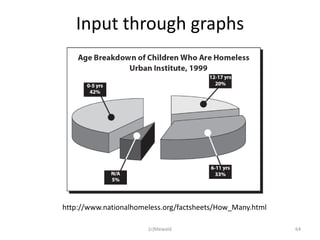
Input through graphs


http://www.nationalhomeless.org/factsheets/How_Many.html

                       (c)Mewald                           64
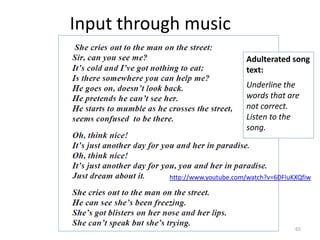
Input through music
                                       Adulterated song
                                       text:
                                       Underline the
                                       words that are
                                       not correct.
                                       Listen to the
                                       song.


                 http://www.youtube.com/watch?v=6DFluKXQfiw


         (c)Mewald                                    65
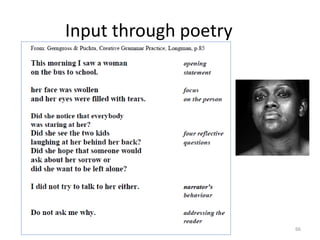
Input through poetry


         (c)Mewald     66
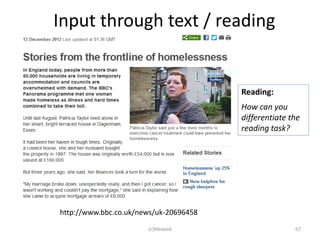
Input through text / reading


                                        Reading:
                                        How can you
                                        differentiate the
                                        reading task?


http://www.bbc.co.uk/news/uk-20696458
                       (c)Mewald                       67
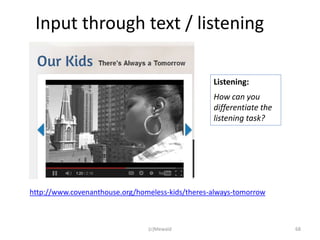
Input through text / listening

                                                  Listening:
                                                  How can you
                                                  differentiate the
                                                  listening task?


http://www.covenanthouse.org/homeless-kids/theres-always-tomorrow


                                (c)Mewald                             68
Bibliography
• Black P. & Wiliam D. (1998a). Assessment and classroom learning.
  Assessment in Education, 5 (1): 7-74.
• Black P. & Wiliam D. (1998b). Inside the black box: Raising standards
  through classroom assessment. Phi Delta Kappan, 80 (2): 139-148.
  (Available online: http://www.pdkintl.org/kappan/kbla9810.htm.)
• Maduakolam, I. & Ibeneme, O.T. (2010) Differentiating instruction to meet
  the needs of diverse technical/technology education students at the
  secondary school level. African Journal of Teacher Education. Vol. 1/1, pp.
  106-114.
• Oaksford L. & Jones L. (2001) Differentiated instruction abstract.
  Tallahassee, FL: Leon
  County Schools.
• Wiggins G. & McTighe J. (2005) Understanding by Design. Expanded 2nd
  Edition. VA: Pearson Education/Association for Supervision & Curriculum
  Development.


                                   (c)Mewald                                69

Differentiated instruction.handout

  • 1.
    Differentiated Instruction Claudia Mewald (c)Mewald 1
  • 2.
    Five Major Tasksof Teachers 1. Designing teaching goals & objectives/aims and developing learning designs 2. Understanding learner characteristics and implementing learning profiles 3. Understanding and implementing ideas about the nature of learning and motivation, e.g. developing learning profiles 4. Selecting and implementing ways of teaching (approaches, methods, strategies) in learning designs 5. Assessing learning processes and outcomes (c)Mewald 2
  • 3.
  • 4.
    Differentiated instruction isthe process of recognizing the students' various background knowledge, readiness, language, preferences in learning, interests, and to react responsively when planning for instruction. Differentiated instruction is an approach to teaching and learning for students of differing abilities in the same class. The intent of differentiating instruction is to maximize each student’s growth and individual success by meeting each student where he or she is, and assisting in the learning process. Source: http://www.efdlrs.com/~crown/di/act-1890.html (c)Mewald 4
  • 5.
    (c)Mewald 5 http://prekandksharing.blogspot.co.at/2012/04/differentiating-power-of-clipboard-and.html
  • 6.
    We differentiate accordingto the learner’s ….. background knowledge, readiness, language, preferences in learning, interests (c)Mewald 6 http://prekandksharing.blogspot.co.at/2012/04/differentiating-power-of-clipboard-and.html
  • 7.
    Background knowledge &language Diagnostic testing or Formative assessment • a range of formal and informal assessment procedures • employed by teachers during the learning process • to modify teaching and learning activities to improve student attainment • typically involves qualitative feedback (rather than scores) for both student and teacher • feedback focuses on the details of content and performance (c)Mewald 7
  • 8.
    Formative assessment • teacher observation • classroom discussion • analysis of output/products • homework assessments become formative when the • diagnostic tests information is used to adapt teaching and learning to meet the learner’s needs Brown & Wiliam 1998b (c)Mewald 8
  • 9.
    Diagnostic testing A1 :YLE Flyers A2 : KET B1 :PET http://www.cambridgeenglish.org/prepare-and-practise/find-free-resources/ (c)Mewald 9
  • 10.
  • 11.
  • 12.
  • 13.
  • 14.
  • 15.
    Display MI Profile,self-chosen work and targets .... e.g. for KEL meetings (c)Mewald 15
  • 16.
  • 17.
  • 18.
    (c)Mewald 18 http://www5.milwaukee.k12.wi.us/school/aal/international-baccalaureate/ib-attitudes/
  • 19.
  • 20.
    Backward design 1. Identify desired results 2. Determine What should the acceptable pupils be able to evidence do at the end of a 3. Plan learning sequence? experiences What can we and instruction assess? How can this be done? What and how can Wiggins & McTighe, 2005:16 we teach to reach the desired results? (c)Mewald 20
  • 21.
    Learning designs 3. Expected 1. ANC outcome and its 2. E8 BIST assessment 4. Achieve- ment test 5. Diagnostic test Requires differentiation 6. Learning design (c)Mewald 21
  • 22.
    Planning for differentiationmeans ... • using varied teaching approaches • using varied strategies for providing input and eliciting output (celebrating success) • using varied assessment strategies (c)Mewald 22
  • 23.
    Planning for differentiation Tomlinson (2010) http://www.diffcentral.com/model.html (c)Mewald 23
  • 24.
    (c)Mewald 24 Tomlinson (2010) http://www.diffcentral.com/model.html
  • 25.
    Instructional Strategies fordifferentiation • RAFTS • Independent Studies • Graphic organisers • Intelligence preferences • Scaffolded reading • Orbitals • Cubing • Complex Instruction • Tic-Tac-Toe • 4MAT • Learning contracts • Web Quests & Web • Tiering Inquiry • Learning/Interest Centres • ETC (c)Mewald 25 Tomlinson (2010) http://www.diffcentral.com/model.html
  • 26.
    Role Audience FormatTopic (R.A.F.T.) • is a writing strategy • helps students understand a topic from different perspectives • provides a focused writing assignment • encourages students to analyze the content while assuming different roles and addressing different audiences • motivates students by allowing for choice and involving them in the topic in a personal way www.learningthroughlistening.org (c)Mewald 26
  • 27.
    RAFT - Instructions 1.Identify the goal of the reading or listening (lesson) 2. Choose a text (book, video …) to read or watch/listen to 3. Identify a number of roles (R) the learners can assume as they write/speak about the topic 4. Decide who the audience (A) will be and what format (F) the writing/discussion will follow. 5. After reading/listening the learners choose from the R.A.F.T. options. 6. Writing/speaking can be done individually or in groups Adapted from www.learningthroughlistening.org (c)Mewald 27
  • 28.
    Example: Bend itlike Beckham Role Audience Format Topic Jess Jules informal her love to Joe and her guilty letter conscience towards her family and her best friend Mrs. Praxton her husband text message Jess has just to come to visit Jules and it seems the girls have a lesbian relationship Mr. Bhamra Equality and formal letter complains that he was kicked Human Rights out of a cricket club because Commission of his race Mr. Bhamra her mother informal the upcoming wedding and letter her daughter Jess Joe Mr. and Mrs. informal to ask for permission to let Bhamra letter Jess play in the finals (c)Mewald 28
  • 29.
    Graphic organisers • Flow chart • Spider Map • KWS / KWL (H) • Sense chart • Cluster diagram etc. http://www.eduplace.com/graphicorganizer/ http://my.hrw.com/nsmedia/intgos/html/igo.htm http://www.enchantedlearning.com/graphicorganizers/ http://www.ncrel.org/sdrs/areas/issues/students/learning/lr1kwlh.htm (c)Mewald 29
  • 30.
    8 most effectivestrategies to scaffold reading • Comprehension monitoring • Cooperative learning • Graphic organizers • Story structure • Question answering • Question generating • Summarization • Multiple Strategy http://www.phschool.com/eteach/language_arts/2002_12/essay.html http://www.reading.org/advocacy/nrp/index.html (c)Mewald 30
  • 31.
    Scaffolded reading Planning Graded goals based on standards Expected descriptors and appropriate Assessment outcomes reading strategies Learners: readiness, interests, learning profiles Implementation 1 Pre-reading Post-reading Input texts & reading tasks tasks tasks (c)Mewald 31
  • 32.
    Multiple Strategy 1. Makingassumptions & gist questions Look at he pictures and answer my questions. What kind of text is this? Who is the story about? What is the story about? (c)Mewald 32
  • 33.
    Multiple Strategy 2. Questiongenerating – e.g. Information gap Ask your partner questions and fill the gaps. Elizabeth is a beautiful princess. She lives in ________and has wonderful clothes. She wants to marry _________. His name is Ronald. One day ___________acomes to her castle and lives in a castle and ha Elizabeth is beautiful princess. She smashes it. It burns all her clothes and it carries off __________________.His name ________________. She wants to marry a prince. _____________. ________________ is very angry but she has an idea. She looks everywhere forday a dragon comes The only thing she finds is a One something to wear. to her castle and _____________. ____________. She puts it on and runs __________________. Ronal burns ___________________and it carries off Prince (c)Mewald 33
  • 34.
    Multiple Strategy 3. Listento / read the story. Listen to the story or read it silently. Then put the statements into the correct order. A dragon destroys her clothes and her castle and carries off Prince Ronald. Wearing a paper bag, Elizabeth finds the dragon. Elizabeth is a beautiful princess who wears fancy clothes. But Ronald tells her to come back when she is dressed like a real princess. She wants to marry Prince Ronald. She outwits the him to save Ronald. http://www.youtube.com/watch?v=hIPrb-sA6Uo (c)Mewald 34
  • 35.
    Multiple Strategy 4. Summarizing Summarizethe story. Use key words / phrases / sentence starters / sample text. Use linking words, sentence starters etc. Draw the summary. Act out the story. (c)Mewald 35
  • 36.
    Cubing Cubing gives studentsthe opportunity to construct meaning about a topic through six different ways: • Description (What is it like?) • Comparison (What is it similar to or different from?) • Association (What does it make you think of?) • Analysis (How is it made or what is it composed of?) • Application (What can you do with it? How is it used?) • Argumentation (Take a stand, arguing for or against it) http://sddial.k12.sd.us/esa/doc/teachers/differ_instruc.htm http://www.readwritethink.org/parent-afterschool-resources/games-tools/mystery- cube-a-30188.html (c)Mewald 36
  • 37.
  • 38.
  • 39.
  • 40.
  • 41.
    Tiering 1. Choose a concept from Standards that students should know or understand and choose whether to tier according to readiness, interest, or learning profile. 2. Assess student's profile, readiness, and/or interest. 3. Create an activity or project that is clearly focused on the concept. 4. Adjust the activity to provide different levels of difficulty. 5. Match students to appropriately tiered assignment. More complex Simpler task Target task task www.pps.k12.or.us/files/tag/Tiered_Instruction-Foundation.ppt Simpler task with (c)Mewald help 41
  • 42.
    Learning/Interest Centres • Learning/InterestCentres structure the classroom to allow students to work in groups • Students move through the centres, which are based on a set of skills or activities established by the teacher • Centre rotation can be done in a specific time or based on individual student needs • Learning/Interest Centres structure learner groups and skill-based activities to maximize student autonomy and time-on-task www.iatefl.org/component/option.com http://www.youtube.com/watch?v=CIa0vHdChN8 (c)Mewald 42
  • 43.
    Independent Studies • Topicsselected by students for in-depth study • Students and teacher agree on a statement of student objective, research, and planned presentation • Students design products to demonstrate their understanding of a topic • Independent study encourages student autonomy in planning and problem solving http://www.adifferentplace.org/classroom.htm http://www.ntuaft.com/TISE/Access%20Folder/Differentiated%20Learning/Differentiated%20Inst ruction%20-%20Introduction.htm (c)Mewald 43
  • 44.
  • 45.
    Orbital studies • doneindividually or in small groups • short term (3-6 weeks) projects • students choose their own topic that orbits around the curriculum • students investigate independently • presentation to five of their classmates for 10-20 minutes • display or demonstration • 1 page handout (c)Mewald 45
  • 46.
    Complex Instruction • developedby Elizabeth Cohen, Rachel Lotan, and their colleagues at the Stanford School of Education • goal of CI is to provide academic access and success for all students in heterogeneous classrooms • 3 major components: Multiple ability curricula, Instructional strategies, Teachers recognize and treat status problems http://www.stanford.edu/group/pci/images/logo_color.gif (c)Mewald 46
  • 47.
    Complex Instruction Multiple abilitycurricula • designed to foster the development of higher-order thinking skills through group work activities organized around a central concept or big idea • tasks are open-ended • Students work interdependently to solve problems • tasks require a wide array of intellectual abilities so that students from diverse backgrounds and different levels of academic proficiency can make meaningful contributions to the group task http://www.stanford.edu/group/pci/images/logo_color.gif (c)Mewald 47
  • 48.
    Complex Instruction Instructional strategies •teacher trains the students to use cooperative norms and specific roles to manage their own groups • teacher is free to observe groups carefully, to provide specific feedback, and to treat status problems which cause unequal participation among group members http://www.stanford.edu/group/pci/images/logo_color.gif (c)Mewald 48
  • 49.
    Complex Instruction Teachers recognizeand treat status problems • the more that students talk and work together, the more they learn • students who are social isolates or students who are seen as lacking academic skills often fail to participate and thus learn less than they would if they were more active in the groups • teachers use status treatments to broaden students' perceptions of what it means to be smart, and to convince students that they each have important intellectual contributions to make to the multiple-ability task http://www.stanford.edu/group/pci/images/logo_color.gif (c)Mewald 49
  • 50.
  • 51.
    4MAT Type 1 -wants to know WHY The imaginative type likes being absorbed into feelings and spending time reflecting, seeking personal meaning and involvement. Type 1 is focused on personal values for them selves and others and making connections. Favourite question: Why? Type 2 - wants to know WHAT The analytic type likes listening to and thinking about information, seeking facts, thinking through ideas, formulating ideas - and learning what the experts think. Favourite question: What? Type 3 - wants to know HOW The common sense type likes thinking and doing. Type 3 are most happy experimenting, building and creating usability. They like tinkering and applying useful ideas. Favourite question: How? Type 4 - wants to find out WHAT IF The dynamic type likes doing and feeling. They are constantly seeking hidden possibilities and exploring ideas to create original adaptations, they learn by trial and error and self-discovery. Favourite question: What if? http://www.4mat.eu/method-learning-styles.aspx (c)Mewald 51
  • 52.
    WebQuests • focus ondoable and interesting tasks – ideally scaled down versions of things that adults do as citizens or workers (=authentic) • require higher level thinking, not simply summarizing = include synthesis, analysis, problem-solving, creativity and judgment • make good use of the web • are more than a research report or a step-by-step science or math procedure - simply distilling web sites and making a presentation about them isn't enough • are more than just a series of web-based experiences - go look at this page, then go play this game, then go here and turn your name into hieroglyphs doesn't require higher level thinking skills …. http://webquest.org/index-create.php http://questgarden.com/51/22/4/070608090111/index.htm (c)Mewald 52
  • 53.
    ETC Educational Technology Clearinghouse Digitalresources for Florida's schools http://etc.usf.edu/ (c)Mewald 53
  • 54.
  • 55.
    Task • Discus whichstrategies would suit your learning design • Use them in your learning design (c)Mewald 55
  • 56.
  • 57.
    Discuss the questions in pairs. What does the woman look like? What kind of person do you think she is? What has she done in her life? How is she feeling right now? What’s she looking at? (c)Mewald 57 http://film-english.com/2013/03/04/moments-2/
  • 58.
    Discuss the questions in pairs. What does the man look like? What kind of person do you think he is? What has he done in his life? How is he feeling now? What’s he looking at? (c)Mewald 58 http://film-english.com/2013/03/04/moments-2/
  • 59.
    The two photosare taken from a short film. Work in groups of 4 and create a story in which the man and woman are characters. - 10 minutes to take notes - one student from each group will present their story You are going to watch a short film. Sit back to back - the person facing the screen tells the other what he/she can see. Compare your stories with the story you saw in the film. http://player.vimeo.com/video/17896628 (c)Mewald 59
  • 60.
    Task: Develop materials toscaffold / differentiate the picture description. Develop materials to scaffold / differentiate the story telling. Develop materials to scaffold / differentiate the story viewing. (c)Mewald 60
  • 61.
  • 62.
    Input through pictures Welcome Home! by Sylvia White (1995, Paperback) ISBN-10: 0516481932 | ISBN-13: 9780516481937 Show students pictures of different homes around the world. Discuss how basic needs and comforts might be met in each home. Show students the picture of a homeless family (e.g. White, 1995, page 25). Compare this family with any other family. (c)Mewald 62
  • 63.
    Task: Collect pictures andmaterials to describes different homes. Develop differentiated materials to describe pictures of homes / places. Develop differentiated materials to describe how people live in different places of the world. (c)Mewald 63
  • 64.
  • 65.
    Input through music Adulterated song text: Underline the words that are not correct. Listen to the song. http://www.youtube.com/watch?v=6DFluKXQfiw (c)Mewald 65
  • 66.
  • 67.
    Input through text/ reading Reading: How can you differentiate the reading task? http://www.bbc.co.uk/news/uk-20696458 (c)Mewald 67
  • 68.
    Input through text/ listening Listening: How can you differentiate the listening task? http://www.covenanthouse.org/homeless-kids/theres-always-tomorrow (c)Mewald 68
  • 69.
    Bibliography • Black P.& Wiliam D. (1998a). Assessment and classroom learning. Assessment in Education, 5 (1): 7-74. • Black P. & Wiliam D. (1998b). Inside the black box: Raising standards through classroom assessment. Phi Delta Kappan, 80 (2): 139-148. (Available online: http://www.pdkintl.org/kappan/kbla9810.htm.) • Maduakolam, I. & Ibeneme, O.T. (2010) Differentiating instruction to meet the needs of diverse technical/technology education students at the secondary school level. African Journal of Teacher Education. Vol. 1/1, pp. 106-114. • Oaksford L. & Jones L. (2001) Differentiated instruction abstract. Tallahassee, FL: Leon County Schools. • Wiggins G. & McTighe J. (2005) Understanding by Design. Expanded 2nd Edition. VA: Pearson Education/Association for Supervision & Curriculum Development. (c)Mewald 69