www.ph-noe.ac.at
Assessing foreign language learners:
The contribution of
formative assessment
to teaching and learning
Not everything that can be counted counts,
and not everything that counts can be counted.
Albert Einstein
(c) Dr. Claudia Mewald1
www.ph-noe.ac.at
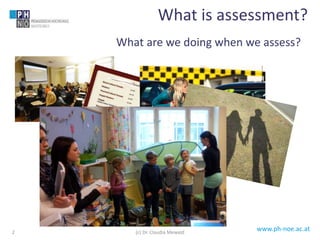
What are we doing when we assess?
2
What is assessment?
(c) Dr. Claudia Mewald
www.ph-noe.ac.at
• Roles of assessment
• Testing & assessment terminology
• Teaching & learning design
• Decision making processes or events
• Classroom-based assessment
3
Content
(c) Dr. Claudia Mewald
www.ph-noe.ac.at
Assessment  methods that educators use to
document, measure and evaluate the academic
readiness, learning progress and skill acquisition of
learners
Don’t take time to assess, unless you are going to take
action with what you discover. Wormeli 2006
Feedback  hold a mirror up to learners and help them
see what they did, comparing it to what they were
supposed to do
4
Assessment for learning
(c) Dr. Claudia Mewald
www.ph-noe.ac.at
What does our understanding of classroom assessment and
feedback mean for our work in the classroom?
Is classroom assessment more formative or summative in nature?
Depending on its focus, its role in informing teaching and learning
and in determining grades will be dramatically different.
5
Assessment of learning
(c) Dr. Claudia Mewald
www.ph-noe.ac.at6
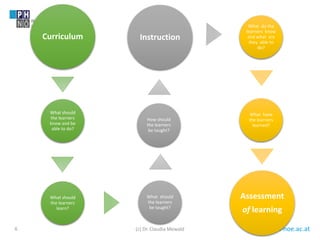
Curriculum
What should
the learners
know and be
able to do?
What should
the learners
learn?
What should
the learners
be taught?
Instruction
How should
the learners
be taught?
What do the
learners know
and what are
they able to
do?
What have
the learners
learned?
Assessment
of learning
(c) Dr. Claudia Mewald
www.ph-noe.ac.at7
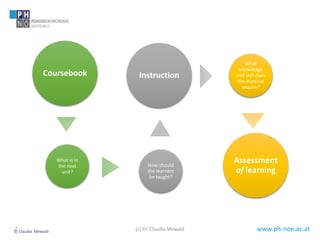
Coursebook
What is in
the next
unit?
Instruction
How should
the learners
be taught?
What
knowledge
and skill does
the material
require?
Assessment
of learning
© Claudia Mewald (c) Dr. Claudia Mewald
www.ph-noe.ac.at8
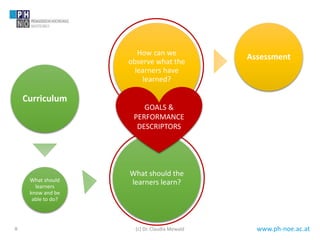
Curriculum
What should
learners
know and be
able to do?
What should the
learners learn?
How can we
observe what the
learners have
learned?
Assessment
(c) Dr. Claudia Mewald
GOALS &
PERFORMANCE
DESCRIPTORS
www.ph-noe.ac.at9
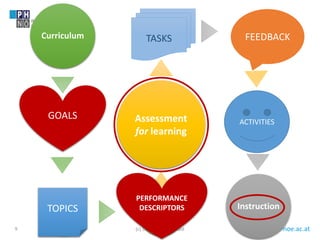
Curriculum
What should
learners know
and be able to
do?
What should
the learners
learn?
How can we
observe what
the learners
have learned?
Assessment
How should
the learners
be taught?
How can we
tell them what
they know and
what are they
able to do?
How should
the learners
learn?
Instruction
Assessment
for learning
(c) Dr. Claudia Mewald
GOALS
TOPICS
PERFORMANCE
DESCRIPTORS
TASKS FEEDBACK
ACTIVITIES
www.ph-noe.ac.at
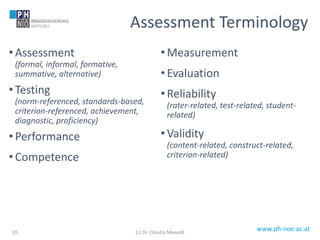
• Assessment
(formal, informal, formative,
summative, alternative)
• Testing
(norm-referenced, standards-based,
criterion-referenced, achievement,
diagnostic, proficiency)
• Performance
• Competence
• Measurement
• Evaluation
• Reliability
(rater-related, test-related, student-
related)
• Validity
(content-related, construct-related,
criterion-related)
10
Assessment Terminology
(c) Dr. Claudia Mewald
www.ph-noe.ac.at
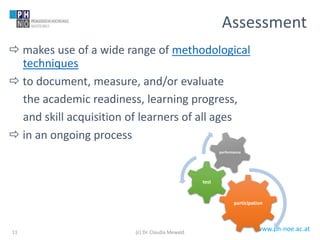
 makes use of a wide range of methodological
techniques
 to document, measure, and/or evaluate
the academic readiness, learning progress,
and skill acquisition of learners of all ages
 in an ongoing process
11
Assessment
participation
test
performance
(c) Dr. Claudia Mewald
www.ph-noe.ac.at
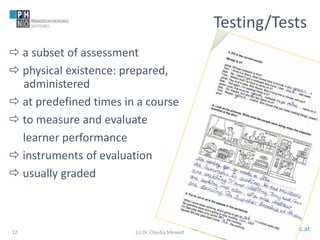
 a subset of assessment
 physical existence: prepared,
administered
 at predefined times in a course
 to measure and evaluate
learner performance
 instruments of evaluation
 usually graded
12
Testing/Tests
(c) Dr. Claudia Mewald
www.ph-noe.ac.at
A grade is an inadequate report of an inadequate
judgment by a biased and variable judge of the extent
to which a student has attained an undefined level of
mastery of an unknown proportion of an indefinite
material.
Source: P. Dressel (1983). "Grades: One More Tilt at the Windmill." In A. W. Chickering (Ed.), Bulletin. Memphis: Memphis State
Univ., Center for Study for Higher Education, p. 12.
13
Dressel quote
(c) Dr. Claudia Mewald
www.ph-noe.ac.at
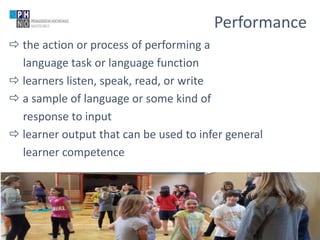
 the action or process of performing a
language task or language function
 learners listen, speak, read, or write
 a sample of language or some kind of
response to input
 learner output that can be used to infer general
learner competence
14
Performance
(c) Dr. Claudia Mewald
www.ph-noe.ac.at
 a set of abilities, knowledge & skills,
commitment, motivation and willpower that
enable a person to act effectively
 in a wide variety of situations
 each level/stage of development has its own
requirements so that competence can occur
at any time in the learning process
15
Competence
(c) Dr. Claudia Mewald
www.ph-noe.ac.at16
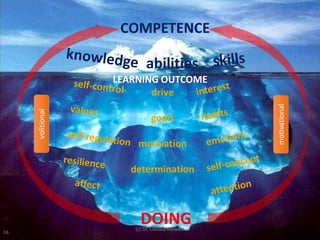
COMPETENCE
abilities
drive
goals
motivation
determination
DOING
LEARNING OUTCOME
volitional
motivational
16
(c) Dr. Claudia Mewald
www.ph-noe.ac.at17
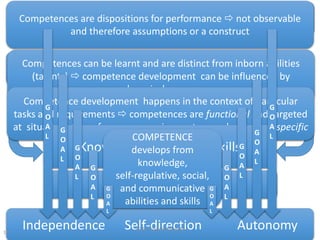
Motivation
Independence Self-direction Autonomy
DispositionCompetences are dispositions for performance  not observable
and therefore assumptions or a construct
LearningCompetences can be learnt and are distinct from inborn abilities
(talents)  competence development can be influenced by
pedagogical measures
ContextualisationCompetence development happens in the context of particular
tasks and requirements  competences are functional and targeted
at situations  performance requirements are also context-specific
Knowledge, Abilities & Skills
COMPETENCE
develops from
knowledge,
self-regulative, social,
and communicative
abilities and skills
G
O
A
L
G
O
A
L
G
O
A
L
G
O
A
L
G
O
A
L
G
O
A
L
G
O
A
L
G
O
A
L
G
O
A
L
G
O
A
L
17
(c) Dr. Claudia Mewald
www.ph-noe.ac.at
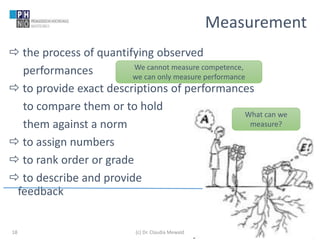
 the process of quantifying observed
performances
 to provide exact descriptions of performances
to compare them or to hold
them against a norm
 to assign numbers
 to rank order or grade
 to describe and provide
feedback
18
Measurement
What can we
measure?
We cannot measure competence,
we can only measure performance
(c) Dr. Claudia Mewald
www.ph-noe.ac.at
 the systematic determination of the worth and
significance of a performance
 uses criteria governed by a set of standards
 assists in decision-making (planning)
 helps to ascertain the degree of achievement or
value in regard to the aim and objectives
 enables reflection and
assists in the identification
of future action/change
19
Evaluation
(c) Dr. Claudia Mewald
www.ph-noe.ac.at
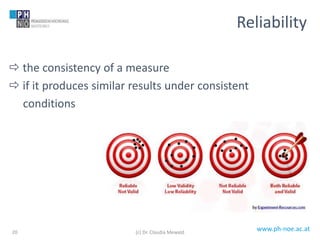
 the consistency of a measure
 if it produces similar results under consistent
conditions
20
Reliability
(c) Dr. Claudia Mewald
www.ph-noe.ac.at
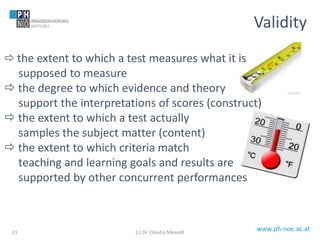
 the extent to which a test measures what it is
supposed to measure
 the degree to which evidence and theory
support the interpretations of scores (construct)
 the extent to which a test actually
samples the subject matter (content)
 the extent to which criteria match
teaching and learning goals and results are
supported by other concurrent performances
21
Validity
(c) Dr. Claudia Mewald
www.ph-noe.ac.at
designed to measure performances against a fixed set
of criteria
criteria are often described as can-do descriptors or
standards descriptors
standards describe what learners should be able to do
at a specific stage of their education and frequently
associated with criterion-referenced (standardised)
tests
22
Criterion-orientated assessment
(c) Dr. Claudia Mewald
www.ph-noe.ac.at
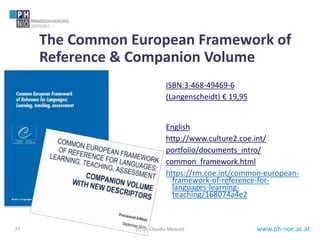
The Common European Framework of
Reference & Companion Volume
ISBN:3-468-49469-6
(Langenscheidt) € 19,95
English
http://www.culture2.coe.int/
portfolio/documents_intro/
common_framework.html
https://rm.coe.int/common-european-
framework-of-reference-for-
languages-learning-
teaching/168074a4e2
23 (c) Dr. Claudia Mewald
www.ph-noe.ac.at24
24
(c) Dr. Claudia Mewald
www.ph-noe.ac.at25 (c) Dr. Claudia Mewald
www.ph-noe.ac.at26
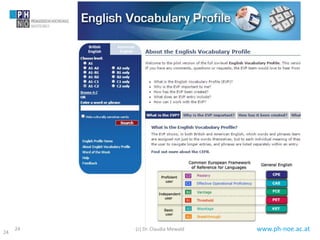
http://www.englishprofile.org/resources/information-booklet
(c) Dr. Claudia Mewald
www.ph-noe.ac.at
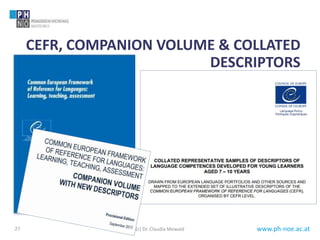
CEFR, COMPANION VOLUME & COLLATED
DESCRIPTORS
27 (c) Dr. Claudia Mewald
www.ph-noe.ac.at
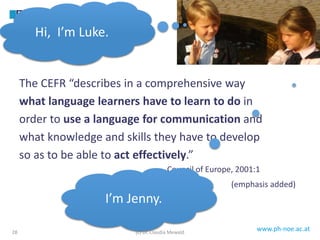
The CEFR “describes in a comprehensive way
what language learners have to learn to do in
order to use a language for communication and
what knowledge and skills they have to develop
so as to be able to act effectively.”
Council of Europe, 2001:1
(emphasis added)
28
Hi, I’m Luke.
I’m Jenny.
(c) Dr. Claudia Mewald
www.ph-noe.ac.at
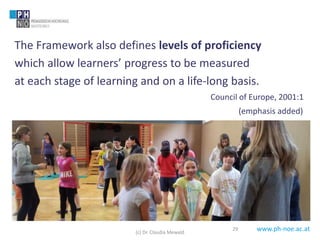
The Framework also defines levels of proficiency
which allow learners’ progress to be measured
at each stage of learning and on a life-long basis.
Council of Europe, 2001:1
(emphasis added)
29
(c) Dr. Claudia Mewald
www.ph-noe.ac.at30
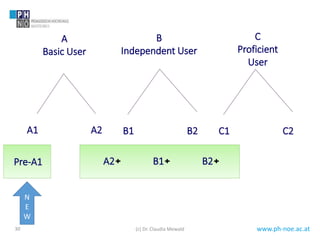
A
Basic User
B
Independent User
C
Proficient
User
C1 C2B1 B2A1 A2
A2+ B1+ B2+Pre-A1
(c) Dr. Claudia Mewald
N
E
W
www.ph-noe.ac.at
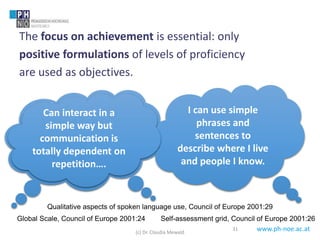
The focus on achievement is essential: only
positive formulations of levels of proficiency
are used as objectives.
31
Can introduce
him/herself and
others and can ask
and answer questions
about personal
details …
Global Scale, Council of Europe 2001:24
I can use simple
phrases and
sentences to
describe where I live
and people I know.
Self-assessment grid, Council of Europe 2001:26
Can interact in a
simple way but
communication is
totally dependent on
repetition….
Qualitative aspects of spoken language use, Council of Europe 2001:29
(c) Dr. Claudia Mewald
www.ph-noe.ac.at
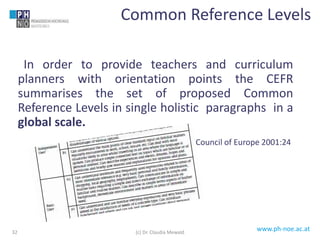
In order to provide teachers and curriculum
planners with orientation points the CEFR
summarises the set of proposed Common
Reference Levels in single holistic paragraphs in a
global scale.
Council of Europe 2001:24
Common Reference Levels
(c) Dr. Claudia Mewald32
www.ph-noe.ac.at
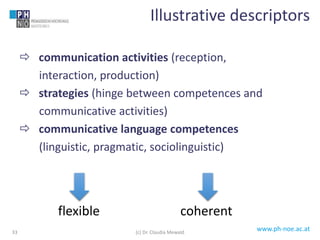
 communication activities (reception,
interaction, production)
 strategies (hinge between competences and
communicative activities)
 communicative language competences
(linguistic, pragmatic, sociolinguistic)
Illustrative descriptors
coherent
(c) Dr. Claudia Mewald33
flexible
www.ph-noe.ac.at
• functional and interactional perspective on the nature
of language
• language learning always needs to be connected to the
social context it is used in
• language is seen as a medium of interaction and
communication between people who want to achieve
specific goals and purposes
• especially in situations in which the learner has to
fulfill a particular role with language skills which can
be predicted or determined for the relevant context
34
Competence Based Language Teaching
(c) Dr. Claudia Mewald
www.ph-noe.ac.at
• mosaic approach to language learning
• assumes that language can be divided into appropriate
parts and subparts
• communicative competence is constructed from these
subparts put together in the correct order
• CBLT is in some respects similar to Communicative
Language Teaching
Richards & Rodgers, 2001, p.143
35
Competence Based Language Teaching
(c) Dr. Claudia Mewald
www.ph-noe.ac.at
• learning design in CBLT differs from the traditional
approach to developing a syllabus
• CBLT is designed not around the notion of subject
knowledge but around the notion of competency
• focus on how the students can use the language
instead of their knowledge about the language
Richards & Rodgers, 2001, p.144
36
Learning design in CBLT
(c) Dr. Claudia Mewald
www.ph-noe.ac.at
• systematically designed to achieve a certain
competence
• real-world tasks which may be related to any domain
of life, especially to survival-oriented situations in a
new environment
Richards & Rodgers, 2001:144
37
Learning activities in CBLT
(c) Dr. Claudia Mewald
www.ph-noe.ac.at
• criterion-based assessment is essential for CBLT
• specific language skills learnt during the course are
assessed
• the competencies tested consist of a description of the
essential skills, knowledge, attitudes, and behaviours
required for effective performance of real-world tasks
or activities
• performance-criteria form the basis for the
assessment Richards & Rodgers, 2001, p.144
38
Assessment in CBLT
(c) Dr. Claudia Mewald
www.ph-noe.ac.at
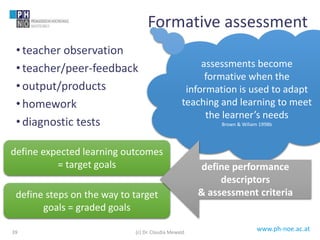
• teacher observation
• teacher/peer-feedback
• output/products
• homework
• diagnostic tests
39
Formative assessment
assessments become
formative when the
information is used to adapt
teaching and learning to meet
the learner’s needs
Brown & Wiliam 1998b
define expected learning outcomes
= target goals
define steps on the way to target
goals = graded goals
define performance
descriptors
& assessment criteria
(c) Dr. Claudia Mewald
www.ph-noe.ac.at
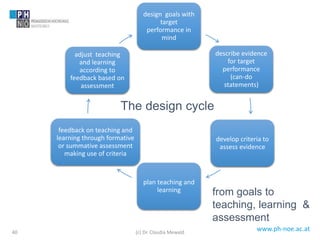
design goals with
target
performance in
mind
describe evidence
for target
performance
(can-do
statements)
develop criteria to
assess evidence
plan teaching and
learning
feedback on teaching and
learning through formative
or summative assessment
making use of criteria
adjust teaching
and learning
according to
feedback based on
assessment
40
The design cycle
from goals to
teaching, learning &
assessment
(c) Dr. Claudia Mewald
www.ph-noe.ac.at
LOA
Jones, N. & Saville, N. (2017) Learning Oriented Assessment. A systemic
approach. Cambridge: CUP
(c) Dr. Claudia Mewald
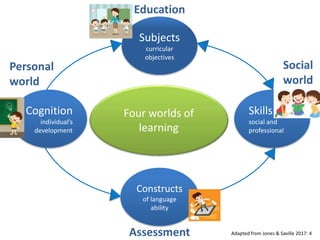
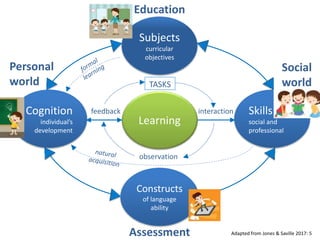
Four worlds of
learning
Education
Assessment
Personal
world
Social
world
Adapted from Jones & Saville 2017: 4
Cognition
individual’s
development
Subjects
curricular
objectives
Constructs
of language
ability
Skills
social and
professional
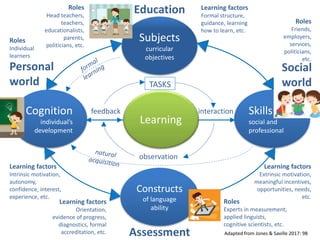
Four worlds of
learning
Education
Assessment
Personal
world
Social
world
Adapted from Jones & Saville 2017: 5
interactionfeedback
observation
TASKS
Learning
Subjects
curricular
objectives
Cognition
individual’s
development
Constructs
of language
ability
Skills
social and
professional
Education
Assessment
Personal
world
Social
world
Adapted from Jones & Saville 2017: 98
interactionfeedback
observation
TASKS
Learning
Subjects
curricular
objectives
Cognition
individual’s
development
Constructs
of language
ability
Skills
social and
professional
Learning factors
Intrinsic motivation,
autonomy,
confidence, interest,
experience, etc.
Learning factors
Extrinsic motivation,
meaningful incentives,
opportunities, needs,
etc.
Learning factors
Formal structure,
guidance, learning
how to learn, etc.
Learning factors
Orientation,
evidence of progress,
diagnostics, formal
accreditation, etc.
Roles
Individual
learners
Roles
Head teachers,
teachers,
educationalists,
parents,
politicians, etc.
Roles
Friends,
employers,
services,
politicians,
etc.
Roles
Experts in measurement,
applied linguists,
cognitive scientists, etc.
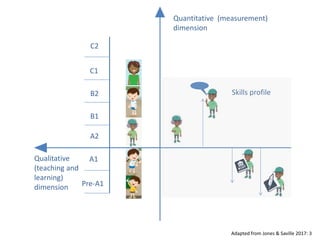
Pre-A1
A1
A2
B1
B2
C1
C2
Quantitative (measurement)
dimension
Qualitative
(teaching and
learning)
dimension
Skills profile
Adapted from Jones & Saville 2017: 3
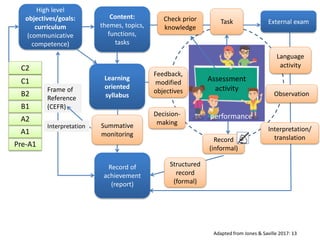
High level
objectives/goals:
curriculum
(communicative
competence)
Pre-A1
A1
A2
B1
B2
C1
C2
Content:
themes, topics,
functions,
tasks
Learning
oriented
syllabus
Assessment
activity
Task
Record
(informal)
Language
activity
Observation
Interpretation/
translation
Decision-
making
Feedback,
modified
objectives
Check prior
knowledge
Record of
achievement
(report)
Frame of
Reference
(CEFR)
Structured
record
(formal)
External exam
Summative
monitoring
Interpretation
Adapted from Jones & Saville 2017: 13
performance
www.ph-noe.ac.at
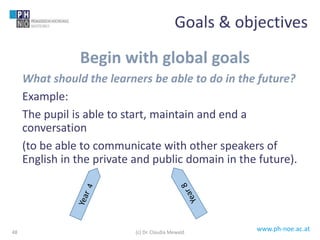
Begin with global goals
What should the learners be able to do in the future?
Example:
The pupil is able to start, maintain and end a
conversation
(to be able to communicate with other speakers of
English in the private and public domain in the future).
Goals & objectives
(c) Dr. Claudia Mewald48
www.ph-noe.ac.at
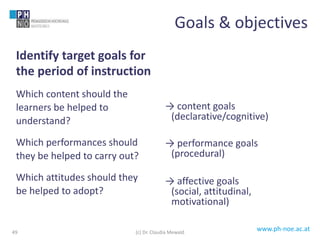
Identify target goals for
the period of instruction
Which content should the
learners be helped to
understand?
Which performances should
they be helped to carry out?
Which attitudes should they
be helped to adopt?
→ content goals
(declarative/cognitive)
→ performance goals
(procedural)
→ affective goals
(social, attitudinal,
motivational)
Goals & objectives
(c) Dr. Claudia Mewald49
www.ph-noe.ac.at
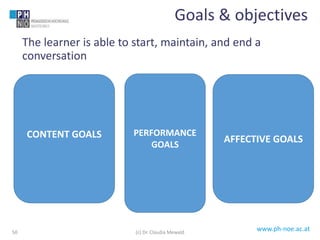
The learner is able to start, maintain, and end a
conversation
Goals & objectives
CONTENT GOALS PERFORMANCE
GOALS
AFFECTIVE GOALS
(c) Dr. Claudia Mewald50
www.ph-noe.ac.at
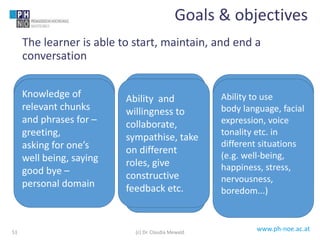
The learner is able to start, maintain, and end a
conversation
Goals & objectives
CONTENT GOALS PERFORMANCE
GOALS
AFFECTIVE GOALS
Knowledge of
relevant chunks
and phrases for –
greeting,
asking for one’s
well being, saying
good bye –
personal domain
Ability to use
body language, facial
expression, voice
tonality etc. in
different situations
(e.g. well-being,
happiness, stress,
nervousness,
boredom...)
Ability and
willingness to
collaborate,
sympathise, take
on different
roles, give
constructive
feedback etc.
(c) Dr. Claudia Mewald51
www.ph-noe.ac.at52
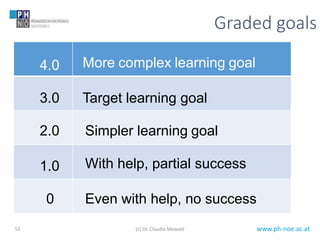
Graded goals
Target learning goal3.0
4.0 More complex learning goal
Simpler learning goal2.0
With help, partial success1.0
Even with help, no success0
(c) Dr. Claudia Mewald
www.ph-noe.ac.at
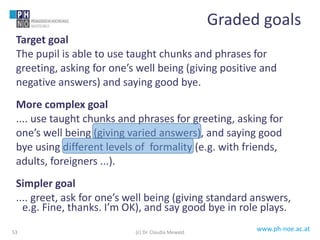
Target goal
The pupil is able to use taught chunks and phrases for
greeting, asking for one’s well being (giving positive and
negative answers) and saying good bye.
More complex goal
.... use taught chunks and phrases for greeting, asking for
one’s well being (giving varied answers), and saying good
bye using different levels of formality (e.g. with friends,
adults, foreigners ...).
Simpler goal
.... greet, ask for one’s well being (giving standard answers,
e.g. Fine, thanks. I’m OK), and say good bye in role plays.
Graded goals
(c) Dr. Claudia Mewald53
www.ph-noe.ac.at54
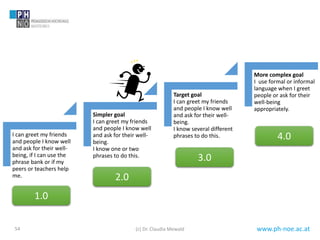
I can greet my friends
and people I know well
and ask for their well-
being, if I can use the
phrase bank or if my
peers or teachers help
me.
Simpler goal
I can greet my friends
and people I know well
and ask for their well-
being.
I know one or two
phrases to do this.
Target goal
I can greet my friends
and people I know well
and ask for their well-
being.
I know several different
phrases to do this.
More complex goal
I use formal or informal
language when I greet
people or ask for their
well-being
appropriately.
3.0
2.0
4.0
1.0
(c) Dr. Claudia Mewald
www.ph-noe.ac.at55 (c) Dr. Claudia Mewald
www.ph-noe.ac.at56
Mewald 2014b
(c) Dr. Claudia Mewald
www.ph-noe.ac.at57
57
Mewald 2014b
(c) Dr. Claudia Mewald
www.ph-noe.ac.at58
Based on: Stiggins, R., Arter, J., Chappuis, J., & Chappuis, S. (2006). Classroom assessment for student learning —
Doing it right, using it well. Portland: Educational Testing Service.
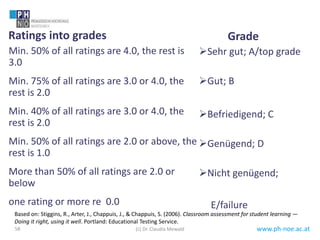
Ratings into grades
Min. 50% of all ratings are 4.0, the rest is
3.0
Min. 75% of all ratings are 3.0 or 4.0, the
rest is 2.0
Min. 40% of all ratings are 3.0 or 4.0, the
rest is 2.0
Min. 50% of all ratings are 2.0 or above, the
rest is 1.0
More than 50% of all ratings are 2.0 or
below
one rating or more re 0.0
Grade
Sehr gut; A/top grade
Gut; B
Befriedigend; C
Genügend; D
Nicht genügend;
E/failure
(c) Dr. Claudia Mewald
www.ph-noe.ac.at59
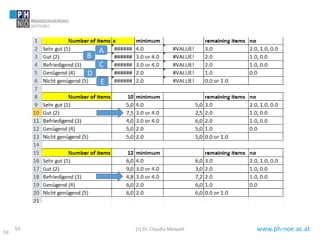
59
A
B
C
D
E
(c) Dr. Claudia Mewald
www.ph-noe.ac.at60 (c) Dr. Claudia Mewald
www.ph-noe.ac.at
• a learner’s evaluation of his/her own success
• a learner’s evaluation of a peer’s success
• based on criteria
• known and understood by learners
• implementation checked by peers and teachers
61
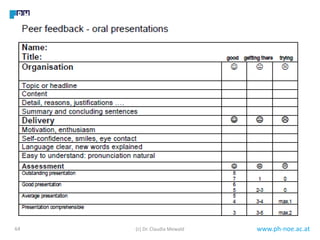
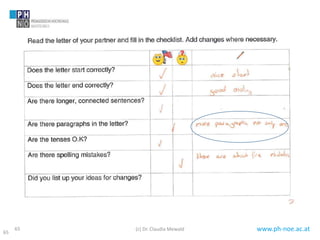
Self- and peer assessment
(c) Dr. Claudia Mewald
www.ph-noe.ac.at62
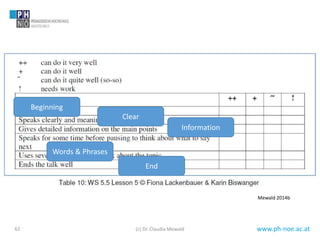
Mewald 2014b
(c) Dr. Claudia Mewald
Beginning
Clear
Information
Words & Phrases
End
www.ph-noe.ac.at63
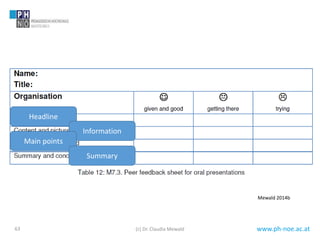
Mewald 2014b
(c) Dr. Claudia Mewald
Headline
Information
Main points
Summary
www.ph-noe.ac.at64 (c) Dr. Claudia Mewald
www.ph-noe.ac.at65
65
(c) Dr. Claudia Mewald
www.ph-noe.ac.at66
66
(c) Dr. Claudia Mewald
www.ph-noe.ac.at
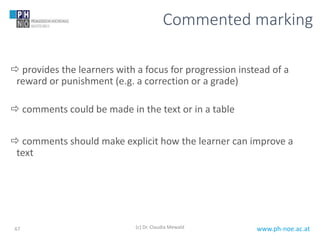
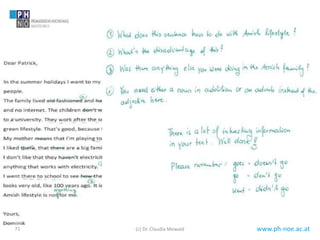
Commented marking
 provides the learners with a focus for progression instead of a
reward or punishment (e.g. a correction or a grade)
 comments could be made in the text or in a table
 comments should make explicit how the learner can improve a
text
(c) Dr. Claudia Mewald67
www.ph-noe.ac.at68
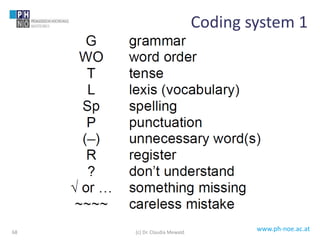
Coding system 1
(c) Dr. Claudia Mewald
www.ph-noe.ac.at69
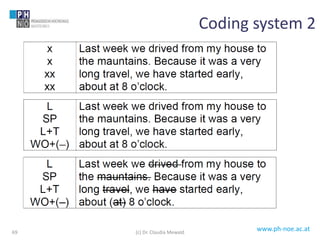
Coding system 2
(c) Dr. Claudia Mewald
www.ph-noe.ac.at(c) Dr. Claudia Mewald70
www.ph-noe.ac.at71 (c) Dr. Claudia Mewald
www.ph-noe.ac.at
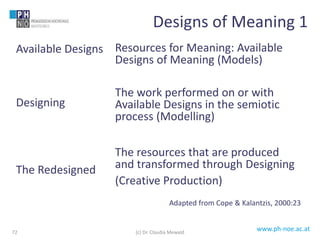
Available Designs
Designing
The Redesigned
Resources for Meaning: Available
Designs of Meaning (Models)
The work performed on or with
Available Designs in the semiotic
process (Modelling)
The resources that are produced
and transformed through Designing
(Creative Production)
Adapted from Cope & Kalantzis, 2000:23
72
Designs of Meaning 1
(c) Dr. Claudia Mewald
www.ph-noe.ac.at
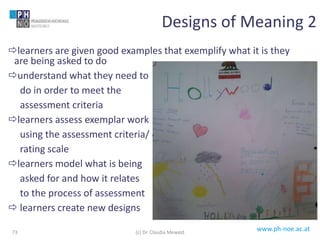
learners are given good examples that exemplify what it is they
are being asked to do
understand what they need to
do in order to meet the
assessment criteria
learners assess exemplar work
using the assessment criteria/
rating scale
learners model what is being
asked for and how it relates
to the process of assessment
 learners create new designs
Designs of Meaning 2
(c) Dr. Claudia Mewald73
www.ph-noe.ac.at74
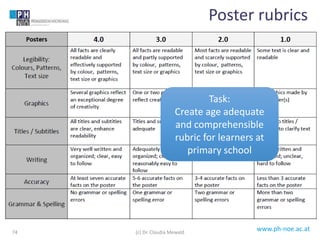
Poster rubrics
Task:
Create age adequate
and comprehensible
rubric for learners at
primary school
(c) Dr. Claudia Mewald
www.ph-noe.ac.at
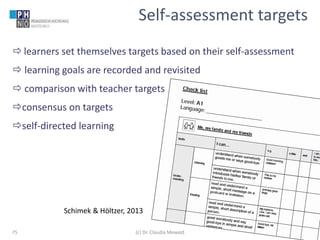
 learners set themselves targets based on their self-assessment
 learning goals are recorded and revisited
 comparison with teacher targets
consensus on targets
self-directed learning
Self-assessment targets
Schimek & Höltzer, 2013
(c) Dr. Claudia Mewald75
www.ph-noe.ac.at76
(c) Dr. Claudia Mewald
http://www.coe.int/t/dg4/education/elp/
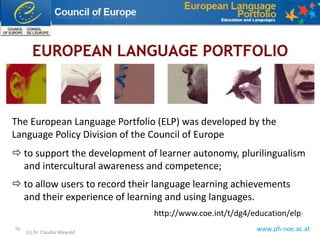
The European Language Portfolio (ELP) was developed by the
Language Policy Division of the Council of Europe
 to support the development of learner autonomy, plurilingualism
and intercultural awareness and competence;
 to allow users to record their language learning achievements
and their experience of learning and using languages.
www.ph-noe.ac.at77
(c) Dr. Claudia Mewald
77
www.ph-noe.ac.at78
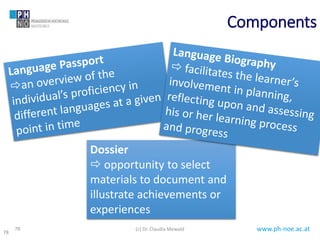
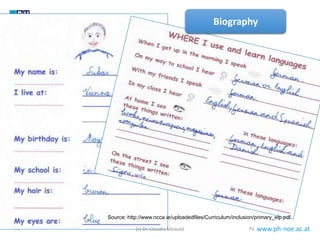
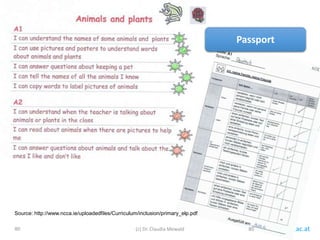
Dossier
 opportunity to select
materials to document and
illustrate achievements or
experiences
Components
78
(c) Dr. Claudia Mewald
www.ph-noe.ac.at79 79
Source: http://www.ncca.ie/uploadedfiles/Curriculum/inclusion/primary_elp.pdf
Biography
(c) Dr. Claudia Mewald
www.ph-noe.ac.at80 80
Source: http://www.ncca.ie/uploadedfiles/Curriculum/inclusion/primary_elp.pdf
Passport
(c) Dr. Claudia Mewald
www.ph-noe.ac.at81 81
Source: http://www.ncca.ie/uploadedfiles/Curriculum/inclusion/primary_elp.pdf
Dossier
(c) Dr. Claudia Mewald
www.ph-noe.ac.at82 82(c) Dr. Claudia Mewald
www.ph-noe.ac.at83 (c) Dr. Claudia Mewald
www.ph-noe.ac.at
Auerbach, E. R. (1986) Competency-based ESL: One step forward or two steps back? TESOL Quarterly 20(3): 411 – 415.
Brown, D. H., & Abeywickrama, P. (2010) Language Assessment. Principles and Classroom Practices. New York: Pearson.
Cope, B. & Kalantzis, M. (2000) Multiliteracies. Literacy Learning and the Design of Social Futures. London: Routledge
Dressel , P. (1983). Grades: One More Tilt at the Windmill. In A. W. Chickering (Ed.), Bulletin. Memphis: Memphis State Univ.,
Center for Study for Higher Education, p. 12.
Jäckl, C. & Manhart, M. (2017) Die Grundkompetenzen Fremdsprache 2. Schulstufe - GK2. Mit exemplarischen
Umsetzungsbeispielen für den Englischunterricht in der Grundstufe 1. Graz: ÖSZ
Jones, N. & Saville, N. (2017) Learning Oriented Assessment. A systemic approach. Cambridge: CUP.
Marzano, R. (2009) Designing & Teaching Learning Goals & Objectives. Bloomington: FSC.
Mewald, C. (2014) Practice what you preach – test what you teach. Testing English as a foreign language in
heterogeneous groups. R&E-Source. Open Online Journal for Research and Education. PH NOE: Baden. Vol 1. Pp. 24-35
Available at: http://journal.ph-noe.ac.at/index.php/resource/article/view/14/13
Mewald, C. (2014) Assessment. In: BIFIE (Hrsg.) Bildungsstandards Englisch 8. Unterrichtsvideos und Begleitmaterialien. BIFIE:
Salzburg
Richards, J. C., & Rodgers, T. S. (2001) Approaches and Methods in Language Teaching (Second Edition). Cambridge: CUP.
Schenck, A. (1978) Oregon Competency Based Education Program. Northwest Regional Educational Laboratory.
Schimek, F., & Höltzer, R. (2013). Europäisches Sprachenortfolio für die Mitteleuropäische Region. Primarstufe (für
SchülerInnen von 6 bis 10 Jahren). Wien: Stadtschulrat für Wien.
Stiggins, R., Arter, J., Chappuis, J., & Chappuis, S. (2006) Classroom assessment for student learning—Doing it right, using it
well. Portland: Educational Testing Service.
Wormeli, R. (2006) Fair Isn’t Always Equal. Portland: Stenhouse Publishers.
Wiggins, G., Mc Tighe, J. (2005) Understanding by Design. Alexandria, VA: Pearson.
84
References
(c) Dr. Claudia Mewald
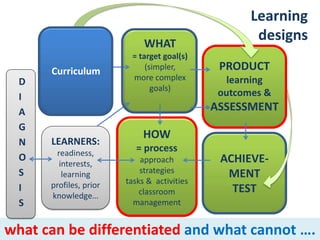
ACHIEVE-
MENT
TEST
Learning
designs
(c) Dr. Claudia Mewald85
WHAT
= target goal(s)
(simpler,
more complex
goals)
LEARNERS:
readiness,
interests,
learning
profiles, prior
knowledge…
HOW
= process
approach
strategies
tasks & activities
classroom
management
PRODUCT
learning
outcomes &
ASSESSMENT
Curriculum
what can be differentiated and what cannot ….
D
I
A
G
N
O
S
I
S
www.ph-noe.ac.at86
86
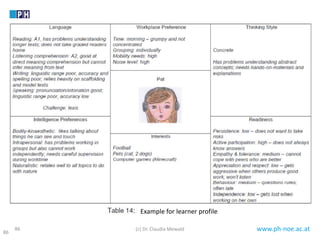
Example for learner profile
(c) Dr. Claudia Mewald
www.ph-noe.ac.at
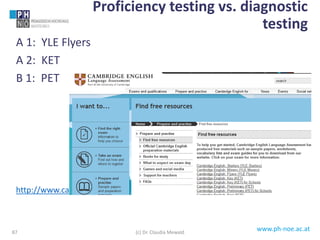
A 1: YLE Flyers
A 2: KET
B 1: PET
http://www.cambridgeenglish.org/prepare-and-practise/find-free-resources/
87
Proficiency testing vs. diagnostic
testing
(c) Dr. Claudia Mewald
www.ph-noe.ac.at
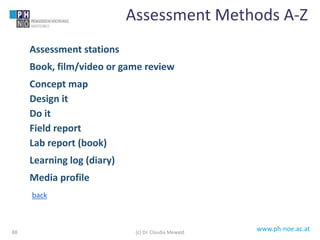
Assessment stations
Book, film/video or game review
Concept map
Design it
Do it
Field report
Lab report (book)
Learning log (diary)
Media profile
(c) Dr. Claudia Mewald88
Assessment Methods A-Z
back
www.ph-noe.ac.at
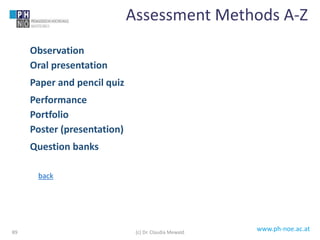
Observation
Oral presentation
Paper and pencil quiz
Performance
Portfolio
Poster (presentation)
Question banks
(c) Dr. Claudia Mewald89
Assessment Methods A-Z
back
www.ph-noe.ac.at90 (c) Dr. Claudia Mewald

Assessment 2018 handout

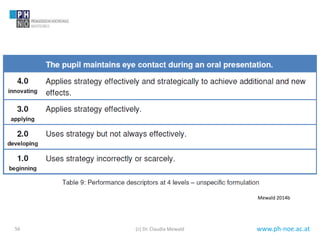
  • 1.
    www.ph-noe.ac.at Assessing foreign languagelearners: The contribution of formative assessment to teaching and learning Not everything that can be counted counts, and not everything that counts can be counted. Albert Einstein (c) Dr. Claudia Mewald1
  • 2.
    www.ph-noe.ac.at What are wedoing when we assess? 2 What is assessment? (c) Dr. Claudia Mewald
  • 3.
    www.ph-noe.ac.at • Roles ofassessment • Testing & assessment terminology • Teaching & learning design • Decision making processes or events • Classroom-based assessment 3 Content (c) Dr. Claudia Mewald
  • 4.
    www.ph-noe.ac.at Assessment  methodsthat educators use to document, measure and evaluate the academic readiness, learning progress and skill acquisition of learners Don’t take time to assess, unless you are going to take action with what you discover. Wormeli 2006 Feedback  hold a mirror up to learners and help them see what they did, comparing it to what they were supposed to do 4 Assessment for learning (c) Dr. Claudia Mewald
  • 5.
    www.ph-noe.ac.at What does ourunderstanding of classroom assessment and feedback mean for our work in the classroom? Is classroom assessment more formative or summative in nature? Depending on its focus, its role in informing teaching and learning and in determining grades will be dramatically different. 5 Assessment of learning (c) Dr. Claudia Mewald
  • 6.
    www.ph-noe.ac.at6 Curriculum What should the learners knowand be able to do? What should the learners learn? What should the learners be taught? Instruction How should the learners be taught? What do the learners know and what are they able to do? What have the learners learned? Assessment of learning (c) Dr. Claudia Mewald
  • 7.
    www.ph-noe.ac.at7 Coursebook What is in thenext unit? Instruction How should the learners be taught? What knowledge and skill does the material require? Assessment of learning © Claudia Mewald (c) Dr. Claudia Mewald
  • 8.
    www.ph-noe.ac.at8 Curriculum What should learners know andbe able to do? What should the learners learn? How can we observe what the learners have learned? Assessment (c) Dr. Claudia Mewald GOALS & PERFORMANCE DESCRIPTORS
  • 9.
    www.ph-noe.ac.at9 Curriculum What should learners know andbe able to do? What should the learners learn? How can we observe what the learners have learned? Assessment How should the learners be taught? How can we tell them what they know and what are they able to do? How should the learners learn? Instruction Assessment for learning (c) Dr. Claudia Mewald GOALS TOPICS PERFORMANCE DESCRIPTORS TASKS FEEDBACK ACTIVITIES
  • 10.
    www.ph-noe.ac.at • Assessment (formal, informal,formative, summative, alternative) • Testing (norm-referenced, standards-based, criterion-referenced, achievement, diagnostic, proficiency) • Performance • Competence • Measurement • Evaluation • Reliability (rater-related, test-related, student- related) • Validity (content-related, construct-related, criterion-related) 10 Assessment Terminology (c) Dr. Claudia Mewald
  • 11.
    www.ph-noe.ac.at  makes useof a wide range of methodological techniques  to document, measure, and/or evaluate the academic readiness, learning progress, and skill acquisition of learners of all ages  in an ongoing process 11 Assessment participation test performance (c) Dr. Claudia Mewald
  • 12.
    www.ph-noe.ac.at  a subsetof assessment  physical existence: prepared, administered  at predefined times in a course  to measure and evaluate learner performance  instruments of evaluation  usually graded 12 Testing/Tests (c) Dr. Claudia Mewald
  • 13.
    www.ph-noe.ac.at A grade isan inadequate report of an inadequate judgment by a biased and variable judge of the extent to which a student has attained an undefined level of mastery of an unknown proportion of an indefinite material. Source: P. Dressel (1983). "Grades: One More Tilt at the Windmill." In A. W. Chickering (Ed.), Bulletin. Memphis: Memphis State Univ., Center for Study for Higher Education, p. 12. 13 Dressel quote (c) Dr. Claudia Mewald
  • 14.
    www.ph-noe.ac.at  the actionor process of performing a language task or language function  learners listen, speak, read, or write  a sample of language or some kind of response to input  learner output that can be used to infer general learner competence 14 Performance (c) Dr. Claudia Mewald
  • 15.
    www.ph-noe.ac.at  a setof abilities, knowledge & skills, commitment, motivation and willpower that enable a person to act effectively  in a wide variety of situations  each level/stage of development has its own requirements so that competence can occur at any time in the learning process 15 Competence (c) Dr. Claudia Mewald
  • 16.
  • 17.
    www.ph-noe.ac.at17 Motivation Independence Self-direction Autonomy DispositionCompetencesare dispositions for performance  not observable and therefore assumptions or a construct LearningCompetences can be learnt and are distinct from inborn abilities (talents)  competence development can be influenced by pedagogical measures ContextualisationCompetence development happens in the context of particular tasks and requirements  competences are functional and targeted at situations  performance requirements are also context-specific Knowledge, Abilities & Skills COMPETENCE develops from knowledge, self-regulative, social, and communicative abilities and skills G O A L G O A L G O A L G O A L G O A L G O A L G O A L G O A L G O A L G O A L 17 (c) Dr. Claudia Mewald
  • 18.
    www.ph-noe.ac.at  the processof quantifying observed performances  to provide exact descriptions of performances to compare them or to hold them against a norm  to assign numbers  to rank order or grade  to describe and provide feedback 18 Measurement What can we measure? We cannot measure competence, we can only measure performance (c) Dr. Claudia Mewald
  • 19.
    www.ph-noe.ac.at  the systematicdetermination of the worth and significance of a performance  uses criteria governed by a set of standards  assists in decision-making (planning)  helps to ascertain the degree of achievement or value in regard to the aim and objectives  enables reflection and assists in the identification of future action/change 19 Evaluation (c) Dr. Claudia Mewald
  • 20.
    www.ph-noe.ac.at  the consistencyof a measure  if it produces similar results under consistent conditions 20 Reliability (c) Dr. Claudia Mewald
  • 21.
    www.ph-noe.ac.at  the extentto which a test measures what it is supposed to measure  the degree to which evidence and theory support the interpretations of scores (construct)  the extent to which a test actually samples the subject matter (content)  the extent to which criteria match teaching and learning goals and results are supported by other concurrent performances 21 Validity (c) Dr. Claudia Mewald
  • 22.
    www.ph-noe.ac.at designed to measureperformances against a fixed set of criteria criteria are often described as can-do descriptors or standards descriptors standards describe what learners should be able to do at a specific stage of their education and frequently associated with criterion-referenced (standardised) tests 22 Criterion-orientated assessment (c) Dr. Claudia Mewald
  • 23.
    www.ph-noe.ac.at The Common EuropeanFramework of Reference & Companion Volume ISBN:3-468-49469-6 (Langenscheidt) € 19,95 English http://www.culture2.coe.int/ portfolio/documents_intro/ common_framework.html https://rm.coe.int/common-european- framework-of-reference-for- languages-learning- teaching/168074a4e2 23 (c) Dr. Claudia Mewald
  • 24.
  • 25.
  • 26.
  • 27.
    www.ph-noe.ac.at CEFR, COMPANION VOLUME& COLLATED DESCRIPTORS 27 (c) Dr. Claudia Mewald
  • 28.
    www.ph-noe.ac.at The CEFR “describesin a comprehensive way what language learners have to learn to do in order to use a language for communication and what knowledge and skills they have to develop so as to be able to act effectively.” Council of Europe, 2001:1 (emphasis added) 28 Hi, I’m Luke. I’m Jenny. (c) Dr. Claudia Mewald
  • 29.
    www.ph-noe.ac.at The Framework alsodefines levels of proficiency which allow learners’ progress to be measured at each stage of learning and on a life-long basis. Council of Europe, 2001:1 (emphasis added) 29 (c) Dr. Claudia Mewald
  • 30.
    www.ph-noe.ac.at30 A Basic User B Independent User C Proficient User C1C2B1 B2A1 A2 A2+ B1+ B2+Pre-A1 (c) Dr. Claudia Mewald N E W
  • 31.
    www.ph-noe.ac.at The focus onachievement is essential: only positive formulations of levels of proficiency are used as objectives. 31 Can introduce him/herself and others and can ask and answer questions about personal details … Global Scale, Council of Europe 2001:24 I can use simple phrases and sentences to describe where I live and people I know. Self-assessment grid, Council of Europe 2001:26 Can interact in a simple way but communication is totally dependent on repetition…. Qualitative aspects of spoken language use, Council of Europe 2001:29 (c) Dr. Claudia Mewald
  • 32.
    www.ph-noe.ac.at In order toprovide teachers and curriculum planners with orientation points the CEFR summarises the set of proposed Common Reference Levels in single holistic paragraphs in a global scale. Council of Europe 2001:24 Common Reference Levels (c) Dr. Claudia Mewald32
  • 33.
    www.ph-noe.ac.at  communication activities(reception, interaction, production)  strategies (hinge between competences and communicative activities)  communicative language competences (linguistic, pragmatic, sociolinguistic) Illustrative descriptors coherent (c) Dr. Claudia Mewald33 flexible
  • 34.
    www.ph-noe.ac.at • functional andinteractional perspective on the nature of language • language learning always needs to be connected to the social context it is used in • language is seen as a medium of interaction and communication between people who want to achieve specific goals and purposes • especially in situations in which the learner has to fulfill a particular role with language skills which can be predicted or determined for the relevant context 34 Competence Based Language Teaching (c) Dr. Claudia Mewald
  • 35.
    www.ph-noe.ac.at • mosaic approachto language learning • assumes that language can be divided into appropriate parts and subparts • communicative competence is constructed from these subparts put together in the correct order • CBLT is in some respects similar to Communicative Language Teaching Richards & Rodgers, 2001, p.143 35 Competence Based Language Teaching (c) Dr. Claudia Mewald
  • 36.
    www.ph-noe.ac.at • learning designin CBLT differs from the traditional approach to developing a syllabus • CBLT is designed not around the notion of subject knowledge but around the notion of competency • focus on how the students can use the language instead of their knowledge about the language Richards & Rodgers, 2001, p.144 36 Learning design in CBLT (c) Dr. Claudia Mewald
  • 37.
    www.ph-noe.ac.at • systematically designedto achieve a certain competence • real-world tasks which may be related to any domain of life, especially to survival-oriented situations in a new environment Richards & Rodgers, 2001:144 37 Learning activities in CBLT (c) Dr. Claudia Mewald
  • 38.
    www.ph-noe.ac.at • criterion-based assessmentis essential for CBLT • specific language skills learnt during the course are assessed • the competencies tested consist of a description of the essential skills, knowledge, attitudes, and behaviours required for effective performance of real-world tasks or activities • performance-criteria form the basis for the assessment Richards & Rodgers, 2001, p.144 38 Assessment in CBLT (c) Dr. Claudia Mewald
  • 39.
    www.ph-noe.ac.at • teacher observation •teacher/peer-feedback • output/products • homework • diagnostic tests 39 Formative assessment assessments become formative when the information is used to adapt teaching and learning to meet the learner’s needs Brown & Wiliam 1998b define expected learning outcomes = target goals define steps on the way to target goals = graded goals define performance descriptors & assessment criteria (c) Dr. Claudia Mewald
  • 40.
    www.ph-noe.ac.at design goals with target performancein mind describe evidence for target performance (can-do statements) develop criteria to assess evidence plan teaching and learning feedback on teaching and learning through formative or summative assessment making use of criteria adjust teaching and learning according to feedback based on assessment 40 The design cycle from goals to teaching, learning & assessment (c) Dr. Claudia Mewald
  • 41.
    www.ph-noe.ac.at LOA Jones, N. &Saville, N. (2017) Learning Oriented Assessment. A systemic approach. Cambridge: CUP (c) Dr. Claudia Mewald
  • 42.
  • 43.
    Education Assessment Personal world Social world Adapted from Jones& Saville 2017: 4 Cognition individual’s development Subjects curricular objectives Constructs of language ability Skills social and professional Four worlds of learning
  • 44.
    Education Assessment Personal world Social world Adapted from Jones& Saville 2017: 5 interactionfeedback observation TASKS Learning Subjects curricular objectives Cognition individual’s development Constructs of language ability Skills social and professional
  • 45.
    Education Assessment Personal world Social world Adapted from Jones& Saville 2017: 98 interactionfeedback observation TASKS Learning Subjects curricular objectives Cognition individual’s development Constructs of language ability Skills social and professional Learning factors Intrinsic motivation, autonomy, confidence, interest, experience, etc. Learning factors Extrinsic motivation, meaningful incentives, opportunities, needs, etc. Learning factors Formal structure, guidance, learning how to learn, etc. Learning factors Orientation, evidence of progress, diagnostics, formal accreditation, etc. Roles Individual learners Roles Head teachers, teachers, educationalists, parents, politicians, etc. Roles Friends, employers, services, politicians, etc. Roles Experts in measurement, applied linguists, cognitive scientists, etc.
  • 46.
  • 47.
  • 48.
    www.ph-noe.ac.at Begin with globalgoals What should the learners be able to do in the future? Example: The pupil is able to start, maintain and end a conversation (to be able to communicate with other speakers of English in the private and public domain in the future). Goals & objectives (c) Dr. Claudia Mewald48
  • 49.
    www.ph-noe.ac.at Identify target goalsfor the period of instruction Which content should the learners be helped to understand? Which performances should they be helped to carry out? Which attitudes should they be helped to adopt? → content goals (declarative/cognitive) → performance goals (procedural) → affective goals (social, attitudinal, motivational) Goals & objectives (c) Dr. Claudia Mewald49
  • 50.
    www.ph-noe.ac.at The learner isable to start, maintain, and end a conversation Goals & objectives CONTENT GOALS PERFORMANCE GOALS AFFECTIVE GOALS (c) Dr. Claudia Mewald50
  • 51.
    www.ph-noe.ac.at The learner isable to start, maintain, and end a conversation Goals & objectives CONTENT GOALS PERFORMANCE GOALS AFFECTIVE GOALS Knowledge of relevant chunks and phrases for – greeting, asking for one’s well being, saying good bye – personal domain Ability to use body language, facial expression, voice tonality etc. in different situations (e.g. well-being, happiness, stress, nervousness, boredom...) Ability and willingness to collaborate, sympathise, take on different roles, give constructive feedback etc. (c) Dr. Claudia Mewald51
  • 52.
    www.ph-noe.ac.at52 Graded goals Target learninggoal3.0 4.0 More complex learning goal Simpler learning goal2.0 With help, partial success1.0 Even with help, no success0 (c) Dr. Claudia Mewald
  • 53.
    www.ph-noe.ac.at Target goal The pupilis able to use taught chunks and phrases for greeting, asking for one’s well being (giving positive and negative answers) and saying good bye. More complex goal .... use taught chunks and phrases for greeting, asking for one’s well being (giving varied answers), and saying good bye using different levels of formality (e.g. with friends, adults, foreigners ...). Simpler goal .... greet, ask for one’s well being (giving standard answers, e.g. Fine, thanks. I’m OK), and say good bye in role plays. Graded goals (c) Dr. Claudia Mewald53
  • 54.
    www.ph-noe.ac.at54 I can greetmy friends and people I know well and ask for their well- being, if I can use the phrase bank or if my peers or teachers help me. Simpler goal I can greet my friends and people I know well and ask for their well- being. I know one or two phrases to do this. Target goal I can greet my friends and people I know well and ask for their well- being. I know several different phrases to do this. More complex goal I use formal or informal language when I greet people or ask for their well-being appropriately. 3.0 2.0 4.0 1.0 (c) Dr. Claudia Mewald
  • 55.
  • 56.
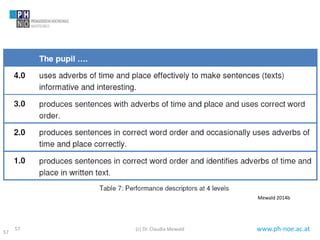
  • 57.
  • 58.
    www.ph-noe.ac.at58 Based on: Stiggins,R., Arter, J., Chappuis, J., & Chappuis, S. (2006). Classroom assessment for student learning — Doing it right, using it well. Portland: Educational Testing Service. Ratings into grades Min. 50% of all ratings are 4.0, the rest is 3.0 Min. 75% of all ratings are 3.0 or 4.0, the rest is 2.0 Min. 40% of all ratings are 3.0 or 4.0, the rest is 2.0 Min. 50% of all ratings are 2.0 or above, the rest is 1.0 More than 50% of all ratings are 2.0 or below one rating or more re 0.0 Grade Sehr gut; A/top grade Gut; B Befriedigend; C Genügend; D Nicht genügend; E/failure (c) Dr. Claudia Mewald
  • 59.
  • 60.
  • 61.
    www.ph-noe.ac.at • a learner’sevaluation of his/her own success • a learner’s evaluation of a peer’s success • based on criteria • known and understood by learners • implementation checked by peers and teachers 61 Self- and peer assessment (c) Dr. Claudia Mewald
  • 62.
    www.ph-noe.ac.at62 Mewald 2014b (c) Dr.Claudia Mewald Beginning Clear Information Words & Phrases End
  • 63.
    www.ph-noe.ac.at63 Mewald 2014b (c) Dr.Claudia Mewald Headline Information Main points Summary
  • 64.
  • 65.
  • 66.
  • 67.
    www.ph-noe.ac.at Commented marking  providesthe learners with a focus for progression instead of a reward or punishment (e.g. a correction or a grade)  comments could be made in the text or in a table  comments should make explicit how the learner can improve a text (c) Dr. Claudia Mewald67
  • 68.
  • 69.
  • 70.
  • 71.
  • 72.
    www.ph-noe.ac.at Available Designs Designing The Redesigned Resourcesfor Meaning: Available Designs of Meaning (Models) The work performed on or with Available Designs in the semiotic process (Modelling) The resources that are produced and transformed through Designing (Creative Production) Adapted from Cope & Kalantzis, 2000:23 72 Designs of Meaning 1 (c) Dr. Claudia Mewald
  • 73.
    www.ph-noe.ac.at learners are givengood examples that exemplify what it is they are being asked to do understand what they need to do in order to meet the assessment criteria learners assess exemplar work using the assessment criteria/ rating scale learners model what is being asked for and how it relates to the process of assessment  learners create new designs Designs of Meaning 2 (c) Dr. Claudia Mewald73
  • 74.
    www.ph-noe.ac.at74 Poster rubrics Task: Create ageadequate and comprehensible rubric for learners at primary school (c) Dr. Claudia Mewald
  • 75.
    www.ph-noe.ac.at  learners setthemselves targets based on their self-assessment  learning goals are recorded and revisited  comparison with teacher targets consensus on targets self-directed learning Self-assessment targets Schimek & Höltzer, 2013 (c) Dr. Claudia Mewald75
  • 76.
    www.ph-noe.ac.at76 (c) Dr. ClaudiaMewald http://www.coe.int/t/dg4/education/elp/ The European Language Portfolio (ELP) was developed by the Language Policy Division of the Council of Europe  to support the development of learner autonomy, plurilingualism and intercultural awareness and competence;  to allow users to record their language learning achievements and their experience of learning and using languages.
  • 77.
  • 78.
    www.ph-noe.ac.at78 Dossier  opportunity toselect materials to document and illustrate achievements or experiences Components 78 (c) Dr. Claudia Mewald
  • 79.
  • 80.
  • 81.
  • 82.
  • 83.
  • 84.
    www.ph-noe.ac.at Auerbach, E. R.(1986) Competency-based ESL: One step forward or two steps back? TESOL Quarterly 20(3): 411 – 415. Brown, D. H., & Abeywickrama, P. (2010) Language Assessment. Principles and Classroom Practices. New York: Pearson. Cope, B. & Kalantzis, M. (2000) Multiliteracies. Literacy Learning and the Design of Social Futures. London: Routledge Dressel , P. (1983). Grades: One More Tilt at the Windmill. In A. W. Chickering (Ed.), Bulletin. Memphis: Memphis State Univ., Center for Study for Higher Education, p. 12. Jäckl, C. & Manhart, M. (2017) Die Grundkompetenzen Fremdsprache 2. Schulstufe - GK2. Mit exemplarischen Umsetzungsbeispielen für den Englischunterricht in der Grundstufe 1. Graz: ÖSZ Jones, N. & Saville, N. (2017) Learning Oriented Assessment. A systemic approach. Cambridge: CUP. Marzano, R. (2009) Designing & Teaching Learning Goals & Objectives. Bloomington: FSC. Mewald, C. (2014) Practice what you preach – test what you teach. Testing English as a foreign language in heterogeneous groups. R&E-Source. Open Online Journal for Research and Education. PH NOE: Baden. Vol 1. Pp. 24-35 Available at: http://journal.ph-noe.ac.at/index.php/resource/article/view/14/13 Mewald, C. (2014) Assessment. In: BIFIE (Hrsg.) Bildungsstandards Englisch 8. Unterrichtsvideos und Begleitmaterialien. BIFIE: Salzburg Richards, J. C., & Rodgers, T. S. (2001) Approaches and Methods in Language Teaching (Second Edition). Cambridge: CUP. Schenck, A. (1978) Oregon Competency Based Education Program. Northwest Regional Educational Laboratory. Schimek, F., & Höltzer, R. (2013). Europäisches Sprachenortfolio für die Mitteleuropäische Region. Primarstufe (für SchülerInnen von 6 bis 10 Jahren). Wien: Stadtschulrat für Wien. Stiggins, R., Arter, J., Chappuis, J., & Chappuis, S. (2006) Classroom assessment for student learning—Doing it right, using it well. Portland: Educational Testing Service. Wormeli, R. (2006) Fair Isn’t Always Equal. Portland: Stenhouse Publishers. Wiggins, G., Mc Tighe, J. (2005) Understanding by Design. Alexandria, VA: Pearson. 84 References (c) Dr. Claudia Mewald
  • 85.
    ACHIEVE- MENT TEST Learning designs (c) Dr. ClaudiaMewald85 WHAT = target goal(s) (simpler, more complex goals) LEARNERS: readiness, interests, learning profiles, prior knowledge… HOW = process approach strategies tasks & activities classroom management PRODUCT learning outcomes & ASSESSMENT Curriculum what can be differentiated and what cannot …. D I A G N O S I S
  • 86.
    www.ph-noe.ac.at86 86 Example for learnerprofile (c) Dr. Claudia Mewald
  • 87.
    www.ph-noe.ac.at A 1: YLEFlyers A 2: KET B 1: PET http://www.cambridgeenglish.org/prepare-and-practise/find-free-resources/ 87 Proficiency testing vs. diagnostic testing (c) Dr. Claudia Mewald
  • 88.
    www.ph-noe.ac.at Assessment stations Book, film/videoor game review Concept map Design it Do it Field report Lab report (book) Learning log (diary) Media profile (c) Dr. Claudia Mewald88 Assessment Methods A-Z back
  • 89.
    www.ph-noe.ac.at Observation Oral presentation Paper andpencil quiz Performance Portfolio Poster (presentation) Question banks (c) Dr. Claudia Mewald89 Assessment Methods A-Z back
  • 90.