CISB PYP Parent
  Presentation
What do you already know?
 Discuss, write and share.

  Your ideas about the PYP    Your questions about the PYP
International
            Baccalaureate
 The International Baccalaureate (IB) began in 1968 in
  Geneva, Switzerland

 IB began its Diploma Program (DP) for internationally
  mobile students who were preparing for university.

 A non-profit educational and non-governmental
  organization (NGO)

 Funded by fees from IB World Schools
IB has expanded and now consists of 3 programs.

1. Primary Years Programme
   3-12 year old students
   PreK3 – Grade 5 at CISB

2. Middle Years Programme
   11-16 year old students
   Grade 6 – 10 at CISB

3. Diploma Programme
   16-19 year old students
   Grade 11 -12 at CISB
The IB Mission
              Statement
 The International Baccalaureate aims to develop inquiring,
  knowledgeable and caring young people who help to
  create a better and more peaceful world through
  intercultural understanding and respect.
 To this end the organization works with schools,
  governments and international organizations to develop
  challenging programmes of international education and
  rigorous assessment.
 These programmes encourage students across the world
  to become active, compassionate and lifelong learners who
  understand that other people, with their differences, can
  also be right.
What does it mean to be “internationally
  minded” and why is it important?

 It is a thoughtful, critical perspective that applies to
  who we are and what we do.
 It includes how we communicate, our political
  awareness, cultural understanding, celebrating
  diversity, global awareness of global issues
 It is a reflection on how knowledge is constructed and
  applied. At CISB, we would like to focus on moving
  students toward becoming people who reflect the
  characteristics of the “Learner Profile.”
International Mindedness
“The learner profile is central to the PYP definition of
 what it means to be internationally minded, and it
 directs schools to focus on the learning. IB World
 Schools should be proud to send out into the world
 students who exemplify the attributes expressed in this
 profile.”
                                Making the PYP Happen, p. 2 ©IBO 2007
Teaching and Learning in the PYP

 “Commitment to structured, purposeful inquiry that
  engages students in their own learning.”

 “inquiry… is recognized as allowing students to be
  actively involved in their own learning and to take
  responsibility for that learning. Inquiry allows each
  students’ understanding of the world to develop in a
  manner and at a rate that is unique to that student.”


How does PYP differ from “traditional” methods? Work in groups and share.
Traditional Teaching Methodology


Teacher


                   Students
Constructivism theory/methodology


  Teachers, Students and Other Adults
The Learner Profile
 Inquirers                                  Open-minded
 Knowledgeable                              Caring
 Thinkers                                   Risk-takers
 Communicators                              Balanced
 Principled                                 Reflective

              Which of these best describes your child?
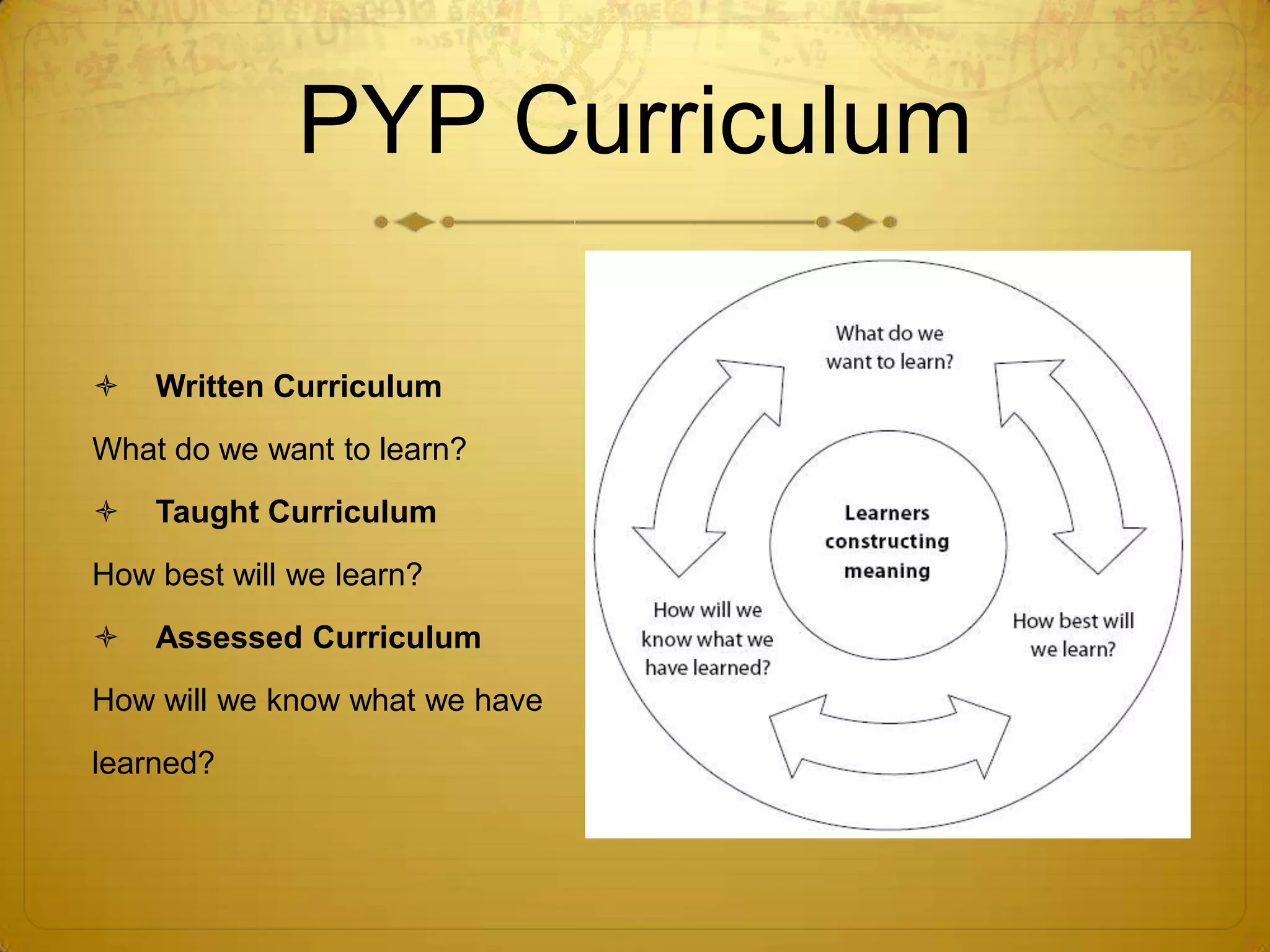
PYP Curriculum

   Written Curriculum
What do we want to learn?
   Taught Curriculum
How best will we learn?
   Assessed Curriculum
How will we know what we have
learned?
Essential elements: How are they described in the PYP
                     curriculum?
   Knowledge

    Significant, relevant content we wish the
    students to explore and know about, taking
    into consideration their prior experience
    and understanding


   Concepts

    Powerful ideas that have relevance within
    the subject areas but also transcend them
    and that students must explore and re-
    explore in order to develop a coherent, in-
    depth understanding.


   Skills

    Those capabilities the students need to
    demonstrate to succeed in a changing,
    challenging world, which may be
    disciplinary or transdisciplinary in nature.
                                                   Page 15
Essential elements: How are they described in the PYP
                         curriculum?


    Attitudes

     Dispositions that are expressions of
     fundamental values, beliefs and
     feelings about learning, the
     environment and people


    Action

     Demonstrations of deeper learning in
     responsible behaviour through
     responsible action; a manifestation in
     practice of the other essential elements


                                                      Page 16
Knowledge: What are the PYP transdisciplinary themes?


   Who we are

    Inquiry into the nature of the self; beliefs
    and values; person, physical, mental, social
    and spiritual health; human relationships
    including families, friends, communities,
    and cultures; rights and responsibilities;
    what it means to be human.


   Where we are in place and time

    Inquiry into orientation in place and time;
    personal histories; homes and journeys; the
    discoveries, explorations and migrations of
    humankind; the relationship between and
    the interconnectedness of individuals and
    civilizations, from local and global
    perspectives.


                                                   Page 17
Knowledge: What are the PYP transdisciplinary themes?


   How we express ourselves                          How we organize ourselves

    Inquiry into the ways in which we discover         Inquiry into the interconnectedness of
    and express ideas, feelings, nature,               human-made systems and communities;
    culture, beliefs and values; the ways in           the structure and function of
    which we reflect on, extend and enjoy our          organizations; societal decision-making;
    creativity; our appreciation of the                economic activities and their impact on
    aesthetic.                                         humankind and the environment.


   How the world works                               Sharing the planet

    Inquiry into the natural world and its laws,       Inquiry into rights and responsibilities in
    the interaction between the natural world          the struggle to share finite resources with
    (physical and biological) and human                other people and with other living things;
    societies; how humans use their                    communities and the relationship within
    understanding of scientific principles; the        and between them; access to equal
    impact of scientific and technological             opportunities; peace and conflict
    advances on society and on the                     resolution.
    environment.


                                                                                           Page 18
Concepts
 Form – What is it like?          Connection – How is it
                                    connected other things?
 Function – How does it
  work?                            Perspective – What are the
                                    points of view?
 Causation – Why is it like it
  is?                              Responsibility – What is
                                    our responsibility?
 Change – How is it
  changing?                        Reflection – How do we
                                    know?
Social Skills        Thinking         Communicatio   Research            Self
                     Skills           n Skills       Skills              Management
                                                                         Skills
Accepting            Acquisition of   Listening      Formulating         Gross /Fine Motor
Responsibility       knowledge                       Questions


Respecting others    Comprehension    Speaking       Observing           Spatial Awareness


Cooperating          Application      Reading        Planning            Organization


Resolving Conflict   Analysis         Writing        Collecting Data     Time Management


Group decision       Synthesis        Non-Verbal     Recording Data      Safety
making


Adopting a variety   Evaluation                      Organizing Data     Healthy Lifestyles
of group roles


                     Dialectical                     Interpreting Data   Codes of
                     Though                                              Behaviour
                     Metacognition                   Presenting          Informed Choices
                                                     Research findings
Attitude Changes Everything
 Appreciation    Empathy
 Commitment      Enthusiasm
 Confidence      Independence
 Cooperation     Integrity
 Creativity      Respect
 Curiosity       Tolerance
Action
 Successful inquiry will lead
  to responsible action that is
  initiated by the student
 It is intended that the
  person taking the
  experience and that the
  process of taking action or
  not will contribute to each
  student establishing a
  personal set of values.
Inquiry is the leading pedagogical
                approach of PYP

 Exploring, wondering and questioning
 Experimenting and playing with possibilities
 Making connections between previous learning and current
  learning
 Making predictions and acting purposefully to see what
  happens
 Collecting data and reporting findings
 Clarifying existing ideas and reappraising perception of
  events
 Deepening understanding through the application
  of a concept

 Making and testing theories

 Researching and seeking information

 Taking and defending a position

 Solving problems in a variety of ways.
 There is a place for drill and practice in the classroom,
  but IB believes that concept based teaching is the
  most substantial form of learning.

 Planning is done collaboratively using the PYP
  planner which is structured around a central idea and
  lines of inquiry.

 Planning in and out of the units of inquiry should be
  done on the PYP planner.
The Assessed Curriculum
 Program standards and practices, overall learning
  outcomes and subject-specific overall expectations
  are assessed

 The process of inquiry and the products of inquiry are
  also assessed

 Summative Assessment and formative assessment
  will be used
Methods of Assessment
Many methods of assessment will be used to provide a
balanced view of the child such as:
 Observations
 Performance assessment of tasks with established criteria that
  are authentic challenges and problems
 Selected response assessments such as tests and quizzes
 Open-ended tasks in which children are presented with a
  stimulus and asked to communicate an original response
 Portfolios of children’s work.
6 Months

Interested
  School


                Consideration
                                                  Candidate           January 2011
                    Phase                          School
                                                                 C
                                                                 a
                                       12-18 Months              n
                                                                 d
                                                                 i
                                                                 d
                                                                 a
                                                                 t    February 2012
                                                                 e
                                                                 P
                                       12-18 Months              h
                                                                 a
     5 Years                                                     s
                                                                 e
                                                                     April 2013
                             3 Years

                                                      IB World
                                                       School


               Authorization
                  Phase
Why is PYP important at our school?


CISB students

• Will be taught WHY they should know something

• Will learn HOW it connects to other subjects and the world around them

• They will experience high quality teaching and learning

• Will have great opportunities to study for college/university worldwide, and
opportunities to make friends with other students at IB schools around the world.
Why PYP for CISB?


 Structured inquiry as the vehicle for learning
 Six transdisciplinarythemes provide the framework for exploration and
    construction of knowledge

 Students develop an understanding of important concepts, acquire essential
    skills and knowledge, develop particular attitudes and learn to take socially
    responsible action.

 International standards for measuring teaching and learning
 Challenging academic programs
 A global professional network for educators to learn effective classroom
    practices and teaching strategies

 Curriculum framework, program evaluation and mentoring
 Smoother transition to the Middle Years Programme (MYP
Let’s Reflect


   What worries do you have about the programme?

   What strengths do you see in the programme?
Sources used in compiling this presentation


   www.ibo.org

   Mrs. Jade Harrold – PYP Presentation

   Making the PYP Happen- A curriculum Framework for an International
    education

   Making the PYP Happen- Pedagogical Leadership in the PYP

   Primary Years Programme A Basis for Practice

   Western Academy of Beijing – Curriculum Framework

   Dubai International Academy – PYP Presentation

Parent PYP English Presentation

  • 1.
    CISB PYP Parent Presentation
  • 3.
    What do youalready know?  Discuss, write and share. Your ideas about the PYP Your questions about the PYP
  • 4.
    International Baccalaureate  The International Baccalaureate (IB) began in 1968 in Geneva, Switzerland  IB began its Diploma Program (DP) for internationally mobile students who were preparing for university.  A non-profit educational and non-governmental organization (NGO)  Funded by fees from IB World Schools
  • 5.
    IB has expandedand now consists of 3 programs. 1. Primary Years Programme 3-12 year old students PreK3 – Grade 5 at CISB 2. Middle Years Programme 11-16 year old students Grade 6 – 10 at CISB 3. Diploma Programme 16-19 year old students Grade 11 -12 at CISB
  • 6.
    The IB Mission Statement  The International Baccalaureate aims to develop inquiring, knowledgeable and caring young people who help to create a better and more peaceful world through intercultural understanding and respect.  To this end the organization works with schools, governments and international organizations to develop challenging programmes of international education and rigorous assessment.  These programmes encourage students across the world to become active, compassionate and lifelong learners who understand that other people, with their differences, can also be right.
  • 7.
    What does itmean to be “internationally minded” and why is it important?  It is a thoughtful, critical perspective that applies to who we are and what we do.  It includes how we communicate, our political awareness, cultural understanding, celebrating diversity, global awareness of global issues  It is a reflection on how knowledge is constructed and applied. At CISB, we would like to focus on moving students toward becoming people who reflect the characteristics of the “Learner Profile.”
  • 8.
    International Mindedness “The learnerprofile is central to the PYP definition of what it means to be internationally minded, and it directs schools to focus on the learning. IB World Schools should be proud to send out into the world students who exemplify the attributes expressed in this profile.” Making the PYP Happen, p. 2 ©IBO 2007
  • 9.
    Teaching and Learningin the PYP  “Commitment to structured, purposeful inquiry that engages students in their own learning.”  “inquiry… is recognized as allowing students to be actively involved in their own learning and to take responsibility for that learning. Inquiry allows each students’ understanding of the world to develop in a manner and at a rate that is unique to that student.” How does PYP differ from “traditional” methods? Work in groups and share.
  • 10.
  • 11.
    Constructivism theory/methodology Teachers, Students and Other Adults
  • 12.
    The Learner Profile Inquirers  Open-minded  Knowledgeable  Caring  Thinkers  Risk-takers  Communicators  Balanced  Principled  Reflective Which of these best describes your child?
  • 13.
    PYP Curriculum  Written Curriculum What do we want to learn?  Taught Curriculum How best will we learn?  Assessed Curriculum How will we know what we have learned?
  • 15.
    Essential elements: Howare they described in the PYP curriculum?  Knowledge Significant, relevant content we wish the students to explore and know about, taking into consideration their prior experience and understanding  Concepts Powerful ideas that have relevance within the subject areas but also transcend them and that students must explore and re- explore in order to develop a coherent, in- depth understanding.  Skills Those capabilities the students need to demonstrate to succeed in a changing, challenging world, which may be disciplinary or transdisciplinary in nature. Page 15
  • 16.
    Essential elements: Howare they described in the PYP curriculum?  Attitudes Dispositions that are expressions of fundamental values, beliefs and feelings about learning, the environment and people  Action Demonstrations of deeper learning in responsible behaviour through responsible action; a manifestation in practice of the other essential elements Page 16
  • 17.
    Knowledge: What arethe PYP transdisciplinary themes?  Who we are Inquiry into the nature of the self; beliefs and values; person, physical, mental, social and spiritual health; human relationships including families, friends, communities, and cultures; rights and responsibilities; what it means to be human.  Where we are in place and time Inquiry into orientation in place and time; personal histories; homes and journeys; the discoveries, explorations and migrations of humankind; the relationship between and the interconnectedness of individuals and civilizations, from local and global perspectives. Page 17
  • 18.
    Knowledge: What arethe PYP transdisciplinary themes?  How we express ourselves  How we organize ourselves Inquiry into the ways in which we discover Inquiry into the interconnectedness of and express ideas, feelings, nature, human-made systems and communities; culture, beliefs and values; the ways in the structure and function of which we reflect on, extend and enjoy our organizations; societal decision-making; creativity; our appreciation of the economic activities and their impact on aesthetic. humankind and the environment.  How the world works  Sharing the planet Inquiry into the natural world and its laws, Inquiry into rights and responsibilities in the interaction between the natural world the struggle to share finite resources with (physical and biological) and human other people and with other living things; societies; how humans use their communities and the relationship within understanding of scientific principles; the and between them; access to equal impact of scientific and technological opportunities; peace and conflict advances on society and on the resolution. environment. Page 18
  • 19.
    Concepts  Form –What is it like?  Connection – How is it connected other things?  Function – How does it work?  Perspective – What are the points of view?  Causation – Why is it like it is?  Responsibility – What is our responsibility?  Change – How is it changing?  Reflection – How do we know?
  • 20.
    Social Skills Thinking Communicatio Research Self Skills n Skills Skills Management Skills Accepting Acquisition of Listening Formulating Gross /Fine Motor Responsibility knowledge Questions Respecting others Comprehension Speaking Observing Spatial Awareness Cooperating Application Reading Planning Organization Resolving Conflict Analysis Writing Collecting Data Time Management Group decision Synthesis Non-Verbal Recording Data Safety making Adopting a variety Evaluation Organizing Data Healthy Lifestyles of group roles Dialectical Interpreting Data Codes of Though Behaviour Metacognition Presenting Informed Choices Research findings
  • 21.
    Attitude Changes Everything Appreciation  Empathy  Commitment  Enthusiasm  Confidence  Independence  Cooperation  Integrity  Creativity  Respect  Curiosity  Tolerance
  • 22.
    Action  Successful inquirywill lead to responsible action that is initiated by the student  It is intended that the person taking the experience and that the process of taking action or not will contribute to each student establishing a personal set of values.
  • 23.
    Inquiry is theleading pedagogical approach of PYP  Exploring, wondering and questioning  Experimenting and playing with possibilities  Making connections between previous learning and current learning  Making predictions and acting purposefully to see what happens  Collecting data and reporting findings  Clarifying existing ideas and reappraising perception of events
  • 24.
     Deepening understandingthrough the application of a concept  Making and testing theories  Researching and seeking information  Taking and defending a position  Solving problems in a variety of ways.
  • 25.
     There isa place for drill and practice in the classroom, but IB believes that concept based teaching is the most substantial form of learning.  Planning is done collaboratively using the PYP planner which is structured around a central idea and lines of inquiry.  Planning in and out of the units of inquiry should be done on the PYP planner.
  • 26.
    The Assessed Curriculum Program standards and practices, overall learning outcomes and subject-specific overall expectations are assessed  The process of inquiry and the products of inquiry are also assessed  Summative Assessment and formative assessment will be used
  • 27.
    Methods of Assessment Manymethods of assessment will be used to provide a balanced view of the child such as:  Observations  Performance assessment of tasks with established criteria that are authentic challenges and problems  Selected response assessments such as tests and quizzes  Open-ended tasks in which children are presented with a stimulus and asked to communicate an original response  Portfolios of children’s work.
  • 29.
    6 Months Interested School Consideration Candidate January 2011 Phase School C a 12-18 Months n d i d a t February 2012 e P 12-18 Months h a 5 Years s e April 2013 3 Years IB World School Authorization Phase
  • 30.
    Why is PYPimportant at our school? CISB students • Will be taught WHY they should know something • Will learn HOW it connects to other subjects and the world around them • They will experience high quality teaching and learning • Will have great opportunities to study for college/university worldwide, and opportunities to make friends with other students at IB schools around the world.
  • 31.
    Why PYP forCISB?  Structured inquiry as the vehicle for learning  Six transdisciplinarythemes provide the framework for exploration and construction of knowledge  Students develop an understanding of important concepts, acquire essential skills and knowledge, develop particular attitudes and learn to take socially responsible action.  International standards for measuring teaching and learning  Challenging academic programs  A global professional network for educators to learn effective classroom practices and teaching strategies  Curriculum framework, program evaluation and mentoring  Smoother transition to the Middle Years Programme (MYP
  • 32.
    Let’s Reflect  What worries do you have about the programme?  What strengths do you see in the programme?
  • 33.
    Sources used incompiling this presentation  www.ibo.org  Mrs. Jade Harrold – PYP Presentation  Making the PYP Happen- A curriculum Framework for an International education  Making the PYP Happen- Pedagogical Leadership in the PYP  Primary Years Programme A Basis for Practice  Western Academy of Beijing – Curriculum Framework  Dubai International Academy – PYP Presentation

Editor's Notes

  • #20 The PYP has constructed a set of eight key concepts, which answer the question: What do we want the students to learn? Questions in each unit of inquiry can fit into one of these key concepts.
  • #22 As part of the PYP, we focus on the development of positive attitudes towards people, towards the environment and towards learning. At CISB, the Attitudes are addressed explicitly throughout every aspect of our curriculum. 
  • #23 In addition to the concepts and attitudes, knowledge of the curriculum, and the transdisciplinary skills of research, communication, thinking and self-management, action is one of the most important. The International Student is challenged to choose his or her action based on the learning. We want to give the students the opportunity and the power to choose their actions, to act, and then reflect on these action in order to make a different in the world.  The action component of the PYP involves service in the widest sense of the word: service to fellow students, to the staff, and to the community.  Through such service, students are able to grow both socially and personally, developing skills such as cooperation, problem solving, conflict resolution, and creative and critical thinking.  These actions are, moreover, ways in which the students exhibit their commitment to the attitudes that teachers seek to engender within the PYP classroom.
  • #25 Teachers will be using a planning tool from IB. All teachers will be teaching the same unit, but inquiry allows children to come to their own understanding so what occurs in one grade 2 class may not be identical to what occurs in another grade 2 class.
  • #27 Is the nature of their inquiry developing over time? Do they apply their knowledge base to new inquires? Etc.Assessing, Recording and Reporting of curriculum- We also have to report on the learner profile.
  • #29 Use this to review the 5 essential elements.Knowledge, Skills, Attitudes, Actions and Concepts
  • #33 Parents will be provided with individual sheets to complete and leave with us.A few will share their worries and strengths they see in the PYP