A framework for meaning making: how
children interact in multilingual contexts
Claudia Mewald
Sabine Wallner
Elisabeth Weitz-Polydoros
1
Promoting Authentic Language Acquisition
in Multilingual Contexts
"The European Commission support for the production of this publication does not constitute an
endorsement of the contents which reflects the views only of the authors, and the Commission cannot be
held responsible for any use which may be made of the information contained therein."
Framework for Intercomprehension Methodology
FRINCOM
Project Goals
• encourage autonomous language learning with a
platform
• encourage 6-14 year-old learners to produce
authentic and engaging texts
• produce learning materials and on-line games to
accompany these texts
• provide immediate feedback on task performance
• support multilingualism
3
Terms
• Multilingualism: ability to use two or more languages,
either by an individual speaker or by a community of
speakers
• Plurilingualism: use of two or more languages in one
conversation for the purpose of effective communication
• Intercomprehension: ability to make sense of written or
spoken texts in languages the readers/listeners have not
(yet) acquired or studied
• Translanguaging: people use their acquired languages to
understand and communicate in the unfamiliar
languages of the others
• Lingua Franca: one language adopted as a common
language between speakers whose native languages are
different
4
Intercomprehension 1
It is a characteristic trait of intercomprehension that it does not
demand the ability of verbal production in the target language
(Doyé, 2005, p. 7)
Differentiation between competence and performance:
•intercomprehension competence: the capacity to
understand other languages without having studied them
•intercomprehensive performance: each person uses his or
her own language and understands that of the other
Intercomprehension can be an alternative or
complement to the common use of a Lingua Franca
5
Intercomprehension 2
More widely spoken languages are frequently used as
bridge (pivot) languages:
If all participants in interlingual/intercultural encounters use and
understand one particular language, this facilitates their
communication enormously. (Doyé, 2005, p. 7)
Dangers of using bridge languages:
•linguistic imperialism (Phillipson, 1992)
•culture-free use of the Lingua Franca (Basset, 1999)
•insufficient communication lacking depth, clarity and
significance (Doyé, 2005)
•potential depreciation of the mother tongue (Piri 2002)
6
FRINCOM
Intercomprehension Competence
• is a complement to the common use of a Lingua Franca
• exploits previously acquired funds of knowledge, skills
and strategies
• employs knowledge from many areas in making sense of
languages not studied
• is highly individual and dynamic in its development
(Cummins 2003; Herdina, P. & Jessner, U. 2000; Jessner, U. 2006; Larsen-
Freeman, D. 1997)
7
FRINCOM
FOSTERING INTERCOMPREHENSION COMPETENCE
• through learning designs that make conscious or
unconscious intercomprehension possible
• through creating the necessary conditions of learning that
facilitate a multilingual acquisition process which
encourages the development of intercomprehension
competence (Marton 2015)
• through establishing intercomprehension as a guiding
principle to help pupils
… acquire the strategies needed for the understanding of
the texts and utterances of any new language they might
encounter in the future. (Doyé, 2005, p. 20)
8
FRINCOM
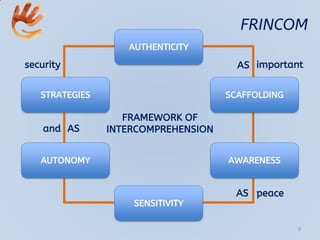
AUTHENTICITY
SCAFFOLDING
AWARENESSAUTONOMY
STRATEGIES
SENSITIVITY
FRAMEWORK OF
INTERCOMPREHENSION
AS
AS
AS
important
peace
and
security
9
Authenticity of situation
Young learners
•reasonably sound command of their family languages
•infer meaning without understanding everything
•interpret meaning and use limited language resources
creatively through mixing or adapting languages they have
picked up
•plurilingual environment – in most families the individual
members speak diverse language varieties
•positive, relaxed and unharmed attitude towards new
languages based on the process of initial language
acquisition without formal instruction
10
Authenticity of inputs and tasks
•the authenticity of the texts (written or spoken) used as
input data
•the authenticity of the actual social situation of the
virtual learning space (platform)
•the authenticity of the tasks in a virtual learning space
adapted from Breen (1985, p. 68)
11
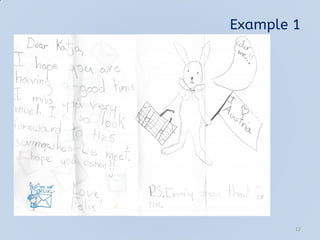
Example 1
12
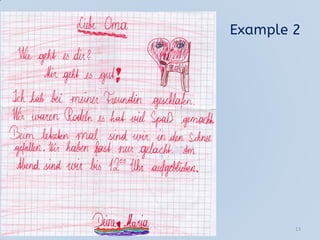
Example 2
13
14
15
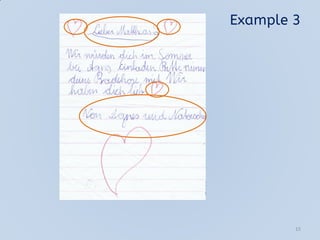
Example 3
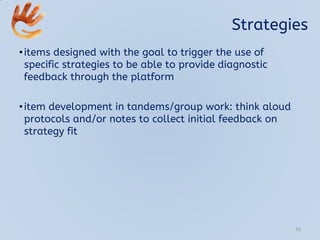
Strategies
•items designed with the goal to trigger the use of
specific strategies to be able to provide diagnostic
feedback through the platform
•item development in tandems/group work: think aloud
protocols and/or notes to collect initial feedback on
strategy fit
16
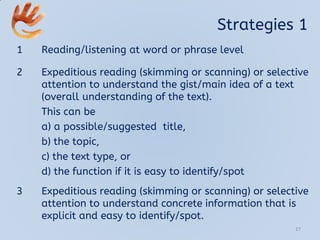
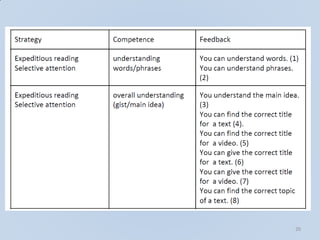
Strategies 1
1 Reading/listening at word or phrase level
2 Expeditious reading (skimming or scanning) or selective
attention to understand the gist/main idea of a text
(overall understanding of the text).
This can be
a) a possible/suggested title,
b) the topic,
c) the text type, or
d) the function if it is easy to identify/spot
3 Expeditious reading (skimming or scanning) or selective
attention to understand concrete information that is
explicit and easy to identify/spot.
17
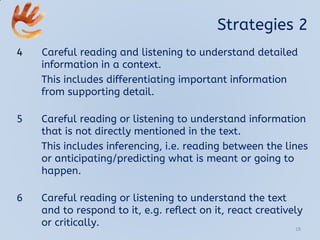
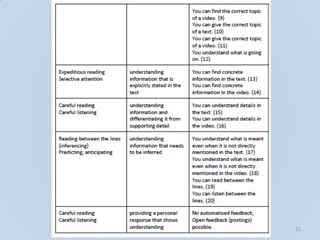
Strategies 2
4 Careful reading and listening to understand detailed
information in a context.
This includes differentiating important information
from supporting detail.
5 Careful reading or listening to understand information
that is not directly mentioned in the text.
This includes inferencing, i.e. reading between the lines
or anticipating/predicting what is meant or going to
happen.
6 Careful reading or listening to understand the text
and to respond to it, e.g. reflect on it, react creatively
or critically. 18
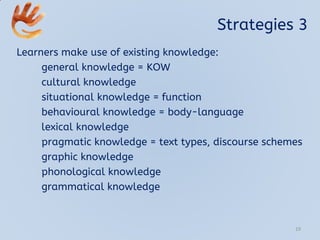
Strategies 3
Learners make use of existing knowledge:
general knowledge = KOW
cultural knowledge
situational knowledge = function
behavioural knowledge = body-language
lexical knowledge
pragmatic knowledge = text types, discourse schemes
graphic knowledge
phonological knowledge
grammatical knowledge
19
20
21
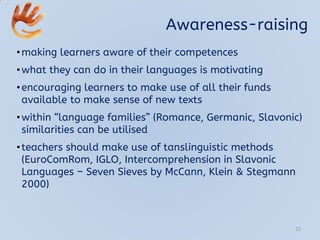
Awareness-raising
•making learners aware of their competences
•what they can do in their languages is motivating
•encouraging learners to make use of all their funds
available to make sense of new texts
•within “language families” (Romance, Germanic, Slavonic)
similarities can be utilised
•teachers should make use of tanslinguistic methods
(EuroComRom, IGLO, Intercomprehension in Slavonic
Languages – Seven Sieves by McCann, Klein & Stegmann
2000)
22
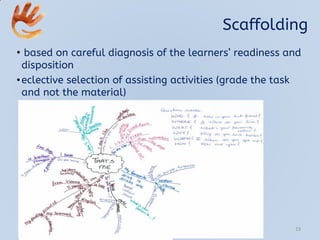
Scaffolding
• based on careful diagnosis of the learners’ readiness and
disposition
•eclective selection of assisting activities (grade the task
and not the material)
23
Autonomy
•measures taken by teachers should have the character
of assistance and never become interference
•intercomprehension is a potentially self-directed
process
•learners take the first step and teachers support after
careful needs analysis
•level of autonomy and self-direction depends on age
and readiness
•fostering autonomy is part of intercomprehension
methodology
24
Sensitivity
•between language(s) and culture(s): intercultural
communication is mutually compassionate, respectful,
tolerant and collaborative
•it should be aiming at transcultural education which
differs from intercultural education in that it intends to
create a transformed cultural understanding
•transcultural understanding creates shared cultures
rather than parallel worlds of two or more cultures next
to each other
25
Intercomprehension Task 1
• functional approach in plurilingual communication
different languages are used to achieve a purpose
involving interaction between various speakers
(cf http://www2.vobs.at/ludescher/Grammar/functional.htm)
Example:
Introducing someone to a group of people: even if different
languages are used, mutual understanding is fostered by
•situational knowledge
•body language
•general knowledge
26
Intercomprehension Task 2
• setting a situation or an occasion
Examples:
• asking for the way
• ordering a meal in a restaurant
• staying in a host family with other students
from different countries
27
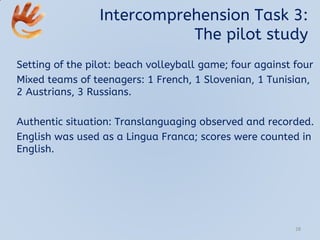
Intercomprehension Task 3:
The pilot study
Setting of the pilot: beach volleyball game; four against four
Mixed teams of teenagers: 1 French, 1 Slovenian, 1 Tunisian,
2 Austrians, 3 Russians.
Authentic situation: Translanguaging observed and recorded.
English was used as a Lingua Franca; scores were counted in
English.
28
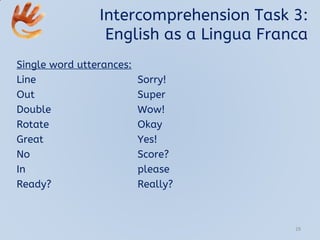
Intercomprehension Task 3:
English as a Lingua Franca
Single word utterances:
Line Sorry!
Out Super
Double Wow!
Rotate Okay
Great Yes!
No Score?
In please
Ready? Really?
29
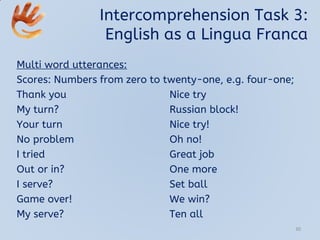
Intercomprehension Task 3:
English as a Lingua Franca
Multi word utterances:
Scores: Numbers from zero to twenty-one, e.g. four-one;
Thank you Nice try
My turn? Russian block!
Your turn Nice try!
No problem Oh no!
I tried Great job
Out or in? One more
I serve? Set ball
Game over! We win?
My serve? Ten all
30
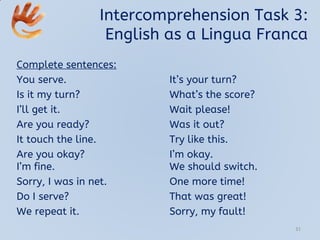
Intercomprehension Task 3:
English as a Lingua Franca
Complete sentences:
You serve. It’s your turn?
Is it my turn? What’s the score?
I’ll get it. Wait please!
Are you ready? Was it out?
It touch the line. Try like this.
Are you okay? I’m okay.
I’m fine. We should switch.
Sorry, I was in net. One more time!
Do I serve? That was great!
We repeat it. Sorry, my fault!
31
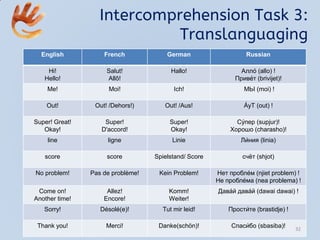
Intercomprehension Task 3:
Translanguaging
English French German Russian
Hi!
Hello!
Salut!
Allô!
Hallo! Алло́ (allo) !
Приве́т (brivijet)!
Me! Moi! Ich! MЬI (moi) !
Out! Out! /Dehors!) Out! /Aus! ÁyT (out) !
Super! Great!
Okay!
Super!
D'accord!
Super!
Okay!
Cу́пер (supjur)!
Хорошо (charasho)!
line ligne Linie Ли́ния (linia)
score score Spielstand/ Score cчёт (shjot)
No problem! Pas de problème! Kein Problem! Нет пробле́м (njiet problem) !
Не пробле́ма (nea problema) !
Come on!
Another time!
Allez!
Encore!
Komm!
Weiter!
Дава́й дава́й (dawai dawai) !
Sorry! Désolé(e)! Tut mir leid! Прости́те (brastidje) !
Thank you! Merci! Danke(schön)! Спаси́бо (sbasiba)! 32
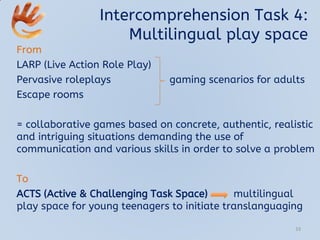
Intercomprehension Task 4:
Multilingual play space
From
LARP (Live Action Role Play)
Pervasive roleplays gaming scenarios for adults
Escape rooms
= collaborative games based on concrete, authentic, realistic
and intriguing situations demanding the use of
communication and various skills in order to solve a problem
To
ACTS (Active & Challenging Task Space) multilingual
play space for young teenagers to initiate translanguaging
33
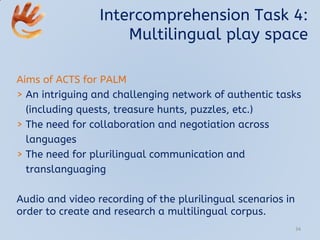
Intercomprehension Task 4:
Multilingual play space
Aims of ACTS for PALM
> An intriguing and challenging network of authentic tasks
(including quests, treasure hunts, puzzles, etc.)
> The need for collaboration and negotiation across
languages
> The need for plurilingual communication and
translanguaging
Audio and video recording of the plurilingual scenarios in
order to create and research a multilingual corpus.
34
Contact
Thank you for your attention!
claudia.mewald@ph-noe.ac.at
sabine.wallner@ph-noe.ac.at
e.weitz-polydoros@ph-noe.ac.at
35
References
Basset, S. (1999). What Exactly is the Everyday? Journal of the Study of British Cultures,
2/99, 185-194.
Breen, M. P. (1985). Authenticity in the Language Classroom. Applied Linguistics,, 6(1),
60-70.
Cummins, J. (2003). BICS and CALP: Origins and rationale for the distinction. In C. B.
Paulston, & G. R. Tucker, Sociolinguistics: The essential readings (pp. 322-328). London:
Blackwell.
COM. (2008). Multilingualism: an asset for Europe and a shared commitment. Retrieved
from EUR-Lex: http://eur-lex.europa.eu/legal-
content/EN/TXT/?uri=CELEX:52008DC0566
Doyé, P. (2005). Intercomprehension. Guide for the development of language education
policies in Europe: from linguistic diversity to plurilingual education. Reference study.
Retrieved from Council of Europe, Language Policy Division:
https://www.coe.int/t/dg4/linguistic/Source/Doye%20EN.pdf
Herdina, P. & Jessner, U. (2000). A Dynamic Model of Multilingualism: Changing the
Psycholinguistic Prespective. Clevedon: Multilingual Matters.
36
References
Jessner, U. (2006). Linguistic Awareness in Multilinguals. English as a Third Language.
Edinburgh: Edinburgh University Press.
Larsen-Freeman, D. (1997). Chaos/Complexity Science on Second Language Acquisition.
Applied Linguistics, 18(2), pp. 141-165.
Marton, F. (2015). Necessary Conditions of Learning. New York: Routledge.
Montola, M (2007). Tangible Pleasures of Pervasive Role-Playing. In Baba,
Akira. Proceedings of DiGRA 2007 Situated Play conference. The University of Tokyo.
pp. 178–185. Phillipson, R. (1992). Linguistic Imperialism. Oxford: Oxford University
Press. Available at: http://www.digra.org/wp-content/uploads/digital-
library/07312.38125.pdf
Nicholson, S. (2015). Peeking behind the locked door: A survey of escape room
facilities. White Paper available at http://scottnicholson.com/pubs/erfacwhite.pdf
Piri, R. (2002). Teaching and learning less widely-spoken languages in other countries.
Strassbourg: Council of Europe.
37

FRINCOM: Framework of Intercomprehension

  • 1.
    A framework formeaning making: how children interact in multilingual contexts Claudia Mewald Sabine Wallner Elisabeth Weitz-Polydoros 1
  • 2.
    Promoting Authentic LanguageAcquisition in Multilingual Contexts "The European Commission support for the production of this publication does not constitute an endorsement of the contents which reflects the views only of the authors, and the Commission cannot be held responsible for any use which may be made of the information contained therein." Framework for Intercomprehension Methodology FRINCOM
  • 3.
    Project Goals • encourageautonomous language learning with a platform • encourage 6-14 year-old learners to produce authentic and engaging texts • produce learning materials and on-line games to accompany these texts • provide immediate feedback on task performance • support multilingualism 3
  • 4.
    Terms • Multilingualism: abilityto use two or more languages, either by an individual speaker or by a community of speakers • Plurilingualism: use of two or more languages in one conversation for the purpose of effective communication • Intercomprehension: ability to make sense of written or spoken texts in languages the readers/listeners have not (yet) acquired or studied • Translanguaging: people use their acquired languages to understand and communicate in the unfamiliar languages of the others • Lingua Franca: one language adopted as a common language between speakers whose native languages are different 4
  • 5.
    Intercomprehension 1 It isa characteristic trait of intercomprehension that it does not demand the ability of verbal production in the target language (Doyé, 2005, p. 7) Differentiation between competence and performance: •intercomprehension competence: the capacity to understand other languages without having studied them •intercomprehensive performance: each person uses his or her own language and understands that of the other Intercomprehension can be an alternative or complement to the common use of a Lingua Franca 5
  • 6.
    Intercomprehension 2 More widelyspoken languages are frequently used as bridge (pivot) languages: If all participants in interlingual/intercultural encounters use and understand one particular language, this facilitates their communication enormously. (Doyé, 2005, p. 7) Dangers of using bridge languages: •linguistic imperialism (Phillipson, 1992) •culture-free use of the Lingua Franca (Basset, 1999) •insufficient communication lacking depth, clarity and significance (Doyé, 2005) •potential depreciation of the mother tongue (Piri 2002) 6
  • 7.
    FRINCOM Intercomprehension Competence • isa complement to the common use of a Lingua Franca • exploits previously acquired funds of knowledge, skills and strategies • employs knowledge from many areas in making sense of languages not studied • is highly individual and dynamic in its development (Cummins 2003; Herdina, P. & Jessner, U. 2000; Jessner, U. 2006; Larsen- Freeman, D. 1997) 7
  • 8.
    FRINCOM FOSTERING INTERCOMPREHENSION COMPETENCE •through learning designs that make conscious or unconscious intercomprehension possible • through creating the necessary conditions of learning that facilitate a multilingual acquisition process which encourages the development of intercomprehension competence (Marton 2015) • through establishing intercomprehension as a guiding principle to help pupils … acquire the strategies needed for the understanding of the texts and utterances of any new language they might encounter in the future. (Doyé, 2005, p. 20) 8
  • 9.
  • 10.
    Authenticity of situation Younglearners •reasonably sound command of their family languages •infer meaning without understanding everything •interpret meaning and use limited language resources creatively through mixing or adapting languages they have picked up •plurilingual environment – in most families the individual members speak diverse language varieties •positive, relaxed and unharmed attitude towards new languages based on the process of initial language acquisition without formal instruction 10
  • 11.
    Authenticity of inputsand tasks •the authenticity of the texts (written or spoken) used as input data •the authenticity of the actual social situation of the virtual learning space (platform) •the authenticity of the tasks in a virtual learning space adapted from Breen (1985, p. 68) 11
  • 12.
  • 13.
  • 14.
  • 15.
  • 16.
    Strategies •items designed withthe goal to trigger the use of specific strategies to be able to provide diagnostic feedback through the platform •item development in tandems/group work: think aloud protocols and/or notes to collect initial feedback on strategy fit 16
  • 17.
    Strategies 1 1 Reading/listeningat word or phrase level 2 Expeditious reading (skimming or scanning) or selective attention to understand the gist/main idea of a text (overall understanding of the text). This can be a) a possible/suggested title, b) the topic, c) the text type, or d) the function if it is easy to identify/spot 3 Expeditious reading (skimming or scanning) or selective attention to understand concrete information that is explicit and easy to identify/spot. 17
  • 18.
    Strategies 2 4 Carefulreading and listening to understand detailed information in a context. This includes differentiating important information from supporting detail. 5 Careful reading or listening to understand information that is not directly mentioned in the text. This includes inferencing, i.e. reading between the lines or anticipating/predicting what is meant or going to happen. 6 Careful reading or listening to understand the text and to respond to it, e.g. reflect on it, react creatively or critically. 18
  • 19.
    Strategies 3 Learners makeuse of existing knowledge: general knowledge = KOW cultural knowledge situational knowledge = function behavioural knowledge = body-language lexical knowledge pragmatic knowledge = text types, discourse schemes graphic knowledge phonological knowledge grammatical knowledge 19
  • 20.
  • 21.
  • 22.
    Awareness-raising •making learners awareof their competences •what they can do in their languages is motivating •encouraging learners to make use of all their funds available to make sense of new texts •within “language families” (Romance, Germanic, Slavonic) similarities can be utilised •teachers should make use of tanslinguistic methods (EuroComRom, IGLO, Intercomprehension in Slavonic Languages – Seven Sieves by McCann, Klein & Stegmann 2000) 22
  • 23.
    Scaffolding • based oncareful diagnosis of the learners’ readiness and disposition •eclective selection of assisting activities (grade the task and not the material) 23
  • 24.
    Autonomy •measures taken byteachers should have the character of assistance and never become interference •intercomprehension is a potentially self-directed process •learners take the first step and teachers support after careful needs analysis •level of autonomy and self-direction depends on age and readiness •fostering autonomy is part of intercomprehension methodology 24
  • 25.
    Sensitivity •between language(s) andculture(s): intercultural communication is mutually compassionate, respectful, tolerant and collaborative •it should be aiming at transcultural education which differs from intercultural education in that it intends to create a transformed cultural understanding •transcultural understanding creates shared cultures rather than parallel worlds of two or more cultures next to each other 25
  • 26.
    Intercomprehension Task 1 •functional approach in plurilingual communication different languages are used to achieve a purpose involving interaction between various speakers (cf http://www2.vobs.at/ludescher/Grammar/functional.htm) Example: Introducing someone to a group of people: even if different languages are used, mutual understanding is fostered by •situational knowledge •body language •general knowledge 26
  • 27.
    Intercomprehension Task 2 •setting a situation or an occasion Examples: • asking for the way • ordering a meal in a restaurant • staying in a host family with other students from different countries 27
  • 28.
    Intercomprehension Task 3: Thepilot study Setting of the pilot: beach volleyball game; four against four Mixed teams of teenagers: 1 French, 1 Slovenian, 1 Tunisian, 2 Austrians, 3 Russians. Authentic situation: Translanguaging observed and recorded. English was used as a Lingua Franca; scores were counted in English. 28
  • 29.
    Intercomprehension Task 3: Englishas a Lingua Franca Single word utterances: Line Sorry! Out Super Double Wow! Rotate Okay Great Yes! No Score? In please Ready? Really? 29
  • 30.
    Intercomprehension Task 3: Englishas a Lingua Franca Multi word utterances: Scores: Numbers from zero to twenty-one, e.g. four-one; Thank you Nice try My turn? Russian block! Your turn Nice try! No problem Oh no! I tried Great job Out or in? One more I serve? Set ball Game over! We win? My serve? Ten all 30
  • 31.
    Intercomprehension Task 3: Englishas a Lingua Franca Complete sentences: You serve. It’s your turn? Is it my turn? What’s the score? I’ll get it. Wait please! Are you ready? Was it out? It touch the line. Try like this. Are you okay? I’m okay. I’m fine. We should switch. Sorry, I was in net. One more time! Do I serve? That was great! We repeat it. Sorry, my fault! 31
  • 32.
    Intercomprehension Task 3: Translanguaging EnglishFrench German Russian Hi! Hello! Salut! Allô! Hallo! Алло́ (allo) ! Приве́т (brivijet)! Me! Moi! Ich! MЬI (moi) ! Out! Out! /Dehors!) Out! /Aus! ÁyT (out) ! Super! Great! Okay! Super! D'accord! Super! Okay! Cу́пер (supjur)! Хорошо (charasho)! line ligne Linie Ли́ния (linia) score score Spielstand/ Score cчёт (shjot) No problem! Pas de problème! Kein Problem! Нет пробле́м (njiet problem) ! Не пробле́ма (nea problema) ! Come on! Another time! Allez! Encore! Komm! Weiter! Дава́й дава́й (dawai dawai) ! Sorry! Désolé(e)! Tut mir leid! Прости́те (brastidje) ! Thank you! Merci! Danke(schön)! Спаси́бо (sbasiba)! 32
  • 33.
    Intercomprehension Task 4: Multilingualplay space From LARP (Live Action Role Play) Pervasive roleplays gaming scenarios for adults Escape rooms = collaborative games based on concrete, authentic, realistic and intriguing situations demanding the use of communication and various skills in order to solve a problem To ACTS (Active & Challenging Task Space) multilingual play space for young teenagers to initiate translanguaging 33
  • 34.
    Intercomprehension Task 4: Multilingualplay space Aims of ACTS for PALM > An intriguing and challenging network of authentic tasks (including quests, treasure hunts, puzzles, etc.) > The need for collaboration and negotiation across languages > The need for plurilingual communication and translanguaging Audio and video recording of the plurilingual scenarios in order to create and research a multilingual corpus. 34
  • 35.
    Contact Thank you foryour attention! claudia.mewald@ph-noe.ac.at sabine.wallner@ph-noe.ac.at e.weitz-polydoros@ph-noe.ac.at 35
  • 36.
    References Basset, S. (1999).What Exactly is the Everyday? Journal of the Study of British Cultures, 2/99, 185-194. Breen, M. P. (1985). Authenticity in the Language Classroom. Applied Linguistics,, 6(1), 60-70. Cummins, J. (2003). BICS and CALP: Origins and rationale for the distinction. In C. B. Paulston, & G. R. Tucker, Sociolinguistics: The essential readings (pp. 322-328). London: Blackwell. COM. (2008). Multilingualism: an asset for Europe and a shared commitment. Retrieved from EUR-Lex: http://eur-lex.europa.eu/legal- content/EN/TXT/?uri=CELEX:52008DC0566 Doyé, P. (2005). Intercomprehension. Guide for the development of language education policies in Europe: from linguistic diversity to plurilingual education. Reference study. Retrieved from Council of Europe, Language Policy Division: https://www.coe.int/t/dg4/linguistic/Source/Doye%20EN.pdf Herdina, P. & Jessner, U. (2000). A Dynamic Model of Multilingualism: Changing the Psycholinguistic Prespective. Clevedon: Multilingual Matters. 36
  • 37.
    References Jessner, U. (2006).Linguistic Awareness in Multilinguals. English as a Third Language. Edinburgh: Edinburgh University Press. Larsen-Freeman, D. (1997). Chaos/Complexity Science on Second Language Acquisition. Applied Linguistics, 18(2), pp. 141-165. Marton, F. (2015). Necessary Conditions of Learning. New York: Routledge. Montola, M (2007). Tangible Pleasures of Pervasive Role-Playing. In Baba, Akira. Proceedings of DiGRA 2007 Situated Play conference. The University of Tokyo. pp. 178–185. Phillipson, R. (1992). Linguistic Imperialism. Oxford: Oxford University Press. Available at: http://www.digra.org/wp-content/uploads/digital- library/07312.38125.pdf Nicholson, S. (2015). Peeking behind the locked door: A survey of escape room facilities. White Paper available at http://scottnicholson.com/pubs/erfacwhite.pdf Piri, R. (2002). Teaching and learning less widely-spoken languages in other countries. Strassbourg: Council of Europe. 37