Introduction and meaning of
Managerial Economics
Introduction to Economics
@ Economics is the science of choice in the face of unlimited ends
and scarce resources which have alternative uses. Since resources
are scarce and the uses to which they can be put to are unlimited,
one is required to choose the best amongst the available
alternatives.
@ The crux of the problem which economics tries to address is the
choice of the best uses of resources among the alternative uses.
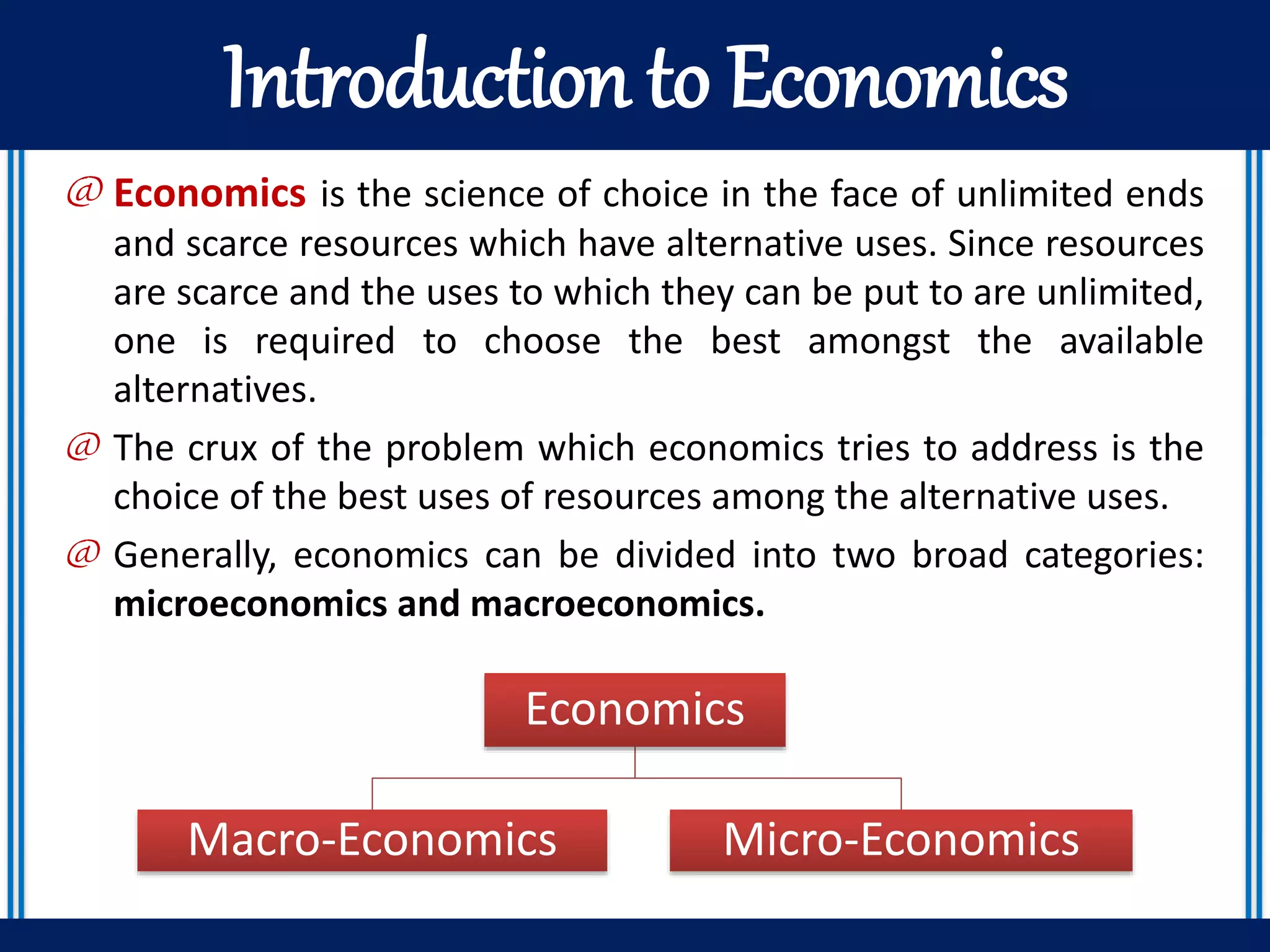
@ Generally, economics can be divided into two broad categories:
microeconomics and macroeconomics.
Economics
Macro-Economics Micro-Economics
Introduction to Economics (cont…)
1. Macroeconomics is the study of the economic system as a
whole. It includes techniques for analyzing changes in total
output, total employment, the consumer price index, the
unemployment rate, and exports and imports. Only aggregate
levels of these variables are considered.
2. Microeconomics focuses on the behavior of the individual
actors on the economic stage, that is, firms and individuals
and their interaction in markets. But concealed in the
aggregate data are countless changes in the output levels of
individual firms, the consumption decisions of individual
consumers, and the prices of particular goods and services.
These all fall under the domain of microeconomics.
Origin of Managerial Economics
@ Like every other individual a manger of a business firm has to take
decisions in the face of scarcity and alternative uses of resources.
In fact success of a business firm largely depends upon the
efficiency in utilization of limited resources remaining in the
disposal of the business firm.
@ Thus managerial economics is evolved as an important tool kits
which is useful in the decision making for the manager.
@ The development of managerial economics as a separate
discipline has a recent origin. Joel Dean’s book Managerial
Economics published in 1951 is taken as the pioneer in this
discipline.
@ Due to wide recognition of the uses of economic theories in the
decision making of the business this subject is rich in literature in
these days.
Concept of Managerial Economics
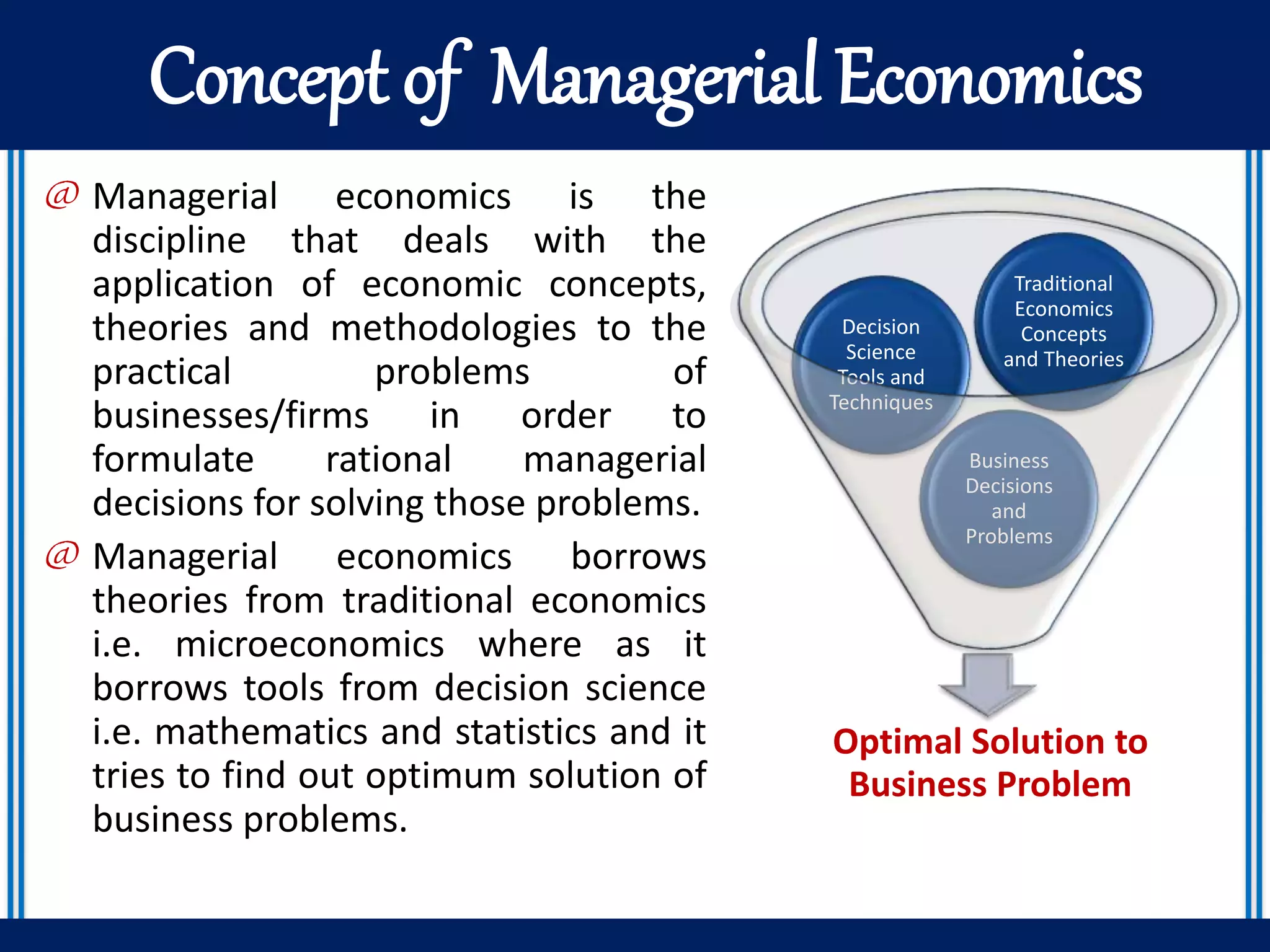
@ Managerial economics is the
discipline that deals with the
application of economic concepts,
theories and methodologies to the
practical problems of
businesses/firms in order to
formulate rational managerial
decisions for solving those problems.
@ Managerial economics borrows
theories from traditional economics
i.e. microeconomics where as it
borrows tools from decision science
i.e. mathematics and statistics and it
tries to find out optimum solution of
business problems.
Optimal Solution to
Business Problem
Business
Decisions
and
Problems
Decision
Science
Tools and
Techniques
Traditional
Economics
Concepts
and Theories
Definition of Managerial Economics
“The integration of economic theory and business practice for the
purpose of facilitating decision-making and forward planning by
management.” - Spencer and Seligman
“Managerial economics can be viewed as an application of that part of
microeconomics that focuses on such topics as risk, demand,
production, cost, pricing, and market structure.” -Petersen and Lewis
“Managerial economics is concerned with the ways in which managers
should make decisions in order to maximize the effectiveness or
performance of the organizations they manage.” - Edwin Mansfield
“Managerial economics is the study of allocation of resources available
to a firm among the activities of that unit.” - Hynes
Definition of Managerial Economics
“Use of economic analysis in formulating policies is known as managerial
economics” - Joel Dean
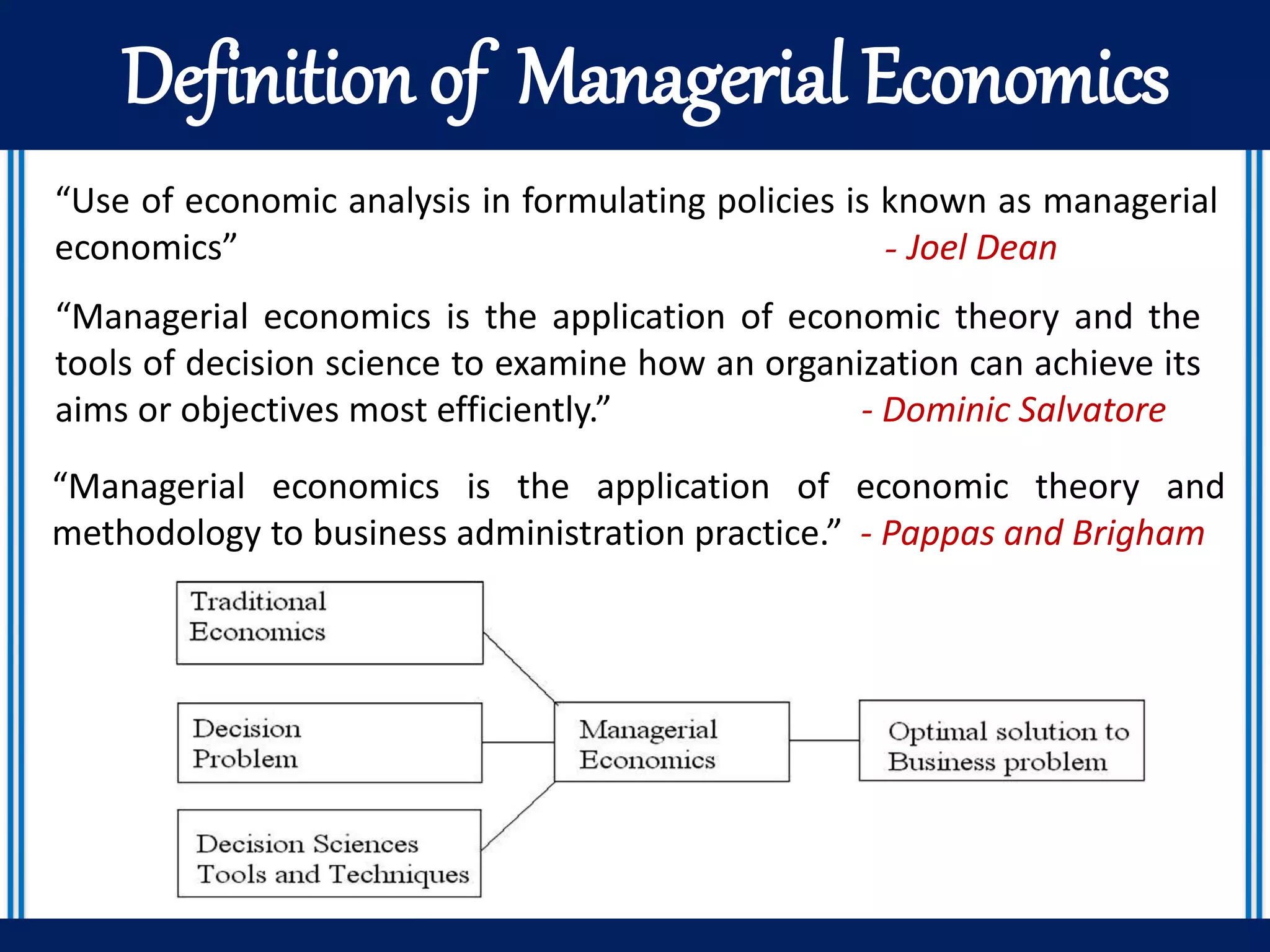
“Managerial economics is the application of economic theory and the
tools of decision science to examine how an organization can achieve its
aims or objectives most efficiently.” - Dominic Salvatore
“Managerial economics is the application of economic theory and
methodology to business administration practice.” - Pappas and Brigham
Conclusion :
@ It had taken more concepts from micro-economics means
individual and firm level (firm or family and unit or individual)
@ It is combination of economics, statistics and mathematics,
problem modeling and business management etc…
@ It is also called business economics, industrial economic and
economics for management etc…
@ It facilitates management to take business decisions
@ It deals all about firm level decisions like pricing, production,
demand, market structure, cost, output maximization and inputs
minimization, efficient and effectiveness of business functions…
@ It directs the utilization of scarce in a goal oriented manner
@ Its ultimate goal is optimal utilization of firm’s resource and
optimal solution for business problems
Introduction and meaning of Managerial Economics
Thank You & Any Doubts

Introduction and meaning of managerial economics

  • 1.
    Introduction and meaningof Managerial Economics
  • 2.
    Introduction to Economics @Economics is the science of choice in the face of unlimited ends and scarce resources which have alternative uses. Since resources are scarce and the uses to which they can be put to are unlimited, one is required to choose the best amongst the available alternatives. @ The crux of the problem which economics tries to address is the choice of the best uses of resources among the alternative uses. @ Generally, economics can be divided into two broad categories: microeconomics and macroeconomics. Economics Macro-Economics Micro-Economics
  • 3.
    Introduction to Economics(cont…) 1. Macroeconomics is the study of the economic system as a whole. It includes techniques for analyzing changes in total output, total employment, the consumer price index, the unemployment rate, and exports and imports. Only aggregate levels of these variables are considered. 2. Microeconomics focuses on the behavior of the individual actors on the economic stage, that is, firms and individuals and their interaction in markets. But concealed in the aggregate data are countless changes in the output levels of individual firms, the consumption decisions of individual consumers, and the prices of particular goods and services. These all fall under the domain of microeconomics.
  • 4.
    Origin of ManagerialEconomics @ Like every other individual a manger of a business firm has to take decisions in the face of scarcity and alternative uses of resources. In fact success of a business firm largely depends upon the efficiency in utilization of limited resources remaining in the disposal of the business firm. @ Thus managerial economics is evolved as an important tool kits which is useful in the decision making for the manager. @ The development of managerial economics as a separate discipline has a recent origin. Joel Dean’s book Managerial Economics published in 1951 is taken as the pioneer in this discipline. @ Due to wide recognition of the uses of economic theories in the decision making of the business this subject is rich in literature in these days.
  • 5.
    Concept of ManagerialEconomics @ Managerial economics is the discipline that deals with the application of economic concepts, theories and methodologies to the practical problems of businesses/firms in order to formulate rational managerial decisions for solving those problems. @ Managerial economics borrows theories from traditional economics i.e. microeconomics where as it borrows tools from decision science i.e. mathematics and statistics and it tries to find out optimum solution of business problems. Optimal Solution to Business Problem Business Decisions and Problems Decision Science Tools and Techniques Traditional Economics Concepts and Theories
  • 6.
    Definition of ManagerialEconomics “The integration of economic theory and business practice for the purpose of facilitating decision-making and forward planning by management.” - Spencer and Seligman “Managerial economics can be viewed as an application of that part of microeconomics that focuses on such topics as risk, demand, production, cost, pricing, and market structure.” -Petersen and Lewis “Managerial economics is concerned with the ways in which managers should make decisions in order to maximize the effectiveness or performance of the organizations they manage.” - Edwin Mansfield “Managerial economics is the study of allocation of resources available to a firm among the activities of that unit.” - Hynes
  • 7.
    Definition of ManagerialEconomics “Use of economic analysis in formulating policies is known as managerial economics” - Joel Dean “Managerial economics is the application of economic theory and the tools of decision science to examine how an organization can achieve its aims or objectives most efficiently.” - Dominic Salvatore “Managerial economics is the application of economic theory and methodology to business administration practice.” - Pappas and Brigham
  • 8.
    Conclusion : @ Ithad taken more concepts from micro-economics means individual and firm level (firm or family and unit or individual) @ It is combination of economics, statistics and mathematics, problem modeling and business management etc… @ It is also called business economics, industrial economic and economics for management etc… @ It facilitates management to take business decisions @ It deals all about firm level decisions like pricing, production, demand, market structure, cost, output maximization and inputs minimization, efficient and effectiveness of business functions… @ It directs the utilization of scarce in a goal oriented manner @ Its ultimate goal is optimal utilization of firm’s resource and optimal solution for business problems
  • 9.
    Introduction and meaningof Managerial Economics Thank You & Any Doubts