Difference between Academic
and Non Academic Writing
Prepared by Mayuri Pandya
Personal Information
Name: Mayuri Pandya
Semester 4
Enrollment number 4069206420210023
Submitted to: S.B.Gardi Department of English,MKBU
Table of contents
What is
Academic writing
01
What is Non-
Academic Writing
02
Difference between Academic and
Non-Academic writing
03
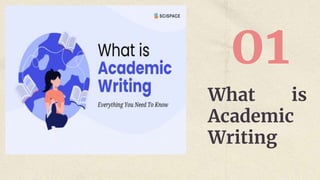
What is
Academic
Writing
01
Academic writing differs from creative writing, which is the kind of writing you do when
writing stories. It is also different from personal writing, which is the kind of writing you
do when you write letters or emails to your friends and family.
Creative writing and personal writing are informal, so you may use slang,
abbreviations, and incomplete sentences.
Academic writing is formal, so you should refrain from using slang or contractions.
Also, you should take care to write complete sentences and organize them in a
certain way. (Oshima and Hogue )
What is Academic Writing
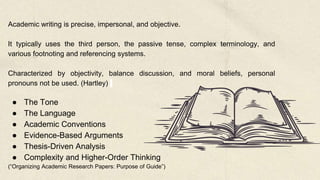
Academic writing is precise, impersonal, and objective.
It typically uses the third person, the passive tense, complex terminology, and
various footnoting and referencing systems.
Characterized by objectivity, balance discussion, and moral beliefs, personal
pronouns not be used. (Hartley)
● The Tone
● The Language
● Academic Conventions
● Evidence-Based Arguments
● Thesis-Driven Analysis
● Complexity and Higher-Order Thinking
(“Organizing Academic Research Papers: Purpose of Guide”)
Examples
● Dissertation
● Thesis
● Essay
● Research proposal
● Bibliography
02
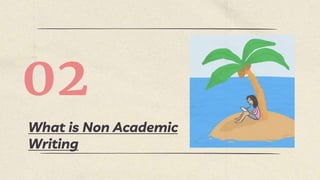
What is Non Academic
Writing
What is Non-Academic Writing
Non-academic writing refers to any type of writing that is not intended
for an academic or scholarly audience and does not necessarily adhere
to the conventions and standards of academic writing. Non-academic
writing may be creative, informative, persuasive, or entertaining in nature
and can take many different forms.
Non-academic writing refers to any form of writing that is not intended
for academic or scholarly purposes. This type of writing is usually more
informal and often written for a general audience rather than for experts
in a particular field.(Swales and Feak)
What is Non Academic Writing
Non-academic writing is writing that is not intended for an academic audience. They
are written for a lay audience or the mass public. This type of writing may be
personal, impressionistic, emotional, or subjective in nature.
The language in non-academic writing is informal or casual. Some types of non-
academic writing may even contain slang. Newspaper articles, memoirs, magazine
articles, personal or business letters, novels, websites, text messages, etc. are some
examples of non-academic writing. The content of these writings is often a general
topic, unlike academic writing, which mainly focuses on a specific field. Furthermore,
the main aim of a piece of non-academic writing is to inform, entertain or persuade
the readers.(Björk and Räisänen)
Examples
● Creative Writing
● Technical Writing
● Business Writing
● Personal Writing
● Blog
● Facebook posts
Difference between Academic and Non
Academic Writing
In academic fields this means that texts embody the social negotiations of
disciplinary inquiry, revealing how knowledge is constructed, negotiated, and made
persuasive. Rather than simply examining nature, writing is actually seen as helping to
create a view of the world. This is because texts are influenced by the problems,
social practices, and ways of thinking of particular social groups.
The difference between academic writing and nonacademic writing stems from
various factors such as audience, purpose, language, format, and tone.(Hyland)
Academic writing is typically formal and objective, using technical vocabulary and
avoiding personal opinions. Non-academic writing, however, can be more
conversational, subjective and may use a more relaxed tone.
Academic writing usually follows a strict structure with clear headings, sections,
and paragraphs, and a citation style. Non-academic writing can vary in structure
and may not follow strict formatting rules.
Academic writing is often based on research, data, and evidence, which must be
cited and referenced correctly. Non-academic writing may rely on personal
experiences, anecdotes, or opinions.(Swales and Feak)
Conclusion
In conclusion, academic and non-academic writing are two distinct
types of writing that serve different purposes and audiences.
Academic writing is formal, objective, and intended for a specialized
audience, while non-academic writing is often more conversational,
subjective, and intended for a broader audience. Academic writing
relies on research, data, and evidence to support arguments, while
non-academic writing may rely on personal experience, anecdotes,
or opinions. Understanding the differences between academic and
non-academic writing can help writers tailor their writing style and
approach to meet the specific needs of their audience and purpose.
Ultimately, both academic and non-academic writing have an
important role to play in communicating ideas and information to
different audiences.
Work Citation
Björk, Lennart A., and Christine Räisänen. Academic Writing: A University Writing Course.
Studentlitteratur, 2003. Accessed 9 March 2023.
Book GIF - Find & Share on GIPHY | Book Gif, Marketing Case Study, Public Relations Strategy.
Book GIF - Find & Share on GIPHY | Book Gif, Marketing Case Study, Public Relations
Strategy. https://www.pinterest.com/pin/book-write-gif-find-share-on-giphy-in-2023--
837739968202699073/. Accessed 9 Mar. 2023.
“Creative Writing Vacation GIF - Find & Share on GIPHY.” Giphy, https://giphy.com/gifs/desert-
island-focustime-lWh9SWSwHKwgUFGhLL. Accessed 9 March 2023.
Hartley, James. Academic Writing and Publishing: A Practical Handbook. Taylor & Francis,
2008. Accessed 9 March 2023.
Hyland, Ken. Disciplinary Discourses, Michigan Classics Ed.: Social Interactions in Academic Writing. University of Michigan
Press, 2004. Accessed 9 March 2023.
“Microlearning Assets that Make you Smile – Animated GIFs.” CommLab India, 22 July 2019,
https://blog.commlabindia.com/elearning-design/animated-gifs-corporate-training. Accessed 9 March 2023.
“Organizing Academic Research Papers: Purpose of Guide.” Sacred Heart University Library, 8 December 2022,
https://library.sacredheart.edu/c.php?g=29803. Accessed 9 March 2023.
Swales, John M., and Christine B. Feak. Academic Writing for Graduate Students: Essential Tasks and
Skills. University of Michigan Press, 2012.
Oshima, Alice, and Ann Hogue. Introduction to Academic Writing. Pearson/Longman, 2007. Accessed 9 March 2023.
“What is Academic Writing — Everything You Need To Know.” Typeset, 23 August 2021, https://typeset.io/resources/what-is-
academic-writing-everything-you-need-to-know/. Accessed 9 March 2023.
What is Academic writing
Academic writing refers to the style of writing used in scholarly or academic settings,
such as universities or research institutions. It is a formal and objective style of writing
that follows specific rules and guidelines.
Academic writing typically involves presenting ideas and arguments in a clear and
concise manner, using evidence and research to support claims. It often follows a
structured format, such as an introduction, literature review, methodology, results, and
conclusion. It also relies heavily on referencing and citation of sources to ensure the
credibility and validity of the work.
Academic writing can take many forms, including research papers, essays, reports,
case studies, and dissertations, among others. It is important for academics and
students to develop strong academic writing skills as it is an essential component of
academic success and contributes to the advancement of knowledge in a particular
field.(ChatGPT, 2023)
Borg, E. "Academic writing and non-academic writing." Journal of English for Academic
Purposes, vol. 2, no. 3, 2003, pp. 193-204. doi: 10.1016/S1475-1585(03)00026-3. MLA
Style.
Difference between Academic and Non Academic Writing.pptx

Difference between Academic and Non Academic Writing.pptx

  • 1.
    Difference between Academic andNon Academic Writing Prepared by Mayuri Pandya
  • 2.
    Personal Information Name: MayuriPandya Semester 4 Enrollment number 4069206420210023 Submitted to: S.B.Gardi Department of English,MKBU
  • 3.
    Table of contents Whatis Academic writing 01 What is Non- Academic Writing 02 Difference between Academic and Non-Academic writing 03
  • 4.
  • 5.
    Academic writing differsfrom creative writing, which is the kind of writing you do when writing stories. It is also different from personal writing, which is the kind of writing you do when you write letters or emails to your friends and family. Creative writing and personal writing are informal, so you may use slang, abbreviations, and incomplete sentences. Academic writing is formal, so you should refrain from using slang or contractions. Also, you should take care to write complete sentences and organize them in a certain way. (Oshima and Hogue ) What is Academic Writing
  • 6.
    Academic writing isprecise, impersonal, and objective. It typically uses the third person, the passive tense, complex terminology, and various footnoting and referencing systems. Characterized by objectivity, balance discussion, and moral beliefs, personal pronouns not be used. (Hartley) ● The Tone ● The Language ● Academic Conventions ● Evidence-Based Arguments ● Thesis-Driven Analysis ● Complexity and Higher-Order Thinking (“Organizing Academic Research Papers: Purpose of Guide”)
  • 7.
    Examples ● Dissertation ● Thesis ●Essay ● Research proposal ● Bibliography
  • 8.
    02 What is NonAcademic Writing
  • 9.
    What is Non-AcademicWriting Non-academic writing refers to any type of writing that is not intended for an academic or scholarly audience and does not necessarily adhere to the conventions and standards of academic writing. Non-academic writing may be creative, informative, persuasive, or entertaining in nature and can take many different forms. Non-academic writing refers to any form of writing that is not intended for academic or scholarly purposes. This type of writing is usually more informal and often written for a general audience rather than for experts in a particular field.(Swales and Feak)
  • 10.
    What is NonAcademic Writing Non-academic writing is writing that is not intended for an academic audience. They are written for a lay audience or the mass public. This type of writing may be personal, impressionistic, emotional, or subjective in nature. The language in non-academic writing is informal or casual. Some types of non- academic writing may even contain slang. Newspaper articles, memoirs, magazine articles, personal or business letters, novels, websites, text messages, etc. are some examples of non-academic writing. The content of these writings is often a general topic, unlike academic writing, which mainly focuses on a specific field. Furthermore, the main aim of a piece of non-academic writing is to inform, entertain or persuade the readers.(Björk and Räisänen)
  • 11.
    Examples ● Creative Writing ●Technical Writing ● Business Writing ● Personal Writing ● Blog ● Facebook posts
  • 12.
    Difference between Academicand Non Academic Writing In academic fields this means that texts embody the social negotiations of disciplinary inquiry, revealing how knowledge is constructed, negotiated, and made persuasive. Rather than simply examining nature, writing is actually seen as helping to create a view of the world. This is because texts are influenced by the problems, social practices, and ways of thinking of particular social groups. The difference between academic writing and nonacademic writing stems from various factors such as audience, purpose, language, format, and tone.(Hyland)
  • 13.
    Academic writing istypically formal and objective, using technical vocabulary and avoiding personal opinions. Non-academic writing, however, can be more conversational, subjective and may use a more relaxed tone. Academic writing usually follows a strict structure with clear headings, sections, and paragraphs, and a citation style. Non-academic writing can vary in structure and may not follow strict formatting rules. Academic writing is often based on research, data, and evidence, which must be cited and referenced correctly. Non-academic writing may rely on personal experiences, anecdotes, or opinions.(Swales and Feak)
  • 14.
    Conclusion In conclusion, academicand non-academic writing are two distinct types of writing that serve different purposes and audiences. Academic writing is formal, objective, and intended for a specialized audience, while non-academic writing is often more conversational, subjective, and intended for a broader audience. Academic writing relies on research, data, and evidence to support arguments, while non-academic writing may rely on personal experience, anecdotes, or opinions. Understanding the differences between academic and non-academic writing can help writers tailor their writing style and approach to meet the specific needs of their audience and purpose. Ultimately, both academic and non-academic writing have an important role to play in communicating ideas and information to different audiences.
  • 15.
    Work Citation Björk, LennartA., and Christine Räisänen. Academic Writing: A University Writing Course. Studentlitteratur, 2003. Accessed 9 March 2023. Book GIF - Find & Share on GIPHY | Book Gif, Marketing Case Study, Public Relations Strategy. Book GIF - Find & Share on GIPHY | Book Gif, Marketing Case Study, Public Relations Strategy. https://www.pinterest.com/pin/book-write-gif-find-share-on-giphy-in-2023-- 837739968202699073/. Accessed 9 Mar. 2023. “Creative Writing Vacation GIF - Find & Share on GIPHY.” Giphy, https://giphy.com/gifs/desert- island-focustime-lWh9SWSwHKwgUFGhLL. Accessed 9 March 2023. Hartley, James. Academic Writing and Publishing: A Practical Handbook. Taylor & Francis, 2008. Accessed 9 March 2023.
  • 16.
    Hyland, Ken. DisciplinaryDiscourses, Michigan Classics Ed.: Social Interactions in Academic Writing. University of Michigan Press, 2004. Accessed 9 March 2023. “Microlearning Assets that Make you Smile – Animated GIFs.” CommLab India, 22 July 2019, https://blog.commlabindia.com/elearning-design/animated-gifs-corporate-training. Accessed 9 March 2023. “Organizing Academic Research Papers: Purpose of Guide.” Sacred Heart University Library, 8 December 2022, https://library.sacredheart.edu/c.php?g=29803. Accessed 9 March 2023. Swales, John M., and Christine B. Feak. Academic Writing for Graduate Students: Essential Tasks and Skills. University of Michigan Press, 2012. Oshima, Alice, and Ann Hogue. Introduction to Academic Writing. Pearson/Longman, 2007. Accessed 9 March 2023. “What is Academic Writing — Everything You Need To Know.” Typeset, 23 August 2021, https://typeset.io/resources/what-is- academic-writing-everything-you-need-to-know/. Accessed 9 March 2023.
  • 17.
    What is Academicwriting Academic writing refers to the style of writing used in scholarly or academic settings, such as universities or research institutions. It is a formal and objective style of writing that follows specific rules and guidelines. Academic writing typically involves presenting ideas and arguments in a clear and concise manner, using evidence and research to support claims. It often follows a structured format, such as an introduction, literature review, methodology, results, and conclusion. It also relies heavily on referencing and citation of sources to ensure the credibility and validity of the work. Academic writing can take many forms, including research papers, essays, reports, case studies, and dissertations, among others. It is important for academics and students to develop strong academic writing skills as it is an essential component of academic success and contributes to the advancement of knowledge in a particular field.(ChatGPT, 2023)
  • 18.
    Borg, E. "Academicwriting and non-academic writing." Journal of English for Academic Purposes, vol. 2, no. 3, 2003, pp. 193-204. doi: 10.1016/S1475-1585(03)00026-3. MLA Style.